

Crypto World
STRC’s Monthly Preferred Dividend Rises to 11.5% for March 2026


Strategy chairman Michael Saylor used social media to announce a dividend adjustment at the Bitcoin treasury vehicle STRC. The company has raised the monthly distribution on STRC (EXCHANGE: STRC) to 11.50% for March 2026, up from 11.25%. STRC is a perpetual preferred stock with a variable yield that changes on a monthly basis, a design intended to balance income with trading dynamics around its $100 par value. The company’s update confirms that the payout remains monthly, with the next distribution scheduled for March 31 to shareholders of record. The move comes amid a broader pivot in Strategy’s financing approach and a continuing expansion of its Bitcoin (CRYPTO: BTC) holdings.
The STRC update, published on the company’s own site, explains that the dividend rate is adjusted monthly to encourage trading activity around the par value and to help dampen price volatility. This mechanism is part of a broader strategy to rely more on preferred stock than common equity for BTC-related funding. The social post from Saylor aligns with Strategy’s stated direction and adds color to a year in which the company has increasingly leaned on structured finance instruments to support its Bitcoin purchases.
On the same subject, February marked a notable shift in Strategy’s funding approach. CEO Phong Le described a transition away from issuing common stock to fund Bitcoin acquisitions toward issuing more preferred shares. The company has argued that the stretch and associated perpetual preferreds have proven effective at raising capital, citing last year’s fundraising results as a proof point.
Le has highlighted the scale of STRC and perpetual issues in the market, noting that last year these instruments raised about $7 billion, representing roughly a third of the entire domestic preferred market. The company’s leadership has signaled that 2026 could see more of a structural emphasis on preferred capital as a means to fund ongoing Bitcoin accumulation while managing shareholder dilution and equity risk. In this context, the market has watched Strategy continue to accumulate BTC, even as Bitcoin’s price has swung lower amid a broader risk-off environment.
In the meantime, Strategy has faced a tougher market backdrop. The price of Bitcoin itself has slipped significantly since October, and Strategy’s common stock has mirrored a broader downturn in crypto-related equities. The company’s stock, which tracks as a proxy for its Bitcoin holdings and management strategy, has retreated from the highs seen in late 2024 and has traded in a lower range in recent months. Data from Saylor Tracker shows Strategy’s aggregate Bitcoin purchases and the balance sheet moving forward, even as the stock’s price has come under pressure from a challenging macro and crypto market environment.
Looking at the larger picture,Bitcoin (CRYPTO: BTC) has fallen by more than a quarter year-to-date, a factor that has weighed on public companies with substantial corporate treasuries. In parallel, the Bitwise Bitcoin Standard Corporations ETF (EXCHANGE: OWNB) has also declined, underscoring the broader drag on equities tied to crypto balance sheets. The latest data shows Strategy’s BTC holdings continuing to accumulate, even as near-term price movements complicate capital planning. Strategy’s trackers and public disclosures show a continued cadence of purchases and a growing balance sheet despite market headwinds.
From a performance perspective, Strategy has faced a grim year in the stock market. The company reported a net loss of $12.4 billion for Q4 2025, released in February, even as revenue rose modestly to about $123 million for the quarter. The earnings backdrop has weighed on investor sentiment, contributing to a broader decline in Strategy’s share price, which fell sharply from the record highs reached in late 2024. The stock hovered around $129.50 at the end of the week, well below its peak levels, highlighting the contrast between the company’s aggressive BTC accumulation and the market’s appraisal of its profitability trajectory. Within this landscape, the price of BTC remains a critical driver of Strategy’s fortunes, underscoring the sensitivity of a BTC-focused treasury model to macro and crypto volatility. The company’s long-running accumulation strategy has included notable milestones, such as the 100th BTC purchase and the expansion of its balance sheet to 717,722 BTC, a testament to the scale of its framing of corporate treasury capacity around Bitcoin.
As the market contends with volatility, Strategy’s approach highlights a broader industry trend: corporate treasuries in the crypto space increasingly lean on structured finance and preferred equity to finance continued accumulation, balancing the goal of owning more BTC with managing equity risk and investor expectations. The broader market environment—characterized by price swings in BTC and a wave of related financial instruments—continues to challenge traditional capital-raising methods, pushing some issuers to rethink balance-sheet financing in favor of instruments like STRC and other perpetual preferreds. The company’s ongoing BTC purchases, including the relatively recent tranches, underscore a willingness to endure short-term price pressures for the longer-term objective of building a sizable Bitcoin reserve. The evolution of Strategy’s capital stack—moving from common equity toward preferred capital—also raises questions about how such a shift will influence liquidity, dividend policy, and the eventual realization of BTC gains in the face of market cycles. The narrative surrounding STRC’s yield adjustments and the related financing strategy paints a picture of a company that remains deeply committed to Bitcoin accumulation, even as it navigates a period of volatile prices and mixed financial results.
In a landscape where both crypto prices and the equities tied to corporate treasuries face headwinds, Strategy’s strategy remains closely watched by investors seeking exposure to Bitcoin through a corporate balance sheet. The company’s public communications, including updates to STRC’s dividend policy and its pivot toward preferred financing, signal a concerted effort to optimize capital structure while maintaining Bitcoin exposure. For market participants, the question remains how sustainable a perpetual preferred-based approach will be in delivering consistent returns to shareholders as BTC price and macro conditions evolve. The intersection of rising dividend yields, ongoing BTC purchases, and shifting financing sources will continue to shape the trajectory of Strategy and its peers in the crypto treasury space.
Why it matters
Strategy’s renewed emphasis on STRC’s elevated dividend rate and the ongoing shift toward preferred capital exposure matters because it reflects a practical adaptation to the realities of financing a BTC-heavy corporate treasury in a volatile market. By adjusting the monthly yield for STRC and maintaining a steady payout schedule, the company aims to offer income stability to investors while cycling through capital to acquire more BTC. This approach could influence the appetite for similar structures among other corporate treasuries seeking to scale Bitcoin holdings without diluting common equity, potentially shaping the broader landscape of crypto corporate finance.
For investors, the shift away from common stock toward preferred capital signals a potential change in risk and return profiles. Preferreds typically occupy a different position in the capital structure, often offering higher yields with a priority claim on assets and earnings relative to common shares. If Strategy can sustain its BTC accumulation while delivering consistent yields, it could attract institutional investors seeking exposure to Bitcoin through a structured instrument with a predictable income stream. However, the persistent price volatility of BTC and the performance of Strategy’s own equity remain critical inputs in assessing the risk-reward balance of this approach. The ongoing performance of Strategy’s BTC holdings, its Q4 2025 earnings, and the trajectory of its financing strategy will likely influence investor sentiment and the broader adoption of similar mechanisms in the crypto treasury space.
Ultimately, the interplay between BTC price movements, dividend policy, and the company’s financing choices will determine how STRC and other crypto treasury instruments fare over time. The market is watching whether the pivot to preferred capital can deliver a sustainable path to capital formation that supports Bitcoin accumulation while avoiding excessive dilution or cost of capital concerns. As Strategy continues to publish updates on its BTC purchases and balance sheet composition, observers will gauge whether this model can translate into durable value creation for shareholders in a sector still defining its long-term viability.
What to watch next
- Monitor STRC’s next monthly dividend adjustment and March 31 payout date for record holders.
- Watch Strategy’s ongoing pivot toward preferred capital and any subsequent financing rounds or issuances.
- Track BTC purchases and total holdings, including the 592 BTC purchase in the week of Feb. 16, to see if the pace of accumulation accelerates or slows.
- Assess Strategy’s Q1 2026 results for any improvement in operating metrics alongside BTC balance sheet expansion.
- Observe market reactions to STRC dividend changes and any European listings related to STRC ETP developments.
Sources & verification
- STRC dividend rate and payout schedule confirmation on Strategy’s official Stretch page.
- Saylor’s post on X (formerly Twitter) confirming the dividend adjustment.
- Strategy’s February statement about shifting from common stock to preferred stock for BTC funding.
- Strategy’s public disclosures of BTC purchases, including the 592 BTC purchase and total holdings of 717,722 BTC.
- Q4 2025 results reporting a net loss of $12.4 billion and revenue of about $123 million.
Strategy’s evolving capital mix and ongoing BTC accumulation
Strategy’s leadership has publicly framed 2026 as a year of structural evolution, with STRC (EXCHANGE: STRC) and other perpetual preferred instruments playing a central role in capital formation. The company’s chairman, Michael Saylor, communicated through a social post that STRC’s dividend rate is being adjusted monthly, targeting an 11.50% yield for March 2026. This adjustment follows a formal update posted on Strategy’s Stretch site, which notes that the payout is aligned with a par value of $100 and that the rate changes are designed to encourage trading around that level while dampening volatility. The monthly cadence remains intact, providing a predictable income stream for holders and a predictable funding mechanism for ongoing BTC acquisitions.
The broader policy shift toward preferred capital aligns with remarks from Strategy’s leadership in February, when CEO Phong Le described the company’s decision to pivot away from common stock issuances as a primary funding source for Bitcoin purchases. As the company continues to accumulate BTC, the balance sheet now holds a substantial stake—717,722 BTC—reflecting a disciplined approach to building a corporate treasury anchored by the world’s leading cryptocurrency. The latest tranche, a 592 BTC purchase in the week of February 16, underscores the ongoing emphasis on scalable BTC accumulation even as market prices fluctuate, with the company’s decision to finance purchases through preferred stock helping to manage dilution concerns and investor expectations.
While the macro backdrop has pressured crypto and related equities, Strategy’s financing strategy highlights a broader industry shift toward asset-backed, income-generating structures that can sustain long-term BTC holdings. The company’s stock performance and the price actions of related instruments—including the Bitwise Bitcoin Standard Corporations ETF (EXCHANGE: OWNB), which is also down—reflect the challenging environment for investor sentiment around crypto corporate treasuries. Nevertheless, Strategy’s approach demonstrates a commitment to leveraging preferred income to support a growing Bitcoin reserve, an approach that could influence other corporate treasuries seeking scalable, income-generating financing alternatives as the crypto industry matures.

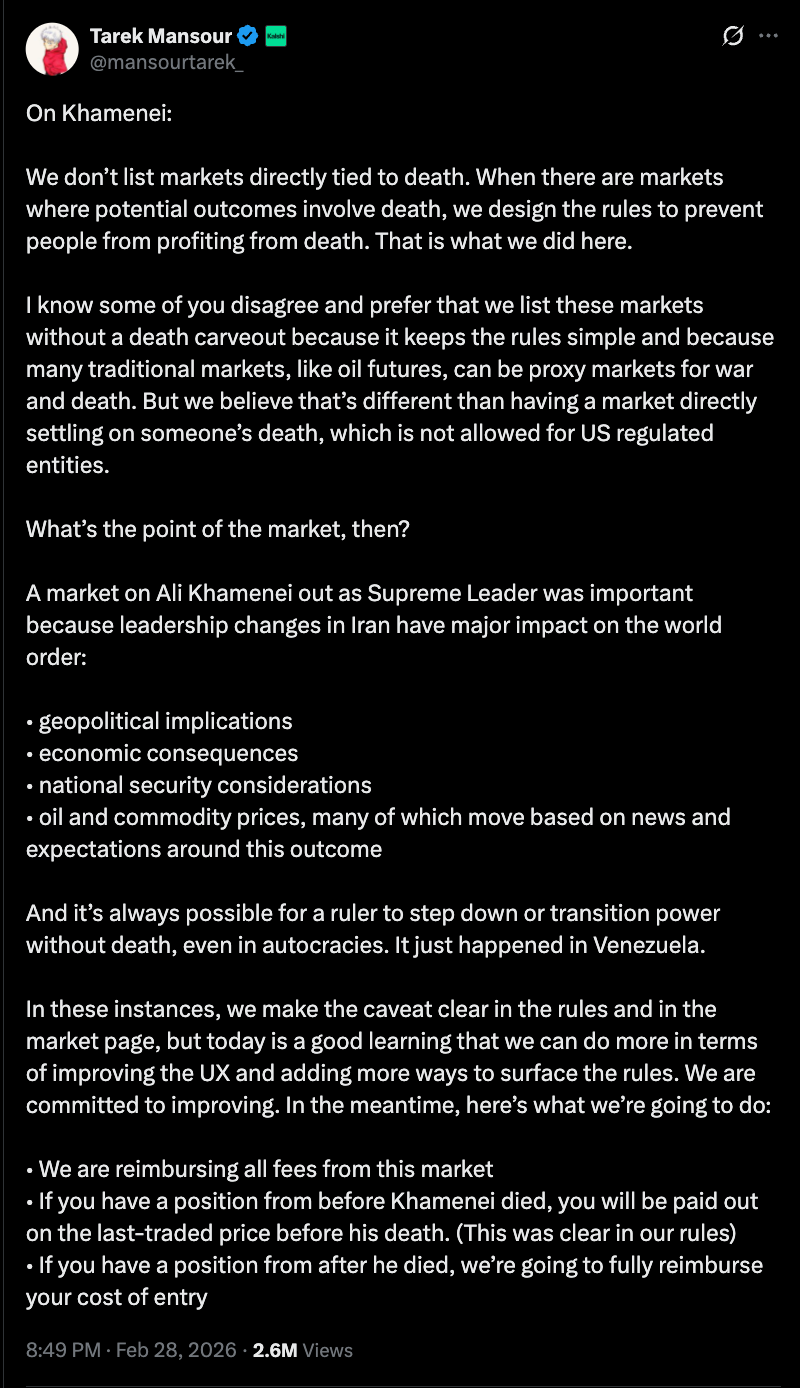
Tarek Mansour, the co-founder of prediction market Kalshi, provided an update, following the platform’s decision to void some positions that were opened after the death of Iran’s Supreme Leader Ayatollah Ali Khamenei was confirmed.
“We don’t list markets directly tied to death. When there are markets where potential outcomes involve death, we design the rules to prevent people from profiting from death. That is what we did here,” Mansour said in a post on X.
Iranian state media reported the death early Sunday, after an attack launched by Israel and the United States a day earlier.
Kalshi is reimbursing all fees from the “Ali Khamenei out as Supreme Leader” market, and will pay traders with positions open before Khamenei died according to the “last-traded price before his death,” Mansour said.
Additionally, users who opened positions after the death of Khamenei were reimbursed the difference between the higher price paid for entry and the last traded price.

A Kalshi spokesperson told Cointelegraph that the platform’s policy on not allowing “death markets” is clear and long-standing.
The platform reiterated the policy on Saturday, and Mansour said that the death carveout stipulations were clearly stated in the rules for the market. However, the decision sparked backlash from users online, who accused the platform of curtailing user profits.

Related: Kalshi bans US politician over alleged insider trading violation
Suspicions of insider trading activity on prediction market platforms rise amid geopolitical tensions
In February, six traders on rival prediction market Polymarket netted about $1 million betting that the US would initiate a strike on Iran before the end of the month.
All six wallets were created in February, mostly bet on markets related to a strike on Iran, and some of the positions were filled hours before the first explosions were heard over the Iranian capital of Tehran, according to Bloomberg.
The trading patterns raised suspicion of insider trading activity among onchain investigators and analysts.
In January, US President Donald Trump announced that the individual who leaked information tied to the raid and capture of former Venezuelan President Nicolás Maduro had been arrested by US law enforcement.
The comments fueled speculation from onchain analysis platform Lookonchain that the leaker Trump was referencing may have been linked to winning bets on Polymarket placed shortly before the US raid in Caracas.
Magazine: Astrology could make you a better crypto trader: It has been foretold
Pi Coin price is attempting to recover after forming a new all-time low earlier this month. The altcoin has shown modest strength in recent sessions, holding above key short-term support.
However, broader technical indicators and historical patterns suggest that Pi Coin’s price recovery may face significant resistance in March 2026.
While some investors anticipate stabilization, momentum indicators highlight persistent weakness. Past seasonal trends and current capital flows imply that Pi Coin could remain under pressure unless buying demand improves meaningfully.
Pi Coin’s Past Is Bleak
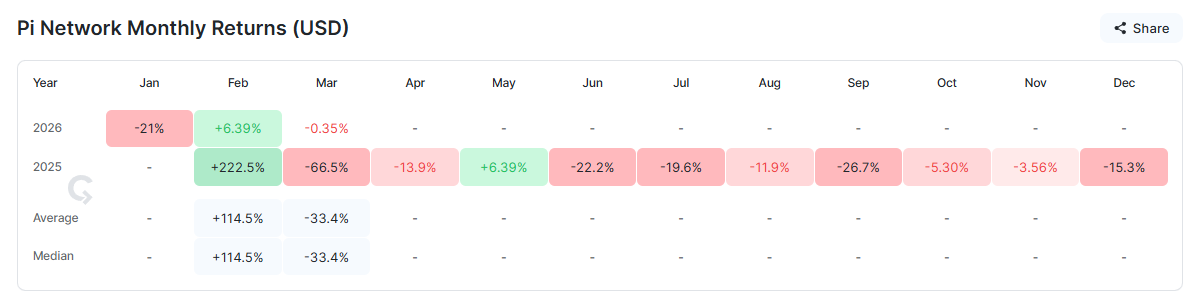
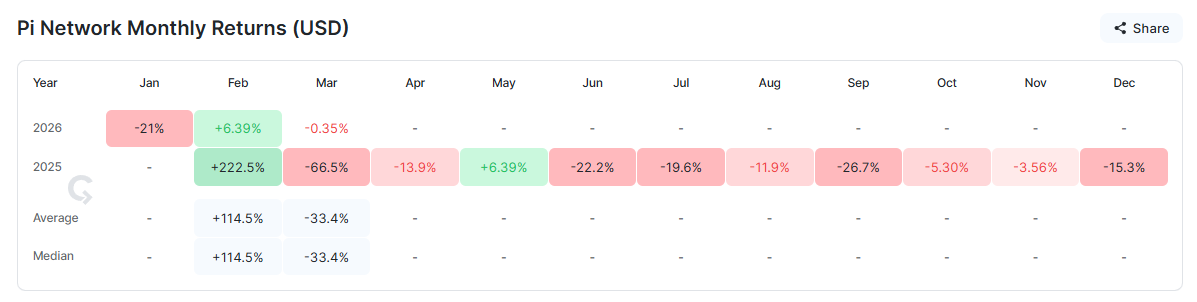
March has historically been volatile for Pi Coin. In March 2024, PI declined by 66.5%, marking its weakest monthly performance on record. That steep drop followed its initial launch phase, when early participants moved quickly to secure profits.
The sharp decline was largely driven by immediate post-launch distribution. Early miners and holders capitalized on newly available liquidity. Those specific launch-related dynamics do not fully apply today. However, the memory of extreme volatility still shapes investor caution entering March 2026.
Want more token insights like this? Sign up for Editor Harsh Notariya’s Daily Crypto Newsletter here.
PI Holders Aren’t Too Supportive
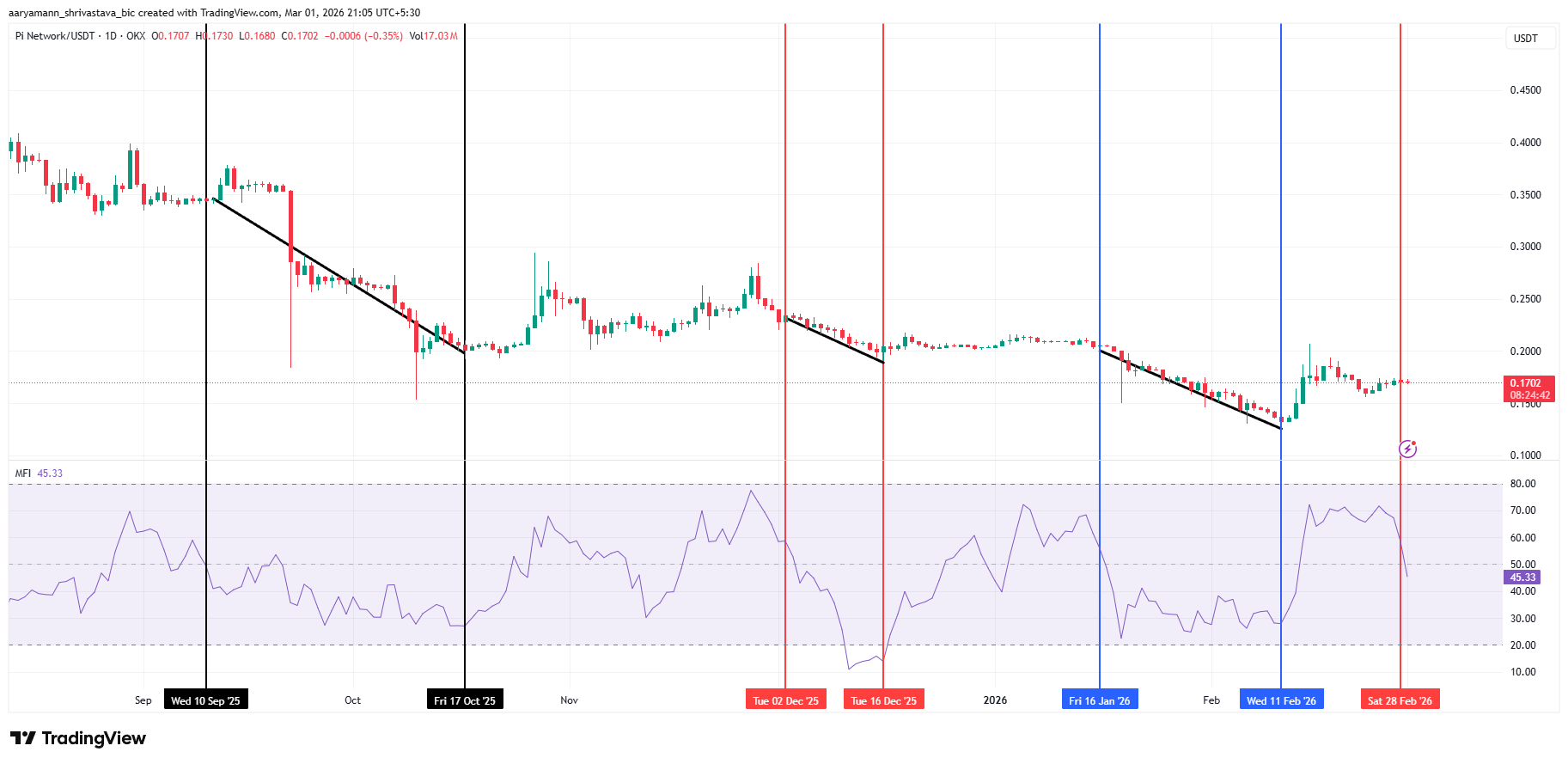
The Money Flow Index now signals renewed selling pressure. MFI has slipped below the neutral 50 mark, reflecting capital outflows rather than sustained inflows. This shift often precedes extended corrective phases when buyer conviction weakens.
Historically, whenever MFI dropped below neutral for PI, the price tended to decline until buying momentum returned. Current readings suggest that sellers remain active. Unless the indicator rebounds above 50, downside risks may continue to outweigh short-term recovery attempts.
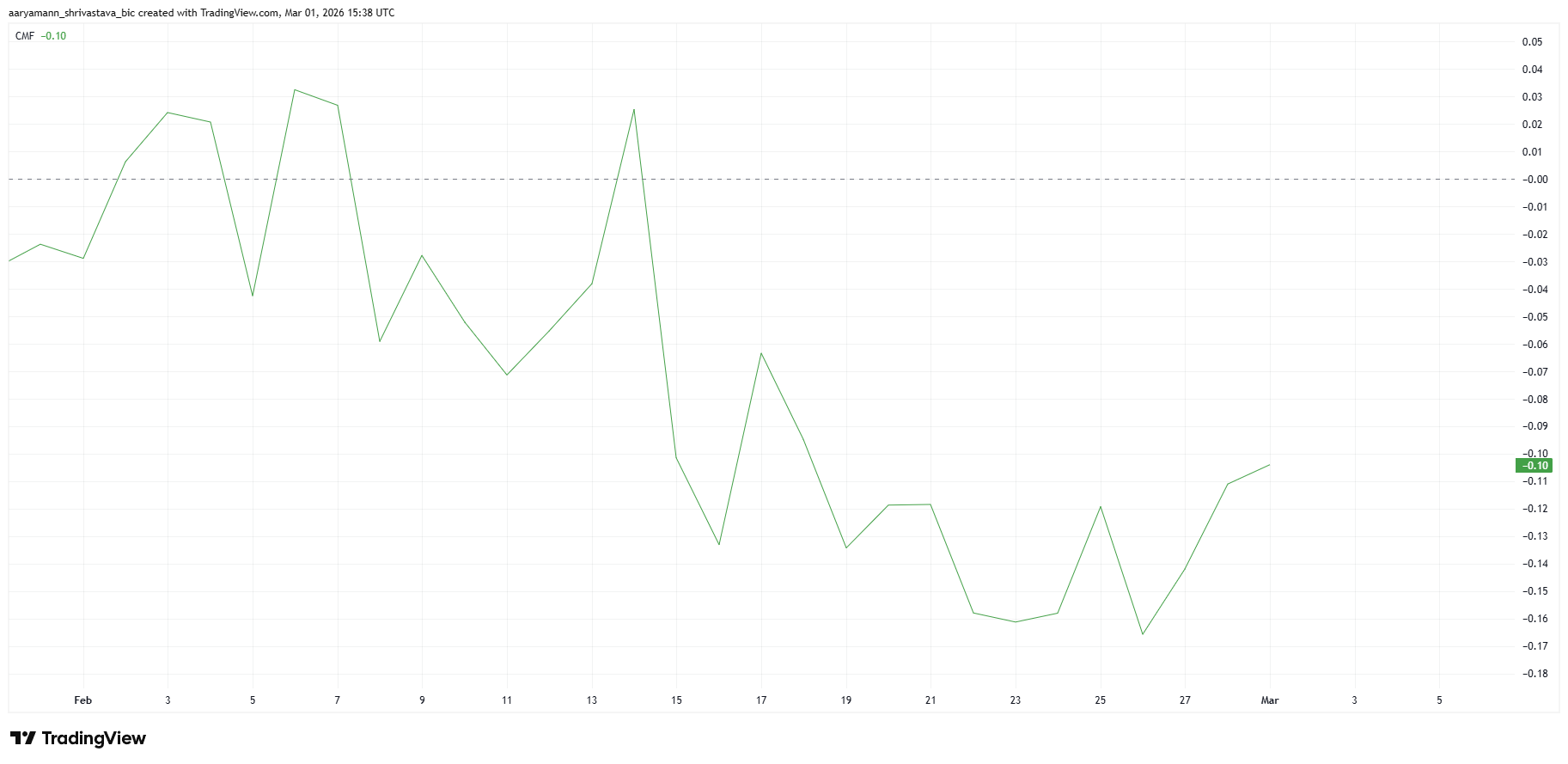
The Chaikin Money Flow indicator reinforces this cautious outlook. CMF has remained below the zero line for nearly three consecutive weeks. Persistent negative readings signal ongoing net outflows from Pi Coin.
These outflows indicate fading investor confidence. Reduced participation from new buyers compounds the issue. Without fresh capital entering the ecosystem, upward price movements may lack sustainability. Weak inflows often limit breakout potential and increase vulnerability to corrections.
PI Price May See a Reversal
Pi Coin price is trading at $0.1701 at the beginning of March, holding above an ascending trendline support. Immediate resistance sits at $0.1752. Despite this structure, technical indicators suggest that March may bring corrective pressure rather than sustained gains.
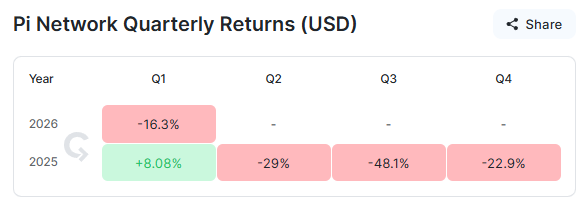
Quarterly performance adds another layer of concern. Following mixed results in January and February, Pi Coin is tracking a 16% loss for Q1 2026. Closing the quarter in negative territory could weigh on investor sentiment heading into Q2, especially if broader crypto market conditions remain cautious.
If selling pressure intensifies, Pi Coin may decline toward the $0.1597 support level. A breakdown below that threshold would likely expose $0.1502. Continued weakness could push the price closer to the all-time low of $0.1300, increasing downside risk in the near term.
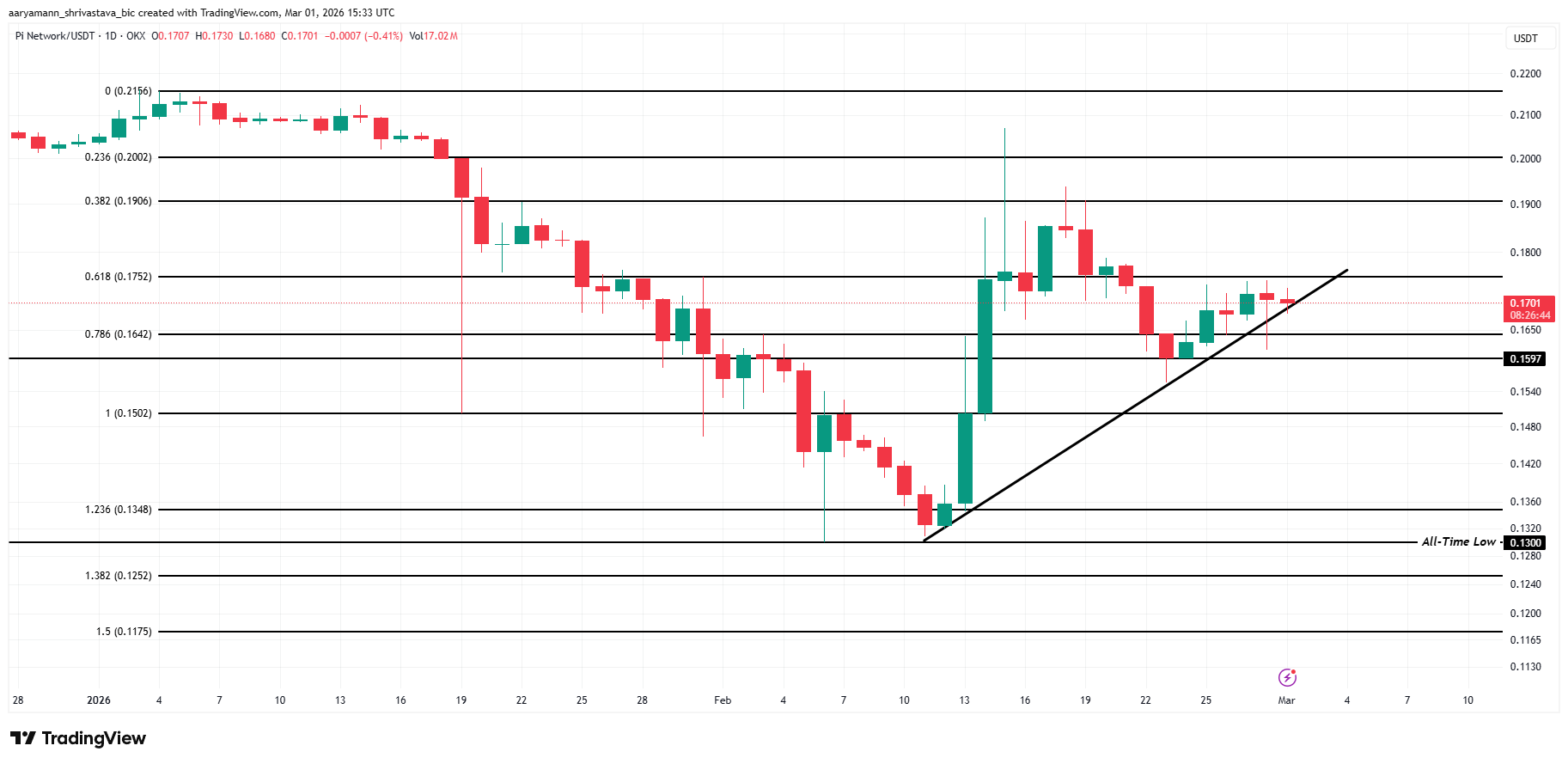
The bearish thesis would be invalidated only if buyers regain control. A decisive breakout above $0.1752 would be the first signal of strength. Flipping $0.2002 into support would confirm renewed bullish momentum. Sustained inflows and improved sentiment would be required to support such a move and stabilize Pi Coin price action.

TLDR:
- Binance received over 472 million XRP worth $652M, marking February’s largest single inflow period.
- U.S.–Iran strikes launched after market close, leaving crypto directly exposed to the geopolitical shock.
- XRP price has rolled back toward $1.44 after rallying above $3, with MACD and RSI turning bearish.
- Open interest across exchanges contracted sharply, signaling leverage is being flushed rather than rebuilt.
XRP selling pressure worth $650 million has emerged as U.S.–Iran tensions escalate sharply. Over the past week, large token inflows into Binance have raised red flags across the crypto market.
Geopolitical uncertainty has driven investors toward a more defensive posture, moving liquidity closer to the market.
Combined with weakening technical readings and shrinking derivatives activity, XRP now faces mounting headwinds that traders and analysts are watching closely.
Binance Inflows Surge as Geopolitical Shock Hits Crypto Markets
The U.S.–Iran standoff intensified over the weekend when the first strikes launched shortly after traditional financial markets closed.
That timing left crypto markets directly exposed to the geopolitical shock without broader market support. Risk assets reacted almost immediately, and XRP was among the most visibly affected tokens.
On-chain analyst Darkfost reported that Binance received more than 472 million XRP over the past week alone. That volume translates to roughly $652 million worth of tokens flowing into the exchange.
Darkfost confirmed this marks the largest single inflow period recorded throughout the month of February.
Large exchange inflows of this size typically reflect a defensive shift among token holders. When investors move tokens onto exchanges, it often signals a readiness to sell or at least position liquidity closer to active markets. Flows at this scale can create conditions for sudden selling waves that affect short-term price action.
Darkfost noted that it remains too early to confirm whether this activity marks the start of a broader distribution dynamic.
However, the analyst stressed the situation warrants close monitoring to determine if panic movements tied to geopolitical uncertainty will deepen further in the days ahead.
Technical Weakness and Derivatives Data Reinforce the Bearish Setup
The $650 million inflow surge arrives against an already deteriorating technical backdrop for XRP. After rallying above $3 earlier this cycle, price has since rolled back toward the $1.44 zone.
Analyst DavidTheBuilder noted that the MACD has crossed lower, histogram bars remain red, and RSI has drifted toward the lower half of its range.
These readings stop short of signaling full capitulation. However, the aggressive upside energy that once powered XRP’s breakout has clearly faded. The current chart structure bears little resemblance to the euphoria phase that drove the earlier rally higher.
Derivatives data tells a similar story. Open interest across major exchanges spiked sharply during the rally, then contracted just as quickly as traders pulled risk off the table.
When open interest compresses while price trends lower, leverage is typically being flushed rather than built back up.
DavidTheBuilder pointed out that sustained positioning growth has not returned to the market. Strong trends require conviction behind them, and without open interest expanding alongside price, XRP’s path to recovery remains uncertain.
With geopolitical tensions still unresolved, market participants are keeping a close watch on whether conditions stabilize or worsen further.


In a major policy shift, X has removed cryptocurrency and gambling from its prohibited industries list for paid promotions, opening the door for influencers and KOLs to legally monetize crypto content on the platform.
The change marks a significant reversal of a ban that had been in place since at least June 2024.
The entire financial products category, including loans, investment services, and crypto, was removed from X’s advertising policies.
“Crypto is no longer listed under Prohibited Industries for paid promo on X,” observed analyst DeFi Ignas. “The policy page changed recently. On February 16, it was still there.”
Gambling was also removed from the list, while other industries such as pharmaceuticals, tobacco, weapons, and weight loss were added.
The platform’s new Paid Partnership framework requires influencers to disclose any compensated promotion.
“Undisclosed promotions hurt the integrity of the product and lead people to distrust the content they read on X. This new feature will allow you to comply with regulations, but more importantly, it enables you to be transparent with your followers,” Nikita Bier, X’s Head of Product, articulated.
Posts created as part of a Paid Partnership must now include the “Paid Partnership” label. Influencers are responsible for ensuring that content complies with applicable laws, including the FTC’s regulations on endorsements and testimonials.
Meanwhile, X’s updated policy distinguishes Paid Partnerships from standard advertising. This means content prohibited under Paid Partnerships may still be permitted through X Ads.
The policy update has drawn mixed reactions in the crypto community, with some users celebrating the return of crypto promotions.
However, not all reactions are positive, with analyst Benjamin Cowen highlighting what the change means for the business models crypto influencers use.
“90% of crypto influencers now need to find a new business model that does not just involve them pretending to like a project they were paid to promote, allowing them to dump their allocations on the people that trusted them,” warned Cowen.
In the same tone, Rune raised concerns about enforcement, noting that the platform was now banning every user promoting (shilling) cryptos, whether disclosed or not. In their opinion, the latest move lays the groundwork for future restrictions on Crypto Twitter.
“It’s supposed to be for ‘paid partnerships,’ but who can tell the difference between someone promoting a token without being paid and someone who is being paid to promote it? There will be a massive ban wave on CT, and everyone will be scared to shill tokens,” Rune wrote.
General sentiment is that this policy change could reshape crypto marketing on X (Twitter). Crypto influencers who previously relied on informal promotion may need to adapt their strategies.
Meanwhile, brands now have a clearer, legal path for campaigns, provided they adhere strictly to disclosure rules.
The update is effective immediately, signaling X’s attempt to balance regulatory compliance with creator monetization.
As the platform navigates these changes, transparency and proper labeling are likely to become the central pillars of any successful crypto marketing strategy on X.
TLDR:
- Bitcoin fell to $63,000 on Saturday as Middle East tensions surged while all traditional markets remained fully closed.
- On-chain data recorded $100 million migrating from Bitcoin into USDT on the Tron network within a single 24-hour period.
- The USDT Flight Signal hit “1,” confirming a capital rotation from Bitcoin into stablecoins during the geopolitical panic weekend.
- Around $1.9 billion in put options at a $60,000 strike on Deribit revealed strong demand for downside protection among traders.
Bitcoin proved itself a round-the-clock financial tool when Middle East tensions rattled global markets last weekend.
While traditional exchanges sat idle on Saturday, Bitcoin dropped to $63,000 and absorbed the immediate shock of the geopolitical event.
By Sunday, it recovered to $66,000. No bank, no stock exchange, and no traditional market was available. Bitcoin was the only ATM open worldwide, and it processed every transaction without interruption.
When Every Other Market Closed, Bitcoin Stayed Open
Traditional financial systems operate on schedules. They close on weekends, on holidays, and during emergencies. Bitcoin does none of that. When panic spread across global markets on Saturday, investors had one liquid exit available — and they used it immediately.
Investors who sold did not lose faith in Bitcoin. They needed fast dollar liquidity to protect themselves against an unfolding geopolitical crisis.
Bitcoin gave them that access within seconds, at any hour, from any location around the world. No other financial instrument offered that during the same window.
As Cryptoquant analyst GugaOnChain noted , “Bitcoin operated as the only global ATM open during a weekend of panic.” That description is precise and accurate. It processed capital exits while every competing system was offline and unavailable to investors.
On-chain data backed this observation directly. The USDT Flight Signal, which tracks capital movement from Bitcoin into stablecoins on the Tron network, recorded approximately $100 million migrating into USDT within just 24 hours.
Bitcoin’s total market capitalization stood at $1.319 trillion during this period, reflecting the weight of capital that passed through it over the weekend.
On-Chain Data Confirms Bitcoin’s ATM Function in Real Time
The Tron network currently holds between 42% and 50% of all circulating global USDT supply. That makes it the most reliable network for measuring capital behavior during stress events.
When the USDT Flight Signal reads “1,” money is moving out of Bitcoin and into stablecoins. Over this weekend, the signal confirmed that rotation in real time.
The USDT supply on the Tron network reached $84.72 billion during this period. That figure captures the scale of the digital dollar vault that investors ran toward. Bitcoin served as the withdrawal point that made accessing that vault possible on a weekend.
Derivatives markets further confirmed the demand for protection. Roughly $1.9 billion in put options were concentrated on Deribit, with a strike price at $60,000.
Traders had already positioned themselves for downside risk, treating Bitcoin as both an exposure and a hedging instrument simultaneously.
True price discovery, according to market expectations, will follow Monday’s reopening of U.S. markets. Bitcoin, however, had already completed its job.
It absorbed the initial tremor, provided emergency liquidity, and directed capital toward stablecoin shelter — all before traditional markets could open their doors.


UAE’s Capital Markets Authority shut both the Abu Dhabi (ADX) and Dubai Financial Market (DFM) stock exchanges for March 2–3 after Iran struck major ports and oil tankers across the Middle East.
The ADX and DFM are the two primary equities exchanges in the United Arab Emirates, together serving as the Gulf region’s key capital market hubs.
Why it matters:
- Iran’s strikes effectively blocked the Strait of Hormuz, the chokepoint through which roughly 20 million barrels of oil per day and nearly 20% of global LNG exports transit.
- A sustained Hormuz closure could push oil above $100 per barrel, according to Kobeissi Letter analysis, spiking US CPI inflation toward 5%.
- War-risk insurance costs have reportedly jumped ~50%, adding hundreds of thousands of dollars per voyage and reducing global trade flow.
- Shipping reroutes around Africa add 10–14 extra days to deliveries, slowing just-in-time manufacturing supply chains.
The details:
- UAE’s Capital Markets Authority ordered the two-day closure explicitly to prevent panic selling; officials said it is not a public holiday.
- The exchange shutdown followed Iranian strikes on regional ports.
- Meanwhile, Israel extended its state of emergency through March 12, 2026.
- Qatar, one of the world’s largest LNG exporters, faces potential supply delays as the Hormuz route remains disrupted.
The big picture:
- Gold surged 13% and oil rose 20% over six weeks prior to the strikes, suggesting markets had already priced in geopolitical risk.
- Analysts at Bull Theory compare potential LNG disruption to the 2022 European energy crisis, when governments drew down emergency reserves.
- Trump’s stated policy goals — low inflation and $2.00/gallon gas — conflict directly with a prolonged Iran conflict, which analysts say creates political pressure for a swift resolution.
The post UAE Suspends Stock Trading Amid Iran Strikes appeared first on BeInCrypto.
TLDR:
- Kalshi’s “Ali Khamenei out as Supreme Leader?” market accumulated over $50 million in total trading volume.
- Traders who held positions before Khamenei’s death were paid out at the last-traded price of 1:14 AM ET.
- Kalshi’s promotional post on X during the strikes drew sharp criticism from former SEC chief of staff Fischer.
- Six Democratic senators urged the CFTC to ban contracts that resolve on or correlate to an individual’s death.
Kalshi, the CFTC-regulated prediction market platform, is under scrutiny following its handling of a controversial contract tied to Iran’s Supreme Leader Ali Khamenei.
Khamenei was killed in U.S.-Israeli strikes early Saturday morning. The market, titled “Ali Khamenei Out as Supreme Leader?” had accumulated over $50 million in total trading volume. Roughly $20 million of that traded on Saturday alone, according to prediction market analyst Dustin Gouker.
Settlement Process Draws Criticism
Kalshi CEO Tarek Mansour addressed the controversy directly on X. “We don’t list markets directly tied to death,” Mansour wrote. “When there are markets where potential outcomes involve death, we design the rules to prevent people from profiting from death.”
Under the CFTC-filed contract terms, positions would settle at the last-traded price before Khamenei’s death. That price was recorded at 1:14 AM ET Saturday, per Mansour.
Trading was halted at approximately 2:59 PM ET on Saturday. Kalshi formally closed the contracts at 10:06 PM ET, according to DeFi Rate.
The platform issued two clarifications throughout the day, acknowledging that prior settlement language was “grammatically ambiguous.”
A key dispute emerged over the timing of Khamenei’s confirmed death. The CFTC-filed terms referenced the “last traded price prior to the death.”
However, the market page read “last traded price prior to confirmed reporting of death.” Hours of active trading occurred between his actual death and public confirmation.
Mansour announced that traders who entered positions before Khamenei died would be paid at the last-traded price.
Those who entered after his death would receive full refunds of their cost of entry. He also confirmed Kalshi would reimburse all fees from the market.
Promotional Posts and Prior Settlements Add to the Debate
While reports of Khamenei’s death circulated Saturday morning, Kalshi posted on X: “BREAKING: The odds Ali Khamenei is out as Supreme Leader have surged to 68%.” Mansour reposted the statement.
Amanda Fischer, a former SEC chief of staff now at Better Markets, described it as “more or less offering a proxy market on assassination.”
Critics also pointed to an earlier Kalshi market asking “Who will be at Trump’s inauguration?” Jimmy Carter was listed as an option.
After Carter died in late December 2024, Kalshi settled that contract to “No.” One widely shared post argued: “You settle on death, just not when it makes you money,” directly contrasting the two outcomes.
Mansour defended the Khamenei market as serving a legitimate purpose. He cited geopolitical, economic, and national security factors as reasons for listing the contract.
He also noted that power transitions in autocracies can happen without death, pointing to Venezuela as a recent example. “It just happened in Venezuela,” Mansour wrote on X.
The controversy also comes as six Democratic senators led by Adam Schiff sent a letter to CFTC Chairman Michael Selig. They urged the agency to ban contracts that result in or correlate to an individual’s death.
The Coalition for Prediction Markets responded that “contracts involving death have no place on American exchanges.” The letter set a March 9 deadline for the CFTC to respond.

Bitcoin (CRYPTO: BTC) is widely cited as undervalued when measured against traditional stores of value like gold and the broad money supply, according to Samson Mow, the chief executive of Bitcoin technology firm Jan3. In a Saturday post on X, Mow argued that BTC sits roughly 24% to 66% below its trend relative to gold’s market cap or the level of global liquidity, while gold itself appears overextended. The claim adds a contrarian note to ongoing debates about whether crypto markets have found a bottom or are simply pausing before another leg lower or higher.
At the same time, macro price benchmarks paint a mixed picture. Gold futures for April delivery closed at $5,247.90, while tokenized gold offering PAX Gold USD was trading around $5,404.14 as of the time of writing. Against that backdrop, Mow pointed to Bitcoin’s Z-score—a metric that gauges how closely BTC’s current price tracks its long-run average relative to a benchmark, in this case the BTC-to-gold ratio. A Z-score of 0 means the price aligns with the historical average; negative values signal the asset trading below that average.
The Z-score for the BTC-to-gold ratio was around -1.24 at press time, suggesting BTC remains below its historical mean but not by the extreme margins seen in past episodes. Data from TradingView shows that the indicator has swung widely in the past, including moments when the ratio dipped far beneath the norm. In November 2022, for instance, the BTC-to-gold Z-score briefly plunged below -3, a period coinciding with the FTX collapse and a subsequent rally in BTC of more than 150% over the following 12 months.
This history of decisive rebounds after deep dislocations is echoed by earlier cycles. During the Covid crisis in March 2020, the Z-score dipped below -2 and BTC bottomed near $3,717, only to surge more than 300% in the ensuing year, culminating in a then-astronomical peak in November 2021 of around $69,000. Those patterns have led some analysts to draw parallels with today, while others caution that the macro and regulatory landscape has evolved, potentially altering how these signals play out in real time.
While Mow highlights potential upside based on valuation gaps and historical Z-score triggers, others in the market remain wary. A cross-section of analysts has projected further downside for BTC as investor sentiment wavers in the face of geopolitical tension and persistent macro uncertainty. Some believe the market could test lower levels, with discussions framing a possible move toward new lows for the current cycle. Yet even within this more cautious camp, the same data points used by Mow—value signals and on-chain momentum—are often cited as important clues for the next meaningful directional shift.
For context, the broader crypto narrative has included crosscurrents—from tailwinds such as institutional interest and macro liquidity to headwinds like regulatory risk and episodic liquidity squeezes. The focal point for many observers remains Bitcoin’s role as a potential hedge or as a risk-on asset depending on the moment, as well as how it weathers macro shocks and liquidity cycles. The weekend’s developments in the Middle East added another layer of geopolitical risk, underscoring that crypto markets, like traditional markets, are not insulated from global events.
As the debate about BTC’s trajectory evolves, the market is reminded of past cycles where valuation gaps and extreme sentiment extremes have preceded sharp reversals. The question remains whether the current price near the mid-to-high $60,000s will reflect a duration that negates those earlier patterns or whether a more persistent risk-off mood will push Bitcoin toward the lower end of the spectrum before new catalysts emerge.
In sum, while the price action continues to oscillate near current levels, the ongoing discussion about BTC’s fair value relative to gold and the money supply—augmented by Z-score analysis—provides a framework for assessing potential turning points. The next few weeks could test the resilience of the current range, particularly if the BTC-to-gold ratio reverts toward its historic mean or if macro developments reassert their dominance over market sentiment.
The Z-score framework has shown that when BTC-to-gold moves extend beyond historical norms, corrections or rallies often follow in subsequent months. The current reading around -1.24 keeps the door open to a test of higher ground if support holds and risk appetite returns.
Bitcoin to crash to $50,000?
The contrarian view presented here sits against a broader chorus of analysts who warn that more downside could be on the horizon, driven by ongoing investor caution and geopolitical tensions. Several observers have flagged the possibility of BTC tracing a path toward the $50,000 mark, arguing that price action could mirror or exceed prior bear-market patterns as macro data and regulatory signals unfold. By contrast, those who emphasize valuation and historical precedents point to the same indicators that historically preceded significant rallies following sharp declines, suggesting that a bottom could be forming even as volatility remains elevated.
The ongoing debate about BTC’s bottoming process is not just about price—it touches on liquidity dynamics, risk sentiment, and the durability of crypto-specific catalysts such as on-chain activity, mining economics, and institutional participation. As BTC hovers in a range, traders will likely scrutinize key technical levels, the pace of liquidity inflows, and how macro shocks translate into risk-on or risk-off moves across crypto markets.
Ultimately, the discussion centers on how investors interpret valuation signals in the context of a still-fragile macro environment and evolving regulatory expectations. While some forecasts call for a dramatic re-rating, others argue that a sustainable recovery could emerge as confidence builds and fundamentals align with price action. The next leg of this narrative will be shaped by the balance between speculative momentum and real-world utility that continues to define the crypto market’s longer-term trajectory.
Why it matters
Valuation-driven arguments like Mow’s underscore a broader point: crypto markets are not merely driven by narratives or hype but by measurable relationships to broader financial assets. If Bitcoin’s price starts to close the gap with gold and money supply on a sustained basis, it would alter the risk-reward calculus for both retail and institutional participants, potentially reshaping portfolio allocations and hedging strategies.
Moreover, the BTC-to-gold comparison frames how crypto assets are perceived in the context of traditional stores of value. A shift back toward historical norms in this ratio could signal renewed appetite for crypto as a non-sovereign store of value or a diversification vehicle, even as gold remains a familiar anchor for risk management. These dynamics matter not only for traders but also for developers, miners, and fund managers evaluating how crypto markets fit into broader exposure targets.
From a market structure perspective, such signals also influence liquidity flows, cross-asset correlations, and the pace at which crypto products—like ETFs and exchange-based investment vehicles—can attract new money. In an environment where macro volatility is a persistent feature, signals that imply potential volatility compression or expansion will be watched closely by participants seeking to calibrate risk and reward.
What to watch next
- Monitor BTC price action relative to the -2 and -3 Z-score thresholds for BTC-to-gold, noting whether the ratio reverts toward the mean or diverges further.
- Track the BTC-to-gold ratio on TradingView for signs of momentum shifts that align with macro liquidity trends or risk-on/off sentiment shifts.
- Watch macro indicators and regulatory updates that affect crypto liquidity and investor confidence, especially in regions with active policy debates.
- Observe major price drivers such as exchange capital flows, mining economics, and the pace of adoption in institutional and retail channels.
Sources & verification
- Samson Mow, X post discussing Bitcoin valuation relative to gold and global money supply (link provided in original coverage).
- TradingView data for the BTC-to-gold ratio (BTCXAU) used to illustrate the Z-score dynamics.
- Historical references to the FTX collapse and subsequent BTC rally from Cointelegraph coverage.
- Cointelegraph reporting on the Covid-era price dynamics and BTC’s subsequent rally to multi-year highs.
- Link to tokenized Gold price (PAX Gold USD) cited in the market context of gold price benchmarks.
Bitcoin valuation signals and potential reversal
Bitcoin (CRYPTO: BTC) sits at a crossroads flagged by valuation comparisons and a momentum metric that has historically preceded meaningful moves. Samson Mow’s main contention is that BTC is notably undervalued relative to gold’s market cap and the broader money supply—an assessment grounded in quantitative gaps rather than pure sentiment. Specifically, he points to a calibration where Bitcoin’s current level is roughly 24% to 66% below its trend line when juxtaposed with gold’s market capitalization or the extent of global liquidity. By contrast, gold, a traditional hedge, is described as overextended in this framing.
The argument leans heavily on the BTC-to-gold Z-score, a gauge of how far the price of BTC deviates from its long-run average when measured against gold. At the moment, the Z-score hovers around -1.24, indicating BTC is below its historical mean but not in territory that has inexorably presaged a parabolic rally. In the past, however, the same metric has signaled powerful reversals: during November 2022, the ratio’s Z-score dipped beneath -3, a backdrop that preceded a roughly 150% advance in BTC over the following year as traders digested the FTX collapse and the broader liquidity environment.
Historical analogies are a recurring feature of crypto markets, and the Covid-19 period is often cited in tandem with the Z-score narrative. In March 2020, the metric slipped below -2 and BTC carved a bottom near $3,717 before staging a multi-hundred percent recovery in the subsequent 12 months, culminating in the 2021 rally that took prices to the vicinity of $69,000. Those episodes illustrate how valuation gaps paired with macro stress can coincide with outsized upside if demand returns and risk appetite stabilizes.
Yet the current cycle carries its own wrinkles. Some analysts project further downside as investors absorb macro uncertainty and geopolitical tensions, with price targets that contemplate a move toward the $50,000 area. Others maintain that the combination of a reversion toward historical norms in BTC’s valuation relative to gold and a renewed willingness to allocate capital to crypto assets could spark a fresh leg higher. The truth likely lies somewhere in between, shaped by how swiftly liquidity conditions normalize, how regulation evolves, and how much on-chain activity confirms sustained network utility.
The price backdrop remains fluid, with BTC trading in the mid- to high-$60,000s and a broader market environment that still rewards resilience and clear catalysts. If the underlying relationships continue to align with past cycles—valuation gaps closing, risk sentiment shifting, and liquidity improving—the potential for a renewed price impulse cannot be discounted. Conversely, if macro headwinds intensify or regulatory constraints tighten, the path could tilt toward range-bound behavior or further corrections. Investors should remain vigilant for shifts in the balance of fear and opportunity that have historically driven crypto volatility.
TLDR:
- UAE attacks forced JPMorgan and Citigroup to instruct staff to work from home as Iran launched strikes on Dubai and Abu Dhabi.
- Dymon Asia Capital held emergency calls, drafted staff safety guidelines, and booked hotels for stranded employees in Dubai.
- Security firm Crownox evacuated high-net-worth individuals and CEOs from the UAE into Oman by land amid flight cancellations.
- Dubai property prices rose 70% in four years, but prolonged instability could now challenge the UAE’s financial hub reputation.
Hedge funds and global banks in the United Arab Emirates shifted into contingency mode after Iran launched missile and drone strikes on the country.
Firms including JPMorgan Chase and Citigroup instructed staff to work from home or shelter in place. The attacks targeted Dubai and Abu Dhabi, disrupting aviation and daily life.
The strikes followed US and Israeli operations that killed Supreme Leader Ayatollah Ali Khamenei, raising fears of wider regional conflict.
Financial Firms Review Safety Protocols
Hedge funds operating in the UAE quickly reviewed business-continuity arrangements after missiles flew over major cities.
Air defense systems intercepted projectiles over Dubai and Abu Dhabi, with debris landing near commercial areas. Smoke was visible close to Palm Jumeirah and Etihad Towers, where diplomatic offices are located.
Citigroup said it was taking steps to keep employees and families safe while serving clients. JPMorgan confirmed staff would work from home for 48 hours as it assessed conditions. BlackRock said its immediate focus was on ensuring staff and clients had the support they needed.
Singapore-based Dymon Asia Capital held an emergency call with senior executives to plan for a possible escalation.
The firm has 17 employees at Dubai International Financial Centre and others stranded as flights were grounded. Deputy CEO Kenneth Kan noted the firm had faced COVID and the Hong Kong riots before, but said, “In terms of wartime related safety issues, this is a first.”
Dubai’s Hedge Fund Hub Status Under Pressure
Dubai has grown rapidly as a hedge fund destination, with the DIFC now hosting over 100 firms. Millennium Management, ExodusPoint, and Citadel have all built or planned a presence there. Abu Dhabi attracted names like Hudson Bay Capital, Marshall Wace, and Arini in recent years.
Some executives began exploring evacuation routes through Muscat, Oman, which initially avoided strikes. Security firm Crownox CEO Hussein Nasser-Eddin said his team moved high-net-worth individuals and CEOs across the border into Oman. He added, “Most requests we are getting are from the UAE to Oman and also from Qatar to Saudi, over land.”
Kish Desai of Tourmaline Partners, who relocated from London to Dubai last year, said, “The UAE is doing an incredible job in terms of defending itself and its residents.”
He added that most people continued to feel safe and described the situation as a short-term event. He said, “We all hope the situation will resolve itself quickly and is just a short-term blip.”
Property Values and Long-Term Stability Come Into Question
Dubai property prices have risen around 70% over four years amid heavy capital inflows. Abu Dhabi also deployed sovereign wealth aggressively in global dealmaking to compete with leading financial centers. That growth story now faces its first serious stress test since the post-pandemic rally.
Hasnain Malik of Tellimer said the scale of escalation raised regional risks for asset prices. He noted Dubai valuations had become elevated after a prolonged rally, making them more exposed to disruption.
However, some executives pointed to the UAE’s track record of recovering quickly from past crises.
Viswanathan Shankar, founder of Gateway Partners, said, “I don’t anticipate UAE’s standing as a rising financial center to be impacted.”
He added, “Historically, UAE has been brilliant at converting every crisis into an opportunity. I expect the same will happen.” The key variable, according to multiple executives, remains how long the attacks continue.
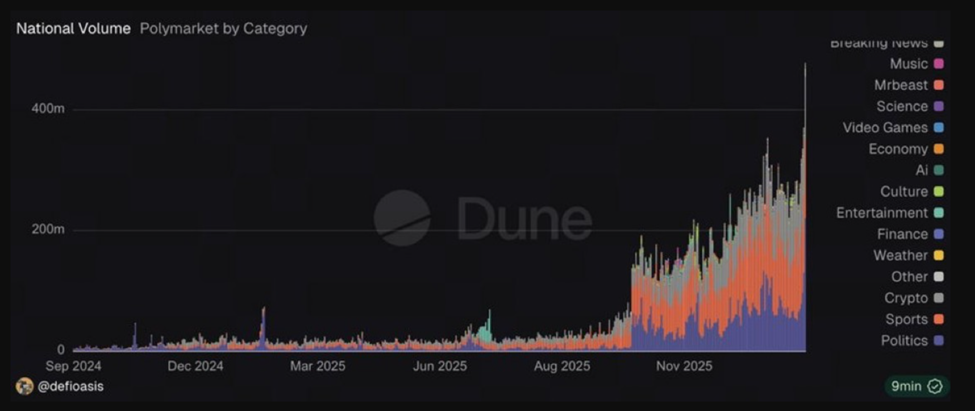
Polymarket recorded a single-day notional trading volume of $478 million, with the politics category alone accounting for $220 million, nearly half of total daily activity.
Elsewhere, rival prediction market Kalshi was on the receiving end of user backlash after a controversial contract over the Khamenei market.
Polymarket Sets Historic Record as Geopolitical Tensions Drive Crypto Betting
Prediction markets surged to historic highs as the United States and Israel launched coordinated strikes on Iran.
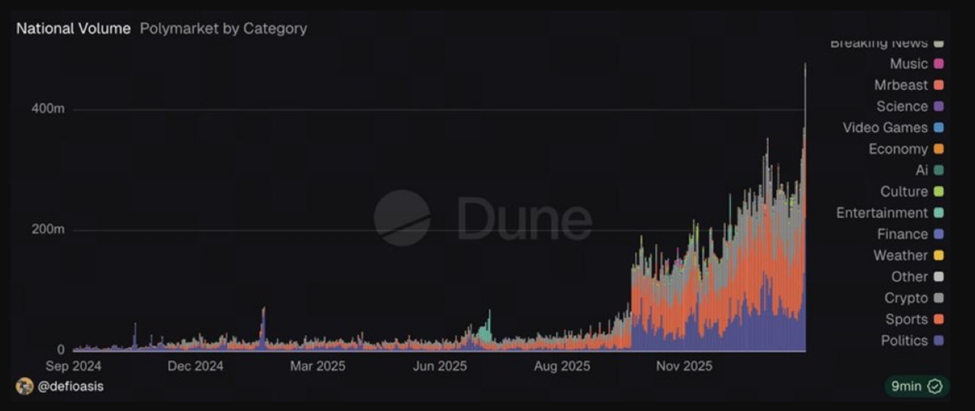
Polymarket reached an all-time high across the platform and its political markets. According to data aggregated by Defioasis, Polymarket’s spike coincided directly with the strikes.
It signals the platform’s capacity to price geopolitical events faster than TradFi markets or polling models.
Certain strike-timing contracts set their own records, with individual trades clearing up to $90 million, reflecting the massive liquidity flowing into the platform.
However, the traction was also marred by allegations of insider trading, with Bubblemaps identifying at least six addresses that profited approximately $1.2 million from bets tied to the Iran conflict.
The surge in activity shows how prediction markets are increasingly blurring the line between financial speculation and geopolitical forecasting, drawing attention from traders, lawmakers, and regulators.
The timely pricing of real-world events demonstrates the efficiency of blockchain-based markets. However, it also raises concerns about transparency and fairness, particularly when wallets appear to perfectly anticipate outcomes.
Kalshi Faces Backlash Over Khamenei Market, CEO Defends Settlement and Ethics
Meanwhile, Kalshi, a US-regulated prediction market, faced its own controversy with the contract titled “Ali Khamenei out as Supreme Leader?”
The market, which had accumulated over $50 million in total volume, saw roughly $20 million traded on strike day alone.
Following Khamenei’s reported death during the strikes, critics argued the platform had effectively created a proxy death market, despite its stated rules against profiting from death outcomes.
Kalshi CEO Tarek Mansour addressed the backlash on X (Twitter), emphasizing that all positions would be settled at pre-death last-traded prices. Meanwhile, post-death positions would be fully reimbursed, including all trading fees.
Mansour defended the market’s design as consistent with U.S. regulations. He noted that leadership changes in Iran carry significant geopolitical, economic, and national security implications. This, he said, makes such markets relevant without directly incentivizing death.
“A market on Ali Khamenei’s out as Supreme Leader was important because leadership changes in Iran have a major impact on the world order,” Mansour wrote, outlining that traders could still profit or lose based on legitimate political outcomes rather than mortality.
The settlement process, he explained, adhered strictly to the CFTC-filed contract terms, which referenced the last-traded price prior to Khamenei’s death, even amid ambiguities in reporting timelines.
On the one hand, Polymarket is setting new benchmarks for trading volume amid geopolitical tension. Meanwhile, Kalshi is facing ethical scrutiny.
Both events highlight the potential and the risks of prediction markets. These platforms offer unprecedented speed and transparency in pricing world events.
However, as February 28 demonstrated, they also amplify ethical dilemmas and regulatory attention during crypto-driven speculation.

T20 World Cup: Sikandar Raza restores Zimbabwe’s pride, albeit in losing cause | Cricket News

Xiaomi’s Leitzphone Looks Exactly Like a Leica Phone Should

MAJOR XRP RUMOR CONFIRMED!?!? THIS IS CRAZY


-

 Sports6 days ago
Women’s college basketball rankings: Iowa reenters top 10, Auriemma makes history
-

 Fashion2 days ago
Weekend Open Thread: Iris Top
-

 Politics6 days ago
Nick Reiner Enters Plea In Deaths Of Parents Rob And Michele
-

 Business5 days ago
True Citrus debuts functional drink mix collection
-

 Politics3 days ago
ITV enters Gaza with IDF amid ongoing genocide
-

 Tech17 hours ago
Unihertz’s Titan 2 Elite Arrives Just as Physical Keyboards Refuse to Fade Away
-
Sports2 days ago
The Vikings Need a Duck
-

 Crypto World6 days ago
XRP price enters “dead zone” as Binance leverage hits lows
-

 Tech5 days ago
Unsurprisingly, Apple's board gets what it wants in 2026 shareholder meeting
-
 NewsBeat1 day ago
Dubai flights cancelled as Brit told airspace closed ’10 minutes after boarding’
-

 NewsBeat4 days ago
Cuba says its forces have killed four on US-registered speedboat | World News
-
 NewsBeat1 day ago
The empty pub on busy Cambridge road that has been boarded up for years
-
 NewsBeat4 days ago
Manchester Central Mosque issues statement as it imposes new measures ‘with immediate effect’ after armed men enter
-

 NewsBeat7 hours ago
‘Significant’ damage to boarded-up Horden house after fire
-
 NewsBeat6 days ago
‘Hourly’ method from gastroenterologist ‘helps reduce air travel bloating’
-

 NewsBeat1 day ago
Abusive parents will now be treated like sex offenders and placed on a ‘child cruelty register’ | News UK
-
 NewsBeat5 days ago
Police latest as search for missing woman enters day nine
-

 Business4 days ago
Discord Pushes Implementation of Global Age Checks to Second Half of 2026
-

 Business3 days ago
Only 4% of women globally reside in countries that offer almost complete legal equality
-
 Sports6 days ago
2026 NFL mock draft: WRs fly off the board in first round entering combine week