The town is only 30 minutes from from Cambridge on the train
Spring is nearly here and there is one town that’s an easy train ride from Cambridge with beautiful lavender fields to explore. With the warmer weather getting closer, you may be looking for some pretty places to walk to admire what spring has to offer.
Advertisement
The Hertfordshire town of Hitchin – only a 30-minute train ride from Cambridge – has large fields of lavender that make it unique. Hitchin’s Lavender is set on the rolling slopes of Wilbury Hills.
It has become known for its stunning views and picturesque walks in the warmer weather. For people who love the camera, the fields are also the perfect place for a photo opportunity.
As well as walking through the fields, there is a tearoom and dining area to enjoy a snack and drink. Hitchin has a lot of other things on offer as well as its landmark lavender fields.
It is a quaint market town with lots of history at its doorstep, as the town dates back to around the seventh century. It also has strong royal links, as the late Queen Mother was born in nearby St Paul’s Walden.
Advertisement
One of the town’s best features is its market. Hitchin market is one of the largest outdoor markets in the region, and features over 150 stalls. It is held on several days of the week.
Buildings throughout the town are made up of stunning architecture that is fine to admire. The old market square is made up of Italianate-style buildings.
The town’s church, St Mary’s Church, is majorly formed of materials from the 14th and 15th century. Hitchin also offers a great shopping experience, with a wide range of independent shops and boutiques in the town.
There are also a number of popular high street brands to shop at. After a long day of shopping, there is also every cuisine you can think of on offer in Hitchin to enjoy a bite to eat and drink at.
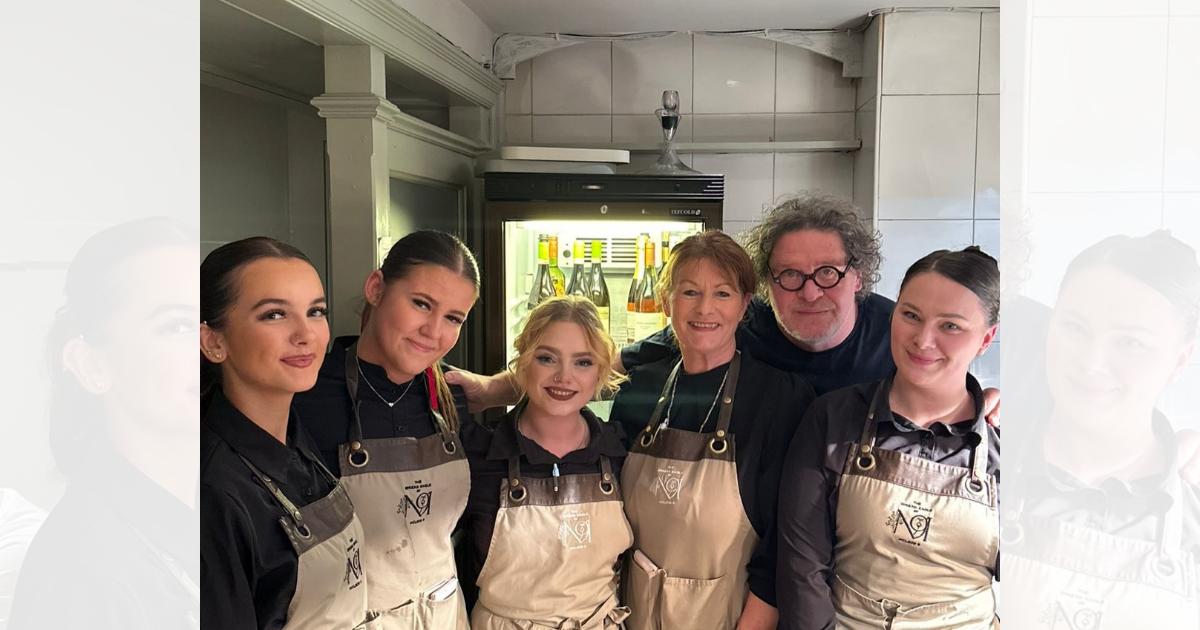
British TV star and restaurateur Marco Pierre White paid a visit to The Spread Eagle on Bolton Road on Saturday and is already said to be ‘making plans to come back soon’.
Joe McLoed of McLoed 9 took over the former Italian restaurant in June last year and it is already going from strength to strength.
Speaking to The Bolton News, Joe said: “I met Marco at Bolton Food and Drink Festival last year and he said that he would come along in the new year.
Marco Pierre White spent time in the kitchen with the team (Image: supplied)
“I got a call from chef Mike Harrison asking if we had space for Marco to come in for food as he was in the area.
Advertisement
“Marco was on fantastic form and had a chat and laugh. He gave us all the time in the world when he didn’t have to.
“We got pictures together and had a good laugh in kitchen about the industry.”
Marco Pierre White with team members at The Spread Eagle (Image: supplied)
Marco Pierre White is widely dubbed the ‘godfather of modern cooking’ and was the first British, and then the youngest, chef to earn three Michelin stars.
He headlined as a guest at the Bolton Food and Drink Festival (BFDF) last year marking his first-ever appearance at the event as it celebrated its 20th anniversary.
Advertisement
Joe was also invited to cook at the prestigious BFDF Gala Dinner alongside some of the UK’s best-known chefs, creating one of the courses for VIP guests.
Joe added: “When a chef of that calibre comes in, you’re nervous about it! If you don’t get it right, it could go wrong.
“Marco was very complimentary and said that he wants to come back soon.
“It was a lovely experience for the team; to attract chefs of that level is humbling,
Advertisement
“There is a lot of love put into the food here and Marco’s words are a nod that we’re heading in the right direction.”
“We’re so grateful that he chose to dine with us.”
Marco Pierre White also signed a menu during his visit (Image: supplied)
Joe also announced that The Spread Eagle has just launched a new lunch offer from Wednesday to Saturday, where diners can try dishes prepared with locally sourced ingredients from sustainable farms and producers for less than £33.
Morsels and Measures is a “McLeod 9 interpretation of bar food” with a selection of Joe’s favourite snippets inspired by the restaurants tasting menu.
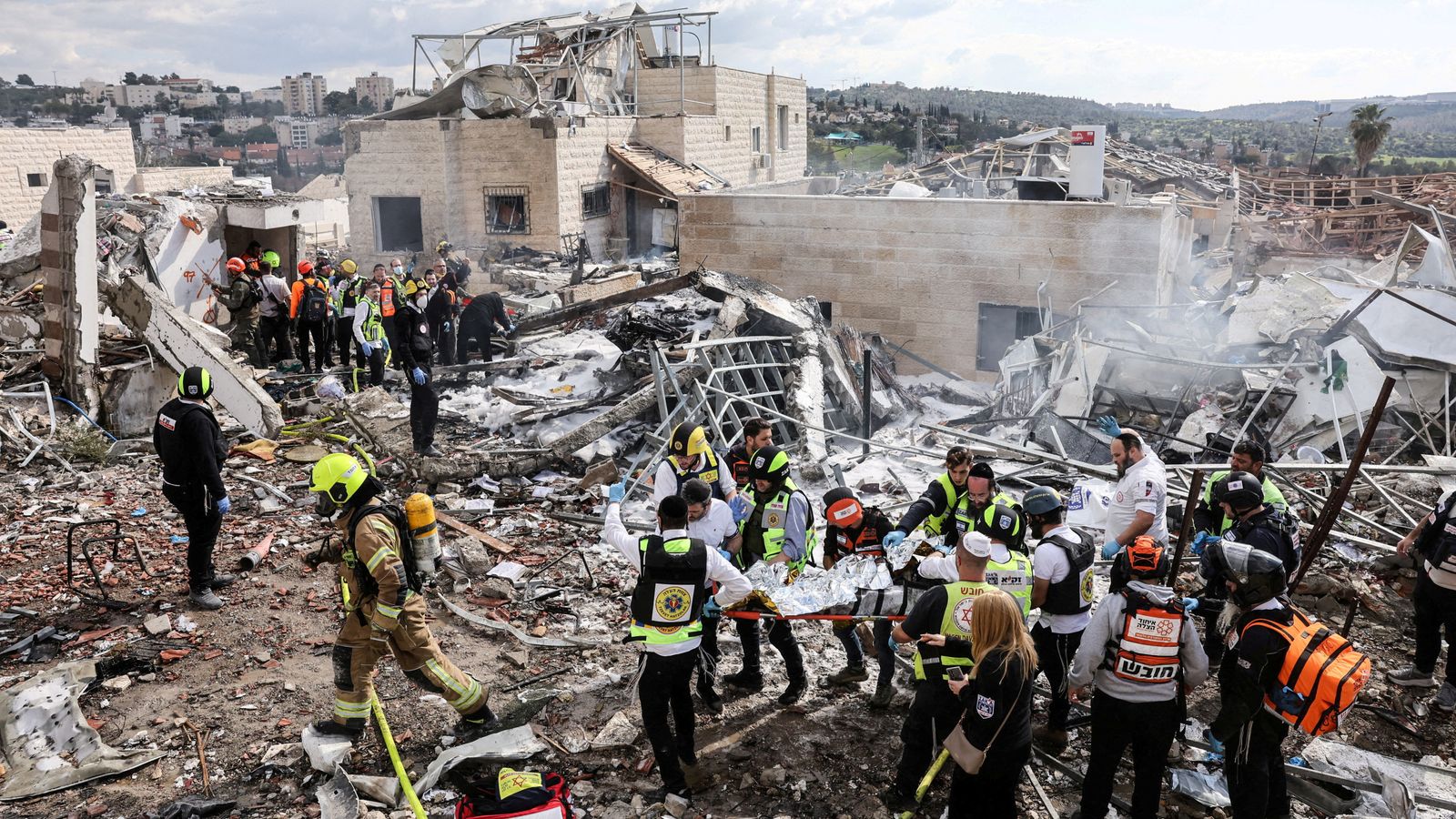
It is an image that will haunt very many people across Israel. A corner of Beit Shemesh, flattened by an Iranian missile; a synagogue destroyed; people killed while they sought refuge in a bomb shelter.
If you wanted proof that war, even this war, is not just about aerial defences and surgical strikes, this was it. A ghastly vista of sudden death.
When we arrived on the scene, we were told, repeatedly, that this was just a place where people lived, prayed and got taught. No military base, no hardware, not even a government office.
Advertisement
“Why would this be a target,” said one person. “There is no excuse.”
What we saw when we arrived was a chaotic aftermath. What we heard was a horror story.
Dozens of residents had gone to the bomb shelter after receiving an alert on their phone and then hearing an air raid siren. It is the sort of behaviour that is, at once, disconcerting and also normal.
Thanks to previous conflicts, including the 12-day war just eight months ago, Israelis are accustomed to getting such warnings.
Advertisement
The shelter was supposed to be their sanctuary. Instead, it became a tomb in a matter of moments.
Image: The aftermath of the strike in Beit Shemesh, Israel. Pic: AP
The missile somehow evaded Israel‘s formidable air defences.
“Nothing can be one hundred percent effective,” said one Israeli military official to me. “We cannot stop every single missile. We can try, but we know that eventually one will get through.”
And so it did, devastatingly. We watched as huge diggers were brought in to try to clear the rubble, and as search and rescue teams worked out how to look for survivors. There were soldiers, emergency workers, local residents, police and politicians.
Advertisement
We spoke to one of them, Amichai Eliyahu, Israel’s outspoken culture minister. He was surveying the destruction, his head shaking. This, he said, was an embodiment of why Israel needed to fight Iran.
“What did these people here ever do to them? What did these babies do to harm them?” he said to me.
“They have never done anything bad to Iran, we don’t even share a border with Iran. This was done for no reason at all, except pure hatred for the sake of hatred. So I’m asking all those who defend them in the world, who are you defending? Monsters, Monsters want to kill us.”
Lieutenant Colonel Yochay Manoff was more sanguine, when we spoke on a ridge overlooking the scene. He is a company commander in Israel’s National Rescue Unit, accustomed to difficult situations and traumatic problems.
But, for him, this one was difficult to accept.
“Just for reference, this is one missile that hit and affected so many buildings and so many lives,” he told me. “Think about the amount of missiles that were on the way from Iran to Israel over the last two days. The damage could be immense.”
Could be, but hasn’t been. Israel puts so much store by its aerial defence systems that sometimes its citizens can appear complacent, so confident are they in the military technology.
Advertisement
But this was proof that nothing works perfectly, all of the time.
Every now and then a missile will get through the array of defence systems that guard Israel’s airspace, and sometimes they strike with horrific impact. This corner of Beit Shemesh offered grim evidence of that.
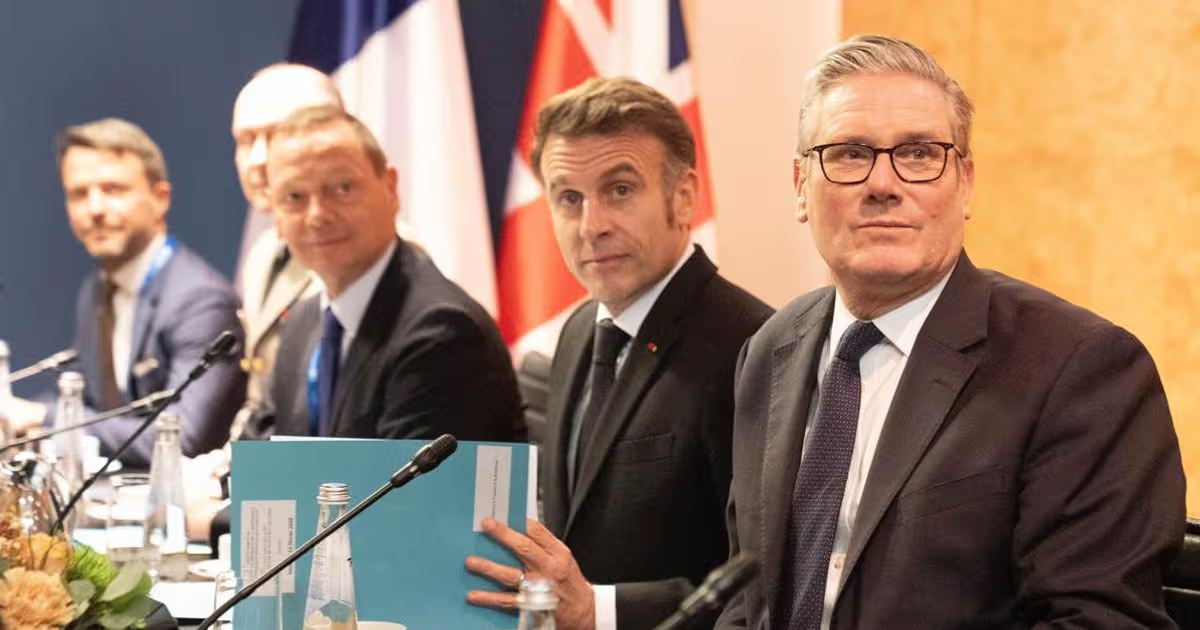
Sir Keir Starmer said the UK will allow the US to use British bases after Britain, France and Germany together said they would help ‘destroy Iran’s capability to fire missiles and drones at their source’
21:24, 01 Mar 2026Updated 22:17, 01 Mar 2026
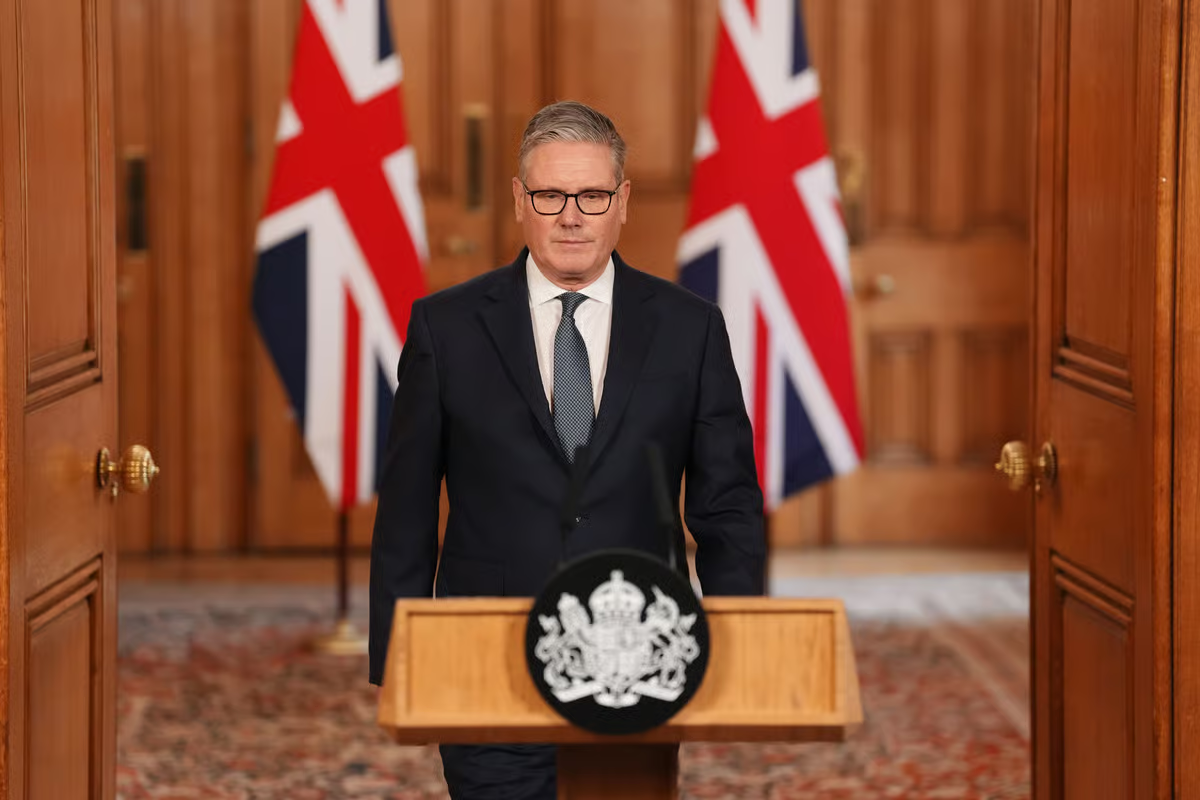
The UK has agreed to a US request to use British military bases to strike Iranian missile sites, Sir Keir Starmer has confirmed.
But the UK Prime Minister said the UK “will not join offensive action” in Iran, adding: “We all remember the mistakes of Iraq and we have learned those lessons.”
It comes as Iran continues its assault on the Middle East in revenge attacks for the joint US-Israeli operation yesterday which saw missiles rain down on Tehran, Mirror reports.
Advertisement
A joint statement between UK, France and Germany said: “We will take steps to defend our interests and those of our allies in the region, potentially through enabling necessary and proportionate defensive action to destroy Iran’s capability to fire missiles and drones at their source.
“We have agreed to work together with the US and allies in the region on this matter.”
In an update this evening, Mr Starmer said it “remains the case” that the UK is not involved with the strikes on Iran, but Britain will allow the US to use British bases to support its operation.
He said “partners in the Gulf have asked us to do more to defend them”, adding that “it’s my duty to protect British lives.”
Advertisement
“We have British jets in the air as part of coordinated defensive operations. Which have already successfully intercepted Iranian strikes. But the only way to stop the threat is to destroy the missiles at source. In their storage depots or the launchers which are used to fire the missiles,” Mr Starmer continued.
“The US has requested permission to use British bases for that specific and limited defensive purpose. We have taken the decision to accept this request. To prevent Iran firing missiles across the region, killing innocent civilians, putting British lives at risk and hitting countries that have not been involved.
“The basis of our decision is the collective self-defence of longstanding friends and allies, and protecting British lives.”
The PM said while the UK is “not joining these strikes”, Britain “will continue with our defensive actions in the region.”
Advertisement
“And we will also bring experts from Ukraine together with our own counter drone expertise, to help our Gulf partners shoot down Iranian drones attacking them.”
He concluded: “We all remember the mistakes of Iraq and we have learned those lessons. We were not involved in the initial strikes on Iran, and we will not join offensive action now.
“But Iran is pursuing a scorched earth strategy, so we are supporting the collective self-defence of our allies and our people in the region, because that is our duty to the British people.
“It is the best way to eliminate the urgent threat and prevent the situation spiralling further.
Advertisement
“This is the British government – protecting British interests and British lives.”
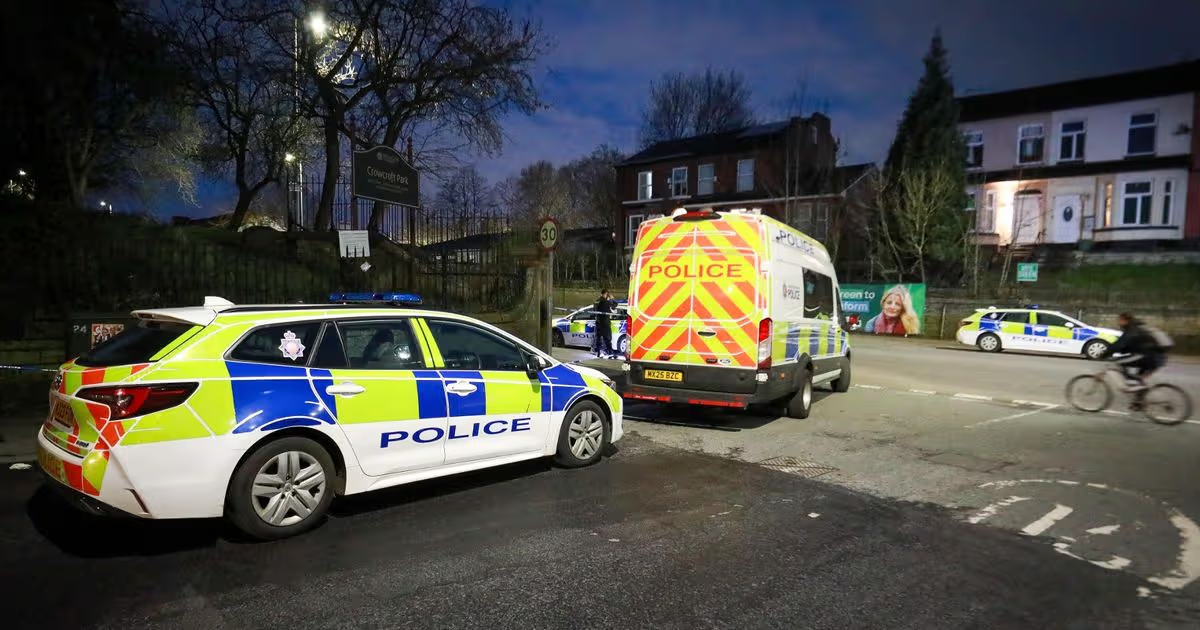
A Manchester park was taped off this evening (March 1) with a police helicopter scouring the scene following reports of a ‘serious assault’ in the area.
An injured man was found at the scene and was taken to hospital for treatment, the force said. Photos from the scene showed multiple police cars in attendance outside the takeaways on Stockport Road.
There were also several cordons in place along Stockport Road and East Road, which run to the north and west of the park. Multiple accounts on Facebook reported seeing a police helicopter in the area and over the park.
Advertisement
A spokesperson for GMP said: “At around 5.35pm today (1 March) officers responded to reports of a serious assault at Crowcroft Park, Stockport Road.
“A man has been taken to hospital for treatment and enquiries are currently ongoing.”
Arsenal are going to have to navigate the tension of the title race with just nine matches left in their bid to win a first league title since 2004.
And when asked by BBC Sport if they have had to go to another level with their work on set-pieces due to the work other sides are doing, Arteta agreed.
“Yes but every team is to be fair,” he said. “Look where they are in terms of the amount of goals that they score.
“We hadn’t scored set-pieces for a few weeks now, but we scored so many in open play.
Advertisement
“Today was an option to score from this kind of situation. We’ve done it so well and we conceded as well.”
Chelsea were starting to grow into the game before Timber’s crucial goal, while they needed goalkeeper David Raya to produce some excellent saves to deny the sixth-placed Blues a point.
“I didn’t think there was an awful lot between the two teams, but Arsenal came out on top and at this stage of the season that’s vital, isn’t it?,” added Arteta’s former Everton team-mate Osman.
“If your strengths are pacy wide men that create things all the time, you give them the ball all the time.
Advertisement
“If your strength is set-pieces, you try to win set-pieces and score from them and they’re very good at it, very effective.
“And ultimately that was that was the difference between the teams, but Arsenal won’t care because it’s another three points.”
According to Osman, Arsenal can be criticised for their style of play and are often compared to title winners of the past but if they win the title, that is all that matters.
“Many people watching want to see beautiful football or purists want to see open play great goals back to front.” he said.
Advertisement
“That’s not how football’s always played. Football is about being effective in both penalty areas, finding a way.
“I think whatever happens in between can be pleasing, can be enjoyable, can be exciting.
“But ultimately, it’s less important than what happens in both penalty areas because that’s where games are won and lost.”
Our columnist asks what he would like Wales and Welshness to be know for
22:16, 01 Mar 2026
It’s one of those questions that people think they know the answer to until they try to write it down because being Welsh isn’t about a flag, a rugby shirt or a childhood memory of rain on a caravan window in Tenby, it’s a living identity shaped as much by what we’ve had done to us as by what we’ve chosen for ourselves.
Advertisement
And if we’re honest as we celebrate St David’s Day in 2026, Welshness is caught between two powerful instincts of being culturally confident and economically cautious. Yes, we are a nation that has never lacked a voice – against the odds, we’ve kept a language alive that history tried to suffocate and produced artists, athletes, and scientists who have done far more than our scale should allow.
When Wales is at its best, it has a kind of intensity where talent and community sit close together, and you’re never far from someone who will help you, introduce you, or just put the kettle on for a panad (cup of tea).
But we are also a nation that too often behaves as if economic success will only happen elsewhere, and to me, that is the tension at the heart of modern Welsh identity.
If we want to understand what it means to be Welsh today, we need to recognise that a nation of just over three million people does not get many “free hits,” and that every year of under-performance matters. So, when Wales has consistently been below the UK average on productivity, wages and economic output since devolution in 1999, those aren’t just another bunch of statistics but a situation that is shaping national confidence, narrowing the horizon of ambition, and quietly rewriting our Welsh identity from “we can” to “we cope”.
Advertisement
Welshness has always contained resilience, and we have endured industrial collapse, political marginalisation, and decades of being talked about as a problem to be managed rather than a place to be built. But resilience is not the same thing as ambition and modern Welshness, if it is to mean anything beyond nostalgia, has to be deliberate in deciding that’s how we will shape our economic future.
That we will not just host economic summits that discuss investment but actually go out and create it; not just train the talent of the future but retain it in our communities; and not just talk about innovation but use it to create companies that scale and stay rooted in their communities.
This is where the conversation usually becomes uncomfortable because it forces a harder question for the economic future of this nation: do we truly believe Wales can build globally significant businesses that dominate their sectors, anchor high-value jobs and recycle wealth into the next generation of founders?
To date, Wales has not normalised that kind of ambition and in fact we treat it as exceptional by celebrating the odd outlier rather than building a pipeline to make it happen.
Advertisement
And that’s why belief matters: small countries with a deep, repeated pattern of scale build a different psychology by producing founders who pitch bigger, firms that recruit for global growth, and policymakers who design programmes to support success.
Let me make it unequivocal – I have always believed Wales has talent, ingenuity and innovation in spades, but what we have lacked repeatedly is the conversion mechanism namely the capital, institutional muscle and the cultural permission to think outrageously big without constantly being told to “be realistic”.
Too often, the aim is preservation through metrics such as businesses supported or jobs safeguarded, and whilst those things matter, they are not the same as creating employment, growing firms and building national prosperity. In other words, we have become a development economy obsessed with avoiding failure, and the inevitable consequence is that the Welsh story has become one of survival rather than success.
This is not about demanding that every business becomes a unicorn, but about understanding that a small nation needs high value wins to change its trajectory as the mathematics of economic development are unforgiving. Simply put, you cannot build prosperity on low productivity and low value-added and instead, need firms that invest, export and grow.
Advertisement
That then brings us to the deeper question: what do we want Wales to be known for? Obviously not another romanticised version of coal and choirs, but do we know what the modern Welsh proposition is in a world of AI, clean energy and deep tech?
Because being Welsh shouldn’t be simply about looking backwards, but about choosing what comes next, and if we want an identity that is proud, modern and confident, then we all need to embrace an economic narrative rooted in better performance.
That requires institutional courage, such as serious mechanisms to turn research into investable companies, development finance that knows when to protect and when to go for it, and a political culture that stops mistaking announcements for outcomes. Until we fix that, Welshness will remain proud of what we have kept but uncertain about what we can create.
So, back to the question of what does it mean to be Welsh in 2026? We will have different answers but to me, it means refusing to accept underperformance as a national personality trait. It means celebrating community but not letting it become a comfort blanket. And it means being proud of what we have whilst constantly demanding better.
Advertisement
But most important of all, Welshness should never be reduced to grievance, nostalgia, or sentimentality, as it needs a modern identity in a modern economy with modern choices. Yes, a small nation does not need to dominate everything, but it should be expected to dominate something, and when we start acting as if we believe that calling in our institutions, our companies, and our culture, the question “what does it mean to be Welsh?” will have a completely different kind of answer.
Fortunately, Sister Veronica has had Geoffrey, played by Christopher Harper by her side for support. The pair have even moved in with another and in Sunday’s episode (March 1) Geoffrey attempted to give Sister Veronica a makeover.
But now, with the Series 15 final just around the corner, fans can’t help but think a spin-off could be in the works for Sister Veronica and Geoffrey.
Advertisement
On X, one person declared: “Give me a whole series of Geoffrey and Beryl living their lives together.” Another added: “Please Please can we have a Jeffrey and Beryl spin-off. Best flatmates ever.”
A third penned: ”Geoffrey and Beryl are just the perfect friendship.” Echoing their thoughts, someone else wrote: “Beryl and Jeffrey spin off or they get married, and have a baby, and have to navigate two worlds.”
Meanwhile, opening up on what it’s like working with the actor, Sister Veronica actress Rebecca previously revealed: “Christopher Harper has become a pal over the years, and it’s really lovely to play scenes with him.”
Advertisement
She continued: “He and Sister Veronica have an ease with each other and a deep friendship, and they have a lot of fun. He takes the mickey out of her and she likes that, and I’ve really loved building that relationship with him.”
**For the latest showbiz, TV, movie and streaming news, go to the new **Everything Gossip** website**
It comes as Call the Midwife is set to air its Series 15 finale next week, with the sad death of Sister Monica Joan likely to take place then. The character’s physical and mental wellbeing has been declining across recent series and was recently diagnosed with chronic kidney disease.
Advertisement
And according to actress Helen George – who plays Trixie – the audience will be a “mess” watching the series finale.
“There’s this scene, I won’t really go into detail, but it sort of encompasses all of the characters that we’ve had on the show over the last 15 years,” she told Radio Times. Helen added: “So if I was a mess – and I’m heart of steel – then the audience will be a mess as well.”
While Renee Bailey, who plays Joyce, described the finale: “It makes you laugh, it makes you cry. It’s a hug and it’s also heartbreaking. It’s a mix of everything, but I think audiences are going to love it.”
Ensure our latest headlines always appear at the top of your Google Search by making us a Preferred Source.** Click here to activate**** or add us as your Preferred Source in your Google search settings.**
Advertisement
Call The Midwife airs every Sunday at 8pm on BBC One.
Mercedes have a new driver on their books – and remarks he made in the past may not sit too well with George Russell or Kimi Antonelli
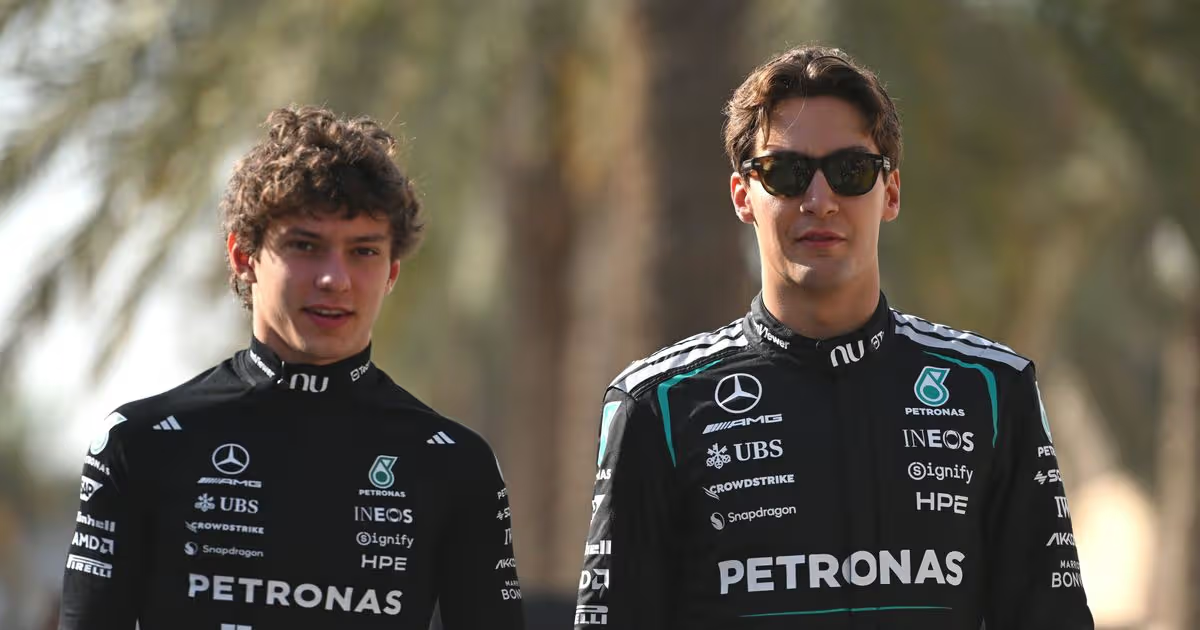
George Russell has a new teammate at Mercedes – and the outspoken young driver has not been shy about sharing his views on Kimi Antonelli in the past. Earlier this week, the Silver Arrows confirmed the signing of former Formula 2 champion Theo Pourchaire, who claimed the F2 title in 2023.
Advertisement
The Frenchman joins Mercedes in a development role and will act as reserve driver to Russell and Antonelli, who are set to begin their second season as Formula 1 teammates next weekend. This marks Pourchaire’s third stint as an F1 reserve.
He previously served in the same capacity for Sauber in 2024 and Alfa Romeo in 2023, although he is still waiting to make his race debut in the competition.
MAKE THE MIRROR YOUR FIRST CHOICE! Click here to activate or add us as Preferred Source in your Google search settings
During the 2024 campaign, Pourchaire argued that it was “unfair” for drivers who had not won the F2 championship – such as Antonelli and Haas driver Oliver Bearman – to be promoted to F1 ahead of those who had secured the title.
Advertisement
“I did my best on track,” Pourchaire told MotorSport. “Sure, some people say I won the championship in my third year of F2 and it doesn’t sound great, but I won it when I was 20. I’m the youngest race winner in F2 and F3, so I have nothing to prove. I just need an opportunity, that’s all.”
Just one of the last four F2 champions have succeeded in securing a seat in F1, with 2024 winner Gabriel Bortoleto being signed by Audi Revolut ahead of the 2026 season.
The most recent F2 champion to successfully establish themselves in F1 was 2021 champion Oscar Piastri, who was subsequently signed by McLaren as a reserve driver before landing a permanent seat with the team in 2023.
Advertisement
“From the outside, for sure, if you’re in my shoes, it seems unfair,” Pourchaire added. “Like I think it’s unfair for [2022 F2 champion Felipe] Drugovich, for example, who won the title. That’s how it is, that’s the world of F1. I’m just happy to be in the paddock again. And like I said, I really hope to get my chance one day. I’m ready to give everything.”
Pourchaire finished runner-up in F3 in 2020 and replicated the achievement in F2 two years later. In 2023, he went one step further by claiming the F2 title.
However, as a member of Sauber’s junior programme at the time, he was unable to obtain a place on the F1 grid for the following season. Having been barred from continuing in F2 as a former champion, Pourchaire sought alternative avenues to further his career, joining Team Impul in Japanese Super Formula.
Advertisement
His time there proved brief, however, as he stepped away after just one round when an IndyCar opportunity came knocking.
He subsequently turned his attention to the World Endurance Championship, taking part in last year’s 24 Hours of Le Mans. For the time being, though, his sights are firmly set on Mercedes – and on finally achieving his long-awaited F1 breakthrough.
Breaking into the race seat at Mercedes could prove an enormous challenge, with both Russell and Antonelli delivering impressive performances last season.
Russell finished fourth in the Drivers’ Championship – matching the finest result of his career – whilst Antonelli claimed seventh place, just six points behind Lewis Hamilton, the man he succeeded following the Brit’s headline-grabbing switch to Ferrari.
Antonelli’s campaign was widely considered one of the most outstanding debut seasons in recent Formula 1 history. This further highlights the enormity of the task confronting Pourchaire should he harbour hopes of forcing his way into the Silver Arrows’ line-up.
Sky’s discounted Formula 1 package
Advertisement
This article contains affiliate links, we will receive a commission on any sales we generate from it. Learn more
Formula 1 fans can watch every practice, qualifier and race live with Sky’s Essential TV and Sky Sports bundle in an introductory deal that saves £336.
As well as Sky Sports access, this includes around 100 TV channels and free subscriptions to Netflix and Discovery+.
In response to the strikes, Iran has launched retaliatory missile and drone attacks across the region, with explosions reported in Israel and Gulf states. Airspace has been closed in multiple countries, including Iran, Iraq, Qatar and the United Arab Emirates, causing widespread disruption to international flights.
Britain, France and Germany have issued a joint statement threatening to ‘destroy Iran’s capability to fire missiles and drones at their source’
Husna Anjum, Olivia Bridge and Husna Anjum Senior Live News Reporter
21:54, 01 Mar 2026
The UK will help the US in its military action to bomb targets in Iran, but Prime Minister Kier Starmer stressed they will “not join offensive action”. This follows a US request to use British military bases to strike Iranian missile sites.
The UK Prime Minister said in a statement on Sunday evening: “We all remember the mistakes of Iraq and we have learned those lessons.”
Advertisement
Mr Starmer said it “remains the case” that the UK is not involved with the strikes on Iran, but Britain will allow the US to use British bases to support its operation.
He said “partners in the Gulf have asked us to do more to defend them”, adding that “it’s my duty to protect British lives.”
“We have British jets in the air as part of coordinated defensive operations. Which have already successfully intercepted Iranian strikes. But the only way to stop the threat is to destroy the missiles at source. In their storage depots or the launchers which are used to fire the missiles,” Mr Starmer continued.
“The US has requested permission to use British bases for that specific and limited defensive purpose. We have taken the decision to accept this request. To prevent Iran firing missiles across the region, killing innocent civilians, putting British lives at risk and hitting countries that have not been involved.
Advertisement
“The basis of our decision is the collective self-defence of longstanding friends and allies, and protecting British lives.”
The PM said while the UK is “not joining these strikes”, Britain “will continue with our defensive actions in the region.”
“And we will also bring experts from Ukraine together with our own counter drone expertise, to help our Gulf partners shoot down Iranian drones attacking them.”
He concluded: “We all remember the mistakes of Iraq and we have learned those lessons. We were not involved in the initial strikes on Iran, and we will not join offensive action now.
Advertisement
“But Iran is pursuing a scorched earth strategy, so we are supporting the collective self-defence of our allies and our people in the region, because that is our duty to the British people.
“It is the best way to eliminate the urgent threat and prevent the situation spiralling further.
“This is the British government – protecting British interests and British lives.”
In a joint statement with France and Germany, the UK suggested it could join attacks on Iranian soil for the first time.
Advertisement
The statement read: “We will take steps to defend our interests and those of our allies in the region, potentially through enabling necessary and proportionate defensive action to destroy Iran’s capability to fire missiles and drones at their source.”
“We have agreed to work together with the US and allies in the region on this matter.” Iran continues its assault on the Middle East in revenge attacks for the joint US-Israeli operation yesterday which saw missiles rain down on Tehran, Star reports.
Additionally more than 96,000 Brits stranded in the UAE and other Gulf hotspots have already signed up with the government for help, with numbers expected to soar into the hundreds of thousands. Most are holidaymakers or passing through, and with airspace still shut, officials are telling people to stay put for now.
However, plans are being drawn up for a huge evacuation through Saudi Arabia if flights remain grounded. The Foreign Office is reportedly in talks with all major airlines as it faces its biggest-ever operation to track and assist British nationals abroad.
This comes as a major humanitarian crisis is unfolding in the Middle East after US and Israeli military strikes against Iran on Saturday (February 28) triggered a rapid escalation of conflict across the region. In retaliation, Iran has launched a barrage of missile attacks targeting US military bases and cities throughout the Gulf, including the UAE, Bahrain, Qatar, and Kuwait.
“At the moment people are being told to stay put but the government is working on plans to evacuate people through Saudi Arabia if the airspace remains closed for a prolonged period,” The Times’ Steven Swinford shared today (March 1) on X (formerly Twitter).
The political editor added: “The government is also in contact with all the main airlines in the region. The scale of the FCDO operation is unprecedented – never before has it registered so many people in so many countries.
Advertisement
“And it’s only just beginning.” An estimated 250,000 UK citizens are believed to be living in or visiting the region.
Want to see more of the stories you love from Belfast Live? Making us your preferred source on Google means you’ll get more of our exclusives… To add Belfast Live as a preferred source, simply click here.