
News Beat
China would prefer its dissent not to be seen – but it is increasingly there | World News

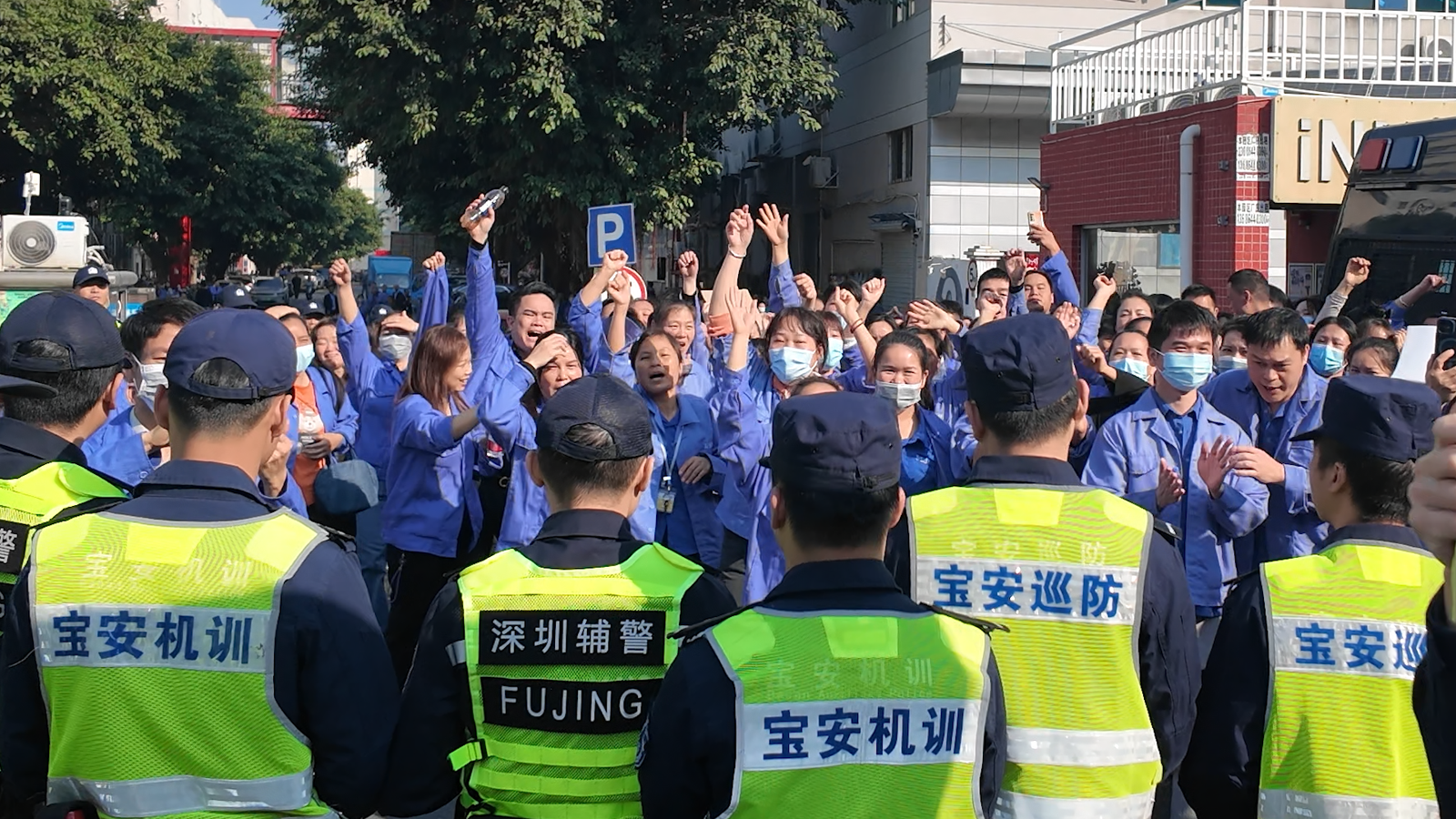
In an industrial corner of the city of Shenzhen, there was a sense the system was bracing.
As they gathered, we watched them from afar. Hundreds of factory workers, clad in matching blue overall uniforms, out together on strike.
It’s immediately obvious that a scene like this is sensitive in China.
Dozens of police and other security workers encircled the protesters. There is a nervous atmosphere, and anyone close was told not to film.
It felt like a standoff of sorts, between those who want to be heard and those who want to silence.
The type of standoff that, despite China’s efforts to keep them under wraps, are actually dramatically on the rise.
Workers at Yi Li Sheng’s Shenzhen factory manufacture audio equipment such as headphones. The day we were there was the fourth day of their strike.
They claim that large portions of the factory’s capacity have been shifted abroad, leaving them with a reduction in their hours, and take-home pay that no longer covers their basic costs in an expensive city like Shenzhen.
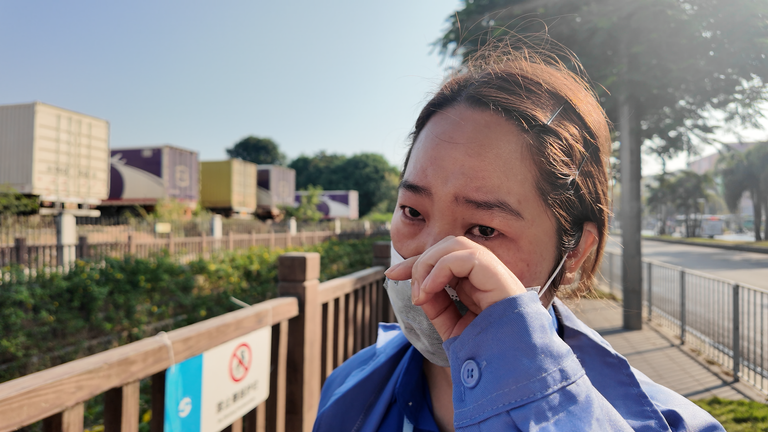
A worker at the Yi Li Sheng factory cries, saying it’s impossible to live off her low wages
“Last month my wages were only 1900RMB (£200),” one woman told us, wiping tears from her eyes. “It’s impossible! How can you survive in Shenzhen on that wage!
“The factory’s exploitation is unbearable. It’s very difficult.”
We put these claims to Yi Li Sheng but we did not get a response.
Capturing scenes like this is rare in China. Protest is often swiftly shut down, local media will rarely report it and evidence will be scrubbed from social media by an army of censors.

Helen-Ann Smith speaks to Chinese dissident Li, who runs the X account ‘Teacher Li is Not Your Teacher’
Expressing dissent is sensitive and risky, doing so is usually a sign of how desperate people see their situation to be.
Indeed, that was the sense from the workers in Shenzhen and it was clear they did want to be heard.
When we got close to their group and they realised we were foreign media, they started cheering, chanting and pumping their fists.
But the reaction from authorities came swiftly.
Hands immediately blocked our lenses, men pulled members of our team to the side, our camera was seized and we were forced into cars and driven away.
We were physically unharmed but, in the moment, the treatment was frightening. A sign, it seems, of just how much this country does not want its dissent to be seen.
Just because protest is hard to document in China, it does not mean it’s uncommon.
In fact, according to data collected and analysed by research group China Dissent Monitor (CDM), quite the opposite is true.
The group, which is an arm of US-based NGO Freedom House, documented over 5,000 cases in 2025 and says that incidents have dramatically increased.
Indeed, exclusive analysis for Sky News shows that the numbers for the first 11 months of last year were up by 48% on the same period in 2024.
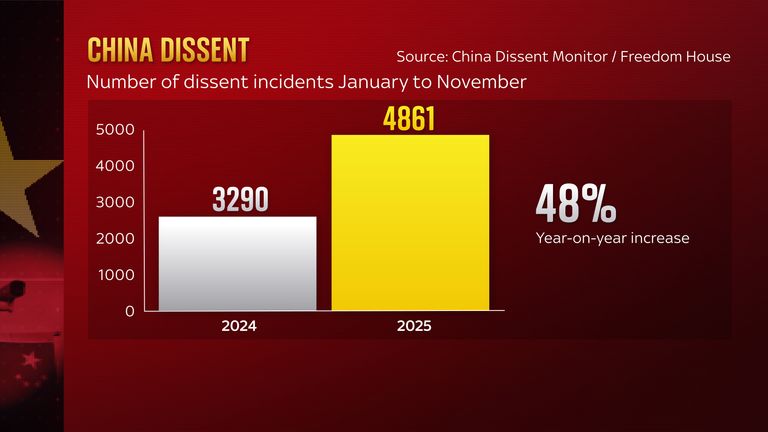
CDM, which was initially funded by the US government but is now funded by private investors, gathers most of its data by constantly trawling Chinese social media, and it says there are likely many more cases that it doesn’t see in time or that are never uploaded.
“Real-world protests are much higher than what we capture,” explains Kevin Slaten, the research lead for CDM. “We don’t know exactly how many times higher.”
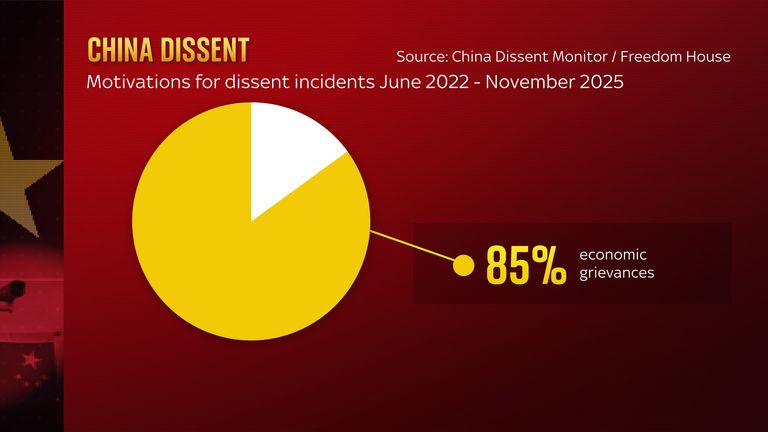
The reasons behind these protests are varied – from unpaid wages to rural land forcibly taken for construction, from perceived unfairness in the school system to homeowners who poured life savings into properties that were never delivered.
But in total 85% of the incidents CDM has charted since June 2022 have been about economic grievances.
Preserving the evidence of such protest and ensuring people see it is a difficult task, and one undertaken by a few committed individuals working from abroad.
One of them is a man who gives his name only as Li.
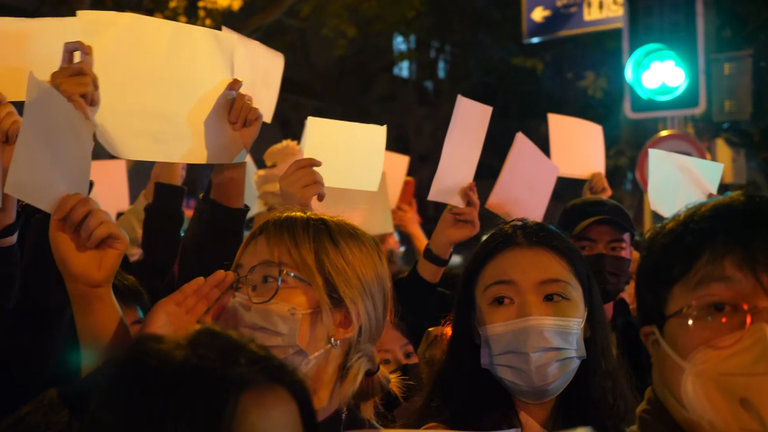
The White Paper Protests erupted in 2022 in reaction to China’s extreme COVID-19 restrictions
He runs an account on X called “Teacher Li is Not Your Teacher” where he reposts videos of protests in China to Western-based sites that the censors can’t control.
He has some 2.1 million followers, but what he does is so contentious that he has to live essentially in hiding and he says that his family back in China have been threatened.
“The reasons [for a rise in protests] are interrelated,” he says. “The economic downturn has led to social instability, which has led to the government’s desire to impose more control over society, which then has led to more discontent in the population.
“Self-expression is a very rebellious thing in traditional Chinese culture, and on top of this, expressing dissatisfaction openly is a thing hidden under a kind of ‘red terror’.
“Our observation is that most people don’t dare to talk about their situation or their thoughts.”
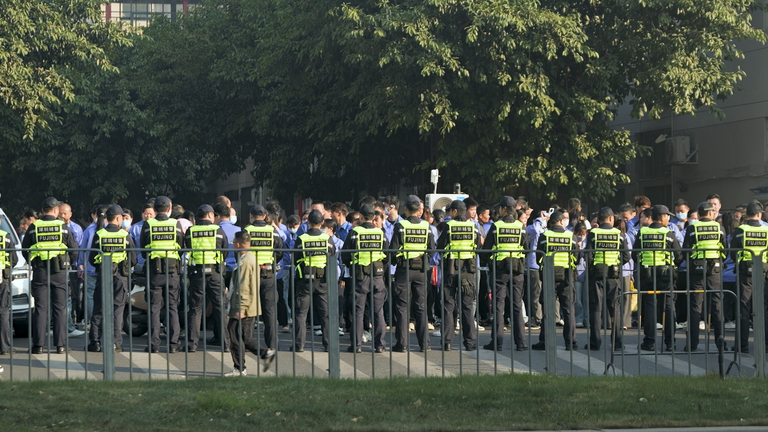
A heavy police presence at a days-long protest held by workers at the Yi Li Sheng factory in Shenzhen in December
Who or what Chinese people blame when they are unhappy is a much more complicated question to untangle.
Indeed, overtly political protest is much more unusual.
There have been some notable recent examples, the most famous being the huge swathe of discontent known as the “White Paper Protests” that erupted in 2022 in reaction to extreme COVID-19 restrictions.
A smaller handful of lone protesters have even used banners and projectors to call for the downfall of China’s Communist Party.
But in a country that prizes “social stability” above almost all else and where a comprehensive system has been built up over many years to sustain it, any gathering is seen as having the potential to spiral and is thus treated as a threat.
“The Chinese people are very, very knowledgeable about their own country and how it works when it comes to politics.
“They know that the Communist Party has complete control,” explains Slaten, who says that 32% of all the protest CDM has charted targets local or central government, public schools or universities.
“People are careful in what they say publicly, to not link this to the central government in many cases. But that doesn’t mean that that’s the same as trusting the central government.”
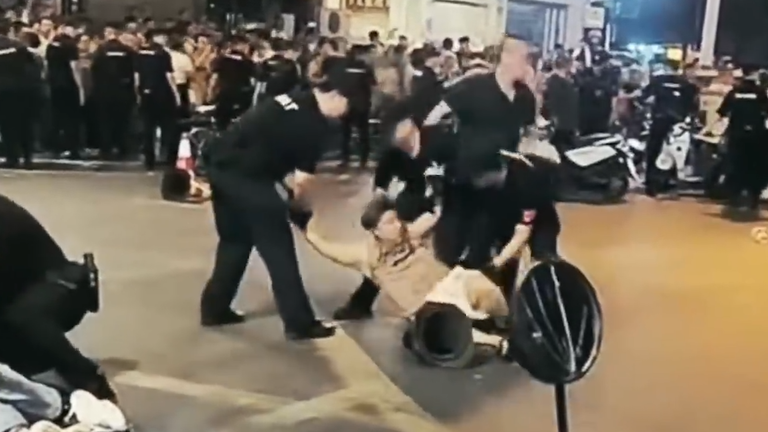
A protest sparked by a school bullying incident spiralled into violence in Jiangyou, Sichuan province in August
A perfect example of this was seen in the southwestern city of Jiangyou this summer.
What started as a peaceful protest about a school bullying incident spiralled into anger at the authorities as people felt their concerns were not being listened to.
Hundreds of people took to the streets, some chanting “huan wo minzhu” [give me back democracy], and the incident culminated in violent clashes with police.
Indeed, some observers point to the fact that many NGOs and advocacy groups in China that used to act as conduits for people’s grievances have been forced to close in recent years. They say people now feel they have fewer options for recompense.
There are, of course, millions of Chinese people who don’t recognise this. They are happy and prosperous and see no need to protest.
A Chinese government official told us that dissidents are not representative of the mainstream of Chinese society.
Freedom House is a sanctioned organisation in China, which says protest is legal and respected.
But it is clear China would prefer its dissent not to be seen, despite the fact it is increasingly there.



