


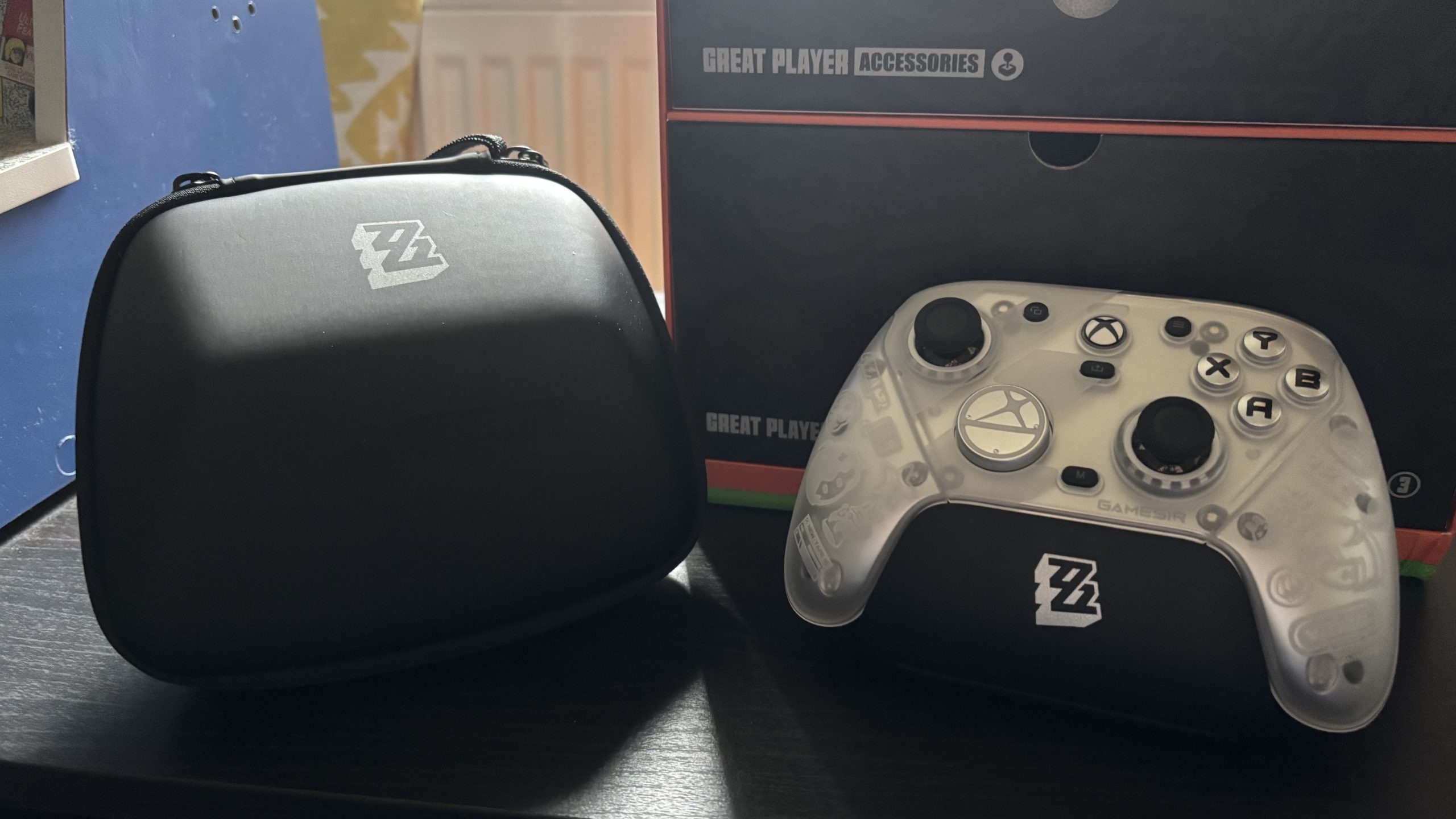
GameSir G7 Pro: one-minute review
GameSir is a controller brand that’s only gone from strength to strength over the last few years. Reliably offering forward-thinking controllers for Xbox and Switch consoles as well as PC and mobile, they’re (typically) competitively priced and offer more features and longevity than even first-party gamepads.
On top of that, the G7 Pro leans into modularity. Similar to the Victrix Pro BFG Reloaded or Thrustmaster eSwap X2 H.E., the G7 Pro has swappable d-pad and stick top modules (though the extra stick tops here are identical and act more like spares). You’ve also got the option to swap out the controller’s face and grip plates, though that’s strictly for cosmetic purposes.
Almost everything about the controller exudes quality; I’d use the G7 Pro over the official option any day. The only slight misstep here that prevents it from earning a perfect five stars, for me, is the face buttons. While using tactile micro switch tech like others in the GameSir lineup, these have a strange halfway bump that makes for a pretty lumpy press feel. It’s something you’ll likely get used to over time, but I definitely prefer the cleaner presses found on the GameSir Kaleid and competing pads like the 8BitDo Ultimate 2.

GameSir G7 Pro: Price and availability
- List price: $79.99 / £89.99 (around AU$114)
- Available to buy now at GameSir’s website, as well as Amazon
- Multiple colorways and special editions exist at various price points
The standard GameSir G7 Pro comes in at $79.99 / £89.99 (around AU$114), slightly pricier than most other GameSir models, though this is understandable when taking the additional modularity into account.
Many colorways and special editions are available for the G7 Pro, some based on games developed by teams in China, including Wuchang: Fallen Feathers and Zenless Zone Zero. The latter even includes a layered keychain and is the one I received for this review.
As mentioned, prices vary for these special editions, and you can also pick up compatible face plates and stick tops from the GameSir website if you so desire.
GameSir G7 Pro: specs
|
Price |
$79.99 / £89.99 (around AU$114) |
|
Dimensions |
6.9 x 6.8 x 3.7in / 177 x 173 x 94mm |
|
Weight |
9.6oz / 272g |
|
Compatibility |
Xbox Series X|S, Xbox One, PC |
|
Connection type |
Wireless (2.4GHz, Bluetooth), Wired (USB-C) |
|
Battery life |
Around 12 hours |

GameSir G7 Pro: design and features
Like many controllers in the ‘Designed for Xbox’ stable, the GameSir G7 Pro bears the approximate silhouette of the Xbox Wireless Controller. It’s a similar size and weight, but there are a number of improvements here that put the G7 Pro lightyears ahead of the official model.
From a pure look and feel perspective, I love this thing. The swappable faceplates add a good bit of personality and put forward a more cost-effective solution than Xbox’s own Design Lab, if you’re into the cosmetics of a controller, of course. The rubberized grips on the rear of the pad are sublime, too; among the sturdiest and most comfortable I’ve ever had the pleasure of testing.
Staying on the rear of the controller for a second, you have a pair of remappable buttons that are strictly optional; you can flick a small switch on either side to fully lock the button, preventing you from pressing it if you’d prefer. You’ll also find the trigger lock toggles back here, as well as a switch for swapping between Bluetooth and 2.4GHz wireless connectivity options.
The front of the pad is pretty standard stuff. You have an Xbox-like asymmetrical stick layout here, as well as the d-pad, face buttons, and Home and share buttons. A Multifunction button also exists here, as it does on other GameSir controllers.
This is immediately useful if you want to make quick and simple adjustments, such as headset and mic volume adjustment, and remappable button assignment. You can do all this in the GameSir Nexus app on Xbox and PC, too, but having on-device shortcuts in addition to that is a real boon.

GameSir G7 Pro: performance
Once again, GameSir has provided a near-luxurious play experience at a mid-range price with the G7 Pro. Hall effect sticks are pretty standard nowadays (and arguably expected), but they’re here and feel great nonetheless.
One thing that really impressed me about the G7 Pro is its trigger locks. Again, nothing new, but I almost always prefer the tighter press of a digital trigger if given the option. On the G7 Pro, they work flawlessly, and it offers one of the most tactile and responsive digital trigger options in the business.
Immediacy really is the keyword here. The micro switch-powered d-pad, as well as the claw grip bumpers and rear remappable buttons, all offer such clicky and immediate responsiveness that I can highly recommend this controller if you’re a competitive gamer.
The one misstep here has to be the face buttons, though, and it’s a real shame they don’t feel quite as nice as everything else on the G7 Pro. Here, as mentioned above, there’s an awkward half-press that makes the face buttons feel uncomfortably bumpy at first. I got used to it after some time with the controller, but the quality of them here is a noticeable step down from the brand’s other products.
On battery life, I managed roughly 12 hours on a single charge. That’s about average for wireless controllers at this price point, so no real complaints here. The inclusion of a charging dock is a really nice touch, and I found that it charges the controller fairly quickly, going from empty to full in about two hours.

Should I buy the GameSir G7 Pro?
Buy it if…
Don’t buy it if…
Also consider…
If the GameSir G7 Pro isn’t quite what you’re after, here are a couple more recommendations that might fit your preferences a little better.
| Row 0 – Cell 0 |
GameSir G7 Pro |
8BitDo Ultimate 2 |
GameSir Tarantula Pro |
|
Price |
$79.99 / £89.99 (around AU$114) |
$59.99 / £49.99 (around AU$90) |
$69.99 / £69.99 (around AU$105) |
|
Dimensions |
6.9 x 6.8 x 3.7in / 177 x 173 x 94mm |
5.7 x 4.1 x 2.4in / 147 x 103 x 61mm |
6.2 x 3.9 x 2.4in / 157 x 99 x 61mm |
|
Weight |
9.6oz / 272g |
8.7oz / 246g |
11.52oz / 325g |
|
Compatibility |
PC, Nintendo Switch, mobile |
PC, Nintendo Switch |
PC, Nintendo Switch |
|
Connection type |
Xbox Series X|S, Xbox One, PC |
PC, Android (Switch version sold separately) |
PC, Switch, Switch 2, Android, iOS |
|
Battery life |
Around 12 hours |
10-15 hours |
Around 12 hours |
How I tested the GameSir G7 Pro
- Tested for two weeks
- Primarily tested on PC with both wireless and wired connections
- Played a wide variety of single and multiplayer games
My GameSir G7 Pro testing largely took place on PC, using the controller in both wired and wireless capacities. As a fan of the best fighting games, I found the G7 Pro, its circular d-pad, and clicky remappable buttons, to be a wonderful fit for Street Fighter 6 and Tekken 8.
I also got plenty of use out of its digital trigger option, allowing for quick and responsive access to alternate hotbars in Final Fantasy 14 Online.
First reviewed January-February 2026