

Crypto World
Trump Media Eyes Spinning Out Truth Social Amid Crypto Push


Trump Media & Technology Group is weighing a structural pivot that could redefine its crypto playbook: spinning Truth Social into a publicly traded entity as part of ongoing talks with energy-fusion developer TAE Technologies and Texas Ventures Acquisition III, a SPAC that would take the platform public. If the merger advances, Truth Social would become a stand-alone company named SpinCo, which would subsequently merge with Texas Ventures III, with SpinCo shares distributed to Trump Media shareholders. The arrangement follows a December merger agreement valued at more than $6 billion and aligns with the company’s broader strategy to monetize its platform through fintech and crypto ventures while pursuing energy-tech ambitions. The moves come against a backdrop of Trump Media’s forays into crypto and digital assets, including a Bitcoin treasury that has been built up over time and a slate of crypto product filings that signal a broader push into tokenized finance.
Key takeaways
- The Truth Social spin-out would be paired with a merger between TAE Technologies and Trump Media, with SpinCo expected to merge into Texas Ventures Acquisition III and distribute SpinCo shares to Trump Media shareholders once closed.
- Truth Media’s crypto arm, launched as Truth.Fi in 2025, now anchors a broader crypto strategy that includes a Bitcoin treasury and a portfolio of crypto ETFs filed in the US, including those tracking Bitcoin (BTC), Ether (ETH), and Cronos (CRO) with staking options.
- The SPAC-backed deal and spin-out are tied to a merger with TAE Technologies, a project that could accelerate Trump Media’s interests in energy fusion and related data-center deployments driven by AI workloads.
- Financial disclosures from 2025 show a significant unrealized drag from crypto prices, with a stated loss of about $712.3 million for the year and end-2025 assets around $2.5 billion, illustrating the volatility and risk in crypto-focused corporate ventures.
- Regulatory and market developments in the near term—SEC filings, merger approvals, and ETF approvals—will shape whether SpinCo can launch as planned and how quickly Truth Social’s crypto ambitions scale.
Tickers mentioned: $BTC, $ETH, $CRO
Sentiment: Neutral
Market context: The unfolding discussions reflect a broader wave of corporate actors pursuing crypto and blockchain-related products within SPAC-structured deals and strategic partnerships, even as macro liquidity and regulatory scrutiny shape the pace of such initiatives.
Why it matters
The potential spin-out of Truth Social into a separately listed company marks a notable shift in how Trump Media plans to monetize its user base and brand footprint. By isolating Truth Social within a public vehicle—SpinCo—the group could unlock capital markets’ interest in a platform with significant reach, while kaleidoscopically aligning with a diversification strategy that extends into fintech, crypto, and energy tech. The arrangement would place SpinCo in a position to pursue crypto product innovations and tokenized offerings without immediate interference from the parent’s other lines of business, potentially attracting investors drawn to crypto-enabled social platforms and revenue streams tied to digital assets.
Truth Media’s crypto arm, launched under the Truth.Fi umbrella, has evolved into a broader fintech initiative that includes a Bitcoin treasury and an appetite for crypto exchange-traded products. The company has filed for Truth Social-branded crypto ETFs in the United States, including ones focused on Bitcoin (BTC) and Ether (ETH) as well as Cronos (CRO), with staking features linked to its ecosystem and a backend partnership framework with Crypto.com. This suite of filings signals an intent to create regulated, investable crypto products that could broaden the company’s investor base and provide diversified exposure to digital assets beyond the social media platform. The plan incorporates the Crypto.com partnership as a crucial enabler for the CRO-related ETF strategy and treasury mechanics.
On the energy front, the merger with TAE Technologies is pitched as a synergy play: a fusion-focused technology developer that could support the power needs of expanding AI data centers and other high-demand workloads. The tie-up would integrate Trump Media’s media and fintech ventures with a long-horizon energy project, aligning with a broader industry trend where crypto mining and blockchain infrastructure searches intersect with energy procurement and efficiency initiatives. The combination could create a framework for deploying fusion-powered energy solutions in data centers, potentially reducing energy costs and capacity constraints for crypto and fintech operations that require robust compute resources.
Financial disclosures from 2025 illustrate the risk profile of such ambitious ventures. Trump Media reported a loss of about $712.3 million for the year, driven largely by unrealized losses tied to crypto prices and related securities. At year’s end, the company noted roughly $2.5 billion in assets, a figure that dwarfs the $776.8 million cash and short-term investments reported for 2024. These numbers underscore the sensitivity of crypto ventures to price cycles and market sentiment, while also highlighting the capital intensity of pursuing a combined media, fintech, and energy-tech agenda. The public-private nature of the SpinCo proposition means investors will be scrutinizing how the tech stack—from Truth.Fi-powered products to fusion-energy capabilities—can scale and become financially material over time.
The storyline also hints at a broader narrative around governance, valuation, and timing. The proposed path—Truth Social’s spin-out followed by a merger with a SPAC—depends on closing conditions, regulatory clearances, and market reception. If the merger with TAE Technologies proceeds, SpinCo would be positioned as a listed vehicle that retains exposure to the crypto product suite while benefiting from the potential upside of energy-tech partnerships. The discussions reflect a strategic attempt to combine a high-visibility social platform with a diversified set of growth engines, including digital assets and energy innovation, in a bid to create value across multiple cycles and market conditions.
From a market-structure perspective, the plan underscores how corporate entities pursue crypto-adjacent strategies by leveraging SPAC frameworks and multi-industry combinations. It also raises questions about risk management, liquidity, and concentration risk in a portfolio that spans social media, fintech, and energy tech. As the parties move through due diligence, investors will be looking for clarity on how SpinCo’s governance, earnings potential, and asset allocation will be balanced against the volatility inherent in crypto markets and the evolving regulatory landscape surrounding crypto ETFs and digital assets.
For now, Trump Media’s narrative remains a blend of strategic ambition and regulatory navigation. The company has not announced a closing date for the merger or SpinCo listing, and the outcome will hinge on regulatory approvals, investor sentiment, and the successful execution of the merger with TAE Technologies. Stakeholders will be watching the timeline for SpinCo’s listing, any subsequent stock distributions to Trump Media holders, and updates on the Truth.Fi roadmap, including ETF approvals and the performance of the Bitcoin treasury and CRO treasury-backed initiatives.
What to watch next
- Clearance and timing of the SpinCo formation and its merger with Texas Ventures Acquisition III; any regulatory milestones or approvals with a timeline.
- Status updates on the TAE Technologies merger, including closing conditions and any amendments to the original >$6B valuation.
- Progress of Truth Social-branded crypto ETFs, with updates on SEC approvals, product launches, and staking features.
- Development and deployment schedules for Truth.Fi products and the performance of the Bitcoin and Cronos treasuries under Crypto.com and Yorkville Acquisition partnerships.
- Regulatory or market developments affecting SPAC activity and crypto-centric offerings that could influence investor appetite for SpinCo and related assets.
Sources & verification
- Trump Media & Technology Group discusses spinning Truth Social into SpinCo as part of a potential deal with TAE Technologies and a SPAC vehicle (the merger agreement listing and SPAC structure).
- The merger agreement with TAE Technologies for a deal valued at more than $6 billion.
- Truth.Fi crypto initiative and a Bitcoin treasury reported by Trump Media, including holdings exceeding 11,500 BTC as of late September.
- Truth Social-branded crypto ETFs filed in the US for BTC, ETH, and CRO, including staking arrangements, tied to partnerships with Crypto.com.
- Partnerships and related disclosures connecting CRO ETFs to the CRO treasury and Yorkville Acquisition.
Trump Media’s potential spin-out ties Truth Social to broader crypto and fusion-energy ambitions
Trump Media & Technology Group is exploring a path that could redefine how a presidential brand expands into crypto, while layering in energy-tech ambitions. The core idea is to spin Truth Social, the company’s flagship social platform, into its own publicly traded entity—SpinCo—then merge that vehicle with Texas Ventures Acquisition III, a blank-check company. The hailed trigger is the ongoing merger with TAE Technologies, the energy-fusion startup that has been positioned as a strategic partner in the broader plan. The deal landscape suggests a multi-layered strategy: a public listing for Truth Social within SpinCo, followed by a merger with SPAC sponsor Texas Ventures III, and a distribution of SpinCo shares to Trump Media shareholders, all contingent on the closing of the merger with TAE Technologies, which itself has a reported value exceeding $6 billion.
Within this framework, Truth Media has emphasized crypto as a growth vector. In 2025, the company expanded its fintech footprint under the Truth.Fi banner, laying the groundwork for crypto products and services that could sit alongside a social platform with a global footprint. A key element of this expansion has been a Bitcoin treasury reported to be in excess of 11,500 BTC as of late September, underscoring a deliberate accumulation of digital assets that could support future product launches or collateral arrangements. The crypto strategy is further reflected in the filing of Truth Social-branded crypto ETFs in the United States—facilities that would allow investors to gain exposure to BTC, ETH, and the Cronos ecosystem while embedding staking features. The ETFs are linked to ongoing partnerships that include Crypto.com, a connection that appears central to the CRO ETF and related treasury operations.
Beyond the crypto dimension, the merger with TAE Technologies signals a parallel emphasis on energy innovation. TAE’s fusion technology is portrayed as a mechanism to address the growing power demands of AI data centers and other data-intensive infrastructure. If realized, the combination would tether a social-media-centric fintech venture to a fusion-energy roadmap, marrying user engagement with a long-horizon energy supply strategy. The ambition is not merely to diversify revenue streams but to create an integrated platform where crypto products, fintech services, and energy tech coalesce under a single corporate umbrella. The public listing—which SpinCo would pursue through the SPAC route—could also broaden access to capital, enabling more ambitious product development and potential partnerships in the crypto and high-performance computing ecosystems.
Of course, the path forward remains contingent on a series of milestones. The 2025 financials already reveal a challenging year, with a reported loss of about $712.3 million largely tied to unrealized crypto losses and related securities, alongside end-of-year assets around $2.5 billion. The figures illustrate the risk profile inherent in crypto-centered corporate bets, where price swings and regulatory shifts can swiftly impact balance sheets. Investors will be evaluating whether SpinCo’s governance, capital structure, and cash flow prospects demonstrate a credible route to profitability, or whether the proposals remain predominantly strategic, with upside tied to future crypto adoption and energy-tech commercialization. As always, the timing of regulatory approvals, due diligence, and market conditions will ultimately shape whether SpinCo’s vision becomes a measurable segment of Trump Media’s portfolio or remains an aspirational blueprint for a broader ecosystem that blends social media, crypto, and fusion energy.

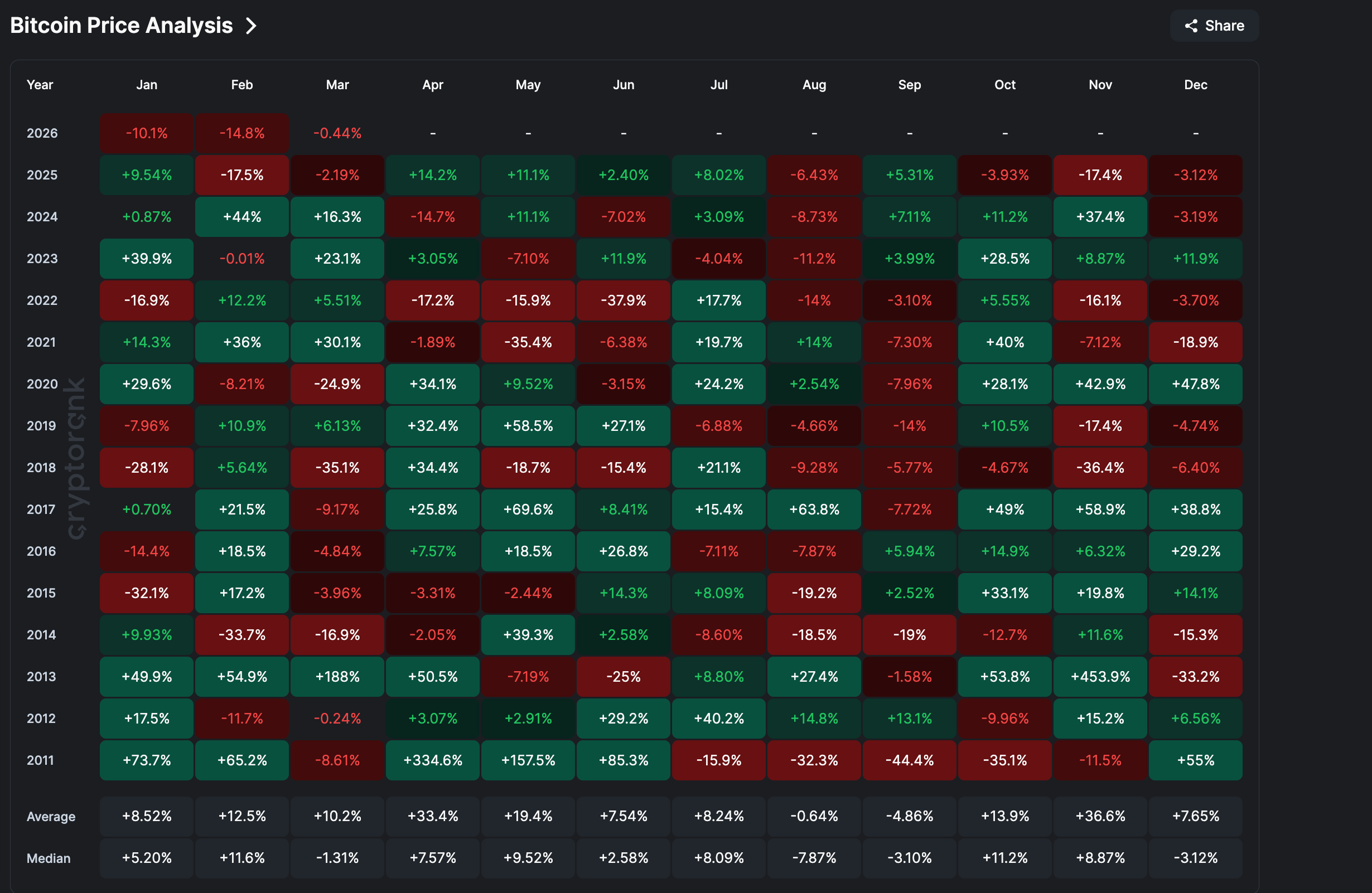
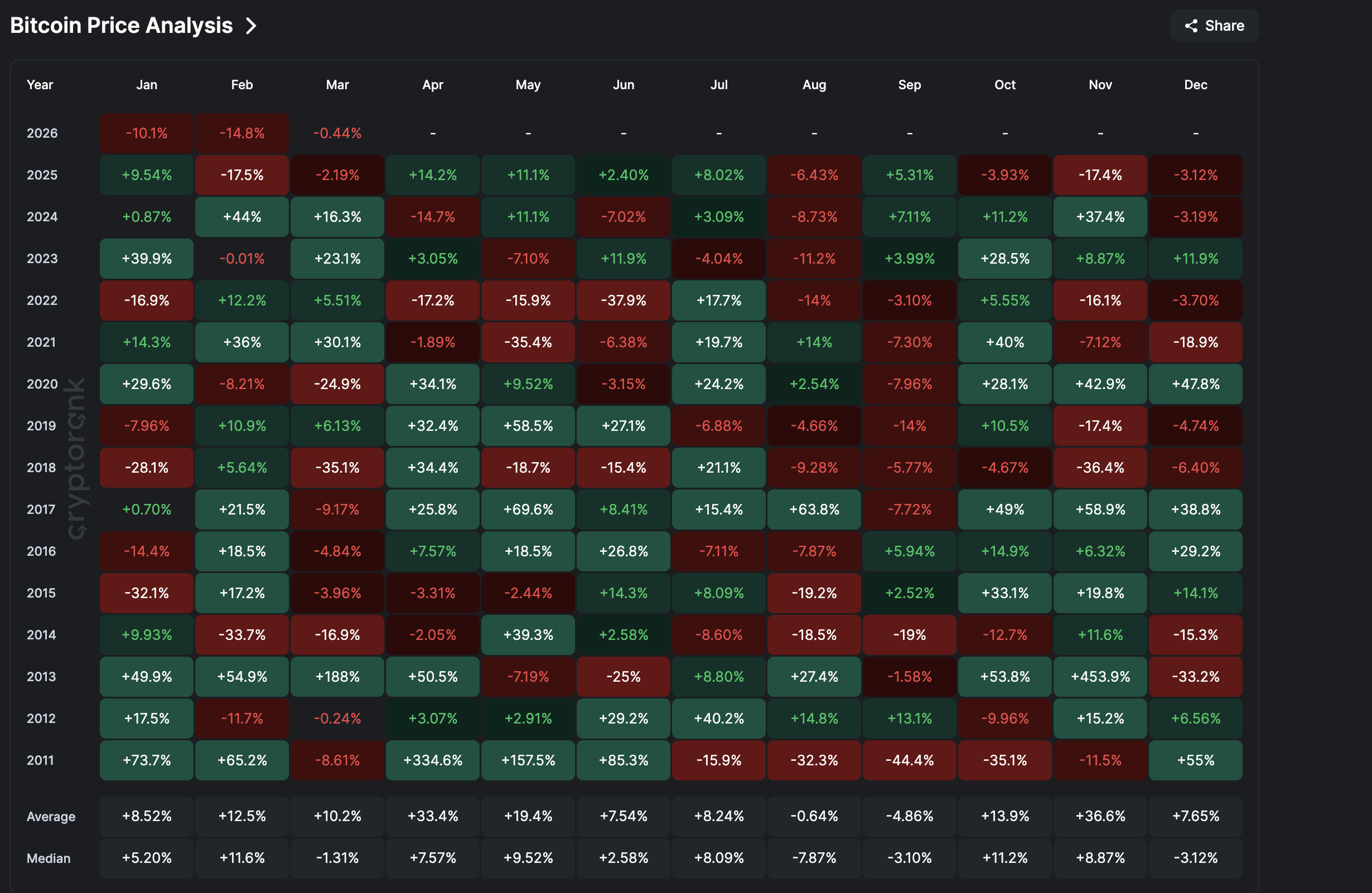
The Bitcoin price enters March bruised. February delivered close to 15% losses, echoing last year’s February, which saw the Bitcoin price drop by over 17%.
With five consecutive red months now on the books, starting from October 2025, and a median March return of −1.31%, the seasonal backdrop offers little comfort. But beneath the surface, a shift may be forming. Here is what the data shows heading into March.
Bitcoin Price Still Trades as a Risk Asset
One of the most pressing concerns for the Bitcoin price right now is its sustained correlation with US equities. This reflects in the historical sightings as a weak S&P 500 month-on-month ensured a dismal February for Bitcoin.
Want more token insights like this? Sign up for Editor Harsh Notariya’s Daily Crypto Newsletter here.
As of March 1, the 30-day rolling correlation between Bitcoin and the S&P 500 stands at 0.55, up from around 0.50 in October 2025.
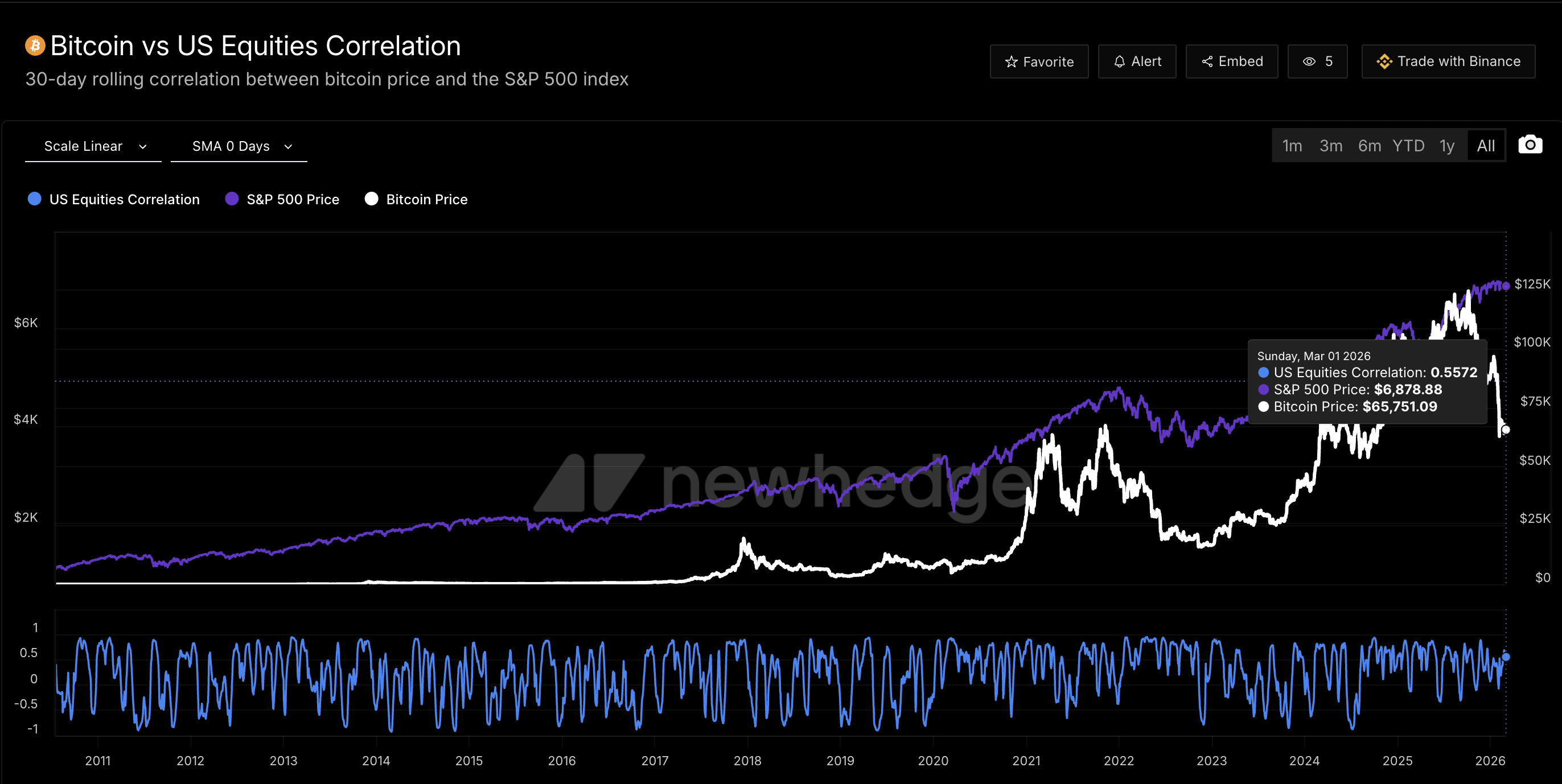
This means the Bitcoin price continues to move largely in step with stocks, undermining its appeal as a hedge against traditional market risk. With Trump’s new global tariffs adding pressure to equities and potential US-Iran military escalation weighing on risk appetite, Bitcoin’s risk-on behavior keeps it vulnerable.
Kevin Crowther, Founder of KC Private Wealth, emphasized this dynamic.
“Bitcoin’s high correlation to software stocks weakens its case as a hedge asset in times of uncertainty, and so as Trump continues to elevate economic uncertainty, continued BTC weakness should be expected,” Crowther said.
Meanwhile, gold and silver continue to surge while Bitcoin bleeds. However, if geopolitical tensions ease, particularly around Iran, risk sentiment could shift. And if the gold and silver trade becomes saturated, capital could begin rotating into Bitcoin as the next uncrowded allocation. That rotation hinges on the equity correlation breaking.
Bitcoin ETF Outflows Are Fading: A Quiet Shift
While the macro picture remains challenging, spot Bitcoin ETF data tells a more nuanced story. February marked the fourth consecutive month of net outflows, but the trend is shifting sharply.
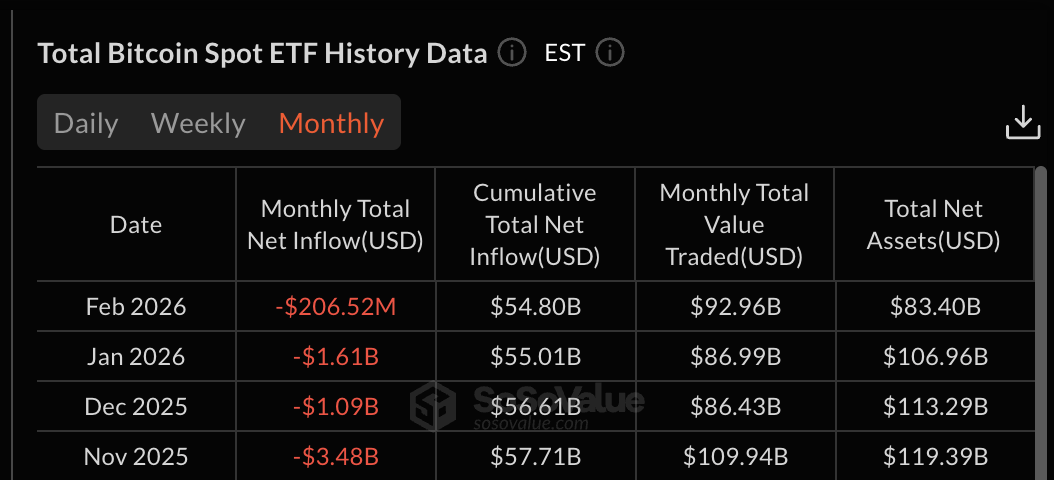
November 2025 saw $3.48 billion in outflows. December brought $1.09 billion, January $1.61 billion, and February closed at just $206.52 million — a 94% reduction from November’s peak.
Orkun Mahir Kılıç, Co-Founder of Citrea, noted that these outflows reflect positioning adjustments rather than a structural retreat.
“The ETF outflows are more consistent with deleveraging than institutional abandonment. For flows to reverse meaningfully, markets need clearer macro direction and lower volatility,” Kılıç explained in an exclusive quote to BeInCrypto.
Nima Beni, Founder of Bitlease, was more direct about what the data signals, especially taking BlackRock’s IBIT outflow into account:
“ETF outflows are retail panic, creating institutional opportunity. BlackRock’s $2.13B IBIT outflow matters less than the fact that 94% of ETF Bitcoin holdings remained despite maximum fear. That’s institutional conviction, not abandonment,” Beni stated.
Overall, the experts didn’t seem perturbed by the ETF outflow streak.
Selling Pressure Is Exhausting Across the Board – The Bounce Catalyst?
Beyond ETFs, on-chain data shows that selling from both long-term holders and Bitcoin miners is drying up rapidly.
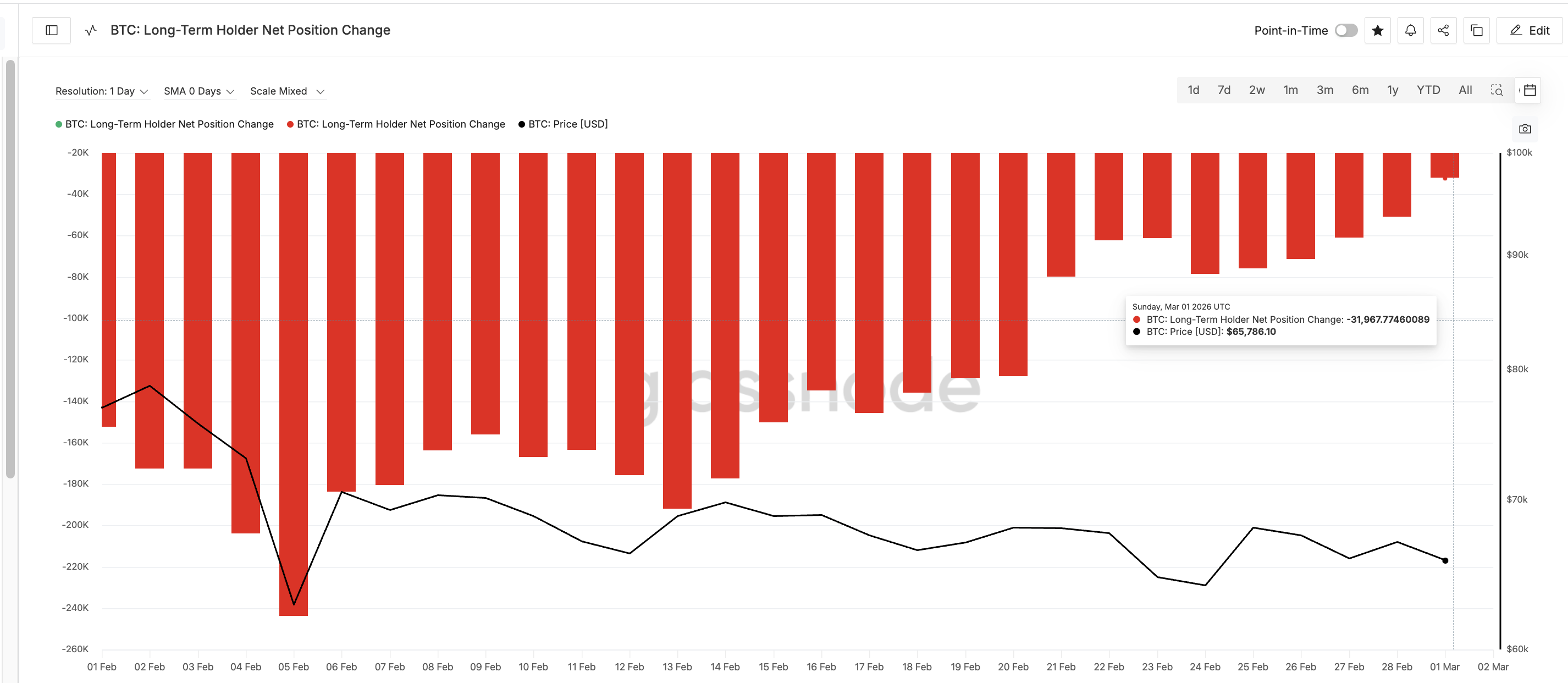
Long-term holders — wallets that have held Bitcoin for 365 days or more — are a critical group for gauging market direction. When their selling ends, the Bitcoin price tends to stabilize and recover. Throughout February, their net selling has collapsed. On February 5, the 30-day rolling net position change for long-term holders stood at −243,737 BTC. By March 1, that figure had fallen to just −31,967 BTC, an 87% reduction.
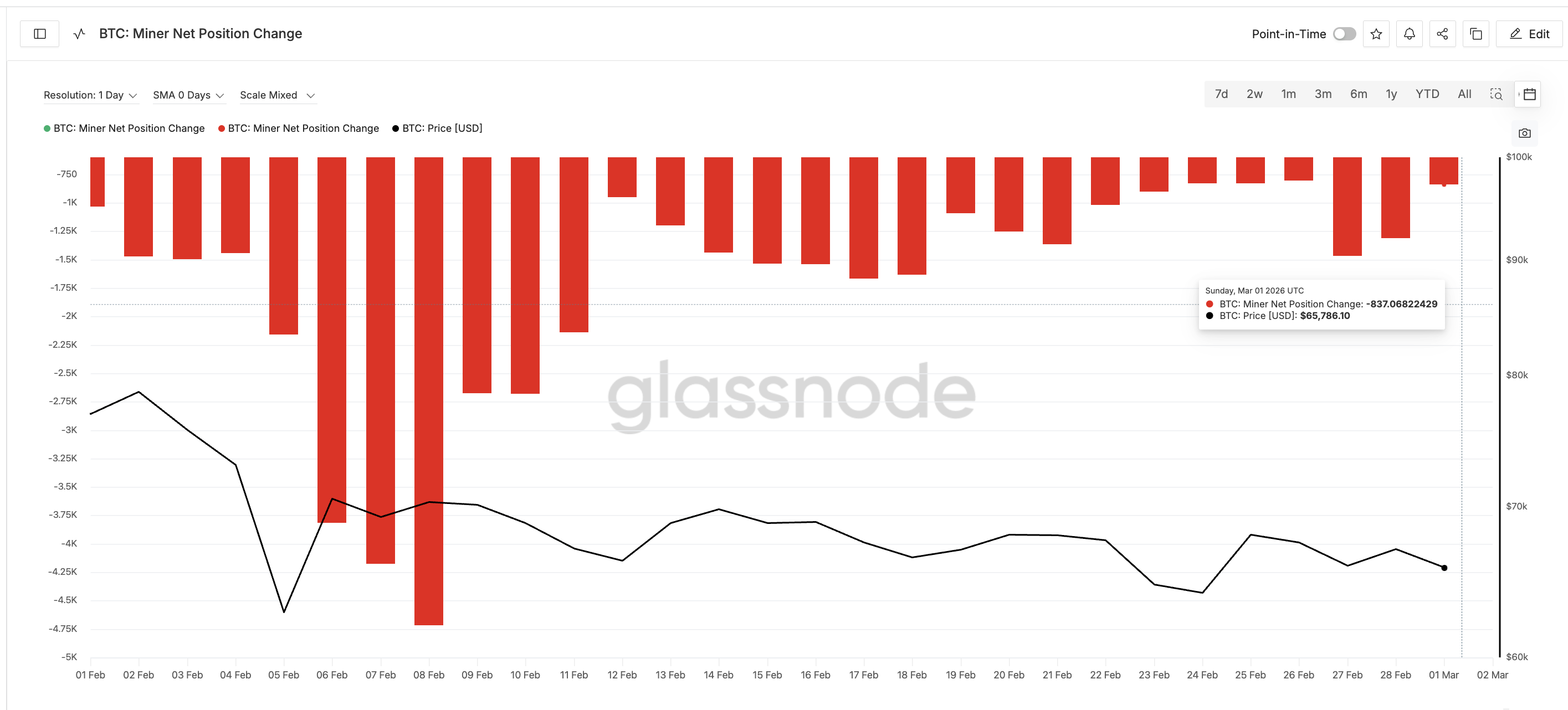
Miner behavior mirrors this trend. Bitcoin miners, who sell BTC to cover operational costs, saw peak capitulation around February 8 when net selling hit −4,718 BTC. By March 1, that had eased to −837 BTC, a sharp decline that suggests the worst of miner capitulation may be behind us.
Han Tan, Chief Market Analyst at Bybit, offered a key distinction here, taking the negative hash rate growth into account.
“Bitcoin miners aren’t capitulating; they’re making strategic diversifications. The drawdown in the hashrate is only to be expected in light of Bitcoin’s price plummet, but does not imply structural capitulation,” Tan noted.
Negative hash rate growth means the total computing power securing Bitcoin is falling instead of rising. This usually happens when miners turn off machines because mining becomes less profitable, often due to lower Bitcoin prices or higher energy costs. This explanation validates what Tan just highlighted.
Whales Are Accumulating Near the 20-Day SMA
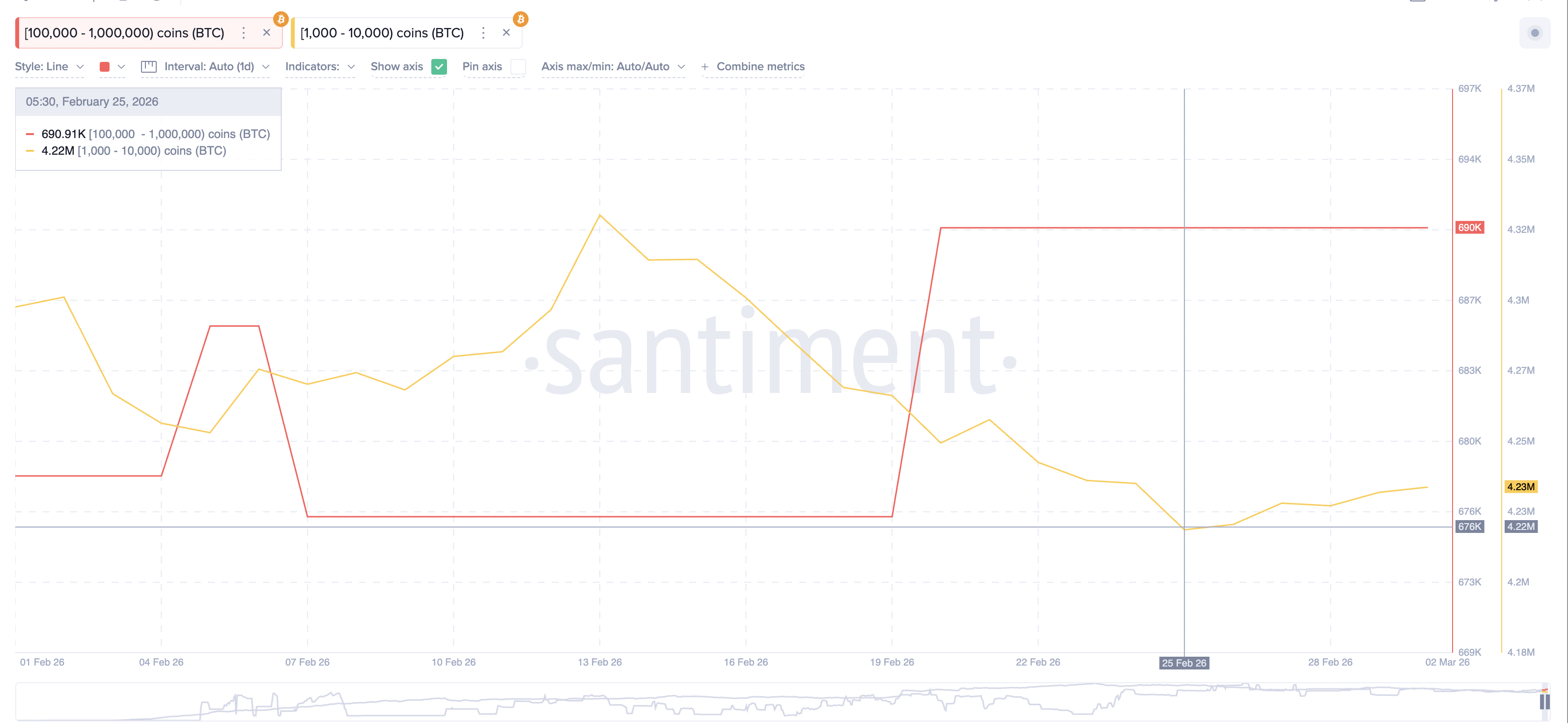
While selling weakens, buying is quietly picking up among whale cohorts. Wallets holding between 100,000 and 1,000,000 BTC increased their holdings from 676,540 to 690,000 BTC around February 19–20, during a brief 4.06% price rebound. Crucially, they have not sold since.
Meanwhile, smaller whales holding between 1,000 and 10,000 BTC began accumulating from February 25, with holdings rising from 4.222 million to 4.23 million BTC.
Why are whales holding?
One likely reason is the 20-day Simple Moving Average (SMA), a short-term trend indicator that smooths prices over 20 days. The Bitcoin price currently trades just below the 20-day SMA at $67,100. The last time this level was decisively crossed — on January 1 — Bitcoin rallied by over 12%. Whales appear to be positioning for a similar breakout.
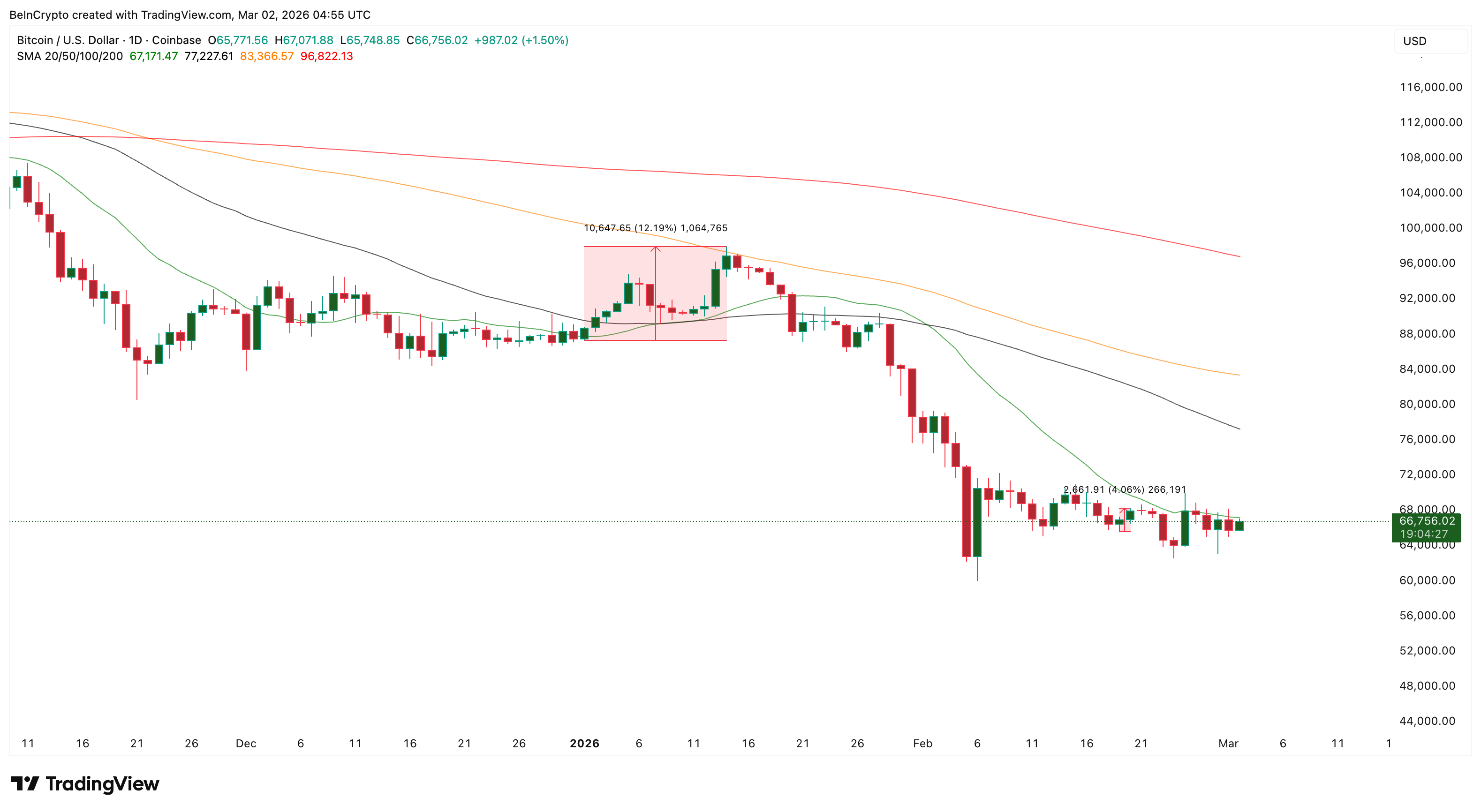
However, the long-term picture requires more conviction. The 50-day SMA sits at $77,200, and the 200-day SMA — the level that could genuinely confirm a bullish reversal — is far above at $96,800.
Han Tan from Bybit highlighted the importance of one such level:
“To the upside, Bitcoin may have to resurface above its 50-day SMA and reclaim the psychological $80k handle before more buyers are enticed back into the fold,” he added.
Bear Flag Threatens Bitcoin Price, but Invalidation Is in Play
On the three-day chart, the Bitcoin price trades inside a bear flag, a bearish continuation pattern where price consolidates upward within parallel trendlines after a sharp drop. The flagpole measures a roughly 39% decline, meaning a confirmed breakdown could project a similar move lower.
Adding weight to this, a hidden bearish divergence has formed on the Relative Strength Index (RSI), a momentum oscillator. Between February 6 and February 24, the Bitcoin price printed a lower high while RSI printed a higher high. This mismatch suggests that despite the bounce, underlying momentum still favors the downside.
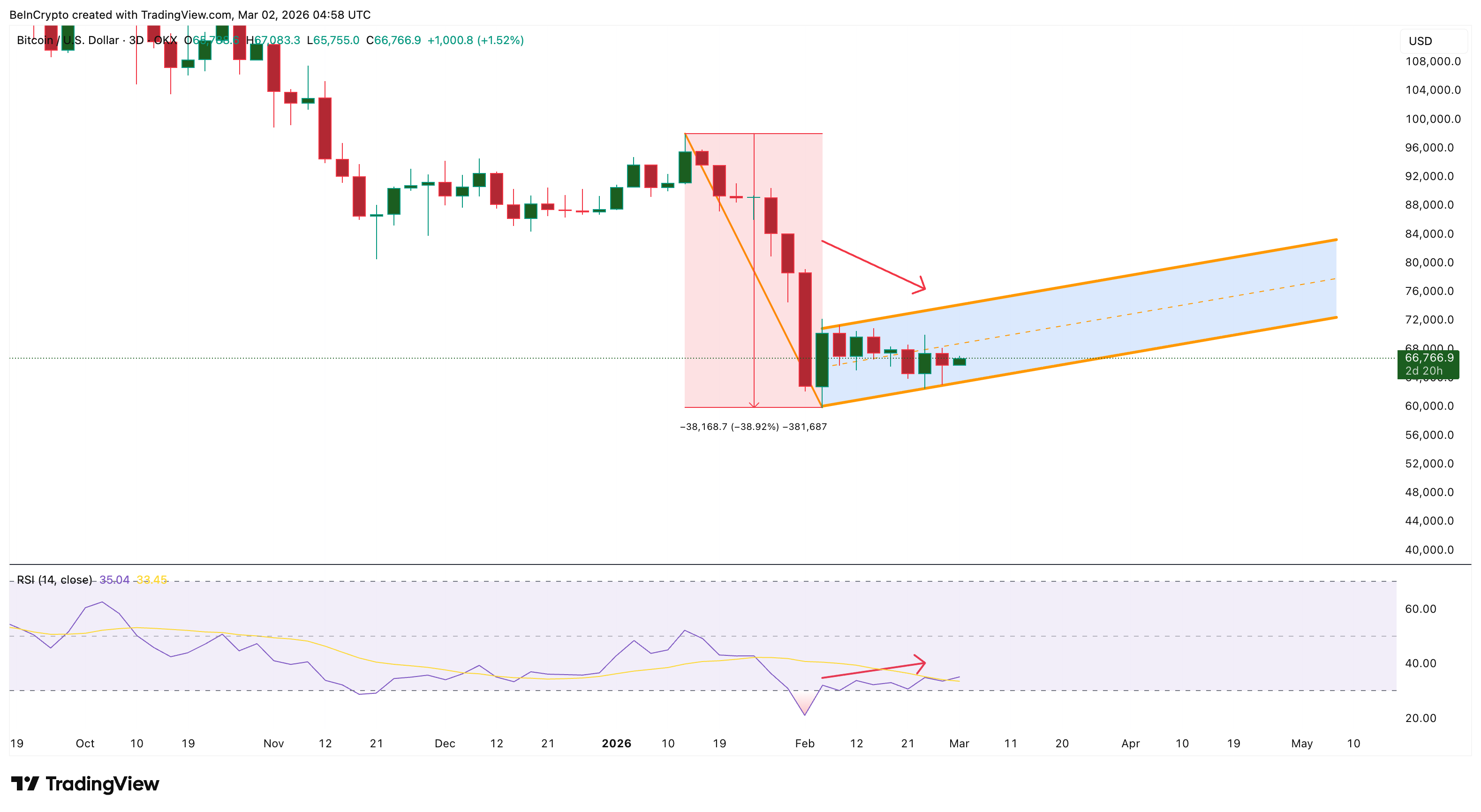
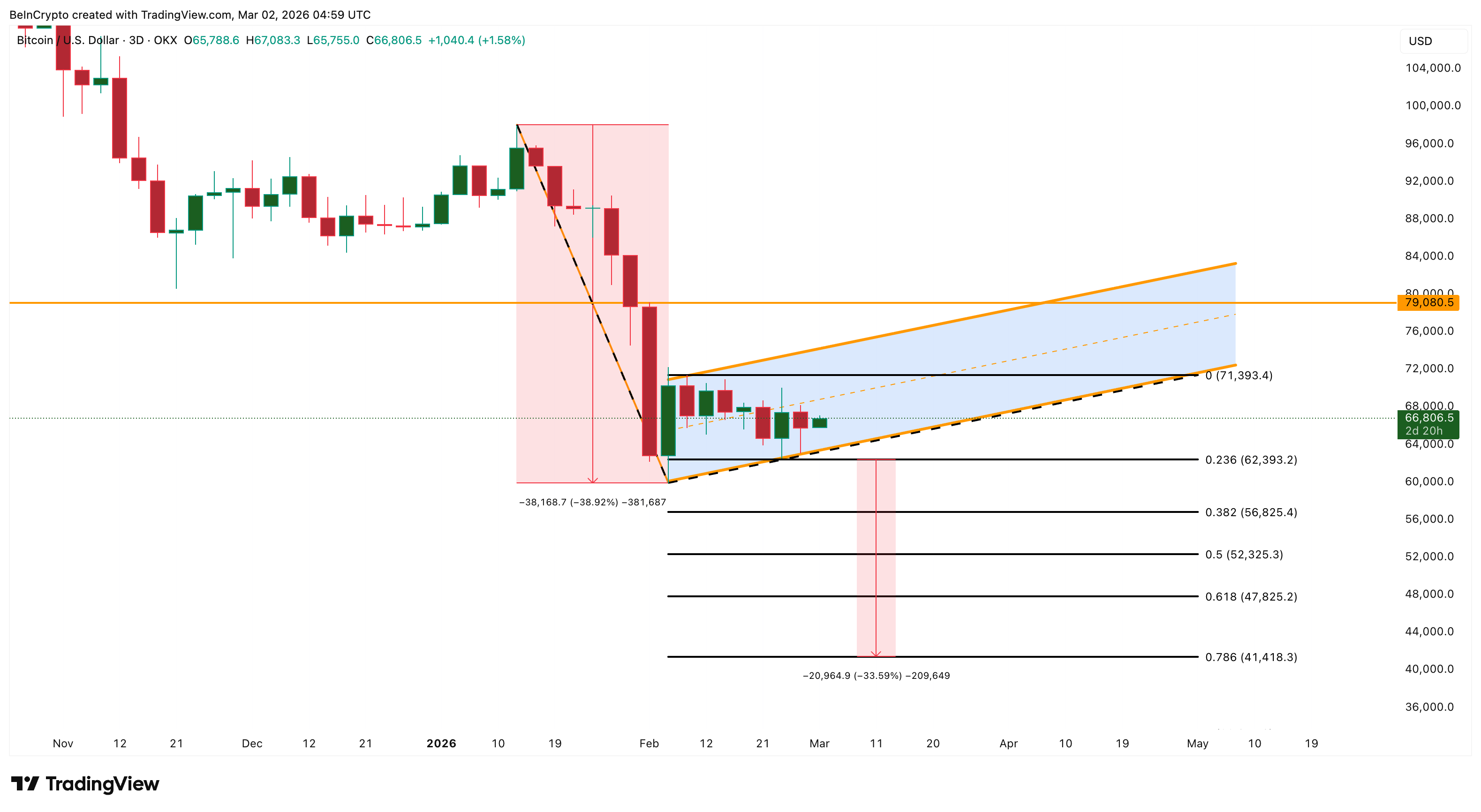
The key levels are clear. On the upside, $71,300 is the first significant resistance. A move above $79,000 would invalidate the bear flag. However, continued BTC price bounces can also shift the structure toward a rising channel, which would become bullish. The next few 3-day candles would therefore determine if the flag breaks or the extension invalidates the bearish pole-and-flag rule.
On the downside, a breakdown below $62,300 opens the door to Fibonacci support levels at $56,800, $52,300, $47,800, and, in extreme scenarios, $41,400.
Crowther sees the most probable outcome as relatively contained, highlighting the chance of a mild bounce.
“Flat, or slightly positive price movement throughout March should be an investor’s base case scenario for now,” he said.
Kılıç, however, pushed back on the bearish framing, aligning with the on-chain selling exhaustion and bounce hopes:
“Extreme fear and the deepest ETF outflow streak in a year aren’t bearish signals. I’d actually define them as classic capitulation, flushing out weak hands and tightening supply,” he stated.
The most likely path for March, therefore, involves a local bounce — driven by exhausting sell pressure and whale accumulation — followed by renewed selling as the broader bear flag structure resolves. Selling is weakening, but it hasn’t been extinguished. A local bottom is not the same as a cycle bottom. March will likely be defined by whether $62,300 support holds or $79,000 resistance breaks first.
Crypto World
Is Quantum Computing Crypto’s Next Big Threat? How One Ethereum Project Is Preparing Early

Quantum computing has moved far beyond theory. Governments and private research labs are racing to increase qubit counts and reduce error rates, with major breakthroughs reported each year. Even though a fully “cryptographically relevant” quantum computer capable of breaking today’s encryption standards has not yet arrived, the direction of travel is clear: progress is accelerating.
Modern blockchains rely heavily on elliptic curve cryptography (ECC) and digital signature schemes like ECDSA. These systems secure wallets, validate transactions, and protect private keys. If a sufficiently powerful quantum computer runs Shor’s algorithm at scale, it could derive private keys from exposed public keys; putting funds at risk.
The concern is not only about when this becomes possible, but also about the “harvest now, decrypt later” model, where attackers collect encrypted data today in anticipation of future breakthroughs.
That long-term vulnerability has triggered a growing debate inside the crypto community. A small but increasing number of developers are building infrastructure designed for a post-quantum world. One of those projects is BMIC ($BMIC), an Ethereum-based initiative focused entirely on quantum-secure finance architecture that’s right now running a presale for its native token.
How $BMIC Is Building a Quantum-Secure Finance Stack
Unlike traditional wallets that bolt on upgrades over time, $BMIC is being developed as a quantum-native system from the ground up. Its architecture combines post-quantum cryptography (PQC), smart account abstraction, and signature-hiding mechanisms to reduce the attack surface that quantum systems could exploit.
A key vulnerability in most wallets today is public-key exposure. Once a transaction is made from a standard externally owned account (EOA), the public key becomes visible on-chain. In a future quantum scenario, that exposure could allow key derivation. $BMIC integrates ERC-4337-style smart accounts and hybrid PQC signatures to minimize this risk. By reducing direct public-key exposure and layering in upgraded cryptographic standards, it aims to eliminate the weakest link in traditional wallet models.

The project goes beyond storage. Its roadmap includes quantum-secure staking, payment infrastructure, and enterprise-facing APIs through a Quantum Security-as-a-Service framework. That broader scope is notable. Many initiatives discuss post-quantum cryptography in theory, but few attempt to integrate it across wallet security, yield systems, and transaction routing.
Artificial intelligence also plays a role in the ecosystem. $BMIC incorporates AI-driven monitoring to analyze activity patterns, detect anomalies, and optimize cryptographic workloads. As post-quantum standards change (particularly through ongoing NIST standardization efforts) the architecture is designed to adapt without forcing users into disruptive migrations.
In short, the project is not retrofitting an existing wallet. It is attempting to build a full-stack security layer prepared for a different era of computing.
Inside the $BMIC Crypto Presale and Token Model
With the technical foundation underway, attention has turned to the $BMIC token launch. This crypto presale is structured across multiple dynamic pricing phases, with a target raise of €40 million and a hard cap of 750 million tokens allocated for sale out of a total 1.5 billion supply.
The pricing model spans up to 50 tiers. Early phases begin at $0.048485 per token, gradually increasing to $0.058182 across the full presale range. The final launch price is planned above the last presale tier, giving earlier participants access at preferential entry levels. That structure has become common among infrastructure-focused projects that aim to reward early support without promising guaranteed returns.

Token utility is tied directly to ecosystem functionality. $BMIC is expected to power wallet features, enterprise API access, governance participation, and a burn-linked model tied to network activity. Revenue-backed burns and staking mechanisms are outlined in the roadmap, particularly in later phases when wallet beta releases and governance activation begin.
From a timeline perspective, Phase 1 focuses on wallet architecture and initial smart contract deployment on Ethereum. Later phases expand into enterprise pilots, compliance modules, and quantum compute integrations. The staged roadmap extends into 2028, with a mainnet launch planned in the final scaling phase.
For participants evaluating the presale, the thesis centers less on short-term price action and more on infrastructure exposure. Quantum risk may not dominate headlines daily, but the conversation is intensifying across security circles. Projects attempting early solutions often gain strategic relevance if the broader narrative accelerates.
Preparing for a Different Crypto Future
Crypto’s history is filled with reactive upgrades. Security patches often arrive after vulnerabilities are exposed. Quantum computing presents a different challenge; one where preparation may need to precede a crisis.
The timeline for a cryptographically relevant quantum computer remains debated. It could take years, possibly longer. Yet the cost of ignoring the risk could be significant, particularly for long-term holders and institutions managing large treasuries.
$BMIC enters that conversation with a clear thesis: secure assets before the threat materializes. By combining post-quantum cryptography, smart account abstraction, AI-enhanced monitoring, and a deflationary token structure, it is building infrastructure aligned with a future that many believe is coming.
$BMIC’s crypto presale window offers early access to that ecosystem as development milestones unfold. For observers who view quantum security as more than a distant academic concern, the project provides an opportunity to engage with a platform designed for the next phase of blockchain evolution.
Whether quantum disruption arrives in five years or fifteen, the projects preparing today may define the security standards of tomorrow.
Meet the future of quantum-secure Web3 with BMIC:
Presale: https://bmic.ai/
Social: https://x.com/BMIC_ai
Telegram: https://t.me/+6d1dX_uwKKdhZDFk
The post Is Quantum Computing Crypto’s Next Big Threat? How One Ethereum Project Is Preparing Early appeared first on Cryptonews.
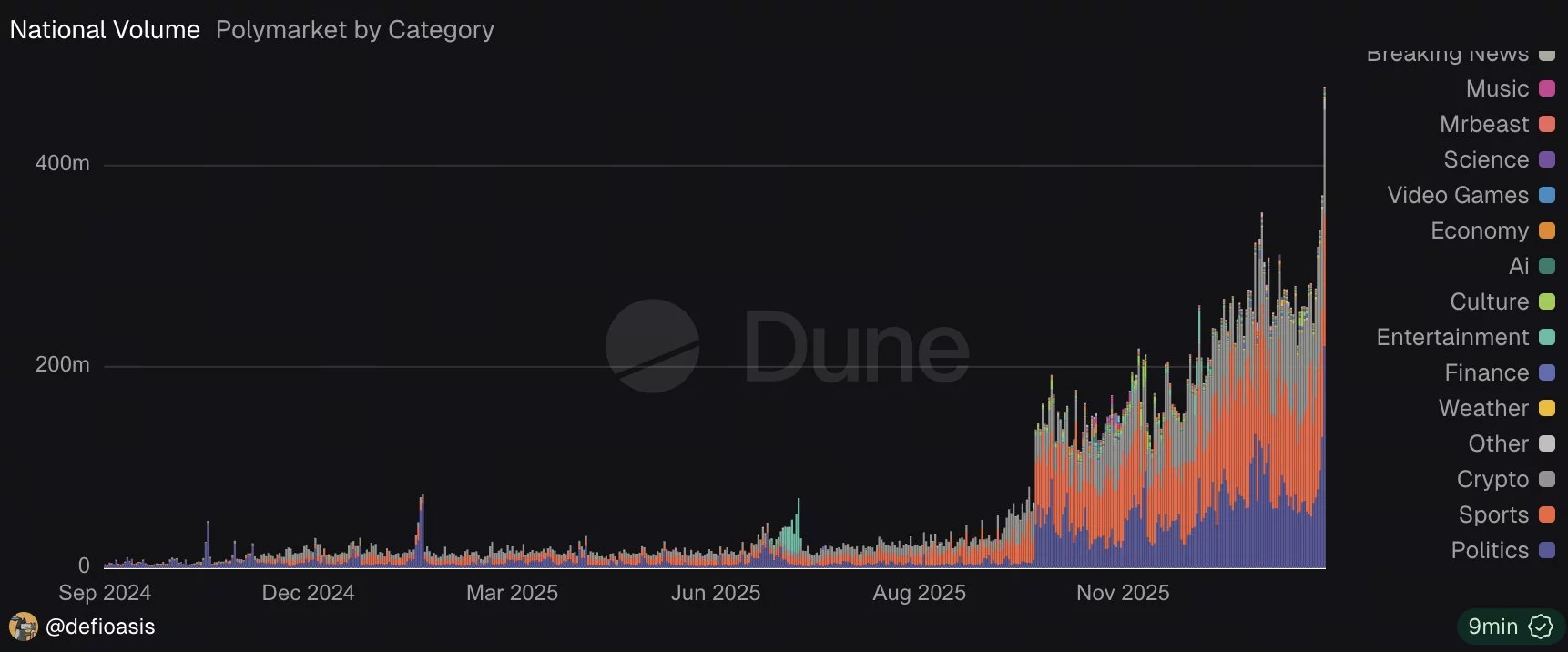
Polymarket recorded historic trading activity on the day of the joint U.S.–Israel strike on Iran, with single-day nominal trading volume reaching $478 million, according to an analyst tracking platform data.
Summary
- Polymarket hit a historic $478 million in single-day trading volume, with politics markets alone accounting for $220 million.
- Six newly funded wallets reportedly made $1.2 million betting “yes” on a U.S. strike just hours before it happened.
- A major trader who had been betting against a strike lost $6.5 million in one day when the airstrikes occurred.
War bets surge: Polymarket hits $478M daily volume
The surge marked the highest daily volume in the platform’s history. The politics sector alone accounted for $220 million, or 46.2% of total daily volume, also setting a record. Polymarket Builders, the ecosystem’s infrastructure arm, similarly posted a single-day high as geopolitical tensions drove traders into war-related contracts.
At the center of the activity was the contract titled “US strikes Iran by February 28, 2026?” hours before coordinated airstrikes were launched early Saturday morning, several newly created wallets piled into “yes” shares.
On-chain analytics firm Bubblemaps flagged six wallets that collectively profited roughly $1.2 million.
According to its findings, most of the wallets were funded within 24 hours of the attack, specifically targeted the February 28 deadline, and accumulated “yes” positions just hours before the strikes occurred, raising suspicions of potential insider knowledge.
The surge has drawn scrutiny from analysts and regulators alike, with critics suggesting that fresh accounts profiting off the timing of strikes could indicate access to privileged information.
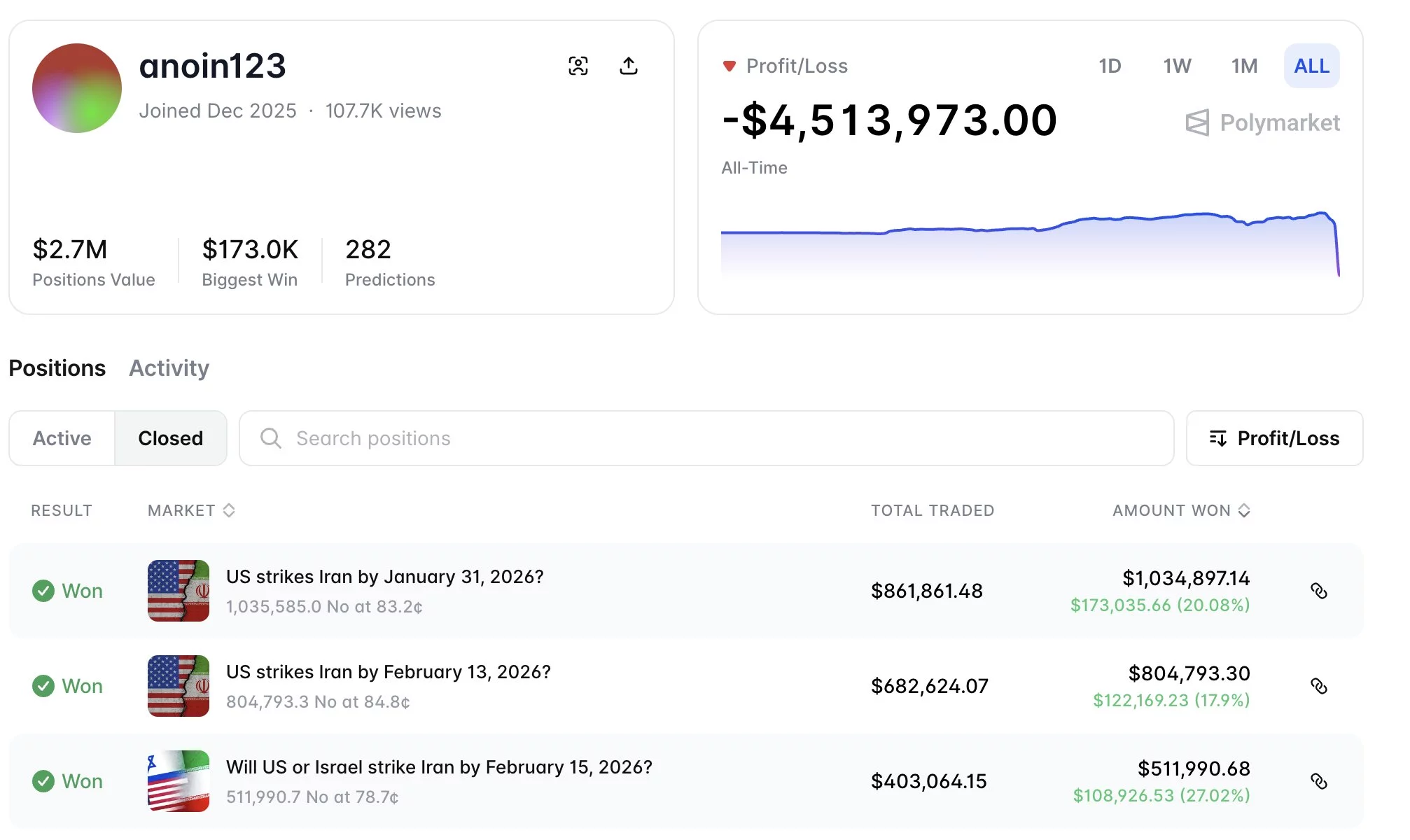
Not all traders emerged unscathed. On-chain tracker Lookonchain highlighted one high-profile bettor, “anoin123,” who had built more than $2 million in profits over two months by consistently wagering that the U.S. and Israel would not strike Iran.
When the strike ultimately took place, the trader lost $6.5 million in a single day, flipping from multimillion-dollar gains to more than $4.5 million in losses.
The episode shows both the explosive growth of blockchain-based prediction markets during geopolitical crises and the mounting scrutiny surrounding suspiciously timed bets.


Bitcoin pulled back from Asian session highs alongside losses in the U.S. stock futures as Iran stepped up attacks in the Middle East.
The leading cryptocurrency fell back below $66,000 after hitting a high of nearly $67,000 in early Asian hours. The S&P 500 e-mini futures fell to 6,790, down 1.4% on the day, reversing the early rise to 6,857. Meanwhile, oil prices continued to trade higher by over 7% on both sides of the Atlantic.
Iran reportedly stepped up missile attacks on the U.S. assets in Bahrain, Kuwait and the UAE. It also attacked Saudi Arabia’s oil infrastructure, the widely-followed Warn and Gore OSINT handle. Saudi Arabia is one of the largest oil producers in the world.

AI Summary
Blockchain platforms have become essential for enterprises in various industries, driving investments in scalable and secure systems. However, the cost of blockchain development in 2026 can vary significantly based on factors like architecture, infrastructure, and scalability planning. Different types of blockchain platforms, such as public, private, and consortium, have varying complexities and costs. The core components influencing the cost include architecture design, smart contract development, platform infrastructure, and integration systems. In 2026, the typical cost ranges for blockchain platforms are: basic platforms ($25,000 – $60,000), mid-scale platforms ($60,000 – $150,000), and large enterprise platforms ($150,000 – $400,000+). Ongoing infrastructure expenses are crucial for long-term planning, representing 10-25% of development costs annually. Choosing between building an internal team or hiring a blockchain development company impacts costs, with experienced teams often reducing long-term expenses. Careful planning and collaboration with reputable development teams are key to successful
Blockchain platforms are no longer experimental technologies. Enterprises across finance, supply chain, gaming, identity, and digital assets are investing in blockchain infrastructure to build scalable & secure systems. However, one of the first things that comes to the mind of the decision-makers is blockchain development cost 2026.
The answer depends on multiple factors, including architecture, infrastructure requirements, development scope, and long-term scalability planning. Unlike standard applications, blockchain platforms require specialized engineering, distributed infrastructure, and security-focused development practices.
Understanding the real cost structure helps organizations plan investments properly and avoid expensive redesigns later.
Reasons Behind the Varying Cost of Blockchain Platform Development
Blockchain platform development costs vary widely because platforms differ significantly in complexity and scale. A simple blockchain application is very different from a full enterprise blockchain infrastructure.
Several factors drive cost differences:
- Type of blockchain architecture (public, private, or consortium)
- Number of platform features
- Security requirements
- Transaction throughput requirements
- Infrastructure scale
- Integration with existing systems
For instance, a basic blockchain-based solution may involve limited smart contract functionality, while enterprise platforms require advanced permission management, auditing, analytics, and compliance layers. This is exactly the reason why blockchain development cost in 2026 can vary significantly depending on project scope.
What Defines a Blockchain Platform
Many organizations underestimate the scope of a blockchain platform. A blockchain platform is not just a smart contract or decentralized application; it is a complete software ecosystem.
A typical blockchain platform includes:
- Consensus mechanism implementation
- Smart contract infrastructure
- Node management systems
- User identity and permission layers
- APIs and integrations
- Admin dashboards
- Monitoring and analytics
- Security layers
Each of these components requires specialized development and testing. Blockchain software development services typically include both infrastructure engineering and application-layer development, which is why blockchain software development cost is higher than traditional application development.
Types of Blockchain Platforms Enterprises Build
Enterprise blockchain platforms vary depending on business objectives. Different types of platforms require different levels of investment.
Public Blockchain Platforms
Public blockchain platforms allow open participation and decentralized validation. These platforms typically require advanced token logic and high scalability. Typical use cases include:
- Tokenized ecosystems
- NFT marketplaces
- Web3 platforms
- Decentralized finance applications
Public platforms usually require higher security investments and extensive smart contract testing.
Private Blockchain Platforms
Private blockchain platforms restrict access to authorized participants and are commonly used by enterprises. Common use cases include:
- Supply chain tracking
- Identity management
- Enterprise data sharing
- Internal record management
Private platforms often require integration with internal systems, which increases development complexity.
Consortium Blockchain Platforms
Consortium blockchains are operated by multiple organizations. These platforms require advanced governance and permission models. Typical use cases include:
- Banking networks
- Healthcare data sharing
- Trade finance
- Logistics networks
Consortium platforms typically involve the highest coordination and development complexity.
Core Components That Determine Blockchain Development Cost
Several technical components directly influence blockchain software development cost. Understanding these components helps organizations estimate budgets more accurately.
Blockchain Architecture
Architecture design defines how nodes communicate and how data is validated. Poor architecture decisions often lead to expensive redesigns later. Architecture planning includes:
- Consensus mechanism selection
- Network topology design
- Data storage structure
- Security model definition
- Scalability planning
Architecture design alone can require significant engineering effort for enterprise platforms.
Smart Contract Development
Smart contracts form the logic layer of blockchain platforms. Secure smart contract development requires careful design and testing. Smart contract work includes:
- Token logic implementation
- Business rule automation
- Permission management
- Upgrade mechanisms
- Security testing
Smart contract errors can be extremely costly, making security-focused development essential.
Platform Infrastructure
Blockchain infrastructure cost represents a major portion of total investment. Infrastructure typically includes:
- Node hosting
- Cloud services
- Storage systems
- Monitoring tools
- Backup systems
- Load balancing
Enterprise-grade platforms require infrastructure designed for reliability and scalability.
Integration Systems
Most enterprises need blockchain platforms to integrate with existing systems. Typical integrations include:
- ERP systems
- Payment gateways
- Identity systems
- APIs
- Analytics platforms
Integration complexity significantly affects development cost.
Real Blockchain Development Cost Ranges
In 2026, the cost to build a blockchain platform depends largely on complexity and scale.Typical enterprise cost ranges include:
Basic Blockchain Platforms
Basic platforms with limited functionality typically cost:
$25,000 – $60,000
These platforms usually include:
- Basic smart contracts
- Simple dashboards
- Limited integrations
- Small-scale infrastructure
Suitable for prototypes or pilot deployments.
Mid-Scale Blockchain Platforms
Production-ready platforms typically cost:
$60,000 – $150,000
These platforms usually include:
- Advanced smart contracts
- Scalable infrastructure
- Multiple integrations
- Security testing
- Admin dashboards
Most enterprise projects usually fall into this range.
Large Enterprise Blockchain Platforms
Enterprise-grade blockchain platforms typically cost:
$150,000 – $400,000+
These platforms usually include:
- Custom blockchain architecture
- High transaction throughput
- Advanced security systems
- Complex integrations
- Compliance features
- Monitoring systems
Large platforms require extensive engineering and infrastructure planning.
These ranges represent typical enterprise blockchain development cost estimates in 2026. However, the actual costs depend on architecture complexity and feature requirements.
Blockchain Infrastructure Cost Explained
Blockchain infrastructure cost continues after development. Ongoing infrastructure expenses are an important part of long-term planning. Typical infrastructure costs include:
- Cloud hosting services
- Node operation costs
- Data storage
- Monitoring tools
- Security services
- Maintenance support
Infrastructure costs typically represent 10–25% of development cost annually, depending on platform scale. Planning infrastructure early helps avoid unexpected operational expenses.
Development Team vs Development Company
One major cost decision involves whether to build an internal team or hire a blockchain development company.
Internal Development Team
Building an internal team requires:
- Blockchain engineers
- Backend developers
- DevOps engineers
- Security specialists
- Project managers
Internal teams provide control but require significant hiring and training investment.
Hiring a Blockchain Development Company
On the other hand, many enterprises choose to hire a blockchain development company to reduce development risk. The key benefits include:
- Experienced blockchain engineers
- Established development processes
- Faster delivery timelines
- Proven architectures
- Lower hiring overhead
Blockchain software development services provided by experienced teams often reduce long-term costs by avoiding architectural mistakes.
Hidden Costs Enterprises Often Miss
Many blockchain projects exceed budgets because hidden costs are not considered early. Some of the common hidden costs include:
- Architecture redesign
- Security improvements
- Infrastructure scaling
- Compliance updates
- Performance optimization
- Integration changes
Planning these factors early improves cost predictability.
Get a Custom Quote for Your Blockchain Platform Development
Final Thoughts
Blockchain platforms require significant investment, but properly designed platforms provide long-term value through automation, security, and scalability.
The cost to build a blockchain platform in 2026 depends on architecture complexity, infrastructure requirements, and development scope. Organizations that plan carefully and work with experienced blockchain development teams are more likely to build platforms that scale successfully.
Enterprises planning blockchain platforms should focus not only on initial development cost but also on infrastructure and long-term scalability.
Working with an experienced blockchain development company like Antier plays a significant role in ensuring that blockchain platforms are built for both performance and long-term sustainability.


A busy week lies ahead on the United States economic calendar as markets continue to digest the fallout from the US-Israeli strikes on Iran over the weekend.
Volatility will be abundant this week as US stock futures open and react to the weekend’s violence in the Middle East. Crypto markets remained relatively flat on Sunday, but have started their usual Monday morning retreat.
US President Donald Trump provided details on “Operation Epic Fury” on Sunday, stating that the US will “avenge” the deaths of Americans, there will be more US casualties, military operations will continue until “objectives are achieved,” and claimed the entire Iranian military command is “gone.”
It is not World War III, said the Kobeissi letter, pointing to oil prices, which have already erased nearly half of their opening gap higher, and US stock market futures, which are down marginally while gold prices are up again. “Don’t panic. The dust will settle,” they said.
Economic Events March 2 to 6
This week sees the release of a lot of labor market reports, which the Federal Reserve looks at to make its monetary policy decisions. The first major report of the week is February’s ISM Manufacturing PMI data, released on Monday, providing insight into the state of the manufacturing sector.
The tranche of employment data begins on Wednesday with the February ADP Employment report, followed by Initial Jobless Claims on Thursday, and the February Jobs Report on Friday, which will also include the January Retail Sales data.
Friday’s jobs report comes after surprisingly strong job gains in January, potentially signaling positive developments in the labor market. The report is expected to show an increase of 60,000 jobs, according to a Reuters poll.
“We saw a good January jobs report, but we also have seen a really weak 2025 for the job market, and so the question becomes, where do we go from here?” Kristina Hooper, chief market strategist at Man Group, told the outlet.
Key Events This Week:
1. US Futures React to Iran Situation – TODAY 6 PM ET
2. February ISM Manufacturing PMI data – Monday
3. February ADP Employment data – Wednesday
4. Initial Jobless Claims data – Thursday
5. January Retail Sales data – Friday
6. February Jobs Report -…
— The Kobeissi Letter (@KobeissiLetter) March 1, 2026
You may also like:
Crypto Market Outlook
Crypto markets are back in the red today following a positive Sunday. Total cap has dropped back to $2.35 trillion, erasing weekend gains.
Bitcoin was rejected at $67,000 three times over the past 24 hours and has fallen back to $66,300 during the Monday morning Asian trading session. It has been trading sideways for the past three weeks, however.
Ether prices could not hold above $2,000 and have retreated to $1,950 at the time of writing. The altcoins are mostly in the red with larger losses for XRP, Solana, Cardano, Canton, and Stellar.
Binance Free $600 (CryptoPotato Exclusive): Use this link to register a new account and receive $600 exclusive welcome offer on Binance (full details).
LIMITED OFFER for CryptoPotato readers at Bybit: Use this link to register and open a $500 FREE position on any coin!
Crypto World
Crypto rally in H2 2026? JPMorgan points to Clarity Act, analyst says ‘buy the rumor’ starts now
JPMorgan analysts say a long-anticipated U.S. crypto market structure bill could be approved by mid-2026 and act as a major positive catalyst for digital asset markets in the second half of the year.
Summary
- JPMorgan says the Clarity Act could trigger a significant crypto recovery in H2 2026.
- The bank cites regulatory clarity, institutional scaling, and tokenization growth as key drivers.
- Analyst argues markets may rally well before passage, following classic “buy the rumor, sell the news” patterns.
The report highlights that despite subdued sentiment and weak trading volumes across the sector, regulatory clarity from the proposed legislation, commonly referred to as the CLARITY Act, could help unlock growth and investment later in 2026.
JPMorgan says Clarity Act may spark second-half crypto upswing
According to the note, the Clarity Act represents not a marginal tweak but a “structural transformation” of the regulatory environment. JPMorgan outlined three key impacts.
First, the elimination of “regulation by enforcement” as the default approach to oversight. The bill would clearly divide jurisdiction between the SEC and CFTC, reducing the legal ambiguity that has deterred institutional investors worried about retroactive token reclassification and undefined liability.
Second, clearer rules could convert institutional crypto interest from exploratory allocations into high-conviction positions. The note argues pension funds and asset managers currently testing exposure may scale significantly once regulatory risks are reduced.
Third, JPMorgan expects an acceleration of real-world asset tokenization, with Wall Street firms moving projects from pilot stages to production scale under a defined legal framework.
However, another analyst strongly disputed JPMorgan’s timeline, arguing that the market reaction would not wait until the second half of 2026. The critic contended that if the Clarity Act is expected to become law by July, the rally would likely begin well in advance, following a classic “buy the rumor, sell the news” pattern.
In that view, crypto prices could start climbing months before the bill is signed, potentially as much as 150 days ahead of the event, followed by a pullback around the official signing, and then a renewed upward move afterwards.
XRP (XRP) holders appear to be adopting a defensive stance amid intensifying geopolitical tensions between the United States, Israel, and Iran.
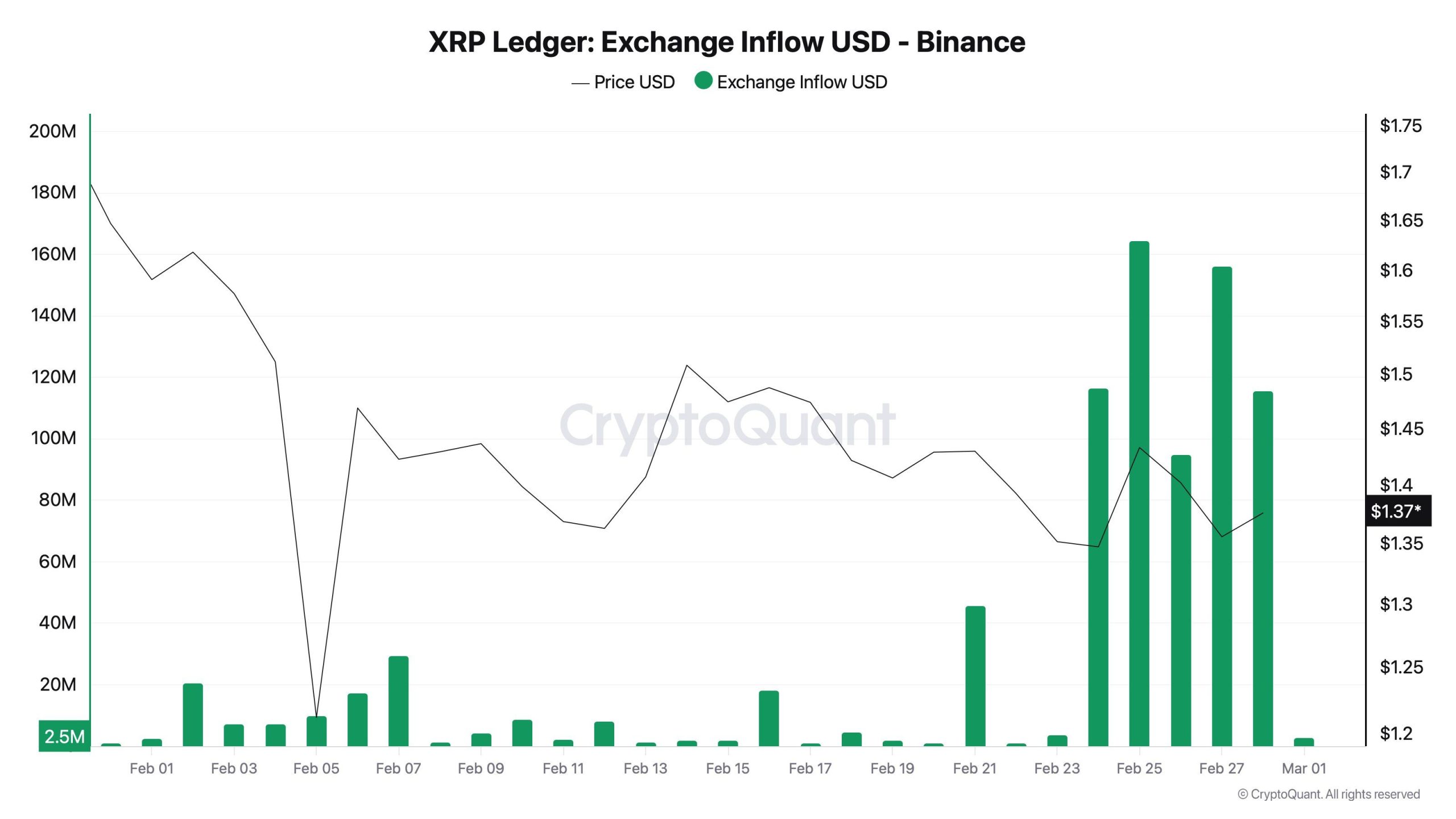
On-chain data shows more than $650 million worth of XRP flowing into Binance over the past week. The sharp rise in exchange inflows suggests investors may be positioning for increased volatility, raising the risk of short-term downside if market uncertainty persists.
Rising Middle East Tensions Trigger XRP Positioning Shift
BeInCrypto reported that a joint strike by Israel and the United States on Iran on Saturday triggered a sharp sell-off across crypto markets.
“The first strikes were launched shortly after the close of traditional financial markets. This timing amplified uncertainty across risk assets, with crypto reacting almost immediately to the geopolitical shock,” analyst Darkfost stated.
Tensions escalated further over the weekend following reports that Iran’s Supreme Leader, Ayatollah Ali Khamenei, had been killed. Iran has intensified retaliatory attacks targeting Israel and several Gulf Arab countries, deepening fears of broader regional instability. The rising geopolitical risk has weighed heavily on investor sentiment.
Crypto markets have declined alongside other risk assets. Meanwhile, gold surged as capital rotated toward traditional safe havens. XRP has not been immune.
On-chain analyst Darkfost noted that more than 472 million XRP, worth approximately $650 million, were transferred to Binance over the past week. According to the analyst, this was the “largest inflow period of the month of February.”
Follow us on X to get the latest news as it happens
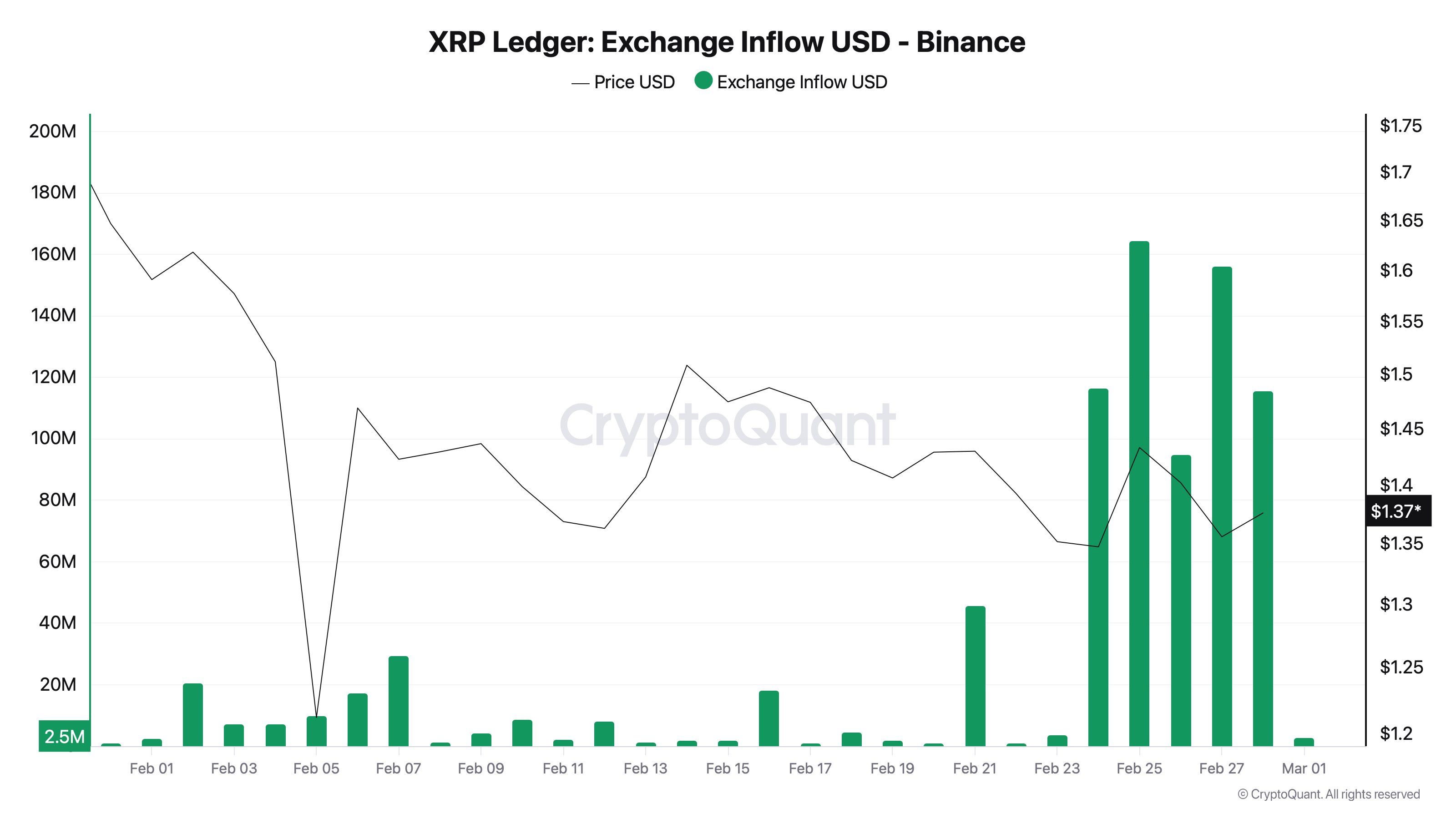
Large exchange inflows are often interpreted as a sign of potential selling pressure, as tokens typically need to be moved onto trading platforms before they can be sold. However, inflows do not automatically translate into immediate sell-offs.
Such transfers may also reflect liquidity repositioning, arbitrage strategies, collateral management, or precautionary moves during periods of heightened volatility. Still, it raises concerns.
“Such inflows typically reflect a more defensive posture from investors holding XRP. When large amounts of tokens move onto exchanges, it often signals a potential willingness to sell or at least to position liquidity closer to the market. When amount of flows like this are recorded, they can create the conditions for a sudden wave of selling pressure capable of impacting price action in the short term,” Darkfost said.
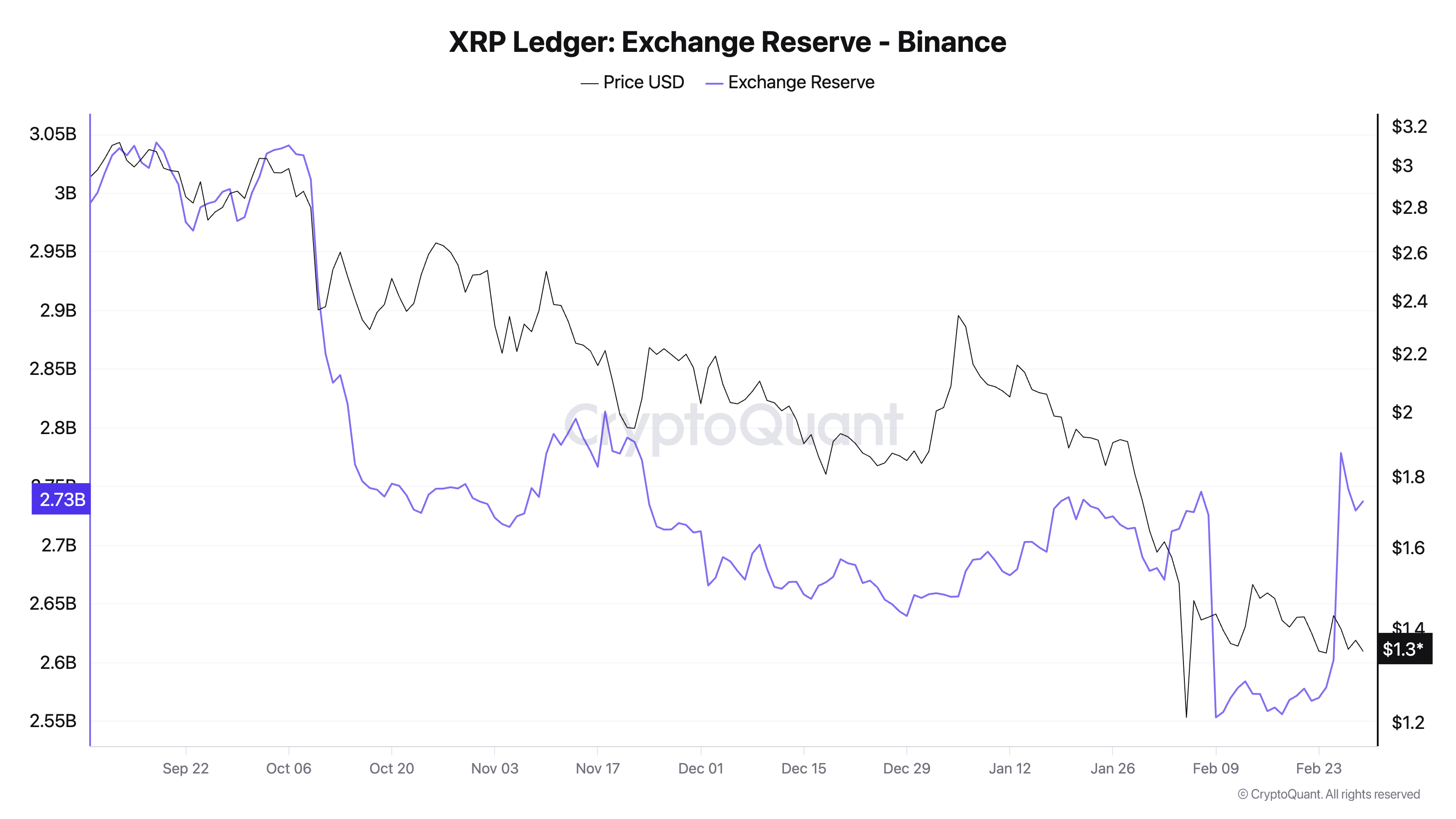
The main question is whether the large inflow signals a lasting distribution phase or just a temporary response to crises. Notably, the transfer has caused Binance’s XRP reserves to tick up.
CryptoQuant data showed that exchange reserves had been broadly declining since October 2025. The recent inflow marks a modest reversal of that trend for now.
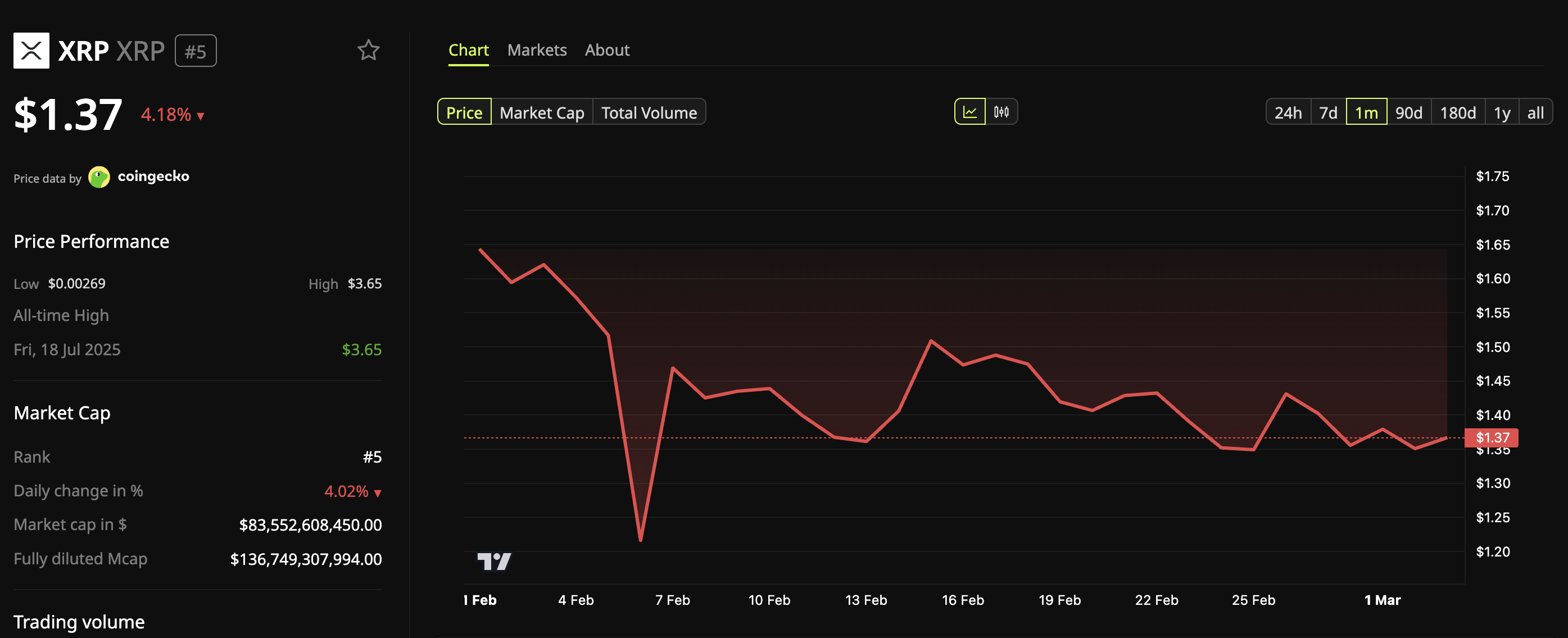
Meanwhile, XRP extended its losses in line with the broader crypto market downturn. According to BeInCrypto Markets data, the altcoin has dropped more than 4% in the past 24 hours. At the time of writing, XRP was trading at $1.37.
The next few days will reveal whether this $652 million move was a one-off or signals the start of further adjustments among XRP holders. As geopolitical risk and crypto market structure collide, both near-term volatility and long-term adoption narratives remain at the forefront.
Subscribe to our YouTube channel to watch leaders and journalists provide expert insights
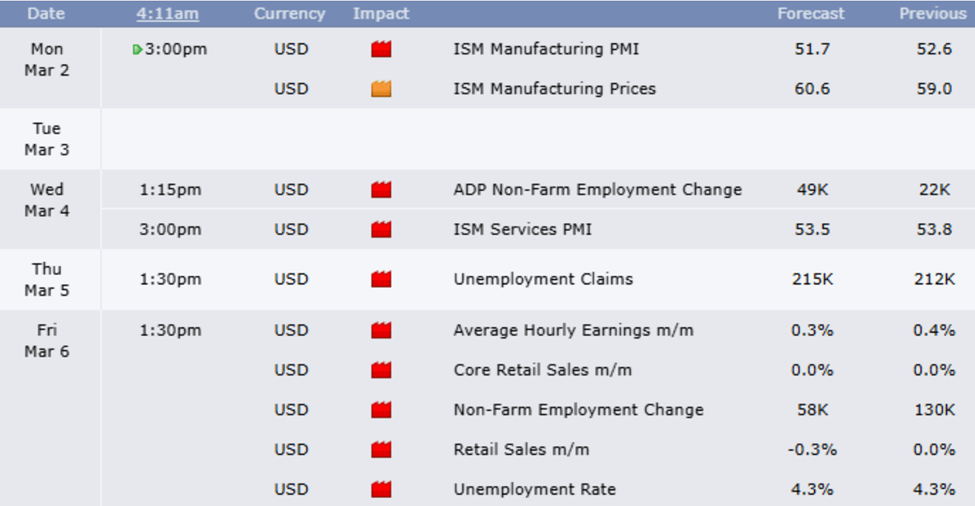
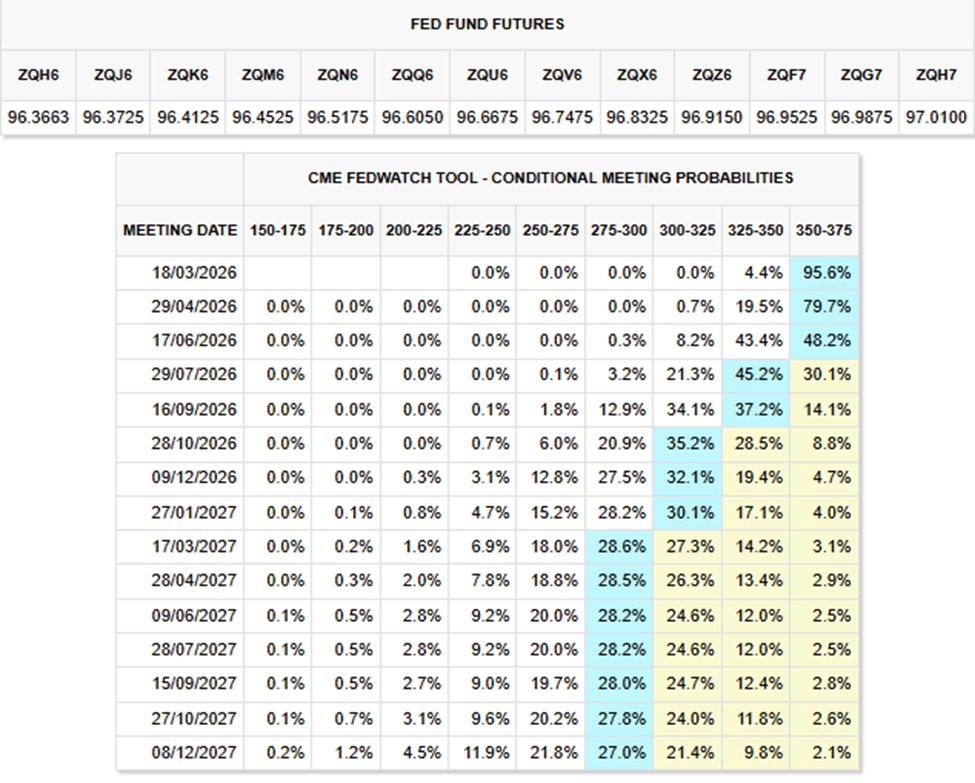
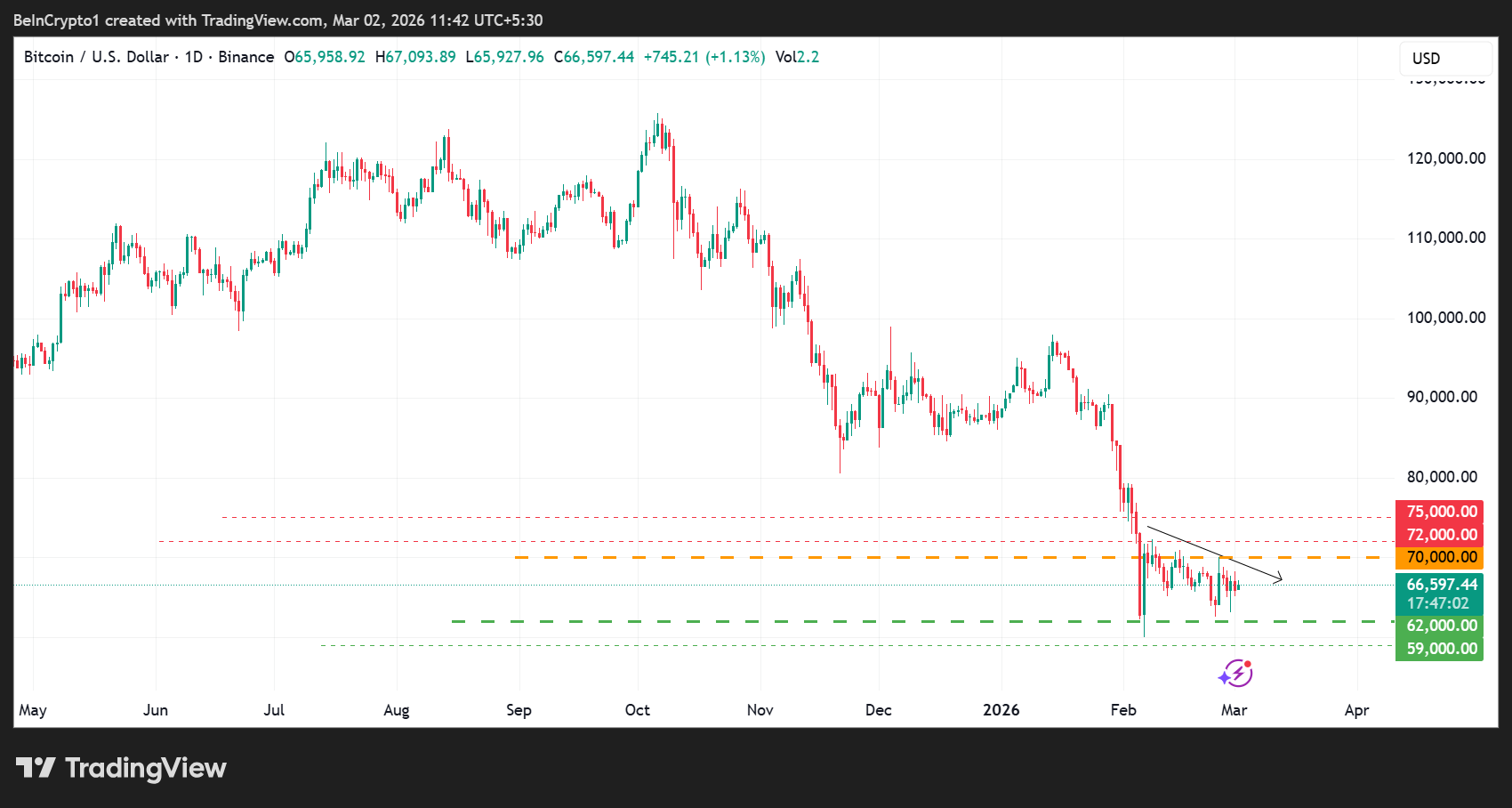
Bitcoin price enters one of the most consequential macro weeks of the first quarter, trading in the $66,000 range, down modestly amid fragile sentiment, thin liquidity, and geopolitical overhang.
After weeks of several lower highs, and with the pioneer crypto recording its weakest start to a year on record, traders are now turning to a heavy slate of US economic data that could redefine Federal Reserve (Fed) rate-cut expectations and, by extension, crypto market direction.
US Economic Data Points to Influence Bitcoin Price This Week
Below are the five key reports expected to sway Bitcoin sentiment this week.
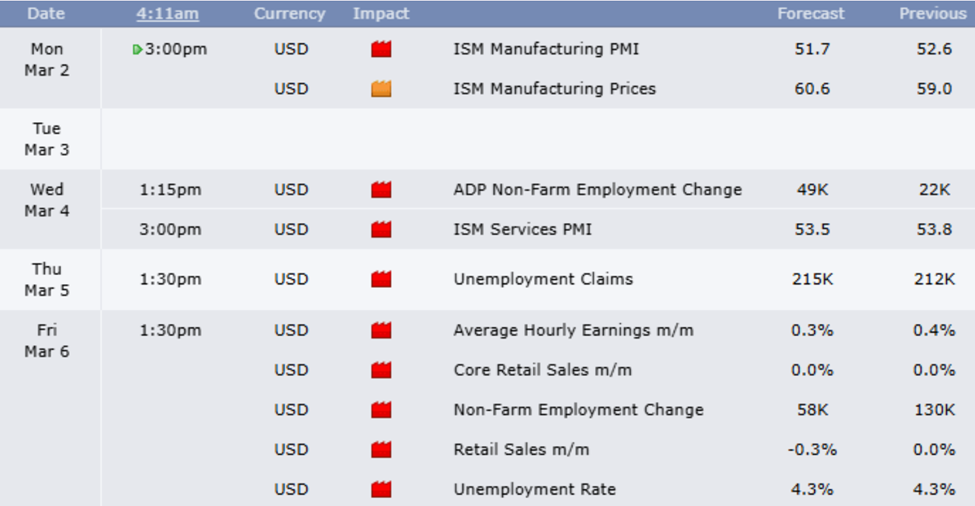
Manufacturing PMI
The week begins with February’s S&P Global Manufacturing PMI and the closely watched ISM Manufacturing PMI.
Consensus expects readings around 51.2 for S&P and 52.0–52.3 for ISM, following January’s surprise surge to 52.6, the strongest expansion since 2022.
The implications could extend to Bitcoin, where a reading above 52.5, particularly if new orders and production strengthen, would reinforce the “resilient economy” narrative.
That scenario typically delays Fed rate cuts, lifts Treasury yields and the U.S. dollar, and puts pressure on non-yielding assets like BTC.
Conversely, a drop toward 50, the contraction threshold, would shift expectations toward earlier easing. Historically, contraction combined with weak BTC positioning has delivered strong upside reversals.
“ISM above 50 is bullish for markets,” commented analyst Bull Theory.
Notably, manufacturing is not the dominant engine of the U.S. economy. However, as the week’s first catalyst, it could set the volatility tone for March.
ADP Employment Signals Labor Tightness
Meanwhile, Wednesday’s ADP Employment Change report acts as the market’s first real labor pulse for February. Economists expect roughly 50,000 new private-sector jobs, up from January’s modest 22,000 gain.
Because ADP often serves as a preview for Friday’s Non-Farm Payrolls (NFP), traders react aggressively to deviations. A strong print above 60,000–75,000 would suggest labor resilience, reinforcing the Fed’s “higher for longer” posture. That would likely push yields and the dollar higher, weighing on Bitcoin.
On the other hand, a soft reading, especially below 40,000, would revive the liquidity narrative. Signs of cooling labor conditions strengthen expectations for rate cuts later this year, which historically benefit risk assets and crypto.
With markets already pricing roughly two to three cuts in 2026, even modest surprises could recalibrate positioning.
Services PMI
Later Wednesday, attention shifts to the services sector with the S&P Services PMI and ISM Services PMI.
Expectations sit in the 52.3–53.5 range, consistent with steady expansion. January’s ISM Services reading came in at 53.8.
Because services account for the majority of U.S. economic activity, this report carries more influence than manufacturing.
Strong services print alongside solid employment data would reinforce economic resilience, dampening hopes for near-term easing and pressuring BTC.
However, signs of slowing demand or weaker employment could quickly change the narrative. Markets remain hyper-sensitive to any indication that growth momentum is cooling.
A combined miss across ADP and services would amplify dovish bets, potentially sparking a relief rally in Bitcoin toward the $70,000 psychological level.
Jobless Claims
Thursday’s Initial Jobless Claims, expected around 215,000, versus the previous 212,000, provide a high-frequency gauge of labor-market stress.
While often overlooked compared to NFP, claims can meaningfully shape expectations ahead of Friday’s headline report.
Last week’s lower-than-expected claims reinforced tight labor conditions and coincided with BTC slipping below $68,000.
If claims remain subdued, it strengthens the hawkish case: a tight labor market limits urgency for rate cuts.
Conversely, an unexpected spike would support the cooling narrative, softening yield pressure and providing near-term support for crypto.
Given its proximity to NFP, Thursday’s release could either validate earlier signals or introduce fresh uncertainty.
Non-Farm Payrolls
Friday’s U.S. Employment Report is the week’s defining event and the highest beta catalyst. Consensus calls for approximately 54,000 new jobs in February, down sharply from January’s strong 130,000 gain.
The unemployment rate is expected at 4.3%, with hourly wages rising 0.3% month-over-month.For Bitcoin, notwithstanding, the NFP is the highest-beta macro catalyst.
A hot print, say above 80,000 jobs with firm wage growth, would reinforce the narrative that the economy remains too strong for imminent cuts.
Yields would likely spike, the dollar would strengthen, and BTC could test lower support zones near $62,000–$59,000.
A soft report, particularly below 40,000 jobs or rising unemployment, would accelerate rate-cut pricing and potentially ignite a liquidity-driven rally.
With sentiment fragile and Bitcoin trading below key resistance in the $72,000–$75,000 range, this week’s data could define March’s trajectory.


Kalshi’s CEO has defended the company’s handling of its market on whether Iran’s Supreme Leader, Ali Khamenei, would be “out” of power, after backlash from users who accused the platform of unfair settlement practices.
Summary
- Kalshi says it does not allow markets that directly settle on death and structured the Khamenei contract with a “death carve-out.”
- The market was settled at the last traded price before the time of death, with fee refunds and reimbursements issued.
- Users accused the platform of unclear rules, unfair payouts and inconsistent standards, threatening to switch to competitors.
In a detailed post on X, the CEO said Kalshi does not list markets that settle directly on someone’s death.
When outcomes may involve death, he explained, the company structures rules to prevent users from profiting from it. That approach was applied to the Khamenei contract, which allowed trading on whether he would be out as Supreme Leader, a development the company argued carries major geopolitical, economic and national security implications, including potential effects on oil and commodity prices.
Under Kalshi’s rules, the market was settled at the last traded price before the time of death. All positions, regardless of when they were opened, were paid out based on that final pre-death price. In addition, the company said it reimbursed the difference for users who bought shares after the time of death at higher prices and refunded all trading fees tied to the market.
The CEO acknowledged that some users disagreed with the “death carve-out,” arguing that simpler rules without exceptions would be preferable. He said the company would work on improving how such caveats are displayed in the user interface.
However, several users pushed back sharply, accusing Kalshi of unclear rules, deleting responses, and failing to honor what they believed was a straightforward bet. Some claimed financial losses and said they would move to rival prediction markets.
Others pointed to previous contracts involving elderly public figures, arguing the company had previously allowed markets where death was a foreseeable outcome.
The dispute highlights growing tensions over how regulated U.S. prediction markets handle sensitive, mortality-linked events.

Bitcoin Price Prediction For March 2026: Bounce And Fall?

James Ford: The Night Czar is dead. But for London’s publicans the Night Mayor has only just begun

Israel judo team withdraws from Uzbekistan competition over safety


-

 Sports7 days ago
Women’s college basketball rankings: Iowa reenters top 10, Auriemma makes history
-

 Fashion3 days ago
Weekend Open Thread: Iris Top
-

 Politics7 days ago
Nick Reiner Enters Plea In Deaths Of Parents Rob And Michele
-

 Business5 days ago
True Citrus debuts functional drink mix collection
-

 Politics3 days ago
ITV enters Gaza with IDF amid ongoing genocide
-

 Tech1 day ago
Unihertz’s Titan 2 Elite Arrives Just as Physical Keyboards Refuse to Fade Away
-
Sports2 days ago
The Vikings Need a Duck
-

 Crypto World6 days ago
XRP price enters “dead zone” as Binance leverage hits lows
-

 Tech6 days ago
Unsurprisingly, Apple's board gets what it wants in 2026 shareholder meeting
-
 NewsBeat2 days ago
Dubai flights cancelled as Brit told airspace closed ’10 minutes after boarding’
-

 NewsBeat4 days ago
Cuba says its forces have killed four on US-registered speedboat | World News
-
 NewsBeat2 days ago
The empty pub on busy Cambridge road that has been boarded up for years
-
 NewsBeat4 days ago
Manchester Central Mosque issues statement as it imposes new measures ‘with immediate effect’ after armed men enter
-

 NewsBeat17 hours ago
‘Significant’ damage to boarded-up Horden house after fire
-
 NewsBeat7 days ago
‘Hourly’ method from gastroenterologist ‘helps reduce air travel bloating’
-

 NewsBeat1 day ago
Abusive parents will now be treated like sex offenders and placed on a ‘child cruelty register’ | News UK
-
 NewsBeat5 days ago
Police latest as search for missing woman enters day nine
-

 Business4 days ago
Discord Pushes Implementation of Global Age Checks to Second Half of 2026
-
 Sports7 days ago
2026 NFL mock draft: WRs fly off the board in first round entering combine week
-

 Business3 days ago
Only 4% of women globally reside in countries that offer almost complete legal equality