

Crypto World
Cost to Build a Blockchain Platform in 2026: Pricing and Features

AI Summary
Blockchain platforms have become essential for enterprises in various industries, driving investments in scalable and secure systems. However, the cost of blockchain development in 2026 can vary significantly based on factors like architecture, infrastructure, and scalability planning. Different types of blockchain platforms, such as public, private, and consortium, have varying complexities and costs. The core components influencing the cost include architecture design, smart contract development, platform infrastructure, and integration systems. In 2026, the typical cost ranges for blockchain platforms are: basic platforms ($25,000 – $60,000), mid-scale platforms ($60,000 – $150,000), and large enterprise platforms ($150,000 – $400,000+). Ongoing infrastructure expenses are crucial for long-term planning, representing 10-25% of development costs annually. Choosing between building an internal team or hiring a blockchain development company impacts costs, with experienced teams often reducing long-term expenses. Careful planning and collaboration with reputable development teams are key to successful
Blockchain platforms are no longer experimental technologies. Enterprises across finance, supply chain, gaming, identity, and digital assets are investing in blockchain infrastructure to build scalable & secure systems. However, one of the first things that comes to the mind of the decision-makers is blockchain development cost 2026.
The answer depends on multiple factors, including architecture, infrastructure requirements, development scope, and long-term scalability planning. Unlike standard applications, blockchain platforms require specialized engineering, distributed infrastructure, and security-focused development practices.
Understanding the real cost structure helps organizations plan investments properly and avoid expensive redesigns later.
Reasons Behind the Varying Cost of Blockchain Platform Development
Blockchain platform development costs vary widely because platforms differ significantly in complexity and scale. A simple blockchain application is very different from a full enterprise blockchain infrastructure.
Several factors drive cost differences:
- Type of blockchain architecture (public, private, or consortium)
- Number of platform features
- Security requirements
- Transaction throughput requirements
- Infrastructure scale
- Integration with existing systems
For instance, a basic blockchain-based solution may involve limited smart contract functionality, while enterprise platforms require advanced permission management, auditing, analytics, and compliance layers. This is exactly the reason why blockchain development cost in 2026 can vary significantly depending on project scope.
What Defines a Blockchain Platform
Many organizations underestimate the scope of a blockchain platform. A blockchain platform is not just a smart contract or decentralized application; it is a complete software ecosystem.
A typical blockchain platform includes:
- Consensus mechanism implementation
- Smart contract infrastructure
- Node management systems
- User identity and permission layers
- APIs and integrations
- Admin dashboards
- Monitoring and analytics
- Security layers
Each of these components requires specialized development and testing. Blockchain software development services typically include both infrastructure engineering and application-layer development, which is why blockchain software development cost is higher than traditional application development.
Types of Blockchain Platforms Enterprises Build
Enterprise blockchain platforms vary depending on business objectives. Different types of platforms require different levels of investment.
Public Blockchain Platforms
Public blockchain platforms allow open participation and decentralized validation. These platforms typically require advanced token logic and high scalability. Typical use cases include:
- Tokenized ecosystems
- NFT marketplaces
- Web3 platforms
- Decentralized finance applications
Public platforms usually require higher security investments and extensive smart contract testing.
Private Blockchain Platforms
Private blockchain platforms restrict access to authorized participants and are commonly used by enterprises. Common use cases include:
- Supply chain tracking
- Identity management
- Enterprise data sharing
- Internal record management
Private platforms often require integration with internal systems, which increases development complexity.
Consortium Blockchain Platforms
Consortium blockchains are operated by multiple organizations. These platforms require advanced governance and permission models. Typical use cases include:
- Banking networks
- Healthcare data sharing
- Trade finance
- Logistics networks
Consortium platforms typically involve the highest coordination and development complexity.
Core Components That Determine Blockchain Development Cost
Several technical components directly influence blockchain software development cost. Understanding these components helps organizations estimate budgets more accurately.
Blockchain Architecture
Architecture design defines how nodes communicate and how data is validated. Poor architecture decisions often lead to expensive redesigns later. Architecture planning includes:
- Consensus mechanism selection
- Network topology design
- Data storage structure
- Security model definition
- Scalability planning
Architecture design alone can require significant engineering effort for enterprise platforms.
Smart Contract Development
Smart contracts form the logic layer of blockchain platforms. Secure smart contract development requires careful design and testing. Smart contract work includes:
- Token logic implementation
- Business rule automation
- Permission management
- Upgrade mechanisms
- Security testing
Smart contract errors can be extremely costly, making security-focused development essential.
Platform Infrastructure
Blockchain infrastructure cost represents a major portion of total investment. Infrastructure typically includes:
- Node hosting
- Cloud services
- Storage systems
- Monitoring tools
- Backup systems
- Load balancing
Enterprise-grade platforms require infrastructure designed for reliability and scalability.
Integration Systems
Most enterprises need blockchain platforms to integrate with existing systems. Typical integrations include:
- ERP systems
- Payment gateways
- Identity systems
- APIs
- Analytics platforms
Integration complexity significantly affects development cost.
Real Blockchain Development Cost Ranges
In 2026, the cost to build a blockchain platform depends largely on complexity and scale.Typical enterprise cost ranges include:
Basic Blockchain Platforms
Basic platforms with limited functionality typically cost:
$25,000 – $60,000
These platforms usually include:
- Basic smart contracts
- Simple dashboards
- Limited integrations
- Small-scale infrastructure
Suitable for prototypes or pilot deployments.
Mid-Scale Blockchain Platforms
Production-ready platforms typically cost:
$60,000 – $150,000
These platforms usually include:
- Advanced smart contracts
- Scalable infrastructure
- Multiple integrations
- Security testing
- Admin dashboards
Most enterprise projects usually fall into this range.
Large Enterprise Blockchain Platforms
Enterprise-grade blockchain platforms typically cost:
$150,000 – $400,000+
These platforms usually include:
- Custom blockchain architecture
- High transaction throughput
- Advanced security systems
- Complex integrations
- Compliance features
- Monitoring systems
Large platforms require extensive engineering and infrastructure planning.
These ranges represent typical enterprise blockchain development cost estimates in 2026. However, the actual costs depend on architecture complexity and feature requirements.
Blockchain Infrastructure Cost Explained
Blockchain infrastructure cost continues after development. Ongoing infrastructure expenses are an important part of long-term planning. Typical infrastructure costs include:
- Cloud hosting services
- Node operation costs
- Data storage
- Monitoring tools
- Security services
- Maintenance support
Infrastructure costs typically represent 10–25% of development cost annually, depending on platform scale. Planning infrastructure early helps avoid unexpected operational expenses.
Development Team vs Development Company
One major cost decision involves whether to build an internal team or hire a blockchain development company.
Internal Development Team
Building an internal team requires:
- Blockchain engineers
- Backend developers
- DevOps engineers
- Security specialists
- Project managers
Internal teams provide control but require significant hiring and training investment.
Hiring a Blockchain Development Company
On the other hand, many enterprises choose to hire a blockchain development company to reduce development risk. The key benefits include:
- Experienced blockchain engineers
- Established development processes
- Faster delivery timelines
- Proven architectures
- Lower hiring overhead
Blockchain software development services provided by experienced teams often reduce long-term costs by avoiding architectural mistakes.
Hidden Costs Enterprises Often Miss
Many blockchain projects exceed budgets because hidden costs are not considered early. Some of the common hidden costs include:
- Architecture redesign
- Security improvements
- Infrastructure scaling
- Compliance updates
- Performance optimization
- Integration changes
Planning these factors early improves cost predictability.
Get a Custom Quote for Your Blockchain Platform Development
Final Thoughts
Blockchain platforms require significant investment, but properly designed platforms provide long-term value through automation, security, and scalability.
The cost to build a blockchain platform in 2026 depends on architecture complexity, infrastructure requirements, and development scope. Organizations that plan carefully and work with experienced blockchain development teams are more likely to build platforms that scale successfully.
Enterprises planning blockchain platforms should focus not only on initial development cost but also on infrastructure and long-term scalability.
Working with an experienced blockchain development company like Antier plays a significant role in ensuring that blockchain platforms are built for both performance and long-term sustainability.


Qivalis, a consortium of Europe’s major banks, is accelerating plans to distribute a euro-pegged stablecoin, with discussions focusing on partnerships with crypto exchanges and liquidity providers. The report from Cinco Días on Monday outlines a path toward a 2026 launch, placing the project on track not only to issue the token but to facilitate its adoption across regulated platforms. The coalition, which includes ING and UniCredit and recently added BBVA, first signaled its ambitions in September 2025 when nine banks publicly joined the effort. The euro-stablecoin aims to serve as a regulated, domestic alternative to US dollar-denominated stablecoins and could reshape cross-border payments for European businesses.
Key takeaways
- Qivalis is targeting a euro-pegged stablecoin with a potential launch in the second half of 2026.
- Participating banks include ING, UniCredit, CaixaBank, Danske Bank, Raiffeisen Bank International, KBC, SEB, DekaBank, Banca Sella, with BBVA joining as the 12th member.
- Distribution negotiations are underway with crypto exchanges, market makers, and liquidity providers; the banks themselves will also distribute the token.
- Regulatory alignment emphasizes compliance with the European Union’s Markets in Crypto-Assets Regulation (MiCA).
- Reserve design features a 1:1 backing, with at least 40% in bank deposits and the remainder in high-quality short-term euro-area sovereign bonds, plus 24/7 redemption for holders.
Market context: The initiative sits at the intersection of Europe’s push for regulated crypto assets and the broader search for stable on-chain rails that can support real-time, cross-border business activities. If realized, the euro-stablecoin could become a cornerstone within a growing European digital-finance infrastructure, complementing MiCA-driven licensing and oversight trends across the bloc.
Why it matters
The Qivalis initiative represents a collective effort by large European banks to reclaim a level of influence over digital settlement rails that have increasingly been shaped by non-bank actors. A euro-denominated stablecoin, designed to be fully regulated and domestically accessible, could provide a trusted on-ramp for corporate treasuries seeking faster settlement and reduced FX friction in cross-border trade. By pursuing partnerships with exchanges and liquidity providers, the consortium signals its intent to integrate the token into existing digital-asset ecosystems rather than building a closed system.
From a regulatory standpoint, the project underscores the EU’s approach to crypto by prioritizing formal oversight and consumer protections. The plan aligns with MiCA’s framework for stablecoins and asset-backed tokens, which is intended to bring transparency to reserves, redemption rights, and governance. For participants, the 1:1 reserve standard—with a minimum of 40% in bank deposits and the remainder in high-quality short-term government bonds—offers a familiar risk profile that may ease integration into corporate treasury policies and accounting practices. The stated goal of 24/7 redemption further underscores a practical mandate for liquidity and accessibility in day-to-day transactions.
Industry observers also note the significance of cross-border settlement capabilities. Real-time, B2B payments and global trade could benefit from a euro-stablecoin that is designed to operate within a regulated EU framework, potentially reducing settlement risk and enabling more predictable cash flows for European exporters and importers. The involvement of institutions with established KYC/AML practices could help mitigate concerns about illicit finance and market integrity as the asset ecosystem grows around the euro-stablecoin concept.
While the focus remains on European institutions, Qivalis’ openness to European and international platform partnerships suggests a wider ambition. The project’s leadership, including Jan Sell, who previously led Coinbase’s operations in Germany, emphasizes a strategy that balances regulatory compliance with broader accessibility. The collaboration aims to ensure the token is usable within a global network of compliant platforms, while preserving the benefits of a domestic, euro-backed settlement asset. The broader crypto-reading community will watch whether these distribution talks translate into formal partnerships, liquidity commitments, and a clear timetable for reserves and redemption mechanics.
In a related development, the ongoing dialogue around stablecoins in Europe continues to unfold alongside initiatives from other European players. The momentum around regulated digital assets—coupled with the MiCA regime—appears to be shaping a landscape where traditional banks can recover a central role in the settlement layer while still engaging with crypto-native ecosystems. As the market digests these developments, the question for investors and corporates becomes whether pilots and pilot-scale rollouts will translate into scalable, compliance-driven usage in the real economy.
What to watch next
- Public distribution agreements with major crypto exchanges and liquidity providers, as reported, and any announced partnerships in the coming months.
- Regulatory milestones tied to MiCA compliance for participating banks and the euro-stablecoin’s reserve framework.
- Official disclosures on the reserve composition, including the location and liquidity of assets backing the 1:1 stablecoin.
- 正式 confirmation of the 2026 launch timetable and any interim testnets or pilot programs with partner platforms.
- Further confirmations of BBVA’s role as the 12th member and the expansion of the consortium’s geographic footprint within and beyond Europe.
Sources & verification
- Cinco Días report on talks with exchanges and the planned 2026 euro-stablecoin launch, including the involvement of ING, UniCredit, and BBVA.
- Initial consortium announcement in September 2025 detailing the nine-bank lineup; subsequent confirmation of BBVA’s addition.
- Markets in Crypto-Assets Regulation (MiCA) regulatory framework cited as a guiding principle for the project.
- Public statement from Jan Sell detailing the proposal to work with European and international platforms and the focus on cross-border real-time payments.
- AllUnity’s Swiss franc stablecoin CHFAU coverage as a related example of regulated, bank-backed stablecoins in Europe.
Qivalis euro-stablecoin plan advances toward distribution in 2026
Qivalis, a consortium of prominent European banks, is moving beyond high-level promises toward concrete distribution plans for a euro-pegged stablecoin. Cinco Días reports that the group is nearing formal partnerships with crypto exchanges, market makers, and liquidity providers, a development that would enable the token to circulate across regulated platforms while ensuring that the stablecoin remains fully backed and freely redeemable. The group’s boardroom dynamic has evolved since the initial launch of the project in September 2025, when nine banks, including ING, UniCredit, CaixaBank, Danske Bank, Raiffeisen Bank International, KBC, SEB, DekaBank, and Banca Sella, signaled a cross-border effort to reimagine euro-denominated digital settlement.
With BBVA recently joining as the 12th member, the coalition has intensified talks about how to distribute the euro-stablecoin both within the bloc and internationally. Jan Sell, the Qivalis chief executive and former Coinbase executive in Germany, stressed that the design prioritizes a regulated, domestic alternative to USD-based stablecoins. He noted the project’s ambition to embrace partners that meet European Union regulatory standards, aligning with MiCA and the broader push for safer, regulated crypto activity. The strategy envisions a two-pronged approach: direct distribution by the consortium’s banks and enablement through established crypto infrastructures via partner platforms.
The operational framework presented by Qivalis emphasizes 1:1 reserve backing for the euro-stablecoin, with a minimum of 40% held as bank deposits. The remainder would be allocated to high-quality, short-term sovereign bonds across various euro-area countries, ensuring diversification and liquidity. Moreover, the token would support 24/7 redemption, enabling holders to convert stablecoins back into euros at any time, a feature designed to maintain liquidity in line with demand. These reserve characteristics are intended to address both trust and practicality in a market that remains vigilant about reserve quality and redemption risk.
Strategically, the project looks to collaborate with both European and international platforms, signaling an ambition to create a broad, interoperable network for euro-denominated digital payments. The initiative’s trajectory suggests that the consortium intends to position the euro-stablecoin as a cornerstone for real-time cross-border settlement, potentially enabling enterprises to streamline payments in multilateral trade without sacrificing regulatory compliance. While Bit2Me is cited as a MiCA-licensed exchange that has engaged in discussions with the consortium’s banks, the precise list of partners and the timeline for on-ramps remains to be finalized, pending regulatory clarity and due diligence processes.
In context, the euro-stablecoin project occurs within a broader European push to integrate digital assets into conventional financial infrastructure while preserving strict regulatory oversight. The alliance between traditional lenders and crypto-market participants could help bridge gaps between the fiat and digital realms, especially for businesses that operate across borders and rely on timelier settlement. If successful, the euro-stablecoin could become a resilient alternative to existing USD-pegged tokens, offering a euro-centric liquidity strand that aligns with Europe’s financial sovereignty goals and its ongoing digitalization drive.
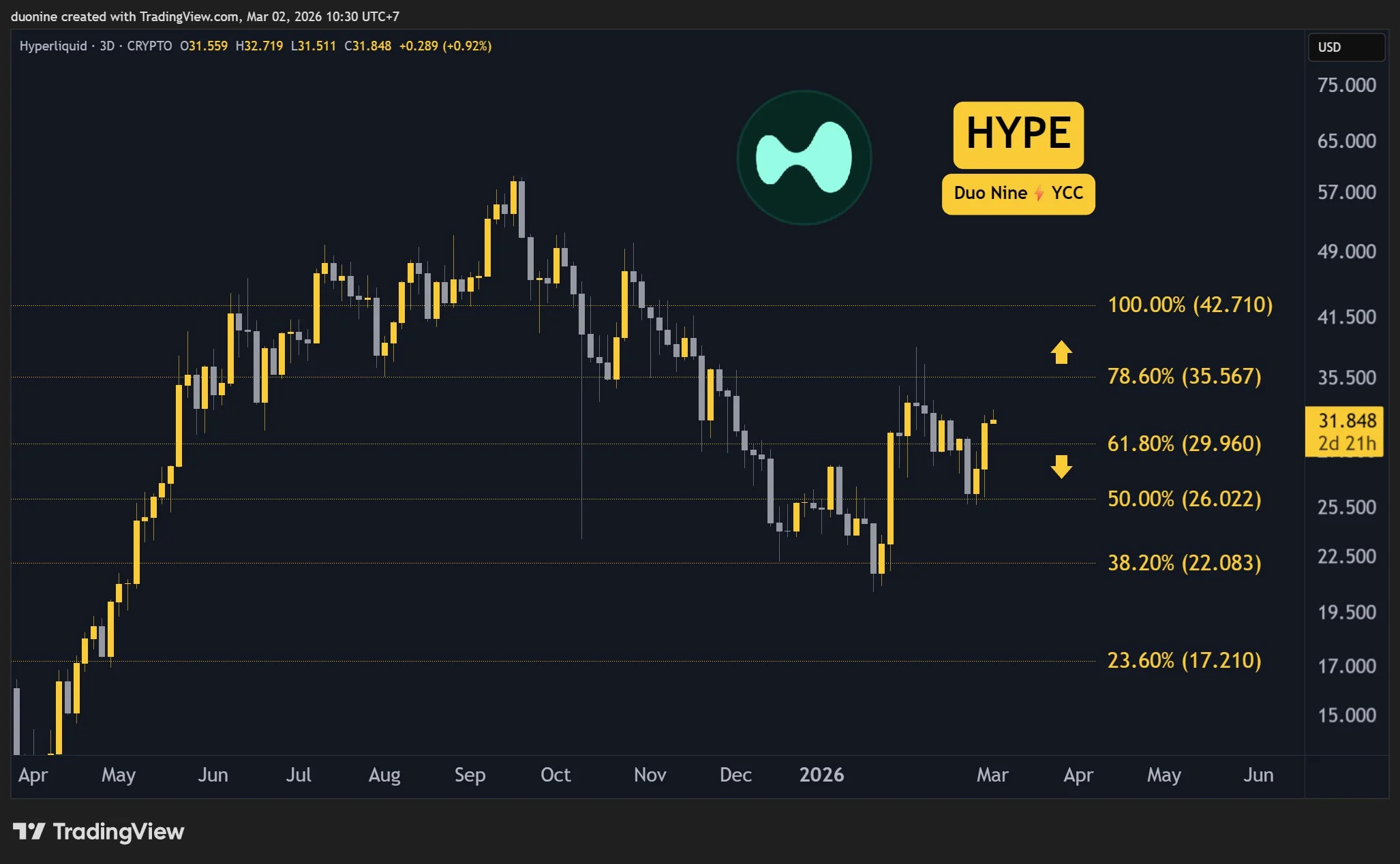
A closer look at a few important price levels to watch for HYPE in the coming days.
HYPE just made a higher low. Is the downtrend over?
Hyperliquid (HYPE) Price Predictions: Analysis
Key support levels: $26
Key resistance levels: $36
Buyers Return
After the price found support at $26, buyers returned and pushed HYPE above $30. If they can hold here, the price has a good chance of testing the $36 resistance next.
Momentum is Turning Bullish
A look at the momentum indicators, such as the MACD or RSI, shows that bulls are taking control of the price action. The 3-day MACD is bullish, with a positive histogram, and the RSI has moved above 50. If nothing changes, HYPE has a good chance to move higher from here.

Buy Volume Picks Up
In the past week, the daily buy volume has been increasing, which shows a clear change in the trend. This shows sustained buy pressure which can propel HYPE higher. A first test of this uptrend will be the resistance at $36.

Binance Free $600 (CryptoPotato Exclusive): Use this link to register a new account and receive $600 exclusive welcome offer on Binance (full details).
LIMITED OFFER for CryptoPotato readers at Bybit: Use this link to register and open a $500 FREE position on any coin!
Ethereum price dips about 1–2% near $1.95k, nearing a 7‑month losing streak as whales trim holdings on macro pressure.
Summary
- ETH trades around $1.94k–$1.97k today, down roughly 1–2% in 24h, with 24h volume near $21–23b and a 24h range around $1.94k–$2.06k.
- Coinglass‑based data show ETH has logged six straight monthly declines, its longest losing streak since 2018, and has closed lower in 12 of the past 15 months.
- On‑chain data highlight selling from 100k–1m ETH wallets over 90 days while RSI sits in historically oversold territory and funding plus open interest have normalized, suggesting reduced leverage risk into key support.
Ethereum (ETH) faces a potential seventh consecutive monthly decline, a rare occurrence in cryptocurrency market history, according to market data.
The digital asset has slipped below a key psychological price level, though it briefly recovered above another threshold before showing signs of weakness, market observers reported.
On-chain data indicates that wallet addresses holding between 100,000 and 1,000,000 ETH have reduced their reserves over the past 90 days, according to blockchain analytics. The reduction has occurred outside of exchanges, suggesting strategic position reduction rather than preparation for short-term trading activity.
The cryptocurrency has faced headwinds from macroeconomic conditions, with persistent inflation dampening institutional appetite for risk assets, analysts noted. Ethereum has been among the hardest-hit major cryptocurrencies during this period.
Technical indicators show the daily Relative Strength Index (RSI) in historically oversold territory, a level where relief rallies have previously formed, according to technical analysis data. Funding rates have normalized and open interest has declined, reducing leverage-related risk in the market.
Market analysts identified a nearby support level as a critical threshold for the asset. Should Ethereum hold above this support and reclaim higher price levels, momentum could shift toward previous resistance zones, according to technical analysis.
The correction appears driven by macroeconomic factors rather than deteriorating network fundamentals, market participants stated. The asset approaches what analysts describe as a short-term inflection point as large holders continue to reduce exposure.

Key Takeaways
- Platform reverses prohibition on compensated cryptocurrency advertising
- Mandatory disclosure labels required for all paid crypto content
- Geographic restrictions apply based on local regulatory requirements
- New transparency framework balances monetization with compliance
- Policy shift enables creator earnings while maintaining oversight
The social media platform X has reversed its prohibition on paid cryptocurrency and gambling advertisements, creating new opportunities for content creators and marketing partners. The platform now permits compensated digital asset content through a structured disclosure program. Mandatory labeling requirements and location-based restrictions form the compliance foundation.
Disclosure System Governs Cryptocurrency Marketing on Platform
Cryptocurrency and related financial instruments have been removed from X’s restricted categories for paid partnerships. This policy modification reverses limitations that existed since mid-2024. Content creators now have authorization to earn revenue from digital asset promotions.
The company established a Paid Partnership designation to regulate compensated promotional activities. All creators must transparently identify financial arrangements when endorsing cryptocurrency offerings. Adherence to relevant advertising standards and consumer protection regulations is mandatory.
X makes clear distinctions between Paid Partnership content and traditional advertising products. As a result, certain material prohibited under partnership guidelines may qualify through alternative X Ads channels. This framework enables the platform to maintain disclosure standards while facilitating revenue generation.
Geographic Boundaries Define Promotion Accessibility
Despite removing the worldwide prohibition, specific territories continue restricting crypto promotions. Nations including the United Kingdom, European Union member states, and Australia enforce rigorous financial advertising regulations. X mandates that creators block paid cryptocurrency material from these jurisdictions.
Content creators hold direct responsibility for geographic compliance under the revised guidelines. X anticipates users will comprehend regional financial marketing requirements prior to posting compensated material. This framework assigns accountability to individual influencers and commercial collaborators.
X maintains prohibitions on numerous industry categories for paid partnerships. The restricted list continues blocking adult services, alcoholic beverages, relationship platforms, controlled substances, tobacco products, and weaponry. Commercial advertising related to political or social causes also remains forbidden.
Market Response and Platform Development Direction
The crypto community has demonstrated varied responses to the policy transformation. Certain participants celebrated restored monetization capabilities following extended restrictions. Alternative voices cautioned that enforcement complexities might generate ambiguity regarding unpaid token recommendations.
Industry observers suggest enhanced labeling standards could transform influencer marketing approaches on X. They predict informal promotional tactics may diminish under heightened disclosure requirements. Nevertheless, marketing organizations now possess a structured framework for regulation-compliant cryptocurrency initiatives.
This policy transformation corresponds with additional platform innovations currently developing at X. Platform owner Elon Musk recently validated intentions to deploy X Money in restricted beta testing soon. Furthermore, X intends to introduce Smart Cashtags functionality enabling direct equity and cryptocurrency transactions.
X has historically functioned as a primary gathering space for cryptocurrency enterprises and enthusiasts. Consequently, the policy reversal reestablishes a recognized marketing avenue while incorporating regulatory safeguards. These modifications demonstrate X’s effort to harmonize regulatory obligations with viable creator compensation models.


Hong Kong is doubling down on its role as China’s financial bridge, signing a new agreement with Shanghai authorities to build cross-border blockchain rails for cargo trade and trade finance.
The memorandum of understanding between the Hong Kong Monetary Authority, the Shanghai Data Bureau, and the National Technology Innovation Center for Blockchain, announced Monday afternoon in Hong Kong, formalizes plans to develop a shared digital platform linking trade data, electronic bills of lading, and financing systems.
The MoU signals growing adoption of bitcoin in real-world plumbing, targeting $1.5 trillion in annual cargo finance where paper work and jams still cost a lot in delays in fraud.
By plugging mainland cargo data into Hong Kong’s international-facing infrastructure, officials aim to reduce friction in cross-border trade while reinforcing the city’s status as the primary conduit between China and global capital markets.
Under the agreement, the parties will study the creation of a cross-border platform under the HKMA’s Project Ensemble framework. The initiative will explore the use of electronic bills of lading and blockchain-based documentation to streamline trade finance, while connecting with Hong Kong’s Commercial Data Interchange and CargoX to facilitate secure data sharing.
For Hong Kong, the move extends its digital asset strategy beyond tokenized green bonds and into the real economy. Instead of focusing solely on sovereign issuance or crypto markets, regulators are targeting the operational bottlenecks in cargo finance, where paper documents, fragmented data, and manual verification continue to slow credit decisions.
If successful, the platform could embed Hong Kong deeper into mainland supply chains while offering international investors and banks a compliant gateway to Chinese trade data. In doing so, the city is attempting to turn blockchain from a pilot project into core cross-border financial infrastructure.

Key Takeaways
- Unidentified objects impacted AWS facilities in the UAE on Sunday, triggering fires and service disruptions
- Emergency services cut power to affected zones; a secondary UAE location experienced additional electrical issues
- Bahrain-based AWS infrastructure also experiencing power supply and network connectivity challenges
- Timing aligns with Iranian military response throughout the Gulf region, though AWS hasn’t established direct causation
- Customers advised to migrate workloads to alternative regions while restoration efforts continue over several hours
Amazon’s cloud computing division experienced significant service interruptions following an incident where unknown projectiles hit its United Arab Emirates facility on Sunday, resulting in fire damage and electrical system failures.
The disruption began approximately 4:30 p.m. local time in Dubai. Emergency response teams disabled the facility’s electrical infrastructure to control the resulting flames.
According to AWS’s official service health dashboard, “objects struck the data center, creating sparks and fire” at one of its UAE-based availability zones.
Subsequently, another UAE availability zone encountered what the company characterized as a “localized power issue,” further extending the scope of regional service degradation.
The cloud infrastructure provider additionally documented electrical and network connectivity complications affecting one of its Bahrain deployment zones.
The company instructed affected customers to redirect their operations to infrastructure located in unaffected geographic regions during remediation. AWS projected that full restoration would require “multiple hours away.”
These technical failures occurred simultaneously with Iranian military operations targeting the UAE, part of a coordinated retaliatory campaign spanning the Middle East following joint US and Israeli strikes that resulted in the deaths of Supreme Leader Ayatollah Ali Khamenei and additional high-ranking Iranian leadership.
Tehran’s response encompassed multiple territories, with projectile and unmanned aerial vehicle assaults documented against American military installations and allied nations including the UAE, Qatar, Kuwait, and Saudi Arabia.
AWS has neither acknowledged nor dismissed any direct correlation between the facility damage and Iranian military actions. Company representatives provided no statement when approached for comment.
Impact on UAE-Based AWS Clients
Prominent AWS enterprise customers operating in the UAE include Al Ghurair Investment LLC and Dubai Islamic Bank.
The cloud provider maintains 123 availability zones distributed across 39 geographic regions worldwide, establishing extensive infrastructure redundancy — though regional concentration still created vulnerability in this scenario.
Ongoing Restoration Efforts
AWS initially communicated progress toward service restoration early Monday but subsequently revised its status, continuing to direct users toward alternative regional infrastructure.
As of Monday morning in Dubai, both affected UAE availability zones along with the single Bahrain zone continued experiencing service degradation.
Shares of Amazon (AMZN) traded up 1.00% at the most recent market check.


Earnings reports are still rolling in. This week Riot Platforms, the fourth-largest bitcoin miner by market cap, is due to report, as is Core Scientific, the No. 6.
Like many of their peers, the two are using their experience running large data centers and negotiating power-supply deals to expand into AI. Core, whose proposed $9 billion purchase by CoreWeave (CRWV) failed in October, barely mentions digital asset mining on its homepage. It will be interesting to see how much of its business still comes from that source.
Also due this week is the U.S. jobs report for February. The world’s largest economy is forecast to have added 60,000 nonfarm positions last month, according to the consensus estimate on Trading Economics.
Traders will also be monitoring the war in the Middle East, which has seen the U.S. and Israel strike Iran in what President Donald Trump called “major combat operations” targeting the country’s missile, naval and nuclear infrastructure.
Iran has retaliated with attacks on various countries in the region that host U.S. military bases. The conflict has been escalating with Iran-backed militias joining in. Trump has said it’s expected to last “four to five weeks,” so an earlier-than-expected truce could bring risk appetite back.
What to Watch
(All times ET)
- Crypto
- March 2: SuperRare to release Delirium, a new collection by artist Xer0x
- March 2: Mantra’s OM token to change to MANTRA with a 1:4 coin split as the Mantra chain upgrades from v6 to v7.
- March 3: SolCex mobile app to debut on Google Play and Apple’s App Store.
- March 4: Qubic begins testing parallel dogecoin mining and AI training
- Macro
- March 2, 10:00 a.m.: U.S. ISM manufacturing PMI for February est. 52.3 (Prev. 52.6)
- March 3, 5:00 a.m.: Eurozone inflation rate YoY flash for February (Prev. 1.7%); Core YoY (Prev. 2.2%)
- March 3, 7:30 p.m.: Australia GDP growth rate QoQ for Q4 (Prev. 0.4%)
- March 3, 8:30 p.m.: China NBS manufacturing PMI for February (Prev. 49.3)
- March 4, 8:15 a.m.: U.S. ADP employment change for February (Prev. 22K)
- March 4, 10:00 a.m.: U.S. ISM services PMI for February (Prev. 53.8)
- March 4, 2:00 p.m.: U.S. Fed Beige Book
- March 5, 8:30 a.m.: U.S. initial jobless claims for week ending Feb. 28 (Prev. 212K)
- March 5, 8:30 a.m.: U.S. nonfarm productivity QoQ prel for Q4 (Prev. 4.9%)
- March 5, 4:30 p.m.: U.S. Fed balance sheet update for period ending March 4
- March 6, 8:30 a.m.: U.S. nonfarm payrolls for February Est. 60K (Prev. 130K)
- March 6, 8:30 a.m.: U.S. unemployment rate for February (Prev. 4.3%)
- March 6, 8:30 a.m.: U.S. average hourly earnings MoM for February (Prev. 0.4%)
- March 6, 8:30 a.m.: U.S. retail sales control group MoM for January (Prev. 0.0%)
- March 8, 8:30 p.m.: China inflation rate YoY for February (Prev. 0.2%)
- Earnings (Estimates based on FactSet data)
- March 2: Riot Platforms (RIOT), post-market, -$0.32
- March 2: Core Scientific (CORZ), post-market, -$0.18
- March 6: Metalpha (MATH), pre-market
- March 9: Sharplink (SBET), pre-market, $0.31
- March 11: Exodus Movement (EXOD), pre-market, $0.14
Token Events
- Governance votes & calls
- PoolTogether DAO is voting to manually resubmit and execute the remaining actions for the PTBR-35 governance shutdown after a previous execution error. Voting ends March 2.
- Angle DAO is voting on an orderly wind-down of the EURA and USDA stablecoins, providing users a one-year 1:1 redemption period followed by a final settlement airdrop. Voting ends March 2.
- GMX DAO is voting to transition to a defined leadership model by hiring a CEO with performance-tied compensation and forming an interim leadership committee to guide the restructuring. Voting ends March 2.
- ShapeShift DAO is voting to appoint PTT as the Tokenomics Workstream Leader for a six-month term, compensated entirely in FOX tokens to eliminate stablecoin costs. Voting ends March 3.
- Decentraland DAO is voting to explore the automatic execution of approved proposals and soft term limits for signer keys while maintaining emergency oversight. Voting ends March 3.
- Uniswap DAO is voting across two linked proposals to expand v2 and v3 protocol fees to eight layer-2 networks and enable a new tier-based fee system across all v3 pools. Voting ends March 4 and 5.
- ENS DAO is voting to replace three DNSSEC oracle algorithms to patch a critical RSA signature forgery vulnerability and significantly reduce gas costs. Voting ends March 4.
- Gnosis DAO is voting to provide a grant to fund the continued support, infrastructure and maintenance of the Revoke.cash security platform. Voting ends March 5.
- Unlocks
- March 5: Ethena (ENA) to unlock 2.24% of its circulating supply worth $18.35 million.
- March 6: Hyperliquid (HYPE) to unlock 2.72% of its circulating supply worth around $288.77 million.
- Token Launches
- March 8 or earlier: Chiliz (CHZ) to deploy revenue from the protocol to buyback and burn CHZ tokens.
- March 8 or earlier: WhiteBit Token (WBT) to be listed on Kraken.
Conferences
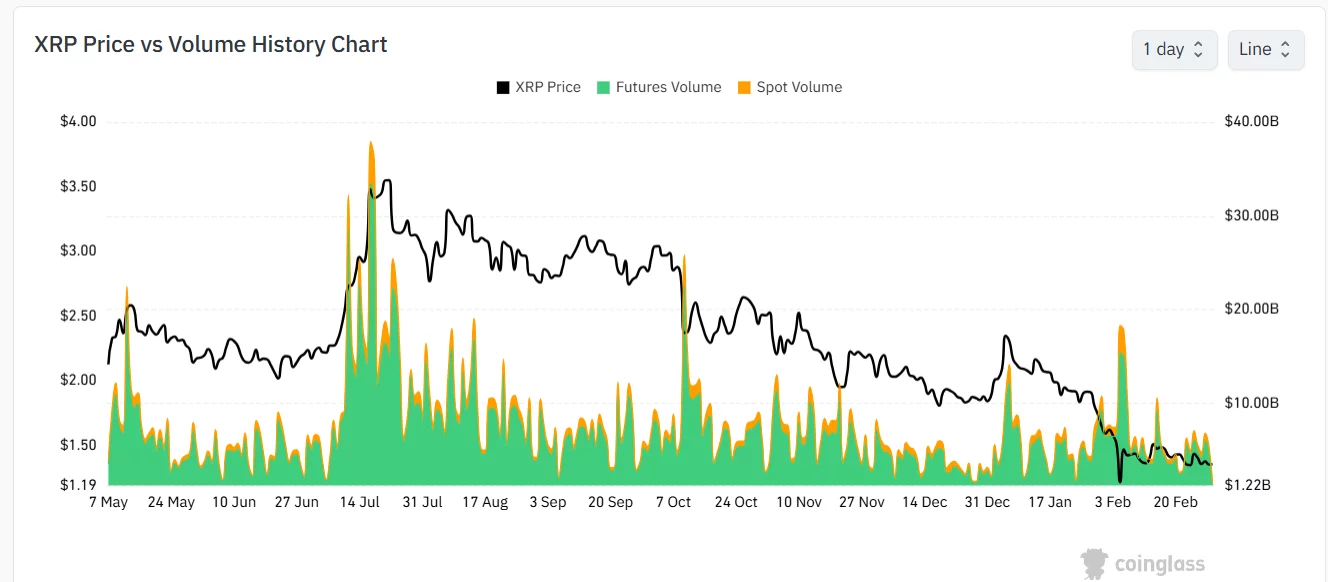
The XRP market is undergoing a structural shift as trading dynamics move from spot accumulation to a derivatives-led environment.
Summary
- XRP is shifting from spot-driven accumulation to a speculative, futures-led market, signaling an impending “volatility squeeze” as leveraged traders position for a major move.
- The price remains trapped below the 50-day SMA ($1.63) with a neutral-to-bearish RSI of 39, indicating a lack of buying pressure despite the surge in trading activity.
- Traders are eyeing $1.20 as the “must-hold” support floor, while a breakout above the $1.50–$1.80 resistance range is required to confirm a bullish reversal.
Recent Coinglass data reveals a significant uptick in XRP futures volume relative to spot trading, signaling that speculative interest is once again a primary price driver. This surge in futures activity typically precedes a “volatility squeeze,” where the price breaks sharply as leveraged positions are either rewarded or liquidated.
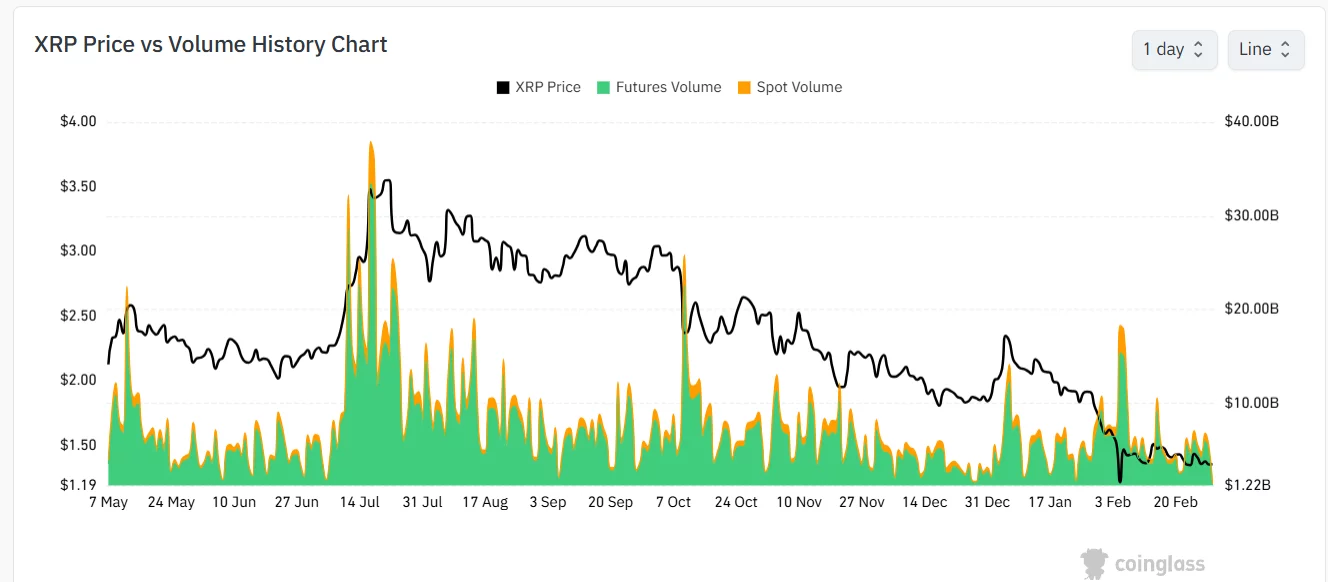
For the Ripple token (XRP), this suggests the market is no longer in a state of passive holding but is bracing for a decisive move.
This futures-dominated landscape makes the price more susceptible to rapid squeezes; while it provides the liquidity needed to break overhead resistance, it also warns that any downside could be exacerbated by a cascade of liquidations.
XRP price navigates critical support
Technically, XRP is navigating a precarious path, currently trading near $1.35 as of March 2026. The price action remains pinned below the 50-day Simple Moving Average (SMA) at $1.63, which acts as a formidable dynamic resistance.
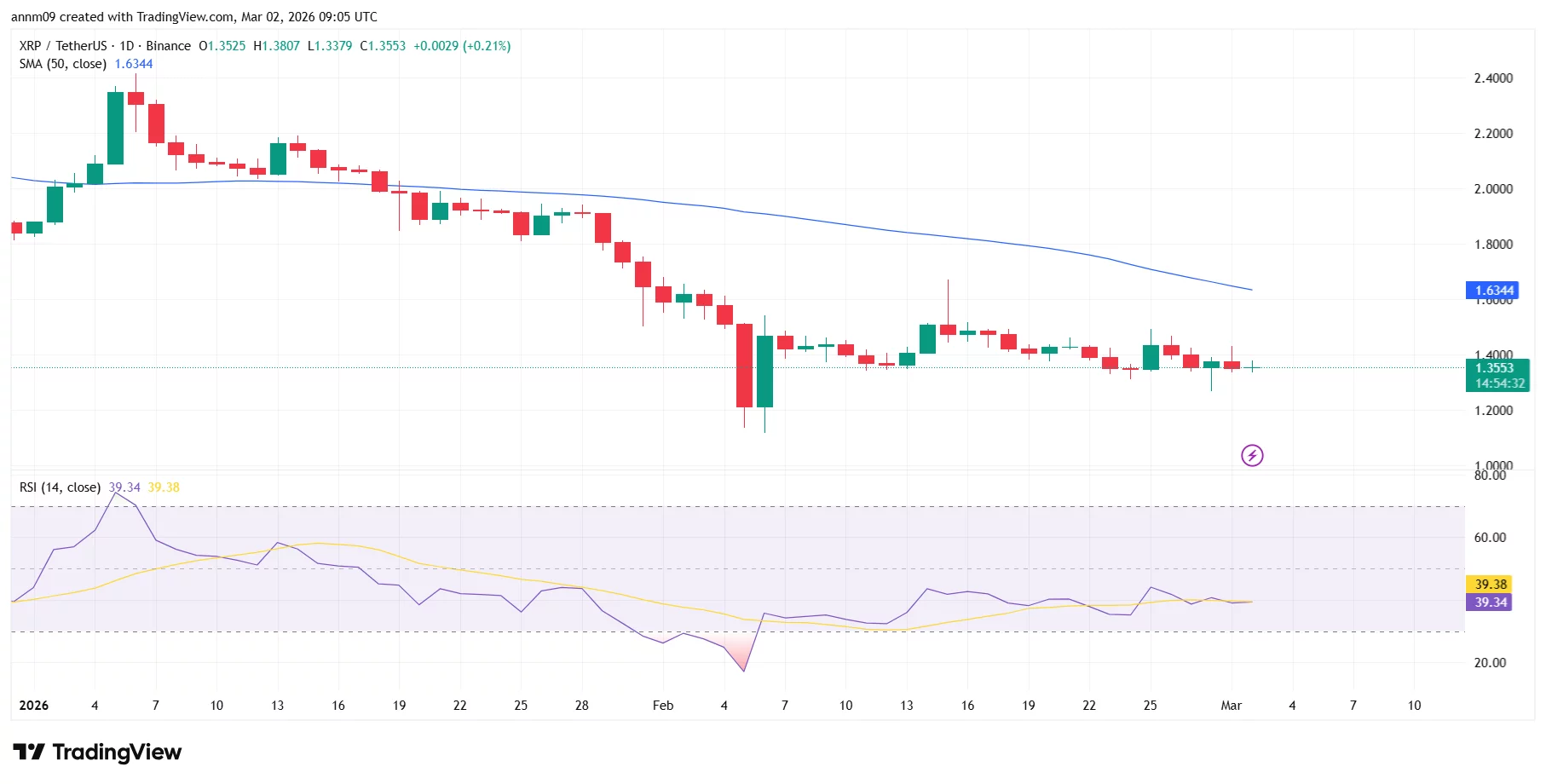
Until XRP secures a daily close above this level, the medium-term bias remains bearish. Recent candlestick patterns show a string of small-bodied “doji” candles, reflecting market indecision despite the rising futures turnover.
The Relative Strength Index (RSI) currently hovers around 39, placing the asset in a neutral-to-bearish zone that lacks the immediate buying pressure required for a reversal.
Immediate support is firmly established at the $1.20 mark, a level that has historically served as a psychological safety net. Should XRP fail to hold $1.20, a deeper retracement toward $1.00 becomes a distinct possibility.
Conversely, the first major hurdle for a bullish recovery sits at $1.50, followed by a high-volume resistance zone at $1.80.
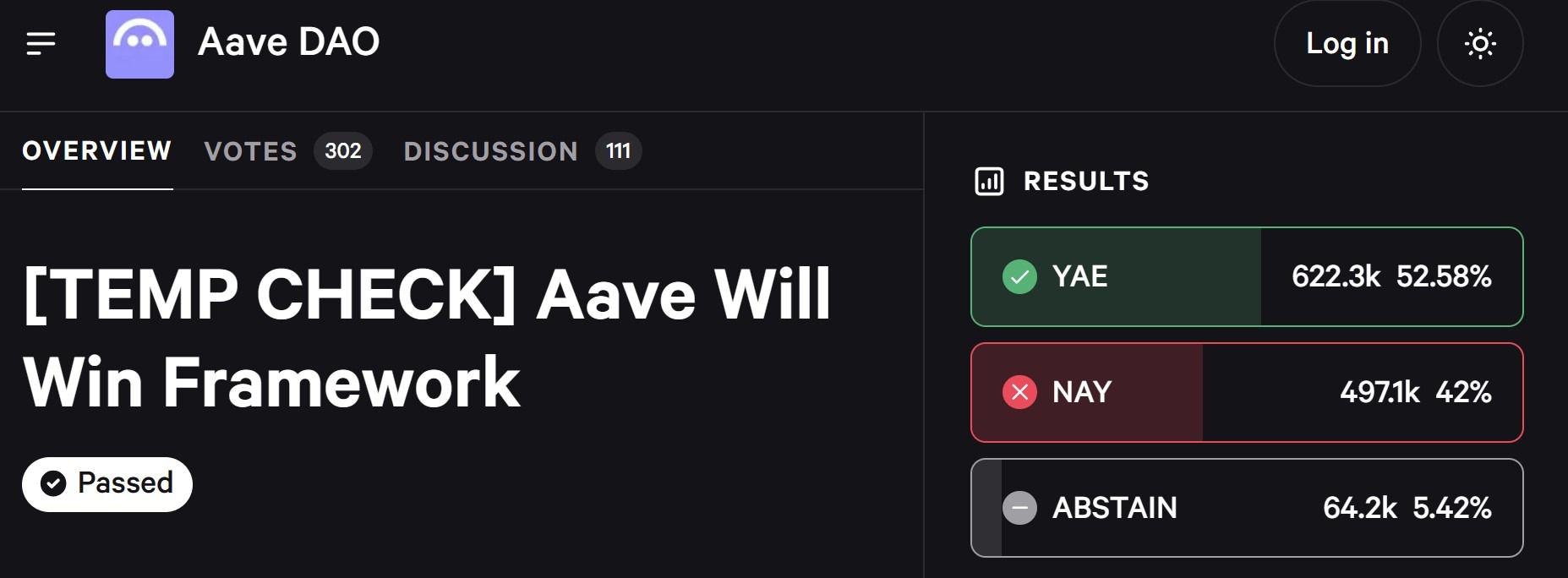
Aave’s “Aave Will Win” framework has passed its Temp Check vote, clearing the first formal stage of the protocol’s governance process.
On Sunday, the off-chain Snapshot vote closed with 52.58% voting in favor, 42% against and 5.42% abstaining. The result advances the measure to the Aave Request for Final Comment (ARFC) stage, where terms may be revised before any binding on-chain vote.
The framework asks tokenholders to approve up to $42.5 million in stablecoins and 75,000 Aave (AAVE) tokens for Aave Labs. In return, the organization would route 100% of revenue from Aave-branded products to the Aave DAO treasury under a DAO-funded operating model.
The narrow margin highlights a divided governance base as the protocol considers structural changes to its funding, revenue alignment and long-term development.

The ARFC stage will determine whether concerns raised during the debate will translate into revisions before a formal Aave Improvement Proposal is submitted on-chain.
Split vote reflects ongoing governance tensions
Aave founder Stani Kulechov said in a post on X that the Temp Check brings the protocol closer to a “fully token-centric model,” adding that structural improvements will be incorporated at the ARFC stage based on community feedback.

Critics previously questioned the size of the funding package and the inclusion of 75,000 AAVE tokens, which carry voting power.
Others called for clearer definitions and stronger disclosure standards around governance holdings.
Related: Grvt integrates Aave so traders can earn yield on perp collateral
On Feb. 25, competing reports from Aave Chan Initiative (ACI) founder Marc Zeller and Aave Labs offered contrasting interpretations of past funding and value creation ahead of the vote.
The ACI published a transparency report reviewing Aave Labs’ historical funding, while Aave Labs outlined its role in building the protocol since 2017.
What happens next in Aave governance process?
Under Aave’s governance framework, proposals typically move from Temp Check to ARFC before advancing to an on-chain Aave Improvement Proposal (AIP) vote. Only AIPs executed on-chain are binding.
If the proposal advances beyond ARFC, tokenholders will vote on whether to formalize the DAO-funded model and ratify Aave V4 as the long-term technical foundation.
The outcome could reshape how the Aave ecosystem structures development, revenue and brand stewardship.
Magazine: Would Bitcoin really be at $200K if not for Jane Street? Trade Secrets
The crypto market is under renewed pressure, with the total market capitalization slipping nearly 1% over the past 24 hours and all top 10 assets posting losses.
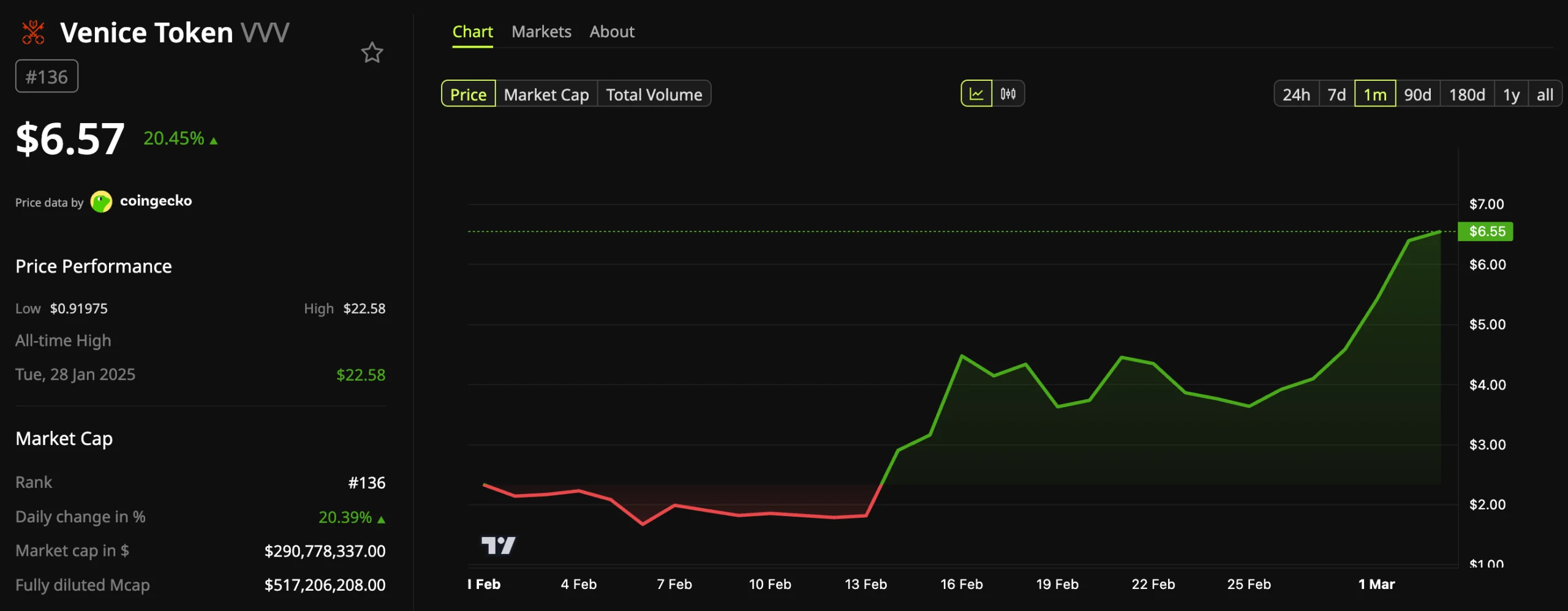
Nonetheless, select altcoins are breaking away from the trend. Venice Token (VVV) stands out as the strongest performer among the top 300 cryptocurrencies.
VVV Token Jumps 20% Despite Market Slump
Venice AI is a privacy-focused, permissionless platform that provides uncensored access to open-source AI models for text, image, video, and code generation. It was founded by Erik Voorhees, the former CEO of ShapeShift.
The Venice Token (VVV) is the native token of the Venice AI ecosystem. It was launched in January 2025. The altcoin’s primary utility is staking.
Users stake VVV to receive yield or mint DIEM. Each DIEM provides $1 of daily API access in perpetuity.
According to data from BeInCrypto Markets, VVV surged over 20% today, reaching an intraday high of $6.78. This marked its highest price since February 2025.
At the time of writing, the token was trading at $6.57. Furthermore, VVV has ranked as the largest gainer among the top 300 cryptocurrencies by market cap, according to CoinGecko.
Follow us on X to get the latest news as it happens
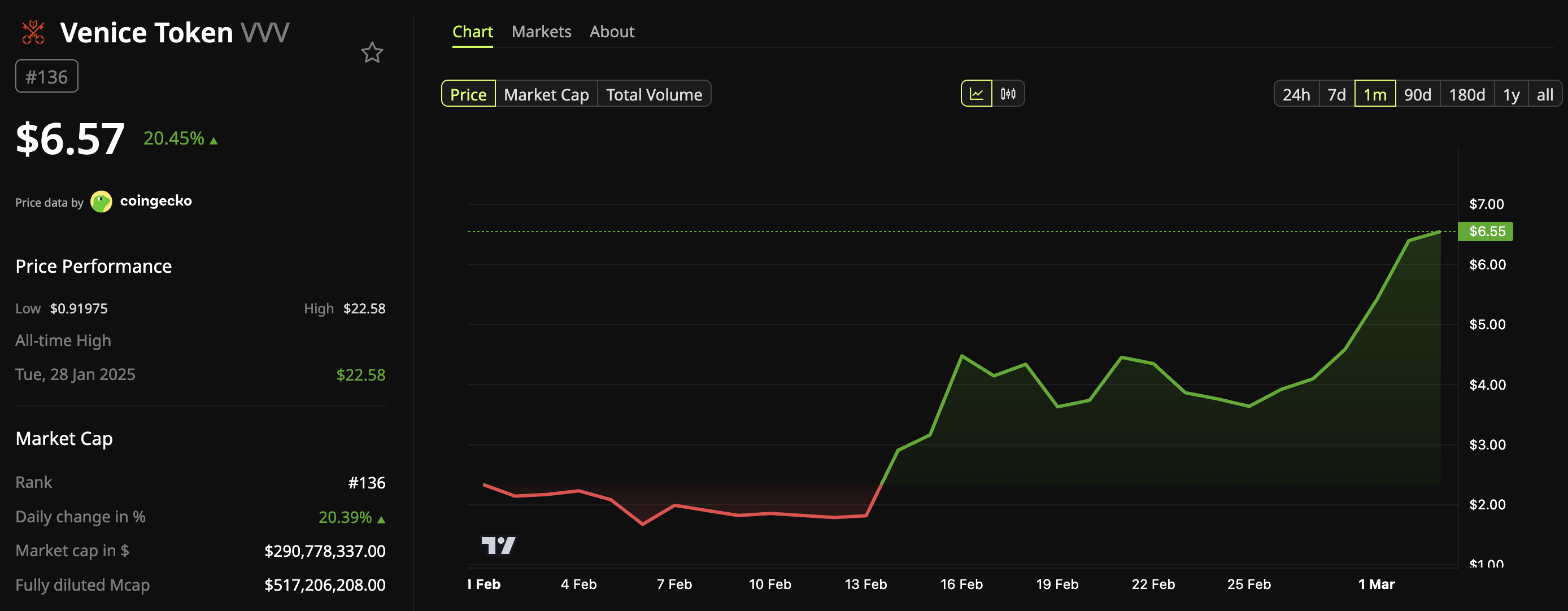
Monday’s surge is not an isolated move but part of a broader uptrend. In a recent post, CoinGecko noted that VVV has delivered 7.5x growth over the past three months. Its market cap has climbed above $290.7 million amid the ongoing rally.
Why is Venice Token (VVV) Surging?
A key question that arises is what is driving the rally. CoinGecko highlighted two primary catalysts behind the surge. First, the platform reduced its annual token emissions from February 10, lowering them from 8 million VVV to 6 million VVV.
This 25% cut in new token issuance tightens supply dynamics. With fewer tokens entering circulation, potential sell pressure from emissions declines, strengthening the token’s scarcity profile. Second, VVV’s integration across several platforms has boosted its exposure and utility.
“Here’s why it pumped: Venice cut annual emissions to 6M VVV/year, improving scarcity. VVV was integrated across several DeFi platforms as utility: → Aerodrome: Liquidity → Morpho: Collateral → Plena: Gasless swaps,” the post read.
In addition, the platform is experiencing rising demand. Venice AI has 2 million registered users, signaling steady ecosystem growth. Moreover, the number of API users has also increased.
LunarCrush data shows high social engagement with VVV. Engagement was 255% above the daily average, and social dominance jumped 424% from last week. The token earned an AltRank of 8 among all cryptocurrencies, reflecting strong performance and interest.
“The thesis that keeps circulating: private uncensored AI inference where compute demand drives staking, staking reduces circulating supply, and tightening supply creates reflexive upward pressure. The $DIEM token launch deepened this – 7.56M VVV already locked as collateral, roughly 17% of circulating supply,” LunarCrush added.
VVV still remains 70% below its all-time high. Whether the current rally, built on supply contraction and user growth, can sustain itself through a softer broader market remains to be seen.

#antique #gold #money #reseller #buisness #coins #collection #silver #fyp #jewelry #ytshorts

Canada’s Carney signs uranium deal with Modi during historic India visit: ‘End of challenging period’

Exxon Mobil Stock Rallies on Oil Price Surge Amid U.S.-Iran Conflict Escalation


-

 Sports7 days ago
Women’s college basketball rankings: Iowa reenters top 10, Auriemma makes history
-

 Politics7 days ago
Nick Reiner Enters Plea In Deaths Of Parents Rob And Michele
-

 Fashion3 days ago
Weekend Open Thread: Iris Top
-

 Business6 days ago
True Citrus debuts functional drink mix collection
-

 Politics3 days ago
ITV enters Gaza with IDF amid ongoing genocide
-

 Tech1 day ago
Unihertz’s Titan 2 Elite Arrives Just as Physical Keyboards Refuse to Fade Away
-
Sports2 days ago
The Vikings Need a Duck
-

 Crypto World6 days ago
XRP price enters “dead zone” as Binance leverage hits lows
-

 Tech6 days ago
Unsurprisingly, Apple's board gets what it wants in 2026 shareholder meeting
-
 NewsBeat2 days ago
Dubai flights cancelled as Brit told airspace closed ’10 minutes after boarding’
-

 NewsBeat4 days ago
Cuba says its forces have killed four on US-registered speedboat | World News
-
 NewsBeat4 days ago
Manchester Central Mosque issues statement as it imposes new measures ‘with immediate effect’ after armed men enter
-
 NewsBeat2 days ago
The empty pub on busy Cambridge road that has been boarded up for years
-

 NewsBeat20 hours ago
‘Significant’ damage to boarded-up Horden house after fire
-
 NewsBeat7 days ago
‘Hourly’ method from gastroenterologist ‘helps reduce air travel bloating’
-

 NewsBeat2 days ago
Abusive parents will now be treated like sex offenders and placed on a ‘child cruelty register’ | News UK
-
 NewsBeat5 days ago
Police latest as search for missing woman enters day nine
-

 Business4 days ago
Discord Pushes Implementation of Global Age Checks to Second Half of 2026
-
 Sports7 days ago
2026 NFL mock draft: WRs fly off the board in first round entering combine week
-

 Business4 days ago
Only 4% of women globally reside in countries that offer almost complete legal equality