

In its Senedd Election manifesto CBI Wales is also calling for the next Welsh Government to devise its own industrial strategy

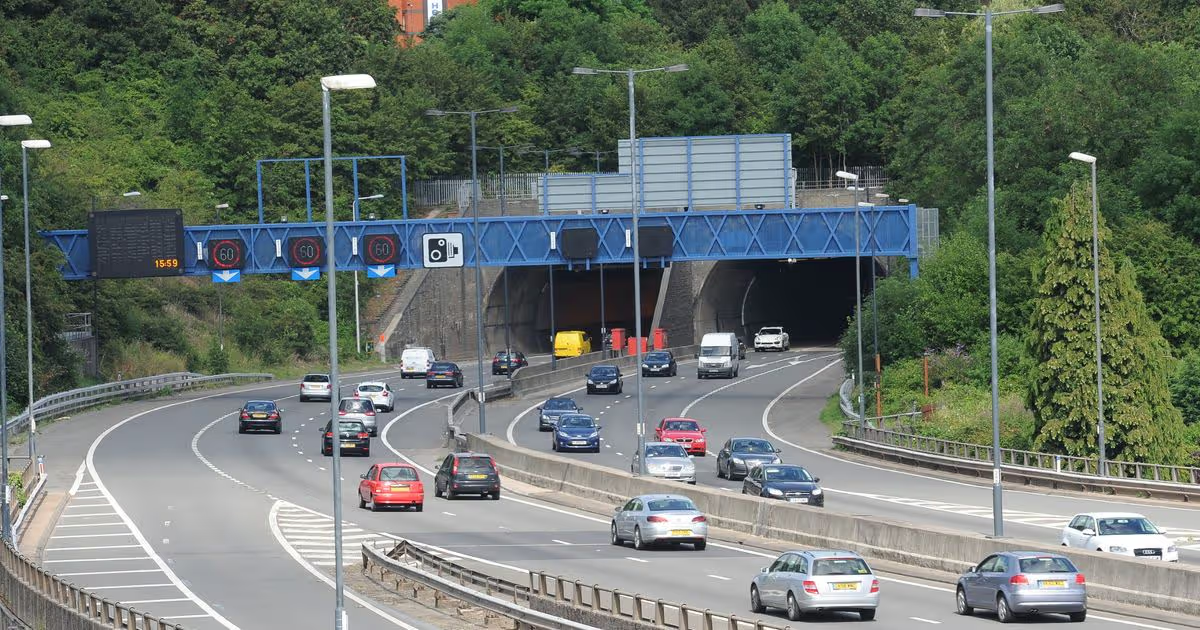
The Brynglas Tunnels(Image: South Wales Echo)
The next Welsh Government should look to build an M4 Relief Road as part of a suite of measures to boost productivity, says business body CBI Wales.
Seven years after plans for a £1.3bn M4 Relief Road – aimed at easing traffic congestion on the existing motorway between Cardiff and Newport, particularly around the Brynglas Tunnels – were rejected by then First Minister Mark Drakeford, CBI Wales is calling for a fresh look at the project in its Senedd election manifesto. It is also calling for improvements to the other main road route linking Wales and England, the A55 in North Wales.
The business membership body had lobbied hard for the so called 14-mile black route, a new section of motorway south of Newport running partly through the Gwent Levels from Castleton to Magor.
The funding model for the project, estimated at £1.3bn, would have combined the Welsh Government’s capital borrowing powers with a £500m facility from the UK Government.
With inflation any new project would likely cost more than £2bn. Any new funding model would require significant UK Government backing. While the CBI’s position is not to add to the cost of running businesses, any new relief road could potentially having a toll, even if a nominal amount.
Numerous versions of an M4 Relief Road were also previously rejected, including proposals before devolution in the 1990s and by the Labour-Plaid coalition Welsh Government in 2009. Those rejections resulted in improvements to the existing motorway, including increased lane capacity. Mr Drakeford went against the recommendation of an independent planning inspector by rejecting the black route on cost and environmental grounds.
Following the decision planning protection for the proposed route -which had been in place for 25 years to prevent other developments – was removed by the Welsh Government.
READ MORE: Swansea Council to fight WRU in court as announcement escalates Welsh rugby warREAD MORE: The man overseeing plans to transform the centre of Swansea
Revisiting an M4 Relief Road, even along the original black route, would require a new legal and public inquiry process. However, most of the publicly-owned land for the route has not been sold or developed on, while the section that would have run through ABP’s Port of Newport, is still available.
When rejecting the project, Mr Drakeford established the Burns Commission to explore public transport investments that could alleviate traffic on the M4, particularly through Newport. Chaired by Lord Burns, the commission recommended five new train stations between Cardiff and the Severn Tunnel. Last month, the UK Government confirmed it would fund these stations, although additional funding will need to be secured in the next spending review ahead of the 2029 General Election.
While supportive of the M4 Relief Road while in Mr Drakeford’s cabinet, First Minister Eluned Morgan is not considering revisiting the project as a manifesto pledge. The Welsh Conservatives have committed to delivering a new relief road.
In Made in Wales: A Manifesto to Support Firms & Create Jobs 2026–30, the CBI calls for prioritising and fast-tracking infrastructure projects that unlock economic growth, including transport links (such as the A55 and M4 Relief Road) and digital infrastructure (achieving full-fibre broadband and 5G coverage, especially in rural areas).

Director of CBI Wales Russell Greenslade
Director of CBI Wales Russell Greenslade said the case for an M4 Relief Road remains pressing with congestion on the existing and ageing M4 remaining a major concern for businesses. He added: “From a transportation and connectivity point of view, the more we have, the better, and an M4 Relief Road would be an example of that. It is not just the M4, but also the A55 in North Wales, which, to quote some of our members, can often be like a car park.
“There is a lot of growth happening in Newport with the compound semiconductor cluster. If we are going to attract more people to work there, then the transportation network needs to be improved. This feedback comes directly from our members and informs our manifesto. The message from business and investors is that infrastructure is needed if we want to grow the economy, though we are not advocating any particular route (M4 Relief Road) solution.”
While not as developed as the black route, there was also the proposed blue route, running through Newport and upgrading existing road infrastructure such as the Southern Distributor Road.
In its wide-ranging manifesto, the CBI calls on leaders to drive forward technology and innovation, remove planning system bottlenecks, invest in infrastructure, and reduce Wales’ high youth unemployment by giving young people access to skills, opportunities, and mental health support.
It also calls for the next Welsh Government to develop its own industrial strategy, aligning Welsh and UK policies to leverage economic growth. Last year, the UK Government published its own ten-year industrial strategy based on eight industry pillars, including fintech and renewable energy.
The business group urges party leaders to work in partnership with businesses to capitalise on Wales’ enterprise, world-class universities, colleges, skilled workforce, and abundant natural resources to bring jobs and prosperity to every corner of Wales. By leveraging pension fund backing, it said the investment capacity of the Development Bank of Wales should be scaled up to £2bn to support the growth of indigenous businesses.
It also calls for the establishment of a long-term Welsh innovation funding framework. This it said could involve merging and coordinating grants from agencies like Innovate UK (though non devolved), Medr, and Business Wales into a single, predictable fund that businesses can tap over a multi-year horizon.
The business body also highlights grid infrastructure capacity issues and consenting bottlenecks that” prevent renewables projects or factories from connecting to networks quickly.” It stresses that well-resourced planning is needed to avoid applications being ‘stuck’ for months or years awaiting approval.
The manifesto also calls for every 16–24-year-old to be offered access to paid placements integrated with mental health support, alongside more flexible, employer-led skills routes aligned with real job opportunities. While it does not specify how it would be measured, the manifesto also “challenges party leaders to transform Wales into “one of Europe’s most competitive and sustainable small economies by 2035.”
Mr Greenslade said: “Welsh businesses have shown great resilience and a fierce competitive streak in dealing with both the high cost of doing business and the uncertainty experienced over the past decade. This election is an opportunity for party leaders to make Wales one of Europe’s most competitive and sustainable small economies by 2035.
“A new Welsh industrial strategy that capitalises on the UK’s modern industrial strategy, and other UK policies on technology such as AI, can be a game-changer in raising innovation and productivity, bringing prosperity and high-quality jobs to every corner of Wales. Getting more young people into work will improve their mental health and tackle skills shortages that limit firms’ prospects.
“Enterprising businesses, a world-class education sector, abundant natural resources, and a superb geographical advantage can all give Welsh businesses a competitive edge. Working with business, party leaders must focus on what unites Wales to drive long-term sustainable growth.”
















![Crypto Leverage Shocker: $61B Risks EXPOSED [Full Report]](https://wordupnews.com/wp-content/uploads/2026/04/1776665179_maxresdefault-80x80.jpg)



































You must be logged in to post a comment Login