








Patrick Fitzgerald bridges the often unaddressed gap in helping people adopt accessibility tools.
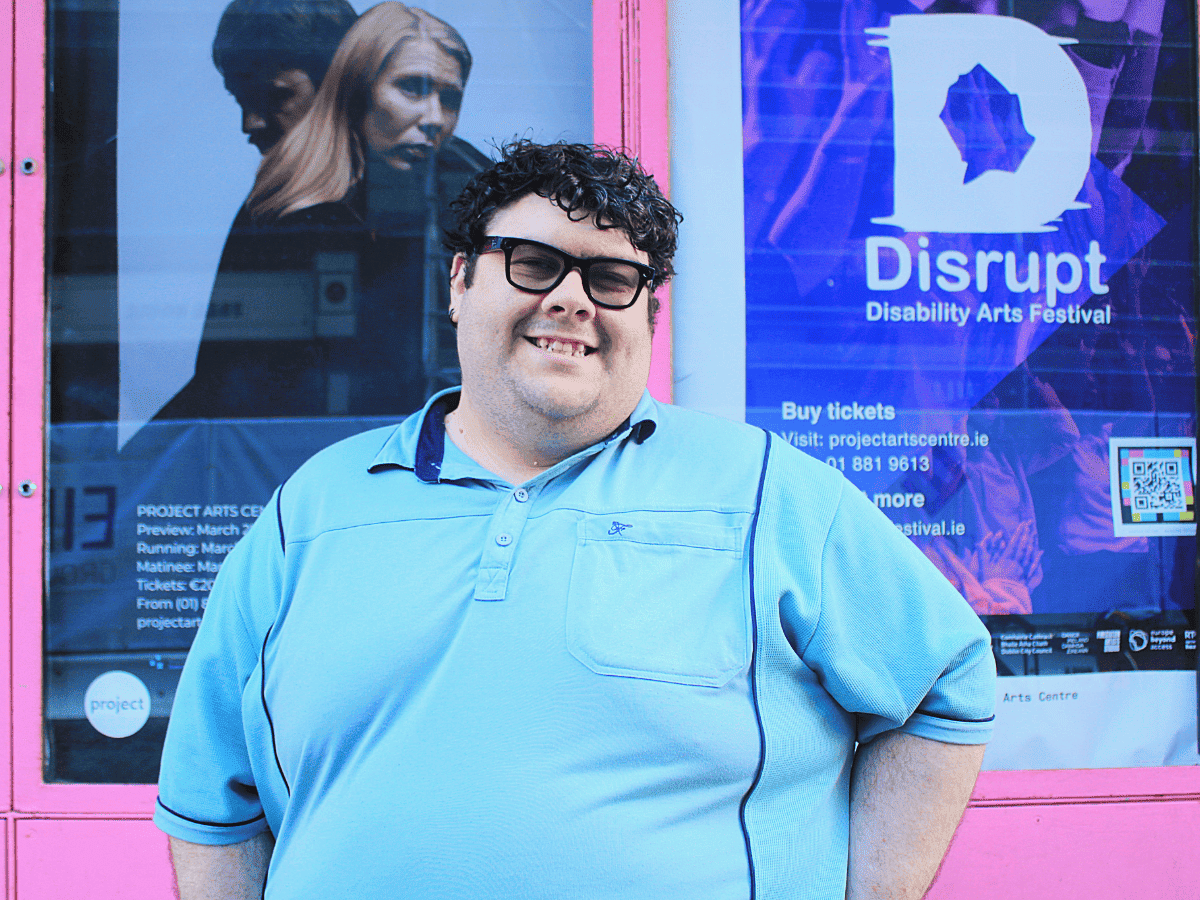
The Disrupt Disability Arts Festival was well underway by the time I reached Projects Arts Centre in Temple Bar. A sunny evening had added to the day’s apparent success, with many milling about the building as a sold-out 5pm theatre performance on life as a non-speaker begins.
In the busy foyer, a volunteer from the centre approaches me with a box of surgical masks, asking if I need one. I catch a small table with snacks and Palestine cola from the corner of my eye.
I’m here to meet Patrick Fitzgerald: a coach, not a teacher. He is persistent about that distinction. He approaches me, walking behind his colleague Sarah Boland, who would be facilitating our conversation.
Fitzgerald needs to use assistive technology (AT). During our chat, he describes screen readers and AI tools such as ChatGPT as essential to his day-to-day life (note how AI presents as a ‘tool of a lifetime’ for people with disabilities).
His Meta Ray-Ban glasses are a new addition to his arsenal. They bleep when I put them on, and after a few quick instructions, the glasses are able to recite text from a poster in front of me. It also translates speech in real-time on command. I concur that these might feel somewhat liberating to an AT user.
Still not a prerequisite
People who, like Fitzgerald, live with disabilities make up around 22pc of Ireland’s population, amounting to around 1.1m.
This population – perhaps still invisible to many – might require AT and other accessibility supports to thrive in their everyday lives. But such supports are still outside the grasp of many. Boland explains that it is likely that “hundreds of thousands” in Ireland could be without the AT support that they need.
And despite the significant disabled population in Ireland, other basic necessities such as internet accessibility (as mandated by law in the EU) are also not a given.
The National Disability Authority finds that websites in Ireland only have an average accessibility score of around 55.2pc when evaluated for features such as colour contrasts, text alternatives and file types. Around 96pc of all websites across the globe fail to meet basic accessibility standards.
Meanwhile, a global survey from 2025 reported that 84pc of its more than 1,500 participants (comprising software developers, engineers, user experience and legal professionals) said digital accessibility is a key priority for their company. Reality seems to be far different.
As an AT user-turned-coach, Fitzgerald uses his lived experience to encourage others and help bridge the AT adoption gap.
Among his many roles, Fitzgerald helps co-design websites and apps alongside developers to ensure accessibility is ingrained in tools from the get-go. Last year, he took part in the Carlow Arts Festival as a co-designer, where he also facilitated a workshop to discuss accessibility barriers.
Meanwhile, St John of God Services – Liffey – where Fitzgerald once learned how to use AT, and now works as a ‘digi-coach’ – has been co-designing websites with Technological University Dublin’s computer science students for a decade now.
In 2023, Boland and Fitzgerald bagged the only Irish win for the annual Zero Project at the UN for their co-designed toolkit for St John of God, which has nine digi-coaches working across its services in Dublin and Kerry. These coaches go into schools to work with students and staff to improve AT adoption.
The disability service also works in collaboration with the Dublin-based Fighting Blindness, which employs six digi-coaches to help with their cause. These coaches run workshops, including for those who don’t need AT in their daily lives.
Among the many tools available to him, Fitzgerald tells me about Osmo, a hands-on learning tool that he uses in his coaching lessons with young school students. Osmo uses computer vision to interact with physical objects. The platform helps with literacy and problem-solving. Other apps such as Book Creator and TD Snap are also in his day-to-day rotation for work.
Wary of technology
Despite the many wins, the stats are still worrying. The Disability Federation of Ireland notes that 14.4pc of disabled people over 15 who have ceased their education only ever completed primary level education. The number is nearly halved – at 7.4pc – for the general population. Boland tells me that a majority of those that St John of God supports don’t have literacy.
Meanwhile, only 12.4pc of new entrants to higher education in 2020 were students with disabilities. Plus, the disability employment rate in Ireland is just upwards of 32pc, nearly 20pc lower than the EU average of 51.3pc.
There is no standalone budget for digital assistive technology in Ireland, which makes it challenging to assert exactly how much is allocated towards improving digital inclusion.
However, the Government has several different schemes to help support AT pick-up, including the HSE Aids and Appliances Scheme, the Disability Services Budget, the Fund for Students with Disabilities, and the Assistive Technology Grant for schools.
Still, AT inaccessibility is a systemic issue, as availability of supports does not automatically translate into adoption. “The gap isn’t just about access, it’s about awareness, confidence, training and whether technology is designed with different types of people and needs in mind,” Boland says.
People can be hesitant to use new technology because of a lack of support when it comes to learning to use it safely and confidently. Fitzgerald notes that some staff members are “terrified that something will come up [in new tools]”. He tells me that some are still wary of commonly used tools such as Microsoft Teams despite the many accessibility supports available in the platform.
“No one knows about these tools so that’s why we get trained up,” Fitzgerald says.
“Looking back, it was very hard for me to communicate [without AT],” Fitzgerald adds. “It was hard with no technology and skills … no one there to support me [with] reading or writing [or] speech”.
He says he picked up AT in his late teens and got completely “caught out” by the tech. A Dublin native from Walkinstown, Fitzgerald went to the St John of God School Islandbridge before joining the charity’s day services.
As he sits up – still with his Meta glasses on – Fitzgerald, now 30, says he wasn’t wary of AT. “I wanted [to] kind of challenge myself and then I kind of got used to it, and then I want[ed] to show other people [including] friends and family.”
While he does much more than just show people how to use accessibility features on their devices, it is undeniable that this simple lesson is enough to begin changing lives.
“Patrick is demystifying [technology], because he’s going in and showing staff [that] this is easy [and] it’s a really great way to communicate,” Boland says.
Meanwhile, outside of the charity landscape, Ireland has a number of upcoming start-ups that focus on providing digital inclusion.
Last year, SiliconRepublic.com interviewed Nexus Inclusion’s Kyran O’Mahoney, whose start-up works alongside businesses to improve digital accessibility. O’Mahoney recently took home an award for his work.
Similarly, accessibility start-up DevAlly enables businesses to audit and fix accessibility issues without requiring specialised expertise or outsourcing.
Don’t miss out on the knowledge you need to succeed. Sign up for the Daily Brief, Silicon Republic’s digest of need-to-know sci-tech news.










































You must be logged in to post a comment Login