

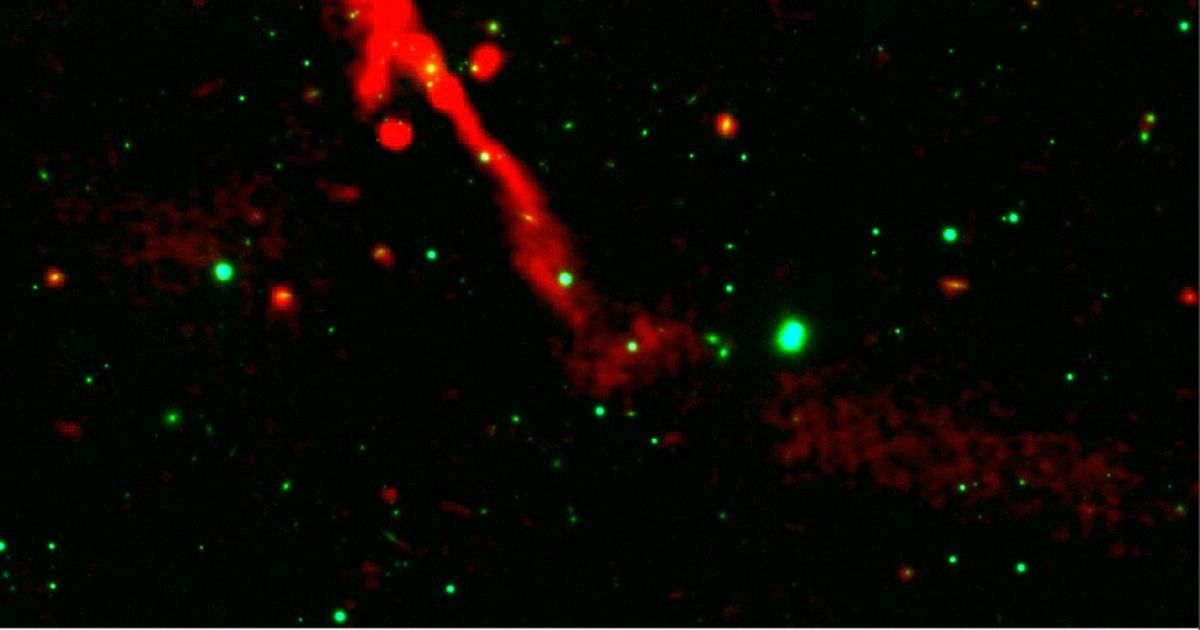
“It’s like watching a cosmic volcano erupt again after ages of calm”
After nearly 100 million years of silence, a supermassive black hole in space has been ‘reborn’. Astronomers say the black hole, called J1007+3540, is erupting ‘like a volcano’ and wreaking havoc nearly a million light-years across space.
A supermassive black hole is the largest type of black hole, which is a place in space where gravity pulls so much that nothing – not even light – can not get out. The gravity is so strong because matter has been squeezed into a tiny space, which can happen when a massive star dies and its core collapses.
While black holes in space are invisible, astronomers can spot them in space by observing their powerful gravitational effects on nearby stars and gas. New research using radio images revealed a bright inner jet of radio-emitting magnetised plasma.
According to lead researcher Shobha Kumari, of Midnapore City College in India, this was the unmistakable sign of the ‘sleeping’ black hole’s reawakening.
“It’s like watching a cosmic volcano erupt again after ages of calm – except this one is big enough to carve out structures stretching nearly a million light-years across space”, she said. “This dramatic layering of young jets inside older, exhausted lobes is the signature of an episodic AGN – a galaxy whose central engine keeps turning on and off over cosmic timescales.”
The research was carried out by Kumari and co-authors Dr Sabyasachi Pal, of Midnapore City College, Dr Surajit Paul, associate professor at the Manipal Centre for Natural Sciences in India, and Dr Marek Jamrozy, of Jagiellonian University in Poland.
“J1007+3540 is one of the clearest and most spectacular examples of episodic AGN with jet-cluster interaction, where the surrounding hot gas bends, compresses, and distorts the jets,” Dr Pal added.
Astronomers say studying black holes like J1007+3540 can help them to understand how black holes turn on and off, and how jets evolve over millions of years. The authors say the latest finding shows that the growth of galaxies is not peaceful or gradual but is instead a battle between the explosive power of black holes and the crushing pressure of the environments they live in.
The research team now plans to use more high-resolution observations to zoom even deeper into the core of the supermassive black hole and track how the restarted jets spread through its environment.
The research was published in Monthly Notices of the Royal Astronomical Society.



