News Beat
Why We See Northern Lights In The UK Now: Explained

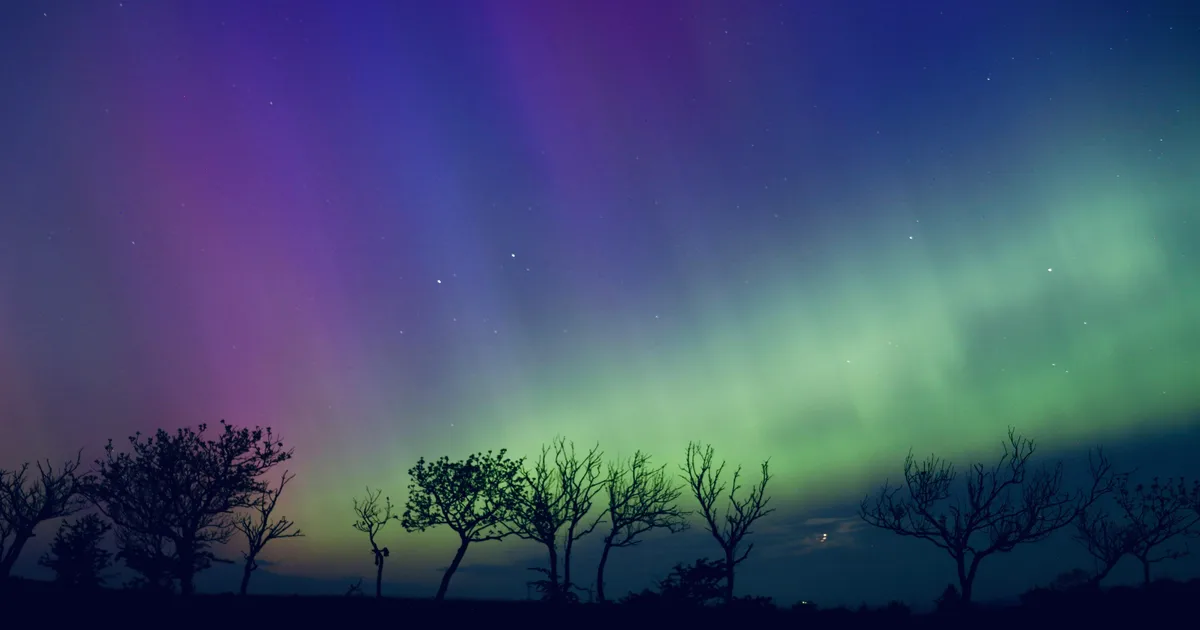
If your social media feeds are anything like mine, this week kicked off with photo after photo of the northern lights lighting up the sky in your friends’ back gardens.
Just a few years ago though, this would have been unfathomable. Seeing the spectacular display was a mainstay on people’s bucket lists and was often only seen in photographs and films.
Why we can see northern lights in the UK
On their website, Royal Museums Greenwich explained that the lights we see in the night sky are caused by activity on the surface of the Sun.
“Solar storms on our star’s surface give out huge clouds of electrically charged particles. These particles can travel millions of miles, and some may eventually collide with the Earth,” the museums’ website explained.
“Most of these particles are deflected away, but some become captured in the Earth’s magnetic field, accelerating down towards the north and south poles into the atmosphere. This is why aurora activity is concentrated at the magnetic poles.”
This is why the further north in the UK you are, the more likely you’ll see one of these stunning displays. However, the northern lights have very occasionally been seen as far south as Cornwall and Brighton.
BBC Bitesize shares that we can expect more this year, saying: “September to April is the best time for aurora spotting, mainly because the colder months of the year are also the darkest.
“The sun is currently in a period of increased activity, meaning there are expected to be more solar storms than usual in the first few months of 2026.”
Why the northern lights look better on camera
If you have taken a photo of the sky during one of these displays, you’ve likely been stunned by what the camera can pick up compared to your own vision.
The Conversation explained: “Inside the human eye, there are two types of cells used for seeing. The ‘cone’ cells are sensitive to colour but need plenty of light in order to function, whereas the “rods” cells are sensitive to low light levels but cannot distinguish colour.
“When it’s dark, the cone cells don’t work and the rods take over. This is why, when you stumble to the bathroom in the middle of the night, everything appears grey as the cones aren’t receiving enough light to recognise colours. But that’s when the rods come into their own, allowing to see your way in grey scale.”
Of course, cameras don’t have this problem and can make up for dark conditions by using a longer exposure, collecting light for longer which builds up colours and an entire picture better than our eyes ever could.
How to find out when the northern lights are visible in the UK?
In the UK, we actually have AuroraWatch UK, which takes geomagnetic activity measurements “to automatically detect when it is likely that aurora can be seen from the UK”.
They provide updates on X, Facebook and with a dedicated AuroraWatch app.