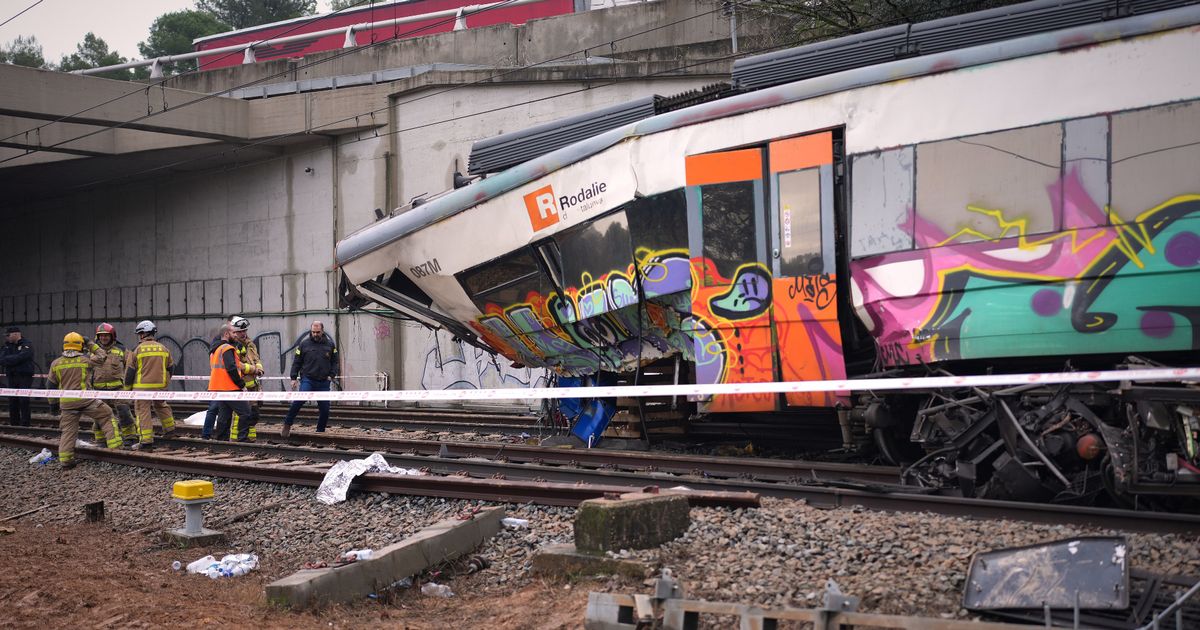
The Foreign Office has issued an update to British travellers after a train derailed near Barcelona
The UK Foreign Commonwealth and Development Office has issued a further update to British travellers warning them of ‘major disruption’ to regional rail services following a second fatal train crash in a matter of days. On Tuesday evening (January 20) a driver was killed and 37 were left injured after a commuter train derailed near Barcelona.
It comes only two days after 42 people died and dozens more were injured in a separate incident when two high-speed trains collided in Andalusia, southern Spain. The second crash occurred as the country enters three days of national mourning following Sunday’s collision.
Emergency services in Catalonia said of the 15 people affected in Tuesday’s crash, three were seriously injured. Five others were in less serious conditions. Emergency services said 11 ambulances had been sent to the site of the crash.
The commuter train crashed near the town of Gelida, located about 35 minutes outside of Barcelona. Spain’s railway operator ADIF said the containment wall likely collapsed due to heavy rainfall that swept across the north-eastern Spanish region this week.
Following the second train crash, the FCO has issued an update to Brits in Spain, warning them of “major disruption” to regional real services. In an update to its travel advice page for Spain, it said: “Following incidents on the Catalan Rodalies (cercanías) rail network on 20 January, expect major disruption on all Rodalies services. Check routes before travelling.”
Earlier this week the FCO issued guidance following the Andalusia collision. It said: “On 18 January, two high‑speed trains collided near Adamuz, in the province of Córdoba in Andalusia, southern Spain.
“Significant disruption to rail services between Madrid and Andalusia is expected, with all high‑speed services between Madrid and Córdoba, Seville, Málaga, Granada and Huelva suspended. Services between Madrid and Cádiz, Algeciras and Granada will also be affected.
“If you need assistance or information about affected passengers, you can contact:
- ADIF: (+34) 900 10 10 20 @Adif_es
- IRYO: (+34) 900 00 14 02 @iryo_eu
- Emergency services (112 EMA): From inside Andalusia: 061; from outside Andalusia: (+34) 953 00 11 49
“If you are a British national and you or a family member have been affected by this accident and require consular support, call the nearest British Embassy or Consulate on 0034 91 714 6300.”
Regarding Sunday’s collision, Antonio Sanz, the regional health minister of Andalusia, where the accident occurred, told Spanish media that the official toll from the collision had risen after another body was discovered in a severely damaged car. Amid the tragedy, it emerged that a six-year-old girl survived the wreck without major injury, while her parents, brother and cousin all perished.
Health authorities said 39 people remained in hospitals on Tuesday morning, while 83 people were treated and discharged. The crash happened at 7.45pm when the tail end of a train carrying 289 passengers on the route from Malaga to the capital, Madrid, derailed and crashed into an incoming train travelling from Madrid to Huelva, another southern city, according to rail operator Adif.
The front of the second train, which was carrying 184 people, took the brunt of the impact, which knocked its first two carriages off the track and down a four-metre (13ft) slope. Some bodies were found hundreds of metres from the crash site, according to Andalusia regional president Juanma Moreno.
Officials are continuing to investigate the causes of the accident that transport minister Oscar Puente has called “truly strange” since it occurred on a straight line and neither train was speeding. Mr Puente said officials had found a broken section of track that could possibly be related to the accident’s origin, while insisting that was just a hypothesis and that it could take weeks to reach any conclusions.
“Now we have to determine if that is a cause or a consequence (of the derailment),” Mr Puente told Spanish radio Cadena Ser. At this time, “all hypotheses are open”, interior minister Grande Marlaska told a press conference.
Accident investigators would analyse “the rails at the point where the derailment began and inspect the wheels” of the first train in a laboratory, he added.