Connect with us

NewsBeat

Is time a fundamental part of reality? A quiet revolution in physics suggests not

Published

on

Is time a fundamental part of reality? A quiet revolution in physics suggests not

Time feels like the most basic feature of reality. Seconds tick, days pass and everything from planetary motion to human memory seems to unfold along a single, irreversible direction. We are born and we die, in exactly that order. We plan our lives around time, measure it obsessively and experience it as an unbroken flow from past to future. It feels so obvious that time moves forward that questioning it can seem almost pointless.

And yet, for more than a century, physics has struggled to say what time actually is. This struggle is not philosophical nitpicking. It sits at the heart of some of the deepest problems in science.

Modern physics relies on different, but equally important, frameworks. One is Albert Einstein’s theory of general relativity, which describes the gravity and motion of large objects such as planets. Another is quantum mechanics, which rules the microcosmos of atoms and particles. And on an even larger scale, the standard model of cosmology describes the birth and evolution of the universe as a whole. All rely on time, yet they treat it in incompatible ways.

When physicists try to combine these theories into a single framework, time often behaves in unexpected and troubling ways. Sometimes it stretches. Sometimes it slows. Sometimes it disappears entirely.

Advertisement

The Insights section is committed to high-quality longform journalism. Our editors work with academics from many different backgrounds who are tackling a wide range of societal and scientific challenges.


Einstein’s theory of relativity was, in fact, the first major blow to our everyday intuition about time. Time, Einstein showed, is not universal. It runs at different speeds depending on gravity and motion. Two observers moving relative to one another will disagree about which events happened at the same time. Time became something elastic, woven together with space into a four-dimensional fabric called spacetime.

Quantum mechanics made things even stranger. In quantum theory, time is not something the theory explains. It is simply assumed. The equations of quantum mechanics describe how systems evolve with respect to time, but time itself remains an external parameter, a background clock that sits outside the theory.

Advertisement


À lire aussi :
Quantum mechanics: how the future might influence the past


This mismatch becomes acute when physicists try to describe gravity at the quantum level, which is crucial for developing the much coveted theory of everything – which links the main fundamental theories. But in many attempts to create such a theory, time vanishes as a parameter from the fundamental equations altogether. The universe appears frozen, described by equations that make no reference to change.

This puzzle is known as the problem of time, and it remains one of the most persistent obstacles to a unified theory of physics. Despite enormous progress in cosmology and particle physics, we still lack a clear explanation for why time flows at all.

Now a relatively new approach to physics, building on a mathematical framework called information theory, developed by Claude Shannon in the 1940s, has started coming up with surprising answers.

Advertisement

Entropy and the arrow of time

When physicists try to explain the direction of time, they often turn to a concept called entropy. The second law of thermodynamics states that disorder tends to increase. A glass can fall and shatter into a mess, but the shards never spontaneously leap back together. This asymmetry between past and future is often identified with the arrow of time.

This idea has been enormously influential. It explains why many processes are irreversible, including why we remember the past but not the future. If the universe started in a state of low entropy, and is getting messier as it evolves, that appears to explain why time moves forward. But entropy does not fully solve the problem of time.

Spools of coloured embroidery threads. Huge knot is haphazardly braided.

It is hard to undo a mess.
klevo/Shutterstock

For one thing, the fundamental quantum mechanical equations of physics do not distinguish between past and future. The arrow of time emerges only when we consider large numbers of particles and statistical behaviour. This also raises a deeper question: why did the universe start in such a low-entropy state to begin with? Statistically, there are more ways for a universe to have high entropy than low entropy, just as there are more ways for a room to be messy than tidy. So why would it start in a state that is so improbable?

The information revolution

Over the past few decades, a quiet but far-reaching revolution has taken place in physics. Information, once treated as an abstract bookkeeping tool used to track states or probabilities, has increasingly been recognised as a physical quantity in its own right, just like matter or radiation. While entropy measures how many microscopic states are possible, information measures how physical interactions limit and record those possibilities.

Advertisement

This shift did not happen overnight. It emerged gradually, driven by puzzles at the intersection of thermodynamics, quantum mechanics and gravity, where treating information as merely mathematical began to produce contradictions.

One of the earliest cracks appeared in black hole physics. When Stephen Hawking showed that black holes emit thermal radiation, it raised a disturbing possibility: information about whatever falls into a black hole might be permanently lost as heat. That conclusion conflicted with quantum mechanics, which demands that the entirety of information be preserved.

Resolving this tension forced physicists to confront a deeper truth. Information is not optional. If we want a full description of the universe that includes quantum mechanics, information cannot simply disappear without undermining the foundations of physics. This realisation had profound consequences. It became clear that information has thermodynamic cost, that erasing it dissipates energy, and that storing it requires physical resources.

In parallel, surprising connections emerged between gravity and thermodynamics. It was shown that Einstein’s equations can be derived from thermodynamic principles that link spacetime geometry directly to entropy and information. In this view, gravity doesn’t behave exactly like a fundamental force.

Advertisement

Instead, gravity appears to be what physicists call “emergent” – a phenomenon describing something that’s greater than the sum of its parts, arising from more fundamental constituents. Take temperature. We can all feel it, but on a fundamental level, a single particle can’t have temperature. It’s not a fundamental feature. Instead it only emerges as a result of many molecules moving collectively.

Similarly, gravity can be described as an emergent phenomenon, arising from statistical processes. Some physicists have even suggested that gravity itself may emerge from information, reflecting how information is distributed, encoded and processed.

These ideas invite a radical shift in perspective. Instead of treating spacetime as primary, and information as something that lives inside it, information may be the more fundamental ingredient from which spacetime itself emerges. Building on this research, my colleagues and I have explored a framework in which spacetime itself acts as a storage medium for information – and it has important consequences for how we view time.

In this approach, spacetime is not perfectly smooth, as relativity suggests, but composed of discrete elements, each with a finite capacity to record quantum information from passing particles and fields. These elements are not bits in the digital sense, but physical carriers of quantum information, capable of retaining memory of past interactions.

Advertisement

A useful way to picture them is to think of spacetime like a material made of tiny, memory-bearing cells. Just as a crystal lattice can store defects that appeared earlier in time, these microscopic spacetime elements can retain traces of the interactions that have passed through them. They are not particles in the usual sense described by the standard model of particle physics, but a more fundamental layer of physical structure that particle physics operates on rather than explains.

This has an important implication. If spacetime records information, then its present state reflects not only what exists now, but everything that has happened before. Regions that have experienced more interactions carry a different imprint of information than regions that have experienced fewer. The universe, in this view, does not merely evolve according to timeless laws applied to changing states. It remembers.

A recording cosmos

This memory is not metaphorical. Every physical interaction leaves an informational trace. Although the basic equations of quantum mechanics can be run forwards or backwards in time, real interactions never happen in isolation. They inevitably involve surroundings, leak information outward and leave lasting records of what has occurred. Once this information has spread into the wider environment, recovering it would require undoing not just a single event, but every physical change it caused along the way. In practice, that is impossible.

This is why information cannot be erased and broken cups do not reassemble. But the implication runs deeper. Each interaction writes something permanent into the structure of the universe, whether at the scale of atoms colliding or galaxies forming.

Advertisement

Geometry and information turn out to be deeply connected in this view. In our work, we have showed that how spacetime curves depends not only on mass and energy, as Einstein taught us, but also on how quantum information, particularly entanglement, is distributed. Entanglement is a quantum process that mysteriously links particles in distant regions of space – it enables them to share information despite the distance. And these informational links contribute to the effective geometry experienced by matter and radiation.

From this perspective, spacetime geometry is not just a response to what exists at a given moment, but to what has happened. Regions that have recorded many interactions tend, on average, to behave as if they curve more strongly, have stronger gravity, than regions that have recorded fewer.

This reframing subtly changes the role of spacetime. Instead of being a neutral arena in which events unfold, spacetime becomes an active participant. It stores information, constrains future dynamics and shapes how new interactions can occur. This naturally raises a deeper question. If spacetime records information, could time emerge from this recording process rather than being assumed from the start?

Time arising from information

Recently, we extended this informational perspective to time itself. Rather than treating time as a fundamental background parameter, we showed that temporal order emerges from irreversible information imprinting. In this view, time is not something added to physics by hand. It arises because information is written in physical processes and, under the known laws of thermodynamics and quantum physics, cannot be globally unwritten again. The idea is simple but far-reaching.

Advertisement

Every interaction, such as two particles crashing, writes information into the universe. These imprints accumulate. Because they cannot be erased, they define a natural ordering of events. Earlier states are those with fewer informational records. Later states are those with more.

Quantum equations do not prefer a direction of time, but the process of information spreading does. Once information has been spread out, there is no physical path back to a state in which it was localised. Temporal order is therefore anchored in this irreversibility, not in the equations themselves.

Time, in this view, is not something that exists independently of physical processes. It is the cumulative record of what has happened. Each interaction adds a new entry, and the arrow of time reflects the fact that this record only grows.

The future differs from the past because the universe contains more information about the past than it ever can about the future. This explains why time has a direction without relying on special, low-entropy initial conditions or purely statistical arguments. As long as interactions occur and information is irreversibly recorded, time advances.

Advertisement

Interestingly, this accumulated imprint of information may have observable consequences. At galactic scales, the residual information imprint behaves like an additional gravitational component, shaping how galaxies rotate without invoking new particles. Indeed, the unknown substance called dark matter was introduced to explain why galaxies and galaxy clusters rotate faster than their visible mass alone would allow.

In the informational picture, this extra gravitational pull does not come from invisible dark matter, but from the fact that spacetime itself has recorded a long history of interactions. Regions that have accumulated more informational imprints respond more strongly to motion and curvature, effectively boosting their gravity. Stars orbit faster not because more mass is present, but because the spacetime they move through carries a heavier informational memory of past interactions.

Image of the Andromeda Galaxy.

Galaxies rotate faster than they should.
Wirestock Creators/Shutterstock

From this viewpoint, dark matter, dark energy and the arrow of time may all arise from a single underlying process: the irreversible accumulation of information.

Testing time

But could we ever test this theory? Ideas about time are often accused of being philosophical rather than scientific. Because time is so deeply woven into how we describe change, it is easy to assume that any attempt to rethink it must remain abstract. An informational approach, however, makes concrete predictions and connects directly to systems we can observe, model and in some cases experimentally probe.

Advertisement

Black holes provide a natural testing ground, as they seems to suggest information is erased. In the informational framework, this conflict is resolved by recognising that information is not destroyed but imprinted into spacetime before crossing the horizon. The black hole records it.

This has an important implication for time. As matter falls toward a black hole, interactions intensify and information imprinting accelerates. Time continues to advance locally because information continues to be written, even as classical notions of space and time break down near the horizon and appear to slow or freeze for distant observers.

As the black hole evaporates through Hawking radiation, the accumulated informational record does not vanish. Instead, it affects how radiation is emitted. The radiation should carry subtle signs that reflect the black hole’s history. In other words, the outgoing radiation is not perfectly random. Its structure is shaped by the information previously recorded in spacetime. Detecting such signs remains beyond current technology, but they provide a clear target for future theoretical and observational work.

The same principles can be explored in much smaller, controlled systems. In laboratory experiments with quantum computers, qubits (the quantum computer equivalent of bits) can be treated as finite-capacity information cells, just like the spacetime ones. Researchers have shown that even when the underlying quantum equations are reversible, the way information is written, spread and retrieved can generate an effective arrow of time in the lab. These experiments allow physicists to test how information storage limits affect reversibility, without needing cosmological or astrophysical systems.

Advertisement

Extensions of the same framework suggest that informational imprinting is not limited to gravity. It may play a role across all fundamental forces of nature, including electromagnetism and the nuclear forces. If this is correct, then time’s arrow should ultimately be traceable to how all interactions record information, not just gravitational ones. Testing this would involve looking for limits on reversibility or information recovery across different physical processes.

Taken together, these examples show that informational time is not an abstract reinterpretation. It links black holes, quantum experiments and fundamental interactions through a shared physical mechanism, one that can be explored, constrained and potentially falsified as our experimental reach continues to grow.

What time really is

Ideas about information do not replace relativity or quantum mechanics. In everyday conditions, informational time closely tracks the time measured by clocks. For most practical purposes, the familiar picture of time works extremely well. The difference appears in regimes where conventional descriptions struggle.

Near black hole horizons or during the earliest moments of the universe, the usual notion of time as a smooth, external coordinate becomes ambiguous. Informational time, by contrast, remains well defined as long as interactions occur and information is irreversibly recorded.

Advertisement

All this may leave you wondering what time really is. This shift reframes the longstanding debate. The question is no longer whether time must be assumed as a fundamental ingredient of the universe, but whether it reflects a deeper underlying process.

In this view, the arrow of time can emerge naturally from physical interactions that record information and cannot be undone. Time, then, is not a mysterious background parameter standing apart from physics. It is something the universe generates internally through its own dynamics. It is not ultimately a fundamental part of reality, but emerges from more basic constituents such as information.

Whether this framework turns out to be a final answer or a stepping stone remains to be seen. Like many ideas in fundamental physics, it will stand or fall based on how well it connects theory to observation. But it already suggests a striking change in perspective.

The universe does not simply exist in time. Time is something the universe continuously writes into itself.

Advertisement

For you: more from our Insights series:

To hear about new Insights articles, join the hundreds of thousands of people who value The Conversation’s evidence-based news. Subscribe to our newsletter.


Source link

Advertisement
Continue Reading
Click to comment

Leave a Reply

Your email address will not be published. Required fields are marked *

NewsBeat

Lisa McHugh says losing the use of her legs changed her life forever – and she feels grateful

Published

on

Ipso logo

Last summer, Lisa McHugh was hospitalised after temporarily losing the use of both legs and experiencing excruciating pain in her face and head. Following extensive tests, she was eventually diagnosed with Functional Neurological Disorder (FND), a condition that affects how the brain and nervous system send and receive signals.

“It basically means there’s a nervous system problem and your brain isn’t sending the signals properly to your limbs or body. They call it a software problem in your brain, not a hardware problem,” Lisa explains.

The diagnosis saw her go from touring and raising two young children – Milo, now four, and Hallie, 18 months – to being unable to carry them and relearning how to walk using a frame.

READ MORE: Lisa McHugh shares health update after sepsis hospitalisationREAD MORE: Lisa McHugh gives health update as she fights sepsis

Advertisement

And speaking to RSVP Country, the country singer says while the past year has been the hardest of her life, it is also somehow one she is deeply grateful for. And she admits while excited about returning to the stage, she has learned the importance of prioritising her own health after years of pushing herself to the brink.

“We’re seven months into recovery, and I keep reminding myself that this wasn’t like having a tooth pulled – you lost your body”, she admits.

“My body basically shut down, the nervous system completely shut down, brought on by a lot of things. Stress is a big one; there was a lot going on at home, with my family, with Hallie not being well. There were worrying times, and all of that took its toll on me. I didn’t look after myself the way I should have,” she reflects.

“Recovery-wise, I’m good with everyday things, but I want to do gigs and live performances again at the level I was doing them, without feeling completely exhausted for days after. That will take time – I need to build up slowly and give my body a chance to get back into the swing of things. But I fully believe I will be fine again.”

Advertisement

However, she insists she will never return to the hectic pace of her former life, adding: “I’ll get back to performing while managing my energy carefully. I won’t put myself in the position I was in this time last year because I know that only ends one way, and that’s the last thing we want.”

Speaking about the stresses that lead up to her becoming so depleted she discussed how like so many working mothers, she tried to do it all: “I definitely know I was wearing a lot of hats, or trying to.

Advertisement

“Hallie was very sick and in and out of hospital for most of last year, which was very worrying. You have the constant stresses of being self-employed, trying to get enough hours in the day, dealing with the kids, and then thinking about social media, gigs, emails. Are there things I’ve missed? Then school, shopping, dinners, being a wife, a daughter, a mother – all of those things take a toll.

“I’ve had to learn that there are things I need to do that are non-negotiable. But there are some things I can do tomorrow. At the end of the day, your health is the most important thing, and the health of your family.

“Work is important, but it’s not life or death if you don’t get back to that email until the following day. It’s about balancing everything and making sure I have even half an hour to myself to rest and recharge.”

While the past year has been extraordinarily difficult, Lisa reveals it has also strangely changed her for the better, and shown her what is most important in her life.

Advertisement

“I 100% believe that. As tough as it was and still is, I also feel very lucky,”, she reveals.

“It could have been much worse. I might not have had the outcome or the chance of recovery and to reset things like I have. So yeah, it’s been tough, but I feel very lucky that it happened because it made me physically stop.

“I knew I was run down, tired, struggling, stressed, but I clearly wasn’t willing to stop and relax. So my body said, okay, if you’re not going to stop, we’ll make you stop. Looking back, what did I expect? It was only a matter of time, and thank God it was this and not something worse.”

Advertisement

She also shared her gratitude for her fans, who have showed Lisa an outpouring of love and support through her illness: “The response was overwhelming – the messages, cards, flowers, gifts, emails were constant, and still are to this day. I genuinely have the best fans in the world. Their prayers, well wishes, and support have helped me get to where I am now.”

To read Lisa’s interview in full and see all the stunning pictures, pick up the Spring edition of RSVP Country on shelves now.

Want to see more of the stories you love from Belfast Live? Making us your preferred source on Google means you’ll get more of our exclusives, top stories and must-read content straight away. To add Belfast Live as a preferred source, simply click here

Source link

Advertisement
Continue Reading

NewsBeat

M&S shoppers can snap up Mother’s Day fragrance for 60p in deal

Published

on

Belfast Live

“The new range of Eau de Parfums from M&S are great quality and long lasting. This scent is nice and fresh.”

If you’re searching for a Mother’s Day present for that important woman in your life, a fresh fragrance is always a safe bet. Marks and Spencer is known for its wide perfume selection, including the ‘Discover’ and ‘Apothecary’ collections that deliver high-end fragrances without the price tag.

The Sweet Water Lily Eau De Parfum 50ml is currently retailing at £16 and has been flagged as ‘selling fast’ on the M&S site, but there’s a way to secure it for considerably less. First-time members of cashback platform TopCashback and new M&S customers (without a login) can get the scent for just 60p after cashback by registering here.

This means you could purchase the present for under a pound. Existing M&S shoppers can still benefit from a reduced price of 87p after cashback – by using the same unique link.

Advertisement

According to the M&S website, the complete product description states: “Expand your fragrance collection with the fresh Sweet Water Lily Eau De Parfum from our Discover range. It’s blended with notes of waterlily and violet leaf that create a natural aroma. Crisp green base aromas, as well as comforting vanilla and musk add warm depth. This scent is housed in a 50ml glass bottle, with a sculptural cap for a stylish look.

“From sweet, fruity notes to spicy ambers, experimentation is a key part of finding the fragrance that suits you. ‘Discover’ offers you a varierty of scents mapped across the fragrance families for you to explore and find your perfect scent.”

For those seeking a luxury branded fragrance, Boots has dramatically cut the price of this Jimmy Choo Eau de Parfum 60ml from its original £70 to £35. It’s been flagged as ‘selling fast’ and the offer can be viewed here, reports the Liverpool Echo.

Meanwhile, at The Perfume Shop, this Gucci Bamboo Eau de Parfum Spray has been discounted to £49.99 from £90. More details are available here.

Advertisement

Returning to the M&S reviews for the perfume, one customer commented: “This is a lovely fragrance…very delicate and floral. Long-lasting on skin as well”.

Another buyer remarked: “Bought for myself, love M&S perfumes. Inexpensive and delightful fragrance.”

A third shopper said: “The new range of Eau de Parfums from M&S are great quality and long lasting. This scent is nice and fresh.”

At the time of publication, no negative feedback for the fragrance has appeared online. It can be bought at full price here.

Advertisement

How to get the M&S fragrance for 60p

  • To claim the new member bonus, new members of TopCashback need to sign up via the TopCashback website.
  • Search for M&S click ‘Get Cashback Now’.
  • Shop and checkout as usual.
  • Cashback will then track and appear in your TopCashback account within seven working days of your purchase.

Want to see more of the stories you love from Belfast Live? Making us your preferred source on Google means you’ll get more of our exclusives, top stories and must-read content straight away. To add Belfast Live as a preferred source, simply click here.

Source link

Continue Reading

NewsBeat

BBC Breakfast’s Naga Munchetty ‘takes swipe at Sally Nugent’s glam makeover’

Published

on

Daily Mirror

Naga Munchetty has allegedly taken a dig at Sally Nugent’s glamorous new look, which she revealed on Instagram thus month, and issued a bizarre insult about her BBC Breakfest co-star

Naga Munchetty is alleged to have ‘ruffled feathers’ with comments about Sally Nugent’s glamorous new look. Naga, 51, is best known for fronting BBC Breakfast but in more recent months has come under fire amid allegations of bullying on set. The allegations were eventually turned into a formal investigation.

According to insiders, Naga issued a bizarre dig aimed at co-star Sally, 54, following her glossy makeover, claiming that she looked as if she was about to take up a job on the “less serious” rival channel with her new look.

According to The Sun, Naga said: “We’re meant to be serious journalists, not trying to look like we’re presenting This Morning!”

Advertisement

READ MORE: BBC Breakfast host Sally Nugent’s appearance distracts viewers minutes into live showREAD MORE: BBC Breakfast shake-up as presenter Ben Thompson hosts programme alone

An insider then claimed that Sally’s new look has caused some upset backstage and Naga’s comment was a “nasty little moment” amid the ongoing investigation.

Advertisement

A source told the outlet: “Sally’s had a glow-up and her new do is looking fantastic. But it ruffled feathers as is often the way in the showbiz industry, There were a couple of remarks about it and Naga particularly made a comment about them being journalists not This Morning hosts.

“Things have been ticking along fairly quietly for the last couple of months whilst the bullying investigations continued but this was a nasty little moment!”

A BBC spokesperson told The Mirror: “We do not comment on individual staff issues.”

Naga has been a part of the programme for over a decade and normally presents with Charlie Stayt from Thursdays to Saturdays, whilst Sally takes the reins at the start of the week alongside Jon Sen.

Advertisement

Sally posted her glamorous new look onto social media earlier this month, and tagged Calum Tierney, who has worked with Coronation Street stars Samia Longchambon and Michelle Keegan in the past.

She instantly won praise from several of her celebrity pals, with Morning Live’s Helen Skelton leaving three fire emojis in the comments section, whilst Strictly Come Dancing professional Nadiya Bychkova said: “Gorgeous” and Michelle Ackerley said: “Beautiful [red heart emoji]”

Towards the end of last year, a string of claims made against Naga, who also presents on BBCRadio 5 Live. Allegations relating to Naga vary from allegedly hitting out at an intern for spreading Marmite on her toast incorrectly, and making an unwanted sexual remark to a female colleague.

Advertisement

Naga also allegedly hit out, claiming her porridge was “too hot” and she wasn’t a fan of blueberries, which had been used as a topping. BBC Breakfast boss Richard Frediani had also faced accusations of bullying before Naga and her co-anchor, Charlie Stayt, faced claims. The complaints about Frediani were not upheld. Stayt is said to remain “under review”.

The workplace culture review, led by management consultant Grahame Russell from Change Associates, was launched in the wake of the furore over disgraced former newsreader Huw Edwards.

At the time, a source said: “Naga has not been taken off air but now has certain members of production monitoring her and her interactions.

“She’s only allowed to speak to specific people too. It’s far from ideal as a way of working and everyone hopes it comes to a head someway or another soon!”

Advertisement

Like this story? For more of the latest showbiz news and gossip, follow Mirror Celebs on TikTok , Snapchat , Instagram , Twitter , Facebook , YouTube and Threads .

Source link

Advertisement
Continue Reading

NewsBeat

North Yorkshire farm shop and deli among UK’s best for 2026

Published

on

North Yorkshire farm shop and deli among UK's best for 2026

Cedarbarn Farm Shop and Cafe, set on the edge of the North Yorkshire Moors in Pickering, has been praised by Olive magazine for being a “treasure trove of Yorkshire deli finds”.

It’s also been described as a “go-to spot for foodies” thanks to its array of stock, including artisan treats, its own farm produce, Shepherd’s Purse cheeses, and Whitby Seafish smoked fish, to name a few.

The foodie publisher explained about its latest guide: “Delicatessens are fast becoming go-to destinations for food lovers seeking quality produce, regional specialities or simply a good cup of coffee and a pastry.

“Whether you’re stocking up on pantry essentials, hunting for a prime foodie gift or intrigued by those little luxuries that make cooking more exciting, these independent gems across the UK deliver on flavour, provenance and a sense of community, from historic establishments to neatly curated farm shops and bucolic village nooks.”

Take a look at all of the UK’s top delis via the Olive magazine website.

Advertisement

Why is this North Yorkshire deli among best in the UK?

Cedarbarn Farm Shop and Cafe on Thornton Road (YO18 7JX) was recently announced as a finalist at the Northern Farmer Awards, as it’s in the running for Food Retailer/Producer of the Year. 

Meanwhile, Olive magazine revealed: “A treasure trove of Yorkshire deli finds, Cedarbarn Farm Shop on the outskirts of Pickering is a must-visit.

“This wholesome deli and farm shop is a go-to spot for foodies to stock up on artisan treats, with a considered range of fresh produce grown on its own farm and groceries from some of Yorkshire’s finest suppliers (Shepherd’s Purse cheeses, Whitby Seafish smoked fish and Yorkshire Rapeseed oil, for example).

Advertisement

“Shelves are lined with Rosebud Preserves jams, local Yorkshire honey, Cartwright & Butler butterscotch crunch biscuits and bottles of Wold Top Brewery ales.”

We recently spotlighted Cedarbarn Farm Shop as it’s been hailed a “hidden gem” by locals – you can read more about that in our previous article.

Additionally, on Google, the best-named foodie spot has a 4.6/5-star rating based on more than 1,600 reviews.

We recently spotlighted Cedarbarn Farm Shop as it’s been hailed a ‘hidden gem’ by locals (Image: Tripadvisor)

A recent customer wrote: “A beautiful shop with luxury provisions.

Advertisement

“With both a delicatessen and butchers on site.

“Lovely cafe as well.

“A good selection of baked goods.

“Also stocking their own brand jams as well.”

Advertisement

Recommended reading:


This guest posted: “Excellent shop, particularly liked the selection and service offered by the butcher – very helpful with selecting the right cut of meat.

“The cafe is delicious as well.

“Highly recommend!”

Advertisement

Someone else commented: “Really good cafe and farm shop, excellent food, good service and reasonably priced, amazing home-made chutney and great farm shop.”

Do you know about any other delis or farm shops that are a “must-visit” in North Yorkshire? Share your suggestions in the comments below.

Source link

Advertisement
Continue Reading

NewsBeat

Trump devotes much of speech to immigration and economy, seeing them as vote-winners

Published

on

Trump devotes much of speech to immigration and economy, seeing them as vote-winners

US President Donald Trump delivered his State of the Union address at the US Capitol, outlining his administration’s accomplishments and his vision for the year ahead.

During his wide-ranging speech, which lasted 1 hour and 48 minutes, Trump made the case that America had improved under his watch.

The BBC’s Daniel Bush takes a closer look at Trump’s main themes of immigration and the economy – and who he was looking to appeal to with his address.

Source link

Advertisement
Continue Reading

NewsBeat

Household energy prices to fall by 7% from April 1

Published

on

Household energy prices to fall by 7% from April 1

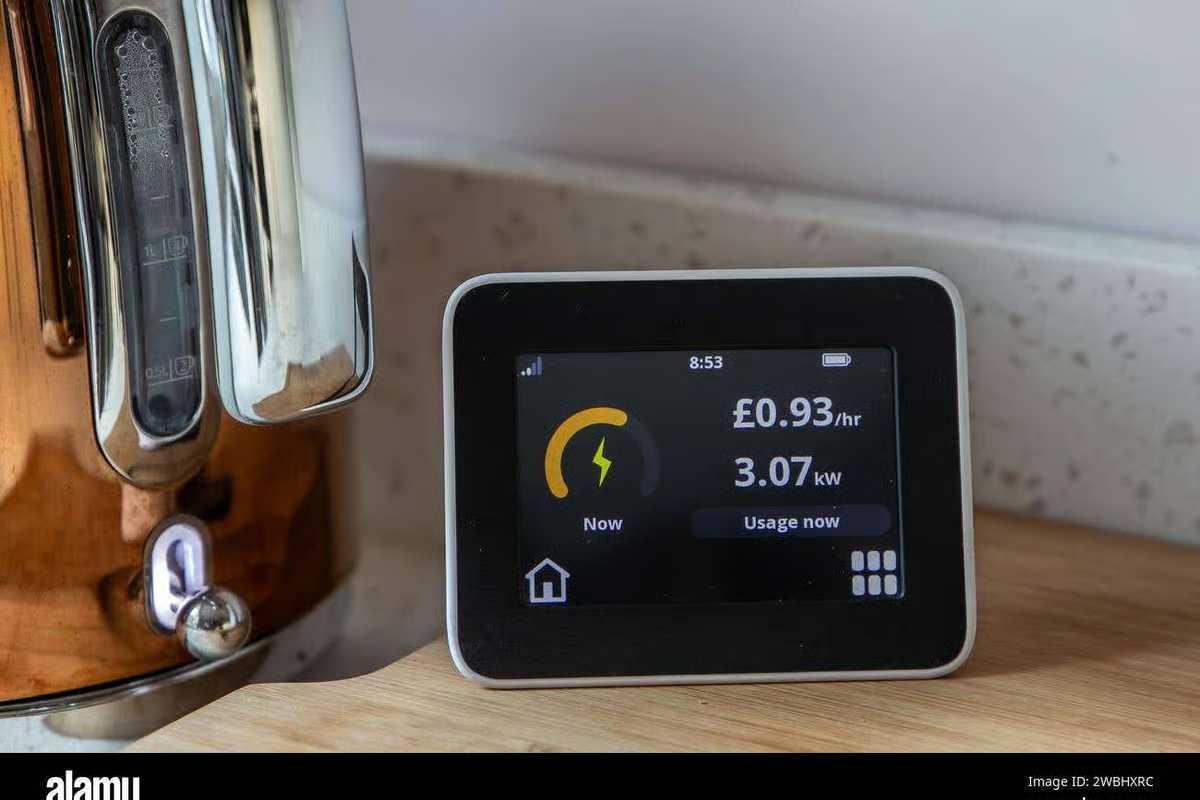
Dhara Vyas, the chief executive of Energy UK, which represents firms, said: “Today’s reduction in the energy price cap is a welcome first step by the Government toward providing meaningful support for households, helping make it more affordable for people to keep their homes safe, comfortable, and warm.

Source link

Continue Reading

NewsBeat

Snoop Dogg makes bizarre Swansea appearance as rival manager makes ‘weed’ joke | Football

Published

on

Snoop Dogg makes bizarre Swansea appearance as rival manager makes 'weed' joke | Football
Snoop Dogg was in attendance for Swansea’s game against Preston (Credits: Alamy Live News.)

The Swansea City co-owner Snoop Dogg was greeted with twirling towels and a guard of honour on his first visit to the Welsh club.

The American rapper, who is a minority owner of the Championship club alongside the television host Martha Stewart and Croatia international Luka Modric, made his first appearance at the Swansea.com Stadium for Tuesday’s clash with Preston.

Snoop joined the Swansea ownership group last July and made his way to south-west Wales after attending the Winter Olympics, where he served as Team USA’s honorary coach as well as a special correspondent for broadcaster NBC.

The celebrity visit had created so much excitement that a sell-out crowd of 20,233 turned up. Snoop Dogg, who had arrived at the stadium nearly three hours before the 7.45pm kick-off, had requested the crowd to be in their seats ahead of the action to twirl the complimentary towels.

Advertisement

Snoop took to the field through a guard of honour for Snoop made up of 20 youngsters representing Wales at the 2026 Street Child World Cup in North America.

Dressed in the club’s all-white colours, with a Swansea crest on his jacket, dark glasses and a beanie hat, Snoop made a pre-match lap of honour as fans twirled their towels with rock music booming in the background.

The star saluted the fans, shook hands with some, and had photographs taken with others. The club mascot, Cyril the Swan, even got a hug. He eventually disappeared down the tunnel seven minutes later just before a light show started prior to kick-off.

Your football fix

Metro‘s Head of Sport James Goldman delivers punchy analysis, transfer talk and his take on the week’s biggest stories direct to your inbox every week.

Advertisement

Sign up here, it’s an open goal.

Swansea City v Preston North End - Sky Bet Championship
Snoop Dogg invested in Swansea last summer and is now one of the club’s co-owners (Picture: Getty)
Swansea City v Preston North End - Sky Bet Championship
Snoop Dogg watched from the stands as Swansea were held 1-1 by Preston (Picture: Getty)

Swansea boss Vitor Matos revealed Snoop Dogg was ‘really happy’ after watching his side salvage a 1-1 draw.

Liam Cullen cancelled out Daniel Jebbison’s first-half strike in the fifth minute of stoppage time with a fine header.

Advertisement

Cullen’s goal extended Swansea’s unbeaten home run to nine games and provided some satisfaction for the watching Snoop.

Matos said: ‘After the game he came to the dressing room and spoke with the players.

‘He’s someone that likes to be involved, not only with us but with the (United States) Olympic team as well.

‘He loves sports, loves sports people. He loves the club, loves the city, and wants to be here.

Advertisement

‘I think that’s all positive and he was really happy because he felt that the team had the right mentality. He felt that the team could push.’

Preston boss Paul Heckingbottom, meanwhile, downplayed the occasion and atmosphere created by Snoop Dogg’s walkabout before kick-off.

Swansea City v Preston North End - Sky Bet Championship
Snoop Dogg’s presence helped generate a record crowd at the Swansea.com Stadium (Picture: Getty)
Editorial use only: DataCo restrictions apply See www.football-dataco.com. No use with unauthorised audio, video, data, fixture lists, club/league logos or
Liam Cullen’s late goal rescued a point for Swansea (Credits: Aled Hopkins/Action Plus/Shutterstock)

Heckingbottom joked that the only difference to other Championship games was the smell of illicit drugs, with Snoop Dogg having built a public persona around his copious marijuana intake.

‘The only thing I noticed different was the smell of weed in the tunnel before the game,’ Heckingbottom quipped.

‘It’s only different for people who are here every week, isn’t it?’ We don’t play at Swansea every week, so it’s no different for us.

Advertisement

‘We go away to Ipswich the other week, they were at it, their fans were at it, and that was noise all game. I felt we kept everyone quiet here until the end.’

Source link

Advertisement
Continue Reading

NewsBeat

Michael Mosley’s son Dr Jack ‘surprised’ by comments about father after death

Published

on

Michael Mosley and his son Jack Mosley in a photo together.

Dr Michael Mosley, a pioneer of intermittent fasting, died while on a walk on the Greek island of Symi in 2024, with his body being discovered four days after he went missing

Dr Michael Mosley’s son says he remains “surprised” by the remarks he hears about his father. Michael passed away on the Greek island of Symi after going missing during a walk in June 2024.

The 67-year-old was discovered just over two miles from the private resort where he was staying with his wife Dr Clare Bailey Mosley. He had been missing for four days at that point.

Advertisement

Michael was recognised by many for his groundbreaking work on the 5:2 diet, which advocated intermittent fasting. It resulted in television appearances on programmes including The One Show, Horizon, and Trust Me, I’m a Doctor.

Now his son, Dr Jack Mosley, has disclosed that people frequently stop him in the street to talk about his father’s contributions. This comes as Jack says his father’s efforts helped “tens of thousands of people” shed weight.

Michael, and the work he undertook with Clare, even inspired Jack to become a GP himself. He has now assumed leadership of the Fast800 from his father, reports the Mirror.

He stated: “He’s had a really big impact on me, they both have really, and they were part of my inspiration to become a doctor, because it was something they were so passionate about and I could see how many tens of thousands of people they had helped with their passion for improving the nation’s metabolic health.

“People tell me all the time how much of a difference my dad has made to their lives and really it has dramatically improved their health. In a way it’s almost surprising at times when people say, ‘I’ve lost X amount of weight’.”

Jack is spearheading The Fast 800 Online Programme, which he describes as a “lifestyle programme” that expands on his father’s work. It provides three types of meal plan: the “Very Fast 800”, utilising an 800-calorie plan for weight loss over 12 weeks; the 5:2 intermittent fasting plan; and a long-term Mediterranean diet plan.

The programme also offers exercise guidance through workout plans, incorporating both high-intensity interval training and resistance exercises, as well as educational content explaining the science behind weight loss.

Jack further explained: “The plan was based on a study that found that 800 calories a day for 12 weeks, this rapid weight loss, can reverse their diabetes, which was not thought possible before and if they kept 10kg of weight off, they could keep their diabetes in remission.

“It progressed from there to be this overall lifestyle support system for people who want to have this rapid weight loss and improve their metabolic health but also, there’s people who want to do it more gradually by fasting, like the 5:2, which my dad famously popularised.

“It’s also there to help people with other aspects that we know are so important in your health like exercise, including aerobic, and also mindfulness. It’s this real complete support system and helps provide people with a group of people to do it with who are on the same page.”

Advertisement

Source link

Continue Reading

NewsBeat

York – thief targets shop in Foxwood and steals alcohol

Published

on

York - thief targets shop in Foxwood and steals alcohol

North Yorkshire Police said alcohol was stolen from the premises of the business in Cornlands Road in Foxwood on Monday, January 26.


Recommended reading:

Multi-agency emergency after man falls from cliffs near East Yorkshire town

Advertisement

Man wanted by police is arrested in York suburb

Crash on main road in East Yorkshire town


The force has published a CCTV image of a man it would like to identify, saying he may have information to support its investigation into the theft.

A North Yorkshire Police spokesperson said: “Please contact us if you recognise the man pictured on CCTV.

Advertisement

“Email ben.hepworth@northyorkshire.police.uk if you can help.

“Alternatively, you can call North Yorkshire Police on 101 and ask for PC 685 Hepworth or contact Crimestoppers anonymously on 0800 555 111 or via their website.

“Please quote reference 12260016094 when passing on information.”

Advertisement

Source link

Continue Reading

NewsBeat

Caledonian Road flooding LIVE: Residents rescued by firefighters as burst water main sends torrent of water into Islington streets

Published

on

Caledonian Road flooding LIVE: Residents rescued by firefighters as burst water main sends torrent of water into Islington streets

“I am in urgent contact with Thames Water and am following progress on the repair closely. I expect Thames Water to break their past pattern of behaviour. They must look after those that are flooded and those without water. And they must do it properly: mitigating their suffering, acting fast, and communicating properly.

Source link

Continue Reading

Trending

Copyright © 2025