

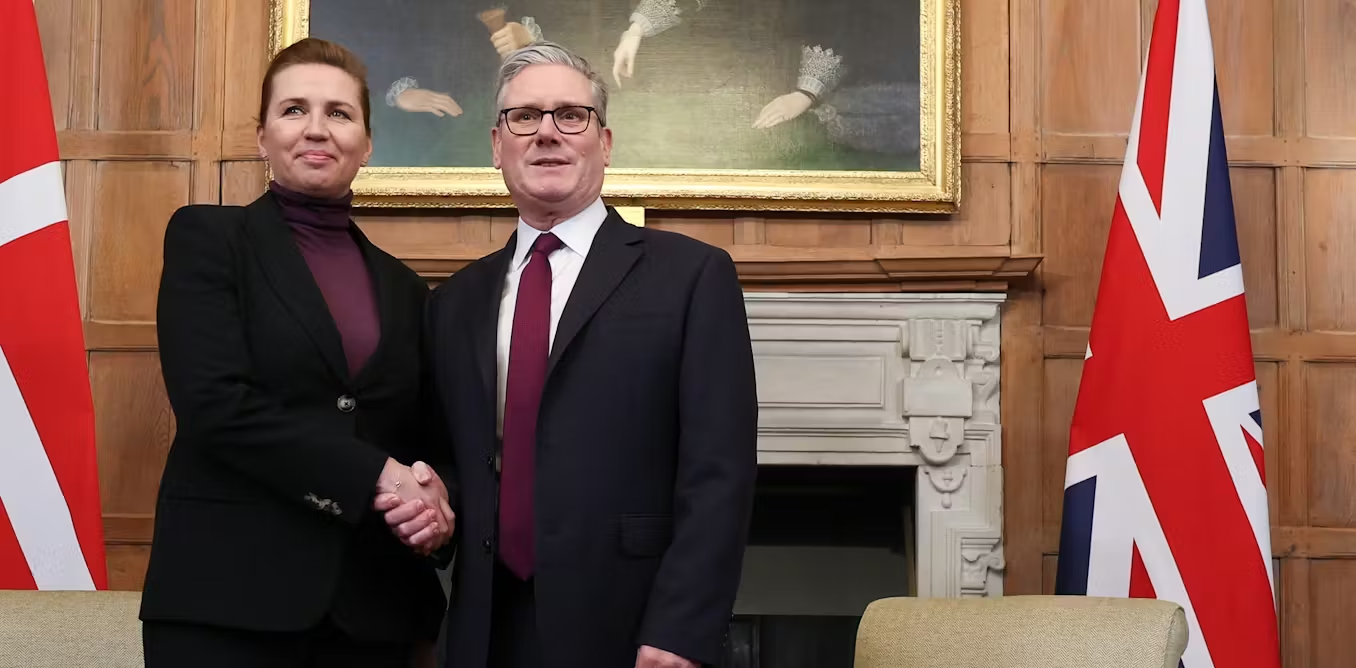
Having thus far taken a highly cautious line with the capricious Donald Trump, Keir Starmer broke with the US president this week over the latter’s desire to acquire Greenland.
With the dust settling on Trump’s address to Davos and his ruling out of military force and tariffs, the UK prime minister congratulated his own approach. Starmer remarked: “We’ve got through the last few days with a mix of British pragmatism, common sense, but also that British sense of sticking to our values and our principles.”
In foreign policy, pragmatism means a lack of ideology or simply “doing what works”. It is related to conservative traditions in political thought, with roots in political philosopher Edmund Burke’s scepticism of the French Revolution.
Twentieth century philosopher Michael Oakeshott characterised his ideal, pragmatic society as a ship in a boundless ocean. The crew should simply be trying to keep afloat and on an even keel, rather than being guided by any grand ideological framework.
Pragmatism has long been associated with UK foreign policy, as both an explanatory framework and something that UK foreign policymakers claim to embody. This was exemplified by Lord Salisbury’s 19th-century posture of “splendid isolation” – having no permanent allies or friends, just permanent interests.
But, as I have written, this approach is problematic – not least because of the significant geopolitical identity that has coloured centuries of UK foreign policy.
All foreign policy is guided by values of some sort, and the UK’s is no exception. Think of the oft-repeated notions of fair play, trading and sovereignty. Prime ministers may come into office wanting to reshape the global or local landscape, only to quickly come up against the need to act in a pragmatic way in response to a sudden crisis.
Pragmatism v idealism
In recent decades, British foreign policymakers have wrestled with an ongoing tension between pragmatism and more ideological approaches. Margaret Thatcher contrasted her own apparently steely-eyed approach to European integration with the “romantic” and “misty” Europeanism of one of her foreign secretaries, Geoffrey Howe.
Thatcher’s successor, John Major, argued that it was his far more positive approach to the EU that represented the truly British posture of pragmatism.
Tony Blair too was wont to burnish his pragmatic credentials, not least over Europe. But this sat uncomfortably alongside his brief flirtation with foreign secretary Robin Cook’s “ethical foreign policy”, and his subsequent part in the highly ideological war on terror, with its unshakeable beliefs in democracy promotion and regime change.
David Cameron rejected the crusading influences of Blair by putting the UK’s involvement in strikes against Bashar al-Assad’s Syria to a Commons vote, which he lost. His subsequent calling of a referendum on the UK’s membership of the EU defined anew a long-running debate between pragmatists and idealists. Here, both sides claimed pragmatism as their own.
For Remainers, continued membership of an EU that broadly “worked” for the UK was the sensible, rational and pragmatic course. They saw those who wanted to leave as overly dogmatic and willing to throw the baby out with the bathwater for so-called principles.
Brexiteers pointed to growing patterns of prosperity in markets beyond Europe. They argued that regaining lost sovereignty was nothing if not pragmatic – and that their opponents had been hopelessly duped by the unrealistic (and in their eyes, dangerous) schemes of Europeans and globalists.
Starmer’s pragmatism?
How then can we characterise Starmer’s foreign policy?
The closer alignment with the EU that he has led can be read as the ideological move of a convinced Remainer. Like his Conservative predecessors, he has made much of the UK’s support for Ukraine in its war with Russia. This signifies the foregrounding of values such as sovereignty, nationhood and the rules-based international order.
Similarly, the 2024 deal with Mauritius over the Chagos islands has been represented as the righting of a historic colonial wrong.
Yet there is a trace of pragmatism in all these policies, too. The realignment with the EU has taken place slowly, with great caution and many accompanying reassurances of red lines. The tough stance over Ukraine can also be read in a pragmatic fashion, given the perceived need to align with European and Nato allies amid Trump’s ratcheting up of tensions.
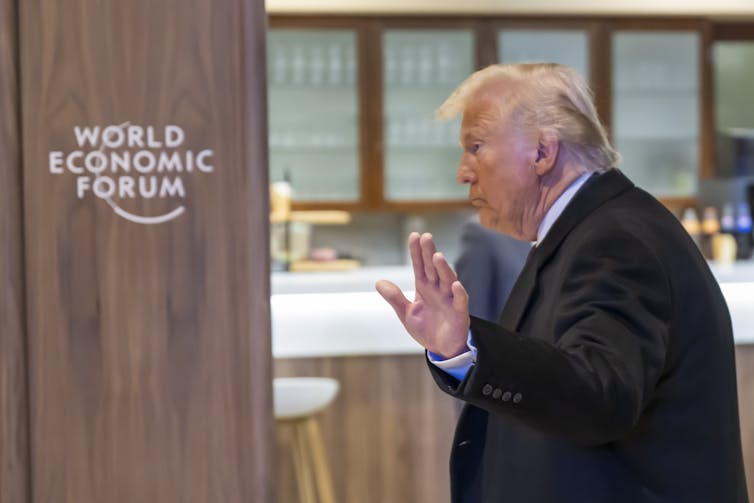
Laurent Gillieron/EPA-EFE
For all of the appealing whiff of decolonial justice surrounding the Chagos deal, this too was infused with a healthy dose of pragmatism. In spite of Trump’s sudden condemnation of it, he had initially backed the deal precisely because of its pragmatism. It protected the US-led base at Diego Garcia and ensured a vital strategic foothold in the Indian Ocean.
Further instances of foreign policy under Starmer ultimately demonstrate the limits of idealism in British foreign policy. The reaction to Russia’s invasion of Ukraine has been characterised by outrage and (especially under Boris Johnson) a Churchillian “whatever it takes” attitude in favour of self-determination. But other situations have been approached with far more caution.
Starmer and his first foreign secretary, the usually loudly principled David Lammy, dragged their feet over condemnation of Israel in Gaza, infuriating some of the Labour party’s leftwing base. Lammy had earlier sought to resurrect Cook’s ethical foreign policy. Yet, whatever their instincts, pragmatically siding with the US tends to win out when it comes to Israel.
Statements on Venezuela were also couched with extreme caution: pragmatism recognising the lack of British interest, let alone clout, in South America.
Starmer’s post-Davos remarks exemplify the seemingly contradictory melding of pragmatism with principle. In reality, these concepts can be difficult to entangle. They are (as with Brexit) often a matter for the eye of the beholder: one man’s pragmatism is another’s principle.
When it comes to the cornerstones of UK policy, such as Nato and the transatlantic alliance, the line is particularly blurry. But over Greenland and the rollercoaster relationship with Trump, Starmer has indeed had to walk a careful line between pragmatism and principle. This is a rare example of a politician’s comment that one can take at face value.

Want more politics coverage from academic experts? Every week, we bring you informed analysis of developments in government and fact check the claims being made.
Sign up for our weekly politics newsletter, delivered every Friday.



