Yuval Rooz has a blunt message for the smart contract sector: If you claim to be the future plumbing of global finance, you’d better show the cash flow.
“People have assigned a lot of value to these networks based on what they say they’ll become,” said Rooz, CEO of Digital Asset and co-founder of the Canton Network. “But when you look at how much actual business they’re doing, there’s a massive disconnect.”
The Canton Network is a privacy-enabled blockchain infrastructure that aims to connect financial institutions and their tokenized assets across interoperable, permissioned applications.
“The issue isn’t about any single chain. Many smart contract networks were architected for retail speculation and token trading, not for regulated, institutional financial workflows,” Rooz told CoinDesk in an interview.
Advertisement
“When you look at metrics like sustained economic throughput, recurring revenue, and real-world asset activity, there’s often a disconnect between valuation and actual financial usage. Building infrastructure for global institutions requires a very different design philosophy around privacy, compliance, and interoperability,” he said.
Rooz, who previously worked at DRW and Citadel before founding Canton, said he isn’t anti-crypto. He drew a distinction between assets like bitcoin BTC$67,316.44, which the market values as a store of value or digital gold, and smart contract platforms that promise to transform financial infrastructure.
“Gold and silver have value because the market assigns it to them,” according to Rooz. “Bitcoin is an asset class. But smart contract networks pitch themselves as the next set of financial rails. If that’s the pitch, then financial institutions should be using them at scale.”
In his view, most aren’t.
Advertisement
“If you’re processing very small amounts of value on your network, how does the market assign you a $10 or $11 billion valuation?” he said, citing large-cap chains that see limited real-world financial throughput. “At the end of the day, it’s a memecoin. It’s not solving the problem it said it would solve.”
A speculative design flaw
Rooz argued the gap stems partly from token design. Many networks copied bitcoin’s issuance model, minting tokens to reward validators, even though bitcoin is an asset secured by miners, not a programmable platform meant to host financial applications.
“Bitcoin is an asset class, not a platform,” he said. “People who secure the asset class get paid. Everyone copied that model for smart contract chains, and that was a mistake.”
On many networks, newly minted tokens flow primarily to validators, regardless of whether the chain is generating meaningful economic activity. If usage is thin, inflation dilutes holders while little value accrues back to the token.
Advertisement
By contrast, Rooz said Canton’s token is designed to reflect the dollar utility of the network itself. Every transaction burns tokens, and there are no priority or front-running fees. If usage grows in dollar terms, more tokens leave circulation.
“If you believe the USD utility of the network will continue to increase, more tokens will go out of circulation and the price should go up,” he said.
Canton also features a “mint curve,” with new tokens issued at regular intervals. But those tokens aren’t reserved only for validators. They’re distributed to users and applications that generate fees on the network.
“Compensating builders should be merit-based,” Rooz said. “Can you bring customers? Can you generate fees? That’s how you get paid.”
Advertisement
He pointed to Hyperliquid as an example of a model that resonates with investors: the trading platform generates revenue and uses it to buy back tokens. “When you do buybacks, price goes up. That’s a much more convincing reason to hold a token,” he said.
In other words, value must flow.
Digital Asset, the company behind Canton, said in December that it had secured strategic investments from four major traditional financial players. Investors in the round were BNY, a financial services firm overseeing $57 trillion in client assets, exchange operator Nasdaq, financial intelligence firm S&P Global and iCapital, a fintech firm backed by BlackRock, Blackstone and JP Morgan.
Bloomberg recently began publishing data related to activity on Canton, and the Depository Trust & Clearing Corporation (DTCC), the industry-owned clearing and settlement market infrastructure, said in December that it had selected the network as its tokenization partner, in a sign of growing institutional traction.
Advertisement
The limits of TVL
Rooz is equally skeptical of total value locked (TVL) as a headline metric.
“TVL is a very bad metric in isolation,” he said. “What matters is usage.”
Canton’s design emphasizes configurable privacy for institutional participants, and in turn, much of the network activity isn’t publicly broadcast. That makes traditional DeFi-style dashboards incomplete.
Because transactions can remain confidential, “we rely on participants to publish information about what they’re doing onchain,” Rooz said.
Advertisement
Still, some data points are emerging. Broadridge, a financial infrastructure provider, processes roughly $400 billion in repo transactions daily on Canton, according to Rooz. Other projects on the network handle comparable volumes, he said.
The network is now generating between $2.5 million and $3 million in daily fees, Rooz said, with ambitions to double that.
“If a company had bylaws saying any profit it makes will be used to buy back stock, and performance keeps going up, the share price should go up,” Rooz said. “A decentralized network should be treated the same way. Look at revenue. Look at growth.”
A coming reckoning
The broader market, he said, is starting to apply that lens.
Advertisement
“When the market is good, money flows into memes and speculative tokens,” Rooz said. “When the market turns, investors get much more demanding.”
Many altcoins that marketed themselves as smart contract platforms have been eviscerated during recent downturns, he noted. Meanwhile, tokens tied to revenue-generating platforms have fared better.
For Rooz, this signals a shift toward what he calls a more “rational economic structure.”
“Crypto has defied the laws of gravity for some time,” he said. “But eventually gravity wins.”
Advertisement
Stablecoins and product-market fit
Even stablecoins, often hailed as crypto’s breakout use case, haven’t fully crossed the chasm in Rooz’s view.
“Stablecoins haven’t hit product-market fit yet,” he said. “You can say stablecoins have product-market fit when more than 50% of usage is not crypto-related.”
Today, he argued, much of stablecoin demand is driven by crypto trading and onchain speculation. Real-world payments and non-crypto financial applications remain a minority of activity.
Canton’s strategy is to push deeper into traditional finance, bringing real-world assets and collateral onchain. The network recently announced gold-related initiatives and plans additional non-crypto collateral integrations.
Advertisement
The goal is straightforward: move beyond crypto-native assets and into mainstream financial workflows.
“If smart contract chains are the next set of financial rails, then financial companies should be using them for financial applications,” Rooz said. “Uptake, activity and usage; the value will follow.”
As for where Canton’s token price goes from here?
“If you’re chasing token price, you’re chasing the wrong thing. Focus on utility. Focus on building real financial infrastructure.”
Advertisement
The rest, he suggested, is gravity.
Canton coin (CC) was trading around $0.1538 at publication time. The token has risen about 2% year-to-date, outperforming wider crypto markets. The token currently has a market cap of roughly $6 billion.
Aon, one of the world’s largest insurance brokers, is testing the use of stablecoins to pay insurance premiums, highlighting the growing role of digital dollars in traditional financial infrastructure following the passage of the GENIUS bill last year.
In a Monday announcement, UK-based Aon said it completed a pilot that settled insurance premiums for clients, including Coinbase and Paxos, using USDC (USDC) on Ethereum and PayPal USD (PYUSD) on Solana.
Tim Fletcher, CEO of Aon’s financial services division, said the pilot reflects the company’s effort to explore stablecoins as a payment rail, predicting that tokenized assets will become more widely used in financial transactions.
Aon said in August that its analysis showed 120 re-insurers wrote nearly $2 trillion of gross written premium in 2024.
Advertisement
Source: Matthew Sigel, head of digital assets research at VanEck
Instead of sending funds through traditional bank wires, the premiums were paid using stablecoins on blockchain networks. The pilot demonstrates how financial institutions are experimenting with blockchain settlement systems rather than relying solely on conventional payment infrastructure.
The approach could have implications for the insurance industry, where premium payments typically move through banks, clearing systems and international wire transfers — processes that can take several days, particularly for cross-border transactions. Stablecoin transfers can settle within minutes.
The pilot did not involve a new insurance product or an onchain policy. The underlying insurance coverage remained unchanged, with the only difference being the use of stablecoins to settle the premium payments.
Stablecoins gain traction among financial institutions
Aon’s pilot also comes amid a more supportive regulatory backdrop for stablecoins following the passage of the GENIUS Act, which established a federal framework for issuing and supervising dollar-backed stablecoins in the United States.
Advertisement
The development reflects a broader shift as traditional financial institutions increasingly explore stablecoins for payments and settlement infrastructure. Several major banks, including Barclays, JPMorgan Chase, Bank of America and Citigroup, are either confirmed or reported to be in various stages of developing stablecoin or tokenized payment systems.
Stablecoins have reached a cumulative market value of $313 billion, led by USDC and Tether’s USDt. Source: DeFiLlama
At the same time, crypto-native companies are expanding into the stablecoin payments stack. For example, Ripple has been building infrastructure aimed at supporting stablecoin custody, settlement and treasury management for institutions.
Cointelegraph is committed to independent, transparent journalism. This news article is produced in accordance with Cointelegraph’s Editorial Policy and aims to provide accurate and timely information. Readers are encouraged to verify information independently. Read our Editorial Policy https://cointelegraph.com/editorial-policy
Fairshake, the political action committee backed by crypto companies Ripple Labs and Coinbase, among others, has reported additional spending on Illinois congressional races with the US midterm elections less than eight months away.
In filings on Sunday with the Federal Election Commission, Fairshake reported a $16,000 media buy to oppose Illinois state representative La Shawn Ford in his run for the US Congress in 2026, adding to its roughly $1.8 million spent in 2026 on the race. The state is set to hold primary elections on March 17.
The filing followed others from Friday, showing that the PAC spent more than $5.5 million to oppose Illinois Lieutenant Governor Juliana Stratton, who is running as a Democrat for the US Senate in the midterm elections. Protect Progress, a Fairshake associated group supporting Democratic candidates, reported about $84,000 spent to support Nikki Budzinski for her 2026 House run representing Illinois, and $90,000 for Robin Kelly’s Illinois Senate race.
Advertisement
Altogether, according to The Daily Northwestern, the PAC and its associated groups have poured about $8.6 million in the Illinois races, a sixfold increase over what it spent in the 2024 elections for races in Midwestern US state. The committee has a larger war chest of funds from the cryptocurrency industry and others, reporting $193 million in its coffers as of January, and has publicly stated it will “oppose anti-crypto politicians and support pro-crypto leaders” in 2026.
Rather than support candidates directly through campaign donations, Fairshake and its associated groups typically fund ads to support or oppose politicians, often on issues completely unrelated to crypto policy. PACs are required to report spending and contributions to the Federal Election Commission.
Potentially influencing Texas primaries?
Fairshake has already made moves in 2026 for some of the early state primaries ahead of the midterm elections.
Advertisement
Last week, residents in North Carolina, Texas and Arkansas voted on some of the first candidates to be decided for the general election. Protect Progress reportedly spend $1.5 million opposing the reelection of Texas Representative Al Green, who has served in Congress since 2005.
While Democrat Christian Menefee, whom the advocacy organization Stand With Crypto rates as “strongly supports crypto,” did not win outright against Green, both candidates will head to a runoff in May.
Cointelegraph is committed to independent, transparent journalism. This news article is produced in accordance with Cointelegraph’s Editorial Policy and aims to provide accurate and timely information. Readers are encouraged to verify information independently. Read our Editorial Policy https://cointelegraph.com/editorial-policy
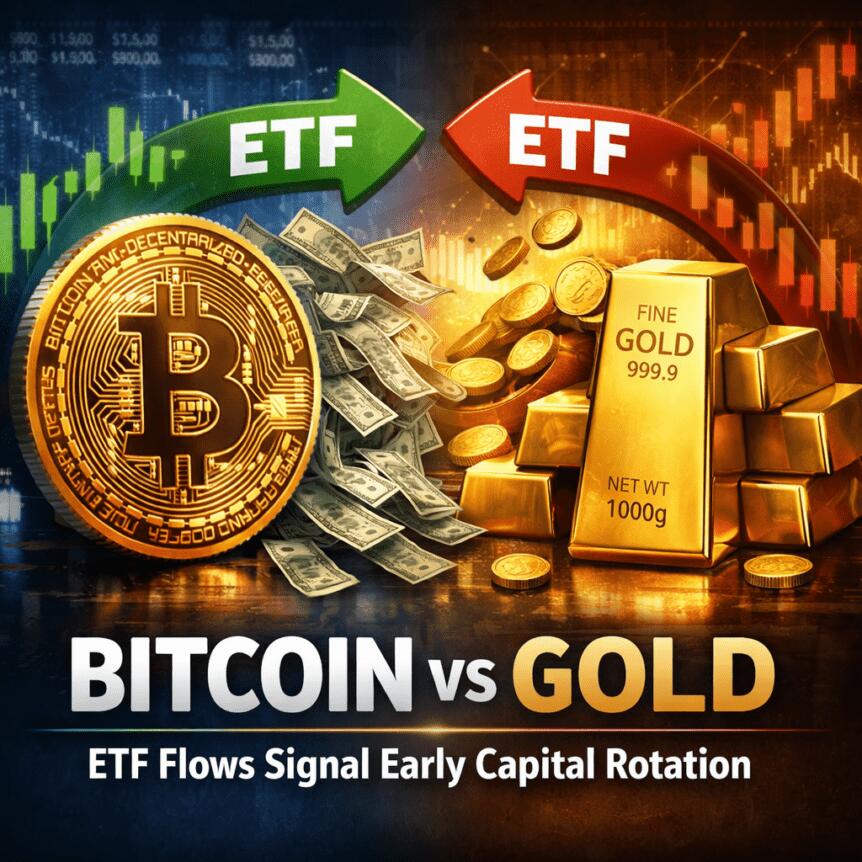
Bitcoin ETF flows have shifted into positive territory over the last 30 days, even as gold ETF demand shows signs of fatigue after a prolonged rally. In the latest data pulse, bitcoin-focused funds logged a net inflow of $273 million on March 6 after a $1.9 billion outflow in February, while GLD—the largest US gold-backed ETF—saw a substantial one-day withdrawal that underscores a potential rotation in investor appetite. The backdrop is nuanced: gold prices have remained elevated, yet momentum appears to be cooling, while bitcoin demand shows resilience that could presage a broader reallocation within risk assets.
Key takeaways
Bitcoin ETFs posted a 30-day net inflow of $273 million on March 6 after a $1.9 billion outflow in February, signaling renewed interest from what some observers call a risk-on cohort.
Gold ETFs experienced a marked reversal, with GLD recording a $3 billion outflow on a single day—the largest in more than two years—after a longer streak of inflows totaling roughly $24 billion across January and February.
Holdings shifted in native units: bitcoin ETF positions rose by about 4,021 BTC on March 6, while gold ETF holdings declined from 1.4 million ounces to roughly 621,100 ounces during the same window.
Analysts point to a potential rotation from gold toward bitcoin as risk sentiment improves and the macro backdrop remains uncertain, though the timing of any sustained shift remains uncertain.
Longer-term context from Fidelity suggests gold’s leadership cycle may be peaking, potentially opening room for bitcoin to take the lead in the coming quarters, in line with historical cross-asset dynamics between the two stores of value.
Price impact: Neutral. While flows point toward a possible rotation, there is no clear, immediate price move indicated by the data.
Market context: The flows sit within a broader pattern of ETF activity shaping crypto and precious metals markets as risk sentiment oscillates and liquidity conditions shift. The bitcoin-related inflows come as gold’s rally cools after a strong start to the year, illustrating how investors are reallocating capital across alternative stores of value in a fluctuating macro environment.
Advertisement
Why it matters
Across mainstream markets, exchange-traded funds provide a surprisingly transparent lens into the evolving sentiment of large participants—often illustrating where capital is seeking safety, exposure, or hedges against inflation and geopolitical risks. The latest divergence between bitcoin and gold ETF flows adds a new chapter to the long-running debate over which store of value may lead in a given cycle. The near-term implication is a potential shift in demand dynamics: as gold’s momentum wanes from its January–February surge, bitcoin could begin to attract fresh buyers seeking upside leverage to a risk-on environment.
On the holdings side, the shift is tangible. Bitcoin ETFs recorded a net increase of more than 4,000 coins in a single day, contrasting with a sharp decline in gold holdings over the same period. The data, drawn from native-asset balances rather than dollar-denominated valuations, give a clearer picture of actual accumulation versus distribution. These internal flows can be early signals that price action might follow as new entrants accumulate positions or exit as conditions change. The contrast between the two assets is notable, given their historically divergent performance during different macro regimes and risk cycles.
Market observers have tied the trend to a broader rotation from “safe-haven” assets toward instruments that offer growth exposure or diversification benefits in an improving risk environment. Joe Consorti, head of growth at Horizon, highlighted the possibility that gold’s leadership phase could be nearing its late-stage, with bitcoin poised to surge if the macro backdrop supports a continued risk-on tilt. He encapsulated the view succinctly: “Gold is stalling out while bitcoin is soaring. BTC is set to overtake gold’s % growth over the last month as the U.S. economy accelerates and risk sentiment improves. The anticipated risk-off → risk-on rotation could be underway.”
Further context comes from a 2026 outlook published by Fidelity Digital Assets. The firm noted gold’s 65% return in 2025—the fourth-largest annual gain since the end of the gold standard—arguing that gold could be near the late phase of its leadership cycle. The takeaway echoed by Fidelity is that the two assets have historically taken turns leading, suggesting that bitcoin could take the baton next if the cycle continues to evolve. This historical pattern adds a framework for investors assessing whether the current rotation is a temporary pause or the start of a more durable shift in cross-asset leadership.
Advertisement
What to watch next
Next 30-day ETF flow data for bitcoin and gold to confirm whether the inflow streak for BTC persists and whether GLD continues to underperform relative to its peers.
Price action around bitcoin and gold in the wake of any macro data releases that influence risk sentiment, including inflation and growth metrics.
Monitoring holdings updates for major bitcoin and gold ETFs to verify ongoing accumulation or distribution in native units.
Geopolitical developments and policy signals that could reintroduce risk-off dynamics or re-ignite appetite for safe havens.
Industry commentary and analysis from market watchers and asset managers regarding the timing and durability of any rotation between gold and bitcoin.
Sources & verification
Kobeissi Letter post detailing GLD’s $3 billion outflow and the context of gold’s price decline.
bold.report flow data showing the 30-day net flow shift for bitcoin ETFs and the December–February momentum for gold ETFs.
Joe Consorti, Horizon, discussion on bitcoin’s relative strength and potential rotation dynamics, as cited in social posts.
Fidelity Digital Assets, 2026 Look Ahead report outlining gold’s prior rally, leadership-cycle considerations, and cross-asset dynamics with bitcoin.
TradingView BTCXAU ratio analysis and related market commentary illustrating how the BTC-to-gold relationship has evolved in recent cycles.
ETF flows hint at Bitcoin-led rotation vs gold
Bitcoin ETF inflows and gold ETF outflows over the past month point to a nuanced shift in investment behavior that could have implications for both assets in the near term. On the one hand, bitcoin funds saw a notable positive swing, with a March 6 inflow of $273 million following a February outflow of $1.9 billion. On the other hand, GLD reversed a long period of inflows, registering a $3 billion one-day withdrawal that marked a stark departure from January’s and February’s robust cash-hauls. The divergence is telling: as gold’s price pullback and consolidation emerged, bitcoin buyers appeared to be re-entering the market, potentially signaling a rotation in the broader risk spectrum.
Holdings data reinforce the narrative. In native units, bitcoin ETF positions rose by about 4,021 BTC on March 6, a clear counterpoint to the gold side where holdings slid from 1.4 million ounces down to roughly 621,100 ounces in the same interval. By focusing on native asset balances rather than dollar valuations, analysts can better gauge genuine accumulation versus mere price-driven valuation changes. This distinction is essential for understanding whether flows translate into meaningful demand that could support higher prices over time.
Analysts have framed the shift within a larger macro tapestry. The idea of a rotation from gold into bitcoin is not new, but recent data adds a degree of plausibility to such a transition—especially if risk appetite improves alongside a cautiously optimistic macro backdrop. The commentary from Horizon’s Joe Consorti emphasizes that the pivot could be underway as market participants reassess the relative appeal of traditional safe-havens against digital stores of value with expected growth characteristics. Fidelity’s outlook provides complementary context, suggesting that the cycles between gold and bitcoin have historically oscillated, with each asset taking turns leading at different phases of monetary and geopolitical stress.
As the market continues to digest these cross-asset dynamics, investors will be watching for confirmatory signs—both in flows and in price action—that the rotation, if it is indeed forming, gains momentum. The 2025 performance of gold—an impressive 65% return—has already shaped expectations about when bitcoin might reassert leadership. The current data do not definitively settle the question, but they do underscore the importance of watching ETF flows as a real-time proxy for investor preferences in a landscape where macro uncertainty and liquidity conditions remain pivotal drivers of asset allocation.
Risk & affiliate notice: Crypto assets are volatile and capital is at risk. This article may contain affiliate links. Read full disclosure
Oil price spikes often precede 20% spikes in Bitcoin value, though initial market reactions remain volatile and unpredictable.
Bitcoin currently mirrors tech stocks with an 81% Nasdaq 100 correlation, making it less sensitive to oil prices.
Oil prices surged to $101 per barrel on Sunday, marking a 55% increase in ten days—the largest move in history. The event caused the SPX to reach its lowest level in 10 weeks on Friday. Bitcoin (BTC) saw an initial positive reaction with prices jumping 16% between Feb. 28 and Wednesday, though it eventually erased the entire move by Sunday.
Traders now question whether Bitcoin price could suffer from the uncertainty brought by the US-Israel war with Iran. Persistently high oil prices could trigger inflation and hurt consumer spending while the US job market remains weak. Bitcoin price has benefited from sudden jumps in oil prices in the past, but the gains usually happen over a four-week period.
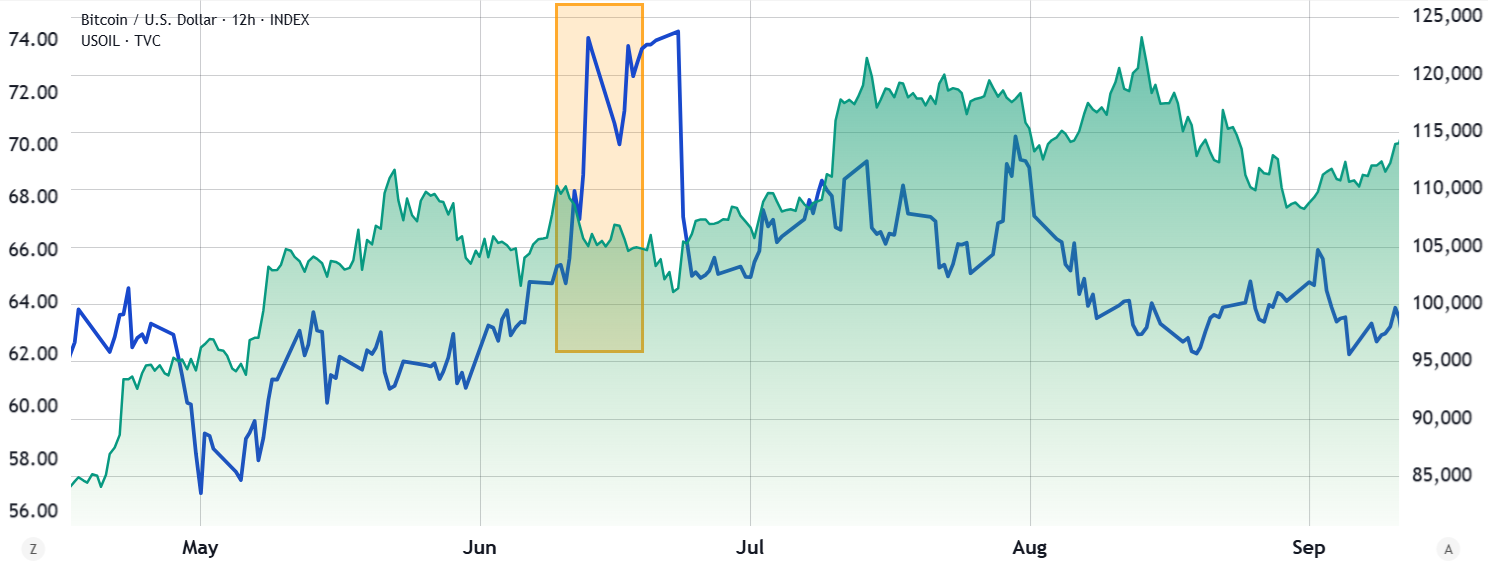
WTI oil (blue) vs. Bitcoin/USD (green) in May-August 2025. Source: TradingView
West Texas Intermediate (WTI) crude oil prices surged by 15% in a week starting on June 11, 2025, after global agencies assessed that Iran had enriched uranium nuclear warheads and Israel launched air strikes in the region two days later. Initially, Bitcoin price declined by 8% to $101,000 from $110,300, but it ended up reverting the move and posted 10% gains in four weeks.
WTI oil (blue) vs. Bitcoin/USD (green) in March-May 2024. Source: TradingView
On March 27, 2023, WTI prices jumped by 16% in eight days, fueled by a legal dispute leading to 450,000 barrels per day in exports from Kurdistan and a surprise production cut from OPEC. Bitcoin price gained 12% in two weeks but failed to sustain the bullish momentum, returning to the initial $28,000 level in less than a month.
WTI oil (blue) vs. Bitcoin/USD (green) in Feb-April 2022. Source: TradingView
A 29% weekly rally in WTI oil prices initiated on Feb. 28, 2022, following the full-scale military invasion of Ukraine by Russia, triggered global sanctions on Russian oil exports. Bitcoin prices jumped 17% over the initial two days, but those gains evaporated by the end of the week. Still, Bitcoin price eventually surged by 25% over the next three weeks as its price reached $48,000.
WTI oil (blue) vs. Bitcoin/USD (green) in Oct-December 2020. Source: TradingView
WTI gained 23% in nine days starting on Nov. 2, 2020, as traders anticipated the rollout of COVID-19 vaccines and US oil inventories showed unexpected drops. Bitcoin price followed the trend, gaining 16% during that nine-day window, eventually seeing 45% gains from the initial $13,500 price in under a month.
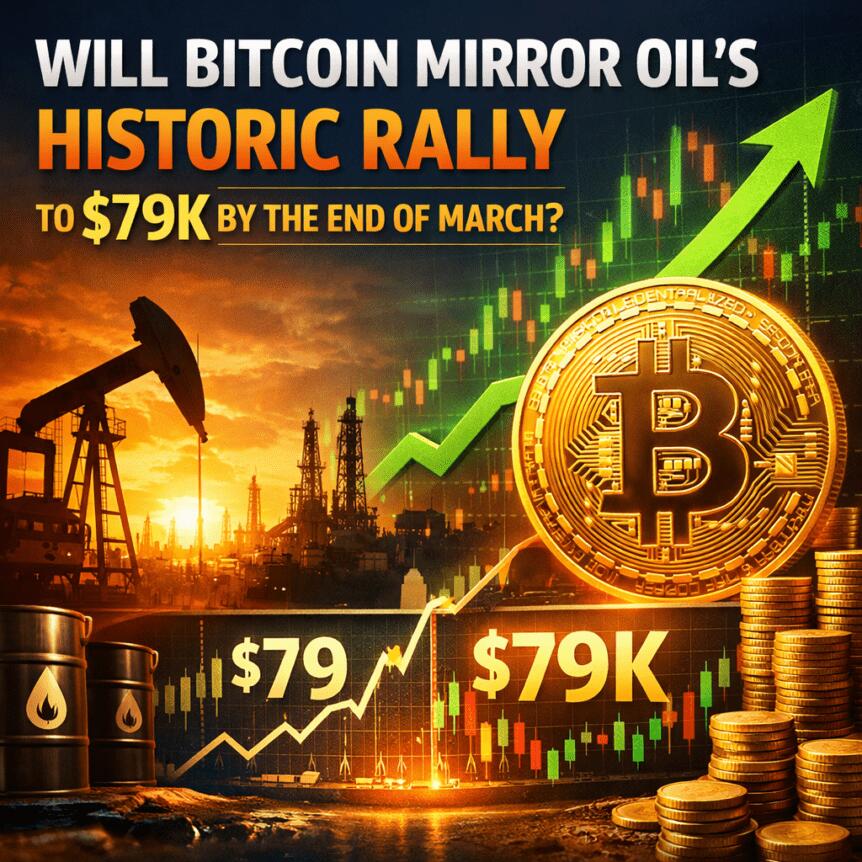
Bitcoin may reach $79,200 by the end of March if history repeats itself
On average, Bitcoin gained 20% over four weeks during the last four times WTI jumped by 15% or more within 10 days. These instances happened between November 2020 and June 2025, a period that includes the bear market of 2022 and most of 2023. Still, four events are not statistically significant enough to prove a solid correlation.
Bitcoin’s price has been much more closely tied to the tech sector lately, shown by its current 81% correlation with the Nasdaq 100 index. If Iran or the US de-escalate sooner than expected, the stock market may recover, and Bitcoin should benefit from that bullish momentum.
Ultimately, the duration of the war in Iran will decide if a Bitcoin rally to $79,200 is possible by the end of March. That target would match the historical 20% average gain from the $66,000 price seen since the oil rally picked up steam on Feb. 28.
This article does not contain investment advice or recommendations. Every investment and trading move involves risk, and readers should conduct their own research when making a decision. While we strive to provide accurate and timely information, Cointelegraph does not guarantee the accuracy, completeness, or reliability of any information in this article. This article may contain forward-looking statements that are subject to risks and uncertainties. Cointelegraph will not be liable for any loss or damage arising from your reliance on this information.
Two new funding rounds for Corastone and Zcash Open Development Lab show blockchain infrastructure maturing for real‑world scale, private markets, and privacy‑first payments.
Summary
Corastone raised backing from Fidelity, Hamilton Lane and others to run a private, permissioned blockchain as shared infrastructure for private‑market workflows.
Zcash Open Development Lab secured over $25m from Paradigm, a16z crypto, Winklevoss Capital and others to scale Zcash’s privacy ecosystem.
ZODL’s wallet, rebranded from Zashi, helped expand Zcash’s Orchard shielded pool while ZEC traded near $240.98 as investors assessed the new roadmap.
Two very different rounds announced this week point in the same direction: blockchain infrastructure is being rebuilt for scale, not hype. In New York, Corastone, a self‑described “hyperscaler for private‑market investing,” said Fidelity Investments, Future Standard and Hamilton Lane have joined Apollo, Franklin Templeton, KKR and Morgan Stanley as investors in its operating platform. The company runs a private, permissioned blockchain that acts as “the shared network infrastructure and data standard for private markets workflows,” replacing legacy file‑based processes with straight‑through processing for asset managers, distributors and administrators.
Advertisement
“As access to private markets continues to scale, firms need standardized, digital infrastructure that supports higher volumes and more complex structures without adding operational burden,” said Hamid Gayibov, co‑founder and president of Corastone. “Corastone was built to serve as a common operating layer for the ecosystem,” he added, arguing that the goal is to let “investors of all sizes access private market assets as efficiently and reliably as public markets.” Future Standard’s CTO Hari Moorthy framed the bet in similar terms, saying the firm “saw a need in the marketplace for an infrastructure technology that connects the various point‑to‑point systems used by investors and enables true straight‑through‑processing of transactions,” adding that its investment “reflects our confidence in the platform’s long‑term role.”
On the privacy side, Zcash Open Development Lab (ZODL) disclosed that it has raised more than $25 million in seed funding from Paradigm, a16z crypto, Winklevoss Capital, Coinbase Ventures and others to build out the Zcash ecosystem. Founded by former Electric Coin Company CEO Josh Swihart, ZODL now houses the technology behind the Zashi wallet, rebranded to Zodl, which helped grow Zcash’s Orchard shielded pool from around 1 million ZEC to roughly 4 million ZEC during 2025 by simplifying privacy UX. Cypherpunk Technologies, which also invested $5 million in the round, said the deal “gives its shareholders exposure to a private company building critical privacy infrastructure on the frontier” and aligns with its mission of “advancing technologies that guarantee privacy for all humans on the internet.”
At press time, Zcash traded near $240.98, up about 3.8% over the last 24 hours, with a 24‑hour volume of roughly $346.4 million, as investors digested the new funding and infrastructure roadmap. For more detailed price data, see the crypto.news price page for Zcash (ZCASH).
Blockchain.com expanded into Ghana after recording a 700 percent rise in brokerage trading volume in Nigeria.
The company reported that Bitcoin, Tether, and Tron ranked as the most traded assets in Nigeria.
Blockchain.com said active users in Ghana increased by 140 percent over the past year.
The company confirmed it is working with Ghanaian regulators to support a local regulatory framework.
Blockchain.com plans to integrate mobile money services as it builds operations in Ghana.
Blockchain.com has expanded into Ghana after reporting a 700% surge in brokerage transaction volume in Nigeria. The company plans to launch its trading platform for Ghanaian users while building local infrastructure. It confirmed ongoing talks with regulators as it targets wider growth across Africa.
Blockchain.com Reports 700% Trading Surge in Nigeria
Blockchain.com launched retail brokerage operations in Nigeria last year and tracked rapid growth. The company recorded a 700% increase in brokerage transaction volume during the period. It said users actively traded major digital assets across its platform.
Bitcoin BTC $68,517 led trading activity on the platform in Nigeria. Tether USDT $1 and Tron TRX $0.29 followed as the most traded assets. The company attributed the growth to rising demand from retail users.
Chainalysis data ranked Nigeria among the top countries for grassroots crypto adoption. The data linked activity to remittances, currency volatility, and mobile usage. Nigeria received over $92 billion in onchain crypto value between July 2024 and June 2025.
Advertisement
Sub-Saharan Africa received more than $205 billion in onchain crypto value during the same period. Chainalysis reported a 52% year-over-year increase across the region. The report placed the region as the third-fastest-growing crypto market globally.
Ghana Market Entry and Rising Bitcoin Activity
Blockchain.com confirmed it will offer Ghanaian users access to its trading services. The company reported a 140% increase in active users in Ghana over the past year. It also recorded an 80% rise in transaction volumes ahead of launch.
A spokesperson said, “We are actively collaborating with Ghanaian officials and regulators to help build a regulatory framework.” The company has established local compliance representation in Ghana. It said it will focus on regulatory engagement as operations expand.
The spokesperson said mobile money integration remains a key priority in Ghana. “Given how widely used mobile money is in Ghana, integration with the mobile money ecosystem is a key focus,” the spokesperson said. The company is building local teams to manage partnerships and compliance.
South Africa, Ethiopia, Kenya, and Ghana rank among the next largest crypto markets in Africa. Analysts linked demand to cross-border payments and currency volatility. Stablecoins have gained traction for remittances and faster settlements.
Advertisement
Vera Songwe spoke at the World Economic Forum Annual Meeting in Davos in January. She said traditional transfers cost about $6 per $100 sent. She added that stablecoins reduce fees and settle transactions within minutes.
Africa Bitcoin Corporation executive chairman Stafford Masie addressed crypto adoption trends. He said on the Coin Stories podcast that some communities use Bitcoin for daily payments. Merchants in certain areas accept satoshis instead of fiat currencies.
Borderless.xyz reported that Africa recorded the highest median stablecoin-to-fiat conversion spreads in February. The payments infrastructure company published the data earlier this month. Blockchain.com operates in more than 70 jurisdictions worldwide.
South Korea’s Financial Intelligence Unit issued a preliminary notice proposing a six-month partial suspension of Bithumb.
Regulators said Bithumb conducted transactions with unregistered overseas virtual asset businesses.
Authorities also cited failures in enforcing certain Know Your Customer procedures.
The proposed suspension would restrict virtual asset transfers for newly registered users only.
Existing users would still deposit and withdraw funds and continue trading on the platform.
South Korean regulators have moved against Bithumb over alleged anti-money laundering failures. The Financial Intelligence Unit issued a preliminary notice that proposes a six-month partial business suspension. However, the measure would limit only certain services for newly registered users if authorities confirm it.
Bithumb Receives Preliminary Sanction Notice From FIU
The Financial Services Commission’s Financial Intelligence Unit sent the notice under the Act on Reporting and Using Specified Financial Transaction Information. The FIU oversees anti-money laundering compliance for cryptocurrency firms operating in South Korea. Regulators said Bithumb continued transactions with overseas virtual asset businesses that lacked local registration.
Authorities also said the exchange failed to enforce certain Know Your Customer procedures. As a result, the FIU proposed a six-month partial suspension and disciplinary action against the chief executive. However, officials stated that the decision remains subject to review before final confirmation.
The proposed restriction would apply only to virtual asset transfers by newly registered users. Therefore, existing customers would still deposit and withdraw Korean won and cryptocurrencies and continue trading. Local media reported that the FIU plans to hold a sanctions deliberation committee later this month.
Officials will determine the final penalty during that review session. The FIU may adjust the scope or duration of the sanction after discussions. Until then, Bithumb continues normal operations for current users.
Advertisement
Regulators Tighten Oversight After Prior Enforcement Actions
South Korean authorities have increased oversight of digital asset platforms over the past year. The FIU previously imposed a three-month partial suspension on Dunamu, which operates Upbit. Regulators also fined Dunamu 35.2 billion won, or about $23.65 million, for compliance failures.
In a separate case, regulators fined Korbit 2.73 billion won and issued an institutional warning. Officials cited similar shortcomings in anti-money laundering controls. These enforcement actions reflect a pattern of stricter supervision of registered exchanges.
Founded in 2014, Bithumb ranks among South Korea’s largest cryptocurrency exchanges. CoinGecko data places it second in domestic trading volume behind Upbit. Along with Coinone and Korbit, it accounts for most trading activity among locally registered exchanges.
The latest action follows an operational error reported last month. Bithumb mistakenly distributed billions of dollars worth of bitcoin to users during that incident. After that event, the country’s financial watchdog increased its oversight of cryptocurrency market operations.
Editor’s note: Recent geopolitical developments involving Iran have heightened market sensitivity to oil prices, inflation and interest rate expectations. While the escalation adds new risk, the broader investment case for equities in 2026 remains intact, with the long‑term outlook now more dependent on macro factors and policy signals. The commentary below highlights how higher energy costs could keep inflation stickier for longer, shifting focus from headlines to how tighter financial conditions could affect valuations.
Key points
Iran-related tensions heighten sensitivity to oil prices, inflation and rate expectations.
The recent Iran escalation has not overturned the broader 2026 case for equities, but it has made that outlook much more dependent on oil, inflation and interest rates.
The shift emphasises macro-driven valuation dynamics over headlines.
The longer-term equity thesis remains positive, but markets are now more responsive to oil, rates and the dollar.
Why this matters
The interplay between higher energy costs and inflation can influence monetary policy expectations and equity valuations. While US markets have shown resilience, a firmer dollar and oil volatility create a more nuanced backdrop for global investors, with emerging markets potentially feeling the impact more than developed ones. In this context, timely macro signals matter for assessing risk and opportunity in 2026.
What to watch next
Oil price and inflation trends to gauge inflation persistence and policy stance.
US dollar movements and Fed policy signals that affect valuation multiples.
Emerging markets sensitivity to dollar strength and commodity volatility.
Disclosure: The content below is a press release provided by the company/PR representative. It is published for informational purposes.
Geopolitical Escalation Raises Oil and Inflation Risks but Equity Outlook for 2026 Remains Intact
Abu Dhabi, United Arab Emirates – March 09, 2026: Recent geopolitical developments involving Iran have heightened market sensitivity to oil prices, inflation, and interest rate expectations, according to Lale Akoner, Global Market Analyst. While the escalation has introduced new risks, the broader investment case for equities in 2026 remains intact—though the path forward has become more dependent on macroeconomic factors.
Commenting on the evolving market dynamics, Akoner noted that higher energy prices could keep inflation elevated for longer than previously expected, potentially reshaping expectations around monetary policy.
“The recent Iran escalation has not overturned the broader 2026 case for equities, but it has made that outlook much more dependent on oil, inflation and interest rates,” said Akoner. “If higher energy prices keep inflation stickier for longer, the main risk is likely to come through valuations rather than earnings, as markets scale back expectations for rate cuts and multiples come under pressure. That is why the focus has shifted from the geopolitical headlines themselves to whether they result in tighter financial conditions.”
Despite rising geopolitical tensions, US markets have demonstrated relative resilience—an outcome that aligns with typical investor behaviour during periods of uncertainty. In such environments, investors often gravitate toward markets with greater liquidity and depth.
Advertisement
“At the same time, US markets have shown relative resilience, which is consistent with how investors typically behave in periods of uncertainty,” Akoner added. “In more volatile conditions, capital often moves toward the depth and liquidity of US assets, and that is also supporting the dollar. For now, the dollar move still looks like a classic safety bid, but if investors continue to favour cash and Treasuries, it could become a more durable upswing rather than a short-term spike.”
A stronger US dollar combined with volatility in oil markets could also create a more challenging environment for emerging markets, particularly those that benefited from expectations of a softer dollar and looser monetary policy.
“That matters because a firmer dollar and higher oil volatility create a more difficult backdrop for the parts of the market that had been benefiting from softer-dollar and easier-policy assumptions, particularly emerging markets,” Akoner explained. “It also means the Fed may need to remain more cautious, even if the broader direction of policy still points to eventual easing.”
While the longer-term outlook for equities remains positive, Akoner emphasized that markets are now far more sensitive to movements in oil prices, interest rates, and the strength of the US dollar.
“So the long-equities thesis is still intact, but it is now far more sensitive to oil, rates and the dollar than it was just a few weeks ago,” she concluded.
eToro is the trading and investing platform that empowers you to invest, share and learn. We were founded in 2007 with the vision of a world where everyone can trade and invest in a simple and transparent way. Today we have 40 million registered users from 75 countries. We believe there is power in shared knowledge and that we can become more successful by investing together. So we’ve created a collaborative investment community designed to provide you with the tools you need to grow your knowledge and wealth. On eToro, you can hold a range of traditional and innovative assets and choose how you invest: trade directly, invest in a portfolio, or copy other investors. You can visit our media centre here for our latest news.
Advertisement
Risk & affiliate notice: Crypto assets are volatile and capital is at risk. This article may contain affiliate links. Read full disclosure
If the crypto industry manages its top priority to get its market structure legislation through the U.S. Senate and to the desk of President Donald Trump, he might not sign it if he holds true to threats he’s been making to withhold his signature from any other legislation before the elections bill.
Trump, in the midst of managing a U.S. war with Iran, has spent significant attention on the SAVE America Act, which he’s declared his top priority in Congress. The proposed legislation would be designed to impose new hurdles for U.S. voting, including identification requirements, proof-of-citizenship demands and strict limits on mail-in ballots that would be expected to thin the voter rolls.
He acknowledged that the effort — a new version of the previous Safeguard American Voter Eligibility (SAVE) Act that already passed the House of Representatives — will have a difficult time in the Senate, where he suggested there are four or five Republican lawmakers who aren’t on board. In addition to the voter requirements, the bill would additionally focus on banning transgender athletes in women’s sports and gender-affirming surgery for children.
Advertisement
Democrats criticize the voter-ID effort as voter suppression written to fix an election-fraud problem for which there’s no evidence, despite the presidents’ claims that he’s been cheated in elections.
Trump argued the act would secure Republican power in the U.S. for half a century.
“You’re going to win the midterms at levels you wouldn’t even believe,” Trump told the Republican audience. The GOP is widely expected to lose ground in November’s congressional midterms, including a potential loss of the House majority, which current betting on prediction market Polymarket puts at an 85% likelihood. “You’re going to win every election for a long time until somebody really screws things up, and hopefully that won’t happen.”
But the president has also been a major driver of the Digital Asset Market Clarity Act that’s been the top policy goal for the crypto industry. His new stance that he won’t approve other bills before his voter-ID effort throws a shadow on the digital assets push, which is working toward a long-awaited approval from the Senate Banking Committee.
Advertisement
The negotiation over the market structure bill has been difficult, but crypto insiders have maintained hope that the talks could find sufficient common ground as soon as this week to get a hearing scheduled to move it through committee. The legislation has already advanced through the Senate Agriculture Committee, so if it makes it through the banking panel, a final version would need to be meshed together for a vote of the overall Senate. Assuming the House would sign off, because it had already approved a similar bill last year, the legislation would then reach Trump’s desk.
Now the crypto sector has to wonder how serious the president was about refusing to sign anything, even a digital asset bill he has demanded be quickly sent to his desk. Establishing a pro-crypto regulatory system in the U.S. has been among the top issues for the Trump White House, so a Clarity Act passage will test whether Trump can force action on SAVE while still getting his crypto project accomplished.
The oil market has moved in tandem with geopolitical headlines, but Bitcoin’s response to these energy shocks remains imperfect and highly nuanced. Crude prices have surged to about $101 per barrel, delivering what observers describe as a record 55% jump in just ten days. In parallel, equities wavered, with the S&P 500 sliding to fresh multi-week lows as investors weighed inflation risks against strategic shifts in global energy supply. Amid this backdrop, Bitcoin has delivered a mixed signal: an initial uptick that faded as energy volatility persisted, underscoring a broader point for traders who once treated oil as a primary driver for crypto moves. Today, Bitcoin appears more closely aligned with tech equities than with crude itself, complicating the conventional “oil up, crypto up” narrative.
Key takeaways
Oil spikes have historically preceded Bitcoin rallies, averaging about a 20% gain over four weeks when WTI jumps 15% or more within 10 days, though the sample size is modest and outcomes vary.
Bitcoin’s current correlation with the Nasdaq 100 sits around 81%, indicating that tech-stock dynamics can dominate price action even amid energy-driven volatility.
When oil prices surged to around $101 per barrel, Bitcoin initially rose about 16% from late February to midweek, but those gains were largely erased within days as macro conditions shifted.
Geopolitical risk, including U.S.–Iraq–Iran regional tensions, remains a persistent backdrop that could reintroduce volatility into both energy and crypto markets, depending on de-escalation timelines and macro data.
If the historical pattern repeats, Bitcoin could target a move toward roughly $79,200 by the end of March, though this remains a probabilistic outcome rather than a forecast with high statistical certainty.
Market context: The interaction between energy prices and tech-driven risk sentiment suggests that volatility in energy markets may feed into broader liquidity conditions and risk appetite, yet the prevailing driver for Bitcoin may be the performance of high-growth tech equities rather than crude alone. As investors parse headlines around the Iran–Israel corridor and potential shifts in oil supply, Bitcoin’s path is being shaped by a mix of macro data, stock correlations, and energy updates rather than a single dominant factor.
Why it matters
For traders and portfolio managers, the recent data emphasize a layered reality: energy spikes can coincide with crypto strength, but the strength may not be durable if broader risk assets weaken. The 81% Nasdaq 100 correlation implies that Bitcoin’s cyclicality and adoption narratives are increasingly tethered to technology-oriented earnings and growth expectations, not just macro energy prices. This matters for hedging strategies, risk budgeting, and asset allocation, particularly in markets where liquidity is stretched and volatility remains elevated.
From a mining and infrastructure perspective, the energy backdrop also matters for costs, margins, and capital discipline. A sustained energy shock can pressure mining economics and influence the sector’s strategic decisions, even as Bitcoin continues to draw interest from institutional investors seeking uncorrelated exposure or diversification across macro regimes. The evolving relationship between oil moves and crypto prices should be evaluated alongside regulatory developments, ETF flows, and the broader macro narrative that governs risk sentiment across digital assets.
Advertisement
What to watch next
Follow near-term oil price trajectories and any supply news that could shift WTI’s direction in the next 2–4 weeks.
Monitor regional developments in the Iran–Israel corridor and any de-escalation signals that could influence risk appetite in equities and crypto alike.
Track macro data releases (inflation, employment, and consumer spending) that can modulate the tech-led risk-on environment and thereby affect Bitcoin’s correlation with the Nasdaq 100.
Watch Bitcoin price action within the four-week window following large oil moves to see whether the historical ~20% average gain materializes again or if the pattern breaks down in 2026’s market regime.
Sources & verification
Oil price data showing WTI near $101 per barrel and a ~55% rise over ten days, and the related S&P 500 performance.
Bitcoin price path during the period, including a ~16% uptick between late February and the following Wednesday, followed by a retrace by Sunday.
The 81% correlation figure between Bitcoin and the Nasdaq 100 index.
Historical episodes cited for oil spikes and Bitcoin responses (dates and outcomes spanning 2020–2025).
Oil shocks, Bitcoin, and the cross-asset puzzle
Bitcoin (CRYPTO: BTC) has long lived in a market where macro shocks travel through multiple channels before settling in price action. The latest sequence begins with a fresh spike in energy costs and geopolitical tensions that have the potential to ripple through inflation expectations, consumer spending, and risk appetite. In the short term, the price environment for risk assets appears complex: crude oil has surged toward the $101 per barrel mark, signaling tight energy markets and persistent inflationary pressures. Yet Bitcoin’s immediate response remains nuanced, with early gains often trimmed as traders reassess liquidity conditions, funding costs, and correlations to more risk-on segments of the market.
The data cited in the current discourse show a consistent, albeit imperfect, pattern: when WTI oil spikes by 15% or more within a 10-day window, Bitcoin has historically managed an average push higher—roughly 20% over the following four weeks. The caveat is clear: the observed sample is small, and real-world dynamics in 2026 may diverge from earlier cycles driven by different macro forces, liquidity regimes, and regulatory contours. In the most recent stretch, the oil leg captured attention with a rapid ascent, while Bitcoin’s first response was an upward spark of about 16% between late February and the subsequent midweek, a move that was subsequently retraced as concerns about inflation, growth, and funding costs reasserted themselves. For investors, this underscored a familiar truth: cross-asset signals can be transitory, and timing risk remains a core feature of crypto-market trades.
In parallel, the Nasdaq 100 continues to exert a strong pull on Bitcoin’s price action. An 81% correlation suggests that the technology sector’s temperament often sets the pace for Bitcoin’s risk-on or risk-off leanings, at times eclipsing crude’s influence. That linkage implies that a recovery in tech equities—should geopolitical tensions ease or macro data improve—could lift Bitcoin even if oil remains volatile. Conversely, a tech-led sell-off or a broad risk-off re-pricing could pressure Bitcoin even as oil markets stabilize, complicating the narrative that energy prices are the sole driver of crypto moves.
Beyond the numbers, the geopolitical landscape remains a critical variable. The Iran–Israel axis, potential escalations, and the prospect of energy-supply constraints all carry the potential to rekindle inflation fears and test the resilience of risk assets. While the near-term outcome is uncertain, the historical record offers a hedged lens: the most consequential moves tend to emerge when energy shocks align with broader macro stress or clarity about policy responses. In that sense, Bitcoin’s path forward may hinge not only on oil price levels but also on how quickly regional tensions move toward de-escalation and how macro data evolves in a world still navigating monetary tightening, fiscal support, and global diversification of energy supply.
For market participants, the key takeaway is balance: energy headlines matter, but the price dynamics of Bitcoin in 2026 likely reflect a composite of tech risk sentiment, macro outcomes, and the evolving regulatory environment. If the pattern observed across prior cycles holds, a renewed energy shock could ignite a larger rally in Bitcoin—but only if tech equities provide supportive momentum and liquidity conditions remain favorable. If not, the energy-driven impulse could be absorbed by broader market volatility, leaving Bitcoin to drift within a wider trading range. The ultimate trajectory will depend on how quickly the geopolitical uncertainty resolves, how energy markets adjust to any shifts in supply resilience, and how investors price the interplay between inflation, growth, and cross-asset correlations.
Advertisement
For readers seeking verifiable anchors, the related note on energy market dynamics remains a useful context: Oil retreats from 25% surge as G7 weighs emergency reserve release offers a contemporaneous lens into how policy actions can modulate the pace and persistence of energy moves when geopolitical risk spikes.
In sum, while crude oil remains a meaningful backdrop for global markets, Bitcoin’s sensitivity appears increasingly tethered to the tech-centric risk environment. The path forward will be shaped by how quickly energy tensions evolve, how tech equities perform, and how macro narrative evolves as liquidity conditions shift in response to central-bank signals and regulatory developments. The coming weeks will be telling as these forces interact, testing the reliability of oil-derived signals in a crypto market that has matured into a broader, more cross-linked risk ecosystem.
Risk & affiliate notice: Crypto assets are volatile and capital is at risk. This article may contain affiliate links. Read full disclosure




















 Politics7 days ago
 Fashion3 days ago
 News Videos13 hours ago
 Crypto World10 hours ago
 Tech5 days ago

 Sports2 days ago
 Sports2 days ago
 Business6 days ago
 NewsBeat4 days ago
 Politics4 days ago
 Business1 day ago
 Entertainment3 days ago

 Tech11 hours ago
 Crypto World5 days ago
 Tech5 days ago
 Business5 hours ago