

Crypto World
KnockoutStocks vs Benzinga: Best Stock Research Platform for 2026

Among active traders and investors seeking immediate market intelligence, Benzinga has established itself as a leading resource. The platform earned its reputation by delivering rapid-fire financial news, options market data, and critical market events that move stocks.
KnockoutStocks pursues an alternative strategy. The platform emphasizes artificial intelligence-driven stock analysis, a unique scoring methodology, and portfolio management tools engineered to help investors identify and monitor quality investment opportunities. While both platforms cater to the investing community, their fundamental approaches differ significantly.
Platform Overview
What Is KnockoutStocks?
KnockoutStocks represents an AI-driven stock analysis platform centered on the KO Score — a unique ranking methodology that assigns each stock a grade between 0 and 100. This evaluation system analyzes stocks through five distinct dimensions: profitability metrics, financial stability, growth trajectory, market momentum, and analyst sentiment.
Users gain access to an intelligent AI investment assistant, on-demand AI-generated stock analyses, sophisticated screening capabilities, portfolio oversight tools, and customized market updates. The platform streamlines investment research by consolidating critical data points that would otherwise require consulting multiple resources.
What Is Benzinga?
Established in 2010, Benzinga operates as a financial media and market data provider. The company’s flagship offering, Benzinga Pro, stands out as its premium service delivering instantaneous market updates, equity alerts, options trading data, and actionable signals for serious traders and investors.
Day traders, swing traders, and highly active market participants represent Benzinga’s core user base—individuals who require constant awareness of developing market stories and time-sensitive opportunities. The platform’s DNA centers on velocity and comprehensive news coverage.
Feature Comparison
Stock Research and Analysis
Through the KO Score system, KnockoutStocks assigns every publicly traded stock a comprehensive quality rating that synthesizes five fundamental and market-based factors into a single, digestible metric. Investors can quickly assess any company’s standing across profitability, financial soundness, growth prospects, momentum indicators, and professional analyst outlook. The design serves investors seeking holistic stock evaluation.
Benzinga’s research infrastructure revolves around news flow, professional analyst opinions, and price target revisions rather than proprietary scoring mechanisms. Individual stock profiles display current headlines, analyst perspectives, earnings information, and options market activity. The emphasis lands on immediate developments rather than comprehensive fundamental quality measurement.
AI Tools and Insights
Artificial intelligence forms the foundation of KnockoutStocks’ architecture. The platform’s AI assistant enables users to pose questions regarding specific securities, portfolio composition, or broader market patterns whenever needed. Premium subscription tiers unlock voice-enabled AI interaction and unrestricted daily question volume.
Benzinga has incorporated certain AI-enhanced capabilities including automated news digests and market overview briefings. While helpful for rapid information consumption, Benzinga lacks a dedicated conversational AI investment advisor or real-time AI stock evaluation comparable to KnockoutStocks’ offering.
AI-Generated Stock Reports
KnockoutStocks produces comprehensive AI stock reports instantaneously for any requested security. These documents encompass business descriptions, financial condition assessment, essential performance metrics, market behavior analysis, recent developments, and analyst perspectives—consolidated into a single resource within moments.
Benzinga’s content strategy doesn’t include instant AI-generated stock reports. The platform concentrates on news publishing, analyst update distribution, and market data presentation rather than automated comprehensive research document creation.
Stock Picks
KnockoutStocks maintains a carefully selected, high-confidence stock portfolio assembled by its internal research specialists. Each position earns inclusion through exhaustive analysis, industry evaluation, and practical investment reasoning grounded in fundamental strength, sustainable competitive positioning, and extended growth runway.
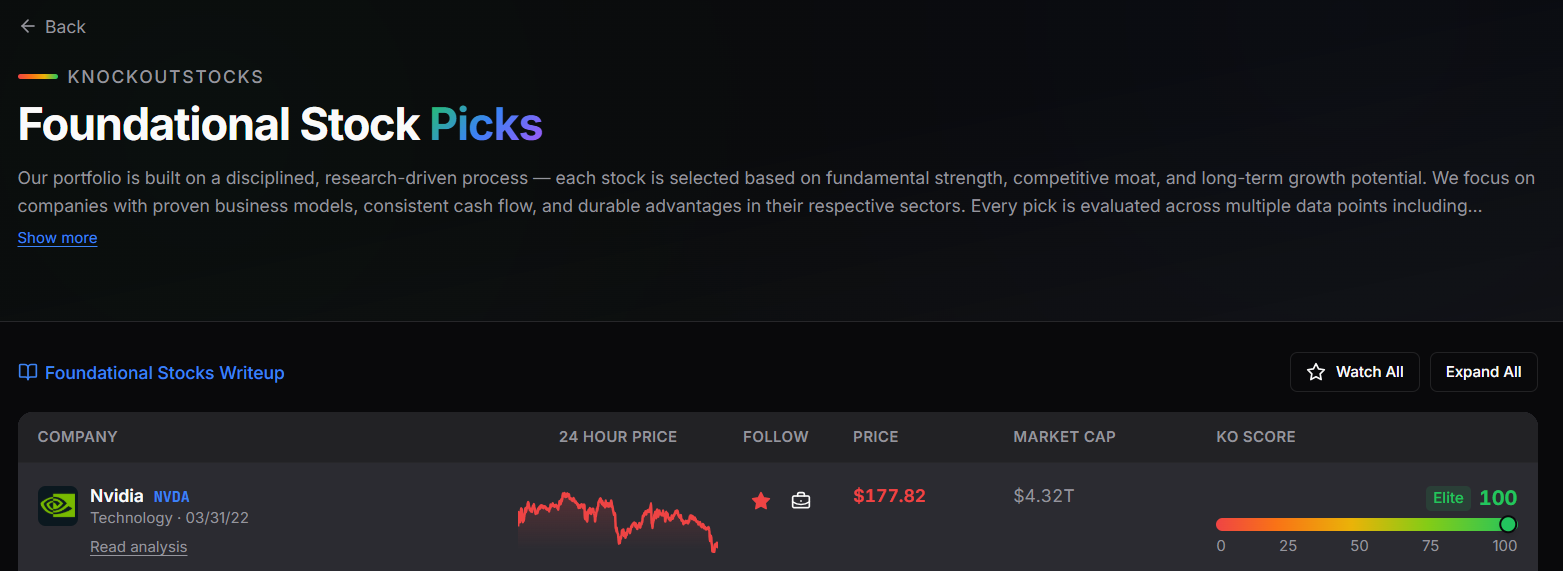
The portfolio undergoes continuous oversight with adjustments made exclusively when the underlying data justifies changes. Complete access to the Stock Picks section—featuring active positions, performance metrics, and detailed rationale for each holding—comes with Middleweight and Heavyweight membership levels.
Benzinga doesn’t provide a comparable curated stock portfolio service. While the platform publishes equity-focused content, analyst rating notifications, and market analysis, it doesn’t maintain a structured, high-conviction portfolio developed and monitored by dedicated research personnel. Investors seeking systematic, research-backed stock recommendations will find KnockoutStocks more aligned with this need.
Real-Time News and Market Data
This category represents Benzinga’s strongest competitive position. Benzinga Pro’s architecture prioritizes speed above all else. The platform’s news stream delivers breaking market intelligence faster than most competitors, while its audio squawk functionality verbalizes headlines in real-time, ensuring traders never miss critical market-moving information.
KnockoutStocks provides personalized market updates calibrated to individual watchlists and portfolio holdings. It maintains user awareness regarding owned and monitored securities. However, real-time news velocity and coverage breadth define Benzinga’s core competency, where it outperforms virtually all alternatives.
Options Flow and Trading Signals
Benzinga Pro incorporates unusual options activity monitoring—among its most valued features for active trading audiences. Detecting substantial unusual options transactions can reveal institutional positioning before significant stock movements materialize. The platform additionally delivers trading signals and equity alerts triggered by technical patterns and news catalysts.
KnockoutStocks doesn’t currently provide options flow intelligence or trading signal generation. Its concentration remains on fundamental equity quality and AI-enhanced research rather than short-duration trading instruments. Investors incorporating options activity into their methodology will find Benzinga superior for this application.
Stock Screener
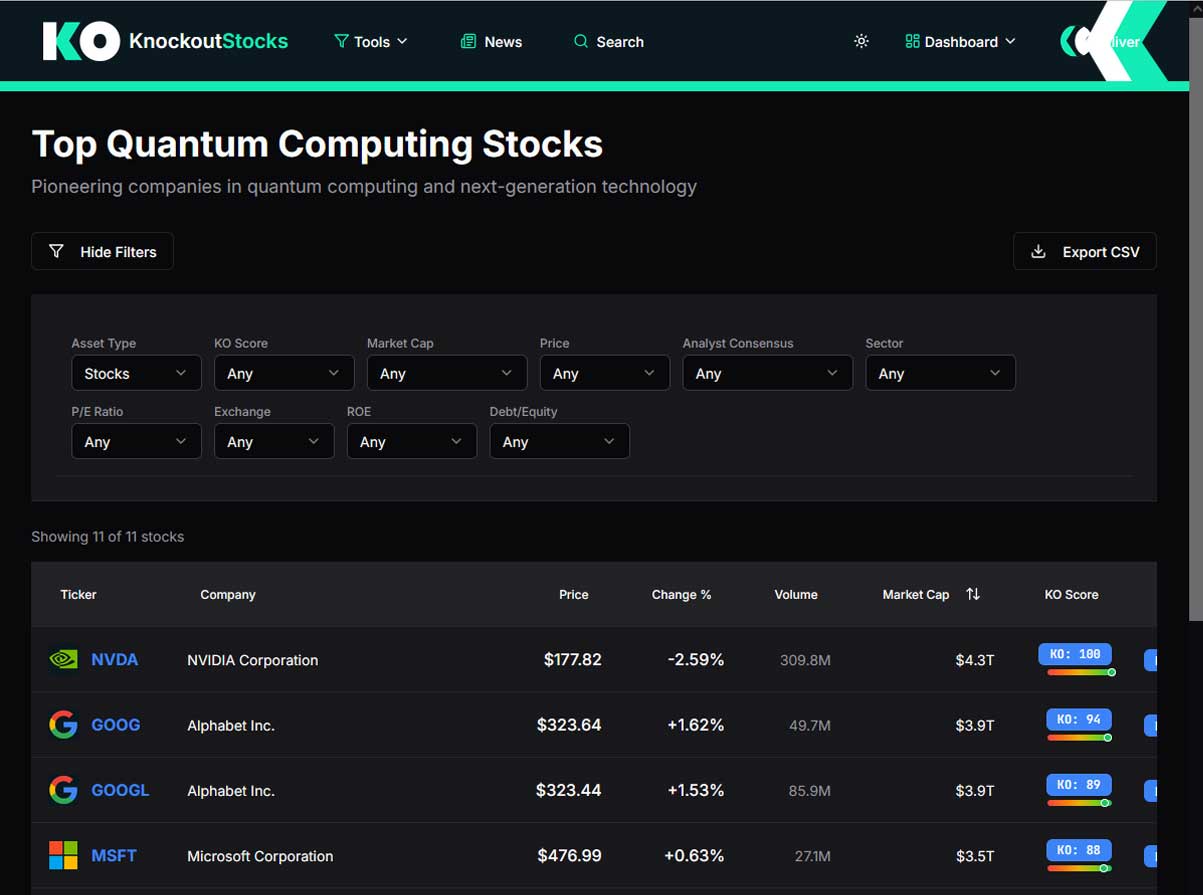
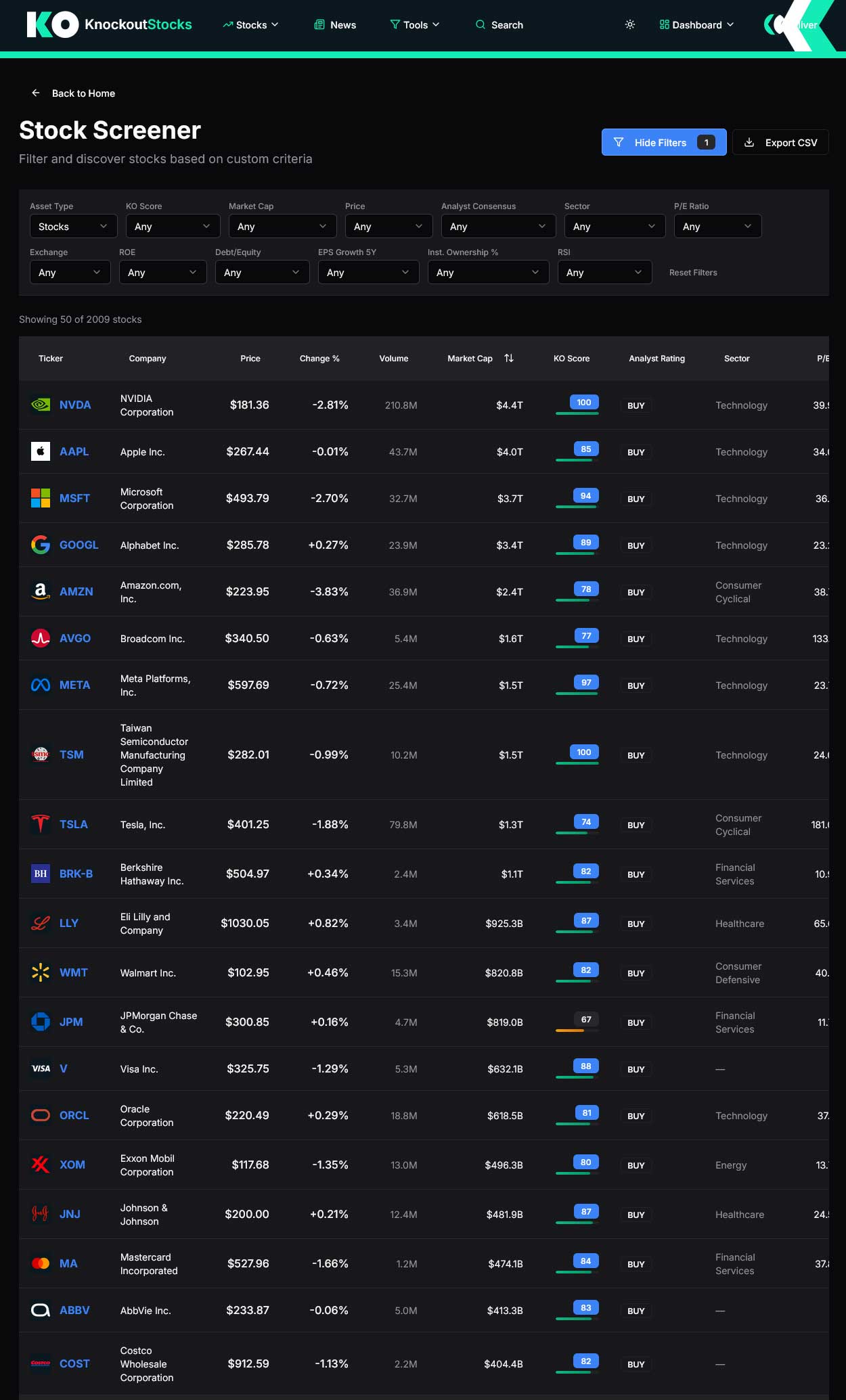
KnockoutStocks features a sophisticated screening tool offering more than 20 filter parameters spanning KO Score, capitalization, share price, trading volume, fundamental data points, and technical indicators. Complete screener functionality is available even on the no-cost membership tier.
Benzinga Pro includes a stock screening utility with filters addressing price, volume, market capitalization, and technical patterns. While functional, it doesn’t match KnockoutStocks’ depth regarding fundamental metrics. The screener design favors identifying near-term trading prospects over assessing long-term equity quality.
Portfolio Tracking
KnockoutStocks delivers comprehensive portfolio monitoring with live performance data, profit/loss calculation, and AI-enhanced portfolio evaluation. The Heavyweight subscription supports up to 100 securities per portfolio with unlimited portfolio creation and AI-generated portfolio assessments.
Benzinga Pro offers elementary watchlist and portfolio capabilities, but portfolio management doesn’t constitute a platform strength. The service functions primarily as a news and data resource rather than a portfolio administration solution.
Alerts and Updates
Both platforms furnish alert capabilities with distinct orientations. KnockoutStocks distributes customized daily or weekly email notifications covering watchlist movements, leading KO Score changes, earnings releases, analyst upgrades, and breaking news relevant to user holdings.
Benzinga Pro’s notification infrastructure emphasizes speed and active trading requirements. Users can configure alerts for news references, price action, analyst rating modifications, and unusual options transactions. For traders requiring rapid market event response, Benzinga’s alerts deliver speed and extensive customization options.
Pricing
KnockoutStocks presents three membership levels. The complimentary tier includes complete screener access, one portfolio slot, five watchlist positions, one weekly AI conversation, and one weekly AI stock report. The Middleweight tier costs $19.99 monthly, providing 10 daily AI queries and 10 weekly AI reports. The Heavyweight tier runs $59.99 monthly with unlimited AI access, voice coaching capabilities, PDF report generation, and CSV data export.
Benzinga Pro pricing begins approximately $37 monthly for the Basic subscription, escalating to roughly $47 monthly for the Essential package incorporating options flow data. Annual payment reduces effective monthly costs. No substantial free tier exists—Benzinga’s principal value proposition requires paid subscription.
Pros and Cons
KnockoutStocks
Pros
- KO Score delivers rapid, comprehensive quality assessment across thousands of securities
- Integrated AI advisor for immediate stock and portfolio inquiries
- Instant AI stock reports accessible for any security on demand
- Curated high-conviction stock portfolio with complete research documentation
- Complete screener access included in free membership
- Robust portfolio monitoring with real-time data and AI analysis
- More accessible pricing with substantial free tier functionality
- Voice-enabled AI advisor included in premium tier
- Customized news streams aligned with watchlist and portfolio composition
Cons
- No live breaking news squawk or audio broadcast
- No unusual options flow monitoring capability
- Not designed for active day trading or short-term signal generation
- Less emphasis on news delivery speed
Benzinga
Pros
- Industry-leading real-time financial news distribution
- Audio squawk feature enabling hands-free news monitoring
- Unusual options activity tracking provides genuine competitive advantage
- Rapid, customizable notification system designed for active traders
- Comprehensive coverage of earnings events, analyst updates, and market developments
- Excellent for traders requiring immediate news reaction capability
Cons
- No dedicated conversational AI investment advisor
- No on-demand AI-generated stock reports
- No curated high-conviction stock portfolio offering
- No proprietary fundamental equity scoring methodology
- Elementary portfolio tracking functionality
- Screener lacks depth in fundamental metric filtering
- No meaningful free membership tier
- Architecture favors traders over long-term investors
Which Platform Is Best for Different Investors?
Use KnockoutStocks if you:
Seek a comprehensive, analytics-driven stock quality perspective using a transparent scoring framework that evaluates profitability, financial stability, growth dynamics, momentum characteristics, and analyst confidence. The KO Score provides immediate insight into any equity’s fundamental standing.
Desire AI-powered capabilities on demand—posing questions, generating instant stock analyses, and evaluating portfolio composition without requiring constant live news feed monitoring.
Want access to a meticulously researched, high-conviction stock portfolio constructed on genuine fundamentals and long-horizon thinking. The Stock Picks section provides Middleweight and Heavyweight members a clear foundation supported by thorough research.
Identify as a long-term or intermediate-term investor focused on discovering quality securities and tracking them across time. KnockoutStocks’ architecture supports this investment approach.
Value a substantial free tier and reasonable premium pricing that delivers genuine research capabilities affordably.
Use Benzinga if you:
Operate as an active trader requiring the most rapid access to breaking market intelligence and price-moving events. Benzinga Pro’s entire infrastructure emphasizes speed, evident across all features.
Incorporate unusual options activity as a signal within your trading methodology. The options flow data represents one of Benzinga’s most powerful and distinctive capabilities.
Require real-time notifications for news mentions, price movements, and analyst modifications enabling immediate action. Benzinga’s alert infrastructure delivers speed and extensive customization for active trading workflows.
Prefer an audio news stream maintaining awareness hands-free during continuous market monitoring throughout trading sessions.
Final Verdict
Benzinga and KnockoutStocks serve distinct investor profiles and investment methodologies.
Benzinga excels in real-time news velocity, options flow intelligence, and capabilities engineered for active traders. If your day involves responding to market news and pursuing time-sensitive opportunities, Benzinga Pro represents a powerful resource for that workflow.
KnockoutStocks excels in fundamental equity analysis, AI-enhanced research, curated stock selections, portfolio oversight, and overall value proposition. The KO Score addresses more analytical dimensions than any Benzinga offering for assessing stock quality, while the AI advisor, instant reports, and high-conviction stock picks provide layers of intelligence and guidance Benzinga simply doesn’t deliver.
For long-term and intermediate-term investors seeking to identify exceptional stocks, follow a research-backed picks portfolio, and obtain AI-powered insights on demand—KnockoutStocks presents the superior platform in 2026. Benzinga remains the better instrument for active traders whose success depends on real-time market news consumption.
If your objective centers on building long-term wealth through intelligent stock selection rather than responding to daily news cycles, KnockoutStocks represents the more appropriate choice.


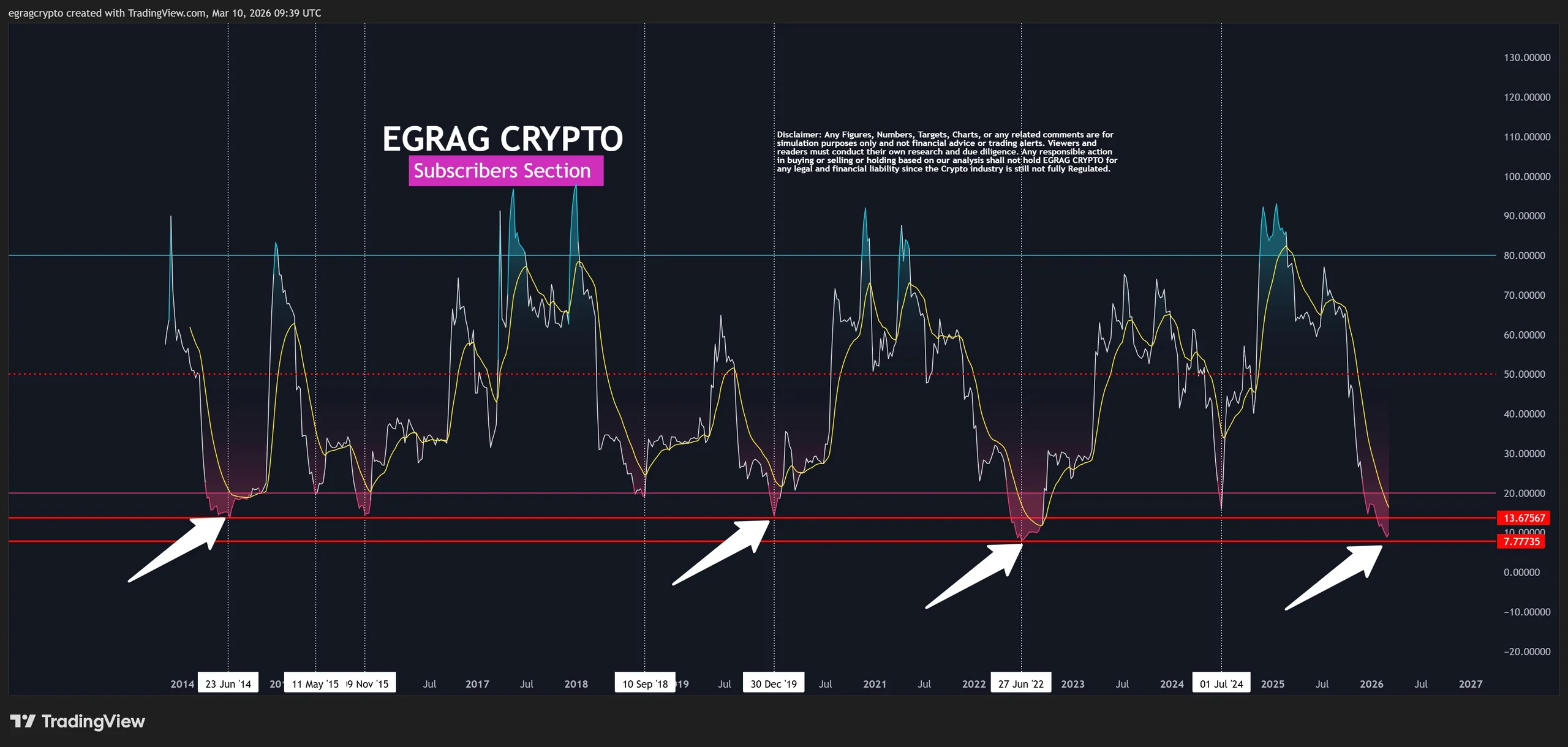
The bearish analyst outlined at which price levels he wants to short XRP.
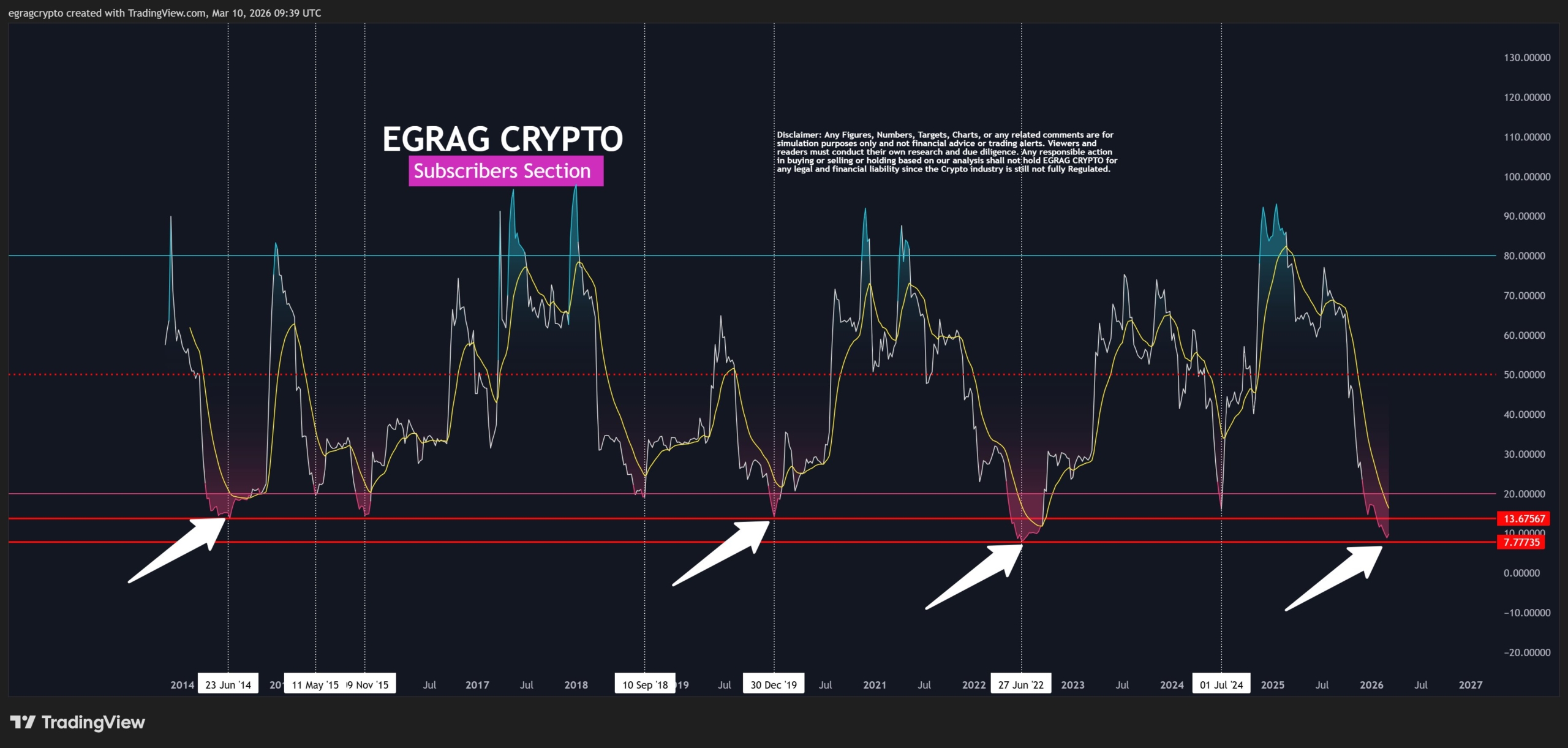
The weekly RSI levels for XRP have declined to their most oversold territory since at least 2022, said popular market commentator EGRAG CRYPTO, adding that this might be a proper entry zone.
While their chart reviews the broader XRP picture, another analyst weighed in on the asset’s daily gains today, noting that he wants to short it only after it reaches a certain level.
Most Oversold in History?
Known for his detailed and mostly bullish analysis on several large cryptocurrencies, but with the main focus on XRP, EGRAR’s latest chart on the cross-border token indicated that the asset is “entering the most oversold region” in its history right now.
They explained that when XRP has plunged to such RSI levels, it has historically bottomed, as was the case in 2014, 2015, 2018, 2020, and 2022. This means that the token has not seen such oversold numbers in four years.
However, EGRAR disclosed that although XRP has indeed reached a macro bottom at similar levels, it does not mean that “the exact bottom prints immediately,” but it’s entering its final phase, which looks like this:
- Final liquidity sweep
- Sideways accumulation
- Gradual reversal
“This is why many experienced investors start accumulating in this region instead of trying to perfectly time the bottom,” they added before asking: “When XRP weekly RSI is in the most oversold zone in its entire history… is this the worst time to buy? Or, one of the best times to start accumulating?”
Or, Maybe Short XRP?
While EGRAG’s analysis focuses on XRP’s macro picture, Crypto Tony weighed in on the asset’s most recent price performance and whether he sees a potential for a trend reversal in the short-term. The token dumped to $1.21 last week, rebounded to $1.55, where it was rejected, and has remained within a tighter range between $1.34 and $1.48 since then.
It jumped to $1.42 earlier today, and Crypto Tony saw an upcoming opportunity to short the upper boundary of this range at $1.47-$1.48. However, XRP was rejected for now and remains around $1.40 as of press time, which is a level that the bulls “need to flip into support,” and they haven’t done it decisively yet.
You may also like:
I would love a spike up to $1.47 range high to then look for shorts. Bulls need to flip $1.40 into support to make this happen pic.twitter.com/U0SrpuCbvz
— Crypto Tony (@CryptoTony__) March 10, 2026
Binance Free $600 (CryptoPotato Exclusive): Use this link to register a new account and receive $600 exclusive welcome offer on Binance (full details).
LIMITED OFFER for CryptoPotato readers at Bybit: Use this link to register and open a $500 FREE position on any coin!


Starknet has launched the STRK20 token standard, aimed at integrating privacy features into ERC-20 tokens on its platform. This development emphasizes the growing trend of privacy in blockchain transactions.
Starknet has unveiled the STRK20 token framework, a new initiative designed to enhance the privacy of Ethereum’s ERC-20 tokens on its platform. According to a blog post from the Layer 2 today, March 10, this development addresses ongoing privacy concerns for token issuers, users, and regulators.
The new framework makes it possible for any ERC-20 token on Starknet to have native privacy, with transactions backed by zero-knowledge proofs.
The mechanism works by letting users transact within the Starknet Privacy Pool, by depositing ERC-20 tokens to the pool, transacting within it, and then withdrawing at any time. Starknet said in the blog post that it’s launching the framework today with both swaps and staking available via Ekubo.
“Privacy on its own is not enough. For it to matter, it has to work where finance actually happens: in swaps, in staking, in the protocols that make DeFi run,” Starknet’s post reads.
As a Layer 2 scaling solution for Ethereum, Starknet utilizes zk-rollups to improve scalability and reduce transaction costs. The introduction of STRK20 aligns with the broader industry trend of incorporating privacy features into blockchain transactions.
This article was generated with the assistance of AI workflows.
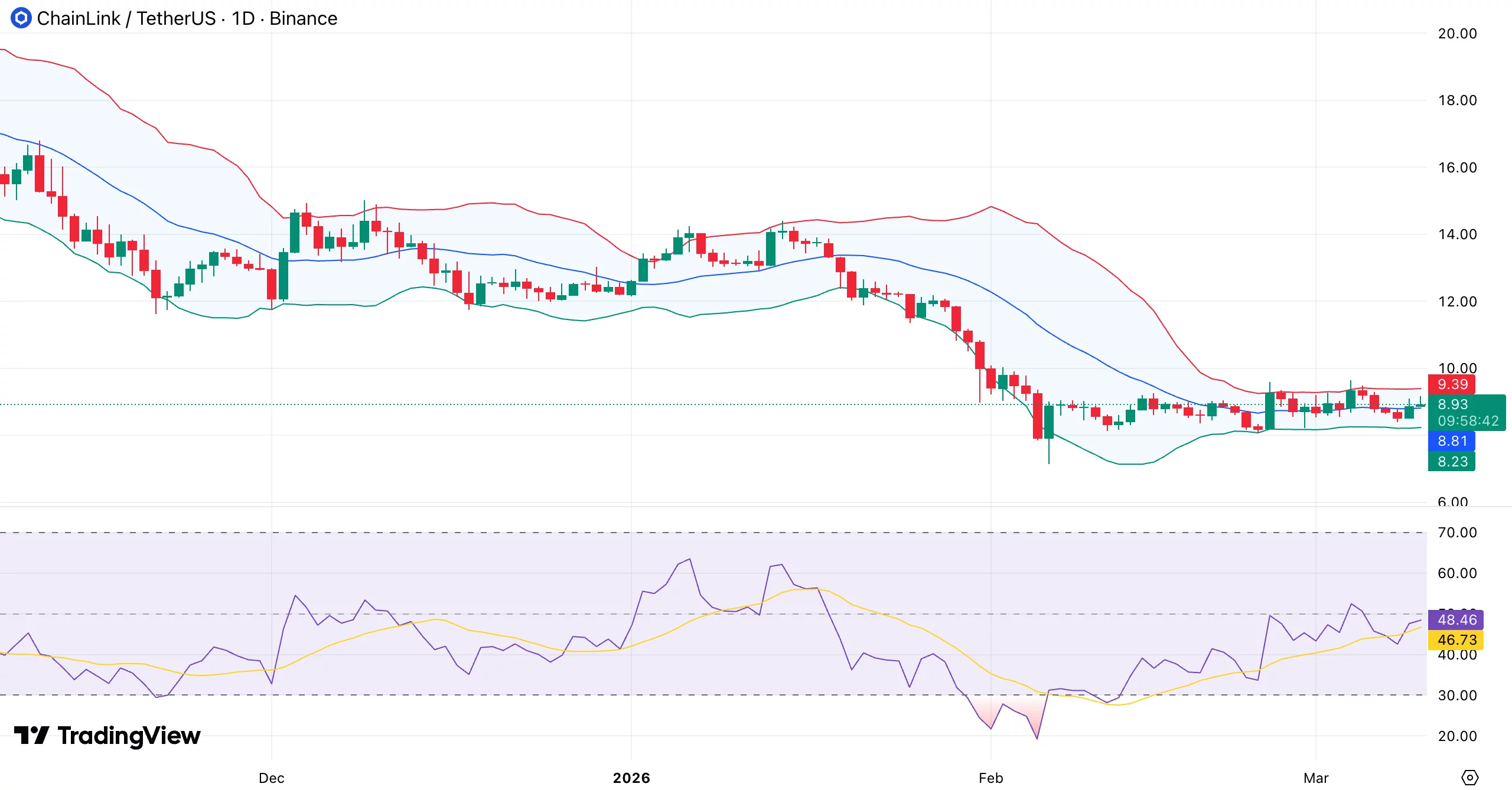
Chainlink price is tightening near $9 as volatility drops, with traders watching whether bulls can push LINK above the key $10 resistance level.
Summary
- Chainlink is trading at $8.94, moving within a tight weekly range between $8.52 and $9.55.
- Derivatives data shows futures volume falling while open interest holds steady, suggesting traders are keeping positions open during the consolidation.
- Technical indicators point to a volatility squeeze, with the $10 level acting as the key breakout zone.
At press time, Chainlink (LINK) was priced at $8.94, up 1.2% in the past 24 hours. Over the past week, the token moved between $8.52 and $9.55 as price action settled after the steep drop earlier this year.
Chainlink is still down about 42% over the past year, though the latest rebound has helped narrow the monthly decline to around 0.8%.
Trading activity eased during the recent sideways move. Daily volume came in at $494 million, a 7% drop from the previous session. Lower volume often appears when the market pauses and traders wait for the next clear move.
CoinGlass data shows only small changes in derivatives markets. Futures volume slipped, while open interest edged up 0.07% to $369.57 million. When price moves sideways and open interest barely changes, it usually means many traders are holding their positions instead of opening new ones.
Network growth continues in 2026
In early 2026, Chainlink has strengthened its place in the blockchain infrastructure market. A March 2 partnership set up a $5 billion cbBTC bridge to the Monad network, connecting the two systems. Another deal with Abu Dhabi’s ADI Foundation will explore tokenization projects in the Middle East.
Chainlink’s Cross-Chain Interoperability Protocol already links more than 75 blockchains, and more connections are being added to move data and assets between them.
Projects such as Injective EVM, Monad, and Perennial have adopted the system, while 11 additional chains, including ADI Chain, Arc, and Base, were recently added.
Traditional finance firms are also experimenting with Chainlink’s infrastructure. Institutions including SWIFT, UBS, and the Bank of England have worked with the network on tokenization pilots tied to the Canton Network, which targets as much as $8 trillion in real-world assets.
Chainlink currently controls about 64% of the oracle market, with over $41 billion in total value secured. The network has secured more than $100 billion in assets and processed roughly $27.3 trillion in total value executed by late 2025.
Institutional interest has increased as well. Even during more periods of outflows in the cryptocurrency market, Grayscale’s LINK ETF, launched in December 2025, reported consistent weekly inflows.
Chainlink has earned SOC 2 and ISO 27001 certifications, which are often required by institutional partners. To make the token more useful, the network is running a $644 million buyback program and working with S&P Global to evaluate stablecoins on-chain.
Chainlink price technical analysis
Chainlink is entering a period of low volatility, known as a volatility squeeze, when price movement tightens before a bigger move. The Bollinger Bands are narrowing, showing that volatility is decreasing.
LINK is trading near the middle band, indicating short-term momentum is neutral.
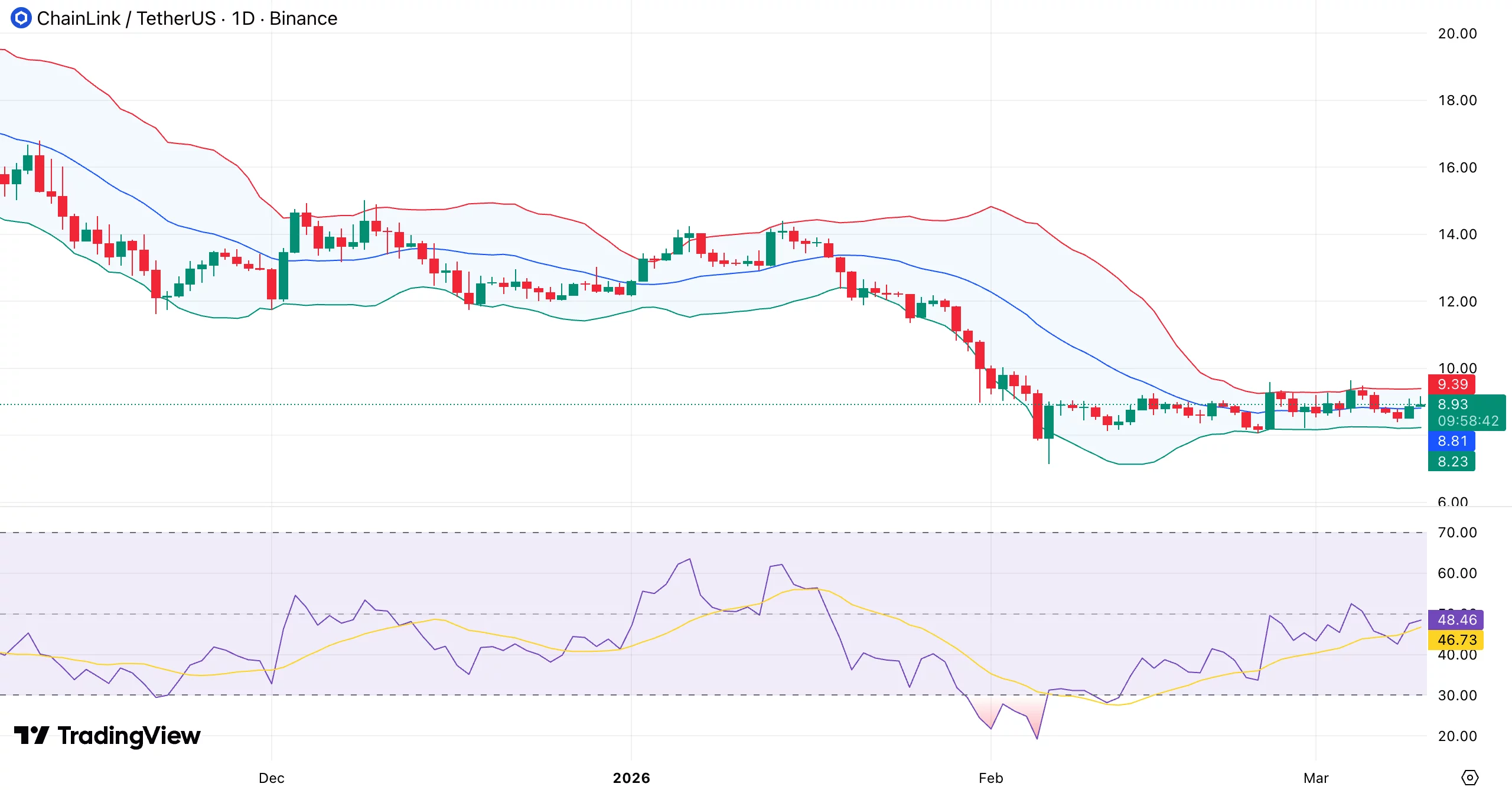
Traders are focusing on $10, which has acted as resistance in recent attempts to move higher. A daily close above $10 could signal a breakout, potentially turning this level into support and opening the way toward $11 to $12.
On the downside, $8.8 to $9.0 is the main support zone. If the price falls below $8.8, the $8.2 to $8.0 range may be tested.
Momentum indicators suggest the market is stabilizing. The relative strength index is around 45–50, meaning selling pressure has eased, but buyers have not yet gained control.
If LINK moves above $10, targets could include $10.8, $11.5, and $12. If it fails to break $10, the token may remain in its current range.
Key Highlights
- Nvidia has injected capital into Thinking Machines Lab, the artificial intelligence venture led by ex-OpenAI CTO Mira Murati (investment amount undisclosed)
- A strategic multi-year collaboration between the companies was revealed on Tuesday
- Thinking Machines plans to implement a minimum of one gigawatt worth of Nvidia’s Vera Rubin infrastructure
- The rollout is scheduled to begin in early next year
- Following a $2B capital raise in July 2025, Thinking Machines achieved a $10B valuation
Nvidia has taken an equity position in Thinking Machines Lab while establishing a comprehensive multi-year strategic alliance with the AI company. The partnership details emerged Tuesday morning.
Neither organization revealed the precise dollar amount of Nvidia’s equity stake.
Under the terms of this collaboration, Thinking Machines will integrate a minimum of one gigawatt of Nvidia’s cutting-edge Vera Rubin infrastructure. This computing power will fuel the company’s advanced model development efforts and platform operations.
According to Thinking Machines, the Vera Rubin systems are slated to go live early in the coming year.
Mira Murati established Thinking Machines Lab after her tenure as Chief Technology Officer at OpenAI. The company’s mission centers on delivering scalable, customizable artificial intelligence solutions for corporate clients, academic institutions, and scientific organizations.
In a prepared statement, Jensen Huang, who founded and leads Nvidia as CEO, commented: “Thinking Machines has assembled an exceptional team dedicated to pushing AI boundaries forward. We’re excited to collaborate with Thinking Machines as they pursue their compelling vision for AI’s evolution.”
Murati offered this response: “NVIDIA’s innovations form the bedrock of our entire industry. This collaboration enhances our ability to develop AI systems that users can customize and truly own.”
A $10 Billion Valuation
This partnership doesn’t mark Nvidia’s initial engagement with Thinking Machines. The chipmaker participated in the startup’s $2B financing round during July 2025, which established the company’s valuation at $10B.
Andreessen Horowitz (a16z) spearheaded that funding round, with additional backing from Nvidia, AMD, ServiceNow, and Cisco Systems.
Tuesday’s disclosure elevates the connection beyond simple investment to a comprehensive strategic partnership framework.
The agreement encompasses collaborative development of training and inference infrastructure optimized explicitly for Nvidia’s chip architectures.
Vera Rubin Takes Center Stage
Nvidia’s Vera Rubin platform represents the company’s latest-generation GPU infrastructure, and this agreement positions a gigawatt-scale implementation as a cornerstone element.
A gigawatt represents significant energy allocation — highlighting the massive scale required for cutting-edge AI model development today.
According to Thinking Machines, the Vera Rubin computing infrastructure will serve as the backbone for developing AI systems that users can tailor and engage with hands-on.
The collaboration aims to broaden accessibility to advanced AI capabilities and open-source models throughout enterprise and academic environments.
Nvidia maintains investment positions across numerous AI ventures and continues strengthening industry relationships through semiconductor supply contracts combined with ownership stakes.
The Thinking Machines agreement represents another addition to this portfolio, distinguished by its gigawatt-level hardware deployment obligation.

Trust Wallet has rolled out a proactive defense against address poisoning, introducing an automated screening feature that checks destination addresses against a live database of known scam and lookalike wallets. The noncustodial wallet provider said the protection will run in the background as users initiate transfers, aiming to thwart attempts to misdirect funds to illicit addresses. The rollout covers 32 Ethereum Virtual Machine-compatible chains at launch, including Ethereum, BNB Smart Chain, Polygon, Optimism, Arbitrum, Avalanche and Base, with the team signaling plans to expand over time. The move comes as the ecosystem contends with increasingly sophisticated phishing attempts that rely on users copying and pasting addresses from their transaction history.
Trust Wallet described address poisoning as among the crypto space’s fastest-growing threats, citing figures that place the total number of attacks at over 225 million and losses nearing $500 million to date. In address poisoning scams, perpetrators typically send a harmless, small amount to a target to establish a history, then capitalize on users who replicate addresses from their own transaction history, inadvertently sending larger sums to the attacker’s wallet. The new screening mechanism seeks to disrupt this attack chain by preventing outbound transfers to detected poison addresses before they are executed.
Beyond automated checks, the broader industry has been pushing for preemptive safeguards across wallets. Notably, several wallets already employ transaction-filtering tools designed to curb malicious transfers—for instance, Rabby Wallet, Zengo Wallet and Phantom Wallet have each introduced similar layers of screening to reduce exposure to scam addresses. The emphasis on preventative controls mirrors growing calls for a more defensive stance from the wallet ecosystem, especially as attackers increasingly rely on social engineering and lookalikes that mimic legitimate counterparts.
The topic has taken on renewed urgency in light of high-profile incident data. In December 2025, a single USDt (USDT) transfer tied to a poisoning scheme underscored the potential scale of losses, prompting calls from industry figures for more robust wallet-level defenses. Analysts and security researchers have long argued that users should not copy addresses from transaction histories, a practice that continues to contribute to successful exploits. Security firm Hacken has highlighted the importance of circumventing copy-paste habits as part of a multi-layered defense strategy.
Security researchers have pointed to the conflicts between convenience and protection in wallet design. The push for stricter verification aligns with expectations that wallets should act as the first line of defense—filtering out poison addresses and preventing users from inadvertently participating in scams. Some commentators have called for wallets to proactively block any receiving address that appears on a known poison list, a stance that aligns with broader calls for universal adoption of blockchain-querying checks at the point of interaction.
In parallel, discussions around address poisoning—both the technical mechanisms and the user-behavior patterns it exploits—continue to evolve. The episode underlines why exchanges, wallets and service providers alike must invest in robust address-checking capabilities, while users remain urged to verify recipient addresses through independent channels and avoid relying solely on transaction histories when copying addresses from trusted sources. As the ecosystem expands, the balance between user experience and security will remain a focal point for developers and regulators alike.
Why it matters
The introduction of address-poisoning protection marks a meaningful step in reducing on-chain losses and encouraging safer transaction practices across major EVM networks. For users, the feature represents a real-time safety net that can prevent inadvertent transfers to illicit wallets if a recipient address matches a known scam pattern or closely resembles a legitimate one. For builders and wallet providers, it sets a benchmark for proactive risk management and cross-wallet collaboration on threat intelligence, potentially reducing the volume of successful attacks that rely on social engineering and address lookalikes.
From a market perspective, the development reinforces the idea that security enhancements are increasingly becoming a differentiator among wallet ecosystems. As hackers refine their techniques, the emphasis shifts from purely cosmetic features to verifiable protections that can be audited and verified by users and independent researchers. The industry’s collective response—combining automated screening, user education and responsible disclosure—could contribute to a more resilient infrastructure over time, even as the crypto landscape remains sensitive to regulatory signals and macro risk sentiment.
For investors and users, this shift underscores the importance of risk management in wallet selection and usage. While no single protection can eliminate all threats, multi-layered defenses—complemented by best practices such as avoiding address copy-paste from transaction histories—can materially reduce exposure to address-poisoning schemes. The broader narrative is one of maturation: as wallets adopt more rigorous checks, the friction between speed and security may gradually tilt toward safer, more reliable user experiences.
What to watch next
- Expansion of the poisoned-address database to cover additional chains beyond the initial 32 EVM-compatible networks, with a timeline for rollout on non-EVM platforms.
- Independent audits or third-party attestations validating the accuracy and speed of the destination-address screening feature.
- Adoption metrics across wallets that implement similar protections, including user feedback and impact on attempted phishing campaigns.
- Updates from Trust Wallet or partner security teams regarding any zero-day findings or refinements to the poisoning-detection database.
Sources & verification
- Trust Wallet official announcement: address poisoning protection and rollout details.
- On-chain data and public logs illustrating address-poisoning incidents (e.g., notable large transfers cited in December 2025).
- Binance Square commentary by Changpeng Zhao advocating universal poison-address checks across wallets.
- Security research from Hacken’s Extractor team on best practices not to copy addresses from history.
- Industry coverage of Rabby, Zengo, and Phantom Wallets’ transaction-filtering approaches.
Trust Wallet rolls out address poisoning protection across 32 EVM chains
Trust Wallet has introduced a proactive defense against address poisoning by adding a destination-address screening feature that checks outgoing transfers against a live database of known scam and lookalike wallets. The aim is to stop users from accidentally sending funds to illicit addresses before the transaction is confirmed. The company emphasized that the protection operates automatically, running in real time as a user initiates a transfer. The initial scope includes 32 EVM-compatible networks, with Ethereum (CRYPTO: ETH) at the forefront, along with BNB Smart Chain, Polygon, Optimism, Arbitrum, Avalanche and Base. The firm noted that address-poisoning attacks have emerged as a fast-growing threat within crypto markets, and it cited figures indicating more than 225 million attacks and roughly $500 million in confirmed losses to date.
Address poisoning, a form of phishing, exploits the habit of users copying and pasting addresses from transaction histories—a behavior that can enable attackers to divert funds to malicious wallets. By cross-referencing recipient addresses with a database of poison addresses, Trust Wallet’s system can halt transactions before they leave a user’s control. This approach aligns with broader industry moves toward preemptive risk controls, particularly as scammers increasingly rely on social engineering and ambiguous address representations to mislead victims.
Industry observers point to complementary protections already available across wallets. Rabby Wallet, Zengo Wallet and Phantom Wallet have implemented early-warning systems or blacklist-based checks aimed at stopping transfers to flagged addresses. The emphasis on prevention reflects a broader trend toward user-centric security features that do not rely solely on post-incident recovery. In tandem with these protections, security researchers and users alike continue to advocate for best practices, such as avoiding direct copying of addresses from transaction histories and verifying recipients through independent channels.
The December 2025 incident involving a USDt (USDT) transfer underscored the ongoing risk, drawing attention to the need for wallet-level defenses that can catch poisoned addresses before funds move. Industry voices have stressed that wallets should not display or reproduce harmful transactions in the first place, a stance echoed by prominent figures who argue for a universal, automated filter at the point of interaction. While no solution is flawless, the convergence of automated screening, user education and cross-wallet sharing of threat-intelligence signals a maturing security posture across the crypto ecosystem.
As the rollout unfolds, the crypto community will be watching for how well these protections scale across networks and how quickly users adapt to new prompts or warnings when initiating transfers. The goal is a safer user experience that preserves the speed and convenience that attract new participants, while delivering meaningful guardrails against one of the space’s oldest and most persistent attack vectors. In a rapidly evolving threat landscape, Trust Wallet’s move signals a continued push toward stronger, more transparent security practices that could shape wallet design choices for years to come.


Trust Wallet launched address poisoning protection on 32 EVM chains, adding scam address screening as wallet security pressure intensifies.


Anthropic just picked a fight with its biggest potential customer.
The AI company behind Claude filed a lawsuit Monday in the U.S. District Court for the Northern District of California naming the Departments of Treasury, Commerce, State, Health and Human Services, Veterans Affairs, the General Services Administration, and several other federal agencies as defendants.
Anthropic says the U.S. government effectively blacklisted its AI systems from federal procurement and did it without following any of the legal procedures required to actually ban a vendor.
It says there was a lack of formal determination, interagency review, documented evidence, and no evaluation of less restrictive alternatives like conditional approval or security audits.
According to the complaint, officials justified the restrictions internally on national security and supply-chain grounds, then let the directive spread informally through centralized procurement channels until Anthropic was locked out of federal contracting across the board.
The timing makes this more than a procurement dispute.
The U.S. government is in the middle of the largest AI adoption push in federal history, using OpenAI’s ChatGPT as its tool of choice. Agencies are deploying generative AI for cybersecurity, intelligence analysis, administrative automation, and internal decision-making. The contracts are large, multi-year, and increasingly central to how the government operates.
Getting locked out of that market isn’t a minor commercial setback, but an existential competitive problem for any AI company that wants to be taken seriously at the institutional level.
Anthropic is asking the court to declare the restrictions unlawful and block agencies from enforcing them. If it wins, the ruling would reopen federal procurement and potentially set a precedent on how far agencies can go when restricting AI vendors on national security grounds without following their own rules.
The government hasn’t publicly responded to the filing, but an Axios report on Tuesday noted the White House was preparing an executive order formally instructing the federal government to rip out Anthropic’s AI from its operations, citing sources familiar with the matter.

X Money will be launching its early public access as soon as next month, Elon Musk confirmed.
The much-anticipated financial app, planned and developed by the popular social media platform X (formerly Twitter), is coming to market sooner than some may have anticipated.
Elon Musk posted on X to reveal that the app’s early public access launch will take place as soon as next month.
𝕏 Money early public access will launch next month
— Elon Musk (@elonmusk) March 10, 2026
Why it Matters for Crypto?
As CryptoPotato reported earlier, Musk’s vision of transforming social media into an “everything app” has been gradually taking shape with the development of X Money. The latter is supposed to be a new payments feature designed to bring financial services directly to the platform.
Up until this moment, Musk said that the app was running in a closed internal beta.
Early screenshots of the popular actor William Shatner suggested that the app may include features such as a debit card with cashback, as well as tools for sending and receiving payments.
One of the biggest questions surrounding X Money, however, is whether or not it will support cryptocurrencies. Musk, who has frequently influenced crypto markets in the past, particularly through his comments about Dogecoin, as well as his decision to integrate Bitcoin payments for Tesla purchases, as well as to hold BTC on Tesla’s balance sheet, has hinted at broader financial capabilities for the platform.
You may also like:
He even recently amplified a post that described potential services, such as crypto support, and commented that the overall initiative will be big.
It’s worth noting, however, that there’s no official confirmation of whether such integrations will be featured.
Binance Free $600 (CryptoPotato Exclusive): Use this link to register a new account and receive $600 exclusive welcome offer on Binance (full details).
LIMITED OFFER for CryptoPotato readers at Bybit: Use this link to register and open a $500 FREE position on any coin!
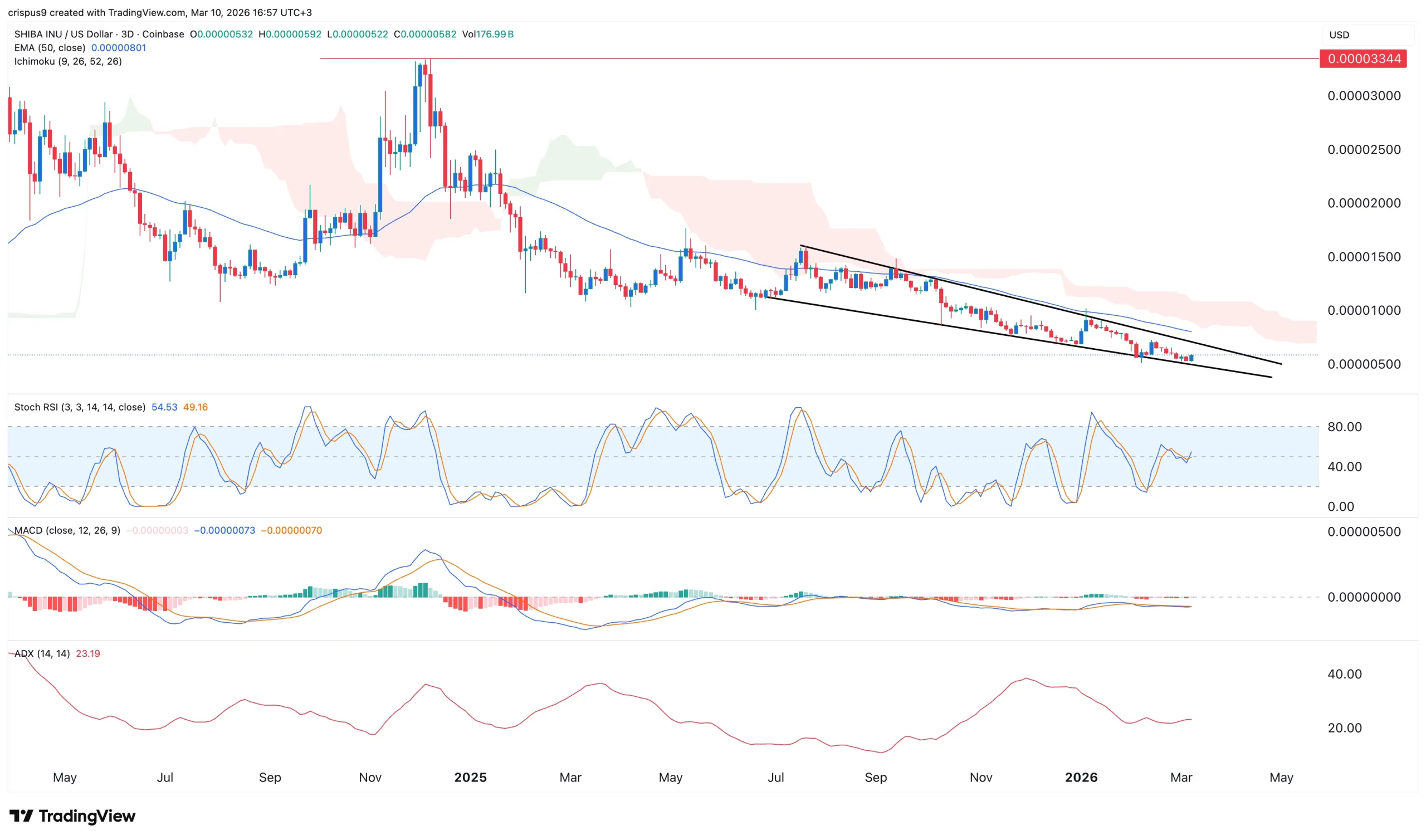
Shiba Inu Coin price rose by 7% on March 10 as the crypto market rallied and as the burn rate jumped by over 162%.
Summary
- Shiba Inu price rose by over 7% on Tuesday as crypto prices rebounded.
- The coin’s burn rate jumped by 162% to 6.5 million.
- It has formed a highly bullish falling wedge pattern, pointing to an eventual rebound.
Shiba Inu (SHIB) token was trading at $0.0000058, a few points slightly above the year-to-date low of $0.00000525. It remains 83% below its highest point in 2025.
On the positive side, the coin’s burn rate jumped by 162% to over 6.58 million in the last 24 hours. The circulating supply has dropped to 585 billion after 410 billion were burned from the initial supply. A token burn reduces a coin’s circulating supply and its inflation.
Meanwhile, futures data shows that activity in the market is doing well. The futures open interest rose to $62.8 million on Wednesday, up sharply from last week’s low of $53 million. Rising open interest is a sign that demand is rising in the futures market.
Shiba Inu’s volume in the spot market has also continued rising this week. It jumped to over $143 million, up from below $100 million last week.
Another potential catalyst for the token is the latest developments in the Middle East, where Donald Trump is seeking to de-escalate the crisis after the stock market dropped and crude oil prices surged to the highest point since 2022.
Shiba Inu Coin price technical analysis
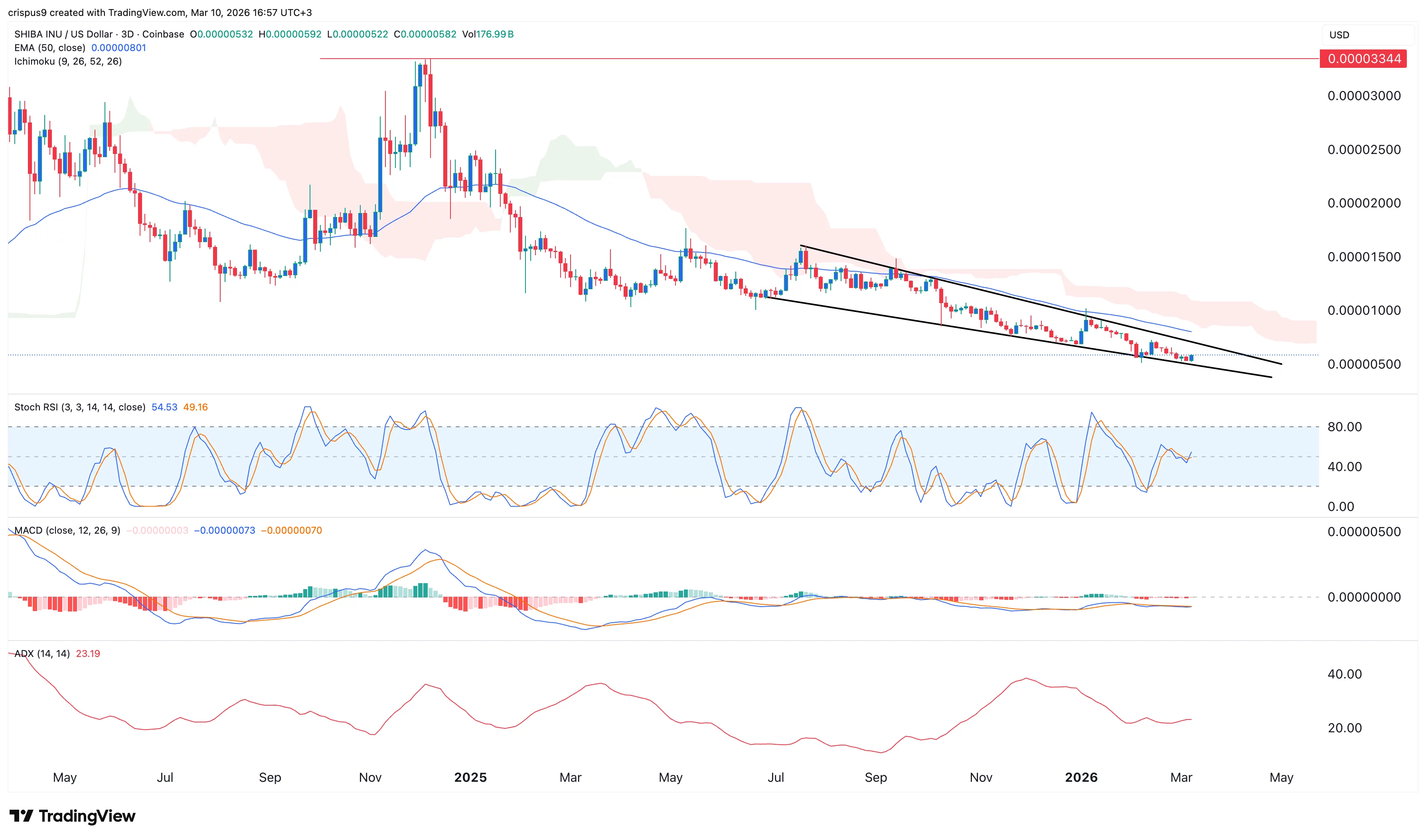
A look at the three-day chart shows that the coin has remained in a bear market this year. This decline, however, is losing momentum as evidenced by the Average Directional Index, which has moved sideways since January.
On the positive side, the coin has formed a large falling wedge pattern, which is made up of two descending and converging trendlines. There are signs that the two lines are nearing their confluence, which is where bullish breakouts normally happens.
At the same time, the Stochastic Relative Strength Index has moved upwards from 20 in January to 55 today. That is a sign that it has formed a bullish divergence pattern.
Therefore, the most likely SHIB price prediction is bullish, with the next key target being at the 50-day Exponential Moving Average level at $0.0000080. The bullish view will become invalid if it drops below the year-to-date low.
Pioneers await additional upgrades and potential ecosystem expansion this week.
Pi Network, a crypto project often surrounded by controversy, has been drawing renewed attention lately after the Core Team announced a series of upgrades and key developments.
In the days ahead, further updates may emerge that could influence PI’s price.
What Happened and What’s Next?
Earlier this month, the team behind the project revealed that the protocol v19.9 migration was successfully completed, while the next version, v20.2, is scheduled for release later this week, or around March 12.
Another notable development was the newly revealed case study showing how Pi Nodes could be leveraged as a distributed network for AI computing and model training.
Beyond the expected protocol upgrade, the community’s attention has shifted to March 14, widely known as Pi Day for its symbolic resemblance to the mathematical constant π (3.14). In 2025, Pi Network expanded its ecosystem around that date, with many speculating that a similar move might occur this year.
Some community members hope for a major listing on Pi Day, whereas others believe a key announcement from the Core Team is more likely.
PI Remains Trending
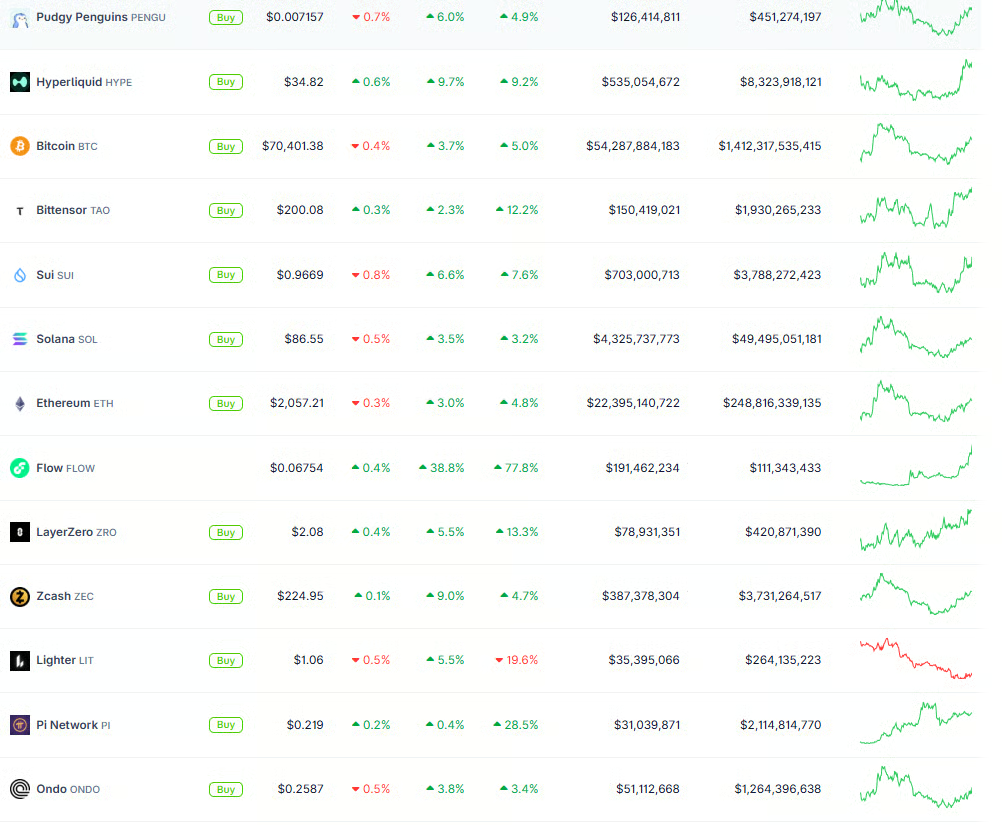
The native token of Pi Network is among the best performers from crypto’s top 100, with its price surging by roughly 30% over the past week. A few days ago, it briefly climbed to a three-month peak of $0.23, while currently it is worth $0.22 (per CoinGecko’s data).
You may also like:
Its impressive rise naturally drew the attention of traders and investors, pushing PI into the spotlight. At one point, it even became the top-trending cryptocurrency on CoinGecko. Although the token has cooled off slightly, it remains among the platform’s 15 most-searched digital assets.

Sell-Off on the Way?
Over the past few days, there has been an evident shift of PI tokens from self-custody to centralized exchanges. Data shows that approximately 4.8 million coins have been transferred to trading venues in the last 24 hours alone, thus bringing the total number to 454.1 million. This doesn’t directly imply a short-term price collapse, although the development is often interpreted as a pre-sale step.

Moreover, PI’s Relative Strength Index (RSI) briefly crossed above the bearish mark of 70 and remains quite close to it. This means that the asset has entered overbought territory and could be headed for a pullback. Conversely, anything below 30 is considered a buying opportunity.

Binance Free $600 (CryptoPotato Exclusive): Use this link to register a new account and receive $600 exclusive welcome offer on Binance (full details).
LIMITED OFFER for CryptoPotato readers at Bybit: Use this link to register and open a $500 FREE position on any coin!
Disclaimer: Information found on CryptoPotato is those of writers quoted. It does not represent the opinions of CryptoPotato on whether to buy, sell, or hold any investments. You are advised to conduct your own research before making any investment decisions. Use provided information at your own risk. See Disclaimer for more information.
Panama Canal expects more traffic as Strait of Hormuz shipping stalls

One Analyst Calls XRP Extremely Oversold, Another Plans to Short It

Pluto TV Is Sending 1 Fan on an Epic ‘X-Files’ Trip to the Desert [Exclusive]


-
Business4 days ago
Form 8K Entergy Mississippi LLC For: 6 March
-

 Fashion4 days ago
Weekend Open Thread: Ann Taylor
-

 News Videos1 day ago
10th Algebra | Financial Planning | Question Bank Solution | Board Exam 2026
-

 Crypto World24 hours ago
Paradigm, a16z, Winklevoss Capital, Balaji Srinivasan among investors in ZODL
-

 Tech5 days ago
Bitwarden adds support for passkey login on Windows 11
-
 Sports5 days ago
499 runs and 34 sixes later, India beat England to enter T20 World Cup final | Cricket News
-

 Sports3 days ago
Three share 2-shot lead entering final round in Hong Kong
-

 Sports2 days ago
Braveheart Lakshya downs Lai in epic battle to enter All England Open final | Other Sports News
-

 Business7 days ago
Guthrie Disappearance Enters Fifth Week as Family Visits Memorial
-

 Politics4 days ago
Top Mamdani aide takes progressive project to the UK
-

 NewsBeat5 days ago
Piccadilly Circus just unveiled ‘London’s newest tourist attraction’ and it only costs 80p to enter
-

 Business2 days ago
Search for Nancy Guthrie Enters 37th Day as FBI Probes Wi-Fi Jammer Theory
-

 Entertainment4 days ago
Hailey Bieber Poses For Sexy Selfies In New Luscious Lip Thirst Traps
-
 NewsBeat15 hours ago
Pagazzi Lighting enters administration as 70 jobs lost and 11 stores close across Scotland
-

 Tech1 day ago
Despite challenges, Ireland sixth in EU for board gender diversity
-

 Crypto World6 days ago
New Crypto Mutuum Finance (MUTM) Reports V1 Protocol Progress as Roadmap Enters Phase 3
-

 Tech5 days ago
ACIP To Discuss COVID ‘Vaccine Injuries’ Next Month, Despite That Not Being In Its Purview
-
Entertainment6 days ago
Harry Styles Has ‘Struggled’ to Discuss Liam Payne’s Death
-

 Business19 hours ago
Search Enters 39th Day with FBI Tip Line Developments and No Major Breakthroughs
-
 NewsBeat5 days ago
Good Morning Britain fans delighted as Welsh presenter returns to host ITV show