Connect with us

NewsBeat

Ten-year-old Donegal boy one of six people in the world diagnosed with rare disease

Published

on

Ten-year-old Donegal boy one of six people in the world diagnosed with rare disease

He ended up in the hospital around 50 times by the time he turned two and was officially diagnosed at age seven

Donations are coming in from across the country and beyond to support the family of a young boy diagnosed with an incredibly rare disease as they raise money for a charity close to their hearts.

Advertisement

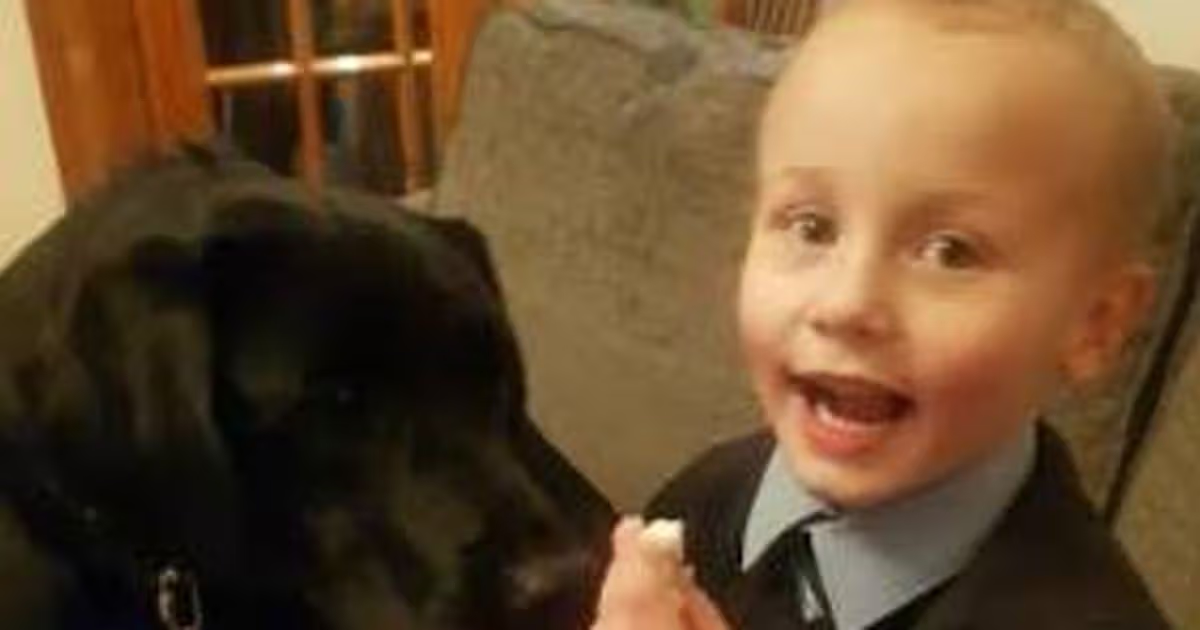
Jason Brady from Mountcharles, Co Donegal, was born 10 years ago on January 13 to parents Laura and Robbie, who initially thought their little boy was in perfect health. But as he grew older, mum Laura, who works for the Irish Defence Force, became concerned about her son.

“He picked up a lot of infections. He ended up in the hospital about 40 or 50 times by the time he turned two. The first time was from a head cold when he was four weeks old. He had an adverse reaction to all the vaccinations, so if he was given the MMR, he got measles from it. Or if he was given the meningitis vaccine, he actually got viral meningitis from it. His wee body couldn’t fight anything.” Laura said, speaking to RSVP Live.

READ MORE: Heartbreaking tributes pour in for ‘brave wee girl’ who passed away after devastating illness battleREAD MORE: Majella O’Donnell shares the moment she realised she’d done a great job raising her kids

“He was also slow to walk and talk; there was definitely something wrong. I kept asking the hospital ‘Is there something wrong’ and they wouldn’t listen to me initially. They said it was just in my head, because, to look at Jason, he’s absolutely adorable, and even to this day, you wouldn’t know anything was wrong with him until he went to walk.

Advertisement

“He was referred to Temple Street when he was two, and the first thing the neurologist said to me was ‘You don’t get referred to Temple Street Children’s Hospital for nothing’ because I was worried we were wasting their time, because that’s the impression I got off all the other doctors, and that was such a relief to me, to know that someone actually believed me that there was a problem.

“We had no history of rare disease, so there were genetic bloods, four brain MRIs, a lumbar puncture, and a spinal tap; we did every test under the sun, and they couldn’t find out what was wrong with him.”

Laura said the doctor gave Jason a clinical diagnosis of Ataxia, which is a neurological condition that can cause uncoordinated, clumsy movement, poor balance, and slurred speech due to damage in the nervous system.

“We reached out to Ataxia Foundation Ireland, and started going to their events, which was very upsetting at first. It was a bit of a shock because we didn’t know what we were dealing with. After attending those events for over a year, I knew, in my heart and soul, that Jason hadn’t had the same Ataxia that the people in the group had. I knew we hadn’t gotten to the bottom of it.

“I went back to Temple Street and asked them to do more bloods, but they told me no, they had all the bloods done. Then I turned to Google and found Rare Ireland. They had a conference about three years ago with a geneticist who spoke about finding conditions in children. I spoke to the geneticist after, and he really changed our lives.

“We went private with Jason, which cost us over €6,000, and after the testing, he told us that Jason had spastic paraplegia 26. It’s mad how getting a diagnosis has given us as parents so much relief, because Jason was misdiagnosed for five whole years.

“A doctor had come from Dublin to Donegal to see Jason when he was about two and a half, and he told me that Jason might never walk or talk, and that he would be dead by the time he was ten. For five years, I was going to people’s funerals and crying my eyes out, thinking about burying my own son. I was grieving for my child. We have another child, Joshua, who is 14, and I was thinking, ‘Oh my God, how is Joshua going to cope with losing his brother?’ How am I going to survive this?”

Advertisement

Spastic paraplegia 26 is an extremely rare, incurable disease, and Jason is one of a handful of people in the world who have been diagnosed with it. The geneticist told the Brady family that people with the condition can live ‘relatively’ normal lives, and that Jason could live into his 60s or 70s.

The condition affects Jason’s lower body. From his core down, his muscles are very weak, and he has difficulty carrying his upper body: “The hardest part about Jason’s disease, for us, as parents, as he gets taller, or even grows a centimetre, it makes life so much harder because he has to learn how to carry that extra centimetre, which causes his walking to get worse.

“He also has a mild intellectual disability, but he goes to a mainstream school, and they absolutely love him there. He has a full-time SNA, and they are like best friends. At Christmas, the school included him in a play, and he came out on stage dressed as a wee sheep. I have never felt so proud in my whole life!”

Advertisement

Jason uses a walker at school so he can get around more easily, which Laura says has given him a lot of independence. He also has a wheelchair that the family uses for long distances, as he struggles to walk far. However, when he falls unwell, due to his weakened immune system, he finds it incredibly difficult to walk. “He has to crawl around the place as his body gets too weak.”

There has been great support for Jason in both the local Donegal community and from outside of it. The ten-year-old is a member of the Little Blue Heroes, making him an honorary Garda, which he takes very seriously. The family also have an assistance dog, a black Labrador called Nelly, who came from Cork’s Dogs For The Disabled.

“Jason is just so lovable, and he never stops talking now! It’s so important to never give up hope. He lives in his own world; he doesn’t see himself as any different from anyone else in his class. He says he walks differently, but he doesn’t see that as a problem.”

If there is one thing that Laura could tell other parents about advocating for their child, she said, “You need to be the voice for them.

Advertisement

“Doctors need to be accountable for what they tell parents. For five years, we were told the wrong stuff. You’re literally given a diagnosis, and you go home and Google it, because there are no other supports there, and it’s all bad stuff online, you never see the good stuff.”

Now, the family is looking forward to abseiling off Croke Park Stadium on Sunday to raise funds for Rare Ireland. “You’re literally in a harness coming down from a 150-foot drop,” Laura explained.

“We have over €10,000 raised, and we’re absolutely delighted.”

You can check out the Brady family’s fundraiser by clicking here.

Advertisement

To ensure you don’t miss out on all the latest from Belfast Live, be sure to make us your preferred source on Google.

Source link

Continue Reading
Click to comment

Leave a Reply

Your email address will not be published. Required fields are marked *

NewsBeat

as human numbers fell, so did plant diversity

Published

on

as human numbers fell, so did plant diversity

Between 1347 and 1353, Europe was gripped by the most catastrophic pandemic in its history: the Black Death. Killing many millions, the plague wiped out between one-third and a half of Europe’s population.

In some cities, mortality rates were as high as 80%. In rural areas, Black Death mortality caused intense labour shortages. Entire villages were left empty as rural economies collapsed. In many places, cultivated fields were abandoned and reclaimed by woodland, scrub and deer.

Given the widely reported negative effects that people have had on nature over recent decades and centuries, we might expect this continental-scale “rewilding” to have enabled biodiversity to flourish. However, our new study in the journal Ecology Letters uncovers a potentially counterintuitive result: when Europe’s human population crashed, plant biodiversity also plummeted.

Fossilised pollen grains in sediment cores extracted from lakes and bogs contain information about plant communities that existed thousands of years ago. We used data from over 100 fossil pollen records from across Europe to explore how plant diversity changed before, during and after the Black Death.

Advertisement

The pollen data show that between 0BC and 1300, plant diversity in Europe increased. It grew through the rise and fall of the Western Roman Empire and continued through the early Middle Ages. By the High Middle Ages, biodiversity levels were at their peak.

However, in 1348, Europe was hit by plague and for about 150 years, plant biodiversity plummeted. It was only after a century and a half – as human populations recovered and farming resumed – that plant diversity began to rise again.

The plague of Florence in 1348, as described in Boccaccio’s Decameron. Etching by L. Sabatelli. Iconographic Collections.
Wellcome Collection gallery (2018-04-05), CC BY-NC-ND

We found that the biggest losses of plant diversity occurred in areas most affected by land abandonment. By plotting patterns of biodiversity changes from sites with different Black Death land use histories, we discovered that biodiversity collapsed in landscapes where crop (arable) production was abandoned, whereas landscapes with growing or stable arable farming became more biodiverse.

Advertisement

Our work suggests that over 2,000 years of increasing European biodiversity was generated because of – not in spite of – humans. But why? And what lessons can we learn from this for managing biodiversity now, when land being converted into farmland is driving biodiversity losses?

Population growth and technological innovations pushed agricultural activities into previously unused lands over the first 1,300 years of the common era. Unlike today – where crop monocultures are dominant – mixed agricultural systems were the norm over the majority of the last 2,000 years. Across Europe, a diverse lattice of farmlands and farming practices were typically separated by woods, rough grazing lands and uncultivated plots, often enclosed by hedgerows or trees.

wooded landscape with crops on farmland

A patchy landscape of woodland, farmland, grazing lands and unused areas creates a mixture of habitats for plants that raises biodiveristy.
Yuri Dondish/Shutterstock

The result was a patchy landscape where there were lots of opportunities for different plant species to survive, and biodiversity was high.

The Black Death disrupted this by reducing human disturbance. The result was a less patchy landscape and an overall loss in plant diversity. Diversity only recovered when extensive farming returned.

Advertisement

People can boost nature

These findings call into question conservation policies that advocate for removing or reducing human influence from Europe’s landscapes to protect biodiversity.

One such policy initiative is rewilding, which is seen by many as a route to achieving a biodiverse future where nature is given space to flourish. Yet, many of the most biodiverse locations in Europe are those with a long history of low-intensity, mixed agriculture. To rewild these human-formed landscapes may, paradoxically, risk eroding the biodiversity that conservationists seek to protect.

Our findings of long-term positive human–biodiversity relationships is not solely a European phenomenon. Multimillennial interactions between humans and the natural world have resulted in elevated biodiversity levels across planet. Examples of diverse, cultural ecosystems include the forest gardens of the Pacific North West (forests cultivated by Indigenous peoples), the satoyama of Japan (low intensity mixed systems of rice paddies and woodlands in mountainous foothills) and the ahupua’a of Hawaii (segments of diverse hillsides used to cultivate multiple crops).

Modern, intensive farming practices have caused substantial biodiversity losses across the globe. Yet, our Black Death findings, in combination with numerous other examples, show us that humans and nature do not always have to be kept separate to conserve and promote biodiversity. Indeed, recognising landscapes as cultural ecosystems may help us imagine futures where both nature and people can live together and thrive.

Advertisement

Traditional, low-intensity land management practices have generated diverse ecosystems for millennia. Today, where locally appropriate, they should be encouraged for the conservation of both biological and cultural diversity.

Source link

Advertisement
Continue Reading

NewsBeat

World Cup: Iraq coach wants play-off to be postponed amid US-Israeli war with Iran

Published

on

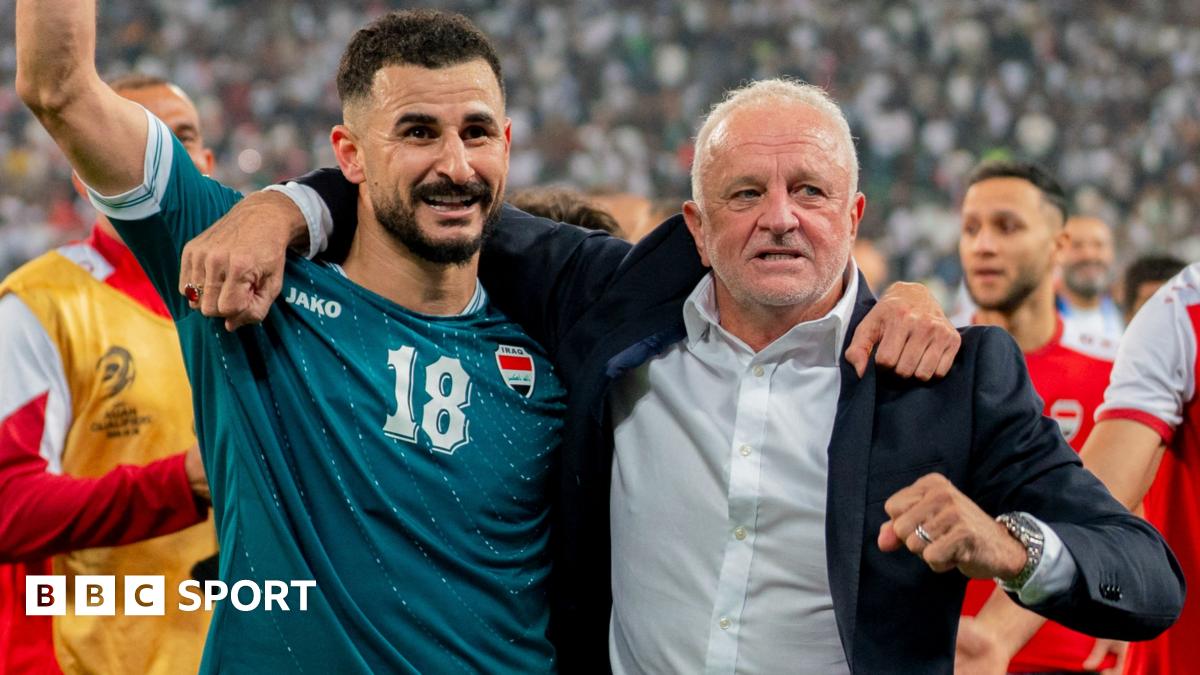
Aymen Hussein (L) raises his fist as he celebrates alongside Iraq head coach Graham Arnold (R) in Basra, Iraq, o

Iraq’s World Cup play-off decider later this month should be postponed amid the escalating US-Israeli war with Iran, says the team’s head coach Graham Arnold.

The Iraqis are set to face either Bolivia or Suriname in the Mexican city of Monterrey on 31 March, with the winner of the inter-continental play-off booking their place in the 2026 World Cup to be held in the United States, Mexico and Canada from 11 June.

But Iraq are concerned they might not be able to get their players and staff over to Mexico for the match because of the travel disruption in the Middle East, triggered by the conflict in neighbouring Iran.

Iraqi airspace has been closed since 28 February when the first US-Israeli strikes began and Iran responded by firing missiles and drones at Israel, Gulf states and other nearby countries.

Advertisement

Arnold, who became Iraq manager in May 2025, said putting together a team solely with players based outside Iraq would hinder the country’s chances of qualifying for their first World Cup since 1986.

“It wouldn’t be our best team and we need our best team for the country’s biggest game in 40 years,” the Australian said.

“The Iraqi people are so passionate about the game that it is insane. The fact that they haven’t qualified for 40 years is probably the main reason I took this job.

“But at this stage with the airport being shut down we are working hard to try and find another alternative.”

Advertisement

Source link

Continue Reading

NewsBeat

FTSE 100 Live 09 March: Index slumps, oil price tops $100 amid output cuts

Published

on

FTSE 100 Live 09 March: Index slumps, oil price tops $100 amid output cuts

Derren Nathan, Hargreaves Lansdown head of equity research, said: “Oversupply in the global oil market has been a dominant theme in recent months, but a 70% production cut at Iraq’s three main oilfields, and a sharp fall in output from Kuwait could be followed by similar moves in the UAE and Saudi Arabia as storage reaches capacity.

Source link

Continue Reading

NewsBeat

Police talk person down from Brompton by Sawdon house roof

Published

on

Brick ‘thrown’ through home window in Scarborough - police

As a subscriber, you are shown 80% less display advertising when reading our
articles.

Those ads you do see are predominantly from local businesses promoting local
services
.

These adverts enable local businesses to get in front of their target audience – the local
community
.

It is important that we continue to promote these adverts as our local businesses need
as much support as possible during these challenging times.

Advertisement

Source link

Advertisement
Continue Reading

NewsBeat

Call the Midwife fans ‘in bits’ as series ends with emotional death ahead of ‘changes’

Published

on

Call the Midwife fans 'in bits' as series ends with emotional death ahead of 'changes'

They said an emotional goodbye to a Nonnatus House legend after 14 years

Those who tuned into the final episode of the latest series of Call the Midwife were left ‘in bits’ as they said an emotional goodbye to a Nonnatus House legend after 14 years.

Advertisement

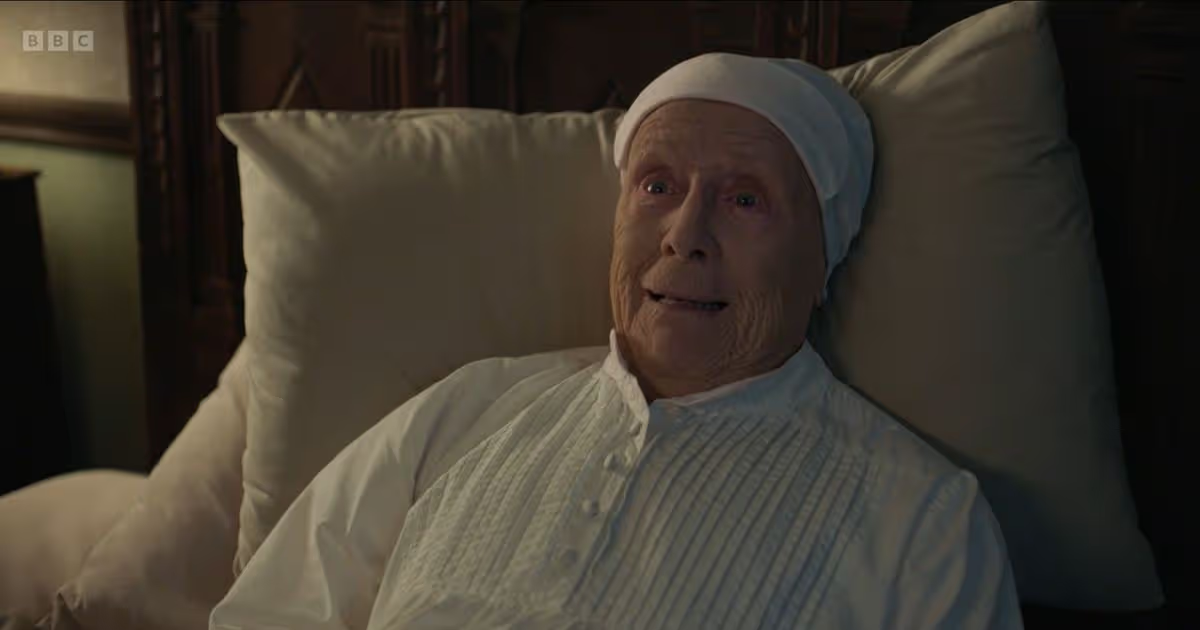
The moment had been brewing all throughout the BBC series’ 15th run as Sister Monica Joan’s health deteriorated but it didn’t make it any less emotional when the beloved character died during Sunday’s (March 8) series 15 finale, having decided to stop taking her medication, and planning her final farewell with the help of local undertaker Bernie Mullucks.

The episode produced a rollercoaster of emotions, with Cyril and Rosalind tying the knot after recently finding out they’re set to become parents, and the looming closure of Nonnatus House as viewers know it, which comes amid the rapid modernisation of the NHS in the early 1970s, with hospital births taking priority over home deliveries.

As the end drew near, Sister Monica Joan saw a vision of Sister Evangelina, marking a brief return for actress Pam Ferris to the role. Her old friend told her: You have shilly-shallied long enough. Even the Almighty’s patience has worn thin.” When Sister Monica Joan asked what it would be like in Heaven, Sister Evangelina added: “It’s everything we were promised, and all that you have worked for.”

With a reaching out of hands, Call the Midwife viewers’ eyes filled with tears as Sister Evangelina guided Siter Monica Joan into the afterlife. Her wishes for her funeral were then honoured by the Order, and after she was laid to rest, the nuns and midwives were seen back at Nonnatus House, which was described as “temporarily closed”.

Fans saw Joyce accept the role of Acting Sister at St Cuthbert’s, while Trixie prepared to leave to become Matron at The Lady Emily. Nurse Crane, meanwhile, remained as Dr Turner’s district nurse, after Sister Julienne explained that an “alteration” was on the cards, rather than closure.

And Call the Midwife viewers flocked ot social media to comment. @alison__jordan said: “#callthemidwife had me in bits. Beautiful ending to the series, so much was changing that we take for granted now.” @JoeMackenzie16 commented: “#callthemidwife Watched every single episode over 15 years. I’m in bits. That was a beautiful final episode.” @Disney_Dani1992 wrote: “That was so so beautifully done & a fitting ending to Sister Monica Joan but I am in absolute bits. #CallTheMidwife.”

@eternitydropped posted: “What a perfect end to 15 years of #CallTheMidwife I am in PIECES.” @exrxdx shared: “What a perfect final episode. No other words to describe it! #callthemidwife.” @CathSmithy53 added: “The death of Sister Monica Joan and the appearance of sister Evangelina on #callthemidwife had me in floods of tears tonight. So sad the show has come to an end but what a finale to end on.”

It comes after the Call the Midwife cast commented on changes being ahead, with a prequal series set to air later this year before series 16 airs. Helen George – who plays Trixie Franklin – has warned that the beloved show will look different when it returns to TV screens.

The 41-year-old told Radio Times: “We’ve all been saying that we’ll feel it most in April because that’s when we usually start filming. So when that comes around and we don’t, we won’t have the support network and community that work has given us.” Helen added: “It won’t be the same, with different characters leaving and whatever.”

Source link

Advertisement
Continue Reading

NewsBeat

Is it safe to travel to Egypt? UK Foreign Office advice

Published

on

Is it safe to travel to Egypt? UK Foreign Office advice

It’s usually a popular tourist destination for those heading abroad from the UK in search of some sun, particularly around its Red Sea coast, Cairo and Sharm El Sheikh.

But following regional tensions which has resulted in closed airspaces and cancelled flights from the likes of Emirates, Virgin and British Airways, let’s take a look at the current Foreign, Commonwealth & Development Office’s (FCDO) Egypt travel warnings for Brits.

Is it safe to travel to Egypt from the UK? Foreign Office’s latest advice

The Foreign Office has outlined that there is a “heightened risk of regional tension” and “escalation could lead to travel disruption and other unanticipated impacts”

Advertisement


It adds: “British nationals should take sensible precautions, considering their own individual circumstances.”

The FCDO recommends UK residents either in Egypt or travelling to, should:

  • read guidance on “how to prepare for a crisis” with suggestions on what you might include in your emergency supplies and “what to do in a crisis”
  • sign up to FCDO Travel Advice email alerts
  • monitor local and international media for the latest information
  • sign up to local information alerts/resources and follow the instructions of the local authorities
  • stay away from areas around security or military facilities

Aside from this, it appears the UK government has not updated its advice since the start of the Middle East conflict.

FCDO advises against all travel and all but essential travel to parts of Egypt

However, there has been longstanding travel restrictions by the Foreign Office prior to the Middle East war for Brits visiting Egypt, including advice against all travel and all but essential travel to parts of the country.

Advertisement

This includes:

Egypt-Libya border

FCDO advises against all travel to within 20km of the Egypt-Libya border, except for the town of El Salloum, where it advises against all but essential travel.

North Sinai

FCDO advises against all travel to the North Sinai Governorate.

Northern part of South Sinai

FCDO advises against all but essential travel to the northern part of the South Sinai Governorate, beyond the St Catherine-Nuweibaa road, except for the coastal areas along the west and east of the peninsula.

Advertisement

Your rights if your flight is cancelled or delayed


Eastern part of Ismailiyah Governorate

FCDO advises against all but essential travel to the Ismailiyah Governorate east of the Suez Canal.

Western Desert

FCDO advises against all but essential travel to the area west of the Nile Valley and Nile Delta regions, except for areas listed on the UK government website.


Recommended reading:

Advertisement

Hala’ib Triangle and Bir Tawil Trapezoid

FCDO advises against all but essential travel to the Hala’ib Triangle and the Bir Tawil Trapezoid.

Stay up to date with the latest UK travel advice to Egypt on the Foreign, Commonwealth & Development Office’s website.

Are you due to travel to Egypt soon? Let us know in the comments below.

Advertisement

Source link

Continue Reading

NewsBeat

The Gulf’s delicate balancing act between the US and Iran is now in flames

Published

on

The Gulf’s delicate balancing act between the US and Iran is now in flames

As Israel and the US continued to bomb Iran after killing the country’s supreme leader Ali Khamenei, Iran lashed out at its neighbours. Among the targets of Iranian drone strikes were a hotel in Dubai, a port in Oman, gas facilities in Qatar, and multiple US bases and embassies in the region, including in the Saudi Arabian capital, Riyadh.

Saudi Arabia and Iran have a long and bitter rivalry. Yet, in recent years, the Saudis had begun building new diplomatic relationship with Iran, even as they and other Gulf states continued to host American military bases, and court American investment.

Advertisement

Now the Gulf states find themselves in the middle of the very regional conflict many of its leaders hoped to avoid. It’s one which threatens longstanding efforts to cement the Gulf as a hub for finance, travel and tourism, and as an oasis of security.

In today’s episode of The Conversation Weekly podcast, we speak to Simon Mabon, a professor of international relations at Lancaster University in the UK and expert in Saudi-Iran relations, about how the Gulf’s delicate balancing act between the US and Iran came toppling down.

Mabon says that in recent years, Gulf states realised they had to live alongside Iran. “You can’t do that without having regional stability. And the only way you could get regional stability is to integrate Iran in some way, shape, or form,” says Mabon.

But after the US-Israeli war on Iran, and Iran’s retaliation against its neighbours, Mabon thinks it will be very difficult “to rebuild the sort of trust that had been cultivated over years between the Gulf Arab states and Iran”. That leaves big questions about how Gulf states, which may have advanced military hardware, but only small armies, ensure the security of their populations and their economies.

Advertisement

Listen to the interview with Simon Mabon on The Conversation Weekly podcast. This episode was written and produced by Mend Mariwany and Katie Flood. Mixing by Eleanor Brezzi and theme music by Neeta Sarl. Gemma Ware was the executive producer.

Newsclips in this episode from CNN, 60 minutes, euronews, BBC News, PBS NewsHour and WION.

Listen to The Conversation Weekly via any of the apps listed above, download it directly via our RSS feed or find out how else to listen here. A transcript of this episode is available via the Apple Podcasts or Spotify apps.

Advertisement

Source link

Continue Reading

NewsBeat

The Willows in beautiful Kirkby Fleetham on the market

Published

on

The Willows in beautiful Kirkby Fleetham on the market

Its ground floor accommodation includes a reception hall and a large living room with views across the garden and village green and a painted fireplace which is currently sealed but could be opened again and a log-burning stove installed if the new owners so wish.

Kitchen: Fitted units, Rangemaster cooker and French doors to rear patio (Image: Robin Jessop Ltd)

Also on this floor are an impressive fully glazed orangery with sliding doors out to a covered veranda, perfect for soaking up the sun in, a shower room, and the kitchen and adjoining dining area.

An L-shaped open-plan room, this features a good range of fitted units and integral appliances including a Rangemaster cooker with gas burners in the kitchen, which also has French doors leading out to the patio at the rear.

Dining area: Exposed brick alcove with fitted shelving and cupboards. (Image: Robin Jessop Ltd)

The dining area – with useful bespoke fitted shelving and cupboards plus a feature alcove in an exposed brick wall – has a door into the orangery, creating the perfect flow for entertaining.

Advertisement

Upstairs are the family bathroom, a family shower room, and four double bedrooms, each of which has fitted furniture and enjoys a pleasant outlook.

The spacious master bedroom is vaulted with exposed beams and eaves storage and benefits from an en suite shower room.

Living room: Dual-aspect room with painted fireplace and views over the garden and village green. (Image: Robin Jessop Ltd)

The Willows has a low maintenance garden at the front with parking for several vehicles on a resin driveway and an EV charger.

Its beautifully landscaped private rear garden features a mix of lawned areas, flower beds, and established shrubs and trees, with over the adjacent open countryside.

Advertisement

Orangery: Fully glazed space with sliding doors to covered veranda. (Image: Robin Jessop Ltd)

Property facts

The Willows, Kirkby Fleetham

Price: Offers over £595,000

Robin Jessop Ltd

Advertisement

01969 622800 or 01677 425950

www.robinjessop.co.uk

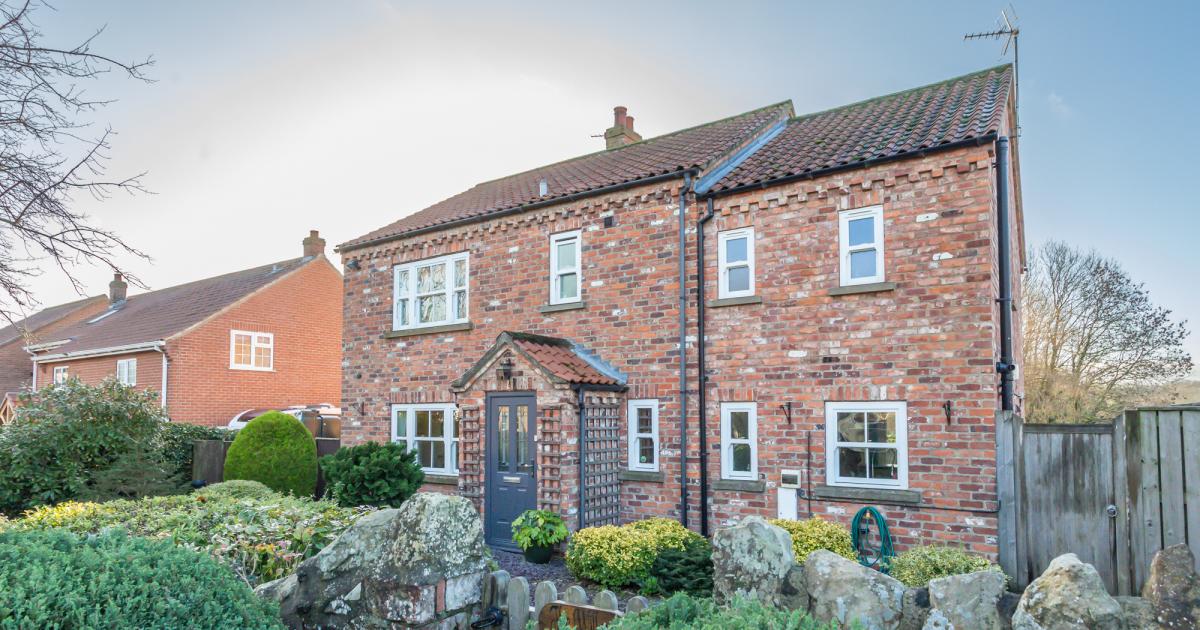
Centred around shared family spaces, The Willows – which was built in 1988 using reclaimed brick – is a spacious family home set within a generous plot in the heart of Kirkby Fleetham. (Image: Robin Jessop Ltd)

Centred around shared family spaces, The Willows – which was built in 1988 using reclaimed brick – is a spacious family home set within a generous plot in the heart of Kirkby Fleetham. (Image: Robin Jessop Ltd)

Garden: Landscaped rear garden with lawn, flower beds and countryside views. (Image: Robin Jessop Ltd)

Orangery: Fully glazed space with sliding doors to covered veranda. (Image: Robin Jessop Ltd)

Centred around shared family spaces, The Willows – which was built in 1988 using reclaimed brick – is a spacious family home set within a generous plot in the heart of Kirkby Fleetham. (Image: Robin Jessop Ltd)

Centred around shared family spaces, The Willows – which was built in 1988 using reclaimed brick – is a spacious family home set within a generous plot in the heart of Kirkby Fleetham. (Image: Robin Jessop Ltd)

Centred around shared family spaces, The Willows – which was built in 1988 using reclaimed brick – is a spacious family home set within a generous plot in the heart of Kirkby Fleetham. (Image: Robin Jessop Ltd)

Source link

Advertisement
Continue Reading

NewsBeat

Police searching for Bolton man missing since November

Published

on

Police searching for Bolton man missing since November

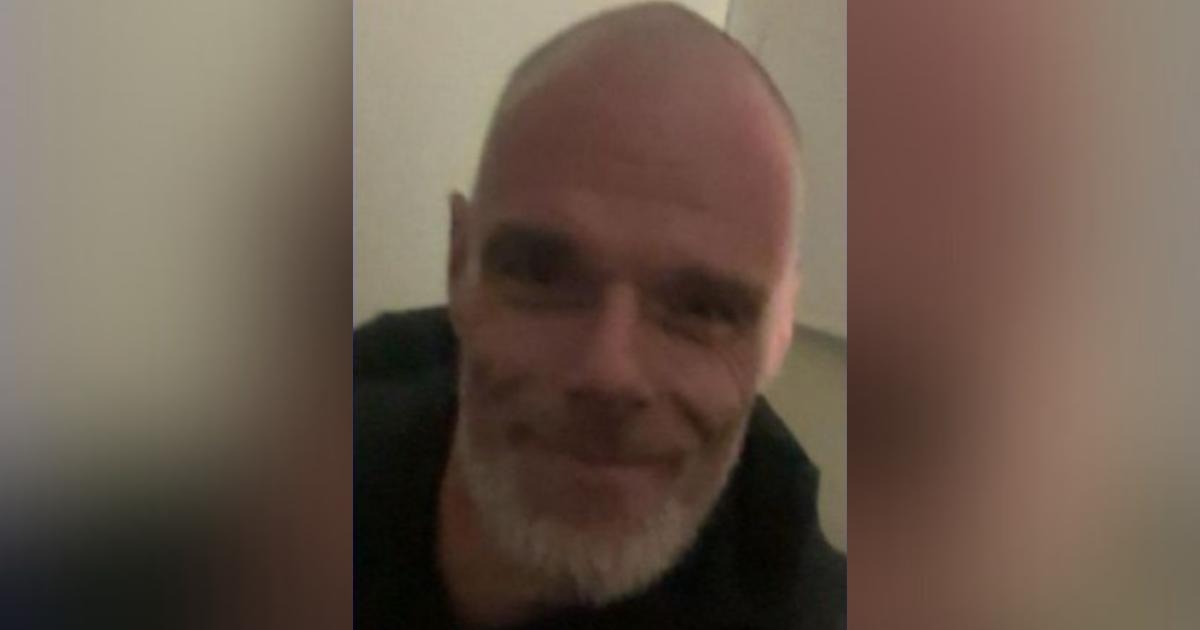
Shaun, 44, has been missing from his home in Bolton since last year and police are “becoming increasingly concerned” about him.

Officers would like to ensure he is safe and well.

Shaun is described as 6’10, white male, and of slim build.

Missing man Shaun is from Bolton (Image: GMP)

Police have asked for anyone with information about his whereabouts to contact them on 0161 856 5546.

Advertisement

Officers issued an appeal on social media late last night, reading: “#MISSING | “Have you seen Shaun from #Bolton?

“He is missing from home and was last seen in Bolton in November.

“Officers are becoming increasingly concerned about him and want to make sure he is safe and well.

“Any info? Contact police on 0161 856 5546.”

Advertisement

Source link

Continue Reading

NewsBeat

Cambridgeshire town’s high street ‘lacking’ shops ‘could use a little more love’, locals say

Published

on

Cambridgeshire town's high street ‘lacking’ shops ‘could use a little more love’, locals say

One person said it would be “nice to have non-charity shops” in the high street

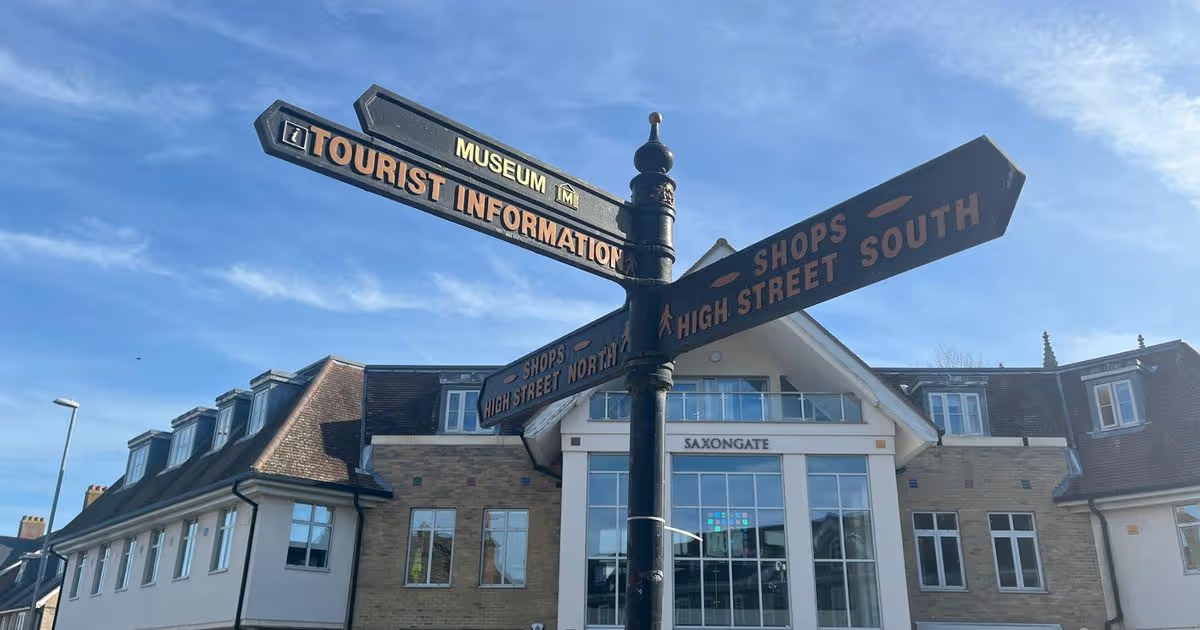
Locals say a Cambridgeshire town’s high street could “use a little more love”, as some feel it is “lacking” a variety of shops. Huntingdon is praised by those who live there as being a “safe” place and a “nice” place to bring up a family.

Advertisement

Like many others across the country, some people feel the high street could be improved. Sarah Gosling, who thinks the town has a “nice family feel” to it, said it would be “nice to have non-charity shops”.

She added: “It’s great to have them [charity shops], but we have a lot of them and it would be nice to have a lot of other stuff. Some of the restaurants are nice, but it would be good to have some more clothes shops.” Sarah’s mum Anne Monkman also thought it would be “good to have more variety of shops.”

Barry Graves said the high street could “use a little more love”. He said: “We have a few down the street that are boarded up or empty. It makes it look sad. It feels like it could be a good opportunity to bring in a few different shops. Maybe some independent places, and then we could support local businesses.”

One woman, who wished to remain anonymous, said it is “lacking” shops. “There’s a running joke that you go into Huntingdon for a vape or haircut,” she said.

Advertisement

She added: “There is also nothing for younger people to do. They are just going around destroying things because they have nothing to do. It could be a lot better.”

Her friend, who also asked not to be named, said that she is moving away from the area. She said: “We just want a change of scenery. There is too much smoking and drugs, we want a quieter life.”

One man, who didn’t want to be named, said the town centre has become “rundown”. He said: “It’s not what it used to be like. It feels like it’s losing its heart. Especially down the high street. It feels like stuff is starting to disappear and it’s sad to see.”

Linda Hamilton doesn’t like the potential developments that could be built around Huntingdon. She said: “I have no idea what stage they are at or what is happening with them, but it’s going to affect all of the traffic in town. There is enough as it is.”

Advertisement

Source link

Continue Reading

Trending

Copyright © 2025