

Crypto World
Why the terror financing case against Binance fell apart in court

A US federal court has dismissed a lawsuit accusing crypto exchange Binance of facilitating terrorism financing, ruling that the plaintiffs failed to establish the legal requirements needed to hold the platform liable under US anti-terror laws.
Summary
- A US federal judge dismissed a lawsuit accusing Binance of facilitating terrorism financing, citing insufficient evidence linking the exchange to specific attacks.
- The court said the plaintiffs failed to show that Binance knowingly provided substantial assistance to terrorist organizations.
- The judge allowed plaintiffs 60 days to amend their complaint, leaving the possibility that the case could return with new allegations.
Federal judge throws out the terrorism financing lawsuit against Binance
In an opinion issued on March 6, Judge Jeannette A. Vargas of the US District Court for the Southern District of New York granted the defendants’ motion to dismiss the complaint brought by hundreds of victims and relatives of victims of terrorist attacks.
The plaintiffs, linked to 64 attacks worldwide between 2016 and 2024, alleged that Binance allowed accounts tied to terrorist groups and their intermediaries to operate on its platform. They argued that the exchange’s services enabled those actors to move funds and therefore amounted to aiding and abetting terrorism under the US Anti-Terrorism Act and the Justice Against Sponsors of Terrorism Act.
However, the court ruled that the complaint did not plausibly show that Binance knowingly provided substantial assistance to terrorist organizations.
According to the opinion, the allegations largely relied on claims that certain wallets linked to sanctioned groups had used the exchange, but they failed to demonstrate that Binance was aware of those connections at the time.
Judge Vargas also found that the plaintiffs did not sufficiently link the alleged cryptocurrency transactions to the specific attacks cited in the lawsuit. The court said the complaint relied on generalized claims about terrorist use of digital assets rather than concrete allegations showing that funds moving through Binance directly supported the incidents referenced by the plaintiffs.
Because of these shortcomings, the court concluded that the complaint failed to meet the legal standard required for aiding-and-abetting liability under US anti-terror statutes.
While dismissing the case, the judge granted the plaintiffs 60 days to file an amended complaint addressing the deficiencies identified in the ruling. If they succeed in presenting stronger allegations, the case could proceed in federal court.

Crypto World
Alphabet (GOOG) Stock: Pentagon to Receive Gemini AI Agents for 3 Million Defense Personnel

Key Highlights
- Pentagon’s complete 3 million-person workforce will gain access to Google’s Gemini AI agents
- Initial rollout targets unclassified systems, while discussions progress for classified network integration
- Platform offers eight pre-configured agents designed for budget creation, meeting notes, and strategic planning
- Defense Department users have generated 40 million prompts through Google’s AI interface since its December debut
- Training completion remains limited to just 26,000 personnel despite significantly higher adoption rates
Google, owned by Alphabet, has initiated a comprehensive deployment of its Gemini AI agent technology throughout the United States Department of Defense, encompassing approximately three million personnel.
The initial phase focuses on unclassified network infrastructure, where the majority of Defense Department personnel operate daily. Emil Michael, serving as under secretary of defense for research and engineering, indicated this strategic starting point.
Michael revealed that negotiations with Google are currently active regarding expansion into classified and top-secret cloud computing environments.
Google Vice President Jim Kelly made the announcement public through a Tuesday blog entry. Defense personnel will have the capability to create customized AI agents through natural language commands, eliminating any programming requirements.
The platform launches with eight ready-to-deploy agents. These automated assistants handle functions including meeting documentation, financial planning, and verification of proposed initiatives against national defense objectives.
Certain agents are designed to provide operational value, assisting with logistical planning and resource forecasting for military operations — capabilities available even on unclassified infrastructure.
Google’s conversational AI interface on the GenAI.mil website has been operational since December. During this period, 1.2 million Defense Department personnel have engaged with the system, generating 40 million distinct queries and submitting over four million documents.
The usage volume demonstrates significant adoption. The Gemini agent platform becomes accessible through this identical portal starting Tuesday.
Personnel Education Falls Short of Adoption Rates
A significant challenge exists. Just 26,000 Pentagon employees have completed formal instruction on appropriate AI utilization. Upcoming educational programs have reached capacity, a Pentagon representative confirmed.
Michael emphasized the importance of proper training. “It saves you a lot of time in the middle, but you have to review at the end to make sure there’s no hallucinations,” he said.
Bridging the divide between actual usage and completed training represents a priority as the Defense Department expands agent availability.
Military Exercise Planning Sees Dramatic Efficiency Gains
The technology has already demonstrated measurable impact in operational settings. Kenneth Harvey, who directs the Mission Training Complex at Fort Bragg, explained that developing a military exercise scenario accommodating up to 50,000 simulated troops previously required his nine-member team six months.
Leveraging the AI platform, a comparable exercise for US Southern Command reached completion within six weeks.
Harvey emphasized that “human eyes vetted every word” throughout the process.
This latest initiative represents a significant expansion of collaboration between Google and the Pentagon, a relationship that has experienced turbulence. In 2018, thousands of Google staff members protested the corporation’s participation in Project Maven, an AI-powered drone surveillance initiative. Google declined to continue that contract.
The technology company subsequently revised its policies regarding military contracts. Michael characterized Google as a “trusted” and “supportive” partner.
The Pentagon has simultaneously broadened its artificial intelligence partnerships. Recent agreements with OpenAI and Elon Musk’s xAI enable operations on restricted networks — developments that coincided with deteriorating relations with Anthropic.
The Department of Defense designated Anthropic a supply-chain security concern last week following the company’s objections regarding potential AI applications. Anthropic has responded by filing legal action against the government challenging this classification.
Prior to this conflict, Anthropic maintained exclusive status as the sole AI vendor with access to the Pentagon’s classified cloud infrastructure.
GOOG was trading at $308.84, up 0.81% on the day at the time of writing.


Bitcoin mining company Canaan increased its digital asset holdings to record levels in February, signaling a long-term accumulation strategy despite challenging market conditions for miners.
In its February unaudited mining update issued Tuesday, Canaan said it produced 86 Bitcoin (BTC) during the month, bringing its total holdings to 1,793 BTC, a new record for the company.
Canaan’s Ether (ETH) holdings also reached a record high of 3,952 ETH, with the combined value of its digital asset treasury totaling roughly $128 million at current prices.
The company’s Nasdaq-traded shares (CAN) were up 1% in late Tuesday morning trading. Sector-tracking exchange-traded fund CoinShares Bitcoin Mining ETF (WMGI) was up 2.5%.
Chairman and CEO Nangeng Zhang said the company remains focused on a long-term strategy of building its digital asset reserves.
“We maintain a long-term perspective on building and managing our digital asset treasury,” Zhang said.

Canaan also expanded its mining operations, with its installed hashrate reaching 14.75 exahashes per second (EH/s).
The update follows Canaan’s recent expansion in the United States. In February, the company acquired a 49% stake in three Bitcoin mining projects in West Texas for $39.75 million, a move aimed at increasing its North American mining capacity.
The Texas facilities are expected to boost Canaan’s presence in one of the world’s largest Bitcoin mining regions.
Related: Bitcoin miner production data reveals scale of US winter storm disruption
Miners ramp up Bitcoin sales as margins tighten
Canaan’s update comes as Bitcoin miners increasingly sell portions of their reserves amid worsening market conditions.
The trend has accelerated since October, when the biggest crypto by market capitalization peaked around $126,000 before falling by more than half to the low-$60,000 range, squeezing mining profitability.
The downturn has compounded what some analysts describe as the harshest margin environment the sector has faced, with rising operational costs and lower BTC prices weighing on miners’ balance sheets.
Data from TheEnergyMag’s Miners Weekly shows that publicly traded mining companies have sold more than 15,000 BTC since October. The total includes several large transactions, such as Cango’s February sale of 4,451 BTC and Core Scientific’s plan to sell up to 2,500 BTC this quarter.

The shift marks a departure from the trend seen earlier in 2025, when many miners adopted a de facto treasury strategy, choosing to retain a larger share of the Bitcoin they mined rather than selling it immediately.
Related: Bitcoin mining’s 2026 reckoning: AI pivots, margin pressure and a fight to survive
Kraken is trying to turn tokenized equities from a side‑show into a parallel equity market running on crypto rails through its xStocks platform and a new Nasdaq partnership.
Summary
- xStocks offers 60+ tokenized U.S. stocks and ETFs, fully backed 1:1, with 24/5 trading and EU rollout aimed at investors shut out of Wall Street hours.
- Kraken is acquiring issuer Backed Finance and has logged over $25B in volume in under eight months across CEX, DEX, and mint/redemption flows.
- A Nasdaq partnership will use xStocks tech to move listed securities onto blockchain rails, while regulators warn that “mimic” products risk diluting shareholder rights.
Kraken is trying to turn tokenized equities from a side‑show into a parallel equity market that runs on crypto rails, 24/7. Its xStocks platform now offers more than 60 tokenized U.S. stocks and ETFs, has been rolled out to eligible clients across the European Union, and has processed over $25 billion in cumulative transaction volume in under eight months, according to company data and recent coverage.
How Kraken’s tokenized stock platform works
xStocks lets users buy, sell and transfer blockchain‑based tokens that mirror real U.S. equities like Tesla, Amazon, Nvidia and broad‑market ETFs, with each token fully backed 1:1 by the underlying security held by a licensed custodian in a bankruptcy‑remote structure. Cointelegraph and Finance Magnates report that the product gives investors 24/5 trading in digital certificates that track U.S. prices, extended hours beyond Wall Street’s 9‑to‑5, and the ability to move positions between compatible venues or self‑custody them on‑chain. Kraken’s European rollout, announced in September 2025, explicitly targets clients who “for too long” have found it “unnecessarily challenging to gain exposure to U.S. markets,” as global head of consumer Mark Greenberg put it.
Under the hood, Kraken is pulling tokenization closer to its core stack. The exchange has agreed to acquire Backed Finance – the issuer behind xStocks – integrating issuance and trading under one roof just as it prepares for a planned 2026 IPO. AInvest and other outlets note that xStocks has already surpassed $25 billion in total transaction volume, including centralized venue trading, DeFi liquidity, and mint/redemption flows, with partnerships in place to distribute the tokens via platforms like Bybit and Gate.io to users in more than 110 countries. In parallel, a separate initiative will see Nasdaq use Payward’s (Kraken’s parent) xStocks tokenization technology to move listed securities onto blockchain rails for global distribution – a sign that incumbents increasingly prefer to build on top of Kraken’s infrastructure rather than compete with it from scratch.
Market structure: equity rails on crypto infrastructure
The pitch is blunt: make stocks as composable as stablecoins. AInvest summarises Kraken’s goal as “making equities as composable as stablecoins in web3 ecosystems,” letting traders post tokenized stocks as collateral, wrap them into on‑chain strategies, or trade perpetual futures that reference xStocks rather than traditional listings. A recent Business Wire release notes that Kraken has already listed “the world’s first regulated tokenized equity perpetual futures,” using xStocks as the reference layer so traders can “respond to market events without waiting for traditional markets to open.” That reframes tokenized equities from a convenient wrapper into a potential new base layer: equity exposure that trades like crypto, clears across borders, and is governed by a mix of securities law and smart contracts rather than just a single national exchange rulebook.
Regulation remains the hard edge. The World Federation of Exchanges has warned that some tokenized stock products act as “mimics” that may not deliver full shareholder rights, and Nasdaq’s 2025 filing to list tokenized securities alongside conventional shares was a direct response to that risk. Kraken is betting that by keeping xStocks fully backed, integrating the issuer, and pushing for regulated derivatives on top, it can stay on the right side of that line – and, in the process, turn its tokenized equity platform into a meaningful revenue and strategic pillar ahead of its planned public listing.


- Jupiter (JUP) price hovered near $0.17 amid a 6% intraday gain.
- The bounce coincided with Bitcoin’s spike to above $70,000.
- The move was also supported by a key Chainlink integration.
JUP, the governance token of Jupiter, has bounced off recent lows as top cryptocurrencies record intraday gains.
The DEX protocol’s token traded around $0.17 on Tuesday, with 24-hour gains of nearly 6% pushing it above a key support level.
Jupiter Exchange taps Chainlink for prediction markets
JUP’s uptick coincided with the DEX platform’s strategic adoption of Chainlink technology to power its newly launched prediction markets.
JUST IN: The largest decentralized exchange on Solana has adopted Chainlink to power its newly launched prediction markets, @jup_predict.@JupiterExchange‘s ($2.8B TVL) 5-min & 15-min markets for BTC, ETH, SOL, & more are now secured by fast Chainlink Data Streams market data. pic.twitter.com/gT8pCYZDrw
— Chainlink (@chainlink) March 10, 2026
Jupiter Exchange, recognised as the largest DEX aggregator on the Solana blockchain, has integrated Chainlink’s advanced oracle solutions to underpin its innovative prediction markets.
These markets, now live with 5-minute and 15-minute settlement options, cover major assets including Bitcoin (BTC), Ethereum (ETH), and Solana (SOL).
By leveraging Chainlink Data Streams, Jupiter ensures sub-second price feeds directly from premium exchange sources.
It minimises latency and mitigates risks like front-running or oracle manipulation that plague traditional DeFi platforms.
Jupiter users can now speculate on short-term price movements with heightened accuracy.
Market participants view this integration as a catalyst for increased trading volume, with Chainlink’s secure, low-latency oracles enhancing user confidence.
The move could attract liquidity providers seeking reliable settlement mechanisms and help shine a spotlight on Jupiter’s potential and thus on JUP.
It’s only in many Jupiter milestones that have seen the exchange token become a top 100 cryptocurrency by market capitalisation.
Jupiter price analysis
The JUP token has navigated a downward channel since plummeting from above $0.70 in April 2025.
A broader weakness across crypto means that at the current price, the token’s value is down by more than 60% over the past year.
Despite this bearish outlook, the token has bounced decisively from the channel’s lower boundary.
Bulls are looking to stabilise above $0.17, and a flip in sentiment could catalyse further gains amid a breakout scenario.
Technical indicators on the daily chart highlight this picture.

As can be seen above, the Relative Strength Index (RSI) has recovered from oversold conditions and hovers above the neutral line.
The indicator boasts a bullish divergence and signals a potential strengthening of the upward momentum.
However, the MACD suggests a bearish reversal.
If buyers hold the sway, more gains could push prices towards the immediate overhead resistance zone around $0.20–$0.22.
A breakout could see bulls test the supply wall around $0.30.
However, a rejection at current levels risks a retest of $0.15.
The support level might act as a demand reload zone and result in fresh consolidation before another bullish move.
If not, the price could drop to $0.100.


US prosecutors want a retrial for Roman Storm after a jury deadlocked on money laundering and sanctions charges.
The U.S. Department of Justice (DOJ) has asked that Tornado Cash developer Roman Storm be put on trial anew on charges of money laundering and sanctions violations.
Last year, a jury was unable to reach a unanimous verdict on the two counts after a four-week hearing in the Southern District of New York (SDNY) presided over by U.S. District Judge Katherine Polk Failla.
Storm Faces Retrial in 2026
The same jury convicted Storm of conspiracy to operate an unlicensed money laundering operation, but hit a deadlock on the more serious charges. Now, as Storm revealed in an update on social media, prosecutors have asked Judge Failla to schedule a retrial in October 2026 to try to settle the unresolved points. He questioned the move, stating,
“The government’s response? Try again to make writing code a crime.”
The Tornado Cash case, along with that of Samourai Wallet co-founders Keonne Rodriguez and William Lonergan Hill, has long been a point of contention in the crypto community, with many viewing it as a direct attack on developers who build privacy-preserving technology.
According to supporters, open-source coders should not be held responsible for how others use their technology. But on the other hand, regulators claim that the mixing service knowingly took part in large-scale money laundering and sanctions evasion.
In his X post, Storm pointed to what he sees as contradictions in the government’s approach. He believes that the DOJ’s request was made despite there being a more favorable policy climate for the crypto industry in the U.S.
The developer specifically mentioned a statement by U.S. President Donald Trump declaring that the “war on crypto is over” and a memo from Deputy Attorney General Todd Blanche, in which he said that the DOJ is “not a digital assets regulator” and would not target crypto mixers for the actions of their end users.
You may also like:
Storm’s post also referenced the U.S. Treasury’s decision to lift sanctions on Tornado Cash, as well as a recent report to Congress under the GENIUS Act that acknowledged lawful crypto users can rely on mixers for financial privacy.
40-Year Prison Sentence
The 36-year-old now faces up to 40 years in prison if convicted on the two undecided conspiracy counts and a sentence of up to 5 years from his previous ruling.
“The 2 counts = up to 40 years in federal prison. For writing open-source code. For a protocol I don’t control. For transactions I never touched,” he wrote.
He also believes that the prosecutors are simply pushing for a different outcome in the case.
The post concluded with him appealing for financial support and a vow to keep fighting for freedom and the rights of other developers. Storm has called on anyone who values financial privacy or believes that writing code is a form of speech to contribute, emphasizing that “this is the moment.”
Binance Free $600 (CryptoPotato Exclusive): Use this link to register a new account and receive $600 exclusive welcome offer on Binance (full details).
LIMITED OFFER for CryptoPotato readers at Bybit: Use this link to register and open a $500 FREE position on any coin!

Modest increase, major bull run, or new pullback: what’s next for ETH?
Despite the turbulence over the past few weeks caused by geopolitical tension and other factors, Ethereum (ETH) managed to stabilize above $2,000.
Multiple industry participants expect the asset to post substantial gains in the near future, with some suggesting that the current levels provide a great buying opportunity.
New ATH in the Making?
The cryptocurrency market, which has been on a rollercoaster lately, experienced a significant revival today (March 10) after US President Donald Trump claimed the war with Iran “is very complete, pretty much.” ETH followed the green wave and is currently trading around $2,070, up 3% on a daily basis.
According to the popular market observer who goes by the moniker Merlijn The Trader on X, the second-largest cryptocurrency has returned to “the discount zone.” He believes the ongoing structure mirrors that of 2023, which was followed by a bull run.
In his view, holding the crucial $2,000 mark could lead to a major rally to almost $10,000, whereas losing it would mean that “the discount zone extends lower.”
For his part, X user James argued that ETH’s performance is similar to NVIDIA “before it melted faces.” That said, he expects the digital asset to follow the footsteps of the AI giant and explode to a new all-time high in the coming years.
Satoshi Flipper is also bullish, albeit making a more modest prediction. The trader thinks that a potential resolution to the military conflict between the USA (supported by Israel) and Iran could drive ETH to $2,500.
You may also like:
Certain on-chain indicators support the optimistic scenario. Some X users, for instance, revealed that whales continue to accumulate ETH: a development that reduces the number of tokens available on the open market and could trigger a rally (should demand remain constant or head north). The actions of large investors are also closely monitored by smaller players, who may follow suit and inject fresh capital into the ecosystem.
It is worth noting that Tom Lee’s BitMine is a notable whale that plays a main role in the buying spree. Most recently, the company purchased almost 61,000 ETH for approximately $123 million, thus increasing its total holdings to 4,535,563 coins.
Another Downtrend on the Horizon?
Contrary to the bullish predictions observed above, some analysts and traders expect ETH to head south soon. X user Crypto Tony said they await a potential rejection at around $2,060 “to short this down again.”
For his part, Ted predicted that ETH could soar to $2,400 if reclaiming the $2,150 level. After that, though, he sees “a decent chance” that the asset would dump toward new lows.
Binance Free $600 (CryptoPotato Exclusive): Use this link to register a new account and receive $600 exclusive welcome offer on Binance (full details).
LIMITED OFFER for CryptoPotato readers at Bybit: Use this link to register and open a $500 FREE position on any coin!
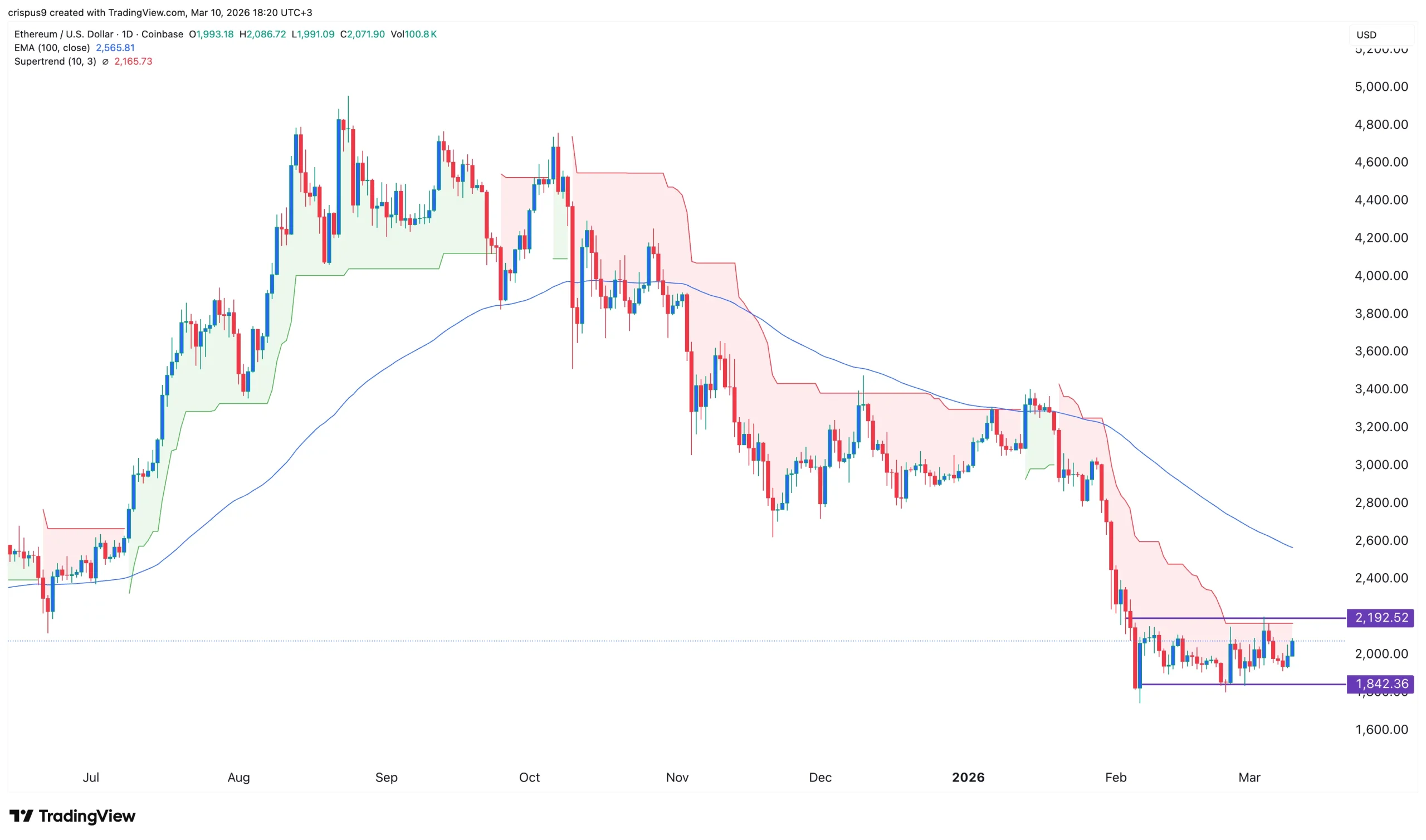
Ethereum price has gone nowhere since February 7 this year. While this could be a sign of bottoming, it has formed an alarming chart pattern, signaling a potential crash.
Summary
- Ethereum price has formed a bearish flag pattern on the daily chart.
- Spot ETH ETFs have shed millions of assets this month.
- The coin may have a strong bearish breakout in the near term.
Ethereum (ETH) price was trading at $2,065 today, March 10, as it rose for the second consecutive day. Despite this rise, it has remained inside the support and resistance levels at $1,843 and $2,143.
The ongoing consolidation has coincided with the waning demand for its exchange-traded funds. SoSoValue data shows that these funds have shed assets in the last three consecutive days. They shed $51 million in assets on Monday after losing $83 million and $90 million in the previous two trading days.
Ethereum ETFs have lost over $37 million in assets this month, and is in the fifth consecutive month in the red. As a result, the cumulative net inflow has dropped from nearly $15 billion to $11.58 billion.
Ethereum has diverged from Bitcoin, whose ETFs have added over $735 milion in inflows this month. Solana ETFs have added $21 million in assets, while Chainlink funds have gained $4.8 billion.
On the positive side, Ethereum’s fundamentals are still strong. For example, data shows that its stablecoin supply has jumped to over $166 billion, while its transaction volume in the last 30 days jumped to over $1.1 trillion. It is also the market leader in the real-world asset tokenization industry by far.
Ethereum price technical analysis
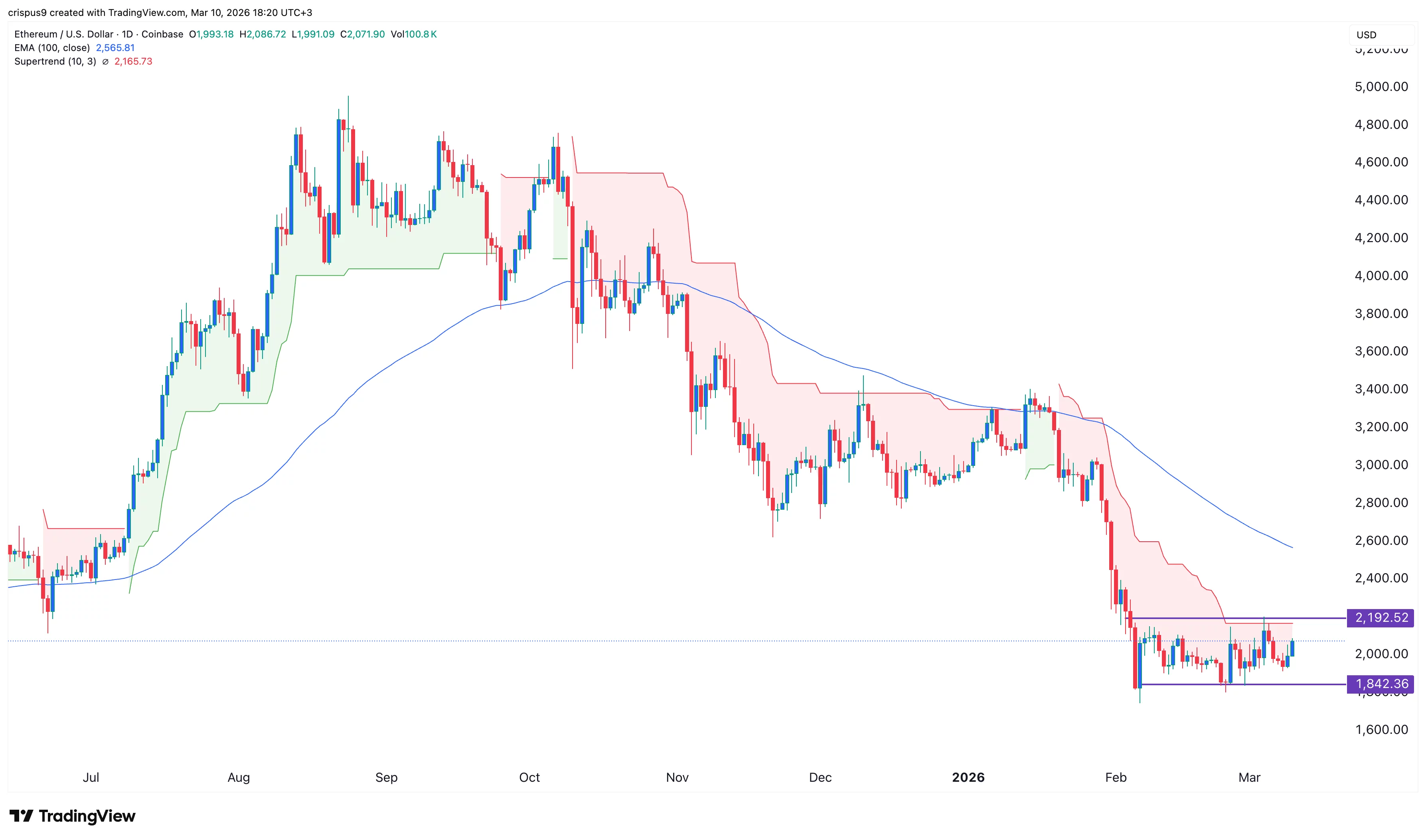
ETH price could be at risk of a big drop in the near term. The daily chart shows that it has formed a horizontal channel in the last 30 days. This channel formed after it dropped sharply. As a result, it has formed a bearish flag pattern, a popular continuation pattern.
The coin has remains below all moving averages and the Supertrend indicator. Therefore, the most likely outcome is where it resumes the downtrend, potentially to the lower side of the flag at $1,843. A drop below that level will point to more downside, potentially to the psychological level at $1,500.

Key Takeaways
- Taiwan Semiconductor disclosed NT$718.91 billion in combined revenue for January and February 2026, representing approximately 30% year-over-year growth.
- Revenue for February specifically totaled NT$317.66 billion — a sequential decline of 20.8% from January but a 22.2% increase versus the prior year.
- Sustained demand for AI chips from major customers including Apple, Nvidia, and AMD is fueling the revenue expansion.
- TSMC’s board greenlit a quarterly dividend of NT$6.0 per share and authorized approximately $45 billion in capital investments.
- Management indicated no significant operational disruption expected from geopolitical tensions involving the U.S., Israel, and Iran.
Taiwan Semiconductor Manufacturing Company (TSM) launched 2026 with impressive momentum, posting robust two-month revenue figures powered by sustained artificial intelligence infrastructure investments from its largest customers.
Taiwan Semiconductor Manufacturing Company Limited, TSM
The semiconductor giant disclosed that its combined revenue for the first two months of 2026 reached NT$718.91 billion — representing approximately 30% growth versus the corresponding period in 2025. These figures underscore the company’s dominant position in advanced chip manufacturing.
For February alone, TSMC recorded NT$317.66 billion in revenue. While this represents a sequential decrease of roughly 21% compared to January, it marks a solid 22.2% gain when measured against February of the previous year.
The sequential pullback from January to February follows typical seasonal patterns. January frequently captures higher revenue due to order timing dynamics, making the year-over-year metric the more significant indicator for market watchers.
TSM stock advanced approximately 1% during early Tuesday session activity after the financial disclosure, while key customers Nvidia (NVDA) and AMD (AMD) also posted gains — climbing 1.53% and 1.21% respectively. Apple (AAPL) shares increased 0.51%.
The revenue expansion underscores ongoing robust demand for cutting-edge semiconductors deployed in artificial intelligence servers and data center infrastructure. As the manufacturing partner for technology industry heavyweights, TSMC continues to see consistent order flows.
Dividend Distribution and Capital Investment Plans
During February, TSMC’s board of directors approved a quarterly cash dividend of NT$6.0 per share — a decision that reflects management’s confidence in the company’s strong financial health.
Additionally, the board authorized capital expenditure totaling approximately $45 billion. These funds will support fabrication facility construction, capacity expansion, and technology upgrades spanning advanced front-end processes, specialty and mature technologies, plus advanced packaging solutions.
TSMC also designated roughly NT$1.2 billion for its Arizona-based subsidiary, which is actively expanding domestic chip production capabilities in the United States.
This magnitude of capital investment aligns with TSMC’s long-standing guidance regarding the financial resources required to meet escalating AI chip demand.
Geopolitical Landscape Assessment
TSMC proactively addressed geopolitical risk factors, stating it does not anticipate any material operational disruption stemming from current tensions involving the United States, Israel, and Iran.
Company leadership emphasized ongoing monitoring of the evolving situation. TSMC’s primary manufacturing operations are concentrated in Taiwan, which presents distinct geopolitical considerations independent of Middle Eastern developments.
Presently, executives appear confident that production and operations remain stable and unaffected.
TSMC has scheduled its complete first-quarter 2026 earnings release for April, when investors will scrutinize detailed guidance on order pipelines and pricing dynamics across the company’s most advanced manufacturing nodes.
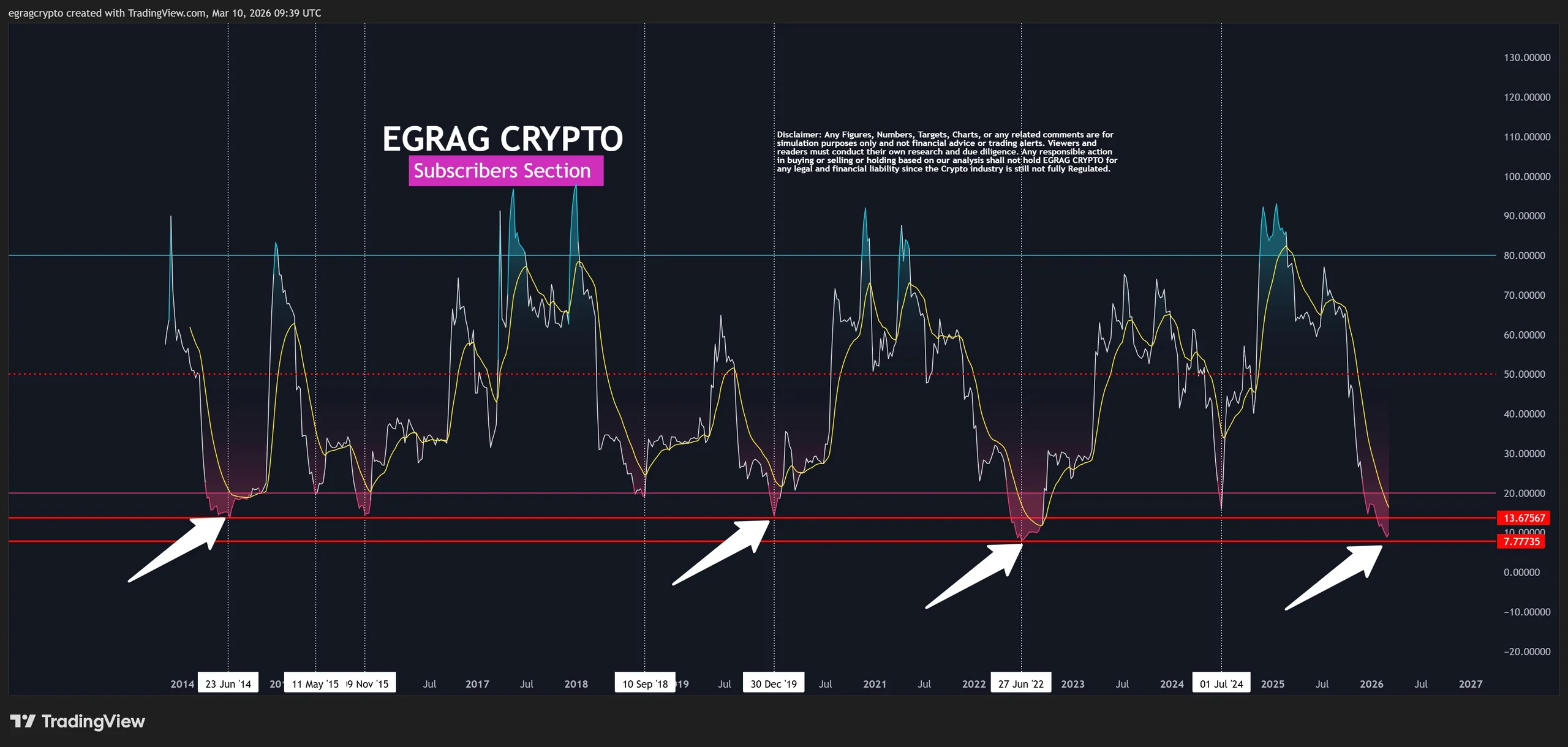
The bearish analyst outlined at which price levels he wants to short XRP.
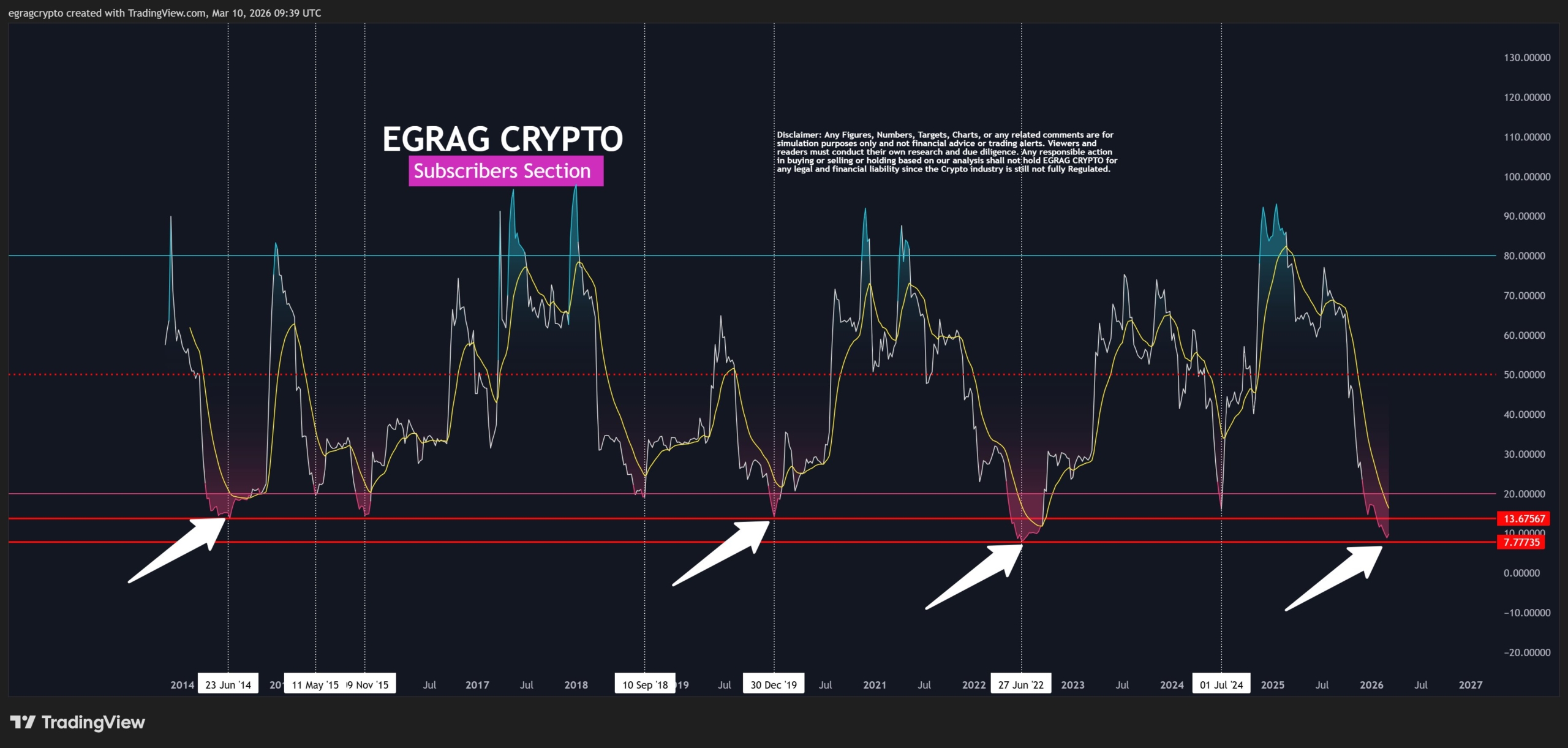
The weekly RSI levels for XRP have declined to their most oversold territory since at least 2022, said popular market commentator EGRAG CRYPTO, adding that this might be a proper entry zone.
While their chart reviews the broader XRP picture, another analyst weighed in on the asset’s daily gains today, noting that he wants to short it only after it reaches a certain level.
Most Oversold in History?
Known for his detailed and mostly bullish analysis on several large cryptocurrencies, but with the main focus on XRP, EGRAR’s latest chart on the cross-border token indicated that the asset is “entering the most oversold region” in its history right now.
They explained that when XRP has plunged to such RSI levels, it has historically bottomed, as was the case in 2014, 2015, 2018, 2020, and 2022. This means that the token has not seen such oversold numbers in four years.
However, EGRAR disclosed that although XRP has indeed reached a macro bottom at similar levels, it does not mean that “the exact bottom prints immediately,” but it’s entering its final phase, which looks like this:
- Final liquidity sweep
- Sideways accumulation
- Gradual reversal
“This is why many experienced investors start accumulating in this region instead of trying to perfectly time the bottom,” they added before asking: “When XRP weekly RSI is in the most oversold zone in its entire history… is this the worst time to buy? Or, one of the best times to start accumulating?”
Or, Maybe Short XRP?
While EGRAG’s analysis focuses on XRP’s macro picture, Crypto Tony weighed in on the asset’s most recent price performance and whether he sees a potential for a trend reversal in the short-term. The token dumped to $1.21 last week, rebounded to $1.55, where it was rejected, and has remained within a tighter range between $1.34 and $1.48 since then.
It jumped to $1.42 earlier today, and Crypto Tony saw an upcoming opportunity to short the upper boundary of this range at $1.47-$1.48. However, XRP was rejected for now and remains around $1.40 as of press time, which is a level that the bulls “need to flip into support,” and they haven’t done it decisively yet.
You may also like:
I would love a spike up to $1.47 range high to then look for shorts. Bulls need to flip $1.40 into support to make this happen pic.twitter.com/U0SrpuCbvz
— Crypto Tony (@CryptoTony__) March 10, 2026
Binance Free $600 (CryptoPotato Exclusive): Use this link to register a new account and receive $600 exclusive welcome offer on Binance (full details).
LIMITED OFFER for CryptoPotato readers at Bybit: Use this link to register and open a $500 FREE position on any coin!
Starknet has launched the STRK20 token standard, aimed at integrating privacy features into ERC-20 tokens on its platform. This development emphasizes the growing trend of privacy in blockchain transactions.
Starknet has unveiled the STRK20 token framework, a new initiative designed to enhance the privacy of Ethereum’s ERC-20 tokens on its platform. According to a blog post from the Layer 2 today, March 10, this development addresses ongoing privacy concerns for token issuers, users, and regulators.
The new framework makes it possible for any ERC-20 token on Starknet to have native privacy, with transactions backed by zero-knowledge proofs.
The mechanism works by letting users transact within the Starknet Privacy Pool, by depositing ERC-20 tokens to the pool, transacting within it, and then withdrawing at any time. Starknet said in the blog post that it’s launching the framework today with both swaps and staking available via Ekubo.
“Privacy on its own is not enough. For it to matter, it has to work where finance actually happens: in swaps, in staking, in the protocols that make DeFi run,” Starknet’s post reads.
As a Layer 2 scaling solution for Ethereum, Starknet utilizes zk-rollups to improve scalability and reduce transaction costs. The introduction of STRK20 aligns with the broader industry trend of incorporating privacy features into blockchain transactions.
This article was generated with the assistance of AI workflows.
Alphabet (GOOG) Stock: Pentagon to Receive Gemini AI Agents for 3 Million Defense Personnel

Melanie Griffith’s Steamy 80s Sci-Fi Actioner Replaces Women With Sex Robots

Access to Work in crisis – Disabled workers pushed out of jobs


-
Business4 days ago
Form 8K Entergy Mississippi LLC For: 6 March
-

 Fashion4 days ago
Weekend Open Thread: Ann Taylor
-

 News Videos1 day ago
10th Algebra | Financial Planning | Question Bank Solution | Board Exam 2026
-

 Crypto World1 day ago
Paradigm, a16z, Winklevoss Capital, Balaji Srinivasan among investors in ZODL
-

 Tech5 days ago
Bitwarden adds support for passkey login on Windows 11
-
 Sports5 days ago
499 runs and 34 sixes later, India beat England to enter T20 World Cup final | Cricket News
-

 Sports3 days ago
Three share 2-shot lead entering final round in Hong Kong
-

 Sports2 days ago
Braveheart Lakshya downs Lai in epic battle to enter All England Open final | Other Sports News
-

 Business7 days ago
Guthrie Disappearance Enters Fifth Week as Family Visits Memorial
-

 Politics4 days ago
Top Mamdani aide takes progressive project to the UK
-

 NewsBeat5 days ago
Piccadilly Circus just unveiled ‘London’s newest tourist attraction’ and it only costs 80p to enter
-

 Business2 days ago
Search for Nancy Guthrie Enters 37th Day as FBI Probes Wi-Fi Jammer Theory
-

 Entertainment4 days ago
Hailey Bieber Poses For Sexy Selfies In New Luscious Lip Thirst Traps
-
 NewsBeat16 hours ago
Pagazzi Lighting enters administration as 70 jobs lost and 11 stores close across Scotland
-

 Tech1 day ago
Despite challenges, Ireland sixth in EU for board gender diversity
-

 Crypto World6 days ago
New Crypto Mutuum Finance (MUTM) Reports V1 Protocol Progress as Roadmap Enters Phase 3
-

 Tech5 days ago
ACIP To Discuss COVID ‘Vaccine Injuries’ Next Month, Despite That Not Being In Its Purview
-
Entertainment6 days ago
Harry Styles Has ‘Struggled’ to Discuss Liam Payne’s Death
-

 Business20 hours ago
Search Enters 39th Day with FBI Tip Line Developments and No Major Breakthroughs
-
 NewsBeat5 days ago
Good Morning Britain fans delighted as Welsh presenter returns to host ITV show