
Business
Amish Shah turns bullish on pharma, remains cautious on IT

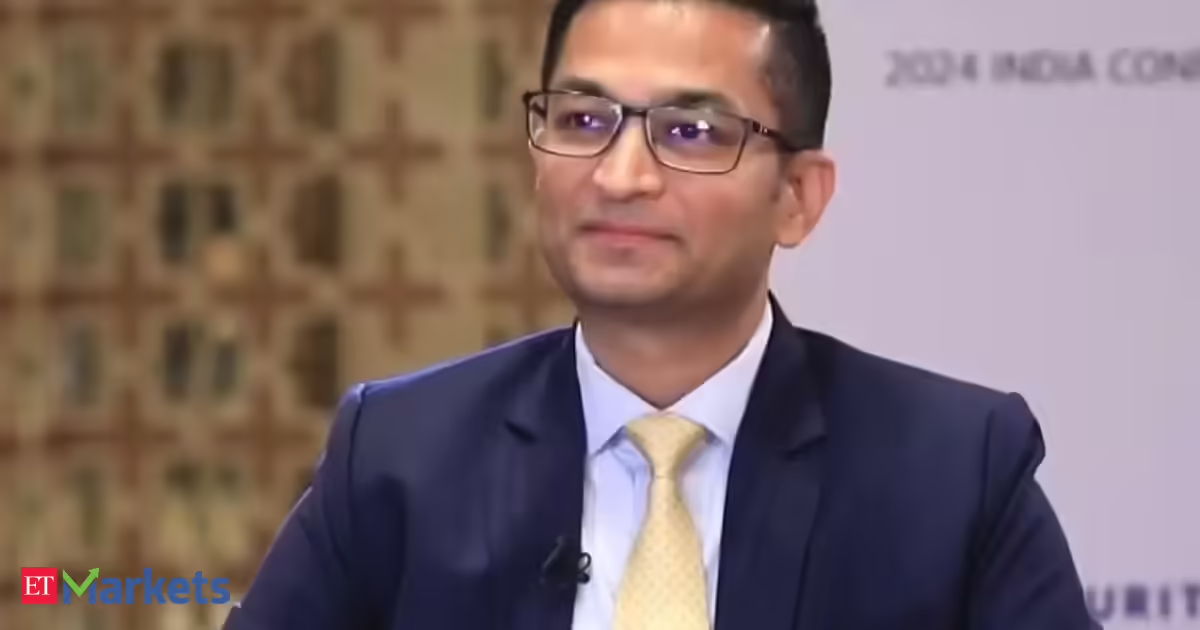
Speaking to ET Now, Amish Shah from BofA Global Research outlined a measured but optimistic outlook for Indian equities, flagging that while near-term earnings surprises may be limited, the medium-term trajectory looks far more encouraging.
Responding to questions on whether earnings upgrades could propel markets higher over the next three quarters, Shah said, “So, look earnings upside not really. All the reasons that you mentioned we have already incorporated in our earnings estimates. But could there be earnings acceleration from where we are in FY26, we certainly think so. So, for FY26 our Nifty earnings estimate is 7%. We are expecting that to go up to 14% next year in FY27.”
Sector churn: Pharma over IT, pockets in midcaps
While the broader market move has remained tempered, certain pockets such as metals have outperformed. This has prompted investors to reassess whether it is time to turn positive on laggards like IT and pharmaceuticals. Shah, however, drew a clear distinction between the two sectors.
“So, within IT and pharma, we were bearish for both in calendar year 25. For the next calendar year we are getting bullish on pharma not on IT yet,” he said.

Explaining the rationale, Shah pointed to the waning impact of patent expiries, especially Revlimid, on pharma earnings. “We think that this is the last quarter of that earnings impact and from next calendar year there will be an acceleration of growth ex of Revlimid.” He also highlighted that generics are unlikely to be caught in tariff-related uncertainties, adding to the sector’s appeal at current valuations.
On IT, the tone was more cautious. While growth may improve modestly, valuations remain a concern. “Let us say ex of currency gains the largecap IT companies in calendar year 25 delivered about 2-3% growth, we think that could accelerate to five or six, but is that exciting for us with the sector still trading at 18 to 20 times PE multiple, we are not that excited yet.” That said, Shah does see selective opportunities emerging from the recent correction. “Basically midcap IT, midcap financials, and then jewellery, hotels, chemicals and consumer durables are some of the pockets of opportunities that we see.”
FIIs could return as global return gaps narrow
One of the most closely watched variables for Indian markets has been FII behaviour, with persistent outflows weighing on sentiment this year. Shah believes this trend could start reversing as early as calendar year 2026.
“So, we do think that it is quite likely… FIIs throughout this calendar year were bearish India, we think that they will start turning slightly positive India going forward,” he said.
High valuations, better opportunities in other emerging markets, and the absence of a direct AI play had kept foreign investors on the sidelines. But that calculus, according to Shah, is shifting.
“Our US equity strategist is arguing for only 4% returns on S&P whereas we are arguing for 12% returns on Nifty,” he noted, adding that historically, Fed rate cuts and dollar depreciation have led to stronger emerging market flows.
Taken together, he expects FII outflows to at least neutralise, “possibly could even turn positive.”
Rupee, trade deal and relative EM appeal
On currency dynamics, Shah acknowledged near-term uncertainty around the rupee, largely tied to delays in the India-US trade deal. “If the India-US trade deal were to get announced, rupee will see an appreciation… But if it continues to get protracted, it is going to be a little bit of drag.”
Over the medium term, however, he expects currency appreciation to add to equity returns for global investors. “The 11.5% returns in rupee terms that we spoke about could actually get an addition in terms of the rupee gains if you are an FII investor.”
Comparing India with other emerging markets, Shah believes India is set to re-enter global portfolios after being largely ignored this year. “As far as the next year goes, we think that India will become a part of the mix,” he said, while noting that Southeast Asian markets remain shallow and largely tactical plays.
“It is primarily going to be between India, China, Taiwan, Korea, and probably Brazil, not so much about the Southeast Asian markets.”
As markets digest slowing global returns and shifting liquidity conditions, the narrative for Indian equities appears to be evolving — from valuation-led caution to earnings-led optimism, with sector selectivity and foreign flows likely to define the next phase.



