




Connect with us

Business

Baby fruit puree recall over elevated patulin toxin levels by Initiative Foods

Published

on

Baby fruit puree recall over elevated patulin toxin levels by Initiative Foods

A nationwide recall has been issued for a baby fruit purée after federal testing found elevated levels of patulin, a toxin that can pose health risks with prolonged exposure.

Initiative Foods announced Friday that it is recalling one lot of its “Tippy Toes” Apple Pear Banana Fruit purée following the test results.

Advertisement

Patulin is a naturally occurring toxin produced by molds that can develop in fruits, particularly apples. Prolonged ingestion of the substance may lead to adverse health effects, including potential immune suppression, nerve damage, headaches, fever and nausea.

According to the U.S. Food and Drug Administration, no illnesses or injuries have been reported.

RECALL EXPANDS TO NEARLY 1M FRIGIDAIRE MINIFRIDGES SOLD AT TARGET OVER FIRE HAZARDS

Baby fruit puree recalled nationwide over toxin

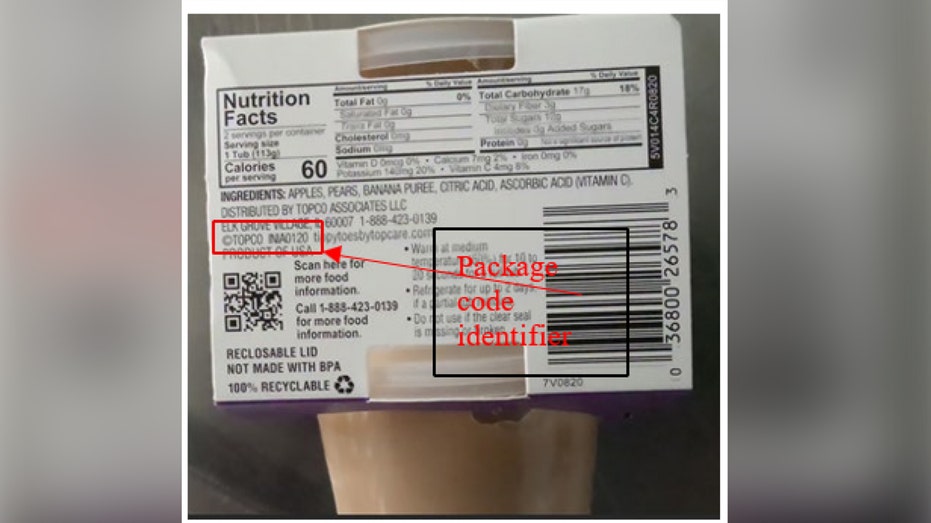
A nationwide recall has been issued for Tippy Toes baby fruit purée after federal testing found elevated patulin levels. No illnesses have been reported. (U.S. FDA / Fox News)

The product was distributed nationwide in grocery stores in all states except Alaska and may also have been sold in Guam and Puerto Rico, the FDA said.

Advertisement

Consumers are urged to check the “Best By” date stamped on the bottom of each plastic tub for “BB 07/17/2026.” The affected packaging is also marked with code “INIA0120.”

TRIO OF DAIRY GIANTS RECALL INFANT FORMULA OVER CONTAMINATION FEARS

Baby fruit puree recalled nationwide over toxin

No illnesses related to the recall have been reported. (U.S. FDA / Fox News)

The company advises anyone who purchased the product with that date to stop using it immediately and dispose of it or return it to the place of purchase for a refund.

Consumers with health concerns after consumption should contact a healthcare provider.

Advertisement

13K POUNDS OF READY-TO-EAT GRILLED CHICKEN BREASTS RECALLED OVER POSSIBLE LISTERIA CONTAMINATION

Baby food on a shelf in a store

Consumers have been advised to stop use of affected products, and to dispose of them or seek a refund. (Jeffrey Greenberg/Universal Images Group via Getty Images / Getty Images)

Retailers have been instructed to check inventory and remove the affected lot from sale or distribution.

“At Initiative Foods, the safety of our consumers and their families is our highest priority,” CEO and President Don Ephgrave said. “We are cooperating with the FDA to ensure strict review and enhanced safety measures across all our products. We thank our retail partners and customers for their understanding and prompt action on this matter.”

GET FOX BUSINESS ON THE GO BY CLICKING HERE

Advertisement

For additional recall information, consumers and retailers can call 1(855) 215-5730.

Continue Reading
Click to comment

Leave a Reply

Your email address will not be published. Required fields are marked *

Business

Bedding firm backs down on 'Swift Home' trademark after Taylor Swift appeal

Published

on

Bedding firm backs down on 'Swift Home' trademark after Taylor Swift appeal

Swift’s team had flagged similarities between her trademark and the company’s contested design.

Continue Reading

Business

BrewDog put up for sale as advisers explore break-up options

Published

on

BrewDog put up for sale as advisers explore break-up options

BrewDog has been put up for sale after the Scottish craft beer group appointed restructuring specialists to explore fresh investment and strategic options.

The Aberdeenshire-founded brewer has hired AlixPartners to oversee a structured process that could result in new investors coming on board or parts of the business being sold off.

Founded in 2007 by James Watt and Martin Dickie, BrewDog grew from a small Ellon-based brewery into an international brand with operations in the US, Australia and Germany, alongside around 60 bars across the UK. It currently employs approximately 1,400 people.

In a statement, the company said the decision followed “a year of decisive action” in 2025, including cost-cutting and efficiency measures, as it sought to strengthen its long-term sustainability in what it described as a challenging economic environment.

A BrewDog spokesperson said the appointment of AlixPartners was a “deliberate and disciplined step” aimed at evaluating the next phase of investment. The company added that it expected to attract substantial interest and that its bars and breweries would continue to operate as normal.

Advertisement

An internal email to staff said no decisions had yet been made and stressed that day-to-day operations would be unaffected while advisers reviewed strategic options.

The move comes after a turbulent period for the brewer. BrewDog reported a £37m loss last year and announced job cuts in October. Earlier this year it confirmed the closure of 10 UK bars, including its flagship Aberdeen venue.

Last month, the group halted production of its gin and vodka brands at its Ellon distillery as part of efforts to “sharpen” its focus on core beer operations.

In recent years BrewDog has frequently attracted headlines, both for bold marketing campaigns and for controversies over workplace culture. In 2024 it faced criticism after announcing it would no longer hire new staff on the real living wage, opting instead to pay the statutory minimum. Co-founder James Watt subsequently stepped down as chief executive, taking on a new role as “captain and co-founder”, while Martin Dickie exited the business last year for personal reasons.

Advertisement

AlixPartners declined to comment on the sales process.

The potential sale marks a significant turning point for one of Britain’s most recognisable craft beer brands, which once positioned itself as a disruptor to global brewing giants and attracted thousands of small-scale investors through its “Equity for Punks” fundraising scheme.


Amy Ingham

Amy is a newly qualified journalist specialising in business journalism at Business Matters with responsibility for news content for what is now the UK’s largest print and online source of current business news.

Advertisement

Continue Reading

Business

Emyria gains Medibank backing for Victoria

Published

on

Emyria gains Medibank backing for Victoria

Treatments from an innovative Perth healthcare company offering novel MDMA and psilocybin-assisted therapy for PTSD will be covered by insurance in three states, after it expanded an agreement with Medibank.

Continue Reading

Business

Racing Ahead While Struggling to Monetize

Published

on

Global Supply Chains at Risk as the U.S. Proposes 25% Tariff on AI Chips

Southeast Asia stands at a fascinating inflection point in the global AI revolution. While hyperscalers pour over $50 billion into regional infrastructure and adoption rates outpace global averages, a troubling paradox emerges from McKinsey’s latest research: companies are moving fast, but they’re not making money from it.

The Paradox

  • Southeast Asia is rapidly adopting AI, with 46% of companies scaling implementations — above global averages.
  • Despite heavy investment (over $50 billion from hyperscalers), 67% of firms report <5% EBIT impact.
  • The issue isn’t technology, but execution and monetization.

The newly released “AI in Southeast Asia: An era of opportunity” report reveals a region sprinting toward an AI-powered future yet stumbling over the chasm between deployment and profitability. This disconnect should concern every C-suite executive, policymaker, and investor betting on Southeast Asia’s digital transformation.

The Adoption Illusion

The headlines look impressive. Nearly half (46%) of Southeast Asian companies have moved beyond AI pilots to scaling implementations, edging ahead of the global average and outperforming most of Asia-Pacific excluding China and India. With 680 million consumers, a population of 380 million under age 35, and mobile penetration reaching 930 million connections, the region appears primed for AI dominance.

Singapore alone hosts over 60 AI centers of excellence. AWS, Google, Alibaba Cloud, and Tencent have collectively committed tens of billions to data centers across Indonesia, Malaysia, Thailand, and Vietnam. The Southeast Asia-Japan Cable 2 went live in 2025, promising the low-latency connectivity that AI applications demand.

Yet beneath this glittering surface lies an uncomfortable truth: 67% of surveyed organizations report that AI has delivered less than 5% impact on their earnings before interest and taxes. 

Advertisement

This is not a technology problem. It’s an execution crisis.

The Value Capture Gap

The McKinsey research identifies three structural barriers preventing Southeast Asian firms from monetizing their AI investments:

Barriers to Value Capture

  1. Talent shortage — lack of skilled AI professionals.
  2. Integration complexity — legacy IT and fragmented data hinder scalability.
  3. Unclear ROI — companies spend boldly but measure poorly.

First, the talent drought is real and worsening. Twenty percent of respondents cite lack of internal AI expertise as their primary obstacle, not budget constraints, not regulatory concerns, but the simple inability to find people who can make AI work. As Alexandro Seminiano, CTO at Bank of the Philippine Islands, notes: “We need people who understand the business and the context of the data being generated.” 

Second, integration complexity is killing scalability. Sixteen percent of companies struggle to embed AI into existing systems, a problem compounded by legacy IT infrastructure and fragmented data environments that plague the region. AI isn’t plug-and-play; it requires fundamental workflow redesign that most organizations resist.

Third, the ROI remains unclear. Despite 64% of organizations allocating more than 11% of their technology budgets to AI initiatives, the business case for transformation remains murky. Companies are spending boldly but measuring poorly.

Advertisement

What High Performers Do Differently

The report’s most valuable insights come from studying the outliers, the 8% of Southeast Asian companies that have achieved full-scale AI deployment. These high performers share three distinguishing characteristics:

They redesign workflows fundamentally rather than layering AI onto existing processes. High performers are twice as likely to integrate AI at the core of operations, not the periphery. Grab exemplifies this approach: their merchant AI assistant, deployed to over 1.2 million merchants, has driven 10% business growth by embedding intelligence directly into seller workflows. 

They invest boldly and consistently. High performers are 2.2 times more likely to expect enterprise-wide transformative change from AI, not incremental improvements. This isn’t about pilot projects; it’s about business model reinvention.

They embed rigorous AI governance. Nearly half of high-performing organizations demonstrate senior leadership ownership and commitment to AI initiatives, with formal governance structures that balance innovation with risk management.

Advertisement

The Agentic AI Wildcard

Perhaps most intriguing is the emergence of agentic AI, autonomous systems that act on behalf of users with minimal human intervention. Ninety percent of surveyed companies plan to experiment with AI agents in 2026, with IT (37%), software engineering (35%), and knowledge management (32%) leading adoption.

This represents a quantum leap beyond today’s generative AI applications. Yet scaling agentic systems beyond technical functions will require precisely the custom development and MLOps expertise that the region currently lacks. The companies that solve this capability gap first will dominate the next competitive cycle.

The Geopolitical Advantage and Risk

Southeast Asia enjoys a unique strategic position as the battleground where Chinese and American tech giants compete for influence. AWS’s $9 billion Singapore commitment, Google’s $2 billion Malaysian data center, Alibaba Cloud’s expansion across the region, and Tencent’s Jakarta operations create a competitive ecosystem that benefits local enterprises through choice, pricing pressure, and accelerated innovation.

As Mayank Wadhwa, President of Microsoft ASEAN, observes: “Southeast Asia is not just a consumer of AI; it’s become a massive co creator.” 

Advertisement

Yet this geopolitical dividend comes with risks. International hyperscalers could inadvertently marginalize local innovation if governments fail to support domestic AI development. With over 1,200 languages spoken across the region, culturally-aware, locally-developed AI systems remain essential for inclusive growth.

The concerning reality: Southeast Asia’s AI start-ups received only $1.7 billion of the $20 billion in venture investment across Asia-Pacific in 2024, representing just 122 of 1,845 AI funding deals. While Q2 2025 saw venture investment jump to $172 million (the highest in three years), the capital gap remains dramatic compared to the scale of infrastructure investment by foreign tech giants.

The Micro, Small, and Medium Enterprise Challenge

The region’s economic backbone, MSMEs that contribute 44.8% to GDP and employ 85% of the workforce, face acute challenges in the AI transition. While platforms like Grab, Sea, and Shopee are democratizing access, smaller enterprises struggle with pricing pressures and capability gaps that threaten to create a two-tier economy of AI haves and have-nots. 

Singapore’s minister for digital development and information, Josephine Teo, emphasizes the importance of leadership: “For AI to truly be transformative, leadership must drive the change. The CEO, C-suite, and board members all play a critical role.”

Advertisement

The Path Forward

The McKinsey report proposes a collaborative framework across five pillars: enabling trusted data flows, strengthening infrastructure and inclusion, expanding regional talent pipelines, catalyzing sector collaborations, and promoting responsible AI at scale.

These recommendations are sensible but insufficient without confronting hard truths:

Companies must stop confusing activity with progress. Piloting 50 AI projects doesn’t create value; scaling three transformative applications does. The discipline to kill experiments and double down on winners separates leaders from laggards.

Governments must balance openness with strategic autonomy. Attracting hyperscaler investment is necessary but not sufficient. Malaysia’s and Singapore’s investments in sovereign AI infrastructure represent the right instinct, retaining local capability while benefiting from global capital.

Advertisement

The talent crisis requires radical solutions. Traditional upskilling programs won’t close the gap fast enough. Singapore’s National AI Strategy 2.0 points the way, but the region needs aggressive immigration policies, stronger university-industry partnerships, and incentives for AI practitioners to relocate to Southeast Asia.

Value measurement must improve dramatically. If two-thirds of companies can’t quantify AI’s business impact, they’re measuring the wrong things. High performers obsess over outcome metrics, revenue growth, cost reduction, customer satisfaction, not deployment statistics.

A Region at the Crossroads

Southeast Asia’s AI moment is unfolding against a backdrop of genuine opportunity and legitimate concern. The fundamentals are strong: young populations comfortable with technology, competitive infrastructure investments, and healthy competition among global tech powers creating optionality for local enterprises.

But momentum without execution is just motion. The region’s 73% adoption rate means nothing if it doesn’t translate into the productivity gains, new business models, and inclusive growth that AI promises. 

Advertisement

As Vivek Lath, McKinsey Partner, frames it: “Leading the AI charge in Southeast Asia requires bold, transformative ambition. It’s about moving beyond isolated use cases to fundamentally reinventing business models with AI at their core.”

The question isn’t whether Southeast Asia will adopt AI, the data shows it already is. The question is whether the region can close the gap between adoption and impact before competitors elsewhere figure out the formula first. With $4.12 trillion in GDP and 4.1% annual growth, Southeast Asia has too much at stake to settle for being fast followers who never capture the value they create.

Advertisement
Continue Reading

Business

Aye Finance shares to debut today. Here’s what GMP suggests ahead of listing

Published

on

Aye Finance shares to debut today. Here's what GMP suggests ahead of listing
Aye Finance is set to list on the BSE and NSE on February 16, with grey market signals pointing to a cautious debut.
The IPO is currently quoting at a negative grey market premium (GMP), indicating that shares are trading below the issue price of Rs 129 per share in the unofficial market.

While GMP is not an official indicator, it often reflects near-term sentiment. A negative premium suggests the possibility of a discount listing, although actual performance will depend on broader market conditions and institutional support.

The IPO, which was open from February 9 to February 11, saw modest investor response. The issue was subscribed 1.04 times overall. Qualified institutional buyers (QIBs) subscribed 1.62 times their quota, while retail participation remained weak at 0.81 times. The non-institutional investor (NII) category was largely undersubscribed at just 0.05 times, indicating limited high-net-worth investor appetite.

Ahead of the public issue, Aye Finance raised Rs 460.51 crore from anchor investors. The IPO comprised a fresh issue of Rs 710 crore and an offer for sale of Rs 300 crore by existing shareholders.

Also read: Risk-on trade back? Smallcap stocks rally up to 28% in 2026, but market breadth stays weak

Business and financials

Aye Finance is a non-banking financial company (NBFC) focused on providing small-ticket secured and unsecured loans to micro and small enterprises (MSMEs). It serves over 5.86 lakh active customers across 18 states and three union territories.
For FY25, the company reported total income of Rs 1,504.99 crore and profit after tax of Rs 175.25 crore. For the six months ended September 2025, income stood at Rs 863.02 crore, while PAT came in at Rs 64.60 crore, reflecting some moderation in profitability.With subscription only marginally above 1 time and negative GMP signals, investors will closely track institutional participation and secondary market mood on listing day. The performance could hinge on sentiment towards financial stocks and appetite for NBFC names in the current market environment.

Advertisement

(Disclaimer: Recommendations, suggestions, views and opinions given by the experts are their own. These do not represent the views of Economic Times)

Continue Reading

Business

Gender pay gap won’t close until 2056 at current pace, warns TUC

Published

on

Gender pay gap won’t close until 2056 at current pace, warns TUC

The UK’s gender pay gap will not close for another three decades if progress continues at its current rate, according to the Trades Union Congress (TUC).

Analysis of official earnings data by the union body shows that the average disparity between men’s and women’s pay stands at 12.8%, equivalent to £2,548 a year. At that pace of improvement, the gap would not be eliminated until 2056, the TUC said.

The gap varies sharply by sector. In finance and insurance it is widest at 27.2%, while in leisure services it is just 1.5%. Even in female-dominated sectors such as education and health and social care, the pay gap remains significant at 17% and 12.8% respectively.

The gender pay gap reflects the difference in average earnings between men and women across organisations and industries. Companies with more than 250 UK employees are legally required to publish gender pay data.

The TUC said the disparity means the average woman “effectively works for 47 days of the year for free” compared with male colleagues.

Advertisement

“Women have effectively been working for free for the first month and a half of the year compared to men,” said TUC general secretary Paul Nowak. “With the cost of living still biting hard, women simply can’t afford to keep losing out.”

The pay gap is largest among workers aged 50 to 59, a trend the TUC attributes partly to the long-term impact of women pausing or scaling back careers to take on caring responsibilities.

The union federation is calling for improved access to flexible working, expanded childcare provision and stronger parental leave policies to help narrow the gap. Nowak described the government’s recent Employment Rights Act as “an important step forward”, but argued further action was needed so parents could better share caring duties.

Business groups have previously warned that additional employment rights and benefits could increase costs for employers. Matthew Percival, director of the future of work and skills at the Confederation of British Industry (CBI), said firms were already facing significant pressures.

Advertisement

“The cost of doing business is leading to job cuts,” he said. “With major changes to employment laws coming, the government must take care not to add further strain.”

Under new rules, employers will be required to publish action plans setting out how they intend to reduce their gender pay gap.

A government spokesperson said ministers were “tackling the root causes of the gender pay gap” through measures including expanded childcare entitlements, strengthened protections for new mothers and changes to flexible working rights.

Despite incremental progress in recent years, the latest figures suggest that without faster reform and structural change, pay parity remains a distant prospect.

Advertisement

Amy Ingham

Amy is a newly qualified journalist specialising in business journalism at Business Matters with responsibility for news content for what is now the UK’s largest print and online source of current business news.

Advertisement
Continue Reading

Business

oOh!media Limited (OMLAF) Q4 2025 Earnings Call Transcript

Published

on

OneWater Marine Inc. (ONEW) Q1 2026 Earnings Call Transcript

Operator

Thank you for standing by, and welcome to the oOh!media Limited OML FY ’25 Results Presentation. [Operator Instructions]

I would now like to hand the conference over to Mr. James Taylor, MD and CEO. Please go ahead.

Advertisement

James Taylor
CEO, MD & Director

Good day, everyone, and thanks for joining us today. I’m James and I joined oOh!media as CEO and MD on the 8th of December. It’s a privilege to join oOh! and lead a business that plays such an important role in Australia’s media and urban landscape.

Out of Homes, a medium I’ve long admired, including as a customer. Having had my feet under the desk at oOh! for just over 8 weeks, I can say that the attractiveness of oOh! as ANZ’s #1 player has only been reinforced. To me, that attractiveness is underpinned by the variety of formats we offer, their physicality and that in an increasingly virtual digital world, it’s part of the last growing physical media channel. The fact that it’s premium and completely embedded into the rhythm of everyday life only adds to this.

The transparency and brand safety that Out of Home provides to both clients and consumers is a huge differentiator. There’s nothing hidden. What you see is what you get. And in today’s media landscape, that clarity is increasingly valuable and recognized by marketers. Out of Home is built into the very fabric of our cities, unskippable and unmissable as people

Advertisement
Continue Reading

Business

Genesis swoops in $639m Magnetic deal

Published

on

Genesis swoops in $639m Magnetic deal

Genesis Minerals has struck a $639 million cash and scrip deal to acquire Magnetic Resources, adding a 2.2-million-ounce resource to its books 20km from Laverton.

Continue Reading

Business

Dynex Series C: On My Watchlist, But The Price Level Isn't Right Just Yet

Published

on

Dynex Series C: On My Watchlist, But The Price Level Isn't Right Just Yet

Dynex Series C: On My Watchlist, But The Price Level Isn't Right Just Yet

Continue Reading

Business

US health regulators to consider safety status of processed ingredients, RFK Jr. says

Published

on

US health regulators to consider safety status of processed ingredients, RFK Jr. says


US health regulators to consider safety status of processed ingredients, RFK Jr. says

Continue Reading

Trending

Copyright © 2025