
Business
California gas prices surge 40 cents to $4.58 amid refinery closures

FOX Business Jeff Flock has the details from New Jersey on Mornings with Maria.
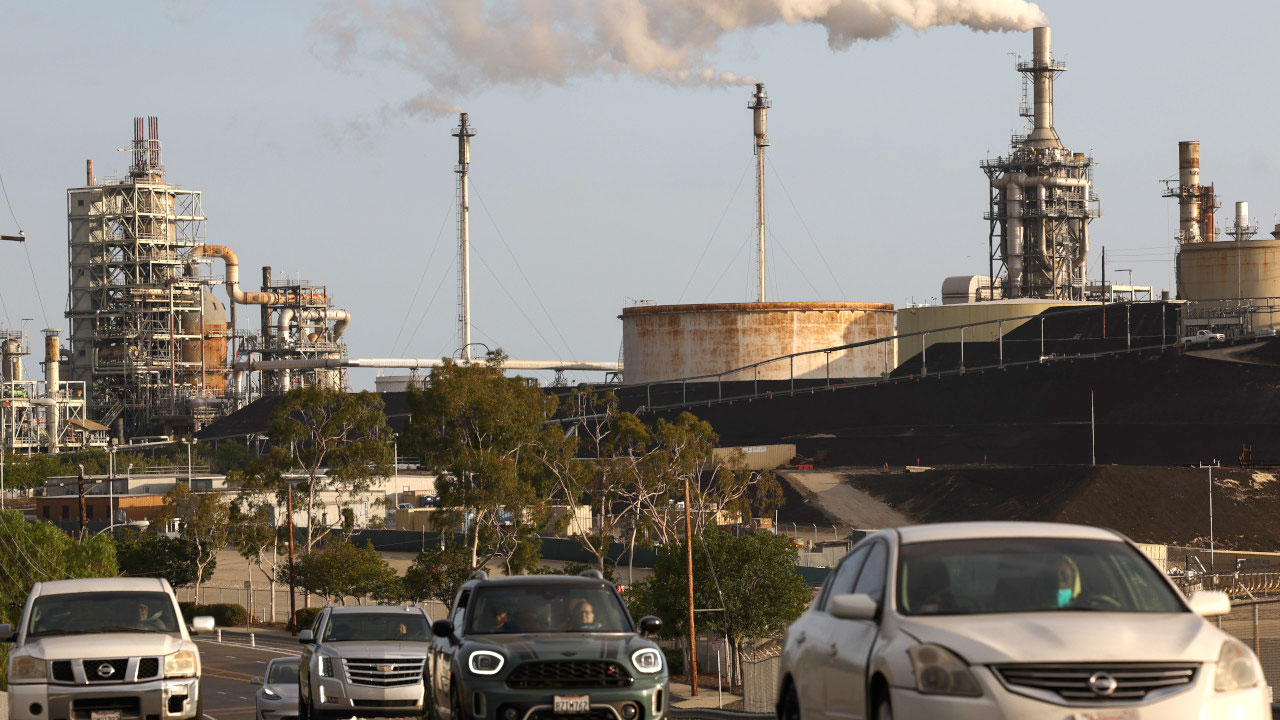
Gas prices have surged in California in recent weeks as the state’s supply is constrained due to recent reductions in refining capacity.
The price of gas rose 40 cents in about two weeks, with the average price of gas across the state of California at $4.58 a gallon – an increase from $4.46 the prior week and $4.18 two weeks before that, according to data from AAA.
Those figures are well above the national average of $2.92 a gallon. California’s gas prices are the highest of all states, topping $4.37 a gallon in Hawaii, $4.15 a gallon in Washington and $3.68 a gallon in Oregon.
Rising gas prices in California come amid a reduction in oil refining capacity due to the wind down of operations at Valero’s refinery in Benicia, as well as the previous closure of the Phillips 66 refinery in Los Angeles.
GAS PRICES FALL IN JANUARY, GIVING AMERICANS A BREAK AT THE PUMP
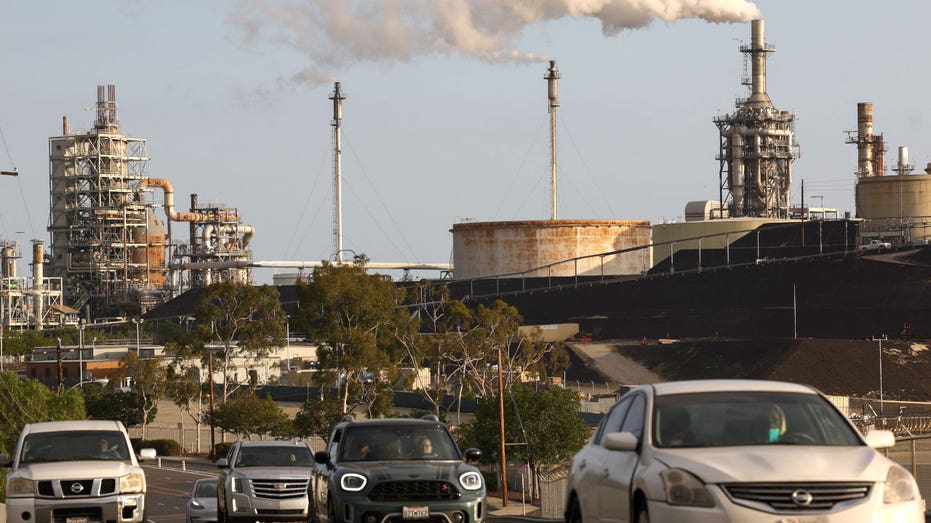
The Phillips 66 Wilmington refinery near Los Angeles previously closed. (Mario Tama/Getty Images)
The closure of the Benicia refinery, located in Northern California, leaves just six operating refineries in the state, which is the largest consumer of fuel among all states except for Texas.
Two others are located in the Bay Area, including Chevron’s Richmond refinery and PBF Energy’s Martinez refinery. The other four are located in Southern California – Marathon’s Los Angeles refinery, Chevron’s El Segundo refinery, PBF Energy’s Torrance refinery and Valero’s Wilmington refinery.
The tightening refining supply prompted the California state senate’s Republican caucus to write a letter to Democratic Gov. Gavin Newsom that called for a special session to address the worsening “cost and supply crisis” created by state policies targeting the oil and gas industry.
CALIFORNIA ‘TRULY AT A BREAKING POINT,’ STATE SENATOR SAYS AS REFINERIES CLOSE AND GAS PRICES SURGE

Valero’s Benicia refinery is scheduled to close, reducing the refining capacity in the state of California. (Paul Morris/Bloomberg)
“California is truly at a breaking point. Refineries are closing, supply is diminishing, and my constituents are paying more at the pump every single day,” Republican state Sen. Suzette Martinez Valladares said in a report by FOX Business’ Jeff Flock that aired on “Mornings with Maria.”
“It isn’t theoretical, this is happening right now. And the longer we wait to address this issue, the more instability and volatility we’ll see here in California,” she added.
TRUMP CONSIDERS CAPPING STATE GAS TAX, SIGNALS POSSIBLE RELIEF FOR CALIFORNIANS
The Big Money Show panelists discuss California’s energy policies its impact on gas prices as well as the oil industry.
For the country as a whole, gas prices have trended down over the last year, according to the latest consumer price index (CPI) data from the Bureau of Labor Statistics.
The BLS’ January CPI inflation report showed that gas prices are down 7.5% over the last year and that prices declined 3.2% from the prior month.
Nationwide energy prices have been largely flat in the last year, with the CPI showing the energy index down 0.1%.
GET FOX BUSINESS ON THE GO BY CLICKING HERE
Declines in gas prices have been somewhat offset by rising prices for electricity and utility gas service, which are up 6.3% and 9.8% over the last year, respectively.
FOX Business’ Arabella Bennett contributed to this report.


TRX Gold Is A Conditional Buy (A Technical Analysis)


US envoys Witkoff and Kushner could visit Ukraine, Kyiv says
Business
Reassessing Brookfield Asset Management: Multiple Compression Despite Strong FRE (NYSE:BAM)


I am a stock analyst with over 20 years of experience in quantitative research, financial modeling, and risk management. My focus is on equity valuation, market trends, and portfolio optimization to uncover high-growth investment opportunities. As a former Vice President at Barclays, I led teams in model validation, stress testing, and regulatory finance, developing a deep expertise in both fundamental and technical analysis. Alongside my research partner (also my wife), I co-author investment research, combining our complementary strengths to deliver high-quality, data-driven insights. Our approach blends rigorous risk management with a long-term perspective on value creation. We have a particular interest in macroeconomic trends, corporate earnings, and financial statement analysis, aiming to provide actionable ideas for investors seeking to outperform the market.
Analyst’s Disclosure: I/we have no stock, option or similar derivative position in any of the companies mentioned, and no plans to initiate any such positions within the next 72 hours. I wrote this article myself, and it expresses my own opinions. I am not receiving compensation for it (other than from Seeking Alpha). I have no business relationship with any company whose stock is mentioned in this article.
Seeking Alpha’s Disclosure: Past performance is no guarantee of future results. No recommendation or advice is being given as to whether any investment is suitable for a particular investor. Any views or opinions expressed above may not reflect those of Seeking Alpha as a whole. Seeking Alpha is not a licensed securities dealer, broker or US investment adviser or investment bank. Our analysts are third party authors that include both professional investors and individual investors who may not be licensed or certified by any institute or regulatory body.

Wolf Report is a senior analyst and private portfolio manager with over 10 years of generating value ideas in European and North American markets.He covers the markets of Scandinavia, Germany, France, UK, Italy, Spain, Portugal and Eastern Europe in search of reasonably valued stock ideas.
Analyst’s Disclosure: I/we have a beneficial long position in the shares of ADRNY either through stock ownership, options, or other derivatives. I wrote this article myself, and it expresses my own opinions. I am not receiving compensation for it (other than from Seeking Alpha). I have no business relationship with any company whose stock is mentioned in this article.
While this article may sound like financial advice, please observe that the author is not a CFA or in any way licensed to give financial advice. It may be structured as such, but it is not financial advice. Investors are required and expected to do their own due diligence and research prior to any investment.
Short-term trading, options trading/investment and futures trading are potentially extremely risky investment styles. They generally are not appropriate for someone with limited capital, limited investment experience, or a lack of understanding for the necessary risk tolerance involved.
I own the European/Scandinavian tickers (not the ADRs) of all European/Scandinavian companies listed in my articles. I own the Canadian tickers of all Canadian stocks I write about.
Please note that investing in European/Non-US stocks comes with withholding tax risks specific to the company’s domicile as well as your personal situation. Investors should always consult a tax professional as to the overall impact of dividend withholding taxes and ways to mitigate these.
Seeking Alpha’s Disclosure: Past performance is no guarantee of future results. No recommendation or advice is being given as to whether any investment is suitable for a particular investor. Any views or opinions expressed above may not reflect those of Seeking Alpha as a whole. Seeking Alpha is not a licensed securities dealer, broker or US investment adviser or investment bank. Our analysts are third party authors that include both professional investors and individual investors who may not be licensed or certified by any institute or regulatory body.
Broadcom: The AI Plumber Set For A Massive Explosion


With a professional background spanning multiple industries, from logistics, construction to retail, I bring a diverse perspective to investing. My international education and career experiences have provided me with a global outlook and the ability to analyze market dynamics from different cultural and economic perspectives. I have been actively investing for over a decade, honing a strategy that focuses on cyclical industries while maintaining a diversified portfolio that includes bonds, commodities, and forex. My interest in cyclical sectors stems from their potential for significant returns during periods of economic recovery and growth. However, I also recognize the importance of balancing risk, which is why I incorporate fixed-income investments (long or short).
Analyst’s Disclosure: I/we have a beneficial long position in the shares of INFQ, IONQ either through stock ownership, options, or other derivatives. I wrote this article myself, and it expresses my own opinions. I am not receiving compensation for it (other than from Seeking Alpha). I have no business relationship with any company whose stock is mentioned in this article.
Seeking Alpha’s Disclosure: Past performance is no guarantee of future results. No recommendation or advice is being given as to whether any investment is suitable for a particular investor. Any views or opinions expressed above may not reflect those of Seeking Alpha as a whole. Seeking Alpha is not a licensed securities dealer, broker or US investment adviser or investment bank. Our analysts are third party authors that include both professional investors and individual investors who may not be licensed or certified by any institute or regulatory body.


I am Gen Alpha. I have more than 14 years of investment experience, and an MBA in Finance. I focus on stocks that are more defensive in nature, with a medium- to long-term horizon. I provide high-yield, dividend growth investment ideas in the investing group iREIT®+HOYA Capital. The group helps investors achieve dependable monthly income, portfolio diversification, and inflation hedging. It provides investment research on REITs, ETFs, closed-end funds, preferreds, and dividend champions across asset classes. It offers income-focused portfolios targeting dividend yields up to 10%. Learn more.
Analyst’s Disclosure: I/we have a beneficial long position in the shares of BAM either through stock ownership, options, or other derivatives. I wrote this article myself, and it expresses my own opinions. I am not receiving compensation for it (other than from Seeking Alpha). I have no business relationship with any company whose stock is mentioned in this article.
I am not an investment advisor. This article is for informational purposes and does not constitute as financial advice. Readers are encouraged and expected to perform due diligence and draw their own conclusions prior to making any investment decisions.
Seeking Alpha’s Disclosure: Past performance is no guarantee of future results. No recommendation or advice is being given as to whether any investment is suitable for a particular investor. Any views or opinions expressed above may not reflect those of Seeking Alpha as a whole. Seeking Alpha is not a licensed securities dealer, broker or US investment adviser or investment bank. Our analysts are third party authors that include both professional investors and individual investors who may not be licensed or certified by any institute or regulatory body.

Hess Midstream: Time To Reap The Rewards, But Not Immune To Macro Pressures

NASA’s Artemis II mission, the first crewed flight to the vicinity of the Moon in more than half a century, is well underway after a flawless launch on April 1, 2026, sending four astronauts on a 10-day journey aboard the Orion spacecraft to test systems and pave the way for future lunar landings.

NASA
The massive Space Launch System rocket lifted off from Launch Complex 39B at NASA’s Kennedy Space Center at 6:35 p.m. EDT, carrying Commander Reid Wiseman, Pilot Victor Glover, Mission Specialist Christina Koch and Canadian Space Agency astronaut Jeremy Hansen. The crew named their spacecraft “Integrity” as they began humanity’s return to deep space exploration.
Artemis II serves as a critical dress rehearsal for Artemis III, which aims to land astronauts on the lunar surface as early as 2027 or 2028. The mission focuses on verifying Orion’s life support systems, heat shield performance and overall crewed operations in the harsh environment beyond low Earth orbit.
Here is the full schedule and key milestones for the Artemis II mission based on the latest NASA updates as the crew continues its outbound journey:
Pre-Launch Preparations (March 29 – April 1, 2026): The countdown officially began on March 30 with the onsite clock ticking down to a targeted 6:24 p.m. EDT liftoff on April 1. Astronauts underwent final medical checks and media briefings while in quarantine. On launch day, propellant loading of the SLS core stage and upper stage began early in the morning, with full NASA coverage starting midday. The crew arrived at the pad in the iconic Astrovan around 2:13 p.m. and boarded Orion for the historic flight.
Flight Day 1: Launch and High Earth Orbit Insertion (April 1) Liftoff occurred precisely at 6:35 p.m. EDT after a smooth terminal countdown. The SLS rocket’s solid rocket boosters separated about two minutes after launch, followed by core stage cutoff and separation. The interim cryogenic propulsion stage then performed burns to place Orion into an initial elliptical orbit and subsequently a high Earth orbit reaching approximately 46,000 miles altitude. The crew conducted initial spacecraft checkouts and settled in for their first night in space.
Flight Day 2: Perigee Raise and Translunar Injection Burn (April 2) Early on April 2, the crew completed a perigee raise burn to optimize the orbit. Later that evening, at approximately 7:49 p.m. EDT, Orion executed the critical translunar injection (TLI) burn using its service module engine. The roughly six-minute firing accelerated the spacecraft out of Earth’s gravitational grip and set it on a trajectory toward the Moon. This maneuver committed the mission to the lunar flyby and marked the moment humans left Earth orbit for the first time since Apollo 17 in 1972. Post-burn, the crew reported the Moon appearing noticeably larger as they sped away from Earth.
Flight Days 3–5: Outbound Coast to the Moon (April 3–5) The astronauts are now in the coasting phase, traveling farther from Earth each hour. They perform daily system checks, exercise using onboard equipment, conduct scientific observations and maintain communication with mission control in Houston. The crew will monitor spacecraft performance, including radiation levels and navigation systems. By the end of this period, Orion will enter the Moon’s gravitational sphere of influence, setting up for the dramatic flyby. During this time, the mission is on track to break the Apollo 13 distance record of about 248,655 miles from Earth.
Flight Day 6: Lunar Flyby and Closest Approach (April 6) The highlight of the mission occurs Monday, April 6, when Orion performs a multi-hour lunar flyby. The spacecraft will pass within approximately 4,000 to 6,000 miles of the lunar surface, allowing the crew to photograph the Moon — including regions of the far side never seen directly by human eyes — and provide live observations. No lunar orbit insertion is planned; instead, the Moon’s gravity will slingshot Orion back toward Earth on a free-return trajectory. This close pass tests Orion’s navigation and communication capabilities in deep space while giving the crew an unforgettable view of Earth’s nearest neighbor.
Flight Days 7–9: Return Journey (April 7–9) After the flyby, the crew begins the inbound leg, covering hundreds of thousands of miles back to Earth. Activities include continued system monitoring, additional photography of Earth and the Moon from increasing distances, and preparation for re-entry. The astronauts will share more images and insights via scheduled downlinks, helping NASA gather data for future missions.
Flight Day 10: Re-Entry and Splashdown (April 10) Orion is scheduled to re-enter Earth’s atmosphere at high speed on April 10, testing its advanced heat shield under crewed conditions. After slowing from nearly 25,000 mph, the spacecraft will deploy parachutes for a gentle splashdown in the Pacific Ocean off the coast of San Diego, California, around mid-afternoon local time. Recovery teams aboard ships will retrieve the crew and capsule, marking the successful conclusion of the test flight.
The entire mission is designed to last approximately 10 days from launch to splashdown, with the crew traveling more than 1 million miles round trip. At its farthest point during the lunar flyby, Orion and its astronauts are expected to reach roughly 252,000 miles from Earth, surpassing previous human distance records.
NASA officials have described the mission as proceeding smoothly, with all major systems performing as expected. Daily news conferences and live updates from mission control continue to provide real-time insights. The crew has remained in high spirits, sharing views of Earth shrinking behind them and the growing lunar disk ahead.
Artemis II builds directly on the uncrewed Artemis I test flight completed in 2022. Success here will clear the path for Artemis III, which will include a lunar landing using SpaceX’s Starship lander in partnership with international agencies. The program ultimately aims to establish a sustainable human presence on the Moon, including the Artemis Base Camp near the lunar south pole.
International collaboration is a cornerstone of Artemis II. Hansen’s participation as the first Canadian on a lunar mission underscores contributions from the Canadian Space Agency, which provided the Canadarm3 robotic system for future Gateway lunar outpost operations. Glover becomes the first Black astronaut to travel beyond low Earth orbit, while Koch is the first woman on such a flight.
Challenges remain for the broader Artemis program, including development of spacesuits, landers and the lunar Gateway station. Budget constraints and technical hurdles have shifted timelines, but NASA maintains confidence in the stepped approach demonstrated by Artemis II.
Public interest has surged with the launch, as millions watched live streams and followed social media updates from the crew. The mission revives the spirit of Apollo while incorporating modern technology, diversity and international partnership for a new era of exploration.
As the astronauts continue their voyage, the focus shifts to the lunar flyby and safe return. Every milestone brings humanity closer to stepping foot on the Moon again — this time to stay.
Engineers on the ground continue monitoring Orion’s performance, with contingency plans in place for any anomalies. The crew’s safety and mission success remain the top priorities.
With Artemis II well into its historic journey, NASA is already looking ahead to the next giant leap. The data collected will refine procedures for crewed lunar operations, ensuring that when astronauts return to the surface, they do so with proven systems and deeper knowledge of deep space travel.


The Investment Doctor is a financial writer, highlighting European small-caps with a 5-7 year investment horizon. He strongly believes a portfolio should consist of a mixture of dividend and growth stocks.
He is the leader of the investment group European Small Cap Ideas which offers exclusive access to actionable research on appealing Europe-focused investment opportunities not found elsewhere. The a focus is on high-quality ideas in the small-cap space, with emphasis on capital gains and dividend income for continuous cash flow. Features include: two model portfolios – the European Small Cap Ideas portfolio and the European REIT Portfolio, weekly updates, educational content to learn more about the European investing opportunities, and an active chat room to discuss the latest developments of the portfolio holdings. Learn more.
Analyst’s Disclosure: I/we have no stock, option or similar derivative position in any of the companies mentioned, and no plans to initiate any such positions within the next 72 hours. I wrote this article myself, and it expresses my own opinions. I am not receiving compensation for it (other than from Seeking Alpha). I have no business relationship with any company whose stock is mentioned in this article.
Seeking Alpha’s Disclosure: Past performance is no guarantee of future results. No recommendation or advice is being given as to whether any investment is suitable for a particular investor. Any views or opinions expressed above may not reflect those of Seeking Alpha as a whole. Seeking Alpha is not a licensed securities dealer, broker or US investment adviser or investment bank. Our analysts are third party authors that include both professional investors and individual investors who may not be licensed or certified by any institute or regulatory body.

Cody Bellinger makes acrobatic catch in Yankees home opener vs Marlins

The Document Foundation Removes Dozens of Collabora Developers

BITCOIN: THINGS ARE ABOUT TO GET WORSE….


![BITCOIN IS ABOUT TO DROP !!! [Bear Flag Confirmed]](https://wordupnews.com/wp-content/uploads/2026/04/1775318607_maxresdefault-80x80.jpg)
-

 NewsBeat2 days ago
Steven Gerrard disagrees with Gary Neville over ‘shock’ Chelsea and Arsenal claim | Football
-

 Business2 days ago
No Jackpot Winner and $194 Million Prize Rolls Over
-

 Fashion23 hours ago
Weekend Open Thread: Spanx – Corporette.com
-
Entertainment5 days ago
Fans slam 'heartbreaking' Barbie Dream Fest convention debacle with 'cardboard cutout' experience
-

 Crypto World3 days ago
Gold Price Prediction: Worst Month in 17 Years fo Save Haven Rock
-

 Tech6 days ago
The Pixel 10a doesn’t have a camera bump, and it’s great
-
Crypto World4 days ago
Dems press CFTC, ethics board on prediction-market insider trades
-
 Entertainment7 days ago
Lana Del Rey Celebrates Her Husband’s 51st Birthday In New Post
-

 Tech6 days ago
Avatar Legends: The Fighting Game comes out in July and it looks pretty slick
-

 Sports4 days ago
Tallest college basketball player ever, standing at 7-foot-9, entering transfer portal
-

 Tech4 days ago
EE TV is using AI to help you find something to watch
-

 Business3 days ago
Login and Checkout Issues Spark Merchant Frustration
-

 Fashion7 days ago
Amazon Sundays: Soft Spring Layers
-

 Tech6 days ago
Elon Musk’s last co-founder reportedly leaves xAI
-

 Fashion5 days ago
The Best Spring Trends of 2026
-

 Tech4 days ago
How to back up your iPhone & iPad to your Mac before something goes wrong
-

 Tech5 days ago
Apple will hide your email address from apps and websites, but not cops
-

 Politics5 days ago
Should Trump Be Scared Strait?
-

 Crypto World5 days ago
U.S. rule change may open trillions in 401(k) funds to crypto
-

 Tech5 days ago
Flipsnack and the shift toward motion-first business content with living visuals
You must be logged in to post a comment Login