

The project is seeking to sell land for major data centre and energy investment to plug a funding gap for the rail testing project

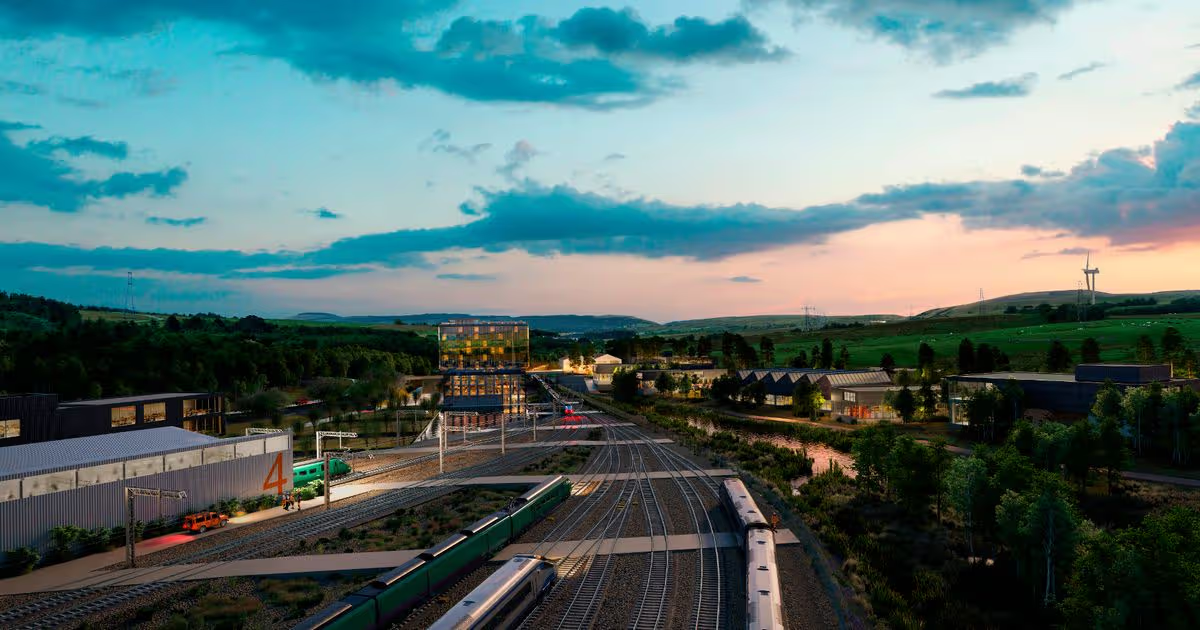
How the Global Centre of Rail Excellence could look.
Plans to secure a major data centre and renewable energy investment to help fund the £400m Global Centre of Rail Excellence (GCRE) project have been pushed back. The overall project, proposed by the Welsh Government seven years ago, is earmarked for a 700-hectare site – the size of Gibraltar – at Onllwyn in the Dulais Valley.
The Welsh Government wholly-owned company behind the project, GCRE Ltd, has been in the marketplace seeking to raise £330m in private funding for the scheme, which would be the world’s first integrated testing facility for both trains and rail infrastructure equipment. The project has already secured, and is close to spending, £50m from the Welsh Government and £20m from the former Conservative UK Government to prepare the site, including the construction of an electricity substation.
The testing facility would consist of two electrified seven kilometre looped testing tracks for rolling stock and infrastructure, both designed to operate 24/7 year-round. It would also include train storage and maintenance facilities, a control centre, a 100-bedroom hotel, as well as training and research and development functions.
READ MORE: Who are Y11 Sport and Media who are in line to acquire Cardiff RugbyREAD MORE: The £30m elevated walkway project that would link Penarth and Cardiff Bay
A later phase, outside of the £400m fundraising package, could also see the development of a rail-related technology park, potentially funded privately.
Fundraising efforts initially focused on securing equity and progressed to talks with three potential investors, including one Middle Eastern investor. When a deal failed to materialise, GCRE entered into advanced negotiations with a long-term debt funder. While confident of closing a deal, the proposed investor – which was also seeking a guarantee from the Welsh Government on its lending – opted at a late stage not to proceed. Whether the project is funded by debt, equity, or a combination of the two.
Ultimately the market determines what amount it is prepared investment. While there is interest, and GCRE Ltd are confident of the testing facility becoming profitable in its early years, there is not the risk appetite to commit £330m, so at present further government funding will be required.
To help narrow the funding gap, GCRE last year sought an energy and data centre partner (EDCP) through an invitation-to-tender process, with the aim of securing a preferred developer before the Senedd election in May. However, the initial timeframe for expressions of interest was deemed too short by interested parties to develop comprehensive proposals for the site. As a result, a new invitation to tender, through Sell2Wales, has been launched with a deadline of March 10.

GCRE site.
GCRE Ltd envisages it will be in a position to take forward three shortlisted bidders in the summer. Following detailed dialogue, a preferred investor – assuming a deal can be struck – is expected to be confirmed by the end of the year. Any land deal, which is most likely to be with a developer that would then strike agreements to bring in data centre and renewable energy operators, is expected to generate tens of millions of pounds towards the rail testing facility.
The current Labour administration remains supportive of the project and has indicated a willingness to provide additional funding to close any gap. However, it would be for the next Cardiff Bay administration to decide whether to take the project forward.
If the required funding is secured, the company status of GCRE Ltd may also need to be changed to ensure it is not viewed by the UK Treasury as being part of the Welsh Government accounting framework.
Otherwise, private investment could be treated as part of the Welsh Government’s block grant, meaning an equivalent amount would need to be held in reserve. While this is ultimately a matter of classification for the Office for National Statistics, one potential solution would be for GCRE to become a community interest company.

Simon Jones CEO of GCRE Ltd.(Image: John Myers)
Chief executive of GCRE Ltd, Simon Jones, said: “The last few weeks have been very encouraging, as we have seen the significant interest there is from the commercial market in the GCRE site as a location for high-quality renewable energy and data centre infrastructure.
“What’s clear, however, is that more time is needed for bidders to develop their proposals. That has meant we have taken the decision as a company to extend our partner search and give everyone in the market more time to put forward proposals.
“That is why we have issued a new invitation to tender with an extended timeline, allowing that interest to crystallise into firm proposals. We had originally hoped to appoint a partner by the end of the current Senedd term, but that has not been possible, and so we have extended the time available into 2026.
“The opportunity for a long-term partnership with GCRE is a unique one. The site’s size, power grid and telecoms connectivity make it very appealing for the development of renewable energy assets and data centre infrastructure. Both 132kV and 400kV power lines cross the GCRE site, with high-quality fibre connectivity being progressed for the area.
“It’s right that we take the time to find the correct partner. Energy and data centre infrastructure at GCRE will help raise the economic profile of the site, which is very important as we continue our search for private investment for the rail project.”
The rail centre has received expressions of interest from more than 200 firms looking to utilise its facilities, including Network Rail, Transport for Wales, and leading train manufacturers such as Hitachi and its Spanish rival Construcciones y Auxiliar de Ferrocarriles (CAF), which has a train manufacturing plant in Newport.
An economic assessment by professional services firm PwC suggests that over ten years – excluding the planned later phase, the Sarn Helen Technology Park – GCRE could create 1,100 permanent jobs, with a £300m gross value added (GVA) impact on the local area and £1.2bn over its lifetime. The project has also been forecast to generate a 15-fold economic return for every £1 invested.























































You must be logged in to post a comment Login