Connect with us
DAPA Banner

Business

Eli Lilly (LLY) earnings Q4 2025

Published

on

Eli Lilly (LLY) earnings Q4 2025

Eli Lilly and Company’s logo is displayed during a press conference in Houston, Texas, U.S., Sept. 23, 2025.

Antranik Tavitian | Reuters

Eli Lilly on Wednesday posted fourth-quarter earnings and revenue and 2026 guidance that blew past estimates, as demand for its blockbuster weight loss drug Zepbound and diabetes treatment Mounjaro soars.

Advertisement

The pharmaceutical giant anticipates its 2026 revenue will come in between $80 billion and $83 billion. Analysts expected revenue of $77.62 billion, according to LSEG. 

Lilly also expected adjusted earnings to be between $33.50 and $35 per share for the year. That compares with analysts’ estimate of $33.23 per share, according to LSEG.

The strong outlook comes days after Lilly CEO Dave Ricks told CNBC in an exclusive interview that he expects upcoming government Medicare coverage of obesity treatments to expand the U.S. market for those drugs this year, saying it’s a “big multiplier on the eligible pool” of patients.

Lilly’s guidance comes in stark contrast to the outlook of rival Novo Nordisk, which is also grappling with lower prices in the U.S. following landmark deals both companies struck with President Donald Trump to slash obesity and diabetes drug costs. Unlike Lilly, Novo warned on Tuesday that it sees sales and profit declining this year, as prices fall in the U.S. and exclusivity expires for its blockbuster obesity and diabetes drugs in China, Brazil and Canada. 

Advertisement

Lilly is working to maintain its dominance in the booming market for those drugs, called GLP-1s, as Novo sees an explosive U.S. launch for its new Wegovy pill for obesity. Lilly hopes to win approval for its own oral weight loss drug, orforglipron, later this year. 

Mounjaro raked in $7.41 billion in revenue for the quarter, up 110% from the same period a year ago. U.S. sales for Mounjaro were $4.1 billion, up 57%, as demand climbed but realized prices were lower. Those numbers surpassed what analysts were expecting for the quarter, according to StreetAccount.

Zepbound, which entered the market roughly three years ago, posted $4.2 billion in U.S. revenue for the fourth quarter. That’s up 122% from the year-earlier period, as demand for the drug also rose while realized prices dropped. Analysts were expecting $3.91 billion in U.S. sales for Zepbound, according to StreetAccount.

Here’s what the company reported for the fourth quarter compared with what Wall Street was expecting, based on a survey of analysts by LSEG: 

Advertisement
  • Earnings per share: $7.54 adjusted vs. $6.67 expected
  • Revenue: $19.29 billion vs. $17.96 billion expected

Eli Lilly shares climbed more than 7% in premarket trading.

The company posted fourth-quarter revenue of $19.29 billion, up 43% from the same period a year ago. 

Revenue in the U.S. climbed to $12.9 billion. Eli Lilly said that was driven by a 50% increase in volume — or the number of prescriptions or units sold — for its products, primarily for Mounjaro and Zepbound. That was partially offset by lower realized prices of those drugs, the company said.

The pharmaceutical giant booked net income of $6.64 billion, or $7.39 per share, for the fourth quarter. That compares with net income of $4.41 billion, or $4.88 per share, a year earlier. 

Excluding one-time items associated with the value of intangible assets and other adjustments, Eli Lilly posted earnings of $7.54 per share for the fourth quarter.

Advertisement

Novo and Lilly’s deals with Trump are expected to eventually increase the number of prescriptions but ultimately hurt total sales.

Under the agreements, Lilly and Novo agreed to slash the prices of those treatments for Medicare and Medicaid beneficiaries in 2026 and offer them directly to consumers at a discount on the Trump administration’s direct-to-consumer platform, TrumpRx, which has yet to launch. 

In return, both companies will also get a three-year exemption from tariffs.

In the interview with CNBC on Friday, Lilly’s Ricks acknowledged that under the drug pricing deal, there will be “a step down in pricing” early this year. But he said volume growth of the company’s drugs “will ramp on the back half of the year.”

Advertisement
Continue Reading
Click to comment

You must be logged in to post a comment Login

Leave a Reply

Business

Italy stocks lower at close of trade; Investing.com Italy 40 down 0.36%

Published

on


Italy stocks lower at close of trade; Investing.com Italy 40 down 0.36%

Continue Reading

Business

Oriole Resources directors complete bed and ISA share transfers

Published

on


Oriole Resources directors complete bed and ISA share transfers

Continue Reading

Business

MPs warn Treasury reforms could undermine Financial Ombudsman independence

Published

on

MPs warn Treasury reforms could undermine Financial Ombudsman independence

The Treasury’s proposed overhaul of the Financial Ombudsman Service (FOS) has come under scrutiny from senior MPs, who have warned that the reforms risk undermining the independence of a body tasked with resolving disputes between consumers and financial firms.

In a letter to City minister Lucy Rigby, Dame Meg Hillier, chair of the Treasury Select Committee, raised concerns that key elements of the government’s proposals could fundamentally alter the role and perceived neutrality of the ombudsman. The reforms, unveiled earlier this week, are intended to address criticism that the FOS has evolved into a “quasi-regulator” rather than a complaints resolution body. However, MPs argue that the changes could have unintended constitutional consequences.

At the centre of the criticism is a proposal that would see the chair of the FOS appointed directly by government. Hillier warned that such a move risks eroding both the actual and perceived independence of the institution, which plays a critical role in adjudicating disputes across the UK’s financial services sector.

Writing on behalf of the committee, she emphasised that the ombudsman “must be and must be seen to be an independent mechanism” for resolving complaints, highlighting that public trust in the system depends on its ability to operate free from political influence.

The committee has called for additional safeguards, including the introduction of a statutory “lock” that would give Parliament, specifically the Treasury Select Committee, the authority to approve or veto the appointment and dismissal of the FOS chair. Such mechanisms are already in place for other oversight bodies, including fiscal and audit watchdogs, and are designed to reinforce institutional independence.

Advertisement

Hillier also questioned why the proposal for government appointment was not included in earlier consultation processes, seeking clarity on what prompted the shift in approach. The intervention reflects broader unease within Westminster about the balance between reforming regulatory bodies and preserving their autonomy.

The debate comes at a sensitive time for the Financial Ombudsman Service, which has faced significant internal upheaval over the past year. Former chief executive Abby Thomas departed abruptly in February following what was described in a Treasury Committee report as a “mutual collapse in confidence” between her and the board over strategic direction. Shortly afterwards, chair Baroness Zahida Manzoor announced she would step down at the end of her term, leaving the organisation’s senior leadership largely in interim positions.

MPs have now sought assurances on whether the proposed reforms would apply to forthcoming permanent appointments, raising concerns about governance stability during a period of transition.

Alongside the governance changes, the Treasury’s reform package includes a series of structural adjustments aimed at reshaping how the FOS operates. These include the introduction of a 10-year time limit for bringing complaints, with the Financial Conduct Authority (FCA) retaining discretion to make exceptions in certain cases.

Advertisement

The government has also begun implementing changes to the cost structure of the ombudsman system. Since April, professional representatives such as claims management companies and law firms have faced a £250 fee for each case submitted beyond an initial allowance, while financial institutions are exempt from fees on their first three complaints each year before incurring a £650 charge per case thereafter.

Ministers argue that these measures are designed to improve efficiency, reduce speculative claims and refocus the FOS on its core function. However, critics warn that the cumulative effect of the reforms — particularly changes to governance — could reshape the institution in ways that weaken its independence and credibility.

The Treasury Select Committee has made clear that it expects a detailed response from the government, particularly on how it intends to safeguard the ombudsman’s impartiality while pursuing its wider reform agenda.


Jamie Young

Jamie Young

Jamie is Senior Reporter at Business Matters, bringing over a decade of experience in UK SME business reporting.
Jamie holds a degree in Business Administration and regularly participates in industry conferences and workshops.

When not reporting on the latest business developments, Jamie is passionate about mentoring up-and-coming journalists and entrepreneurs to inspire the next generation of business leaders.

Advertisement

Continue Reading

Business

Frozen food retailer Heron Foods cuts jobs at Humber head office

Published

on

Business Live

The changes are said to impact fewer than 1% of the more than 5,500-strong workforce

Heron Foods started life as a butchers in Hull.

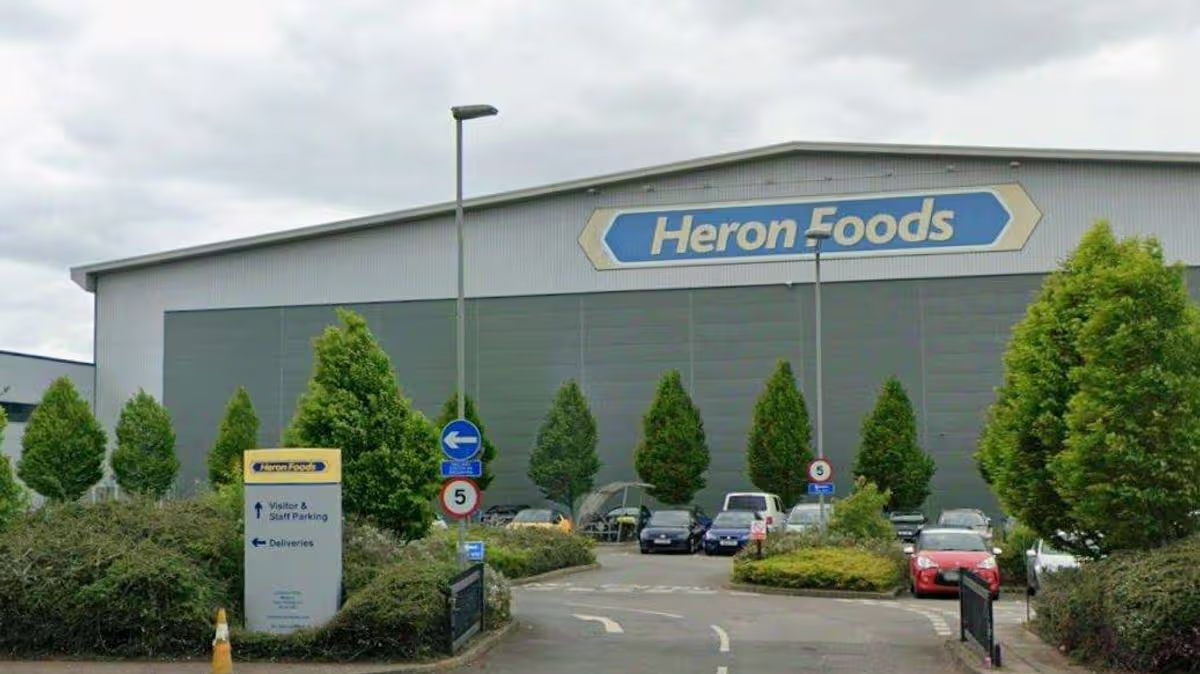
Heron Foods’ Store Support Centre in Melton.(Image: Google Streetview)

Several jobs have been axed at the East Yorkshire headquarters of frozen foods supermarket Heron, with management stating they are part of alterations to the business. The Melton-based retailer – which operates a network of over 340 locations nationwide – confirmed a “small number” of employees at its head office had been affected.

The modifications are reported to impact less than 1% of the more than 5,500-strong workforce at the discount food company’s base. It stated efforts were underway to offer impacted employees alternative roles within the firm.

Last year, Heron slashed as many as 250 staff across the country, throughout its stores and warehouses as it grappled with declining sales and profits. However, the budget chain had pinpointed areas for growth – and is aiming for 10 new store launches in its current financial year.

Despite escalating costs, including from a rise in the National Minimum Wage, Heron said it was intensifying efforts to refurbish existing shops and relocate others, where opportunities arose to enhance customer experience and attract more consumers.

Advertisement

In January, the firm’s owner – discount titan BandM – issued a profit warning citing Heron’s weak financial performance. BandM executives said they were reassessing the company’s offering to customers, and chief executive Tjeerd Jegen spoke of a “back to BandM basics” strategy for the group, reports Hull Live.

A spokesperson for Heron Foods stated: “Unfortunately, a small number of roles at our Store Support Centre in Melton, East Yorkshire are impacted as part of changes within the business. Wherever possible, we have worked to transition affected colleagues into alternative roles within the business.

“These changes impact less than 1% of our workforce and are necessary as we continue to adapt to an evolving retail landscape. Our focus remains unchanged: providing customers with top-quality products at the lowest possible prices, every day in every store.”

Heron Foods originated as Grindells Butchers on Hull’s Holderness Road in the late 1970s. It has since expanded significantly and is now owned by the B&M group.

Advertisement

In the year ending 29 March 2025, the retailer launched 14 new and relocated outlets. This represented eight net additions following the closure of older and underperforming locations that had reached the end of their lease agreements.

Last year, the chain’s Cottingham outlet was relaunched following a refurbishment which introduced new-style freezers and its food-to-go meal deal selection. The Spring Bank West branch in Hull also underwent a makeover.

Continue Reading

Business

NSE said to set modest fee for its $2.5 billion Indian IPO

Published

on

NSE said to set modest fee for its $2.5 billion Indian IPO
National Stock Exchange of India has set advisory fees at about 0.65% of the issue size for its upcoming initial public offering, according to people familiar with the matter.

Based on an expected deal size of about $2.5 billion (approx Rs 23,085 crore), the total fee pool could be about $16.25 million, with the bulk likely to be shared among the six lead banks, the people said, asking not to be identified because the information is private.

That compares with a roughly 1.86% average paid by 417 companies last year and 1.67% by 350 issuers in 2024, according to data from LSEG.

NSE last week appointed about 20 banks to work on the IPO. Of those, Kotak Mahindra Capital Co, JM Financial Ltd, Morgan Stanley, HSBC Holdings Plc, Citigroup Inc. and JPMorgan Chase & Co. have been given key roles, with Kotak acting as left lead, the people said.

Advertisement

Representatives for NSE and the banks didn’t immediately respond to requests for comment.


The relatively modest fee underscores a broader pattern in India, especially in government-linked or quasi-sovereign transactions, where issuers keep tight control over costs. In some cases, banks accept token fees in exchange for the prestige and league table positioning that comes with marquee mandates. When State Bank of India raised Rs 25,000 crore ($2.8 billion) in July, it paid six banks a symbolic Re 1 each, according to local media.
“Compared with large state-owned or public institutions, NSE’s fee payout appears relatively fair,” said Raghuram Kasiviswanathan, head of IPO advisory at Uniqus Consultech. “With the exchange at the heart of the country’s capital markets, securing a role offers not just immediate revenue, but a longer-term strategic foothold.”Earlier this year, State Bank of India and France’s Amundi SA offered fees of about 0.01% for the planned $1.4 billion IPO of SBI Fund Management, a level some bankers described as rock-bottom, prompting a few global firms to opt out. Life Insurance Corporation Ltd. paid about 0.58% of the issue size as fee in 2021 while NTPC Green Energy paid around 0.54%, according to IPO prospectus.

By contrast, private-sector deals have tended to be more lucrative. Hyundai Motor India’s record IPO in 2024 paid about 4.93 billion rupees, or 1.77% of the issue size, in fees and commissions, the largest such payout in the country. LG Electronics paid about Rs 226 crore or 1.94% to five banks for its $1.3 billion India listing.

Continue Reading

Business

McGrath RentCorp Remains Attractive Despite Its Plunge

Published

on

McGrath RentCorp Remains Attractive Despite Its Plunge

McGrath RentCorp Remains Attractive Despite Its Plunge

Continue Reading

Business

Iran’s government degraded but appears intact, top US spy says

Published

on

Iran’s government degraded but appears intact, top US spy says


Iran’s government degraded but appears intact, top US spy says

Continue Reading

Business

Niall Horan Announces New Single ‘Dinner Party’ Releasing March 20 as First Taste of Upcoming Fourth Album

Published

on

Niall Horan

LONDON — Former One Direction member Niall Horan has fans buzzing with the announcement of his new single “Dinner Party,” set for digital release on Friday, March 20, 2026. The track marks the Irish singer-songwriter’s first solo single since his 2023 album *The Show* and serves as the lead single from his as-yet-untitled fourth studio album.

Niall Horan
Niall Horan

Horan, 32, shared the news directly with fans in early March via Instagram and other social platforms, posting a heartfelt video in which he teases lyrics and explains the song’s deeply personal inspiration. “I’m so happy and excited to tell you my new single ‘Dinner Party’ is coming out March 20,” he said. “This song is about a really happy and big moment in my life. An evening at a simple dinner party that changed the course of my life.”

He continued, revealing that the song became the creative core of the entire new record: “After writing the song, the words ‘Dinner Party’ became the nucleus for the rest of the record. That once-in-a-lifetime moment that I am grateful for and for everything that came after that night.”

A snippet shared by Horan includes lines such as “I’m done looking for somebody / behind closed doors / things I never felt before / crashing lights / when you first saw me / yeah, I met you at a dinner party,” hinting at a romantic, introspective ballad rooted in real-life gratitude. Multiple reports suggest the track draws from his relationship with girlfriend Amelia Woolley, though Horan has not explicitly confirmed details beyond its transformative personal significance.

The announcement follows Horan’s February 2026 update that his fourth solo album was “DONE,” posted alongside casual photos and a brief preview of new music. That post ignited speculation among Directioners and solo fans eager for fresh material after a multi-year gap since *The Show*, which debuted at No. 1 on the Billboard 200 and earned critical praise for its folk-pop maturity.

Advertisement

In the weeks leading up to the single’s arrival, Horan has built anticipation with listening events. Fans in select cities including Milan and Toronto got early access to “Dinner Party” on March 14, followed by London, Paris and Berlin on March 15, and Manila on March 17. These intimate previews have generated widespread social media excitement, with clips circulating on TikTok, Instagram and X.

Physical formats are also available for preorder. Horan’s official online store offers a limited-edition red 7-inch vinyl featuring the new single, described as his first solo release since 2023. Digital presaves went live immediately after the announcement at niallhoran.com.

**A New Era for Horan**

Horan rose to global fame as one-fifth of One Direction, the British-Irish boy band that dominated charts in the 2010s before going on hiatus in 2016. His solo career launched successfully with 2017’s *Flicker*, followed by 2020’s *Heartbreak Weather* and 2023’s *The Show*. Known for blending pop, folk and rock influences with introspective songwriting and guitar-driven melodies, Horan has also built a television presence as a coach on “The Voice” and collaborated with artists including Lewis Capaldi and, more recently, Myles Smith on “Drive Safe.”

Advertisement

The upcoming project, tentatively referred to in some fan circles and early reports as connected to the “Dinner Party” theme, represents Horan’s continued evolution as an artist. While a full album title and release date remain unconfirmed in official channels as of March 19, recent social media buzz and unverified posts have circulated speculation of a June 5, 2026, album drop titled *Dinner Party*, complete with track lists featuring upbeat cuts like “Boys Are Fun.” However, Capitol Records, EMI and Horan’s team have not yet corroborated those details, focusing promotion strictly on the March 20 single.

Music critics and industry observers view the single as a strategic re-entry. After a period of touring, television work and personal milestones, “Dinner Party” appears positioned to showcase Horan’s growth while delivering the heartfelt, relatable storytelling that built his loyal fan base. Early lyric snippets suggest themes of unexpected connection, gratitude and life-changing encounters — a departure from some of the more polished pop of prior eras toward something more intimate.

**Fan and Industry Reaction**

The news has been met with widespread enthusiasm across social platforms. Directioners, who have cheered on solo releases from bandmates Harry Styles, Louis Tomlinson and Zayn Malik in recent years, celebrated the timing as “2026 is the year of One Direction alumni.” Hashtags such as #DinnerParty, #NiallHoran and #NH4 trended shortly after the announcement, with fans sharing pre-save confirmations and theories about the dinner party’s real-life details.

Advertisement

Radio stations and streaming playlists have already begun teasing the track. Outlets including Audacy, iHeartRadio and MOViN 92.5 highlighted the personal story behind the song, positioning it as a potential spring radio hit. Previews have drawn comparisons to Horan’s softer acoustic moments on *Flicker* while hinting at evolved production.

Limited details about additional album tracks or a supporting tour have emerged, though Horan’s official store lists festival appearances, including BBC Radio 1’s Big Weekend in May 2026. Fans hope the single’s release will be followed by more reveals, potentially including a full album rollout later in the year.

**What’s Next**

“Dinner Party” arrives on streaming platforms and digital retailers worldwide on March 20, 2026. The limited red vinyl is available for preorder now via niallhoran.com, with shipping expected after the digital launch. Fans can presave the single and stay updated through Horan’s official social channels and website.

Advertisement

As anticipation builds in the final hours before release, Horan’s message of gratitude and personal milestone resonates strongly. In an industry often focused on spectacle, the former boy band star continues to ground his music in authentic moments — starting with a simple dinner party that, according to the artist, altered everything that followed.

For the latest updates on Niall Horan’s “Dinner Party” single, upcoming album and tour news, follow official announcements at niallhoran.com or his verified social media accounts. The March 20 release is expected to dominate playlists and social conversations heading into the weekend.

Continue Reading

Business

UK government backs away from AI copyright overhaul as licensing emerges as the battleground

Published

on

UK government backs away from AI copyright overhaul as licensing emerges as the battleground

The UK government has stepped back from one of its most controversial proposals on artificial intelligence and copyright, signalling a decisive shift towards market-led licensing and greater transparency rather than sweeping legal reform.

In its long-awaited Report on Copyright and Artificial Intelligence, published in March 2026, ministers confirm they will no longer pursue a broad copyright exception for AI training with an opt-out mechanism — a policy that had triggered fierce opposition from across the UK’s creative industries.

Instead, the government is opting for a more cautious, evidence-led approach, prioritising transparency obligations and allowing a nascent but rapidly expanding licensing market to develop. The move marks a significant recalibration of policy at a time when the UK is seeking to position itself as both an AI superpower and a global creative hub.

At the heart of the report is a clear admission: the government’s preferred option, allowing AI developers to use copyrighted material unless rightsholders explicitly opted out, failed to win support.

The consultation attracted more than 11,500 responses, with the overwhelming majority of creators, publishers and rights organisations rejecting the proposal outright.

Advertisement

Ministers now concede that a broad exception “with opt-out is no longer the government’s preferred way forward”, citing strong industry opposition, lack of consensus, and insufficient evidence on economic impact.

This represents a notable victory for the UK’s creative sectors, from publishing and music to film and photography, which argued that such an exception would effectively legalise uncompensated use of their work by generative AI systems.

The report lays bare the fundamental policy dilemma: how to balance AI-driven economic growth with the protection of intellectual property.

On one side sit AI developers, who require vast datasets, often including copyrighted material, to train large language models and generative systems. On the other are creators whose works underpin those systems but risk being displaced by them.

Advertisement

The government acknowledges that modern AI models are typically trained on “billions of copyright works”, raising complex questions about fairness, consent and competition.

Yet it also highlights uncertainty around the economic benefits of reform, noting limited evidence that loosening copyright rules would materially increase AI investment in the UK.

In effect, ministers are choosing to pause rather than gamble.

Rather than legislating, the government is placing its bets on licensing, a market-based mechanism already beginning to take shape.

Advertisement

A growing number of deals between AI firms and content owners, particularly in publishing, music and image libraries, suggests a commercial model is emerging. However, the report acknowledges this market is still “new and evolving” and lacks transparency.

Crucially, ministers have ruled out direct intervention for now:

“We propose not to intervene in the licensing market at this stage… and will keep market-led approaches under review.”

This position aligns closely with industry sentiment across both creative and technology sectors, which broadly favour voluntary, negotiated agreements over statutory schemes.

Advertisement

However, it also raises important questions, particularly for SMEs and individual creators, about bargaining power and equitable remuneration.

Among those welcoming the shift is Tom West, CEO of Publishers’ Licensing Services (PLS), who sees licensing as both practical and scalable.

West said: “We welcome that the government has listened to the strong response it received from across the UK’s creative industries to its consultation and has stepped back from its preferred option of a copyright exception with an opt out and is to review the transparency of AI inputs, which would further boost licensing.

Whilst we await further clarity from the government on the long-term direction of its copyright policy, PLS will continue to serve our publishers and work with our partners on market-based, industry-backed AI licensing solutions.

Advertisement

This approach is already being put into practice. At the London Book Fair last week, PLS launched the first stage of a new collective licensing solution designed specifically to support the use of published content in AI. It was met with strong interest and positive feedback from publishers and industry partners, with publishers already beginning to sign up. The solution offers a practical, scalable way for AI developers to access high-quality content while ensuring creators are paid and retain control over how their work is used.

The case has not been made for the introduction of a new copyright exception. There is no market failure and a dynamic licensing market for the use of content in AI has developed and continues to grow. Any copyright exception for generative AI would jeopardise these licensing solutions, removing the ability of large and small rightsholders to receive payment for the use of their works in AI and reducing control over their content.

PLS welcomes the government’s engagement on this critical issue. We share a commitment to a mutually beneficial outcome and invite the government to work closely with us to help further develop and promote licensing options that support rightsholders of all sizes and AI developers seeking high-quality, trusted content.”

If licensing is the economic mechanism, transparency is the regulatory lever.

Advertisement

More than 90% of consultation respondents supported requirements for AI developers to disclose the sources of training data.

The government agrees, in principle, but stops short of immediate regulation. Instead, it proposes:
• developing industry-led best practice
• monitoring international frameworks (notably the EU AI Act)
• considering future legislation if needed

Transparency is seen as essential to enable enforcement, licensing and trust, particularly given that creators often have no visibility over whether their work has been used.

For UK businesses, particularly SMEs, the implications are nuanced.

Advertisement

For creators and publishers
• greater protection in the short term
• stronger negotiating position in licensing deals
• ongoing challenges around enforcement and visibility

For AI startups and developers
• continued legal uncertainty
• potential cost barriers to accessing training data
• reliance on licensed or overseas-trained models

For the wider economy
• slower regulatory clarity
• reduced risk of over-regulation
• continued dependence on global AI ecosystems

The report explicitly notes that SMEs on both sides, creators and developers, face disproportionate challenges under the current system.

Advertisement

Perhaps the most striking aspect of the report is its tone: cautious, iterative, and deliberately non-committal.

The government repeatedly emphasises the need for more evidence, more international alignment, and more market development before taking decisive legislative action.

With ongoing litigation in the US, new rules emerging in the EU, and rapid advances in generative AI, the UK risks being pulled in multiple directions, economically, legally and politically.

This is not a resolution, it is a holding position.

Advertisement

By stepping back from sweeping reform, the government has bought time. But it has also shifted responsibility onto the market to prove that licensing can work at scale, fairly and efficiently.

If it can, the UK may yet carve out a balanced model that supports both innovation and creativity.

If it cannot, the debate over copyright and AI will return, sharper, louder, and far harder to resolve.


Paul Jones

Harvard alumni and former New York Times journalist. Editor of Business Matters for over 15 years, the UKs largest business magazine. I am also head of Capital Business Media’s automotive division working for clients such as Red Bull Racing, Honda, Aston Martin and Infiniti.

Advertisement

Continue Reading

Business

Pentair plc (PNR) Presents at JPMorgan Industrials Conference 2026 Transcript

Published

on

OneWater Marine Inc. (ONEW) Q1 2026 Earnings Call Transcript

Pentair plc (PNR) JPMorgan Industrials Conference 2026 March 18, 2026 9:25 AM EDT

Company Participants

John Stauch – President, CEO & Director
Nicholas Brazis – Executive VP & CFO

Conference Call Participants

Advertisement

C. Stephen Tusa – JPMorgan Chase & Co, Research Division

Presentation

C. Stephen Tusa
JPMorgan Chase & Co, Research Division

Advertisement

Okay. Moving along here with Nick and John from Pentair. Guys, thanks for making it.

John Stauch
President, CEO & Director

Thanks for having us.

Advertisement

C. Stephen Tusa
JPMorgan Chase & Co, Research Division

So maybe just start at the top here, talk about — I would assume you guys don’t really have any like maybe just Middle East and any like exposure there just to kind of check the box on that one in the macro to get that kind of out of the way?

Advertisement

Question-and-Answer Session

Nicholas Brazis
Executive VP & CFO

Yes. Really, no exposure in the supply chain to the Strait, no near-term concerns with what’s going on over there as far as supply chain goes.

Advertisement

C. Stephen Tusa
JPMorgan Chase & Co, Research Division

Right. I guess.

Advertisement

John Stauch
President, CEO & Director

We did confirm our guidance at Investor Day on March 4, both for Q1 and full year, and there’s no new updates to that, either of those two guidances. I will just make sure that’s understood.

C. Stephen Tusa
JPMorgan Chase & Co, Research Division

Advertisement

Okay. So nothing in the last 2 weeks necessarily. Can you just talk about — starting with pool, just talk about what you’re seeing in the various disciplines, new aftermarket remodel start there?

Nicholas Brazis
Executive VP & CFO

Yes. About 80% of our pool revenue, as you know, Steve, comes from the installed base with an aging installed base continue to provide valued products and services to our distributors, to our dealers, and

Advertisement
Continue Reading

Trending

Copyright © 2025