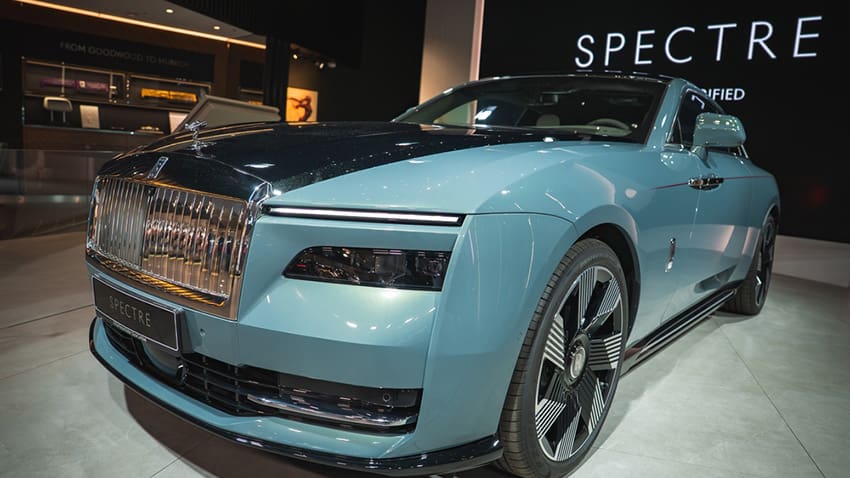
Rolls-Royce Motor Cars has abandoned its ambition to become a fully electric brand by 2030, marking a significant shift in strategy as the global transition to electric vehicles shows signs of slowing at the very top end of the automotive market.
The decision, confirmed by chief executive Chris Brownridge, reverses a high-profile commitment made in 2022 under his predecessor Torsten Müller-Ötvös, who had pledged that Rolls-Royce would cease production of its iconic V12 combustion engines by the end of the decade.
At the time, the company positioned its first electric model, the Spectre, as the beginning of a rapid transition, targeting 20 per cent of annual sales in the near term and as much as 70 per cent by 2028. The long-term ambition was clear: a complete shift away from internal combustion engines within eight years.
However, Brownridge has now acknowledged that the assumptions underpinning that strategy have changed materially. He pointed to a combination of softened customer appetite for fully electric luxury vehicles and a broader easing of regulatory pressure in key markets.
“For every client that loves an electric vehicle there is one who does not,” he said, underlining the continued demand among Rolls-Royce’s ultra-high-net-worth clientele for traditional powertrains. “Some clients do want an electric vehicle, we build what is ordered.”
The recalibration reflects a wider industry trend, particularly among premium and luxury manufacturers, where the pace of electrification is proving more uneven than previously anticipated. While mass-market brands continue to push towards electrification, high-end marques are increasingly adopting a more flexible, demand-led approach.
Brownridge was careful not to outline a revised electrification timeline, declining to specify new targets for zero-emission sales or confirm how many additional electric models Rolls-Royce plans to introduce. Nor did he disclose current sales performance for the Spectre, though its market reception has been closely watched as a bellwether for electric adoption in the luxury segment.
Instead, the emphasis appears to be shifting towards optionality rather than outright transition. The V12 engine, long synonymous with Rolls-Royce’s heritage and brand identity, will remain part of the company’s offering for the foreseeable future.
“The V12 is part of our history,” Brownridge said, suggesting that legacy and customer preference are now being given equal weight alongside environmental considerations.
The move comes amid a broader reassessment of electric vehicle strategies across the luxury automotive sector. Just a day earlier, Bentley confirmed that its own transition to an all-electric lineup would be delayed, with its first zero-emission model now expected at least two years later than originally planned.
Together, the announcements highlight a growing divergence between policy ambition and market reality. While governments continue to push for decarbonisation, including through bans on new petrol and diesel vehicles in the 2030s, manufacturers are increasingly signalling that consumer demand, particularly at the premium end, may not align neatly with those timelines.
Rolls-Royce’s original 2030 commitment was made at a time of strong political momentum behind electrification and rising optimism about battery technology, infrastructure rollout and customer adoption. Since then, a more complex picture has emerged, with concerns around charging infrastructure, range anxiety and the experiential differences between electric and combustion engines influencing buyer behaviour.
In the ultra-luxury segment, where emotional connection and heritage play a significant role in purchasing decisions, those factors appear to be even more pronounced.
Despite stepping back from a fixed deadline, Rolls-Royce is not abandoning electrification altogether. The Spectre remains a central part of its future portfolio, and the company is expected to continue investing in electric technology. However, the transition will now be paced according to customer demand rather than dictated by a hard deadline.
The shift underscores a broader reality facing the automotive industry: the road to electrification is unlikely to be linear. For Rolls-Royce, the strategy now appears to be one of balance, preserving its legacy while adapting to a changing, but still uncertain, future.
Paul Jones
Harvard alumni and former New York Times journalist. Editor of Business Matters for over 15 years, the UKs largest business magazine. I am also head of Capital Business Media’s automotive division working for clients such as Red Bull Racing, Honda, Aston Martin and Infiniti.



















































You must be logged in to post a comment Login