

Connect with us
DAPA Banner

Business

Essity AB (publ) 2025 Q4 – Results – Earnings Call Presentation (OTCMKTS:ETTYF) 2026-01-30

Published

on

OneWater Marine Inc. (ONEW) Q1 2026 Earnings Call Transcript

This article was written by

Seeking Alpha’s transcripts team is responsible for the development of all of our transcript-related projects. We currently publish thousands of quarterly earnings calls per quarter on our site and are continuing to grow and expand our coverage. The purpose of this profile is to allow us to share with our readers new transcript-related developments. Thanks, SA Transcripts Team

Continue Reading
Click to comment

You must be logged in to post a comment Login

Leave a Reply

Business

How to make the most of your Lifetime Isa

Published

on

How to make the most of your Lifetime Isa

Martin Lewis explains that you can use your Lifetime ISA to buy with someone who has already bought.

Continue Reading

Business

Petrofac deal cleared as HMRC drops challenge saving 2,000 North Sea jobs

Published

on

Petrofac deal cleared as HMRC drops challenge saving 2,000 North Sea jobs

More than 2,000 North Sea jobs have been safeguarded after HM Revenue & Customs agreed not to pursue further legal action against a restructuring deal involving Petrofac, clearing the way for the sale of its UK business to US engineering firm CB&I.

The decision removes a major obstacle that had threatened to derail the transaction and push Petrofac’s North Sea operations into insolvency, with potentially severe consequences for workers, supply chains and energy infrastructure.

HMRC had been seeking to recover more than £150 million from Petrofac relating to a long-running tax dispute, and had argued that the proposed debt restructuring was unfair because it would leave the tax authority with just £3 million, while other creditors stood to recover a greater proportion of their claims.

However, Scotland’s Court of Session rejected HMRC’s challenge earlier this month, and the tax authority has now confirmed it will not appeal that ruling. The move effectively clears the path for completion of the rescue deal, which is contingent on significant debt write-offs across the group.

Petrofac had warned that without swift resolution, its UK asset solutions division, which employs around 2,250 people and operates approximately 20 North Sea platforms, was at risk of running out of cash and collapsing.

Advertisement

Such an outcome would likely have triggered emergency contingency measures to maintain offshore operations, potentially leading to a break-up of the business and significant job losses.

The company, once a FTSE 100 constituent, employs around 8,000 people globally and has been under sustained pressure in recent years, grappling with a combination of legal issues, project delays and financial strain.

The asset solutions division had continued trading after Petrofac entered administration in October, and a deal was agreed in December to sell the business to CB&I.

The transaction is seen as a viable route to preserve operations and employment, while providing a stable long-term owner for the business.

Advertisement

Petrofac said it is now focused on completing the sale “as soon as possible”, describing CB&I as “an excellent fit” that offers a positive outcome for both the company and its workforce.

In his judgment, Lord Sandison criticised HMRC’s handling of the case, highlighting delays in pursuing the tax claim, which dates back to alleged avoidance issues between 1999 and 2014, allegations Petrofac denies.

The judge noted that the liability was not formally assessed until 2020 and was not scheduled for tribunal determination until 2025, describing the pace of enforcement as “very leisurely”.

He concluded that HMRC’s position in 2026 was due “at least as much to its own inaction” as to the restructuring itself, suggesting the dispute could have been resolved much earlier.

Advertisement

The resolution of the case underscores the delicate balance between creditor rights and the need to preserve viable businesses and jobs in complex restructurings.

For the UK’s energy sector, the outcome is particularly significant. Petrofac’s North Sea operations play a critical role in maintaining offshore infrastructure, and disruption could have had wider implications for production and supply chains.

The case also highlights the challenges facing companies in the oil and gas services industry, which has been navigating a difficult period marked by regulatory scrutiny, shifting energy policies and financial pressures.

With the legal uncertainty now removed, attention will turn to finalising the sale and stabilising operations under new ownership.

Advertisement

For workers and stakeholders, the decision represents a reprieve after months of uncertainty. For Petrofac, it marks a crucial step in its restructuring process.

And for policymakers and regulators, the case serves as a reminder of the importance of timely intervention, and the potential consequences when disputes drag on in critical sectors of the economy.


Amy Ingham

Amy is a newly qualified journalist specialising in business journalism at Business Matters with responsibility for news content for what is now the UK’s largest print and online source of current business news.

Advertisement

Continue Reading

Business

Concerns over ‘lucrative’ plan for Wirral homes as campaigners vow to keep up greenbelt fight

Published

on

Business Live

Barratt Homes says scheme will provide jobs for people locally and provide new housing for ‘range of social and demographic groups’

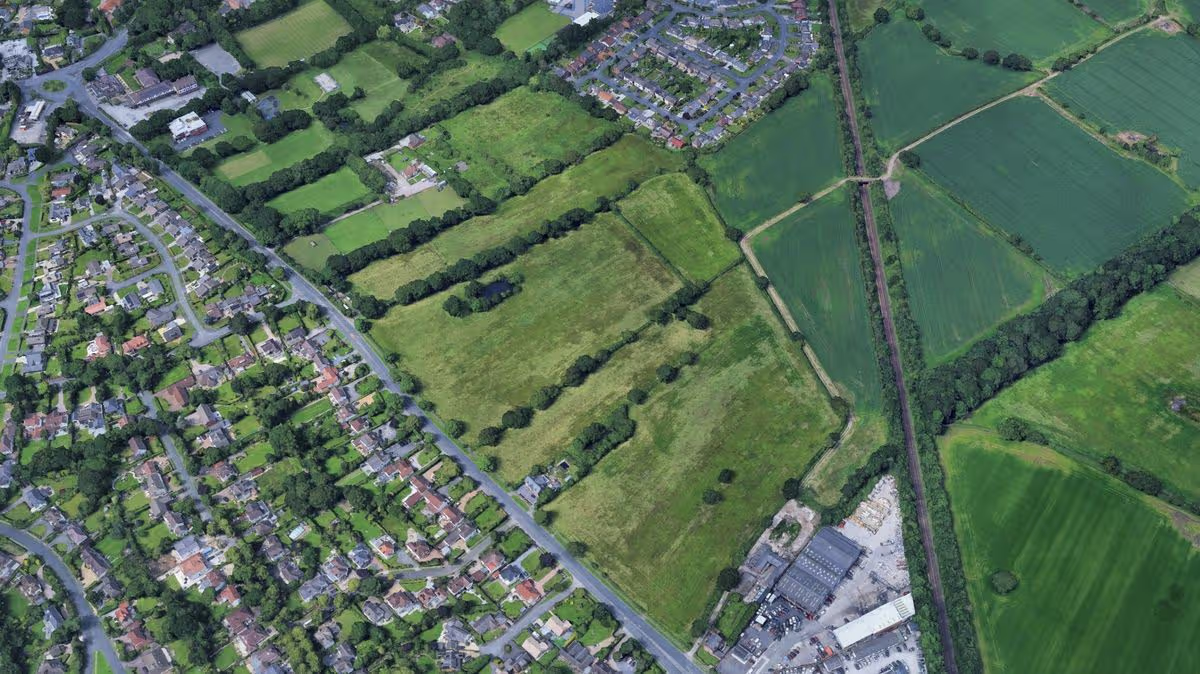
The Heswall site that could be developed by Barratt Homes.

The Heswall site that could be developed by Barratt Homes(Image: Google Maps)

Hundreds of homes could be built next to a Wirral town where properties “aren’t actually affordable to the normal person”. The developer behind the plans has been accused of “testing the waters” over the “lucrative” site.

Advertisement

Barratt Homes has approached Wirral Council to ask whether a environmental assessment is needed for plans to build up to 300 homes off Chester Road to the south of Heswall. The developer does not see this as necessary for any future planning application and said it has provided information to the local authority to back this up.

Documents put forward by the developer highlight the site’s “mature trees” as well as the site’s grassland and farmland used to grow cereal crops. However it said the application is not next “to an environmentally sensitive area” with low risk of flooding and surveys showed little evidence of wintering or breeding birds.

Barratt Homes said the plans will include cycle and footpaths, open space and play areas, as well as efforts made to protect existing trees and hedges. The plan would be for the homes to be built within six years if approved.

The developer does not consider the plans “to be out of scale” given its close location to Heswall. There are also plans to include affordable housing which would likely be sold at 20% of the market rate.

Advertisement

Heswall is one of the wealthiest areas in Wirral with an average house price of £488,645. Detached houses in the area sell on average for £632,015.

The early stage plans have already prompted concerns in the Wirral town. Community organisation the Heswall Society already say they are against the plans.

Steve Anderson said their group’s position was “there should be no building on greenbelt land unless it’s necessary”. He said this was not the case in Wirral because of the council’s Local Plan which only includes development on brownfield land.

The Local Plan is a strategic document outlining where the council thinks developments should happen across the borough. Thousands of homes are included with a focus on regeneration in deprived areas such as Birkenhead, Seacombe and Bromborough.

Advertisement

He said Barratt Homes really needed to answer why it was putting the plans forward, adding: “My guess is they are trying to test whether the council really does have a housing supply.

“As soon as there is any weakness there, the developers will want to develop on the green belt. It’s maybe testing the waters, I do not know.”

Mr Anderson feels work needs to be done to assess the environmental impact of any plans including potentially ancient trees on the site as well as heritage buildings nearby.

He added: “It’s certainly a very lucrative site for a builder. When they talk about building affordable houses, all the houses maybe meet the government definition of affordable but they aren’t actually affordable to the normal person.”

Advertisement

The Barratt Homes application said the development would provide jobs for people locally and provide new housing for “a range of social and demographic groups” that would support the government’s aim to build 1.5m homes across the country.

The developer said: “The proposed development will help to tackle the ongoing housing crisis at a local level, although it is recognised that this is a national problem that the current government are desperate to resolve.”

It added: “There will be a limited number of people who will be affected by this proposal, mainly by landscape and visual impacts.” The site is also considered “relatively small and self-contained” and would be unlikely “to lead to the loss of a significant amount of additional green belt land beyond its boundaries”.

Barratt Homes was approached for comment.

Advertisement

To find all the planning applications, traffic diversions, road layout changes, alcohol licence applications and more in your community, visit the Public Notices Portal.

Continue Reading

Business

Volkswagen’s biggest investor increases defence focus after earnings slump

Published

on

Volkswagen’s biggest investor increases defence focus after earnings slump


Volkswagen’s biggest investor increases defence focus after earnings slump

Continue Reading

Business

Next profits jump 15% but retailer warns Iran war could push up prices

Published

on

Business Live

The high street giant faces £15m in costs from the Middle East conflict and warns prices may rise if disruption continues, as it announces Yorkshire warehouse expansion

A Next store

Next is developing a new warehouse near Wakefield

High street giant Next has revealed it will absorb a £15m blow from the surging air freight and fuel costs triggered by the Iran conflict, as it scrambles to identify savings elsewhere to counterbalance the expenses.

Advertisement

The FTSE 100 retailer said it anticipates the conflict will restrict its expansion in the Middle East, which represents six per cent of its turnover, and will affect costs, pricing and consumer demand throughout the entire business.

Next recorded £1.2bn in pre-tax profit for the year to January 2026, an increase of 15 per cent from the previous year, as sales climbed 11 per cent to £7bn.

The retailer stated it has factored in £15m – offset by savings elsewhere – on the assumption that disruption from the Middle East conflict continues for three months. However, it cautioned that prices would need to rise if the hostilities persisted any longer, as reported by City AM.

The firm stated: “At this point, the longer term implications of the conflict are uncertain, and NEXT is not well placed to make predictions. “

Advertisement

“Much will depend on how long the conflict persists, and how much permanent damage is done to the world’s energy infrastructure.”

The company reports the conflict is already damaging its sales, attributing its shortfall against its 16.5 per cent international sales growth guidance to disruption in the Middle East.

Sales in the Middle East will remain below projections for at least the remainder of the first half of the year, Next indicated.

The retailer experienced £75m in cost increases over the past year, with national insurance and wage rises, higher interest costs and an increased marketing spend contributing to the £15m impact from the Middle East conflict.

Advertisement

Next said it achieved £57m in savings last year, including £39m from returning employee bonuses to standard levels.

The firm’s profit from its retail stores fell five per cent to £193m despite rising sales (up 2.4 per cent), which the company attributed to increased employment costs.

Retail leaders have warned the rise in national insurance contributions and minimum wage levels is placing pressure on recruitment, as bosses prepare for additional costs when Labour’s workers’ rights reforms take effect this year.

Next said its overall profit growth was partly driven by expansion of its international business, with global sales increasing 35 per cent – significantly faster than the UK’s seven per cent.

Advertisement

While many retail giants rush to incorporate AI-powered shopping into their systems, Next has said it will not develop a central artificial intelligence function.

The firm said: “The benefits AI can bring to software development, range development, customer service and warehouse operations are so varied, and their challenges so different, that generic advice from a central function would be little more use than a central Spreadsheet Department.”

The retailer stated that its investment in fresh and recently-acquired brands is fuelling growth, and announced it has received planning permission for a 1.2m sq foot warehouse in Elmsall, Wakefield, which it believes could contribute £2.5bn to UK sales.

In January, Next acquired high-street footwear retailer Russell & Bromley, adding to recent purchases including vintage-inspired retailer Cath Kidston and clothing brand Joules.

Advertisement

Next’s chairman, Michael Roney, revealed his contract has been extended by the board, as he announced the departure of two board members: Jane Shields and Jonathan Bewes.

Continue Reading

Business

Family offices make opportunistic bets on real estate

Published

on

Family offices make opportunistic bets on real estate

Colorful epic aerial panorama of San Francisco skyline downtown with business building skyscraper and waterfront at twilight in California, USA.

Prasit Photo | Moment | Getty Images

A version of this article first appeared in CNBC’s Inside Wealth newsletter with Robert Frank, a weekly guide to the high-net-worth investor and consumer. Sign up to receive future editions, straight to your inbox.

Advertisement

Private investment firms of the ultra wealthy are snapping up domestic real estate as the market’s recovery continues to stall, family-office investors told Inside Wealth.

While persistently high interest rates and geopolitical conflicts have many investors sitting on the sidelines, family offices can afford to make opportunistic bets as they invest for the long haul.

Travis King, CEO of Realm, said the collective of some 100 families has invested about $100 million in Northern California real estate in the past six months. Realm has seized on bargains, such as buying an office property in San Francisco at about 21% of what it last traded for and what it could cost to build it today.

“We looked at it said, ‘Hey, San Francisco has been beaten up, but we believe that tech is going to continue to be a very robust environment, and we continue to believe that that’s going to be the main driver of the U.S. economy going forward. We don’t think San Francisco is going anywhere,’” he said. “It seems like that call is accurate, based on the fact that we’re now trading paper on either leases or purchase and sale agreements on several of these properties.”

Advertisement

King said some families are nervous about deploying their money during these turbulent times, but that more are interested in taking advantage of low valuations.

“It’s a difficult time to live through, just as a citizen, but it’s an interesting time as an investor, because that’s the time that makes it the best pricing,” he said.

Matthew Cohen, partner at Declaration Partners, the investment firm anchored by Carlyle billionaire David Rubenstein’s family office, said the firm’s long investment horizon allows it to seize opportunities that traditional asset managers cannot.

Declaration Partners closed its second real estate investing fund in October, raising about $303 million. It has made a flurry of deals in recent months, such as inking a $50.1 million master lease for three storefronts in New York City’s SoHo. While the tenants’ current rents are below market rates, Declaration Partners’ lease spans 25 years, with an option to extend to 2091.

Advertisement

“A lot of institutional funds look at opportunities like that and say, ‘If I can’t execute a business plan in a year and a half or in two years or three years, that’s not quick enough,’” Cohen said. “It required somebody who had the longer-term perspective to say, ‘I’m willing to hold longer term to wait out the expirations of those leases,’ and the patience and flexibility to work with a private owner to come up with a structure that was mutually beneficial.”

Get Inside Wealth directly to your inbox

Family office surveys have indicated ambivalence toward real estate investing, but those in the U.S. have been more optimistic.

A J.P. Morgan Private Bank poll, released in February, found 35% of U.S. family offices planned to increase their exposure to real estate, while only 24% of their international peers said the same. A whopping 40% of respondents also reported no allocation to real estate.

However, family offices that cited inflation as the top risk to their portfolios reported an average 16.3% allocation to real estate, twice that of the general respondent pool.

Advertisement

“Any time inflation becomes an issue, people start investing in things that they can see and touch,” said Cozen O’Connor real estate lawyer Jennifer Nellany.

Jason Ozur, CEO of wealth manager Lido Advisors, said that even with low acquisition prices, investors have to heed many factors, like leverage costs and rising insurance costs, to beat inflation. Lido Advisors has been able to invest in attractive multifamily properties at 20% to 30% discounts to replacement costs, he said. The firm is focused on major cities like Salt Lake City, Denver and Dallas, he added.

Ozur said cash flow and portfolio diversification are stronger draws for clients to invest in real estate. He also described real estate as a tax-efficient asset, citing strategies such as depreciation deductions and 1031 exchanges, which allow real estate investors to defer capital gains by reinvesting gains in a like-kind property. Clients can also gift real estate to their children at discounted values over time, he said.

As for data centers, the hottest asset class in commercial real estate, Nellany said family offices find it hard to invest at attractive price points. She also said that some family offices, especially those with a philanthropic bent, are concerned about the environmental impact of data centers.

Advertisement

Real estate investor Chaz Lazarian is doubling down on office real estate, often considered the least attractive area of commercial real estate, through his firm, Elle Family Office.

Lazarian said he snaps up distressed assets at severe discounts. He said he acquired the former Home Depot headquarters building in Atlanta and its debt for about $21 million, paying about 18 cents on the dollar when he acquired it in October compared with what its private equity owner paid in 2019.

While that property has been kept as an office building, he has razed others to build multifamily housing. Unlike many family office principals, Lazarian does not invest for the long term, aiming to flip properties in two to three years.

“I think generational wealth can be created by taking some risks,” he said. “This opportunity didn’t exist in 2007, 2008, and we just want to rinse and repeat as many times as we can until the market dries up.”

Advertisement
Choose CNBC as your preferred source on Google and never miss a moment from the most trusted name in business news.
Continue Reading

Business

'A game-changing moment for social media' – what next for big tech after landmark addiction verdict?

Published

on

'A game-changing moment for social media' - what next for big tech after landmark addiction verdict?

The ruling could be the beginning of the end of social media as we know it, writes the BBC’s technology editor Zoe Kleinman.

Continue Reading

Business

DroneShield Soars 19% to Lead ASX 200 Gainers

Published

on

5 Biggest Gainers in the S&P/ASX 200 Today: DroneShield Soars

SYDNEY — Defence technology company DroneShield Ltd led the S&P/ASX 200’s biggest gainers on Wednesday, surging 19.33% to close at A$4.26 as investors piled into counter-drone and resources names amid ongoing uncertainty from the US-Iran conflict and broader commodity movements.

5 Biggest Gainers in the S&P/ASX 200 Today: DroneShield Soars
5 Biggest Gainers in the S&P/ASX 200 Today: DroneShield Soars 19% to Lead ASX 200 Gainers

The benchmark index recovered strongly, rising 1.85% to close at 8,534.3 points after earlier weakness tied to oil price volatility and global risk sentiment. While the broader market showed mixed performance, select stocks in defence, nuclear technology and critical minerals posted double-digit gains, reflecting themes of geopolitical hedging and supply chain security.

Here are the five biggest percentage gainers among ASX 200 constituents on March 25, 2026, based on closing prices and trading data:

1. DroneShield Ltd (ASX: DRO) — Shares exploded 19.33% higher to A$4.26. The counter-drone specialist benefited from heightened global security concerns and potential increased demand for its systems amid Middle East tensions. Trading volume was robust, with the stock attracting strong retail and institutional interest as investors sought exposure to defence technology plays.

2. Silex Systems Ltd (ASX: SLX) — The nuclear technology and enrichment company jumped 13.50% to A$5.55. Silex has been linked to advanced uranium processing capabilities, drawing attention as energy security and alternative fuel sources gain focus amid oil market disruptions. The stock has been volatile but found support from positive sector sentiment.

Advertisement

3. Vulcan Energy Resources Ltd (ASX: VUL) — Lithium and geothermal energy developer Vulcan rose 11.90% to A$3.29. The company’s zero-carbon lithium extraction projects in Europe and Australia appealed to investors betting on long-term critical minerals demand, even as short-term oil shocks dominated headlines.

4. Liontown Ltd (ASX: LTR) — The lithium miner gained 11.61% to A$1.73. Liontown’s Kathleen Valley project in Western Australia continues to progress, and the stock benefited from renewed interest in battery metals amid expectations of sustained electric vehicle and energy storage growth despite near-term economic headwinds.

5. Bellevue Gold Ltd (ASX: BGL) — Gold producer Bellevue climbed 11.07% to A$1.41. Safe-haven demand for gold provided some support, though the stock’s strong move also reflected company-specific developments and broader resources sector rotation on the day.

The session highlighted a clear rotation into defence and select resources names. DroneShield’s outsized gain stood out, with analysts noting the company’s technology could see increased adoption as nations bolster defences against drone threats in unstable regions. The stock has been a strong performer in recent months but remains volatile given its smaller size and sector exposure.

Advertisement

Silex Systems and Vulcan Energy underscored ongoing interest in energy transition and security themes. While the immediate focus remains on oil and traditional energy prices, longer-term bets on nuclear, lithium and critical minerals continued to attract capital. Liontown and Bellevue added to the resources flavour, with gold providing some defensive characteristics amid uncertainty.

Broader market context showed the ASX 200 rebounding from recent pressure linked to the Middle East conflict. Oil price volatility had weighed on sentiment earlier in the week, but signs of potential diplomatic progress or contained escalation helped lift risk appetite on Wednesday. Materials and industrials sectors outperformed, while financials and consumer stocks were more mixed.

Trading volume across the ASX 200 was solid, reflecting active participation from both institutional and retail investors. Defence and technology-related names saw particularly elevated turnover as traders repositioned portfolios in response to geopolitical developments.

For investors, the day’s movers illustrate how specific sectors can decouple from broader indices during periods of uncertainty. Defence stocks like DroneShield often rally on heightened global tensions, while resources companies can benefit from both commodity price swings and long-term thematic investing in energy transition.

Advertisement

Analysts caution that single-day moves can be volatile and driven by short-term catalysts rather than fundamental shifts. DroneShield, for instance, has a history of sharp swings tied to contract news or sector sentiment. Similarly, lithium and gold stocks remain sensitive to global economic outlooks, interest rates and supply-demand dynamics.

Looking ahead, attention will turn to further developments in the Middle East and any impact on commodity prices. A prolonged conflict could sustain volatility across resources and defence sectors, while a quick resolution might see profit-taking in recently strong names.

Australian investors should consider portfolio diversification and risk tolerance when evaluating these high-performing stocks. Many of the day’s top gainers carry higher volatility than the broader index, making them suitable for those comfortable with short-term price swings.

The ASX 200’s performance on March 25 provided a welcome lift after recent pressure, but underlying uncertainties from global events mean caution remains warranted. As always, past performance is no guarantee of future results, and investors are advised to conduct their own research or consult professional advisers.

Advertisement
Continue Reading

Business

10 Essential Things You Must Know to Use Starlink in Australia in 2026: From Setup to Roaming

Published

on

Illustration shows Starlink logo and Ukraine flag

SYDNEY — Starlink, SpaceX’s satellite internet service, has transformed connectivity for thousands of Australians in remote, regional and rural areas where traditional NBN or fixed broadband falls short. With flexible plans starting at A$69 per month for a 100 Mbps tier and hardware options including the Standard kit and portable Starlink Mini, the service continues to expand rapidly across the country in 2026. Whether you’re a homeowner, caravan traveller or business operator, mastering the basics ensures reliable high-speed internet from virtually anywhere with a clear view of the sky.

Illustration shows Starlink logo and Ukraine flag

Here are 10 key things every Australian user needs to know to get the most out of Starlink.

1. Check Availability and Choose the Right Plan Before ordering, enter your address on the Starlink website (starlink.com/au) to confirm service availability. In 2026, Starlink offers tiered residential plans in Australia: the Residential 100 Mbps plan at A$69 per month (capped speeds typically 80-100 Mbps down), the Residential 200 Mbps plan at A$99 per month, and the uncapped Residential Max at A$139 per month. Unlimited data applies across plans, but priority data varies. Roam plans for travel start higher, with options including a low-cost Standby Mode for occasional use. Telstra also resells Starlink with its own pricing. No long-term contracts in most cases, but some discounted hardware deals require 12-month commitments.

2. Order the Right Hardware Kit The Standard kit (Gen 3) includes the rectangular dish, kickstand or mount options, Gen 3 router and cables. In select areas, hardware may be offered with no upfront cost on certain plans. The portable Starlink Mini is ideal for RVs or travel, with its own compact dish and lower power draw. Expect shipping fees around A$19. Kits arrive quickly in most regions. Choose permanent mounts for home use or mobile mounts for vehicles/caravans.

3. Download the Starlink App First The free Starlink app (available on iOS and Android) is essential. Use it before unboxing to check for obstructions at your intended installation site via the augmented reality “Check for Obstructions” tool. The app also handles account setup, Wi-Fi configuration, speed tests, firmware updates and troubleshooting. Keep it installed for ongoing monitoring of signal strength, outages and statistics.

Advertisement

4. Find an Optimal Installation Location Starlink requires a clear, unobstructed view of the northern sky (in Australia) for the best connection to the satellite constellation. Use the app’s obstruction scanner to identify the ideal spot — rooftops, poles or open ground work well. Avoid trees, buildings or hills that block the view. For permanent home setups, professional installers are recommended for roof mounting to ensure safety and compliance with local regulations. DIY is possible but requires care with cabling and weatherproofing.

5. Perform the Physical Setup Unbox the kit carefully. For the Standard dish, attach the cable to the dish, mount it on the kickstand or permanent bracket, and position it outdoors facing roughly north with a clear sky view. Run the cable indoors to the Gen 3 router. Plug the router into power. The dish will automatically search for satellites (stow and align features help). The process typically takes 15-30 minutes. For Starlink Mini, the setup is even simpler with its integrated kickstand.

6. Complete Activation and Wi-Fi Setup Once powered on, connect your phone to the Starlink Wi-Fi network (default password on the router or in the app). Open the Starlink app to activate the service, update firmware and customise your network name and password. The system may take 10-20 minutes to achieve full connectivity as it aligns with satellites. Run a speed test in the app to verify performance — expect 50-250+ Mbps download depending on plan, location and network load.

7. Understand Performance and Limitations Starlink delivers low-latency broadband (typically 20-60 ms) suitable for streaming, video calls, online gaming and remote work. Speeds vary by plan tier, time of day and obstructions. In Australia, performance is generally strong in open regional areas but can be affected by heavy rain (rain fade) or dense foliage. The service includes unlimited data, but very high usage may trigger temporary deprioritisation during congestion. Roam users on mobile plans can take the dish anywhere in Australia with coverage.

Advertisement

8. Comply with Australian Regulations and Safety Starlink installations must follow Australian building and electrical codes. Professional installers are often required for roof or elevated mounts to ensure structural safety and compliance with local council rules. Cabling must be properly weatherproofed. Starlink is approved for use in Australia, but users in strata properties or rentals may need body corporate or landlord approval. For vehicles and vessels, ensure mounts comply with road or maritime safety standards.

9. Optimise for Travel and Mobile Use Starlink excels for caravans, RVs and remote work. Use the Starlink Mini or Standard with a mobile/roam plan. Secure the dish with vehicle-specific mounts to handle vibrations and wind. Power solutions include 12V inverters or portable batteries. The app’s obstruction checker helps find clear spots at campsites. Standby Mode offers a low-cost pause option for occasional travellers. Real-world users report reliable connectivity across much of Australia, including remote outback areas.

10. Troubleshoot and Maintain Your System Common issues include obstructions (use the app to scan), poor cable connections or firmware needing updates. The app provides detailed diagnostics and support tickets. Keep the dish clear of snow, heavy rain or debris. For long-term reliability, consider professional mounting and surge protection. Starlink support is available via the app or website. Firmware updates happen automatically and often improve performance.

Starlink has become a game-changer for Australians in areas with poor terrestrial broadband, delivering city-like speeds to the bush. With tiered pricing making it more accessible in 2026 and ongoing improvements in coverage and hardware, proper setup and usage are key to unlocking its full potential. Always check the official Starlink website or app for the latest plans, availability and guides specific to your location.

Advertisement
Continue Reading

Business

THG shares up as firm returns to profit with TikTok Shop growth

Published

on

Business Live

North West beauty and nutrition retailer saw TikTok Shop sales more than double

THG has rebranded its Myprotein business

THG brands include Myprotein (Image: THG)

THG shares surged on Thursday after the e-commerce company swung back to profit, with pre-tax earnings surpassing market expectations.

Advertisement

The Manchester beauty and nutrition retailer reported profit after tax of £54.1m for 2025, reversing a loss of £326m the previous year, boosted by securing £103m from the sale of ingredients business Claremont in August.

TikTok Shop proved a key driver of the company’s growth, with sales on the platform more than doubling compared with 2024 after online beauty store Lookfantastic became the top-selling multi-brand beauty retailer on the social media platform.

Meanwhile, THG Nutrition’s sales growth was driven by increasing awareness of bodybuilding supplement Myprotein, with products now stocked in over 40,000 stores globally, and new licensing partnerships with global confectionery brand Mars.

The London-listed business is forecasting mid-to-high single digit revenue growth in its nutrition division with “strong underlying growth” in sales of beauty products, as reported by City AM.

Advertisement

The company could be in line for a windfall of as much as £78m if it wins a claim with HMRC over the VAT treatment of its protein powder.

Chief executive Matt Moulding said: “Our 21st year in business has been a ‘coming of age’ moment: A year of accelerating momentum, marked by a return to continuing CCY revenue growth, decisive strategic actions, and a clear validation of our long-term vision.

“We have simplified our structure, sharpened our focus on our key territories and brands, and strengthened our financial foundations.”

THG shares rose 8.3 per cent to 34.1p in the early moments of trading on Thursday. THG plc was the owner of City AM until its Ingenuity division separated from the wider group at the beginning of 2025.

Advertisement
Continue Reading

Trending

Copyright © 2025