
Business
EXCLUSIVE: Saudi Global Ports unveils $933m expansion to challenge UAE transshipment dominance

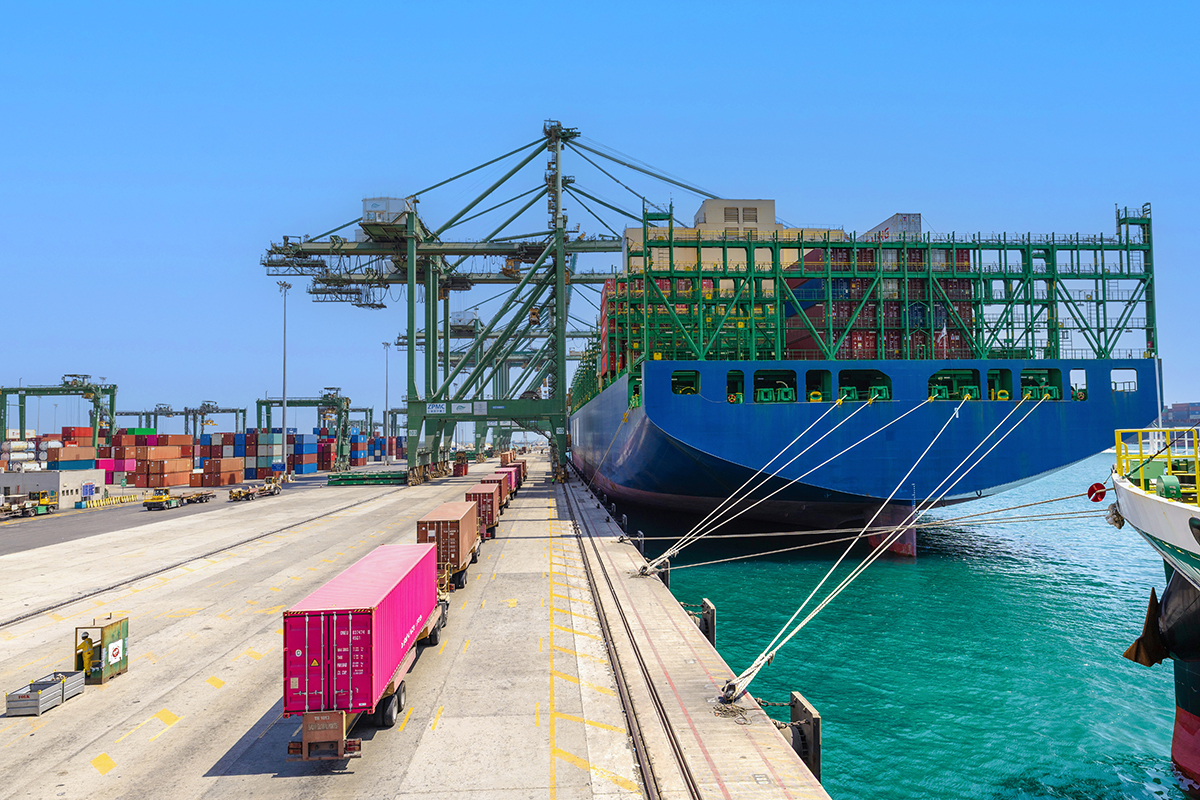
Saudi Global Ports is investing 3.5 billion Saudi riyals ($933 million) over the next five years as part of a strategic push to capture gateway cargo that has traditionally flowed through Jebel Ali and Abu Dhabi.
The operator of Dammam port is ploughing funds into container terminals, multi-purpose facilities and a new integrated logistics zone to exploit geographic advantages over Emirati rivals as the kingdom’s non-oil economy expands.
Chief executive Rob Harrison told Arabian Business the investment represents phase three in the company’s evolution from port operator to ecosystem developer, positioning Saudi Global Ports to serve the kingdom’s 36 million consumers more directly than transshipment-focused competitors.
“We don’t see the need to create ourselves as a transshipment hub,” Harrison said. “As long as we can continue to build out this ecosystem and the ecosystem can compete with the likes of the neighbouring operators, we’re going to continue to see growth because that volume is eventually going to find its way through the market.”
The geographic advantages are obvious: Dammam sits 400 kilometres from Riyadh compared with 1,000 kilometres from Jeddah on the Red Sea coast. Cargo routed through Jebel Ali or Abu Dhabi also faces a 1,000-kilometre journey plus a border crossing to reach the capital.
Saudi Global Ports operates rail connectivity, sending five to seven trains daily between Dammam and two Riyadh locations. “Riyadh is squarely part of our market,” Harrison said. “We’re very closely linked to the non-oil and gas transition of the kingdom, particularly from Riyadh east.”
Harrison said the company is allocating two billion riyals to container terminals, which are projected to generate 80 per cent to 85 per cent of revenues. A further 665 million riyals will upgrade equipment at multi-purpose terminals, while 670 million riyals – earmarked to rise to one billion – will develop the Dammam integrated logistics zone.
The logistics zone will deliver 300,000 square metres of Grade A warehousing in its first phase over the next 18 months, creating what Harrison described as a free zone to compete with established Emirati ecosystems.
“We’re emulating that to an extent,” he said, acknowledging the success of Jebel Ali and Abu Dhabi in building regional logistics hubs. “They’ve done a great job, amazing. They really have led the world in being able to create an ecosystem that can add value.”
The investment comes as the Red Sea crisis provided an unexpected proof of concept for Saudi Global Ports’ strategy. The operator ran at 122 per cent capacity throughout 2024 as container ships diverted around the Cape of Good Hope to avoid Houthi attacks, forcing cargo owners to redesign supply chains.
“We’ve benefited from having more volume but the real strategic benefit is that we’ve been able to show we are a viable supply chain routing,” Harrison said. “That’s giving assurance that the kingdom can service them if there’s a problem, so they have an alternative route.”
Logistics providers established warehouses on the east coast and in Riyadh, routing containers through Dammam via rail rather than through Jeddah or UAE ports. Harrison said the company does not expect all volume to remain when the Red Sea reopens but believes a significant portion will continue flowing through Dammam.
The operator finished a major expansion phase in October, increasing capacity to 3.5 million twenty-foot equivalent units and doubling its capability to handle the largest container vessels afloat. Two berths can now simultaneously accommodate 24,000 TEU ships.
“We’ve reached the stage now where the port itself is a port of scale,” Harrison said. “There’s not many ports in the world that handle over three million containers as a gateway port.”
Saudi Global Ports has expanded from 1,200 to nearly 4,000 direct employees after taking control of the Riyadh dry port ecosystem in 2022, the integrated logistics zone in 2024 and four multi-purpose terminals on the east coast in July 2024. Including contractors and third parties, the operation now employs over 5,000 people.
Harrison said he expected the company to finish 2025 operating in the high 90s percentage of capacity.
He added the fundamentals underpinning long-term growth remain robust. Time-bound megaprojects including Expo 2030, the World Cup and Asian Cup will drive demand, while ongoing infrastructure investment by Aramco, Sabic and other corporates would support the non-oil diversification central to Vision 2030.
Saudi Global Ports is 51 per cent owned by PIF.



