Connect with us

Business

FCA to publish London share trading data to defend UK market liquidity

Published

on

Business Live

City watchdog plans to collect and share all available share trading data

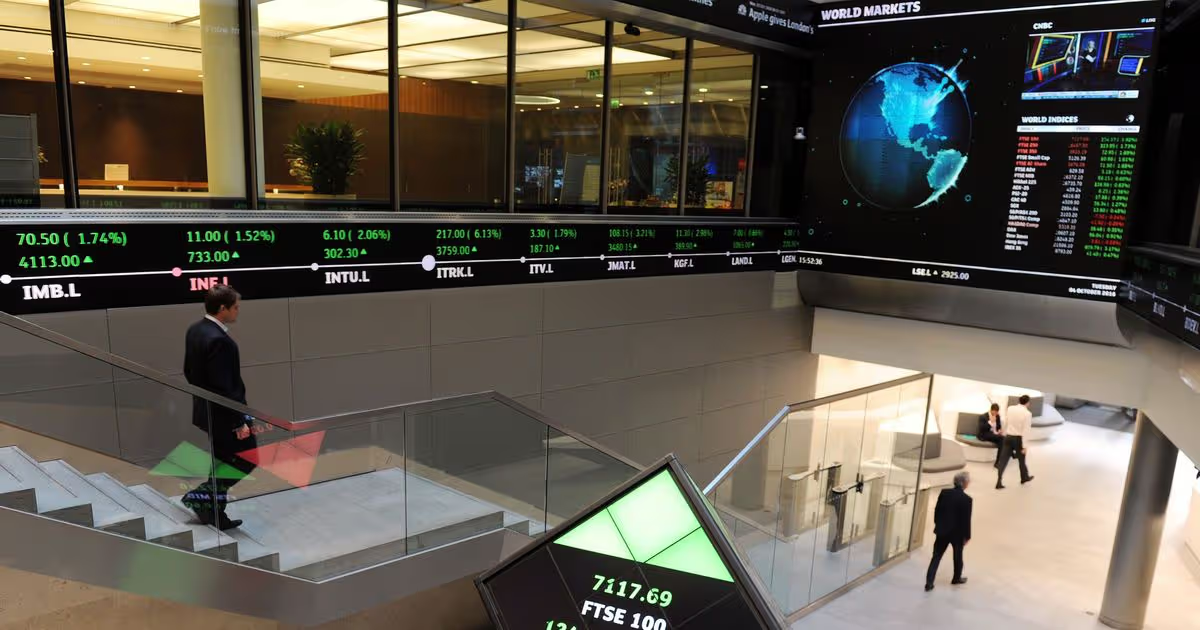
Stairway Inside the London Stock Exchange

Some companies have criticised the UK’s perceived lack of liquidity(Image: PA Archive/PA Images)

The City regulator is set to begin gathering and disclosing all accessible data on share-trading in a bid to demonstrate that liquidity in UK public markets is not as poor as often perceived.

These plans will serve as an interim measure until the Financial Conduct Authority (FCA) releases its ‘consolidated tape’ of trading data next year, which will amalgamate data from various platforms.

“The truth is we have way more liquidity here than is often reported, and that is just silly,” Simon Walls, interim director of markets at the FCA told the Financial Times in an interview.

“We are talking to loads of parties at the moment about whether the FCA can, at a little bit of risk to ourselves, step in and just sort this out.”

Advertisement

Current liquidity estimates are based on the London Stock Exchange’s central limit order book, but this overlooks periodic trades at the LSE – where companies must wait until the end of a scheduled auction period for the transaction to be finalised – as well as trading on dark pools, as reported by City AM.

Dark pools are private trading venues that enable large trades to be executed without publicly revealing information before the trade is completed, helping to minimise the impact on the broader market.

From January to September last year, 270m transactions were logged in the LSE’s data, but the FCA believes the total number of trades could be four times larger.

Numerous companies have cited the UK’s perceived lack of liquidity as a reason for changing their listing. For instance, in 2024, Flutter Entertainment stated it could tap into “the world’s deepest and most liquid capital markets” in New York, while Tui revealed that less than a quarter of its share trading occurred in London compared to Frankfurt, where it also has a listing.

Advertisement

“People in the market know this (the under-reporting) is a problem,” said Walls. “But it does dog us because sometimes when an issuer has historically chosen to move from the UK to the US, one of the thoughts is that liquidity is lower in the UK and often it’s not true.”

Over the past year, the FCA has been distributing a ‘myth-busting’ document asserting that actual liquidity across FTSE indices is on par with the S&P 500 and the Nasdaq 100.

This initiative is the latest effort in recent years to rejuvenate the UK’s public markets following a challenging period. In 2024, approximately 88 firms either completely delisted or shifted their primary listing away from the UK.

Advertisement
Continue Reading
Click to comment

Leave a Reply

Your email address will not be published. Required fields are marked *

Business

Peter Kyle urges SMEs to take leap into exporting

Published

on

Peter Kyle urges SMEs to take leap into exporting

The business secretary, Peter Kyle, has urged small businesses to rediscover Britain’s exporting spirit, calling on entrepreneurs to take a “leap of faith” and start selling overseas with the backing of government finance and advice.

Speaking to an audience of small business owners at the UK Trade and Export Finance Forum in London last week, Kyle warned that the UK was losing momentum as an exporting nation. Official figures show that the proportion of UK companies that have ever exported has fallen from 45 per cent to 38 per cent in recent years.

Kyle said reversing that trend was a priority for the government, arguing that international demand for British goods and services remains strong. Drawing on recent visits to China, Japan and the World Economic Forum in Davos, he told delegates there was a “great thirst for Britain”.

“I accept that exporting for the first time is different, it’s difficult and it’s novel,” he said. “Anything that’s novel takes a bit of getting used to and a bit of confidence and enthusiasm to jump into. Sometimes it takes a leap of faith.”

Kyle suggested many SMEs underestimate both the level of overseas demand and the support available to help them expand internationally. He pointed to the £11 billion trade finance lending package announced at the end of January, funded through the balance sheets of five major high street banks.

Advertisement

Under the scheme, UK Export Finance will guarantee up to 80 per cent of loans, while also providing advisory support to help businesses navigate international markets.

“I understand that the world looks intimidating at the moment,” Kyle said. “I’m not sitting here saying everything’s perfect. But what investors are seeing is the right direction of travel.”

However, business groups warned that encouragement alone would not be enough. Tina McKenzie, policy chair at the Federation of Small Businesses, said many small firms were willing to take the risk of exporting — but only if the government improved its offer.

“Small businesses need clear, practical help to navigate trade rules, paperwork and market access, particularly when trading with the EU and beyond,” she said. “If we want more firms to export, policy needs to make it simpler, cheaper and more predictable, so businesses can take that step with confidence rather than crossing their fingers.”

Advertisement

On stage, Kyle highlighted four trade agreements signed since the government took office, with India, China, the US and the Comprehensive and Progressive Agreement for Trans-Pacific Partnership, arguing they provided a foundation of stability. But he acknowledged that signing deals was only the beginning.

“It takes time to get goods flowing and services delivered,” he said. “And it takes a while to get the legal aspects nailed down so the agreements can be fully enforced.”

Some business leaders questioned how much smaller firms would really benefit. Simon Holloway, commercial director at Dynisma, a Bristol-based developer of simulators for Formula 1 drivers, said the complexity of trade deals often left SMEs struggling to engage.

“We don’t have time to figure out what is going on,” he said. “We’re running 100 miles an hour trying to scale our businesses and secure jobs.”

Advertisement

Tim Reid, chief executive of UK Export Finance, accepted that awareness remained a challenge. “Small businesses are good with ideas, but short on time,” he said. “We need to make it as easy as possible for them.”

Despite the obstacles, Kyle argued that periods of uncertainty could also create opportunity. “Be bold and confident in yourself, your skills and fundamentally the products and services your business offers,” he said.

Some companies are already doing just that. Urban Apothecary, a Leicester-based home fragrance brand, now sells into 35 countries. Liz Ripley, its head of global partnerships, said using distributors had helped the business manage risk, with support from the Department for Business and Trade helping it enter new markets such as South Korea.

Paul Sopher, director at Joe & Seph’s, which exports its artisan popcorn from north London to 19 countries, said the department had also been a useful sounding board when assessing new overseas customers.

Advertisement

Kyle ended with a clear message for hesitant entrepreneurs: “I want to see more start-ups and scale-ups taking risks, building up, branching out and breaking into new markets, backed up by government action.”


Jamie Young

Jamie Young

Jamie is Senior Reporter at Business Matters, bringing over a decade of experience in UK SME business reporting.
Jamie holds a degree in Business Administration and regularly participates in industry conferences and workshops.

When not reporting on the latest business developments, Jamie is passionate about mentoring up-and-coming journalists and entrepreneurs to inspire the next generation of business leaders.

Advertisement
Continue Reading

Business

Alphabet Is Selling 100-Year Debt as Part of a Big Bond Sale

Published

on

Alphabet Is Selling 100-Year Debt as Part of a Big Bond Sale

Alphabet is gearing up to sell bonds that won’t come due for a century, as it becomes the second big tech company to tap the bond market this year after Oracle issued $25 billion of debt a week ago.

The Google parent plans to sell debt in dollars, British pounds and Swiss francs with varying maturities, according to an investor familiar with the matter. That will include debt with maturities of three to 100 years for the sterling debt, and of three to 25 years for the Swiss francs.

The dollar bonds will likely total about $15 billion, the investor said. Final deal sizes could change depending on demand.

Continue Reading

Business

MSCI at UBS Conference: Growth Driven by Innovation

Published

on


MSCI at UBS Conference: Growth Driven by Innovation

Continue Reading

Business

Caliwater hires first CEO

Published

on

Caliwater hires first CEO

Blair Owens appointed CEO following departure of president Nick Benz.  

Continue Reading

Business

Ocado considers up to 1,000 job cuts in renewed cost-cutting drive

Published

on

Ocado

Ocado is preparing plans that could see up to 1,000 jobs cut as part of a renewed effort to rein in costs, following a difficult year for its automated warehouse technology business.

Up to 5 per cent of the group’s global workforce could be affected, according to people familiar with the discussions, although talks remain at an early stage and no final decision has been taken. An announcement could come as soon as this month.

The majority of redundancies are expected to fall at Ocado’s UK head office, with technology roles likely to be among those affected alongside back-office functions such as legal, finance and human resources.

The proposed cuts come ahead of Ocado’s full-year results on 26 February, after the group reiterated last month that it was targeting positive cashflow in the next financial year, “underpinned by rigorous cost and capital discipline”.

Last year, Ocado said it would cut around 500 roles in technology and finance as it scaled back research and development spending. That followed around 1,000 redundancies across the group in 2023 and 2024.

Advertisement

Founded in 2000 by three former Goldman Sachs bankers, Ocado has built its business around selling robot-operated warehouse systems to global grocery chains, alongside its online grocery joint venture with Marks & Spencer.

However, investor confidence has been shaken after two major North American partners announced plans to close a number of Ocado’s automated warehouses, known as customer fulfilment centres (CFCs), citing concerns over costs and efficiency.

Shares in the FTSE 250 group have fallen by almost a third over the past year. In November, US supermarket giant Kroger said it would close three CFCs, a move that briefly pushed Ocado’s share price back towards the 180p level at which it floated in 2010.

That was followed late last month by Sobeys, which announced plans to shut a CFC in Calgary, Alberta, pointing to slower-than-expected growth in online grocery shopping and the limited size of the regional market.

Advertisement

Although Ocado is set to receive hundreds of millions of pounds in compensation linked to the closures, analysts have warned that the setbacks could undermine its ability to secure new international partnerships. Mutual exclusivity agreements with most retail partners expired in December, raising questions about the long-term pipeline for its technology.

Tim Steiner, Ocado’s founder and chief executive, has previously described the company as the “Tesla of grocery”. Despite its technological ambitions, the group has yet to turn a profit. Pre-tax losses narrowed slightly last year to £374.5 million, from £393.6 million in 2024.

In a statement, Ocado said: “We regularly review our operations to ensure we’re set up for long-term success. If and when decisions are made that affect our people, we are committed to communicating with them directly and ensuring they are supported throughout.”

The coming weeks are likely to be closely watched by investors and staff alike as Ocado seeks to stabilise its business and prove it can translate cutting-edge automation into sustainable financial returns.

Advertisement

Jamie Young

Jamie Young

Jamie is Senior Reporter at Business Matters, bringing over a decade of experience in UK SME business reporting.
Jamie holds a degree in Business Administration and regularly participates in industry conferences and workshops.

When not reporting on the latest business developments, Jamie is passionate about mentoring up-and-coming journalists and entrepreneurs to inspire the next generation of business leaders.

Advertisement
Continue Reading

Business

Smithfield to shutter sausage plant

Published

on

Smithfield to shutter sausage plant

Springfield, Mass., facility to halt operations in August.

Continue Reading

Business

Engineering company delists from AIM

Published

on

Business Live

Versarien collapsed into administration last month after running out of cash

Graphene firm Versarien's base in Longhope, Gloucestershire

Graphene firm Versarien’s base in Longhope, Gloucestershire(Image: Google Maps)

A Gloucestershire engineering company that produced graphene for use in the clothing, aerospace and biomedical sectors has delisted from AIM. Longhope-based Versarien was in financial trouble for months before it collapsed into administration in January.

The business appointed advisors from Leonard Curtis last month to oversee its affairs after filing an intention of notice to appoint administrators in December. The group fell into financial difficulty last year and was forced to put a number of its businesses and assets up for sale.

On Monday (February 9), it issued a statement to the stock market that read: “Pursuant to AIM Rule 1 the following securities have been cancelled from trading on AIM with effect from the time and date of this notice.”

Versarien was founded at the end of 2010 to commercialise an innovative process for making metallic foams developed at the University of Liverpool. After its launch on AIM in June 2013, the company began acquiring businesses and expanding its Gloucestershire workforce.

Advertisement

By 2015, it had won a government Innovate UK grant to help it develop its technology.

But in recent years the business has struggled with cash flow and last year was forced to place a number of its businesses in administration. In July, Versarien confirmed it had closed down its Korean arm and in August the Chancellor of the Duchy of Lancaster blocked the proposed sale of Versarien assets to a Chinese joint-venture on security grounds.

The decision was made on the basis of maintaining the security of know‐how and intellectual property relating to the production and use of graphene with dual‐use applications.

Three months later a deal to sell Versarien’s remaining assets and subsidiaries to an unnamed public company fell through. The agreement was for some £200,000 and involved the sale of Total Carbide Limited and Gnanomat SL, the patent and trademark portfolio held by Versarien, as well as the graphene production equipment held by Versarien Graphene Limited.

Advertisement
Continue Reading

Business

Barry Callebaut plans major investment in Belgian plant

Published

on

Barry Callebaut plans major investment in Belgian plant

Described as biggest chocolate facility in the world.

Continue Reading

Business

Cornwall to London daily flights could face axe over cost

Published

on

Business Live

Cornwall Council’s ruling cabinet is likely to drop the daily subsidised flights from Newquay to the capital

Aerial view of Cornwall Airport runway

Aerial view of Cornwall Airport runway(Image: UKREiiF)

Cornwall Council’s ruling cabinet is expected to agree to drop the daily Public Service Obligation (PSO) flights between Newquay and London, as the service would likely necessitate a taxpayer subsidy of approximately £14m to £16m over the coming four years if continued.

Advertisement

Air connectivity between Cornwall and London has been sustained through PSO arrangements for over a decade. The scheme was initially established to preserve the viability of the capital route when commercial operations could not support year-round services.

Cornwall Council and the Department for Transport (DfT) granted a multi-year PSO which was operated by Flybe until the carrier went into administration at the beginning of the Covid pandemic, leading to the service’s termination.

The route was subsequently revived and allocated to Eastern Airways, which also collapsed last year. An interim contract, concluding in May, was then given to Cornwall’s Skybus, which has encountered difficulties securing appropriately sized aircraft and has experienced just 20 per cent seat occupancy.

Officers have advised Cornwall Council’s Liberal Democrat/Independent coalition administration to vote in favour of ending the PSO and to advocate for a commercial operation, though it is unlikely to operate on a daily basis. The decision follows the council’s failure to secure tenders during two PSO procurement processes over the past nine months.

Advertisement

A cabinet report revealed that “both procurements failed to attract a tender that could be lawfully or affordably awarded, with bids significantly exceeding the council’s affordability cap”.

It is understood that several well-known commercial airlines have expressed interest in operating flights from Cornwall, but not under the constraints of the PSO.

Ryanair currently runs direct commercial services from Newquay to London Stansted up to four times weekly, with typical fares ranging between £30 and £75 for a single journey.

The PSO service provided by Skybus operates daily services between Newquay and London Gatwick, though at a higher cost with flights beginning at £79.99 for a one-way ticket.

Advertisement

“The commercial operator currently delivers around 40,000 passengers per year whilst offering competitive ticket pricing. This gives confidence that in the event of the removal of the PSO that Cornwall will not become isolated from the capital,” the cabinet report by Cornwall Council’s strategic director Phil Mason and Gloria Ighodaro, its interim service director for economy regeneration, states.

The cabinet report states: “Since the 2021–2025 PSO was awarded, the operating environment has changed materially. National policy now requires a 50:50 funding split with the Department for Transport, aviation costs have risen sharply and operator appetite has reduced.

“Market feedback indicates that a compliant PSO would likely require public subsidy of £14-£16m over four years, or major reductions to airport charges, neither of which are financially viable for the council or the airport.

“While commercial provision may offer less winter resilience than a PSO, the associated risks are manageable and time‐limited.

Advertisement

“The primary impact of not awarding a PSO will be a short‐term impact on Cornwall Airport Newquay’s revenue income until commercial activity grows. Awarding the PSO after the retender would have exposed the council to significant legal, financial and governance risk.

“Not awarding a PSO avoids an unsustainable subsidy commitment, maintains compliance with procurement law and allows the market to respond to modern travel patterns. The council will continue to work with the Department for Transport to ensure Cornwall’s strategic connectivity needs remain recognised and to explore future opportunities for national support.”

The cabinet has been advised that “the future approach to securing regular air connectivity between Cornwall Airport Newquay and London should be based on the needs of the business community, developed on a commercial basis and led directly by Cornwall Airport Ltd”.

Council leader Cllr Leigh Frost said: “We have to make this decision very carefully in the best interests of the taxpayers of Cornwall within our tight budget”.

Advertisement

The issue will be deliberated, along with the approval of this year’s council budget, at a cabinet meeting on Friday, February 13.

Continue Reading

Business

Once Upon a Farm IPO raises $198 million

Published

on

Once Upon a Farm IPO raises $198 million

The company’s market cap is approximately $847 million.

Continue Reading

Trending

Copyright © 2025