
Business
How the Hat Yai Floods Were Manufactured when the Rain weren’t Falling

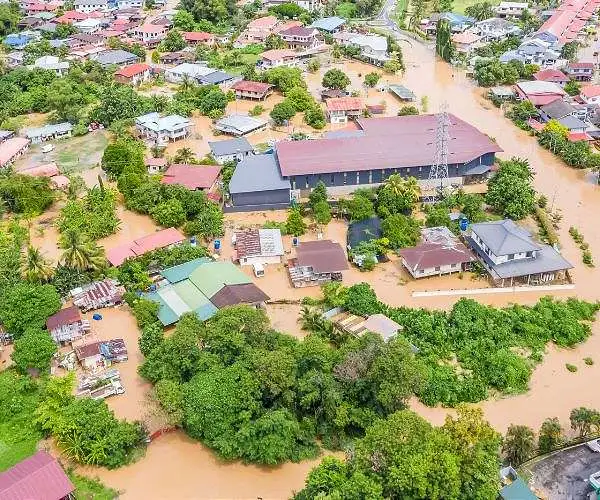
To understand the devastation in Hat Yai, we must first strip away the excuses. The hydrological cause of the flooding is, of course, undeniable. An unprecedented volume of rain assaulted the Deep South, specifically Songkhla, driven by linear rainbands—the phenomenon known as “still rain”—and likely exacerbated by atmospheric rivers linked to climate change. While I am not a meteorologist, I have no reason to doubt the validity of this theory.
However, in the calculus of flood management, rainfall is only one side of the equation. The other side is drainage capacity. For over a decade, we have placed our faith in “grey infrastructure.” We believed that the R1 Canal, with its impressive drainage capacity of 1,200 cubic meters per second (m³/s), combined with the U-Ta-Pao Canal’s 400 m³/s, would be our shield. But while we focused on these man-made arteries, we ignored the slow, silent strangulation of our natural veins. We have no accurate data on how much natural drainage capacity has been obliterated over the last ten years by unchecked urbanization, new roadways, and construction projects.
The math was simple and unforgiving: Too much rain, too little drainage.
But this hydrological imbalance only explains the Crisis. It does not explain the Catastrophe.
A flood of this magnitude is without any doubt a crisis. But it is not inevitable that a crisis results in the catastrophic loss of life and treasure, estimated conservatively at 20,000 million baht (though I strongly believe the true figure is far higher). This escalation from crisis to catastrophe was a failure of management. It was the direct result of squandering the most valuable resource in a disaster: Time.
The Warning Void: A Failure of Political Will and Public Trust
A specific, actionable warning issued just 12 hours in advance would have changed the course of events for Hat Yai, not to mention the course of countless lives. That 12-hour window can greatly reduce economic loss, loss of life, and suffering.
We missed this window not because we were ignorant, but because the warning system was so flawed it was essentially inoperable. Signals of an extreme event were reported by the Department of Meteorology as early as October 17th. Yet, these reports languished in bureaucratic silos. When a private citizen’s warning appeared on Facebook—a report that proved to be incredibly accurate—it was aggressively censored by the government as “fake news.” This suppression did more than hide the truth; it destroyed the public’s trust in official channels.
When the threat became imminent—the final 12-hour countdown—the failure turned political. Political capital had been heavily invested in the narrative that “there will be no flood in Hat Yai.” For the political leadership, particularly the Mayor, admitting that the region’s worst historic flood was hours away would have been a humiliating U-turn. The Mayor’s defense—that he lacked the authority to raise the “Red Flag” without approval from the Provincial Governor and the joint department committee—is a profound mischaracterization of executive power. The “committee” he deferred to is an informal advisory group with no legal standing. The authority to declare a crisis is, and always has been, endowed within the office of the Mayor by customary practice.
The “Soft Infrastructure” Deficit: Why the SMS Failed
Even when the political paralysis momentarily broke, the resulting communication proved useless. Consider the SMS alert sent at 04:00 AM on the 23rd. It warned that due to heavy rainfall, water would rise to a maximum high of 1.5 meters by 06:00 PM, and people living on low ground should evacuate to high ground.
On the surface, this looks like a warning, but for real people receiving this message, it provided nothing but confusion. A warning cannot be just data transmission; it needs shared understanding between the sender and the receiver regarding how the message should be interpreted and acted upon. The warning utterly failed in three aspects:
Ambiguity: 1.5 meters from where? Above mean sea level? From the road surface? From the canal bank? Or from the roof of my house?
Lack of Context: Who is on “low ground”? Where is the designated “high ground”?
Timing: By the time citizens woke up to read this ambiguous text, it was too late. By 08:00 AM, roads were cut. By 11:00 AM, the canals overflowed. By 5:00 PM, the water had risen two meters.
Because there had been no investment in community outreach during the “Normal Period,” the public had no vernacular to interpret the message. This proves a critical axiom: You cannot educate a population on how to survive a disaster while the disaster is happening. That work must be done years in advance.
Even if the message had been understandable, many questions remained, such as how to get to designated high ground, which routes were accessible, and to whom. An effective warning system must be preceded by a great deal of preparatory work.
The Capability Vacuum: Why You Cannot Improvise Survival
Once the waters rose and 400,000 people in the Hat Yai metro area were trapped, the only mechanism capable of mitigating the disaster was a robust organizational capability, which can be described using C3 framework: Command, Control, and Capability.
We had none of that.
Although a great deal of blame is placed upon the leadership—specifically the Prime Minister, the Minister of Interior, the Head of Emergency Response Directorate, and the Mayor of Hat Yai—and justifiably so, the collapse of the relief effort was 90% due to a lack of preparation and 10% due to incompetence. You cannot conjure a organizational capabilities out of thin air during a crisis. It requires months of planning, investment, and rehearsal. Without it, the response in Hat Yai devolved into chaos. According to the C3 framework, we were deprived of every aspect that constitute capability:
No Policies or Objectives: A C3 system defines the operational goal. Without one, responders were unaware of key objectives and paralyzed by competing priorities. Should they focus on evacuating the vulnerable or resupplying hospitals? Without a policy framework, there is no rational way to make this choice. Since no policies were established, the scope of operations was never defined; hence, resource requirements were never known.
Undefined Roles and Responsibilities: No one knew their specific job. Agencies did not know how to coordinate with one another. There was no clear chain of command, leading to friction rather than synergy.
Absence of Operational Plans: There was no “game plan,” protocols, or rulebooks. Without a “game plan,” responders—as noble as they certainly were—were directionless. They were not directing their efforts toward actual objectives, which were never defined in the first place. Without clear protocols and rulebooks, enormous pressure was placed on responders’ decision-making under extreme stress. For example, when rescue teams encountered strong currents and low visibility, they had no protocol to guide them. Should they push forward at risk to themselves, or turn back? In the absence of protocol, emotion overrides rationality, leading to high-stress, dangerous decision-making.
Zero Situational Awareness: A C3 system requires a monitoring loop to tell operational leaders what is happening on the ground. In Hat Yai, the leadership was flying blind – sometimes literally, unaware if their efforts were succeeding or needed revision.
Provisioning Failure: An effective C3 system would have put in place the infrastructure and protocols that enable rapid mobilization of manpower, equipment, supplies, and logistics. But since none had been established, the relief effort suffered a severe shortage of both men and material for days after the flood had engulfed the whole city. By the time help arrived, it was already very late, as is customary in Thailand.
The Critical Lack of Training: Training in this context includes imparting to responders and managers the skills to carry out relief operations, as well as “War gaming.” Conducting relief operations during a crisis is very complex and dangerous, thus requiring a specific set of skills. “War gaming” (simulation and rehearsal) is essential not just to test operational plans, but to familiarize responders with their own missions as well as those of others. It builds muscle memory and creates a shared expectation of action and response between entities. This predictable pattern of action is necessary to achieve effective coordination. We had none of these.
Contrast this with the flawed but functional evacuation of New Orleans during Katrina, where the city utilized pre-planned logistics to move 20,000 people to the Superdome using 2,000 buses. In Hat Yai, with a population of 400,000, we didn’t even know where the vulnerable people were, let alone how to move them.
The Strategic Blind Spot: Ignoring the “Normal Period”
The tragedy of Hat Yai is a symptom of Thailand’s broken disaster management doctrine. We must view disaster management in four distinct phases:
The Normal Period (Peacetime)
The Pre-Event Period (The warning window)
The Incident Period (The flood itself)
The Post-Event Period (Cleanup and recovery)
Thai policy is obsessed with Phases 3 and 4. We are experts at handing out relief bags and cleaning up mud. We spend billions on grey infrastructure—dams and canals—thinking that concrete is the only solution.
But we spend virtually nothing on Phase 1: The Normal Period.
This is where the battle was lost. We built the R1 Canal (hardware), but we refused to build the “soft infrastructure” (software). We did not invest in preparedness. We did not invest in community outreach to define the vernacular of warnings. We did not invest in capabilities using the C3 architecture.
Nuthasid Rukkiatwong
Senior Researcher



