
Business
How the new road safety measures will affect you

Emer MoreauBusiness reporter

 Getty Images
The UK government has launched the first major road safety strategy in over a decade, aimed at lowering the number of people who are killed or seriously injured on the roads.
The changes only apply to England and Wales – some of them are in force in Scotland and Northern Ireland already.
The measures will be open to public consultation but here are the government’s main proposals and how they might affect you.
Eye and cognitive tests for older drivers
Drivers over the age of 70 could have to have their vision checked every three years, instead of simply declaring that their sight is good enough to get behind the wheel.
Drivers must be able to read a number plate from 20 metres away, but they do not have to provide proof of this.
NHS eye tests are free for over-60s across the UK.
The Department for Transport (DfT) has also pledged to “develop options for cognitive testing for older drivers”.
A learning period before your test
Learner drivers could face a minimum learning period of up to six months between sitting their theory and practical tests.
Currently, novice motorists can book a practical test as soon as they have passed a theory exam.
The government believes a minimum period between sitting the theory test and the practical exam would help learner drivers develop their skills, including driving in different conditions.
This change is not set in stone — it will be subject to a public consultation before the government makes a decision.
The proposed learning period would include any informal learning people may do with parents or guardians as well as formal lessons with a driving instructor.
Evidence from other countries suggests minimum learning periods could reduce collisions by up to 32%.
Learner drivers currently face a waiting time of around six months to take their practical tests anyway, due to a backlog from the Covid pandemic. The backlog is expected to last until late 2027.
Stricter drink driving limits
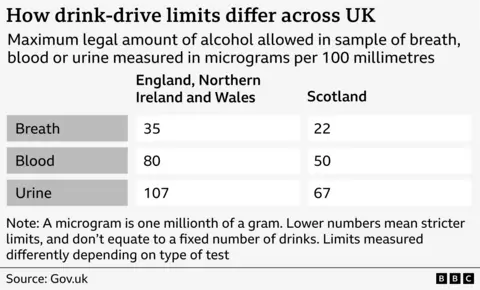
The DfT has proposed reducing the alcohol limit in for novice motorists and those within their two-year probation period from 80mg per 100ml of blood to around 20mg.
For all other drivers, the level would be lowered to around 50mg. This is the current limit in Scotland.
The current limit in England and Wales is 35 micrograms per 100ml of breath.
It is difficult to say how much of a drink this translates to, as people process alcohol differently depending on factors such as their age and weight.
The strategy also proposes a new requirement for some drink-drive offenders to have “alcolocks” installed in their vehicles — devices which prevent a vehicle being started or driven unless the driver passes a breath test.
Fitting these on an offender’s car would be a condition of them being allowed to drive again.
They are already used in several countries such as Australia, Belgium, Canada, the Netherlands and the US.
Penalties for drink driving will also be reviewed.
Changes for motorcyclists
The process of learning to ride a motorbike could be overhauled following a consultation.
This could include changes to the existing Compulsory Basic Training and to government-funded schemes to ensure motorcyclists are wearing safe helmets.
The government also wants to roll out new pilots of Project Prime, an initiative to help motorcyclists drive more safely on rural roads.
Tougher fines and penalties
Enforcement of road regulations will be updated to “penalise the most dangerous road users”.
Proposed ways to do this include new powers to suspend the licences of people suspected of drink or drug driving until they appear in court. Currently, people on bail for these offences are free to continue driving.
Drivers could be given penalty points for not wearing a seatbelt, or for driving with children who are not wearing a seatbelt.
Tougher punishments are also planned for people who drive without insurance or an MOT, as well as people using “ghost” number plates which cannot be read by recognition cameras.



