

Business
India’s growth story and the road ahead: Experts share insights ahead of Budget 2026

A Year of Unexpected Growth
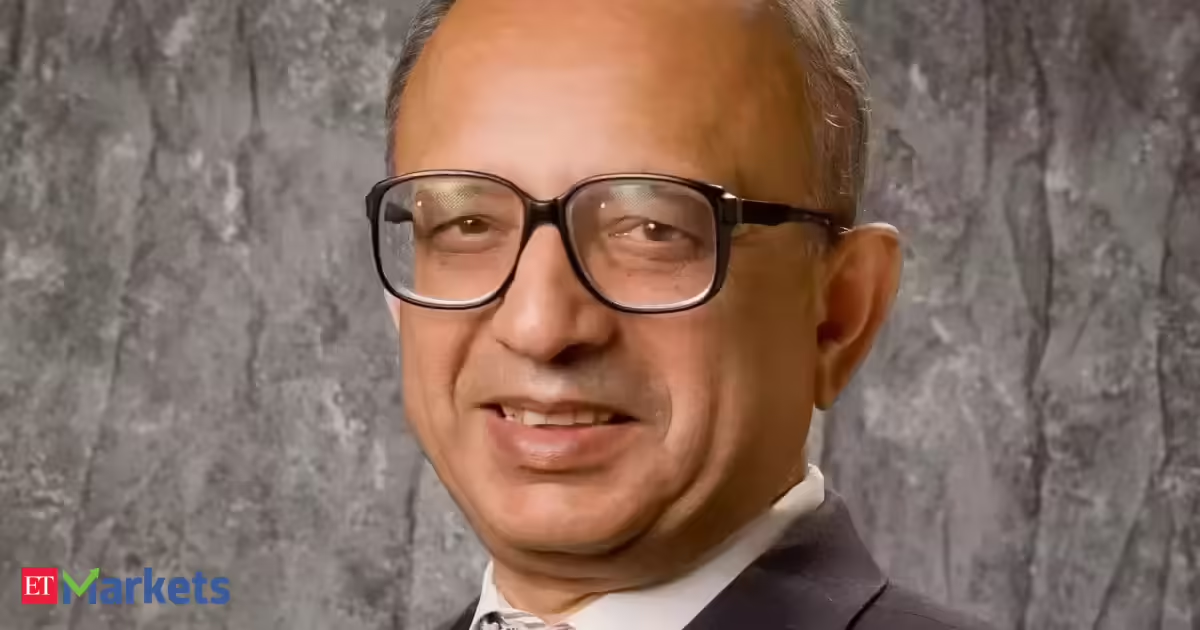
Swaminathan Aiyar noted that 2025 defied many expectations. “This is a year which was very unexpected. One year ago, Trump was coming. There were all kinds of disruptions that were anticipated. Many people said there is going to be a recession globally. Everything is going to go to hell. What has happened? At this particular year, it has been a year of unexpectedly fast growth in India, 7.5%; very low inflation, below 2%. The RBI governor has called this a Goldilocks year. It is a remarkable year giving all the headwinds that we have seen.”
Looking ahead, Aiyar suggested that Finance Minister Nirmala Sitharaman is likely to adopt a cautious approach. “It seems to me that Nirmala Sitharaman, once again faced with headwinds globally, faced with all kinds of uncertainties, is likely to say, ‘Look, batten down the hatches. The global storms are still going on. There is no need to risk any radical changes.’ This should be a year largely of continuity. We are doing various things right. That is why it is a Goldilocks time right now. Let us continue with it.”
The Role of Cyclical Factors and the Need for Policy Innovation
Pranjul Bhandari offered a nuanced take on the factors that contributed to 2025’s strong growth. “It was a year of great rains after a few years of very uncertain, drought-like situations. It was a year when oil prices really fell and that gave us a terms-of-trade boost, generally good for growth. It was a year in which the fiscal gave us all kinds of tax cuts, GST, personal income tax. And it was also a year in which the central bank, because of low inflation, came and cut rates and did a lot of regulatory easing as well. So, a lot of cyclical factors came together and made this a year of remarkable growth despite uncertain external environment.”

Bhandari cautioned that these one-off factors may not sustain growth in 2026. “Many of these one-time boosts may not last in full vigour. Oil prices, I do not think, are going to fall further. Even if rains are good for another year, I do not think growth can really rise on the back of that because the base effect has already been adjusted last year. We need to do something new, something more. We need to think about new sectors that can participate to make 2026 a stellar year as well.”
Fiscal Restraint and Capex Focus
Both experts emphasized fiscal prudence. “At least the budget should focus on restraint,” Bhandari said. “Focusing on restraint just basically means bringing down the fiscal deficit gradually. I am happy to say that the job this year will not be as tough as the last few years because the ask rate for bringing down the deficit is a bit smaller this time, about 0.2% of GDP, from 4.4% to 4.2% of GDP. In previous years, it has been much more. And this year we also have a lot of help from non-tax revenues. I think RBI dividend is going to be strong once again.”
Aiyar highlighted the current investment climate. “If you are already achieving this to say that there is not enough investment, I would put a question mark. A lot of people look at the trends and say that especially private sector investment is less than it used to be and therefore perhaps it has to be raised. I would say that in these current global conditions, people will focus on producing for the domestic market and they will not focus on producing for the global market, which is very, very uncertain. And right now, the current rate of investment that is going on, if it is enough to achieve 7% plus, to say it is insufficient or that it has to be stimulated, I would raise a question.”
Bhandari added that a strategic reallocation from current expenditure to capital expenditure could help sustain growth. “If you look at current expenditure, my sense is that the number of centrally sponsored schemes has only doubled in the last couple of years. I think it is getting messy again. These schemes get messy after a cycle of elections, and eventually you get some saving. I am hoping that this year we do that cleanup of current expenditure and use some of that money to boost the capex budget. I do think that after a year in which we focus so much on consumption, we need to also focus on capex, especially state capex.”
Foreign Investment and Labour Considerations
Aiyar emphasized the importance of attracting foreign direct investment (FDI), including from China. “If a large amount of FDI came in from outside, that would be private sector investment and the foreign companies can do it because they can export to their own international arms. They do not face an additional problem of Trump uncertainty. They are in a much better position to do so.”
Bhandari agreed, highlighting opportunities in mid-tech and labour-intensive sectors. “India and China can partner in terms of manufacturing and FDI in mid-tech goods. Things like textiles, footwear, furniture. These are areas where the security issue is much lesser. They are not chips. They are not defence goods and it is to India’s advantage because India has a huge amount of labour force.”
On the topic of labour reforms, both experts noted that more work remains. Bhandari observed, “While there were very big steps taken a few months ago, a lot more needs to be done. But alongside hard reforms, we also need softer reforms—things like certainty and predictability. For example, look at our taxes. We need a lot of stability so that investors and MNCs feel secure about long-term investment in India.”
Southeast Asia and Trade Opportunities
Looking beyond traditional partners, Bhandari highlighted the potential of ASEAN. “The producer is the east, the producer is China and it is ASEAN. While we are striking all these trade deals with the west, my sense is that is half the job done. The other half is to really clean up our engagement and our trade agreements with ASEAN, which has suddenly become a large manufacturer and has huge potential to grow over the next decade. If we can work with ASEAN and actually get into the manufacturing value-added chain, we can then become even bigger manufacturers to serve the west eventually.”
Optimism for 2026
Despite challenges, both experts expressed cautious optimism for the upcoming year. “When we look at markets today, we see that across asset classes—equities, debt and FX—we have underperformed emerging markets over the last year. But if I look at the fundamentals, I see India having decent growth, low inflation, a fiscal deficit that yes is high but is coming down, a current account deficit that is in the 1% to 1.5% range which is sustainable. Our fundamentals are extremely strong,” Bhandari concluded.
As India approaches Budget 2026, the focus appears likely to remain on continuity, fiscal discipline, investment in infrastructure, and strategic FDI, with careful attention to both hard and soft economic reforms.



