Business
Iran protests: Why thousands of merchants, shop owners and students are protesting across the country

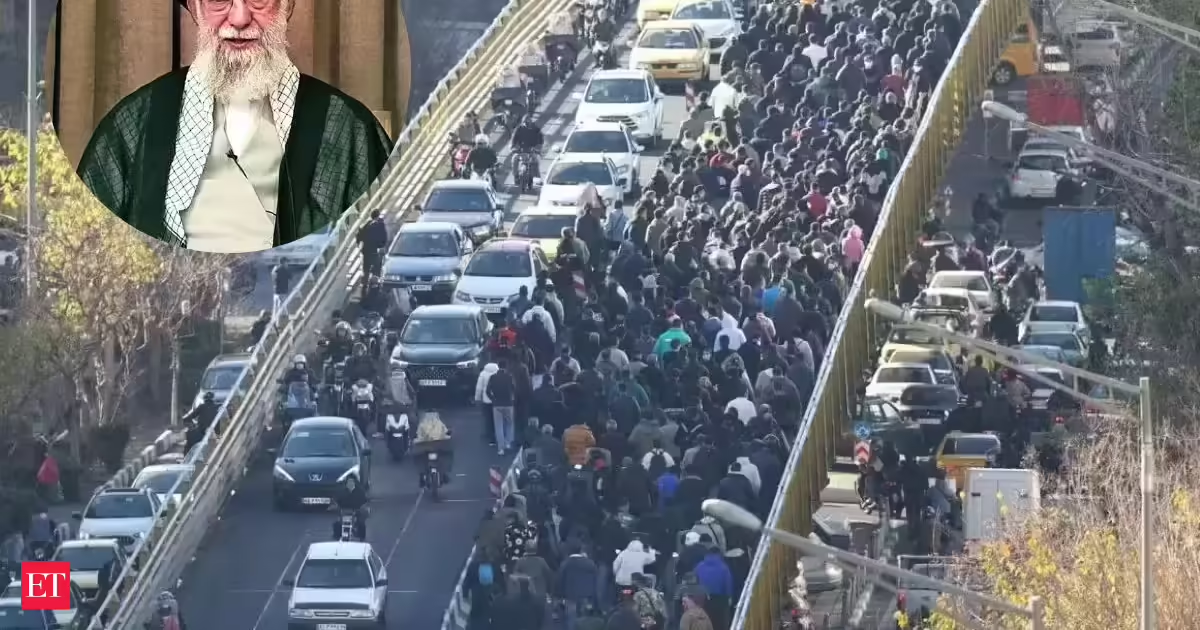
What began as scattered protests over rising prices and a falling currency has quickly spread nationwide, becoming the biggest wave of unrest Iran has seen in the past three years. The demonstrations have disrupted daily life, shut major bazaars and drawn a heavy security response from authorities.
Iran Protest Reason: Economic pain
The protests first erupted on Sunday when shopkeepers protested against the government’s handling of a sharp slide in the Iranian rial and rapidly rising prices. With inflation officially crossing 40% and household costs surging, anger spread quickly to students and traders in multiple cities.
Merchants closed shops, students held demonstrations on university campuses, and major markets in several cities went dark as protests gathered pace.
Violence erupts in western Iran
As protests intensified, violence broke out in several provinces. The semi-official Fars news agency reported that three protesters were killed and 17 injured during an attack on a police station in Lorestan province.

“The rioters entered the police headquarters around 1800 (local time) on Thursday … they clashed with police forces and set fire to several police cars,” Fars reported.
Earlier, Fars and rights group Hengaw reported deaths in Lordegan city in Charmahal and Bakhtiari province. Authorities also confirmed one death in the western city of Kuhdasht, while Hengaw reported another fatality in Isfahan province in central Iran.
Iran Protests Deaths
Fars said two people were killed in Lordegan during clashes between security forces and what it described as armed protesters. Hengaw, however, said several people were killed and wounded there by security forces.
The Revolutionary Guards said one member of its affiliated Basij volunteer paramilitary unit was killed and 13 others wounded in Kuhdasht. It blamed demonstrators, accusing them of exploiting the protests.
Hengaw identified the man named by the Guards as Amirhossam Khodayari Fard and said he had been protesting and was killed by security forces. The group also reported that a protester was shot dead on Wednesday in Isfahan province.
Reuters said it could not independently verify these claims.
Protests spread despite arrests
Demonstrations were also reported in Marvdasht in southern Fars province, according to activist news site HRANA. Hengaw said authorities detained demonstrators in the western provinces of Kermanshah, Khuzestan and Hamedan.
Despite arrests and a strong security presence, protests continued in several areas, signalling growing frustration across different sections of society.
Pressure mounts on Iran’s leadership
The unrest has come at a difficult moment for Iran’s clerical rulers. Western sanctions have weighed heavily on the economy, while recent Israeli and U.S. airstrikes in June targeting Iran’s nuclear and missile infrastructure and military leadership have added pressure.
In response, Tehran has combined security measures with an offer of talks. Government spokesperson Fatemeh Mohajerani said authorities would hold direct dialogue with representatives of trade unions and merchants, without sharing further details.
The Islamic Revolutionary Guards Corps later accused those involved in the unrest in Kuhdasht of “taking advantage of the atmosphere of popular protests.”
Markets shut, country slows down
For days, merchants, shop owners and students have shut businesses and boycotted classes. On Wednesday, the government declared a nationwide holiday due to cold weather, effectively shutting down much of the country.
Iran has repeatedly crushed protests in recent years over high prices, water shortages, women’s rights and political freedoms, often using mass arrests and heavy security.
The economic strain remains severe. The rial lost about half its value against the dollar in 2025, and official inflation stood at 42.5% in December, leaving many Iranians struggling, and fuelling protests that show no sign of fading.
(Inputs from Reuters)