
Business
Melania Trump calls husband ‘unifier’ in FOX Business interview


The first lady Melania Trump tells FOX Business’ Maria Bartiromo she encouraged President Trump to bring the country together despite deep divisions.
First lady Melania Trump has long guarded her privacy, even as her husband holds the most scrutinized office in the world.
During an interview with FOX Business’ Maria Bartiromo ahead of the Jan. 30 premiere of her new documentary, titled “Melania,” the first lady revealed she agreed to be filmed during the inauguration period — but only on her own terms.
“Everyone knows, I’m [a] very private and selective person,” she said on “Mornings with Maria” Thursday.

First lady Melania Trump and President Donald Trump on election night. (Chip Somodevilla/Getty Images)
During the conversation, Bartiromo pointed to a moment in the film in which Melania urges the president to act as a unifier at a time of deep political division. Asked what that advice looks like in practice, the first lady said the two speak openly about the challenges facing the country.
“Well, I give him my advice and, you know, we talk about that, and we could see that the country is divided,” she said. “And it’s very hard no matter what he says. They don’t like to listen and, what’s going on in our country now, I feel that it’s a lot of pushback and I hope it stops.”
MELANIA TRUMP ANNOUNCES NEW BUSINESS VENTURE AHEAD OF MOVIE RELEASE
When asked how the president can bring Americans together, the first lady described him as already working toward that goal, pointing to his priorities on public safety and border enforcement.
“I think he’s doing a fantastic job. He had a great success. And he’s a unifier,” she said, “He’s a positive-thinking, forward-thinking. He wants to put… this country in the order that everybody can live here freely, not in danger.”
The first lady Melania Trump joins ‘Mornings with Maria’ to discuss her new documentary, legislative wins focused on children and her vision for unity in a divided America.
The first lady added that public safety is central to that vision, stressing the importance of Americans feeling secure in their own communities.
“He would like to have a country that all of the people can walk down the street and not to be harassed or murdered or women raped,” she said. “A few years ago, so many criminals came over the border, and he closed the border now, a while back already, and we need to take care of our citizens.”
The interview also highlighted a lighter moment, noting the first lady’s admission that she does not always watch the president on television. She said her absence from the screen is simply a reflection of her workload.
Exclusive senior advisor to First Lady Melania Trump, Marc Beckman, discusses Amazon’s new documentary and the momentum behind the first lady’s growing public profile on ‘Mornings with Maria.’
“I can’t. I have work to do. I’m not in front of TV. I work,” she said. “You travel in different places. You need to do… what you called for… you cannot watch all the time.”
Trump’s remarks offer a rare glimpse into a first lady who prefers to work quietly behind the scenes, guided by conviction rather than the spotlight.
“It’s important what you have to say… when you true to yourself… listen yourself… speak when it’s important and not performing for the cameras… that’s the best,” she said.


STOCKHOLM—A Swedish company is defying a downturn in green-technology funding by raising new capital as investors bet that its electric ferries can make a splash with public transport operators and commuters.
Stockholm-based Candela started out developing hydrofoiling electric leisure boats, but is now applying the technology and lessons learned from its speed boats to ferries.
Copyright ©2026 Dow Jones & Company, Inc. All Rights Reserved. 87990cbe856818d5eddac44c7b1cdeb8
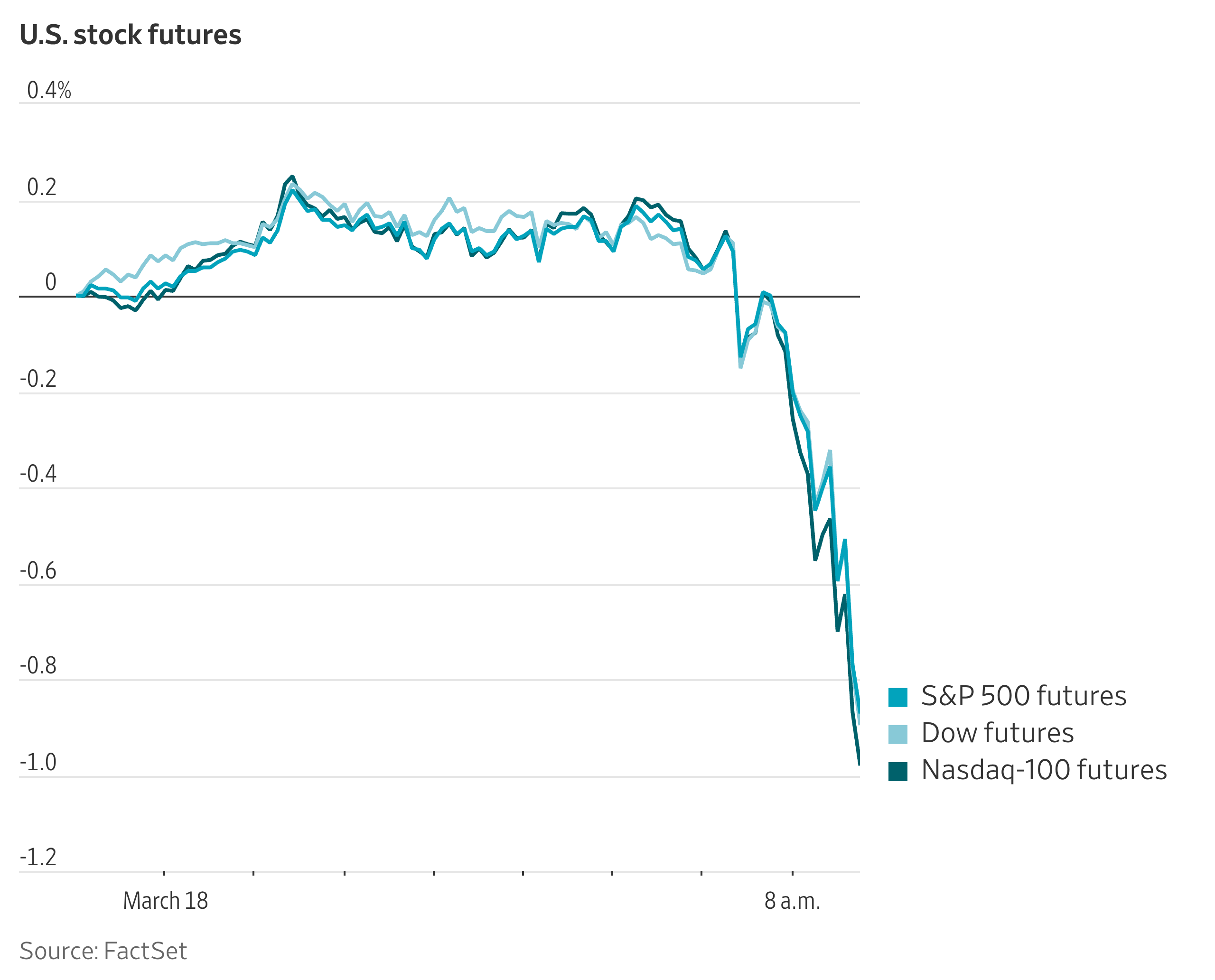
Here's How Markets Are Reacting After Hotter-Than-Expected PPI

Analysts said the exit, coupled with uncertainty surrounding the term renewal of the incumbent CEO, may keep the stock under pressure in near term despite mouthwatering valuations. CEO Sashidhar Jagdishan’s second term ends in October.
 Agencies
The stock ended 5.3% lower at ₹798.2, its weakest close since August 2024, erasing ₹69,026 crore in market value. It had fallen to ₹770 apiece at the start of the day. The Nifty 50 fell 3.3% to 23,002.15. HDFC Bank has the strongest influence on the index movement with an 11.83% weight.
Brokerage Macquarie said the stock may continue to underperform in the near term.
“While fundamentals remain strong with good ROA, at this point in time governance concerns will weigh down heavily on the stock,” the brokerage wrote. “Investors would want more comfort from the board. Also now the uncertainty surrounding Sashi’s reappointment will weigh down on the stock.”

Macquarie has an ‘Outperform’ rating on the stock with a target price of ₹1,200.
Brokerage Bernstein noted that while the stock is already trading at or below Covid-era valuation levels, recovery from governance-related concerns will be neither quick nor easy. “Investors will likely wait to ensure that this doesn’t trigger any investigations from regulators that could take longer to conclude,” Bernstein said. The firm has a target price of ₹1,150. Technically, the stock may see some relief after sharp sell-off. HDFC Bank has dropped 24% over the past four months and has breached key support zones at ₹860 and ₹840.
“Momentum indicators are now in oversold territory, suggesting a potential pullback,” said Rohan Shah, technical analyst at Asit C Mehta Investment Intermediates. “But failure to sustain above ₹840 could renew selling pressure, with downside risk towards ₹750-730 over the coming weeks.”
He added that weakness in the broader Bank Nifty and the overall market could add to the drag.
At current valuations of about 1.7 times FY27 price-to-book, the stock offers an attractive entry point, said Sunny Agrawal, Head of Fundamental Research at SBI Securities. who has a target price of ₹1,100.
“The management clarified on Thursday that the resignation was solely due to personal relationship issues between chairman (non executive) and leadership team and does not impact the bank’s business performance or underlying values and ethics,” he said. “With RBI reaffirming the bank’s fundamentals and Keki Mistry returning to the board, we believe investor confidence should stabilise.”

Global private equity firms including Warburg Pincus, EQT, and Partners Group had shown interest in acquiring the business at $1.5-1.6 billion (₹13,980-14,912 crore) valuation. However, this fell short of the $2 billion valuation sought by the promoters and existing investor Quadria Capital, said the people cited above.
“As the promoters plan an IPO in the next 12-18 months, Quadria Capital is likely to stay invested and partially exit through the public offering,” one of the persons said.
Promoter Mehul Shah and his family currently hold around 84.2% in the company, while Quadria owns 14.9%, with the remainder held by other investors and the ESOP pool. Quadria had acquired the stake in 2021 at a valuation of $800 million.
AgenciesBidders’ valuation of $1.5-1.7 b failed to match the $2b sought by promoters, investors
A consortium led by Warburg Pincus and Abu Dhabi sovereign wealth fund Mubadala Investment Company had emerged as the frontrunner to buy up to a 74% stake in the company, ET reported last month.
Quadria had appointed JPMorgan to run the sale process.
Encube is a generics-focused pharmaceutical contract manufacturer known for brands such as Soframycin. Founded in 1998, Encube specialises in topical formulations and has built a strong portfolio spanning creams, gels, and ointments catering to dermatology and reproductive healthcare. In 2021, the company entered the consumer healthcare space by acquiring brands such as Soframycin, Sofradex, Sofracort, and Soframycin-Tulle from Sanofi for India and Sri Lanka in a deal worth around ₹125 crore.

Unknown Executive
Greetings. Gary Fishman is having some technical difficulties. This is Bradley. I just wanted to say welcome to the RCI Hospitality Holdings Fourth Quarter and Year-end Earnings Conference Call. My name is Bradley Chhay.
You can find the company’s presentation on the RCI website. Go to Investor Relations section. All the links are on the top of the page. Please turn to Slide 2 of our presentation. Our speakers today are Travis Reese, Interim President and CEO; and Albert Molina, Interim CFO.
Please turn to Slide 3. RCI is making this call exclusively on X Spaces. To ask a question, you will need to join the Space with a mobile device. To listen only, you can join the space on a personal computer. At this time, all participants are on listen-only mode. A Q&A session will follow after the call. The conference is being recorded.
Please turn to Page 4. I want to remind everyone of our safe harbor statement. You may hear or see forward-looking statements that involve risks and uncertainties. Actual results may differ materially from those currently anticipated. We disclaim any obligation to update information disclosed in this call as a result of developments that occur afterwards.
Please turn to Page 5. I also direct you to the explanation of RICK’s non-GAAP financial measures. Now I’m pleased to introduce Travis Reese, Interim President and CEO. Take it away, Travis.
Travis Reese
Interim President, CEO, Secretary & Chairman
Thank you, Bradley. Thank you all for joining us. Please turn to Slide 6. I’m pleased to report that we filed our 10-K today and announced our

Check out what’s clicking on FoxBusiness.com.
Bizarre footage has captured the chaotic moment a service robot appeared to spin out of control at a restaurant near San Jose, California, violently striking a customer’s food and tableware without warning before abruptly breaking into a series of erratic dance moves.
The wild incident was captured in a viral video in Cupertino at a Haidilao hot pot location, a chain known for integrating artificial intelligence and robotic technology to help streamline operations, including delivering food to tables.
In the video, the robot appeared to begin a dance routine near diners before suddenly pounding a neighboring table, sending tableware, chopsticks and condiments flying off the surface.
Staff members were then seen struggling to restrain the uncontrollable humanoid as it continued to move with even greater energy, appearing to hype up the crowd with its wild gestures.
GRUBHUB LAUNCHES FIRST-EVER COMMERCIAL DRONE FOOD DELIVERY SERVICE IN NEW JERSEY

A robot goes out of control at a hot pot restaurant in California. (@meooow via Storyful / Fox News)
The robot carried on for another minute with a condiment-stained hand as it displayed a cheerful expression.
The restaurant reportedly said the robot’s sudden attack on the dining space was caused by human error and was not a programming malfunction. The bot simply appeared too close to the table when it began its entertainment routine.
DELL WORKFORCE SHRINKS BY 10% FOR THIRD CONSECUTIVE YEAR

A serving robot at a hot pot Haidilao location goes out of control near San Jose, California. (@meooow via Storyful / Fox News)
“In this case, the robot was brought closer to a dining table at a guest’s request, which is not its typical operating setting,” Haidilao said in a statement, NBC reported. “The limited space affected its movement during the performance.”
The robots, which are more widespread in China than overseas, have been used by the Beijing-based company for years.
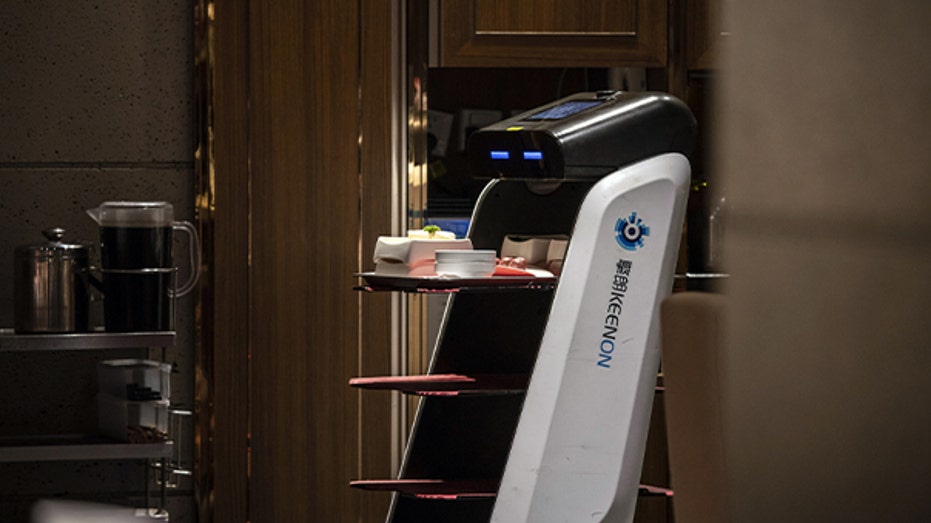
A Keenon Robotics Co. smart delivery robot moves through a Haidilao hotpot restaurant, operated by Haidilao International Holding Ltd., in Shanghai, China, on Wednesday, April 7, 2021. (Qilai Shen/Bloomberg via Getty Images / Fox News)
GET FOX BUSINESS ON THE GO BY CLICKING HERE
In 2022, the tech-forward dining chain launched its first smart restaurant worldwide in Beijing, featuring tools such as an intelligent kitchen management system, automatic broth-mixing machines, and robot servers.
| Ticker | Security | Last | Change | Change % |
|---|---|---|---|---|
| HDALF | HAIDILAO INTERNATIONAL HOLDING LTD. | 2.04 | -0.10 | -4.67% |
FOX Business reached out to Haidilao for more information.

Sebi is also likely to review the ‘fit and proper’ criteria for market intermediaries, such as stockbrokers, people in the know told ET. The review pertains to disqualification norms for key managerial persons and directors.
At present, individuals in key roles face automatic disqualification if an FIR or charge sheet is filed in an economic offence case. The regulator intends to scrap this automatic trigger, offering relief to executives facing allegations that are yet to be proven in court.
“Currently, mere filing of a criminal complaint triggers disqualification for key personnel, even before any guilt is established,” said Aditya Joby, senior associate at Joby Mathew & Associates. “This can unfairly damage careers and livelihoods. Moving to conviction-stage disqualification better reflects the presumption of innocence in Indian law. The challenge will be how this interacts with the proposed Securities Market Code and delays in Sebi’s special court, which can still affect individuals in the interim.”
The regulator also plans to ease rules for alternative investment funds (AIFs) seeking to wind up schemes and surrender registration, helping funds stuck due to unresolved legal or tax issues.
“Sebi’s proposal to allow netting will ease liquidity pressures for FPIs and reduce forex costs, particularly on days where securities have to be bought and sold for rebalancing purposes,” said Rajesh Gandhi, partner at Deloitte. ” This is another step taken by Sebi to ease norms for FPIs and provide regulatory ease to enable greater flow of capital to India.”
At present, FPIs are required to trade on a delivery basis, meaning transactions must result in the actual exchange of securities and cash, with no netting or same-day offset. All trades are settled on a gross basis through custodians, requiring full pay-in for both buys and sells. For instance, an FPI buying shares of A worth ₹100 crore and selling an equal amount of shares of B must still fund the purchase and deliver the securities before receiving cash and shares in settlement.
Sebi noted that this pay-in obligation of ₹100 crore leaves the FPI underinvested for at least a day, as funds cannot be netted against sale proceeds.
Dhaval Jariwala, partner at P N D J & Associates, added that netting would cut FPI funding costs with minimal operational challenges. FPIs withdrew over ₹71,746 crore from Indian equities this month (up to March 17), according to ETIG data.
At the meeting, the Sebi board will also discuss a proposal to allow InvITs (Infrastructure investment trusts) to continue holding investments in SPVs (special purpose vehicles) after a project’s concession period ends, widen the pool of liquid mutual funds for parking surplus funds, and permit privately listed InvITs to invest up to 10% of assets in under-construction or greenfield projects.
The regulator may also reduce the minimum investment in social impact funds from ₹2 lakh to ₹1,000 to encourage small investors to back social projects.
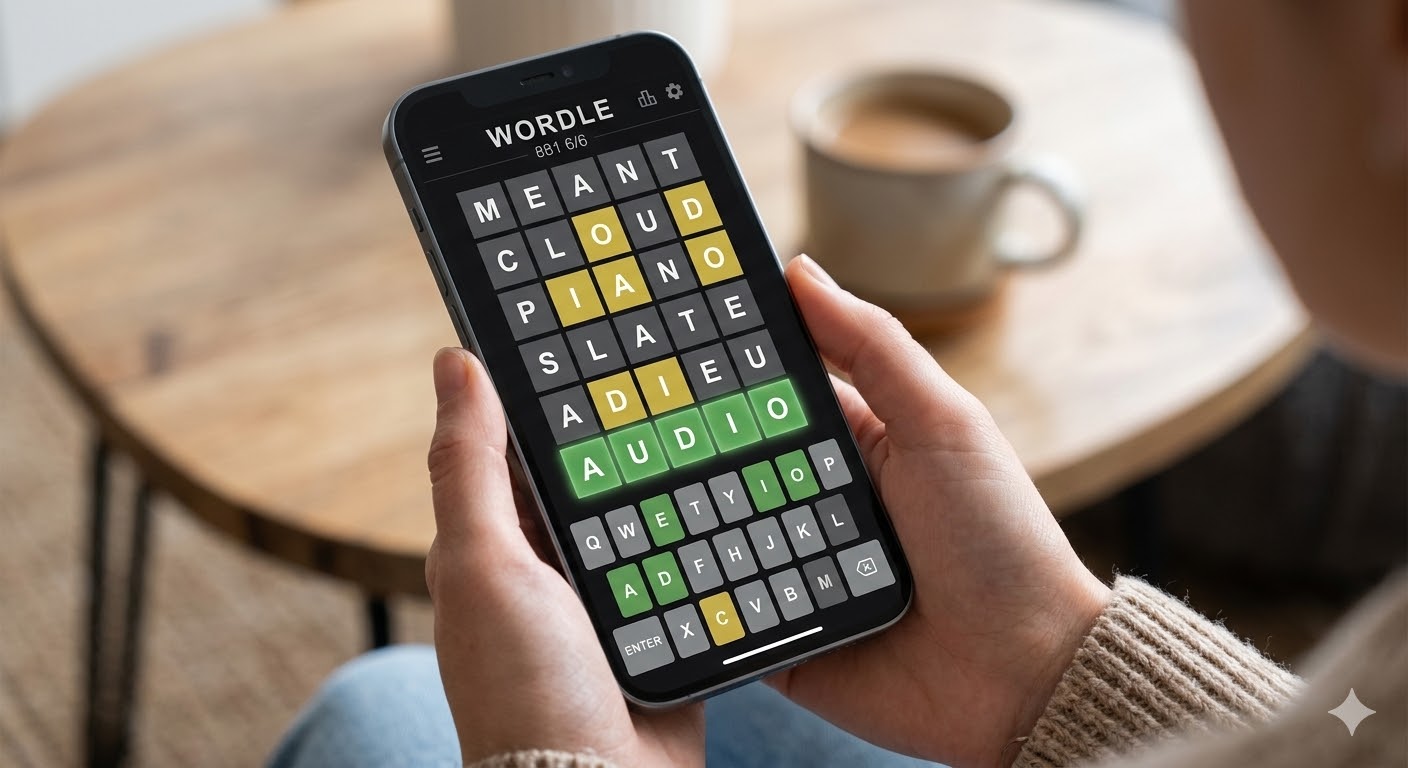
The New York Times Wordle puzzle for Friday, March 20, 2026 — Puzzle No. 1735 — challenged players with a five-letter word that evoked relief in a barren landscape, earning praise for its thematic elegance and moderate difficulty.
Released at midnight Eastern time on nytimes.com/games/wordle and the NYT Games app, today’s Wordle featured the answer **OASIS**. The noun refers to a fertile spot in a desert providing water and vegetation, or metaphorically, a place of refuge amid hardship.
Wordle players receive six attempts to guess the secret five-letter word, with color feedback: green for correct letter and position, yellow for correct letter in wrong position, and gray for absent letters. The puzzle resets daily, and streaks encourage consistent play.
### Progressive Hints for Today’s Puzzle
For solvers preferring to crack it independently, here are layered clues:
– It contains three vowels and two consonants.
– The word starts with O.
– It has one repeated letter (the same vowel appears twice).
– Think of a desert feature that offers water and shade.
– It’s commonly used figuratively for something comforting in a tough situation, like a calm break in chaos.
Community feedback on forums and social media rated the puzzle around average to slightly above average difficulty. Many solved it in 4-5 guesses, with average attempts at about 5 per NYT data. Testers found it “very challenging” in some reviews, though starter words often revealed key vowels early.
### Full Answer and Breakdown
**Today’s Wordle answer: OASIS**
– Position 1: O (green early for many)
– Position 2: A
– Position 3: S
– Position 4: I
– Position 5: S (repeated S at end)
No uncommon letters tripped players; the double S and vowel-heavy structure made it accessible once vowels locked in.
### Strategies to Solve Wordle Efficiently
Wordle’s enduring appeal lies in its simplicity and strategic depth. Experts and top solvers recommend these approaches:
1. **Strong openers**: Begin with words rich in common vowels (A, E, I, O, U) and frequent consonants (R, S, T, L, N). Popular starters include ADIEU, AUDIO, RAISE, SLATE, CRANE or TRACE. Today’s puzzle rewarded vowel-focused guesses like AUDIO or ARISING.
2. **Second guess optimization**: Use the first guess’s feedback to maximize information. If green/yellow letters emerge, incorporate them while testing new common letters. Avoid repeating eliminated grays.
3. **Position awareness**: Green letters fix positions; yellows need repositioning. Eliminate impossible placements quickly.
4. **Hard mode consideration**: For added challenge (optional in settings), reuse confirmed letters in subsequent guesses. It sharpens logic but increases difficulty.
5. **Avoid rare words early**: Skip obscure starters; focus on high-frequency letters per computational analyses (e.g., from Wordle solver bots).
6. **Streak protection**: If stuck, note possible words without guessing recklessly. Many use paper or notes for tracking.
Today’s puzzle exemplified good design: common word, fair letter distribution, no obscure meanings. It avoided traps like plurals or past tenses that sometimes mislead.
### Player Reactions and Community Insights
On Reddit’s r/wordle and X, solvers shared grids showing 3-6 guess solves. One user posted a lucky 3-guess win starting with PARSE → BASIL → OASIS. Others noted the repeated S caught them off-guard after vowel tests.
The puzzle’s desert theme resonated amid spring discussions of renewal and escape. Some linked it metaphorically to finding calm in busy lives or global events.
Wordle, created by Josh Wardle and acquired by The New York Times in 2022, remains free (with optional subscription for ad-free play and archives). It spawns variants like Quordle, Sedecordle and Worldle, but the original daily ritual endures.
For those who missed it or want practice, the archive lets subscribers replay past puzzles. Puzzle #1736 arrives at midnight ET on March 21.
With consistent daily engagement, Wordle sharpens vocabulary, pattern recognition and persistence — small wins that build satisfying streaks.

The accomplished women were inducted into the WA Women’s Hall of Fame on the week of International Women’s Day.

Although on Tuesday Reeves, in contrast, stressed that the red lines set out in Labour’s manifesto still stand, the chancellor has now clearly signalled a shift. She indicated in her Mais lecture that, wherever it was in Britain’s interest to do so, the government wants to align the UK’s regulatory regime with that of the EU in more areas.

WWE star Gunther gives himself a new name

Ctrl-Alt-Speech: Money For Nothing And Clicks For A Fee

How the US copied a cheap Iranian kamikaze drone and used it to bomb Iran


-
 Crypto World6 days ago
HYPE Token Enters Net Deflation as HyperCore Buybacks Outpace Staking Rewards
-

 Tech4 days ago
Your Legally Registered ‘Motorcycle’ Might Not Count Under Proposed US Law
-

 Fashion6 days ago
Weekend Open Thread: Addict Lip Glow
-
 Tech2 days ago
Are Split Spacebars the Next Big Gaming Keyboard Trend?
-
Sports5 days ago
Why Duke and Michigan Are Dead Even Entering Selection Sunday
-

 Business4 days ago
Search for Savannah Guthrie’s Mother Enters Seventh Week with No Arrests
-

 Business5 days ago
US Airports Launch Donation Drives for Unpaid TSA Workers as Partial Government Shutdown Enters Fifth Week
-
Crypto World5 days ago
Coinbase and Bybit in Investment Talks: Could Bybit Finally Enter the US Crypto Market?
-

 Business4 days ago
Australian shares drop as Iran war enters third week
-

 Business6 days ago
Country star Brantley Gilbert enters growing non-alcoholic beer market
-

 Crypto World4 days ago
Crypto Lender BlockFills Enters Chapter 11 with Up to $500M in Liabilities
-

 Sports6 days ago
College Basketball Best Bets: Conference Tournament Semifinal Picks
-

 Politics2 days ago
The House | The new register to protect children from their abusers shows Parliament at its best
-

 Fashion4 days ago
25 Celebrities with Curly Hair That Are Naturally Beautiful
-

 News Videos1 day ago
RBA board divided on rate cut, unusually buoyant share market | Finance Report | ABC NEWS
-

 Crypto World1 day ago
Canada’s FINTRAC revokes registrations of 23 crypto MSBs in AML crackdown
-

 Crypto World5 days ago
Crypto Losses Drop 87% in February, But Hackers Are Now Targeting People, Not Code
-
 Politics2 days ago
Real-time pollution monitoring calls after boy nearly dies
-
 NewsBeat1 day ago
Residents in North Lanarkshire reminded to register to vote in Scottish Parliament Election
-
 Business3 days ago
Meta planning major layoffs as AI spending and automation reshape workforce


You must be logged in to post a comment Login