The latest earnings season has shown broad-based growth across multiple sectors, although market sentiment remains cautious, particularly in midcap and smallcap stocks. Metals and oil & gas have powered corporate earnings, but fundamentals beyond commodities have also held strong.
Commodity-Led Earnings Boost
Commenting on the theme, Gautam Duggad from Motilal Oswal said, “Metals and oil & gas gave an additional kicker, but even ex-commodities, earnings growth stood at 12%. This is the sixth consecutive quarter of high earnings growth, increasing from 10% to 16% over the period. Out of 27 sectors, 19 delivered double-digit growth, which is encouraging.”
“Strong earnings came from auto, capital goods, NBFCs, and PSU banks. Lending NBFCs grew nearly 30%, non-lending 35%, and PSU banks delivered 18% growth versus an expected 5-6%. Even IT and retail showed healthy growth.”
Advertisement
He also highlighted a smallcap recovery: “Smallcaps posted close to 30% growth after five quarters of zero or negative numbers. Midcaps ex-commodities grew 20%, slowing the pace of earnings cuts significantly.”
Live Events
Market Sentiment and Valuation Concerns Duggad noted: “India has underperformed in dollar terms over the last 15-18 months. Largecaps are fairly valued, but midcaps and smallcaps still need selectivity—midcap index trades at 28 times, smallcap at 24 times. Volatility arises from trade deals, IT, and AI disruption, but fiscal and monetary steps by the government and RBI are now reflecting in earnings, particularly in auto and consumer staples.” IT Disruption and Uncertain Valuations On IT valuations, Duggad said: “We upgraded IT in November, yet Infosys dropped 15-17% shortly after. It has now retraced to around 1300. Short-term levels remain uncertain.”Narrow Nifty Contributions Mask Broader Strength Discussing Nifty earnings, he added: “Financials, consumer, and IT account for 60% of Nifty profits. With these sectors growing only 3-10%, headline Nifty growth of 7-8% is concentrated in few stocks. Broader coverage shows 16% growth, highlighting strong opportunities in mid- and smallcaps. This is truly a stock-picker’s market.”
Centenary House in Morecambe has been largely empty since 1990s
Robbie Macdonald and Local Democracy Reporter
13:00, 04 Apr 2026
Centenary House, on Morecambe’s Regent Street(Image: Google Maps)
New calls have been made to regenerate a landmark Morecambe building, as a big shake-up of councils looms in 2028 with uncertainty about future support.
Advertisement
Centenary House, on Morecambe’s Regent Street, has been largely vacant since the mid-1990s except for a ground-floor Co-op shop. Some repairs were done in 2024 using government cash. Earlier in 2019, a plan was approved for offices, a café, work and event spaces but it did not progress.
Council talks have been held recently with an affordable homes organisation about it. But a lack of nearby car parking, and possibly other things, could be turning-off some developers, councillors were told at Lancaster City Council’s latest full meeting.
Labour’s David Whittaker asked Morecambe Bay Independent Martin Bottoms, a cabinet member, about the situation.
Coun Whittaker said: “Has there been any recent engagement with external funding sources to help Centenary House? What do you see as a realistic outcome for the future of the building? Car parking is another consideration. I know this is a long-term question but a lot of people are asking about it.”
Advertisement
Coun Bottoms, who has a remit for Morecambe regeneration and its local economy, said: “Brownfield regeneration money is available for developers to move this forward. Centenary House is bordered by roads and there is little car parking space. Whether it has community or commercial uses, there are going to be some parking issues.
“We are in talks with an affordable housing developer but they are aware that car parking needs have to be considered.”
Then Coun Whittaker added: “Will things progress before local government reorganisation?”
Coun Bottoms said: “It’s something we have all had concerns about since the council’s new administration was formed. We need to find a solution. It’s down to us to get it done. Or, at least, get it started before local government reorganisation. I will be pressing for that.”
Advertisement
The Lancaster City Council district including Morecambe could be merged with Preston and the Ribble Valley under the government’s push to reorganise all Lancashire councils in 2028. The government wants to end the two-tier system of district and county councils created in 1974.
New bigger unitary councils, with access to major funds and government contacts, will likely cover bigger areas and include a wider intake of councillors. So how projects like Centenary House will be viewed by future councillors is unknown.
To find all the planning applications, traffic diversions, road layout changes, alcohol licence applications and more in your community, visit the Public Notices Portal.
Posters of films are on display at a cinema in Shanghai, Aug. 31, 2025.
Vcg | Visual China Group | Getty Images
Hollywood has lost one of its most lucrative theatrical markets. It’s unclear if it will ever win it back.
Advertisement
The Chinese box office was once a coveted space for American-made movies, so much so that studios produced films that would appeal directly to this international audience. But in the postpandemic cinema landscape, Hollywood hasn’t generated the strong ticket sales it once saw for its biggest blockbusters — and a waning relationship with Chinese cinemas is at least partly to blame.
The U.S.-China Film Agreement, struck in 2012 between the two governments, guaranteed 34 U.S. films would be released in China each year. That pact ended in 2017 and was never renewed or renegotiated. At the same time, China began expanding its local film production and instituting blackout dates to promote viewership of its homegrown titles.
Add in strict censorship policies from the China Film Administration and recent political strains between the U.S. and China, and Hollywood films have faced several hurdles just to get distribution in the country post-Covid.
“I think that the kind of euphoria about the world’s largest market and thinking about China as a place that always creates a larger market for U.S. [intellectual property] is not accurate,” said Aynne Kokas, a professor at the University of Virginia and the author of “Hollywood Made in China.”
Advertisement
“[There are] constraints on the market in a couple of ways, first related to content control and not just content control in terms of censorship, but also in terms of control of distribution channels by the party,” Kokas said.
She said the film bureau will “turn on and off the levers of distribution based on the needs of the market.” If local Chinese films are doing well, the country will limit distribution access for foreign films. If there are gaps in film releases or releases aren’t selling as many tickets, it will open up the market.
In 2019, nine U.S. titles each generated more than $100 million at the Chinese box office, with Disney and Marvel Studio’s “Avengers: Endgame” collecting more than $600 million in the region, according to data from Comscore.
In the past five years combined, however, only 10 American films have generated more than $100 million in China, with only two topping $200 million.
Advertisement
The outlier is Disney’s “Zootopia 2,” which tallied a record-breaking $650 million in the country following its 2025 release.
Box office analysts tell CNBC that this feat is likely an anomaly and studios and Wall Street shouldn’t expect a sudden resurgence of ticket sales for American-made fare in the region even as major franchises launch ahead of the key summer movie season.
Market nuances
What performs well in the U.S. isn’t guaranteed to succeed in China, despite the massive audience potential.
“There’s not necessarily a one-to-one correlation between popular IP in the U.S. and popular IP in China,” Kokas said.
Advertisement
In some cases, it’s a lack of nostalgia on the part of Chinese audiences. Kokas noted that when Star Wars was introduced in the region with the sequel trilogy in 2015, it fell flat because the previous films from the original and prequel trilogies were never released in China, so the later installments didn’t have the boost of a built-in fanbase.
Distribution experts told CNBC that the Chinese film bureau and audience tend to gravitate toward features that are visual spectacles and apolitical.
Films that have performed well in the region since the pandemic include entries from the Fast & Furious saga, Jurassic World flicks and installments from the Godzilla and King Kong franchises.
Even with the recent lull in ticket sales from Chinese releases, studios aren’t deterred from launching titles in the region. One distribution expert told CNBC that China remains a major theatrical opportunity for American-made films.
Advertisement
“China remains an essential component in any international strategy by U.S.-based studios because there are many hundreds of millions of dollars potentially to be earned there due to an undeniable appetite in the region for the big Hollywood movies,” said Paul Dergarabedian, head of marketplace trends at Comscore.
Universal’s “The Super Mario Galaxy Movie” is the next U.S. entrant into the country, due in theaters this weekend.
The franchise’s first film, “The Super Mario Bros. Movie,” tallied more than $1.3 billion globally in 2023, but only $25 million of that total came from China.
One distribution expert told CNBC that console games, like Nintendo’s Super Mario franchise, are not as prevalent in the region, meaning the nostalgia that drove $575 million in domestic ticket sales was not a major factor over in China.
Advertisement
Meanwhile, in Japan, where Super Mario is a cultural icon, the film generated $102 million.
Still, the Chinese market helps bolster the overall haul of a film and has the potential to cement a breakout hit. So studios are still willing to give titles a theatrical release in the region.
Also on the docket for distribution in China this year is Universal’s “Michael,” Warner Bros.’ “Mortal Kombat II” and Disney’s “The Devil Wears Prada 2.”
Because of China’s strict censorship policies, films must be completed and screened by the film bureau before they are considered for distribution. Therefore, the Hollywood slate in China is not set in stone in the same way the domestic movie slate is.
Advertisement
But box office analysts expect titles like Disney and Pixar’s “Toy Story 5” and Warner Bros.’ “Dune: Part Three,” as well as Disney and Marvel’s “Avengers: Doomsday” to also land in Chinese theaters this year.
Amazon is dusting itself off for another tilt at Britain’s fiercely competitive grocery sector, this time by converting its abandoned Fresh convenience stores into outlets for Whole Foods Market, the organic chain it acquired for $13.7 billion in 2017.
The move comes barely six months after the US tech giant shuttered 19 of its much-hyped “grab and go” Fresh stores across the country. Launched in 2021 with bold talk of hundreds of locations and a revolution in convenience shopping, the till-free format simply failed to resonate with British consumers. By September last year, the experiment was over.
Now Amazon is hoping Whole Foods can succeed where Fresh could not. The brand, which currently operates seven shops in London, intends to open five additional sites by the end of June. Four of these will occupy former Fresh premises, including a new store in Angel, Islington, which opened this week, alongside planned locations at Wood Wharf in Canary Wharf, Gracechurch Street in the City, Liverpool Street and Notting Hill Gate. A further opening is earmarked for St James’s.
Jade Hoai, executive leader of purchasing at Whole Foods Market UK, said the London expansion reflected confidence in the brand’s offer, particularly in neighbourhoods where customers shop frequently and seek high-quality food as part of their daily routine.
Yet the pivot inevitably raises the question of whether Amazon is merely replacing one struggling format with another. Whole Foods has endured a bruising time on this side of the Atlantic since entering the British market in 2004. Turnover at its UK arm fell seven per cent to £86.4 million in the year to December 2024, while pre-tax losses hit £20 million. Cumulative losses have now surpassed £200 million. The company closed two underperforming stores and its Dartford distribution centre in early 2024 and cut its average headcount from 798 to 608.
Advertisement
High operating costs and stiff competition from established players have consistently undermined the chain’s efforts, and its premium pricing has proved a hard sell in a market dominated by the discounters Aldi and Lidl at one end and well-entrenched giants such as Tesco and Sainsbury’s at the other.
The picture is markedly different in the United States, where Whole Foods has enjoyed steady growth under Amazon’s stewardship. The American operation has expanded its market share by aggressively cutting prices and rolling out smaller-format stores, successfully shedding the nickname “Whole Paycheque”, a longstanding joke that a single bag of groceries there could swallow an entire salary.
Whether that formula can translate to the UK remains to be seen. Hoai pointed to what she described as a clear shift in consumer behaviour, with growing demand for quality, transparency and a more considered retail experience.
The new Angel store, spanning 3,600 square feet, features a hot food counter, self-serve coffee and an Amazon kiosk. Delivery through Deliveroo is expected to follow shortly.
Advertisement
For Amazon, the stakes extend beyond groceries. The company has long viewed physical retail as a gateway to embedding itself more deeply in consumers’ daily lives and driving subscriptions to its Prime service. But its track record in British bricks-and-mortar retailing offers little cause for confidence, and the decision to pour further investment into a brand that has bled more than £200 million in losses will test the patience even of a company with pockets as deep as Amazon’s.
Amy Ingham
Amy is a newly qualified journalist specialising in business journalism at Business Matters with responsibility for news content for what is now the UK’s largest print and online source of current business news.
The majority of Britain’s ultra-wealthy individuals are actively weighing up whether to leave the country, driven not so much by the level of taxation but by what they see as a government incapable of providing a stable fiscal framework.
A survey of 200 multi-millionaires, each with a personal fortune of at least £50m, carried out by accountancy firm BDO, found that two-thirds had considered relocating over the past twelve months. The most striking finding, however, was the reason: 42 per cent pointed to inconsistent tax policies as the principal factor behind their deliberations, while just 18 per cent cited high tax rates alone.
The distinction matters. Britain has long taxed at rates comparable to or above those of its European neighbours, yet the ultra-rich have historically stayed put. What appears to have shifted the calculus is a succession of policy reversals and threatened reforms under Labour, particularly around inheritance tax and capital gains tax, that have left wealthy individuals unable to plan with any confidence.
Elsa Littlewood, a tax partner at BDO, said that many of those considering departure would prefer to remain but feel unable to manage long-term wealth planning against such an unpredictable backdrop.
Since Labour took office, a string of high-profile departures has underlined the trend. Hedge fund manager Michael Platt relocated his family office to Dubai. Norwegian-born shipping magnate John Fredriksen put his £250m Chelsea townhouse on the market. Richard Gnodde, formerly Goldman Sachs’s most senior banker in Europe, moved to Milan, whilst brothers Ian and Richard Livingstone shifted their primary residence to Monaco. Indian billionaire Lakshmi Mittal, a British resident for nearly three decades, also moved to Dubai, as did Egyptian businessman Nassef Sawiris.
Advertisement
The exodus began in earnest when Rachel Reeves, upon becoming Chancellor, abolished the non-domicile status, a long-standing tax regime that had made Britain attractive to internationally mobile wealth. A proposed 40 per cent inheritance tax on worldwide assets provoked such fierce opposition that it was subsequently scaled back, but by then confidence had already been dented.
Ms Reeves’s second Budget in November compounded the uncertainty. Having signalled possible increases to capital gains tax, she ultimately left CGT largely untouched but raised rates on savings and dividends and introduced what critics dubbed a “mansion tax” on higher-value properties, a set of measures that few had anticipated.
Maxwell Marlow, a director at the Adam Smith Institute, warned that the absence of any replacement scheme to attract wealthy investors’ capital and spending to Britain meant the broader population would bear the cost.
For Business Matters readers running or advising businesses that depend on access to high-net-worth capital, the message from BDO’s research is clear: it is not the size of the tax bill that is driving people away, but the inability to know what that bill will look like next year. Certainty, it seems, has become the scarcest commodity in British fiscal policy.
Advertisement
Amy Ingham
Amy is a newly qualified journalist specialising in business journalism at Business Matters with responsibility for news content for what is now the UK’s largest print and online source of current business news.
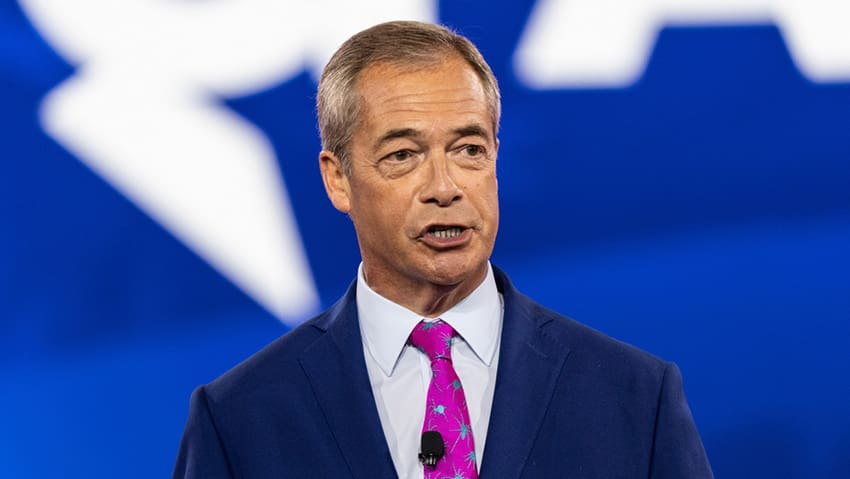
Reform UK is venturing into podcasting with a weekly show that will offer listeners behind-the-scenes access to Nigel Farage and senior figures within the party, marking the first time a British political party has produced its own audio programme.
The first episode, due out on Saturday, will feature footage from Reform’s campaign trail ahead of the local elections, including exchanges with both supporters and detractors. Subsequent instalments will follow Farage’s campaigning efforts in Wales and Scotland while covering major policy announcements in depth. The show will be available on Spotify and Apple, though the party has confirmed there are no plans to appoint a regular presenter.
The move represents a significant escalation in Reform’s broader digital media strategy, which has already seen the party invest tens of thousands of pounds in an in-house television studio. Farage commands a social media following of nearly 7.3 million across X, Facebook, TikTok, Instagram and YouTube, a figure that exceeds the combined followings of Sir Keir Starmer, Kemi Badenoch, Sir Ed Davey and Green Party leader Zack Polanski.
That digital dominance has translated into tangible political momentum. Reform now leads the national polls and has become the most popular party among Generation Z men, according to research by JL Partners for the think tank Onward. The party’s sharp use of TikTok has been widely credited as a driving force behind its surge in support among younger voters.
The podcast launch also underscores a growing tension between political parties and traditional broadcast media. Farage already hosts a primetime programme on GB News, a channel that has faced repeated scrutiny from Ofcom over its use of politicians as presenters. Culture Secretary Lisa Nandy has argued that Farage’s show is undermining public trust in news broadcasting.
Advertisement
Reform’s digital success has not gone unnoticed by its rivals. The Prime Minister joined both TikTok and Substack late last year, while Labour has enlisted FourOneOne, a digital marketing agency backed by Silicon Valley investors including LinkedIn founder Reid Hoffman, to mount a campaign targeting Reform on TikTok. The party has further strengthened its online presence following Robert Jenrick’s defection from the Conservatives, with the former shadow justice secretary having built a considerable profile through attention-grabbing social media content.
Farage said the podcast would bring listeners closer to the party’s operations in a way that no other political organisation has attempted, describing it as offering access to every aspect of Reform’s activities.
Amy Ingham
Amy is a newly qualified journalist specialising in business journalism at Business Matters with responsibility for news content for what is now the UK’s largest print and online source of current business news.
OpenAI’s much-trumpeted plans to build a major data centre in the north-east of England have ground to a halt, dealing a significant blow to Sir Keir Starmer’s strategy of placing artificial intelligence at the centre of Britain’s economic growth.
The maker of ChatGPT announced last September that it would bring its Stargate programme, a global data centre initiative originally valued at $500bn (£378bn), to British shores through a partnership with Nscale, the UK-based data centre operator. The initial plan envisaged housing approximately 8,000 Nvidia AI processors at Cobalt Park on Tyneside during the first quarter of 2026. That deadline has now passed without a spade in the ground, and OpenAI has declined to offer a revised timetable.
The reasons behind the delay remain unclear, though commercial negotiations between the parties are understood to be continuing. Both OpenAI and Nscale refused to comment on the state of play.
The Stargate concept was first unveiled by Sam Altman, OpenAI’s chief executive, at a White House press conference in January 2025 alongside Donald Trump. Altman subsequently pledged to extend the programme internationally, with the UK earmarked as a key location. In a government press release at the time, he described Stargate UK as part of a “shared vision” to expand opportunity through the right infrastructure.
The project was enthusiastically embraced by ministers, who have sought to position Britain as a global leader in AI. OpenAI further signalled its commitment to the UK by appointing George Osborne, the former Conservative chancellor, to spearhead its international expansion.
Advertisement
Yet the Tyneside setback is far from an isolated case. In the United States, negotiations over Stargate’s broader rollout have proceeded sluggishly, with key backer SoftBank among those yet to finalise terms. A planned expansion of a major site in Texas, being developed with the American data giant Oracle, was quietly shelved earlier this year.
The wider industry is grappling with similar headaches. Technology groups have collectively committed to spending hundreds of billions of dollars on data centres to satisfy surging demand for AI applications, but delivery is proving far harder than the headline figures suggest. Research by Sightline Climate indicates that up to half of all large-scale data centre projects are now running behind schedule, hampered by planning difficulties and constraints on energy supply.
Nscale, valued at $15bn and counting Sir Nick Clegg, the former deputy prime minister, among its board members, has itself been forced to push back timelines on a separate development in Loughton, Essex, as Business Matters reported last week.
Critics have been quick to seize on the lack of progress. Tom Hegarty, a spokesman for Foxglove, the campaign group that has raised concerns about the environmental impact of the data centre boom, said the Stargate UK project amounts to little more than a press release issued eight months ago.
Advertisement
The government maintained that it remains focused on fostering the right conditions for investment. A spokesman said ministers are continuing to work with OpenAI and other leading AI firms to strengthen the UK’s computing capacity. Whether that reassurance will be enough to quieten growing scepticism about the pace of delivery is another matter entirely.
Amy Ingham
Amy is a newly qualified journalist specialising in business journalism at Business Matters with responsibility for news content for what is now the UK’s largest print and online source of current business news.



















































You must be logged in to post a comment Login