Connect with us

Business

More frequent train services from Bristol Temple Meads to continue after government agreement

Published

on

Business Live

The news comes as the regional authority looks to build more stations across the South West

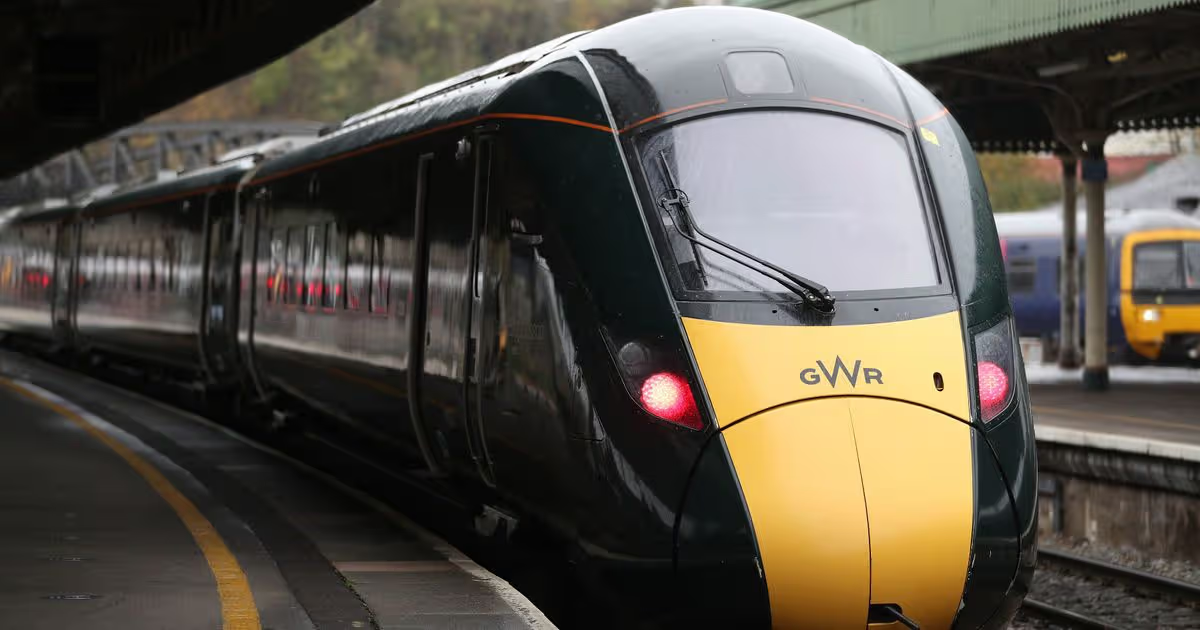
A GWR (Great Western Railway) train waiting on a platform at Bristol Temple Meads station

A train waiting on a platform at Bristol Temple Meads station (Image: Andrew Matthews/PA Wire)

More frequent trains on a number of lines from Bristol Temple Meads station will continue following an agreement with the government.

The West of England Combined Authority (Weca) said that since introducing half-hourly services on certain lines, there had been more than three million more train journeys on those routes.

The routes that will continue to offer more frequent services are:

  • Bristol Temple Meads to Westbury (part of the Heart of Wessex Line), also stopping at Keynsham, Oldfield Park, Bath Spa, Freshford, Avoncliff, Bradford-on-Avon, Trowbridge, and Westbury;
  • Bristol Temple Meads to Gloucester, via Yate, also stopping at Filton Abbey Wood and Bristol Parkway – and will also serve every hour the new Charfield station currently under construction;
  • Bristol Temple Meads to Severn Beach (the Severn Beach Line), also stopping at Lawrence Hill, Stapleton Road, Montpelier, Redland, Clifton Down, Sea Mills, Shirehampton, Portway Park and Ride, Avonmouth, St Andrews Road (hourly), and Severn Beach (hourly).

Weca said its “longer-term ambition” is to have four trains per hour serving stations across the network, after the region secured £752m investment for transport infrastructure improvements from the government last year.

The announcement comes as Weca prepares to unveil a new ‘Transport Vision for the West of England’ this week, setting out more details about the authority’s goals for the future.

Advertisement

Helen Godwin, mayor of the West of England, said: “Half-hourly services between Westbury, Gloucester via Yate, Severn Beach, and Bristol Temple Meads are important for local commuters, giving people more options to travel on our growing regional rail network.

“Our new agreement to protect these regular services is welcome news for passengers across the West Country. As we build five new train stations, and look to increase the frequency of services across the board, this is another vote of confidence in the West of England.”

Claire Young, MP for Thornbury and Yate, said she was “thrilled” with the news that train services in Yate would run on a half-hour frequency permanently.

“This is something I have campaigned hard for alongside local councillors and I raised the issue five times in Parliament,” she said.

Advertisement

“It also means that the new Charfield station will be able to run hourly trains. The half-hour service will support jobs in Yate and also help students to access colleges in the area.”

GWR Wales and West of England commercial development manager Hannah Shackleford added: “These aren’t just trains – they’re vital economic lifelines connecting communities and businesses across the region. The decision validates our belief that reliable rail services are essential for local and national growth.”

Two new railway stations have opened in the region in recent years: Portway Park and Ride, and Ashley Down.

Five more are being delivered as part of a wider £400m regional investment: Charfield, Henbury, North Filton, Pill, and Portishead.

Advertisement
Continue Reading
Click to comment

Leave a Reply

Your email address will not be published. Required fields are marked *

Business

Household spending falls

Published

on

Household spending falls

New ABS data has revealed household spending fell 0.4 per cent during December, reversing the trend of spending increases observed during the latter months of last year.

Continue Reading

Business

Apple Will Reportedly Release Entry-Level iPhone 17e with MagSafe and A19 Chip Upgrades

Published

on

CEO Tim Cook

Apple is set to maintain the entry-level price for its budget iPhone at $599, Bloomberg’s Mark Gurman reports.

According to the tech reporter, iPhone 17e is due imminently and will match the iPhone 16e’s price. For those who are looking to upgrade their current smartphone, this is a good sign to do that without paying flagship costs.

Upgraded Performance and Features

The Apple iPhone 17 Pro

The iPhone 17e brings several upgrades over its predecessor. It will include MagSafe charging, the A19 chip from the base iPhone 17, and Apple’s newest in-house cellular and wireless chips.

Gurman wrote that these enhancements promise faster processing, improved connectivity, and a smoother user experience, narrowing the gap between Apple’s budget and premium smartphones.

Camera and Design Enhancements

While the iPhone 16e faced criticism for its limited camera capabilities, the iPhone 17e introduces subtle improvements in imaging and performance, all while keeping the $599 price intact.

Advertisement

Apple appears to be striking a balance between affordability and meaningful upgrades, appealing to entry-level buyers without undercutting its higher-end models.

Target Markets and Competitive Edge

Per Engadget, Apple is positioning the iPhone 17e to capture buyers in emerging markets and enterprise sectors. With growing iPhone demand in China and India, the 17e could expand Apple’s footprint in Asia, even as it competes with devices like Google’s Pixel 10a.

Analysts predict Apple’s combination of strategic pricing and upgraded features will drive strong adoption globally. Introducing an upgraded model with the same entry price will be a massive magnet for fans who are looking to upgrade their old devices.

The new variant is reportedly coming with the same 16e display, according to a July report by Tech Times.

Advertisement

Originally published on Tech Times

Continue Reading

Business

QYLG: Covered Calls On The NDX, But In Its Own Way

Published

on

QYLG: Covered Calls On The NDX, But In Its Own Way

QYLG: Covered Calls On The NDX, But In Its Own Way

Continue Reading

Business

The Philanthropist Behind the Super Bowl Champion Seattle Seahawks

Published

on

The NFL logo appears on a goal post before the 2015 NFC Championship game between the Seattle Seahawks and the Green Bay Packers at CenturyLink Field in Seattle Jan. 18, 2015.

Jody Allen, chair of the Super Bowl LX champion Seattle Seahawks, has emerged as one of the most influential figures in professional sports and philanthropy following her brother Paul Allen’s death in 2018. As trustee of the Paul G. Allen Trust and chair of Vale Group (formerly Vulcan Inc.), she oversees a vast portfolio of assets while steering major teams and charitable initiatives. Here are 10 key things to know about the low-profile businesswoman and philanthropist who recently hoisted the Lombardi Trophy after Seattle’s 29-13 victory over the New England Patriots.

Jody Allen
Jody Allen
  1. Younger Sister of Microsoft Co-Founder Paul Allen Jody Allen, born Jo Lynn Allen on Feb. 3, 1959, in Seattle, is the younger sibling of Paul G. Allen, who co-founded Microsoft with Bill Gates in 1975. Raised in Seattle’s Wedgwood neighborhood by parents Kenneth Sam Allen, a University of Washington Libraries associate director, and Edna Faye Gardner Allen, a schoolteacher, the siblings shared a close bond. Jody graduated from Lakeside School in 1975 — the same elite private school attended by Gates — and studied drama at Whitman College, earning her degree around 1980.
  2. Co-Founder of Vulcan Inc. (Now Vale Group) In 1986, Jody co-founded Vulcan Inc. with Paul to manage family investments, projects and philanthropy. She served as CEO for years, handling day-to-day operations while Paul pursued broader visions in technology, real estate and science. Vulcan oversaw diverse holdings, including real estate developments like Lumen Field (home of the Seahawks) and the Moda Center (home of the Portland Trail Blazers). The company rebranded to Vale Group, with Jody as chair, continuing to execute Paul’s innovative projects.
  3. Chair of the Seattle Seahawks and Portland Trail Blazers As trustee of the Paul G. Allen Trust, Jody assumed control of the Seahawks after Paul’s 2018 death from non-Hodgkin lymphoma complications. She serves as chair, emphasizing the team’s role in fostering civic pride in Seattle. Similarly, she chairs the Portland Trail Blazers, which Paul bought in 1988. Under her leadership, the Seahawks won Super Bowl LX in 2026, marking the franchise’s second title and her first as chair. She proudly identifies as a “12,” the Seahawks’ fanbase nickname.
  4. Trustee of the Paul G. Allen Trust Paul’s will designated Jody as executor and sole trustee of his estate, valued at around $20 billion at his death. The trust holds the Seahawks, Trail Blazers (and a stake in the Seattle Sounders MLS team), requiring eventual sale of sports assets with proceeds directed to charity. Jody manages these holdings, preserving Paul’s vision while navigating complex legal and financial responsibilities. Despite Super Bowl success, she cannot personally profit from team sales due to the charitable mandate.
  5. Major Philanthropist Through Allen Family Philanthropies Jody co-founded and chairs Allen Family Philanthropies with Paul, focusing on arts and culture, youth development, environmental conservation and more. She also chairs the Fund for Science and Technology, supporting bioscience, environmental efforts and AI for good. Passionate about conservation, she founded Wild Lives Foundation in 2016 to combat wildlife trafficking and protect African elephants. She serves on boards like the Allen Institute and Sealife Response, Rehab and Research (SR3), emphasizing marine wildlife welfare in the Pacific Northwest.
  6. Founder and Director of MoPOP Jody is the founding director of the Museum of Pop Culture (MoPOP) in Seattle, a critically acclaimed institution celebrating music, film, science fiction and popular culture. Opened in 2000 as the Experience Music Project, it reflects the Allen family’s commitment to arts innovation. Jody remains actively involved, ensuring the museum’s role in cultural education and community engagement.
  7. Net Worth and Financial Influence Estimates place the assets Jody manages through the trust and Vale Group at around $20 billion, aligning with Paul’s wealth at death. Her personal net worth is harder to pinpoint due to private structures, but she ranks among the wealthiest sports owners, with the Seahawks valued over $6 billion in recent assessments. The 2026 Super Bowl win boosts franchise value further, though charitable directives limit personal gain.
  8. Low-Profile Yet Impactful Leadership Jody maintains a private life, avoiding the spotlight common among team owners. Described as detail-oriented and passionate about real estate and building projects, she earned praise for operational efficiency at Vulcan. Her quiet stewardship has sustained success across sports and philanthropy, with recent Super Bowl triumph highlighting her steady hand amid transition.
  9. Commitment to Civic Pride and Community Both the Seahawks and Trail Blazers serve as catalysts for regional identity under Jody’s watch. She recognizes sports’ power to unite communities, investing in facilities like Lumen Field that enhance Seattle’s landscape. Philanthropic efforts prioritize local youth programs, environmental initiatives and cultural access, reflecting a deep Seattle roots commitment.
  10. Navigating Future Transitions As trustee, Jody faces the mandate to sell the Seahawks and Trail Blazers, with proceeds benefiting charity. Despite the 2026 championship, rumors of pressure to divest persist, though she continues guiding both franchises. Her legacy intertwines Paul’s visionary entrepreneurship with her own focus on sustainable impact, conservation and community uplift.

Jody Allen’s story blends family legacy, business acumen and philanthropy. From co-founding Vulcan to leading Super Bowl champions and championing global causes, she upholds her brother’s innovative spirit while carving her distinct path in sports and giving.

Continue Reading

Business

Duratec subsidiary MEnD acquires RGK Resources

Published

on

Duratec subsidiary MEnD acquires RGK Resources

Duratec’s wholly owned subsidiary MEnD Consulting has recently acquired Port Kennedy-based RGK Resources.

Continue Reading

Business

Weight-loss jabs threaten Greggs’ growth, analysts warn

Published

on

Heathrow has said passenger numbers were 60% lower in November than before the coronavirus pandemic and there were “high cancellations” among business travellers concerned about being trapped overseas for Christmas as Omicron spreads. The UK’s largest airport said the government’s travel restrictions had dealt a fresh blow to travel confidence and predicted it was likely to take several years for passenger numbers to return to pre-pandemic levels. This week ministers said passengers arriving in the UK would have to take a pre-departure Covid test, as well as a post-flight test, because of fears about the spread of the new variant. “[The] high level of cancellations by business travellers concerned about being trapped overseas because of pre-departure testing shows the potential harm to the economy of travel restrictions,” the airport said in an update. Heathrow said the drop in traveller confidence owing to the new travel restrictions had negated the benefit of reopening the all-important corridor to North America for business and holiday travel last month. Eleven African countries have been added to the government’s red list, requiring travellers to quarantine before reuniting with families. “By allowing Brits to isolate at home, ministers can make sure they are reunited with their loved ones this Christmas,” said John Holland-Kaye, the chief executive of Heathrow. “It would send a strong signal that restrictions on travel will be removed as soon as safely possible to give passengers the confidence to book for 2022, opening up thousands of new jobs for local people at Heathrow. Let’s reunite families for Christmas.” Heathrow said that if the government could safely signal that restrictions would be lifted soon, then employers at Heathrow would have the confidence to hire thousands of staff in anticipation of a boost in business next summer. The airport is expecting a slow start to 2022, finishing next year with about 45 million passengers – just over half of pre-pandemic levels. This week Tui, Europe’s largest package holiday operator, said it expected bookings for next summer to bounce back to 2019 levels. However, Heathrow said on Friday not to expect the aviation industry to recover for several years. “We do not expect that international travel will recover to 2019 levels until at least all travel restrictions (including testing) are removed from all the markets that we serve, at both ends of the route, and there is no risk of new restrictions, such as quarantine, being imposed,” the airport said.

The growing use of weight-loss injections could dent demand for sausage rolls and pastries at Greggs, potentially depriving the bakery chain of some of its most lucrative customers, according to City analysts.

The warning comes as Greggs continues to grapple with slower sales growth since mid-2024, a period that has prompted investor speculation over whether the UK has reached “peak Greggs”. The company has attributed its softer performance to fragile consumer confidence and last summer’s unusually hot weather, which reduced footfall, while some shareholders have questioned whether its rapid store expansion has begun to cannibalise like-for-like sales.

Analysts at Jefferies have now added another potential headwind: the rising popularity of weight-loss drugs such as Mounjaro and Wegovy. In a note to clients, the broker said the trend could represent an “enduring challenge” for Greggs and weigh on its longer-term growth prospects.

The drugs work by mimicking the GLP-1 hormone, which suppresses appetite and increases feelings of fullness. Jefferies pointed to US research suggesting that users of such treatments tend to cut back particularly on high-calorie, ultra-processed savoury foods, a category that includes many of Greggs’ core products.

The analysts estimate that as many as four million people in the UK may now be using weight-loss jabs, equivalent to around 7.5 per cent of the adult population.

Advertisement

“It may only be 10 per cent of GLP-1 users that would shop at Greggs,” the Jefferies team said. “But that 10 per cent would be high-BMI individuals consuming lots of calories and, we would infer, likely some of Greggs’ best customers. Those customers could go from being among the most valuable to potentially never spending a penny with the business again.”

Roisin Currie, Greggs’ chief executive, acknowledged last month that there was “no doubt” weight-loss injections were having an impact on consumer behaviour. In response, the chain has begun expanding its healthier ranges, including products such as egg pots, to reflect shifting preferences.

Despite those efforts, Jefferies said the spread of weight-loss drugs should be seen as a “structural issue” rather than a passing trend. The broker cut its forecasts for Greggs’ like-for-like sales growth and profit margins and downgraded the stock to “hold” from “buy”, underlining the growing uncertainty facing one of Britain’s most recognisable high-street brands.


Amy Ingham

Amy is a newly qualified journalist specialising in business journalism at Business Matters with responsibility for news content for what is now the UK’s largest print and online source of current business news.

Advertisement

Continue Reading

Business

Raymond James upgrades Lumexa Imaging stock to Strong Buy with $23 target

Published

on


Raymond James upgrades Lumexa Imaging stock to Strong Buy with $23 target

Continue Reading

Business

UK government must end its boycott of British innovation, says Megaslice

Published

on

UK government must end its boycott of British innovation, says Megaslice

The UK government must overhaul its approach to public sector procurement if it is serious about backing British innovation, according to Justin Megawarne, managing partner at Megaslice, who has accused Whitehall of hiding behind rigid frameworks and “arbitrary scoring systems”.

Megawarne’s comments follow the decision to award Fujitsu a place on a government framework worth up to £984 million, despite the company’s central role in developing and supporting the Post Office Horizon IT system. The system led to the wrongful prosecution of 736 subpostmasters across the UK and has since become one of the most serious miscarriages of justice in modern British history.

Fujitsu had previously written to the government committing not to bid for new public contracts until the public inquiry into the Horizon scandal had concluded. Its inclusion on the framework has reignited debate about how the government selects suppliers — and whether it is doing enough to support genuine domestic innovation.

“If an organisation has performed so badly for its customers that it has become a national scandal and warranted its own TV drama, surely it’s time the government spent its money elsewhere,” Megawarne said.

“With so much public money wasted on technology that isn’t fit for purpose, and in this case fraudulently criminalised people, the budget for real innovation continues to shrink. We are failing to support the next generation of founders who are building genuinely innovative businesses, instead recycling contracts to the same organisations that have failed us before.”

Advertisement

Megawarne argues that government procurement processes are fundamentally flawed, relying too heavily on mechanistic evaluation tools that struggle to identify real value.

“Current approaches to adopting new technology are overcomplicated and painfully slow,” he said. “Scoring sheets don’t capture innovation. If the government actually engaged with businesses instead of keeping them at arm’s length, we could save millions of pounds currently wasted on the wrong solutions.”

Rather than relying on civil servants to assess complex and novel technologies, Megawarne believes the government should enlist independent industry leaders with proven innovation credentials.

“Let experts judge ideas using their experience and judgement, not a spreadsheet,” he said. “Yes, some will say that sounds unfair, but it dramatically increases the chances of finding a genuinely game-changing solution. You simply need to ensure those experts have no conflicts of interest.”

Advertisement

He added that procurement decisions are too often driven by price rather than outcomes. “Spending less on the wrong solution isn’t saving money at all. Much of what’s been invested in so far has failed to solve the day-to-day problems government departments actually face.”

Megawarne also criticised what he sees as the government’s default preference for large, established suppliers, regardless of past performance.

“The mindset is still, ‘no one ever got fired for buying IBM’,” he said. “It’s a way of avoiding responsibility. If something goes wrong, you can always point at the big name.”

In the case of Fujitsu and the Post Office Horizon system, he said the failure was neither minor nor isolated. “This wasn’t a simple error. It destroyed lives. The company apologised only when it was forced to, and repeatedly resisted compensation. Yet here we are again, awarding more public contracts.”

Advertisement

According to Megawarne, the same pattern plays out repeatedly across government IT spending. “Huge consultancies win major contracts, fail spectacularly, and face no real consequences. It’s a cycle of failure with zero accountability.”

At the heart of the problem, Megawarne believes, is an institutional aversion to risk.

“True innovation exists in the UK, and much of it sits with founders who are building solutions that could genuinely transform public services,” he said. “But the government is fundamentally risk-averse.”

He warned that founders are being steered down the wrong path, optimising for procurement scorecards rather than solving real problems. “They chase perfect scores on frameworks that measure the wrong things, while innovation is sidelined in favour of cost-cutting and box-ticking.”

Advertisement

“If the government genuinely wants to unlock British innovation,” Megawarne added, “it needs to stop prioritising spreadsheets over people, and start backing ideas that actually work.”


Amy Ingham

Amy is a newly qualified journalist specialising in business journalism at Business Matters with responsibility for news content for what is now the UK’s largest print and online source of current business news.

Advertisement
Continue Reading

Business

Golub Capital: Too Risky To Touch Despite 15% Dividend Cut

Published

on

Golub Capital: Too Risky To Touch Despite 15% Dividend Cut

Golub Capital: Too Risky To Touch Despite 15% Dividend Cut

Continue Reading

Business

Ranked from Prince to Bad Bunny

Published

on

The NFL logo appears on a goal post before the 2015 NFC Championship game between the Seattle Seahawks and the Green Bay Packers at CenturyLink Field in Seattle Jan. 18, 2015.

The Super Bowl halftime show has evolved from marching bands and novelty acts into one of the world’s biggest annual music spectacles, drawing more than 100 million viewers and often generating as much buzz as the game itself. With Bad Bunny’s historic 2026 performance featuring Lady Gaga and Ricky Martin still fresh in memory, here is a ranking of the 10 greatest Super Bowl halftime shows of all time, based on cultural impact, production value, surprise moments, viewership records and lasting legacy.

Prince – Super Bowl XLI (2007) Widely regarded as the gold standard, Prince delivered a rain-soaked masterpiece in Miami. Performing “Purple Rain” under a torrential downpour, the purple lights reflecting off the sheets of rain created an otherworldly visual. He covered Foo Fighters’ “Best of You,” shredded on guitar during “Purple Rain,” and closed with a silhouette against a giant Prince symbol. The show’s raw energy, technical brilliance and defiance of weather conditions cemented Prince’s legacy. Many critics and fans still call it the greatest halftime performance ever.

Beyoncé – Super Bowl XLVII (2013) After announcing her surprise reunion with Destiny’s Child, Beyoncé delivered a fierce, 13-minute set that included “Crazy in Love,” “Baby Boy,” “Single Ladies” and a medley of DC classics with Michelle Williams and Kelly Rowland. The choreography was razor-sharp, the staging minimalist yet powerful, and the Destiny’s Child reunion moment sent shockwaves through social media. It remains one of the most-watched and most-replayed halftime shows, with Beyoncé’s command of the stage unmatched.

Advertisement

Michael Jackson – Super Bowl XXVII (1993) The performance that transformed the halftime show forever. Michael Jackson stood motionless for 90 seconds as the Rose Bowl crowd erupted, then launched into “Jam,” “Billie Jean,” “Black or White” and “Heal the World.” The spectacle introduced pyrotechnics, massive choreography and celebrity cameos (including children holding signs spelling “Heal the World”). It drew 133.5 million viewers — a record at the time — and set the template for modern halftime extravaganzas.

Lady Gaga – Super Bowl LI (2017) Lady Gaga leapt from the stadium roof, flew across the field on wires and delivered a patriotic, high-flying medley of “God Bless America,” “This Land Is Your Land,” “Poker Face,” “Bad Romance,” “Telephone,” “Born This Way,” “The Edge of Glory,” “Million Reasons” and “Just Dance.” The production was cinematic, the message unifying, and her live vocals under physical duress earned universal praise. It remains one of the most technically ambitious and emotionally resonant shows.

Advertisement

The Weeknd – Super Bowl LV (2021) In a pandemic-era spectacle at Raymond James Stadium, The Weeknd invested $7 million of his own money into a labyrinthine set that mirrored his “After Hours” aesthetic. He performed “Starboy,” “The Hills,” “Can’t Feel My Face,” “I Feel It Coming,” “Save Your Tears” and “Blinding Lights,” complete with a hall-of-mirrors effect and a bloody bandage reveal. The show’s cinematic quality and commitment to artistic vision earned it high marks despite no live crowd.

Shakira & Jennifer Lopez – Super Bowl LIV (2020) A celebration of Latin culture, this high-octane performance featured Shakira’s belly-dancing flair and J.Lo’s pole-dancing prowess, backed by Bad Bunny, J Balvin and Emme Muñiz. Hits included “Hips Don’t Lie,” “Whenever, Wherever,” “Jenny from the Block” and “Let’s Get Loud.” The vibrant costumes, intricate choreography and powerful message of Latino pride made it one of the most culturally significant shows, drawing massive global attention.

Advertisement

U2 – Super Bowl XXXVI (2002) Just months after 9/11, U2 delivered a poignant, stripped-down set in the Superdome. Bono opened with “Beautiful Day,” then the band performed “MLK” and “Where the Streets Have No Name” beneath a massive, billowing American flag projection listing names of 9/11 victims. The emotional weight, Bono’s salute to New York firefighters and the raw sincerity made it unforgettable.

Madonna – Super Bowl XLVI (2012) Madonna’s theatrical extravaganza featured LMFAO, Nicki Minaj, M.I.A. and CeeLo Green. She performed “Vogue,” “Music,” “Give Me All Your Luvin’,” “Like a Prayer” and “Ray of Light” in elaborate costumes and with Cirque du Soleil-style acrobatics. The show’s scale, production value and star-studded collaborations made it a benchmark for spectacle.

Advertisement

Katy Perry – Super Bowl XLIX (2015) The most-watched halftime show ever (118.5 million viewers), Perry’s performance included a giant mechanical lion, dancing sharks, a beach scene with “Teenage Dream” and a closing “Firework” with fireworks exploding overhead. Missy Elliott’s surprise appearance added hip-hop energy. The sheer fun, color and viral moments (Left Shark) made it a pop-culture phenomenon.

Bad Bunny – Super Bowl LX (2026) In a groundbreaking performance, Bad Bunny became the first Latino solo headliner and the first to perform primarily in Spanish. Joined by Lady Gaga for a Latin remix of “Die with a Smile” and Ricky Martin for “Lo Que Le Pasó a Hawaii,” the set celebrated Puerto Rican heritage with a live wedding ceremony, marketplace staging and cameos from Pedro Pascal, Jessica Alba, Karol G and Cardi B. The joyful, inclusive energy and bold cultural statement earned immediate acclaim as one of the most significant halftime shows in history.

Advertisement

Honorable mentions include Justin Timberlake & Janet Jackson (2004, infamous for the wardrobe malfunction), Bruce Springsteen & the E Street Band (2009), Coldplay with Beyoncé & Bruno Mars (2016), and Rihanna (2023).

The Super Bowl halftime show has become a cultural institution, blending music, spectacle and social commentary. From Prince defying the rain to Bad Bunny celebrating Latino pride on the world’s biggest stage, these performances continue to shape how America — and the world — experiences live entertainment.

Advertisement
Continue Reading

Trending

Copyright © 2025