
Business
Opinion | The Phone Call That Will Fix Everything

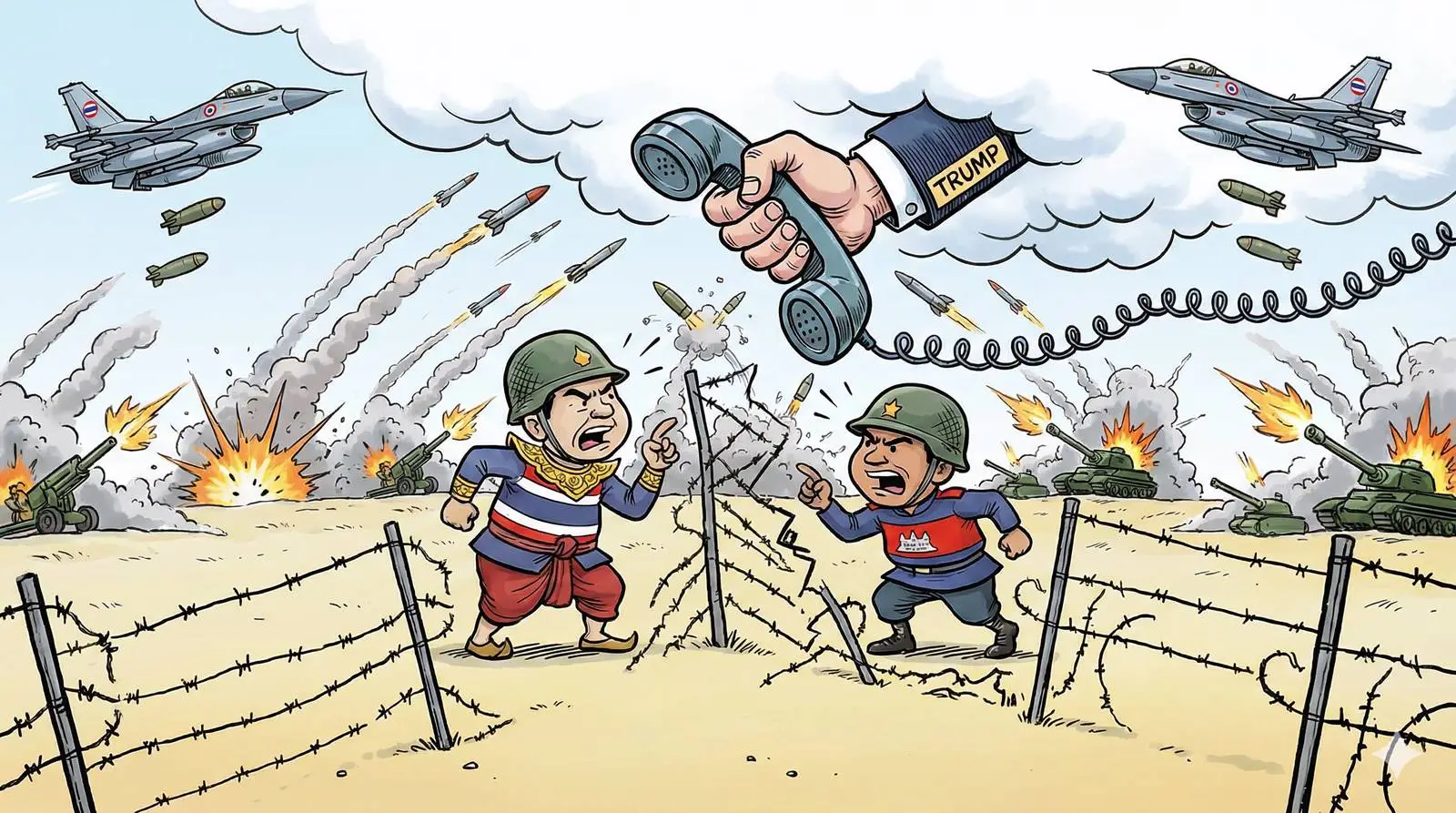
As casualties rise along the Thai‑Cambodian border, the world is once again being reassured that a single phone call — the phone call — is all it will take to calm a conflict that has already stretched into its fifth day. Thailand reports nine soldiers killed and dozens injured; Cambodia counts at least ten civilian deaths and around sixty seriously hurt. Evacuation centers in Surin are filling, artillery exchanges continue, and regional diplomats are scrambling to keep the situation from escalating further.
“Who else could say, ‘I’m going to make a phone call and stop a war’?”
President Trump’s question to a rally crowd in Pennsylvania on Tuesday was rhetorical, but for those of us watching the artillery smoke rise along the border, the answer is anything but simple. But just today Thailand’s foreign minister stated in an interview on Tuesday that he saw no prospects for negotiations in the border conflict, emphasizing that the situation was unsuitable for third-party mediation.
But not to worry. The President of the United States says he plans to make a call. The phrasing alone feels like déjà vu: the familiar confidence that complex geopolitical tensions can be resolved with the ease of ordering takeout. However, the reality on the ground is not transactional; it is historical and structural. The dispute over the Preah Vihear temple complex is not just about lines on a French colonial map; it is a deep-seated nationalist trigger for both nations. When domestic approval ratings dip in Bangkok or Phnom Penh, the border heats up. No phone call from the White House removes that political incentive.
It’s hard not to notice the timing. A simmering border dispute, rising casualties, and a stage perfectly set for a leader eager to craft a legacy moment — perhaps even one worthy of a certain Scandinavian committee. After all, few narratives sparkle quite like “I stopped a Southeast Asian conflict with a single call.” It’s the kind of storyline that fits neatly into a campaign reel, a memoir chapter, or a long‑imagined Nobel acceptance speech.
Meanwhile, on the ground, the reality is far less cinematic. Border clashes between Thailand and Cambodia are rooted in decades of territorial friction, political sensitivities, and military posturing. These are not the sorts of problems that melt away because someone in Washington picks up the phone. Diplomacy in this region is slow, layered, and often fragile — the opposite of the quick‑fix mythology being projected.
A peace that relies entirely on the mood and attention span of a distant superpower is not stability—it is a pause. Businesses require predictability. We need to know that supply chains running through Cambodia to Vietnam are secure for Q1 and Q2, not just for the duration of a news cycle. Sustainable stability will not come from Mar-a-Lago. It will come when the economic integration between Thailand and Cambodia becomes too valuable to jeopardize for cheap nationalist points. It will come when the business lobbies in both nations make it clear to their respective governments that the cost of conflict outweighs the political gain of a border skirmish.
Still, the promise of the phone call persists. It’s a tidy solution in a messy world, a headline‑friendly gesture that suggests control even when events are spiraling. And if the conflict doesn’t immediately resolve? Well, that’s just the world failing to appreciate the power of the gesture.
For now, the artillery continues, the casualty numbers climb, and evacuation centers remain crowded. But any minute now — we’re told — peace is just one call away.



