Pfizer Inc.’s stock traded modestly higher near $27.14 in late February 2026, closing at $27.14 on February 24 after a 0.30% gain, as the pharmaceutical giant builds on solid fourth-quarter and full-year 2025 results that beat expectations while reaffirming its 2026 outlook despite anticipated revenue pressures from declining COVID-19 products and patent expirations.
Illustration shows Pfizer logo
As of February 24, 2026, Pfizer (NYSE: PFE) traded in a session range of $27.08 to $27.42 with volume of approximately 34.7 million shares. The shares have risen about 6-7% over the past month and remain near the upper end of their 52-week range from around $20.92 to $27.94. Market capitalization stands near $153-154 billion, reflecting cautious optimism amid a transitional period for the company.
The performance follows Pfizer’s fourth-quarter and full-year 2025 earnings released February 3, 2026. The company reported full-year revenue of $62.6 billion, down 2% operationally year-over-year, but non-COVID portfolio revenues grew 6% operationally. Fourth-quarter revenue reached $17.6 billion, down 3% operationally, while adjusted diluted EPS for Q4 hit $0.66, beating consensus estimates of around $0.56-$0.57 by $0.09-$0.10. Full-year adjusted diluted EPS came in at $3.22, above prior guidance ranges.
Excluding contributions from Comirnaty and Paxlovid, the company delivered strong underlying growth driven by oncology, rare disease, and other key franchises. Management highlighted disciplined execution, cost savings, and margin expansion, with adjusted gross margin reaching 76% for the year. Free cash flow remained robust, supporting $9.8 billion in dividend payments and investments in R&D and business development, including the Metsera acquisition and other deals adding to the obesity and immunology pipeline.
Pfizer reaffirmed its full-year 2026 guidance, projecting revenue of $59.5 billion to $62.5 billion and adjusted diluted EPS of $2.80 to $3.00. The outlook incorporates approximately $5 billion in expected COVID-19 product revenues and a roughly $1.5 billion negative impact from products facing loss of exclusivity (LOE). Non-COVID and non-LOE revenues are anticipated to grow about 4% operationally at the midpoint. The guidance also reflects productivity savings of $7.2 billion targeted by end-2026, manufacturing program savings of $1.5 billion by 2027, and continued investment in approximately 20 key pivotal study starts planned for 2026.
Advertisement
CEO Albert Bourla described 2025 as “a very good year” marked by strong execution, while noting 2026 as a catalyst-rich period with pivotal trials advancing, including in obesity (ultra-long-acting assets from Metsera) and oncology (PD-1 x VEGF bispecific from 3SBio). The company emphasized its late-stage pipeline strength and strategic focus on high-value therapeutic areas to offset headwinds.
Analysts remain mixed but generally constructive on the long-term outlook. Consensus among 22 analysts rates PFE a Hold, with average 12-month price targets around $27.70—implying modest upside of about 2% from recent levels. Targets range from lows near $23-$24 to highs of $35, reflecting divergence on pipeline execution and revenue risks. Some firms maintain Buy ratings citing undervaluation and dividend appeal (yield around 6.3-6.4%), while others express caution over patent cliffs and modest growth prospects.
The next earnings report, for first-quarter 2026, is expected in late April or early May 2026. Investors will scrutinize updates on non-COVID growth, pipeline milestones, cost discipline, and any refinements to full-year guidance amid evolving macro and policy dynamics.
Pfizer continues navigating a post-COVID landscape with a diversified portfolio, robust cash flow, and aggressive R&D investment. While near-term revenue faces headwinds from declining pandemic products and LOE impacts, the company’s scale, pipeline advancements, and shareholder returns position it for potential recovery as new therapies launch in coming years. With shares trading at attractive multiples relative to historical averages and peers, Pfizer remains a core holding for income-focused investors seeking stability in healthcare.
More than two decades into his career, Chris Brown remains one of R&B and pop’s most consistent hitmakers, with his catalog dominating streaming platforms in 2026. “Under The Influence” stands tall as his most-streamed track on Spotify with over 1.8 billion plays, while classics like “No Guidance” and early smashes continue to rack up millions of daily streams.
Chris Brown
Brown, affectionately known as Breezy, has released more than a dozen studio albums since bursting onto the scene in 2005. His blend of smooth vocals, sharp dance moves and genre-blending production has earned him multiple Grammy Awards and a dedicated global fan base. As of April 2026, his music continues to resonate across generations, with newer releases from the “11:11” era mixing seamlessly with decade-old favorites on playlists and radio.
Compilations of his greatest hits in 2026 frequently highlight the same core tracks, though rankings vary slightly depending on whether the metric is Billboard chart performance, Spotify streams or critical acclaim. Here is a consensus top 10 drawn from current streaming data, historical chart peaks and enduring popularity.
No. 10: “Forever” (2008, from “Exclusive”) Originally created for a Doublemint gum commercial, “Forever” became an anthem for celebrations and young love. The upbeat track peaked at No. 2 on the Billboard Hot 100 and has amassed over 800 million Spotify streams. Its infectious chorus and energetic production helped cement Brown as a pop crossover star. In 2026, it remains a staple at weddings and parties.
No. 9: “With You” (2007, from “Exclusive”) Brown delivered a more acoustic, heartfelt ballad with “With You,” which climbed to No. 2 on the Hot 100. The Stargate-produced song showcased his vulnerable side and strong vocal range. It has surpassed 690 million streams on Spotify and continues to appear on romantic playlists worldwide. Critics often cite it as one of his purest pop-R&B moments.
Advertisement
No. 8: “Loyal” (featuring Lil Wayne and Tyga, 2014, from “X”) A club and radio domination track, “Loyal” became a cultural catchphrase. It peaked at No. 9 on the Hot 100 but spent weeks atop urban charts. The song’s catchy hook and featured verses made it a party staple. In 2026 it still receives heavy airplay and features prominently in throwback sets.
No. 7: “Look At Me Now” (featuring Lil Wayne and Busta Rhymes, 2011, from “F.A.M.E.”) This high-energy hip-hop track highlighted Brown’s rapid-fire flow alongside two rap legends. It earned a Grammy nomination and became one of his most acclaimed rap-leaning releases. The song’s fast-paced delivery and infectious beat keep it popular among fans who appreciate his versatility.
No. 6: “Run It!” (2005, from “Chris Brown”) Brown’s debut single announced his arrival at age 16. The dance-heavy track topped the Hot 100 for five weeks and introduced the world to his smooth vocals and impressive choreography. It remains a foundational hit that defined early 2000s R&B-pop and still lights up dance floors in 2026.
No. 5: “Go Crazy” (with Young Thug, 2020, from “Slime & B”) Released during the pandemic, “Go Crazy” became a massive streaming success and cultural moment. The bouncy, feel-good track spent months on charts and inspired countless TikTok dances. It helped keep Brown relevant during a challenging period and continues to generate streams daily.
Advertisement
No. 4: “Fine China” (2013, from “X”) A bold artistic shift, “Fine China” paid homage to Michael Jackson and Stevie Wonder with its retro-soul groove. The single showcased Brown’s maturity as an artist and received praise for its sophisticated production. It stands as one of his most critically respected releases.
No. 3: “No Guidance” (featuring Drake, 2019, from “Indigo”) After years of speculation about their relationship, Brown and Drake delivered a smooth, sultry collaboration that exceeded expectations. “No Guidance” became a chart smash and has accumulated more than 1.29 billion Spotify streams. Its sensual vibe and polished production made it a late-2010s R&B highlight.
No. 2: “Kiss Kiss” (featuring T-Pain, 2007, from “Exclusive”) Featuring T-Pain’s signature auto-tune, “Kiss Kiss” topped the Hot 100 for three weeks. The playful, flirtatious track captured the fun side of Brown’s artistry and became a defining song of the mid-2000s. Its energy still resonates with fans two decades later.
No. 1: “Under The Influence” (2022, from “Indigo”) Currently Brown’s biggest streaming success with over 1.83 billion plays on Spotify as of April 2026, “Under The Influence” blends seductive R&B with modern production. The track’s moody atmosphere and catchy melody have made it a favorite for late-night listening and playlists. It exemplifies how Brown’s catalog continues to thrive years after release, often outperforming newer singles in daily streams.
Advertisement
Beyond these standouts, Brown’s recent work from the “11:11” album and its deluxe editions, including tracks like “Residuals,” has earned radio success and Grammy consideration. In 2026 he continues dropping new music and collaborations, keeping his output fresh while his classics maintain strong catalog performance.
Brown’s ability to evolve across pop, R&B and hip-hop has sustained his relevance. From teenage heartthrob to seasoned veteran, he has navigated personal challenges while consistently delivering hits. His dance skills, often showcased in elaborate music videos, add another layer to his artistry that fans still celebrate.
Streaming has reshaped how fans engage with his music. Playlists and algorithms keep older tracks alive, while viral moments on TikTok and social media introduce his catalog to new generations. In early 2026, Brown’s total streams across platforms continued to climb, with several songs crossing major milestones.
Advertisement
Critics and fans alike note his vocal talent and production instincts. Whether delivering heartfelt ballads or high-energy club tracks, Brown demonstrates range few artists match. Collaborations with stars like Usher, Future and Drake have expanded his reach without diluting his signature sound.
As Brown approaches his 37th birthday later in 2026, his music shows no signs of slowing. Tours, new releases and constant catalog rotation ensure he remains a fixture in contemporary R&B. Playlists titled “Chris Brown Greatest Hits 2026” and similar collections on YouTube and Spotify draw millions of views and plays, proving the staying power of his best work.
For new listeners or longtime fans revisiting his discography, these 10 songs offer an ideal entry point. They capture the evolution of an artist who helped define modern R&B while pushing boundaries in pop and dance music.
Brown’s influence extends beyond charts. His style, choreography and emotional delivery have inspired countless emerging artists. In an era where streaming metrics often define success, his ability to maintain high daily streams on decade-old tracks underscores genuine fan connection.
Advertisement
As the music industry continues shifting toward catalog consumption, Chris Brown’s top songs illustrate how quality songwriting and versatile performance create lasting value. Whether you’re discovering him in 2026 or have followed since “Run It!,” these tracks represent the best of Breezy — catchy, emotional and undeniably danceable.
The team at Cumbria Employment Solicitors will integrate into Sintons’ operations
Chris Welch is managing partner at Sintons LLP in Newcastle(Image: David Wood – for Sintons LLP)
Newcastle law firm Sintons has announced the acquisition of a Cumbrian solicitors firm.
Sintons said the deal for Cumbria Employment Solicitors would extend its reach across the North and represented both an extension of its geographical footprint and investment in what it called “heavyweight legal talent.”
Cumbria Employment Solicitors has been established for more than 15 years and its link-up with Sintons will allow it to add more legal services for its clients. Michael Bauer and his team will be fully integrated into the Sintons’ employment team.
Christopher Welch, managing partner at Sintons, said: “Sintons are in a period of sustained, strategic growth. We are delighted to bring Cumbria Employment Solicitors into the Sintons’ family.
Advertisement
Sintons office in Newcastle(Image: Newcastle Journal)
“However, this isn’t just a talent acquisition; this is part of our strategic drive to expand into different geographic regions by partnering with people who have a proven track record whilst sharing our values of client excellence. This latest move, when coupled with our continued growth in the Yorkshire region means that we are bigger, stronger, and more capable than ever.
“When I first started to speak to Michael, I was immediately struck not only by his talent as an employment lawyer but also by his passion for his clients and for the region in which he has lived and worked the majority of his career. I knew instantly that we had found people and a firm that we could work with for the benefit of all our clients.”
Michael Bauer, partner at Sintons, added: “Joining forces with Sintons was the natural next step for us. To continue to compete at the highest level, you need the resources and backing of a larger firm.
“By joining with Sintons, we are giving our existing client base access to the range of services and to the expertise in other areas of law that only a firm of this stature can provide. We now have the right platform to drive the growth of our combined business across Cumbria whilst still delivering the excellent, and personal, service for which we are known.”
Advertisement
Earlier this year Sintons toasted record revenues and the expansion of its workforce. The company, based at The Cube on Barrack Road, published accounts in which revenues rose 6.5% to £19.3m, while employee numbers rose to 180.
Britain’s high streets enjoyed a welcome lift last month as an early Easter drew shoppers back through the doors, but retailers are warning that the bounce may prove fleeting as a fresh wave of tax rises and wage costs bears down on the sector this month.
Total UK footfall climbed 2.4 per cent year-on-year in March, according to figures from the British Retail Consortium (BRC), reversing a grim start to the year that saw shopper numbers fall by 0.6 per cent in January and a chastening 4.5 per cent in February as persistent wet weather kept high streets quiet.
Yet behind the headline figure lies a more anxious story. The BRC cautioned that the Easter uplift, which arrived earlier than usual this year, fell short of what retailers had been banking on, leaving many in no mood to celebrate as April’s cost pressures begin to bite.
Shopping centres led the recovery with a 2.6 per cent rise, followed closely by retail parks at 2.5 per cent, while high streets themselves managed a more modest two per cent gain. Regionally, Manchester staged the strongest comeback, with total footfall surging by more than nine per cent, while London edged ahead of the national average at 3.3 per cent.
Helen Dickinson, chief executive of the BRC, struck a cautious note. With Easter and the school holidays falling earlier this year, she said, retailers had been expecting a stronger boost than March actually delivered. Warmer weather might help sustain momentum in the coming weeks, Dickinson added, but without a repeat lift in April the recovery was far from assured.
Advertisement
Andy Sumpter, retail consultant at Sensormatic, which compiles the BRC’s footfall data, was blunter still, suggesting that March would have recorded a decline altogether were it not for the Easter effect. He pointed to a worrying cocktail of falling consumer confidence, geopolitical uncertainty and rising living costs, not least at the petrol pump, as reasons shoppers are cutting back on discretionary trips. The real test, he argued, will be whether footfall can hold up once the Easter boost fades and tougher year-on-year comparisons return.
The mood among retail chiefs has been lifted, if only tentatively, by President Trump’s announcement of a two-week ceasefire, although that deal has since been cast into doubt. The BRC noted that a reopening of the Strait of Hormuz, should it materialise, could bring global energy prices back towards more manageable levels before the bulk of companies come to renew their supply contracts.
Even so, the warning lights on the retail dashboard remain firmly on. Trade bodies representing both retail and hospitality are sounding the alarm over mounting employment costs and April’s hike to business rates, which together threaten to swallow any windfall the Easter trade may have produced.
Dickinson urged ministers to do their bit by easing the burden of domestic policy costs, arguing that lower overheads would free operators to invest in value, experience and their in-store offer, the very things, she said, that help drive footfall and breathe life into local economies.
Advertisement
For Britain’s SMEs, which make up the bulk of independent high-street operators, the message from the data is unmistakable. Easter has provided a fleeting reprieve, but the structural pressures squeezing margins show little sign of easing. Whether March’s modest rebound proves to be the first swallow of summer or merely a brief interlude before tougher trading conditions return will, retailers fear, come down to decisions taken in Whitehall as much as on the shop floor.
Jamie Young
Jamie is Senior Reporter at Business Matters, bringing over a decade of experience in UK SME business reporting.
Jamie holds a degree in Business Administration and regularly participates in industry conferences and workshops.
When not reporting on the latest business developments, Jamie is passionate about mentoring up-and-coming journalists and entrepreneurs to inspire the next generation of business leaders.
The Gateshead company is a former North East Company of the Year
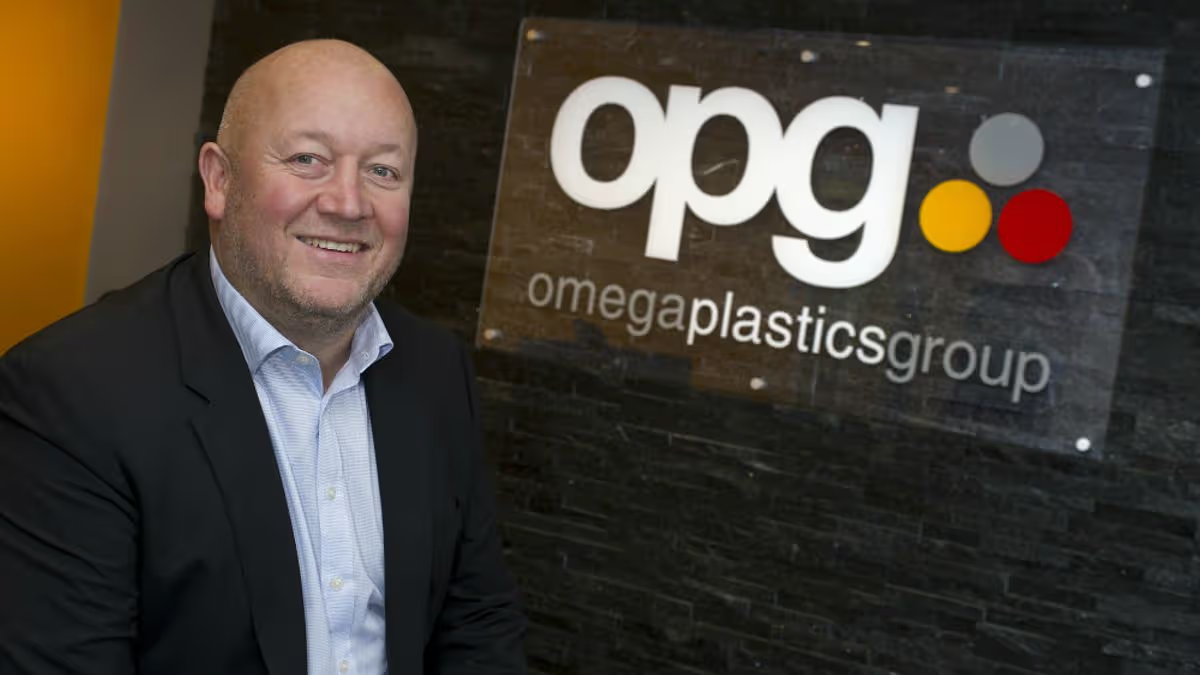
Dave Crone, managing director of Omega Plastics Group(Image: Unknown)
A former North East Company of the Year has been sold after the retirement of its long-time owner.
Dave Crone has stepped down as group managing director of Gateshead firm Omega Plastics after nearly 30 years with the company. The business has been acquired by Chris Thompson and Mark Thornton, both of whom have previously worked in senior positions at Omega.
The company, which has sites in Gateshead, Washington and Hartlepool, won the top prize at the North East Business Awards in 2017. Its most recent accounts show turnover of just over £7m and a headcount of 89.
As part of the takeover, the company will consolidate its operations to a single site in Team Valley.
Advertisement
In a statement to mark his retirement, Mr Crone said: “Having recently celebrated my 66th birthday, and after nearly 30 years with Omega Plastics, I have decided the time is right to sell my shares and step back from my role as group managing director. I want to reassure you that this transition has been carefully planned to ensure the future success and stability of the company. As part of this transaction, the business has secured significant additional investment to support our next phase of development.
“This business has been a lifelong passion of mine, and whilst it is an emotional milestone, I am incredibly proud of the journey we have shared and the business we have built together.
“I am delighted to confirm that the business has been acquired by Chris Thompson and Mark Thornton, both of whom have deep historical ties to Omega Plastics and a genuine passion for its success.
“Fundamental to my wish to retire was ensuring that Omega Plastics Group secured the correct leadership and investment to support its long- term objectives and sustainability. After detailed discussions with Chris and Mark it was clear they shared the same vision, were supportive of the needs of the business and through Chris’ ownership of the Gateshead facility they were also able to provide additional benefits that their ownership could bring to a single site operation.
Advertisement
“This investment gives the business significant increased working capital and additional funding to drive a transformational move to a single site in Gateshead, which will facilitate improved efficiencies and enhanced levels of service for you, our customers.”
Mr Thompson helped start the firm in the 1990s and remained a shareholder until 2024 when he left to become CEO at Express Engineering. Mr Thornton was a member of the company’s executive team in 2019 and 2020.
Mr Crone added: “We understand that the plastics sector has faced well-publicised challenges recently. Because of this, I want to be clear: Omega Plastics Group is now stronger, better funded, and more ambitious than ever.”

























































You must be logged in to post a comment Login