
Business
Thailand Shifts Focus on Border Disputes, Targeting Cybercrime Syndicates

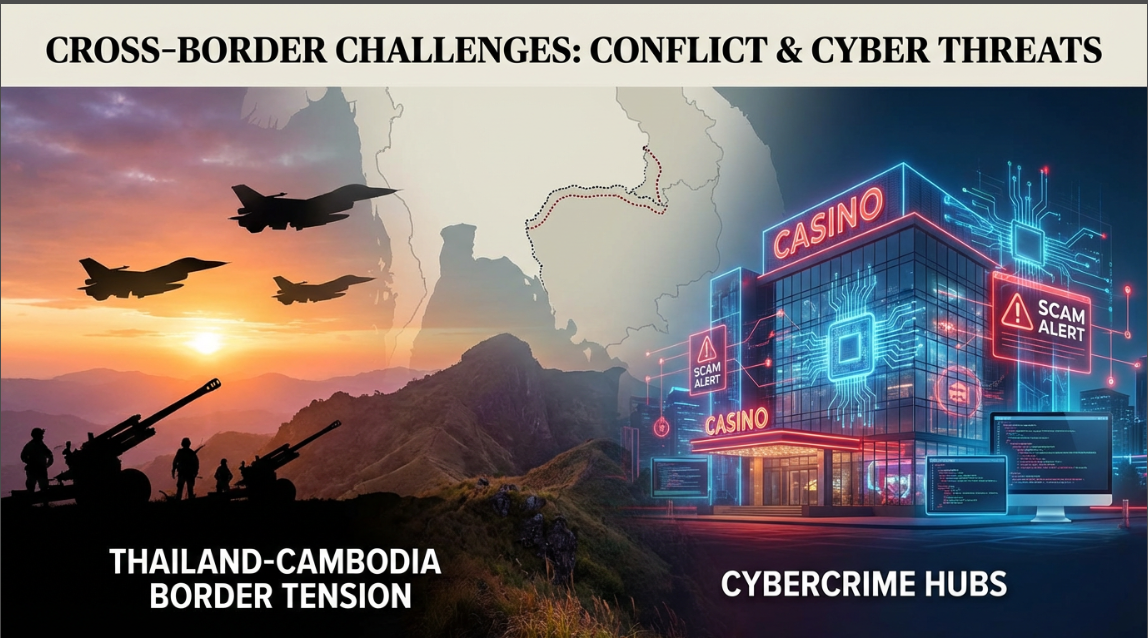
Thailand is repositioning its escalating military confrontation with Cambodia as a decisive offensive against sprawling cybercriminal operations clustered along the disputed frontier between the two Southeast Asian neighbors.
Key takeaways
- Thailand has reframed its military strikes against Cambodia as a campaign against cybercrime syndicates operating massive scam compounds along their disputed border, rejecting ceasefire calls until Cambodia dismantles these operations.
- Southeast Asian scam centers generate an estimated $41 billion annually and hold hundreds of thousands of trafficked victims in forced labor conditions, with operations deeply embedded in Cambodia’s ruling establishment.
- The conflict has escalated amid political tensions following Cambodia’s role in ousting Thailand’s former prime minister, with Thai F-16 strikes now targeting facilities previously sanctioned by the U.S. for operating forced labor scam compounds.
Hostilities reignited this month with artillery barrages and aerial bombardments following a brief respite in clashes that erupted in July over longstanding territorial grievances.
Bangkok now characterizes this month’s air strikes against Cambodian casino and hospitality facilities as an essential component of its “war against the scam army.”
Speaking Wednesday at an international anti-scam summit in Bangkok, caretaker Prime Minister Anutin Charnvirakul declared that peace remains unattainable until Cambodia’s Phnom Penh administration takes decisive measures to “destroy scamming attempts,” according to AFP reporting. Anutin previously dismissed ceasefire appeals, stating via social media just hours after U.S. President Donald Trump announced a purported truce agreement that Thailand would “continue to perform military actions until we feel no more harm and threats to our land and people.”
Industrial-Scale Criminal Operations
Transnational criminal syndicates generating tens of millions of dollars daily through online fraud operate from fortified compounds dispersed throughout Cambodia and broader Southeast Asia, with a significant concentration in Poipet, a Cambodian border city renowned for its casino industry. On Thursday, Thailand deployed F-16 fighter jets against targets in Poipet, with military officials identifying a rocket launcher depot as the objective.
“The attacks were not solely focused on casinos and scammers,” a Royal Thai Army spokesperson clarified when questioned about the Poipet operation’s objectives, Bloomberg reported. “Every target identified was clearly being used as a military base, frequently including drone command centers and weapons depots.”
Thailand’s military previously bombed the O-Smach Resort, a casino-hotel complex situated near the border. The U.S. Department of the Treasury sanctioned both the establishment and its proprietor in September 2024 for operating a forced labor scam facility, the Wall Street Journal reported. Thai forces also struck a compound in Cambodia’s Pursat Province that faced U.S. sanctions in September for hosting cryptocurrency fraud operations.
Deep-Rooted Criminal Networks
Transnational cybercriminals operating at an industrial scale have become deeply embedded within Cambodia’s ruling establishment, according to May 2024 findings from the U.S. Institute for Peace. Their criminal enterprises encompass romance and investment fraud schemes such as “pig butchering,” elaborate cons where perpetrators manipulate victims into transferring escalating sums until their resources are exhausted, alongside illicit online gambling operations.
The U.N. Office on Drugs and Crime estimates Southeast Asian scam centers generate $41 billion annually. These facilities, present not only in Cambodia but also in Laos, Malaysia, Myanmar, and the Philippines, have “reached the level of a humanitarian and human rights crisis,” according to experts advising the U.N. Human Rights Council.
The U.N. Human Rights Office estimates hundreds of thousands of individuals remain trapped in scam centers, including at least 100,000 victims across 300 facilities in Cambodia alone. Analysis suggests Chinese cybercrime syndicates frequently control these operations (see: Cambodian Conglomerate a ‘Pig Butchering’ Outfit, Says US).
“Southeast Asia is the ground zero for the global scamming industry,” declared Benedikt Hofmann, a UNDOC regional representative.
The Trafficking Pipeline
To staff these criminal enterprises, recruiters typically exploit email and social media platforms, including Facebook and WhatsApp, to ensnare job seekers with fabricated offers of lucrative telemarketing and IT positions.
Upon arrival, victims discover they’ve been deceived by criminal organizations and face torture threats unless they participate in voice phishing and related scams. Survivors describe being forced into 17-hour work shifts, shackled by ankles or to beds during work and rest periods, beaten with iron pipes, subjected to electric shocks, sometimes administered by North Korean operatives, and threatened with escalating violence if they resist or attempt escape. These operations profit not only from fraud victims but also through ransoms extracted from trafficked individuals’ families.
Political Tensions and Military Escalation
Thai-Cambodian relations have deteriorated sharply, exacerbated by Cambodia’s apparent role in orchestrating former Prime Minister Paetongtarn Shinawatra’s downfall. Cambodian Senate President Hun Sen leaked a June phone conversation where Paetongtarn appeared critical of Thailand’s military. The resulting public backlash led to her constitutional court suspension in July for ethical violations and subsequent removal in August.
Thailand’s parliament appointed business magnate Anutin as caretaker prime minister in early September, the third person occupying that position within two years. Subsequent ceasefire initiatives by Trump and Malaysian Prime Minister Anwar Ibrahim have been rejected. “We don’t have to listen to anyone,” Anutin stated, according to BBC reporting.
The border conflict has featured artillery exchanges, imprecise Cambodian rocket attacks, and Thai air force bombing campaigns inside Cambodia, multiple media outlets report.
Washington has pressed both nations toward diplomatic resolution. Thursday, U.S. Secretary of State Marco Rubio urged Thai Foreign Minister Sihasak Phuangketkeow to implement “concrete actions” for de-escalation.
Complicity Questions
Cambodia’s government has rejected criticism regarding insufficient anti-scam efforts, asserting it “remains firmly committed to preventing and suppressing all forms of cross-border crimes, particularly online scams.”
However, the U.S. Department of State’s trafficking report published this year noted that “government officials financially benefit from human trafficking,” including through “senior-officials-owned properties used by online scam operators to exploit victims in forced labor and forced criminality.” Human rights advocates maintain these operations flourish through active Cambodian government complicity.
Amnesty International accused Cambodia’s government in June of “deliberately ignoring a litany of human rights abuses, including slavery, human trafficking, child labor and torture” perpetrated by criminal organizations operating from “50 scamming compounds located across the country.”
Government criticism intensified following this summer’s torture killing of a 22-year-old South Korean student lured to Cambodia by an apparent scam syndicate. Three Chinese nationals face murder and online fraud charges, while two additional suspects remain fugitives.
South Korea has issued travel advisories warning citizens about increased kidnapping risks and cautioning against visiting certain Cambodian regions.



