
Business
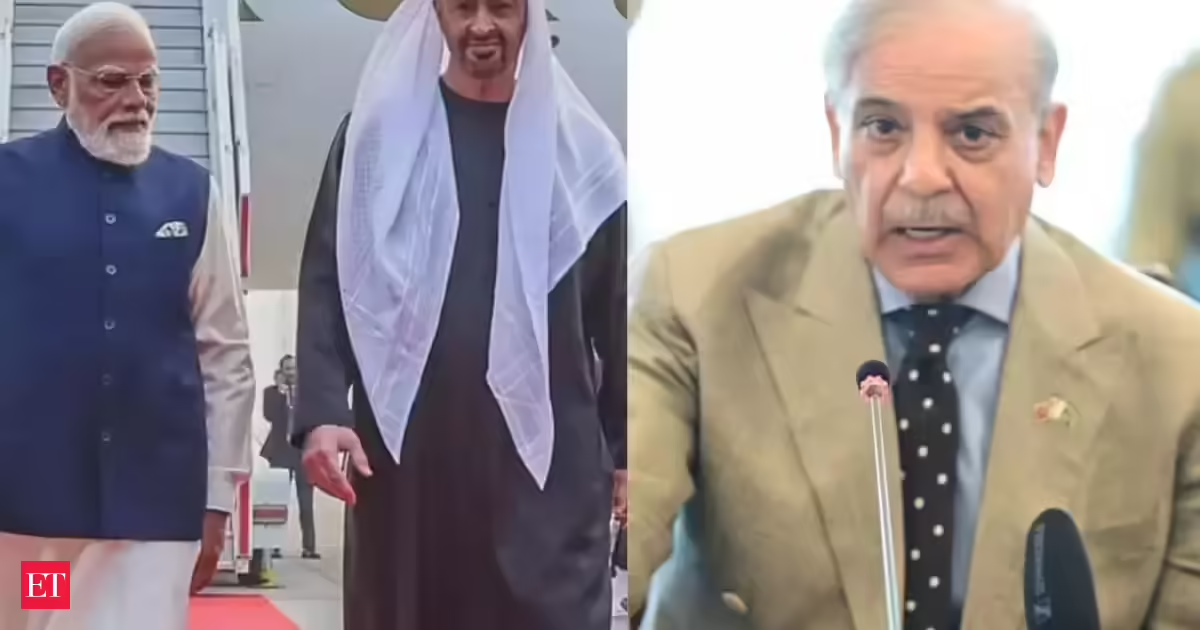
UAE gives a big jolt to Pakistan, Abu Dhabi pulls out of Islamabad Airport project days after President Nahyan’s sudden visit to India

UAE-Saudi tensions and Pakistan
Once close Gulf allies, Saudi Arabia and the UAE are now publicly at odds, particularly over Yemen. Riyadh has opposed UAE-backed separatist factions, and Saudi media has openly criticised Abu Dhabi’s regional strategy.
Meanwhile, Pakistan has deepened defence ties with Saudi Arabia, aiming to form an “Islamic NATO” alongside Turkey. “Saudi Arabia is also leaning on Pakistan’s military know-how, while the UAE has signed new defence deals with India,” noted reports. This widening gap between the Gulf giants appears to have had a knock-on effect on Pakistan’s airport plans.
Cooling Pakistan-UAE ties
Nearly four decades ago, the UAE was one of Pakistan’s largest trading partners and a key source of remittances, employing thousands of Pakistani workers. The countries also collaborated on defence, energy, and investment projects.
Over time, however, relations soured amid safety concerns, licensing disputes, and ageing infrastructure. Mismanagement and political interference in state-run enterprises led to heavy losses, prompting Islamabad to sell assets like Pakistan International Airlines (PIA) last year.

Despite the UAE’s proven experience in managing airports in challenging environments, including Afghanistan, its exit from Islamabad Airport underscores a clear erosion of confidence in Pakistan’s infrastructure and governance.
India-UAE ties strengthen
In contrast, Sheikh Nahyan’s India visit signalled a growing closeness between Abu Dhabi and New Delhi. The UAE leader approved the release of 900 Indian prisoners, widely seen as a gesture of goodwill. During talks with Prime Minister Narendra Modi, both leaders reviewed the full spectrum of bilateral cooperation, describing the India-UAE Comprehensive Strategic Partnership as entering “a more ambitious and multidimensional phase.”The visit also resulted in a Letter of Intent paving the way for a Framework Agreement on Defence Cooperation, marking a step toward a full-fledged Strategic Defence Partnership. Analysts suggest this agreement could have long-term geopolitical and economic implications for the region.
Saudi‑UAE relations have hit a visible low
Saudi Arabia and the United Arab Emirates, once close Gulf allies, are now at odds over regional strategy especially in Yemen. Saudi forces have pushed back UAE‑backed separatist factions and have acted to curb UAE influence on the ground, marking one of the most serious ruptures in their partnership.
Saudi state media has publicly criticised the UAE, accusing it of supporting proxies and undermining Saudi security interests, especially in Yemen and other theatres like Sudan. This level of public criticism reflects an unusually open rift between the two capitals.
The disagreement stems largely from divergent approaches to Yemen, where the UAE backed the Southern Transitional Council (STC), while Saudi Arabia supported Yemen’s internationally recognised government. The fragmentation of the anti‑Houthi coalition and competing strategies intensified mistrust between Riyadh and Abu Dhabi.
Saudi Arabia and Pakistan are strengthening defence and strategic cooperation
Saudi Arabia and Pakistan signed a Strategic Mutual Defence Agreement in September 2025. Under this pact, any aggression against one is treated as aggression against both, a framework that signals a deeper military alignment beyond traditional cooperation.
Analysts describe this agreement as elevating decades‑old ties into a formal collective security arrangement, expanding military coordination amid shifting Gulf dynamics.
Commentators note that the pact reflects Saudi anxieties about the reliability of traditional security guarantees and a desire to cement regional partnerships that can balance pressures from Iran, instability around the Gulf, and even the perceived assertiveness of neighbours.



