Connect with us

Business

UK unemployment rises to post-pandemic high as wage growth slows

Published

on

Business Live

The rate of joblessness edged up to 5.2 per cent between October and December

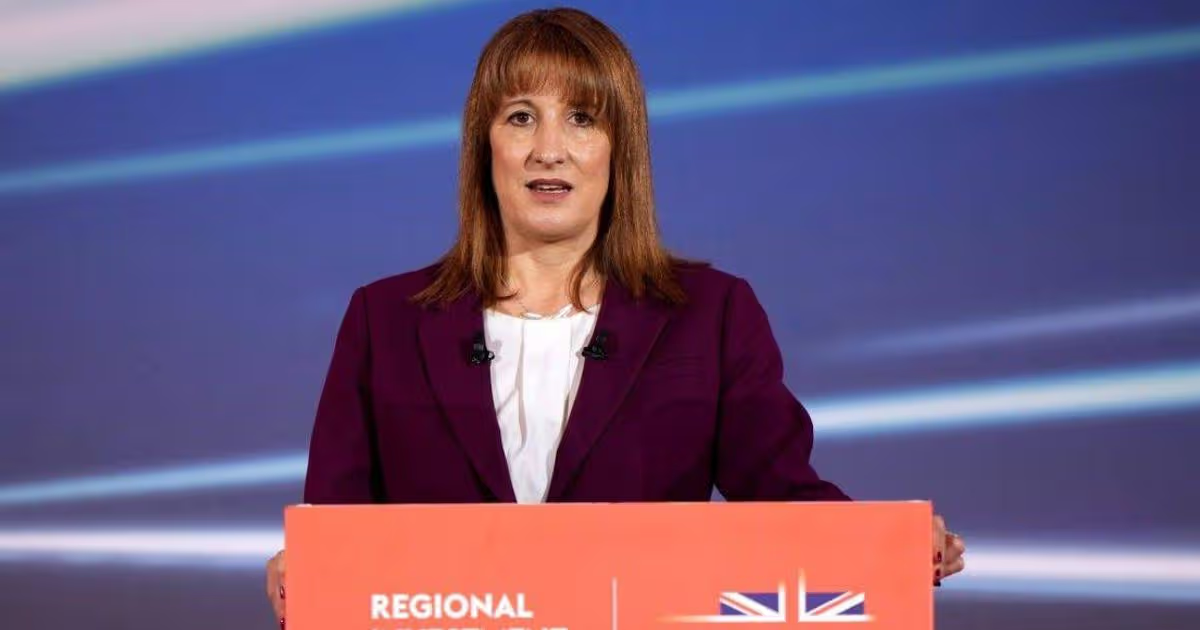
Reeves' policies have been blamed for poor hiring. (WPA Pool/Getty Images)

Reeves’ policies have been blamed for poor hiring(Image: WPA Pool/Getty Images)

The labour market continued to loosen in the final quarter of last year, official figures show, with wage growth easing and unemployment climbing steadily higher. The rate of joblessness edged up to 5.2 per cent between October and December, according to the Office for National Statistics (ONS), the highest level since early 2021 and marginally above market expectations.

The number of workers on company payrolls also fell by 46,000 compared to the previous quarter, with provisional estimates suggesting a further 11,000 jobs were shed in January.

“The number of workers on payroll fell further in the final quarter of the year, reflecting weak hiring activity, although it is largely unchanged in the latest month,” said Liz McKeown, director of economic statistics at the ONS.

Jonathan Raymond, investment manager at Quilter Cheviot, said the labour market was “showing signs of creaking when economic growth is difficult to come by”, as reported by City AM.

Advertisement

The labour market has faced pressure in recent months as businesses wrestle with the additional costs of hiring imposed by the government, including a rise in payroll taxes and an elevated minimum wage.

Businesses are also concerned by the prospect of the Employment Rights Act, with a recent survey indicating that a third of firms would cut back on hiring as a consequence of the measures. The easing labour market also resulted in slower wage growth, increasing the likelihood that the Bank of England will reduce interest rates in March.

Average earnings including bonuses decelerated to 4.2 per cent in the final quarter of the year, down from 4.6 per cent previously. City economists had anticipated it to remain roughly stable.

Excluding bonuses, average wages increased by 4.2 per cent over the period, lower than the previous figure of 4.4 per cent but in line with expectations.

Advertisement

McKeown observed that private sector wage growth was at its lowest rate in five years, whilst public sector figures remained “elevated” as some of last year’s pay awards continue to feed into the statistics.

Yael Selfin, chief economist at KPMG UK, stated the data “raises the prospect” of a March rate cut.

“The MPC will be reassured by further evidence of pay pressures easing, and the labour market continuing to soften. The Bank may also want to minimise downside risks to the labour market and lower rates ahead of the next forecast meeting in April,” she said.

Paul Dales, chief UK economist at Capital Economics, concurred that the chances of a March rate cut had risen.

Advertisement

“The lack of green shoots of recovery in the labour market and further fall in wage growth supports the idea that the Bank of England has at least a couple more interest rate cuts in its locker, with the chances of the next cut happening in March rather than April edging higher,” he said.

Sterling slipped 0.3 per cent versus the dollar after the data release, signalling that markets believe rate reductions are becoming more probable.


Continue Reading
Click to comment

Leave a Reply

Your email address will not be published. Required fields are marked *

Business

Rates Spark: Eurozone Pushing For Global Euro, But Not Overnight

Published

on

Rates Spark: Eurozone Pushing For Global Euro, But Not Overnight

From Trump to trade, FX to Brexit, ING’s global economists have it covered. Go to ING.com/THINK to stay a step ahead. We’re sorry we can’t reply to individuals’ comments.Content disclaimer: The information in the publication is not an investment recommendation and it is not investment, legal or tax advice or an offer or solicitation to purchase or sell any financial instrument.This publication has been prepared by ING solely for information purposes without regard to any particular user’s investment objectives, financial situation, or means. For our full disclaimer please click here.

Continue Reading

Business

UWE Bristol opens grant scheme for SMEs looking to scale

Published

on

Business Live

Eligible business must employ between five and 249 people and be located within a 50-mile radius of the university

BRISTOL, ENGLAND - SEPTEMBER 01: Balloons take to the sky as musician Jerome Gamble plays guitar to accompany the recorded music as it is played to the city below on September 01, 2020 in Bristol, England. Created by Bristol-based artist Luke Jerram and composer Dan Jones, "Sky Orchestra  A Moment in Time" was first performed at the Bristol International Balloon Fiesta in 2003. (Photo by Finnbarr Webster/Getty Images)

View of Bristol(Image: Getty Images)

Companies in and around Bristol looking to scale up and boost productivity are being encouraged to apply for grant funding from the University of the West of England (UWE). The university has launched the next round of its Scale up 4 Growth (S4G) scheme, which is designed to accelerate the growth of small and medium‑sized enterprises across the region.

Eligible SMEs can apply for 50 per cent match‑funded grants contributing toward projects valued between £20,000 and £80,000.

S4G supports projects that help companies scale, innovate and boost productivity. Funding can be used to address specific challenges or opportunities, such as adopting new technology, developing new products or services, or increasing operational capacity.

The grants aim to support growth activity for SMEs from the UK Government’s eight high-growth sectors: advanced manufacturing; clean energy; creative; defence; digital and tech; financial services; life sciences; and professional and business services.

Advertisement

All funded projects must create at least one full-time equivalent role per £10,000 of grant awarded, ensuring meaningful economic impact for the region.

Eligible businesses must:

  • Employ between five and 249 people;
  • have a turnover of under £44m or a balance sheet total of under £38m;
  • be located and deliver project activity and outcomes within a 50‑mile radius of UWE Bristol;
  • and demonstrate clear ambitions to grow, including increased employment and turnover.

According to UWE, proposals should also link to at least one of the five growth challenges facing scale-up and high-growth enterprises including finding talent; building leadership capacity; increasing sales or access to markets; accessing finance or growth capital; and accessing infrastructure.

As well as financial support, participating SMEs will receive one-to-one guidance from the S4G team.

Tracey John, director of research and external engagement at UWE Bristol, said: “We are proud to champion SMEs across the region. At such a pivotal moment for the regional economy, this programme is helping businesses unlock their potential and accelerate their growth. This area is a hub for innovation, and we’re delighted to play a role in driving that momentum forward.”

Advertisement

Applications close at midday on March 12, 2026, and companies will need to complete an expression of interest via the university’s website before receiving an application pack.

Continue Reading

Business

Northrop Grumman: Underwhelming Growth Today, F/A-XX Win Could Change The Story (NYSE:NOC)

Published

on

B-2 Spirit bomber carrying a heavy aerial bomb, the Massive Ordnance Penetrator

This article was written by

Dhierin-Perkash Bechai is an aerospace, defense and airline analyst.
Dhierin runs the investing group The Aerospace Forum, whose goal is to discover investment opportunities in the aerospace, defense and airline industry. With a background in aerospace engineering, he provides analysis of a complex industry with significant growth prospects, and offers context to developments as they occur, describing how they might affect investment theses. His investing ideas are driven by data informed analysis. The investing group also provides direct access to data analytics monitors.
Learn more.

Analyst’s Disclosure: I/we have no stock, option or similar derivative position in any of the companies mentioned, and no plans to initiate any such positions within the next 72 hours. I wrote this article myself, and it expresses my own opinions. I am not receiving compensation for it (other than from Seeking Alpha). I have no business relationship with any company whose stock is mentioned in this article.

Seeking Alpha’s Disclosure: Past performance is no guarantee of future results. No recommendation or advice is being given as to whether any investment is suitable for a particular investor. Any views or opinions expressed above may not reflect those of Seeking Alpha as a whole. Seeking Alpha is not a licensed securities dealer, broker or US investment adviser or investment bank. Our analysts are third party authors that include both professional investors and individual investors who may not be licensed or certified by any institute or regulatory body.

Advertisement
Continue Reading

Business

Global stocks steady as US-Iran talks, AI keep market on edge

Published

on

Global stocks steady as US-Iran talks, AI keep market on edge


Global stocks steady as US-Iran talks, AI keep market on edge

Continue Reading

Business

Kerry Group FY 2025 presentation: 3% volume growth drives 7.5% EPS expansion

Published

on

Kerry Group FY 2025 presentation: 3% volume growth drives 7.5% EPS expansion


Kerry Group FY 2025 presentation: 3% volume growth drives 7.5% EPS expansion

Continue Reading

Business

Jesse Jackson, civil rights leader and US presidential hopeful, dies at 84

Published

on

Jesse Jackson, civil rights leader and US presidential hopeful, dies at 84


Jesse Jackson, civil rights leader and US presidential hopeful, dies at 84

Continue Reading

Business

Trek to raise $15m, as moves toward extensive drilling program at Christmas Creek

Published

on

Trek to raise $15m, as moves toward extensive drilling program at Christmas Creek

Derek Marshall-led Trek Metals has announced plans to raise $15 million, in order to propel an upcoming extensive drilling program at its Christmas Creek gold project.

Continue Reading

Business

Royal Mail given two weeks to respond to claims it is prioritising parcels

Published

on

Royal Mail given two weeks to respond to claims it is prioritising parcels

MPs have raised “significant concerns” about reports of “failures in service” at the company.

Continue Reading

Business

Meta, X and TikTok face Spanish investigation over AI child abuse content

Published

on


Meta, X and TikTok face Spanish investigation over AI child abuse content

Continue Reading

Business

Adding or Modifying Business Activities Post-Incorporation in the Philippines

Published

on

Adding or Modifying Business Activities Post-Incorporation in the Philippines

Philippine corporations operate within their registered purpose; expansion requires amendments, affecting ownership, capital, and regulation. Foreign investment rules specify capital requirements, restrictions, and tax benefits.

Operating Limitations and Expansion Requirements

A Philippine corporation can only operate within the purposes outlined in its Articles of Incorporation, registered with the Securities and Exchange Commission under the Revised Corporation Code. Any expansion into a substantially different activity requires an amendment to the purpose clause. This process involves a thorough review of ownership eligibility, capital classification, and regulatory compliance, as it may affect the company’s legal standing and operational scope.

Capital Requirements for Retail and Domestic Enterprises

Retail trade businesses with foreign involvement generally need a paid-in capital of US$2.5 million, with specific thresholds of US$250,000 per store in certain cases. If the activity falls into a restricted sector, an equity restructuring must be undertaken before amending the purpose clause. For foreign-owned domestic market enterprises, a minimum paid-in capital of US$200,000 is typically required, which can be lowered to US$100,000 upon meeting employment or certified technology criteria. Export-oriented firms are exempt from this threshold.

Foreign Investment Regulations and Tax Incentives

Under the Foreign Investments Act, enterprises registered with the Philippine Economic Zone Authority or the Board of Investments may qualify for income tax holidays lasting four to seven years, and occasionally a 5% tax on gross income. However, income from activities outside the approved scope could be taxed at the standard corporate rate of 25%, or 20% for qualified small domestic corporations, which could impact overall tax obligations within a single legal entity.

Advertisement


Read the original article : How to Add or Amend Business Activities After Incorporation in the Philippines

Continue Reading

Trending

Copyright © 2025