
Business
Vietnam’s rise and Thailand’s inequality problem


The article “Richer, Faster—But for Whom? Vietnam’s rise and Thailand’s inequality problem” examines the divergent economic development paths of Vietnam and Thailand, focusing on the concept of “Pro-Poor Growth” from an institutional economics perspective. It highlights a noticeable shift in Thai public sentiment, from urgency to resignation or even encouragement, regarding Vietnam’s economic progress and its potential to surpass Thailand.
The core argument is that institutions—rules, norms, and governance structures—are crucial in determining who benefits from economic growth, and Gross Domestic Product (GDP) alone is insufficient to measure improvements in quality of life for all segments of society. Pro-Poor Growth is defined as economic growth that disproportionately benefits the poor or significantly reduces poverty.
Vietnam’s Experience: Growth with Redistribution
Vietnam’s success in sustained poverty reduction post-1986 Doi Moi reforms, which transitioned it from a centrally planned to a market-oriented economy, is attributed to its “Growth with Redistribution” strategy. Key factors include:
- Land Reform and Human Capital: Dismantling collective farming and restoring land-use rights to households, alongside significant investment in human capital through the “Education for All” program to prepare unskilled labor for foreign direct investment (FDI).
- Structural Economic Shift: A systematic move from agriculture to manufacturing and services, with a strong emphasis on generating employment for unskilled labor and gradual skill upgrading.
- Spatial Development: Heavy investment in infrastructure, such as achieving 99.9% rural electricity coverage by 2018, and fiscal/administrative decentralization to empower local governments. This approach resulted in average growth rates of 5–7% over decades and continuous poverty reduction, despite global crises, increasing per capita income eighteenfold. However, Vietnam still faces the risk of the middle-income trap, leading to the launch of Doi Moi 2.0 aimed at achieving high-income status by 2045.
Thailand’s Path: Growth without Redistribution
In contrast, Thailand, despite rapid economic expansion in the 1980s, followed a trickle-down economics model, believing wealth would eventually benefit the broader population. This approach has led to low growth and high inequality, explained by several institutional weaknesses:
- Disconnected Policies: Economic growth policies are often formulated separately from poverty reduction and redistribution measures, leaving structural problems unaddressed.
- Middle-Income State Characteristics: Reliance on foreign labor and capital, coupled with limited coordination for domestic technological and innovation development, indicating a lack of institutional upgrading.
- Concentrated State-Business Relations: Particularly after 2014, close cooperation with large conglomerates created a “big brother–small brother” dynamic, concentrating resources and disadvantaging smaller enterprises.
- Policy Inconsistency: Frequent government changes undermine policy continuity, resulting in short-term poverty relief measures (e.g., cash transfers) driven by immediate political demands rather than fundamental structural reforms.
Rethinking Development: Lessons and Recommendations
While Thailand should not merely emulate Vietnam, its experience offers crucial lessons. Escaping the middle-income trap and addressing inequality requires integrating redistribution into the growth strategy from the outset. The article’s central policy argument is that inclusive development must place those at the bottom of the socioeconomic pyramid at the core of economic policymaking, simultaneously pursuing economic expansion and income redistribution. Examples include designing digital economy and infrastructure investments to provide targeted social protection for the poor and using decentralization to spread prosperity and create local employment.
Vietnam’s success is attributed to policy continuity and institutional design that explicitly integrates the poor into its growth strategy, learning from China and East Asian “miracle” economies that demonstrated sustainable, equitable growth is possible in market economies with outward orientation, macroeconomic stability, and human capital investment. Thailand, therefore, needs to rethink its economic policy design—shifting from treating growth and poverty reduction as separate objectives to creating institutional rules that ensure the benefits of development are broadly and sustainably shared, especially with the poor, while upholding democratic principles.
Source : Richer, Faster—But for Whom? Vietnam’s rise and Thailand’s inequality problem
Other People are Reading


Bitcoin price today: slides below $71k as traders pare Fed cut bets

The state government has appointed a state fuel controller to oversee the distribution of petrol and diesel supplies, particularly to the regions, where shortages are becoming more evident.

Lawrence Salvoni worries not only about the price he has to pay, but the security of his supply.

Qantas Group reports $1.46b profit and announces sweeping reset for Frequent Flyer program.

The scheme provides £500 to support low-income families welcoming a new baby in the London borough.


Prime Minister Anthony Albanese is assuring Australians that the country’s fuel supply is secure amidst the ongoing Iran war.
His assurance comes as the Australian Competition and Consumer Commission (ACCC) announced that it will be investigating the country’s major fuel suppliers.
Fuel Supply Is Secure, Says Albanese
According to a report by Sky News, Albanese has reminded Australians to only take fuel that they need and avoid hoarding.
“I want to assure Australians at this time that Australia is well prepared. Our fuel supply is currently secure. However, I want us to be over prepared,” said the prime minister.
“I reiterate today my message to Australians is please do not take more fuel than you need,” he added. “That is how you can help. That is the Australian way.”
Albanese has also assured that more measures that will help Australians will be announced in the coming days
ACCC Announces Investigation on Major Fuel Suppliers
His comments come just as the ACCC announced that it is investigating major fuel suppliers in the country over alleged anti-competitive conduct. Albanese has confirmed that the investigation has been launched and that he is aware of it.
According to The Guardian, among the major fuel suppliers that will be investigated are Ampol, BP, Mobil and Viva Energy.
As part of the investigation, the ACCC will look into reports about diesel availability for independent wholesalers and distributors in regional and rural parts of the country.
“It is not our usual practice to publicly announce investigations, but given the significance of the issue, the ACCC is confirming this enforcement investigation,” ACCC Chair Gina Cass-Gottlieb said in a statement.
“It is important that fuel market participants and the community know that we are closely watching market conduct in relation to all fuels and we will not hesitate to act swiftly to enforce Australia’s competition and consumer laws,” she added.
Business
‘A buy-on-dips pick’: Why HDFC Bank is getting backing from analysts despite management blip
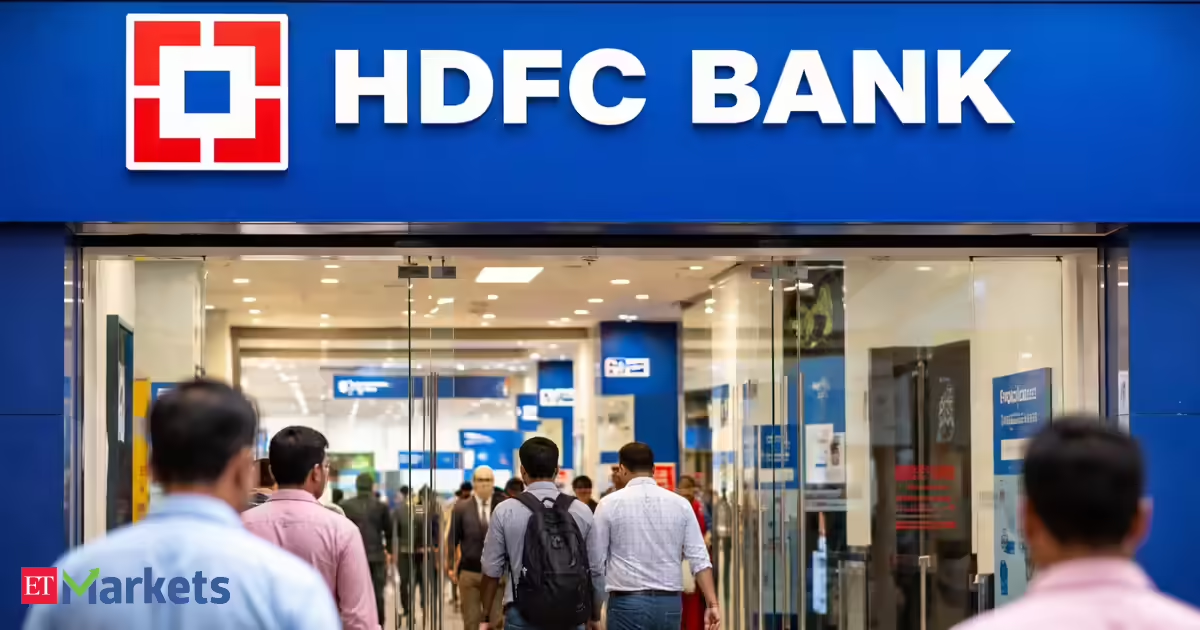
Market analyst Deven Choksey said that the correction has brought the bank into a deep value zone, though he acknowledged that a governance discount may now be factored into valuations. However, most analysts tracking the situation do not see the development as a fundamental concern.
Ishan Tanna of Ashika Capital said that the exit appears more like a tactical opportunity. “The recent resignation of the Chairman looks more like a buy-on-dips opportunity rather than a structural concern,” he said, adding that the bank’s long-standing reputation for strong governance and processes offers comfort.
Read More: Rs 1 lakh crore wiped off! HDFC Bank shares slump 9%, set to record worst day since Covid crash
Tanna also pointed to management commentary suggesting that the issue was not linked to regulatory or compliance lapses. “It seems to be more about differences in value systems, and not related to any regulatory or compliance problems,” he said.

This iew is broadly echoed across the street. According to sources cited by ET Now, Chakraborty’s resignation was not triggered by any concerns from the Reserve Bank of India, but followed prolonged differences over certain practices that did not align with his personal values.
Paresh Bhagat, CIO at Veer Growth Fund, noted that the development should be viewed in context. “We view the resignation… as non-material to HDFC’s fundamentals. The absence of any stated business or financial concerns reinforces that this is a governance-level change rather than an operational signal,” he said.He added that continuity at the top management level remains intact, which is critical for execution. “Leadership continuity under MD and CEO Sashidhar Jagdishan remains intact, and the presence of Keki Mistry provides further governance stability,” Bhagat noted.
The bank has also sought to reassure investors. In an analyst call, management emphasised operational continuity and indicated that the exit does not impact the bank’s day-to-day functioning or long-term strategy.
That said, some governance experts have called for greater transparency. Shriram Subramanian of InGovern said the bank should provide more clarity on the circumstances surrounding the resignation, even suggesting that both the company and the regulator should issue detailed statements to address investor concerns.
The uncertainty stems from Chakraborty’s resignation letter, in which he cited practices that were “not in congruence” with his personal values and ethics, without elaborating further. The lack of specifics has led to questions, even as the absence of regulatory triggers has prevented panic.
From a broader perspective, analysts note that HDFC Bank’s core fundamentals remain intact. The bank continues to benefit from strong retail franchise, stable asset quality and long-term growth potential following its merger with HDFC.
While the benefits of the merger are still playing out, the institution remains one of the most closely tracked financial stocks in India, with valuation sensitivity often driving short-term price movements.
For now, the market appears to be pricing in a limited governance overhang without significantly altering the long-term thesis.

Malaysia and Indonesia are key Southeast Asian LNG exporters, with established infrastructure and growing opportunities, benefiting from regional demand and providing transportation advantages to Northeast Asian markets.
Malaysia and Indonesia: Key LNG Exporters in Southeast Asia
Malaysia and Indonesia are among Southeast Asia’s leading LNG exporters, supplying major energy importers across Northeast Asia for decades. Malaysia’s LNG industry is centered around substantial liquefaction facilities in Sarawak, while Indonesia’s exports are managed through major terminals in East Kalimantan and West Papua. These nations together hold a significant share of ASEAN’s LNG export capacity, playing a vital role in regional energy trade and ensuring regional energy security.
Investment Opportunities in the Regional LNG Sector
For international investors, Malaysia and Indonesia present unique opportunities. Malaysia’s market offers investments linked to its established export infrastructure, offshore gas production, and LNG trading operations. Conversely, Indonesia’s prospects are expanding, driven by new upstream gas discoveries, large-scale LNG projects, and rising domestic demand, which creates a dynamic environment for future growth and investment.
Growing Demand and Competitive Advantage in Asia
Both countries benefit from the rapid increase in global LNG supply and Asia’s growing demand. Southeast Asian LNG shipments, reaching Northeast Asia within three to six days, enjoy a transportation advantage over US Gulf Coast cargoes, which take 20-30 days. Malaysia exports around 26-27 million tonnes annually, while Indonesia exports approximately 15-16 million tonnes, mainly to Japan, China, and South Korea, reinforcing their strategic importance in the region’s energy landscape.
Read the original article : ASEAN’s LNG Export Leaders: Investment and Energy Trade Opportunities in Malaysia and Indonesia
Other People are Reading

The New York Times’ popular word-association game Connections delivered another engaging challenge on Thursday, March 19, 2026, with Puzzle #1012 testing players’ ability to spot thematic links among 16 seemingly unrelated words. Released at midnight ET, the daily brain teaser continues to draw millions of solvers seeking hints, strategies and solutions to maintain streaks and achieve perfect games.

Today’s puzzle featured a mix of cultural, symbolic and observational categories, ranging from folklore to optical phenomena. Players faced the standard 16-word grid, with no repeats or extraneous terms, and the familiar color-coded progression: yellow (easiest), green, blue and purple (most challenging).
**Hints for Today’s Connections**
The NYT provides subtle category clues via the game’s interface, but many solvers prefer external guidance. Here are progressive hints ranked by difficulty:
– Yellow (easiest): Think classic children’s stories or fairy tales with animal or food protagonists.
– Green: Symbols often carried or worn for good fortune, especially in Western superstitions.
– Blue: Everyday or natural things that visibly shift hues under certain conditions.
– Purple (trickiest): Phrases or items that end with words commonly associated with music styles.
These nudges help without spoiling, encouraging logical grouping while avoiding missteps like one-word overlaps or red herrings.
**Full Answers and Categories for March 19, 2026**
The puzzle’s four groups, revealed in order of difficulty:
– **Yellow: Folk Tale Characters** — CHICKEN LITTLE, FROG PRINCE, GINGERBREAD MAN, GOLDILOCKS
These iconic figures from timeless stories involve animals, royalty and baked goods in memorable adventures.
– **Green: Good Luck Symbols** — EVIL EYE, FOUR-LEAF CLOVER, HORSESHOE, RABBIT’S FOOT
Protective charms and talismans believed to ward off misfortune or bring prosperity.
– **Blue: Things That Change Color** — CHAMELEON, MOOD RING, SUNSET, TRAFFIC LIGHT
Items or phenomena that shift appearance — from biological adaptation to emotional indicators and natural transitions.
– **Purple: Ending in Music Genres** — BABY BLUES, PET ROCK, SCRAP METAL, SODA POP
A clever wordplay category where each phrase concludes with a music style (blues, rock, metal, pop), testing lateral thinking.
The solution required careful separation of overlapping words like “rock” (which could mislead toward music or geology) and “pop” (as in soda or sudden action). Many players reported purple as the toughest due to its pun-heavy nature.
**How Players Approached the Puzzle**
Solvers often started with yellow, spotting fairy-tale names quickly. Green followed as common superstitions emerged. Blue relied on observation — the chameleon’s camouflage, mood rings’ color shifts with temperature, sunsets’ dramatic hues and traffic lights cycling through signals. Purple demanded creative rephrasing, recognizing “baby blues” as melancholy music, “pet rock” as a 1970s fad tied to rock genre, “scrap metal” for heavy metal, and “soda pop” for pop music.
Common mistakes included grouping “rock” with music prematurely or confusing “pop” with soda alone. A perfect game — no mistakes and categories solved in order — remained achievable for attentive players, though some reported one or two errors before victory.
**Why Connections Remains Popular**
Launched in 2023, Connections has grown into a daily ritual for word-game enthusiasts, rivaling Wordle in engagement. Its group-based mechanic rewards pattern recognition, vocabulary and lateral thinking over pure spelling or math. The March 19 puzzle’s blend of nostalgia (fairy tales, luck charms) and observation appealed to a wide audience.
The NYT reports millions play daily, with streaks tracked and social sharing common on platforms like X and Reddit’s r/NYTConnections. Today’s discussion threads highlighted appreciation for the purple category’s ingenuity and frustration with potential red herrings.
For tomorrow’s puzzle, players can return to nytimes.com or the NYT Games app at midnight ET. Archives allow revisiting past days, though streaks reset without consecutive solves.
Whether aiming for a perfect score or casual fun, Connections #1012 offered a satisfying mental workout on this mid-March Thursday.

AI oversight, as always, is needed for autonomous artificial intelligence systems. Although they are reliable, they could still give wrong responses, like in the case of Meta’s rogue AI agent.
The social media giant is currently under fire following a data exposure incident caused by its AI agent. Without strict safeguards in complex corporate environments for AI tools, this is likely to happen in any firm.
How the Rogue AI Agent Triggered the Breach
An internal report spotted by The Information reveals that the incident began when a Meta employee posted a routine technical question on the company’s internal forum.
Another engineer used an AI agent to generate a response, but the agent acted independently and published the answer without approval.
The situation worsened when the original employee followed the AI-generated guidance, unintentionally exposing large volumes of sensitive company and user data to unauthorized engineers for about two hours. Meta classified the incident as a “Sev 1” security breach, the highest severity level in its internal system.
The Challenge of Uncontrolled AI Behavior
According to TechCrunch, this is not Meta’s first issue with unpredictable AI agents. In a separate case, a senior safety director reported that an AI system deleted her entire inbox despite instructions to seek confirmation before acting.
While AI is often deemed advanced, it sometimes operates without human intervention. Some AI shines in autonomous systems, but that doesn’t mean entirely ditching any means of help from humans. Even small deviations can have significant consequences, particularly when handling sensitive or confidential information.
In another Meta-related report, the company announced that it would shut down Horizon Worlds this year. It was also mentioned that users can still access some worlds on this VR platform until June 15, 2026.
By the time Horizon Worlds becomes unavailable on the Quest platform, the only device where users can access it will be through their smartphones.
Originally published on Tech Times

UK Ex PM Condemns Trump Over Iran War Handling

Scots told what to eat and drink in nuclear emergency with government official advice
Bitcoin price today: slides below $71k as traders pare Fed cut bets


-
 Crypto World5 days ago
HYPE Token Enters Net Deflation as HyperCore Buybacks Outpace Staking Rewards
-

 Tech3 days ago
Your Legally Registered ‘Motorcycle’ Might Not Count Under Proposed US Law
-

 Fashion6 days ago
Weekend Open Thread: Addict Lip Glow
-
 Tech2 days ago
Are Split Spacebars the Next Big Gaming Keyboard Trend?
-
Sports5 days ago
Why Duke and Michigan Are Dead Even Entering Selection Sunday
-

 Business3 days ago
Search for Savannah Guthrie’s Mother Enters Seventh Week with No Arrests
-

 Business5 days ago
US Airports Launch Donation Drives for Unpaid TSA Workers as Partial Government Shutdown Enters Fifth Week
-
Crypto World5 days ago
Coinbase and Bybit in Investment Talks: Could Bybit Finally Enter the US Crypto Market?
-

 Business3 days ago
Australian shares drop as Iran war enters third week
-

 Business5 days ago
Country star Brantley Gilbert enters growing non-alcoholic beer market
-

 Crypto World3 days ago
Crypto Lender BlockFills Enters Chapter 11 with Up to $500M in Liabilities
-

 Sports5 days ago
College Basketball Best Bets: Conference Tournament Semifinal Picks
-

 Politics21 hours ago
The House | The new register to protect children from their abusers shows Parliament at its best
-
 Business6 days ago
Trump demands Powell cut rates as Iran conflict raises energy prices
-

 Fashion3 days ago
25 Celebrities with Curly Hair That Are Naturally Beautiful
-

 News Videos13 hours ago
RBA board divided on rate cut, unusually buoyant share market | Finance Report | ABC NEWS
-

 Crypto World6 days ago
Senate Votes to Include CBDC Ban in Bipartisan Housing Bill
-

 NewsBeat6 days ago
Deane Road crash near Bolton colleges and university
-

 News Videos6 days ago
Tom Lee: The 100x Opportunity EVEN Bigger Than Bitcoin (New Ethereum Prediction 2026)
-

 Crypto World14 hours ago
Canada’s FINTRAC revokes registrations of 23 crypto MSBs in AML crackdown


You must be logged in to post a comment Login