
Business
Why has Paramount launched a hostile bid for Warner Bros Discovery?


Natalie ShermanBusiness reporter

 Warner Bros Discovery
The fight in Hollywood to buy Warner Bros Discovery is shaping up to be a blockbuster.
Paramount Skydance, backed by the billionaire Ellison family, has been wooing Warner Bros for months, hoping to join forces with the storied Hollywood name as the media company struggles to compete with the likes of Netflix and Disney.
So far, Warner Bros has spurned its proposals. Then it announced a deal to sell the most valuable parts of its business – its studio and streaming divisions – to Netflix instead.
Undeterred, Paramount chief executive David Ellison launched a hostile takeover bid, making his suit directly to shareholders.
What is a hostile takeover bid?
In corporate deals, a hostile takeover is when a company moves to acquire another firm without the consent of the target company’s management, typically by offering to buy its target’s shares.
It differs from a friendly takeover – one that is mutually agreed upon by the boards of directors and shareholders at both companies.
What do we know about the two bids?
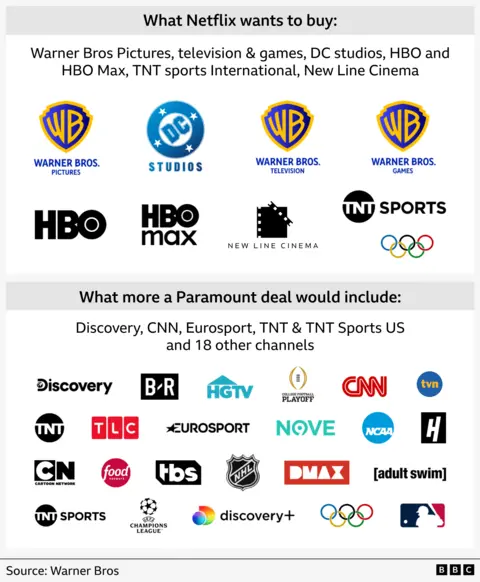
Netflix’s proposal includes Warner Bros’ studio and streaming networks, leaving the rest of the company to be spun off as an independent company.
Its offer values those holdings which include brands such as Warner Bros, New Line Cinema, and HBO Max, at $82.7bn, including debt.
Netflix is offering to pay $23.25 per share, and give existing Warner Bros a stake in the new company – a mix of cash and equity it says is worth about $27.75 per share.
Paramount, by contrast, says it wants control of the entire company, including the firm’s traditional pay-TV networks, which are seen as a declining business.
Its deal values the entire company at $108.4bn.
Paramount is proposing to pay $30 per share, in an all-cash offer, which it says gives shareholders more certainty than Netflix’s plan.
In both cases, the target completion date is many months away.
Why do Paramount and Netflix want Warner Bros?
Warner Bros, which traces its roots back about a century, has a vast library of content, ranging from classics like Looney Tunes and Casablanca to Friends, Superman and Harry Potter. Its HBO division is known for “prestige” television, including The Sopranos, Sex and the City and Succession.
But the storied firm has been under pressure as online streaming has disrupted film and television industries.
For Netflix, the streaming industry’s biggest player with more than 300 million customers, buying the film and streaming division would bolster its movie offerings, while heading off any potential rivals looking to get their hands on the Warner Bros content.
Paramount, by contrast, is looking for a partner that will give it the scale to compete against industry giants such as Netflix and Disney.
A takeover would build on Mr Ellison’s purchase of Paramount, which he folded into his Skydance film studio over the summer.
On the streaming side, he is looking to add HBO Max’s roughly 120 million streaming customers to Paramount’s 79 million.
Analysts say a tie-up could offer benefits to the struggling traditional pay TV networks as well, giving them greater clout in business negotiations and presenting opportunities for cost savings.
Paramount’s traditional networks include brands such as Nickelodeon, CBS and Comedy Central, while Warner Bros would bring CNN, the Food Network and a range of sports offerings.
Who is likely to win?
Both deals raise competition concerns and are expected to face scrutiny from regulators in the US and Europe.
Netflix’s plan has drawn warnings that it would give the dominant streaming player even more power over actors and screenwriters, while putting further pressure on local cinemas.
But a combined Paramount-Warner Bros would also leave it in control of a significant slice of sports and children’s entertainment, raising potential concern for advertisers and local television distributors.
Paramount’s plans, which would put CBS and CNN under the same parent company, have also been closely watched because of the potential impact on the news business and the Ellisons’ ties to Trump.
Analysts said approval would likely hinge on how broadly regulators decide to define the market, and whether players like YouTube are considered part of the competition.
Netflix is relatively new to deal-making.
Some have also suggested that Paramount could be in a stronger position thanks to the relationship between Trump and the Ellison family, including tech billionaire and Republican megadonor Larry Ellison. Trump’s son-in-law, Jared Kushner, is also one of Paramount’s financial partners.
But Trump himself has offered little certainty about his views.
Though he has praised the Ellisons in the past, on social media on Monday, he took aim at their ownership of Paramount, triggered by a 60 Minutes interview that the company aired with former Trump ally Marjorie Taylor Greene, a Republican representative.
Previously, he had noted potential concerns about Netflix’s tie-up, given the size of the company, while also praising the streamer’s bosses.
How could the deal affect consumers?
It’s not clear.
Neither Netflix nor Paramount have offered much insight into how they would incorporate Warner Bros into their current offerings or seize the opportunity to launch new kinds of streaming packages.
When it comes to prices, boosting Netflix’s offerings could allow it to charge customers more. But if viewers find they are paying for one streaming service rather than two, it could cost them less.
More than 70% of HBO Max customers in the US also subscribe to Netflix, according to analysts at Raymond James.
Reporting contributed by Danielle Kaye



