
Crypto World
AI rout hits software stocks, but Grayscale says blockchains stand to benefit



Blockchains and artificial intelligence are complementary technologies, according to crypto asset manager Grayscale, even as markets have recently treated them as part of the same trade.
Zach Pandl, Grayscale’s head of research, said that while disruptive technologies tend to produce clear winners and losers, the relationship between AI and blockchain is more symbiotic than competitive. Rapid AI adoption is expected to reward some industries, such as chipmakers, while pressuring others, including segments of professional services.
“Although crypto valuations have been tightly correlated with the drawdown in software stocks, we think blockchains and AI are complementary from a fundamental standpoint,” he said in the Wednesday blog post.
U.S. equity markets have lately focused on the downside. The S&P 500 software index has fallen roughly 20% year to date, and crypto valuations have moved closely with the selloff. But Pandl maintains that the parallel drawdown obscures a more constructive long-term dynamic between the two technologies.
Investor anxiety about artificial intelligence’s disruptive potential has sparked a broad sell-off in tech and software stocks, erasing significant market value as traders reassess long-held valuations.
U.S. software and services shares have plunged sharply, wiping out roughly $1 trillion in market capitalization, as fears mount that fast-advancing AI tools could upend traditional business models and revenue streams.
The S&P 500 software index has slumped as investors rotate out of high-flight tech names amid heightened volatility and skepticism over how quickly and profitably AI adoption will play out.
Pandl contends that blockchains are likely to become the financial rails for AI agents. Today’s chatbots operate largely outside the financial system. But if AI agents are equipped with digital wallets, he expects them to transact over blockchains rather than traditional bank infrastructure.
Blockchains offer transparency, near-instant settlement, 24/7 availability and global reach with an internet connection, he said. While opening a bank account requires a human intermediary, any user, including a bot, can create a blockchain address. Pandl said rising volumes of low-value stablecoin transactions would be an early signal that this thesis is playing out.
At the same time, he argued that blockchain technology could help mitigate some of AI’s risks. As large language models proliferate, concerns around data provenance, deepfakes and the concentration of control over resources and decision-making are likely to intensify. Public blockchains, Pandl said, can provide verifiable records and more decentralized infrastructure to counterbalance those trends.
The report acknowledged AI may also introduce new challenges for crypto networks. Advanced tools could make blockchain surveillance more effective, potentially eroding user privacy. AI agents may also uncover new vulnerabilities in smart contracts; OpenAI recently launched EVMbench, an initiative aimed at using AI to identify and patch such risks.
Read more: Crypto isn’t losing to AI, its just ‘capitalism doing its job,’ says Dragonfly



The Japanese government passed an amendment to the Financial Instruments and Exchange Act on Friday, officially reclassifying crypto assets as financial instruments.
Summary
- The Japanese government officially reclassified cryptocurrency as a financial instrument on Friday through an amendment to the Financial Instruments and Exchange Act.
- New regulations reported by Nikkei now prohibit insider trading and require asset issuers to provide transparent financial disclosures once a year.
According to a report by Nikkei, the new legislation introduces a ban on insider trading and prohibits any buying or selling of digital assets based on non-public information.
Previously, the Financial Services Agency handled crypto under the Payment and Settlement Act, viewing it primarily as a tool for transactions. The pivot to the new legal framework comes as a direct response to a surge in institutional interest.
Under these updated rules, crypto “issuers” must adhere to higher transparency standards, including mandatory annual disclosures.
To support this transition, the Financial Services Agency has updated its oversight from the previous Payment and Settlement Act.
Cryptocurrency “issuers” are now required to maintain higher levels of transparency, including the mandate to disclose financial information at least once a year. The amendment also stiffens penalties, increasing both fines and potential prison sentences for exchanges that operate without a license.
“We will expand the supply of growth capital in response to changes in financial and capital markets, and ensure market fairness, transparency, and investor protection,” Finance Minister Satsuki Katayama said in an accompanying statement.
Beyond immediate regulations, the government is also overhauling the tax structure to encourage market participation. In December, officials backed a plan to drop the maximum tax rate on crypto profits in favor of a 20% flat rate.
This follows comments from Katayama earlier this year, suggesting that robust exchange infrastructure is essential for citizens to benefit from blockchain technology.
The long-term roadmap includes the legalization of crypto exchange-traded funds (ETFs) by 2028, as noted in a January report. Major financial players, such as Nomura Holdings and SBI Holdings, are already expected to lead the development of these crypto-linked products as the country prepares for broader mainstream adoption.


World Liberty Financial has dismissed market warnings regarding its borrowing activity on the lending platform Dolomite, labeling concerns over its debt health as “FUD.”
Summary
- On-chain data shows World Liberty Financial deposited 5 billion WLFI tokens on Dolomite to borrow $75 million in stablecoins shortly before a major U.S. foreign policy announcement.
- World Liberty Financial dismissed liquidation concerns as FUD.
On-chain data from Arkham reveals that a wallet belonging to the Trump family-backed project deposited approximately 5 billion WLFI tokens into the protocol to secure a $75 million loan in USDC and USD1 stablecoins.
Subsequently, the World Liberty wallet transferred over $40 million to Coinbase Prime just hours after Trump announced a U.S.-Iran ceasefire.
Dolomite was co-founded by Corey Caplan, an advisor to World Liberty; as such, the high concentration of WLFI on the platform has triggered intense scrutiny from DeFi analysts.
Currently, WLFI tokens represent $428.9 million of the $825.4 million in total assets supplied to Dolomite. This means the project’s native token now accounts for more than half of the protocol’s total liquidity, creating what researchers describe as a significant concentration risk.
DeFi analysts on X warned that if WLFI’s price hits liquidation levels, the lack of market depth could result in massive bad debt for the protocol’s other lenders.
“If that WLFI collateral position ever gets close to liquidation, it’s basically unliquidatable without major losses for lenders,” wrote analyst EthanDeFi.
He pointed to the token’s low liquidity relative to its $10 billion valuation, advising users to withdraw stablecoins from any pools that accept WLFI as collateral.
In a series of posts on Thursday, World Liberty countered that its presence as an “anchor borrower” actually helps the platform by providing higher yields for other participants.
The team maintained that they have ample resources to defend their position, noting they have repurchased 435 million tokens over the last six months to support the ecosystem.
“We are nowhere near liquidation — and frankly, even if markets moved dramatically against us, we’d simply supply more collateral,” the team stated.
“That’s not a risk. That’s how this works.”
Despite these assurances, WLFI’s price fell 5.6% to $0.86 as the controversy spread, bringing its total decline over the past week to 14%.
The project is now looking toward a governance vote scheduled for next week to address a long-awaited token unlock for early retail buyers. This plan will involve a structured, phased vesting schedule rather than an immediate release of all tokens.
The team remains firm that the protocol is designed for long-term growth rather than short-term speculation.
“The critics are looking at the wrong thing,” World Liberty added. “We’re building something that compounds.”


The global crypto market cap rose back above the $2.5 trillion figure as geopolitical and macroeconomic concerns led to the wipeout of over $250 million in short positions that fueled crypto price gains.
Summary
- Crypto market cap climbed back above $2.5T as over $250M in short positions were liquidated, driving price gains.
- Bitcoin touched $73K while ETF inflows rebounded, with $343M into BTC ETFs and $85M into ETH products.
- Ceasefire tensions and sticky U.S. inflation remain key risks that could trigger renewed volatility.
According to data from CoinGecko, the total market cap of all cryptocurrencies combined rose 1.4% to $2.52 trillion on Friday, April 10. Bitcoin (BTC) rose over 3% to touch the $73,000 mark before paring off with some of its gains and settling at $72,000 at the time of writing. Ethereum (ETH) surged past $2,200 while other top 10 major crypto assets were also seen in the green territory.
The market rally began in late U.S. hours yesterday after news broke out that Iran was looking into accepting Bitcoin for oil cargo ships crossing the Strait of Hormuz.
The sudden uptick in crypto prices caught short sellers off guard, who were then forced to buy back assets, fueling the crypto market rally. Data from CoinGlass shows that over $250 million of short positions were liquidated in the past 24 hours, in comparison to $95 million in long positions.
Crypto ETFs also played a significant part in supporting market gains. Data compiled by SoSoValue shows that spot Bitcoin ETFs drew in $343 million in net inflows on Thursday, while their Ethereum counterparts drew in $85 million. Both of these investment products had recorded outflows over the past two days.
The crypto market also appeared to share the positive sentiment from Asian tech stocks such as Japan’s Nikkei 225, which rose 1.8% over the past day, alongside the Hang Seng and Shanghai Composite, which also posted notable gains.
Investors also seem to be rotating capital from traditional safe-haven assets such as gold and silver, which have given up some of their gains over the past day. Gold and Silver fell by 1% each, trading at $4,750 and $75.5 each at press time.
However, there remains a key concern that could potentially derail crypto prices again.
First, the stability of the ceasefire remains quite shaky as Iran has so far failed to comply with the specific terms of the agreement, having still maintained a military presence in the Strait of Hormuz area. U.S. President Donald Trump has threatened the regime to uphold its side of the deal or face strikes with full force from the American military. Meanwhile, the Iranian government continues to maintain a defiant stance.
Such geopolitical tensions could likely continue to trigger volatility, especially if no clearer diplomatic resolution is reached to end the war.
Second, recent U.S. economic data have pointed out that inflation has continued to remain stickier than expected. Data from the U.S. Bureau of Economic Analysis showed that the core PCE index rose by 0.4% on Thursday.
This inflationary pressure might force the Federal Reserve to maintain a hawkish stance and hence delay interest rate cuts, which generally hurts risk assets, including cryptocurrencies, by keeping borrowing costs elevated.
Disclosure: This article does not represent investment advice. The content and materials featured on this page are for educational purposes only.


Binance co-founder Changpeng ‘CZ’ Zhao believes blockchain and cryptocurrency are on a path to becoming as common and unnoticed as the internet within the next five years.
Summary
- Binance co-founder Changpeng Zhao expects blockchain to become an invisible part of daily life by 2031 and compares its future integration to how the world uses the internet today.
- Zhao warns that nations failing to adopt blockchain and AI will face significant economic disadvantages.
Speaking on Scott Melker’s Wolf of All Streets podcast on Thursday, Zhao explained that the goal for the industry is to reach a stage where the underlying technology is no longer the main topic of conversation.
He compared the current phase of crypto to the early days of the web, suggesting that the technical jargon will eventually fade into the background.
“I’m hoping that we don’t talk about crypto as crypto in five years, just like we don’t talk about the internet anymore, we don’t talk about TCP/IP, we don’t talk about HTML, JavaScript, etc. We don’t talk about that stuff anymore. We just use it,” Zhao said.
The drive toward mainstream use is backed by recent data and industry forecasts. Figures from DemandSage show that global crypto users have reached an estimated 559 million in 2026.
Financial institutions are also preparing for this transition; a Citi survey from last September revealed that most banks and asset managers expect tokenized securities and stablecoins to handle 10% of global post-trade market turnover in less than five years.
Looking further ahead, ARK Invest recently projected that the digital asset market could reach $28 trillion by 2030. Other industry leaders, such as Tether co-founder Reeve Collins, expect nearly all traditional currencies to eventually transition into stablecoins.
Chainalysis has shared an even more aggressive outlook, estimating that stablecoin volumes could reach $1.5 quadrillion by 2035.
The role of AI and global competition
Zhao noted that the rise of artificial intelligence is likely to pull blockchain adoption along with it, particularly as AI agents begin to handle financial transactions. He suggested that the combination of these technologies is now essential for national competitiveness.
“I think there’s really three big industries in my adult lifetime: the internet, blockchain and AI. Any country that misses one of them is going to be severely disadvantaged,” he said.
While Microsoft recently identified the United States as the leader in AI infrastructure, other nations are moving faster in specific areas of adoption.
Signzy and Arkham have both highlighted Switzerland as a top hub for crypto innovation, while the United Arab Emirates has outpaced the U.S. in the actual day-to-day usage of new digital tools.
To keep pace, Zhao previously advised AI developers to focus on the practical utility of their tools rather than simply launching new tokens to raise money.
Crypto World
Could Pepeto Deliver the Best Crypto Presale to Buy as ETH and ARB Recover on Ceasefire News
A two week ceasefire between the U.S. and Iran just triggered $427 million in short liquidations, sending BTC back above $72,000 and ETH past $2,200 in a single session. Wallets positioned before the news printed gains overnight that took months of patience to build.
While the rally lifts large caps, Pepeto has crossed $8.87 million in presale capital while a Binance listing draws closer, making it what analysts call the best crypto presale to buy before the next wave of capital arrives.
The U.S. and Iran agreed to a two week ceasefire that includes reopening the Strait of Hormuz and suspending strikes, according to Yahoo Finance.
BTC jumped 4.5% to $71,926 and ETH climbed 6.3% to $2,239 within hours. The rally erased weeks of fear driven selling and pushed total crypto market cap above $2.4 trillion according to CoinMarketCap. Short sellers lost $427 million in forced closures overnight.
How ETH, ARB, and Pepeto Stack Up After the Ceasefire Rally
Pepeto: Swap Tools and Pepe Legacy Creating the Entry Analysts Keep Flagging
Every cycle has a moment where one presale pulls capital while the rest of the market bleeds, and this time the signal is hard to miss. One name drawing serious money through the noise is Pepeto, a presale built for real returns rather than temporary hype, which is why analysts keep naming it the best crypto presale to buy this cycle.
The ecosystem rewards holders on multiple levels. Staking at 186% APY gives early wallets growing returns that compound ahead of the listing. The 420 trillion token supply keeps active traders and committed holders in balance.
The exchange system already runs and processes live trades. PepetoSwap handles token swaps across chains at zero cost, so holders protect the full size of every position. The risk scorer reviews each contract before a trade completes, catching red flags that cost unprepared wallets their capital every day.
Capital kept coming even when the Fear and Greed Index touched single digits, pushing total presale past $8.87 million. Pepeto at $0.0000001863 trades at a fraction of what listing projections show, and the distance between that entry and where trading opens is where wealth gets created for wallets that commit while the number exists.
The presale locks out permanently when the Binance listing opens, and the current entry goes away forever. Market watchers target 100x or more, pointing to the cofounder’s history of building the original Pepe coin to billions without a single working product. Stages keep selling out ahead of schedule, and the wallets still searching are watching the entry they wanted get smaller with every hour that passes.
Ethereum: ETH Climbs on Ceasefire but Faces Familiar Ceiling
ETH trades near $2,217 according to CoinMarketCap after jumping 6.3% on the ceasefire. BlackRock’s staked ETH fund saw $15.5 million in first day volume.
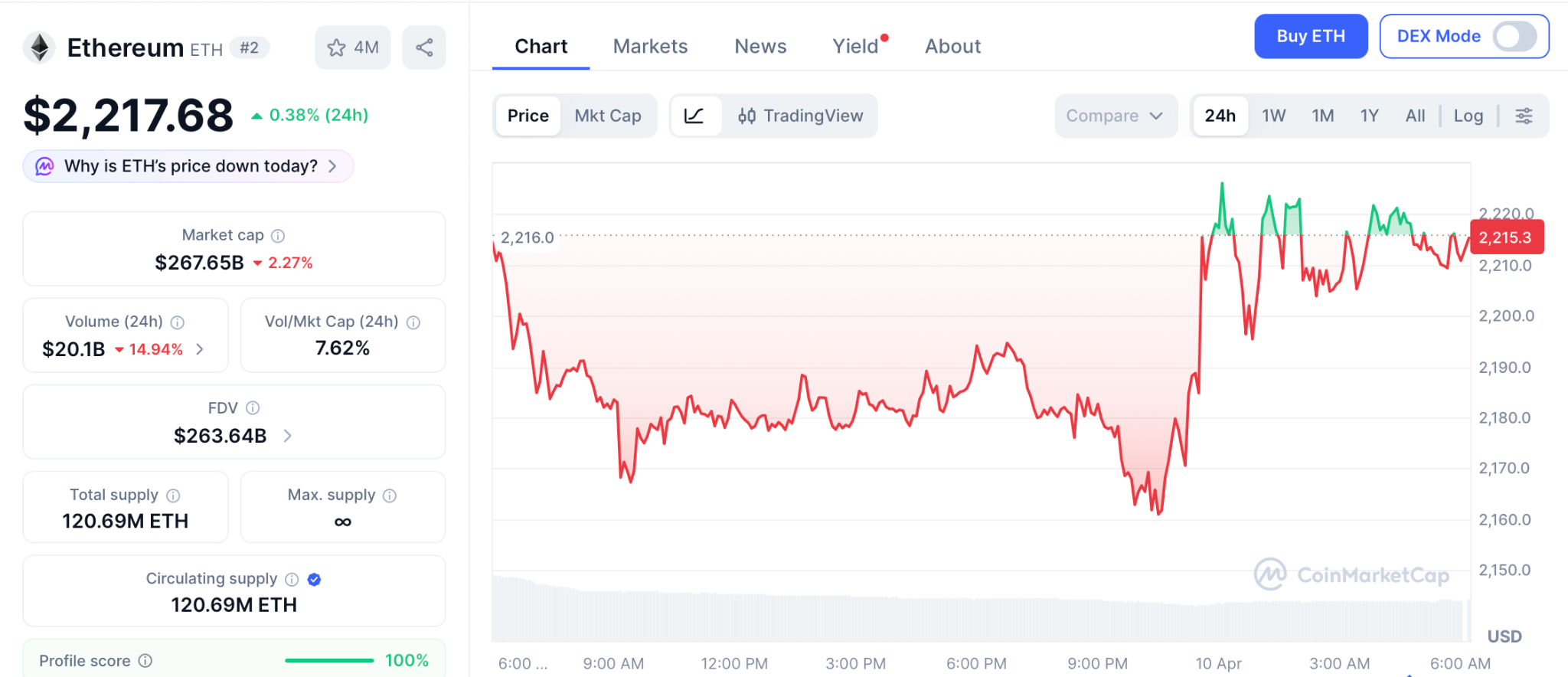
Support holds at $2,000 with resistance near $2,400. Even reaching $5,000, the August 2025 all time high, delivers roughly 120% from here, strong for a large cap but far from what the best crypto presale to buy can produce in the same window.
Arbitrum: ARB Sits 96% Below Its Peak With Unlock Pressure Ahead
ARB trades near $0.10 according to CoinMarketCap, sitting 96% below its all time high of $2.40. An $8.72 million token unlock arrives April 16, releasing 92.65 million tokens that add selling pressure.
Monthly unlocks keep dragging the price lower even as the Layer 2 network processes real DeFi volume. A recovery to $0.20 only doubles capital while dilution risk remains for holders waiting for the unlock schedule to end.
Conclusion:
The best crypto presale to buy becomes clearest when a rally reminds everyone that crypto rewards wallets already inside. ETH and ARB recovered on the ceasefire, but their ceilings pale against what presale entries produce when a listing arrives. Pepeto combines swap tools and contract protection with pricing that reshapes a portfolio after one event.
Pepe exploded from presale price and those early wallets collected life changing returns, and the same pattern is forming around Pepeto before the crowd confirms it. Capital flowing through Pepeto proves the signal is loud, and the presale price disappears permanently when the Binance listing opens. Every hour the presale stays open is an hour closer to the listing that turns this into the best crypto presale to buy someone else got instead of you.
Click To Visit Pepeto Website To Enter The Presale

FAQs
What makes Pepeto the best crypto presale to buy right now?
Pepeto runs live swap tools with zero fees, a Pepe cofounder leads the project, and a confirmed Binance listing sits days away at $0.0000001863 entry. The presale pulled $8.87 million during extreme market fear.
Did the ceasefire rally change the crypto outlook?
The ceasefire triggered $427 million in short liquidations and sent BTC above $72,000 in hours. Fresh capital entering the market benefits presale entries like Pepeto that are priced before exchange listing.
Disclaimer: This is a Press Release provided by a third party who is responsible for the content. Please conduct your own research before taking any action based on the content.

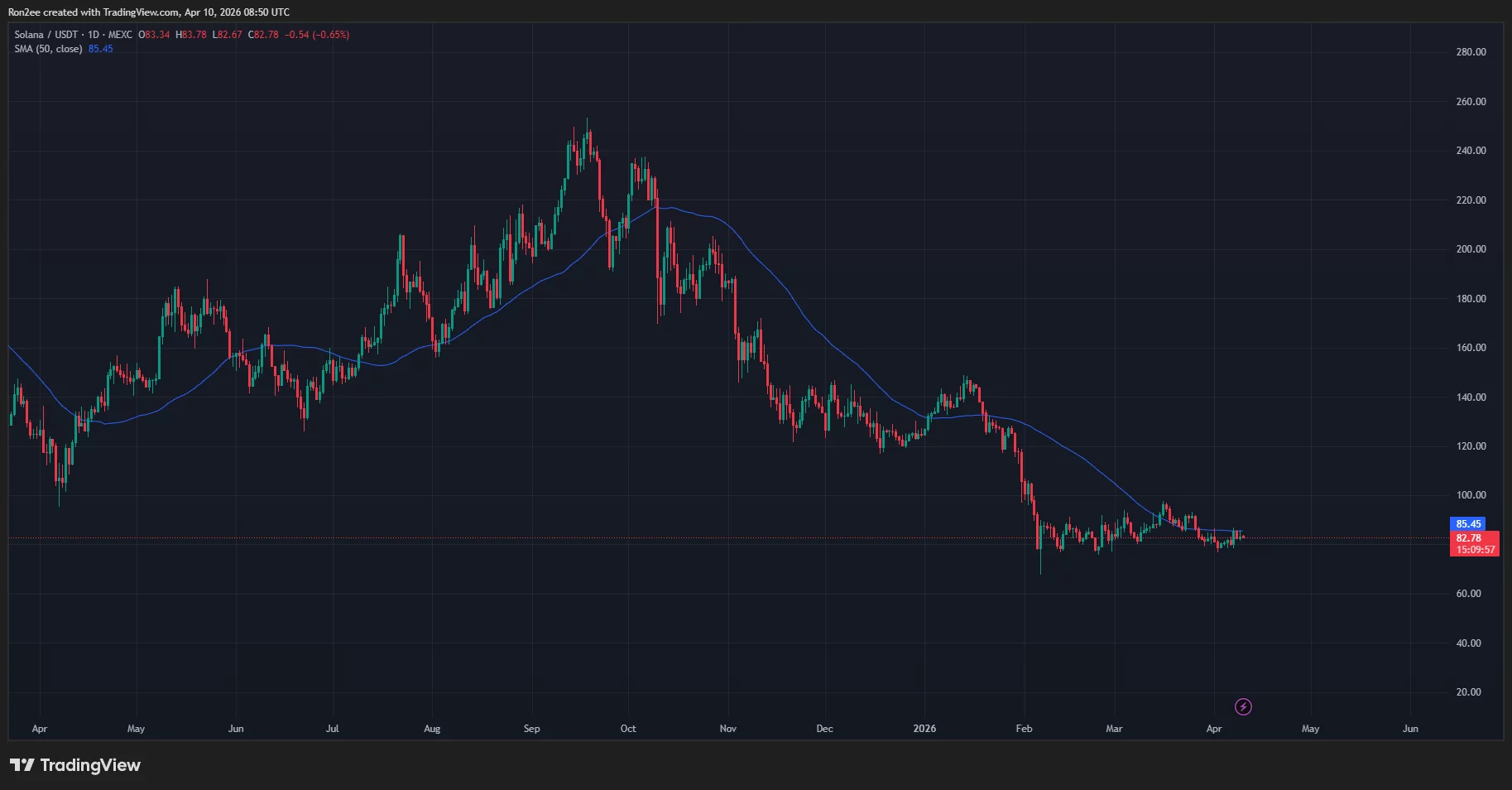
Solana price has rebounded back above $85 on Friday morning, retracing back some of its losses following Wednesday’s rally. However, it still remains below a key SMA level that puts it at risk of moving to its next leg lower over the coming sessions.
Summary
- Solana price rebounds above $85 but remains below the key 50-day SMA, keeping downside risk intact.
- Repeating a three-step pattern signals consolidation phase may precede another sell-off.
- Failure to reclaim the $86 level could trigger a sharp decline toward $52.
According to data from crypto.news, Solana (SOL) price rose 4.5% to an intraday high of $85.2 before stabilizing around $83 at the time of writing. The rebound following a market-wide recovery as Bitcoin moved above $73,000 helped the altcoin to backpedal on some of its losses experienced since dropping from its Wednesday high.
Despite the token’s recent rebound, it remains at risk of a more downside in the coming weeks, as it has failed to reclaim a key SMA level, failure of which has historically led to strong downsides.
The daily chart shows that Solana price has been trading within the $76 to $92 range since February this year. The token recently moved into the lower end of this range in the past two weeks.
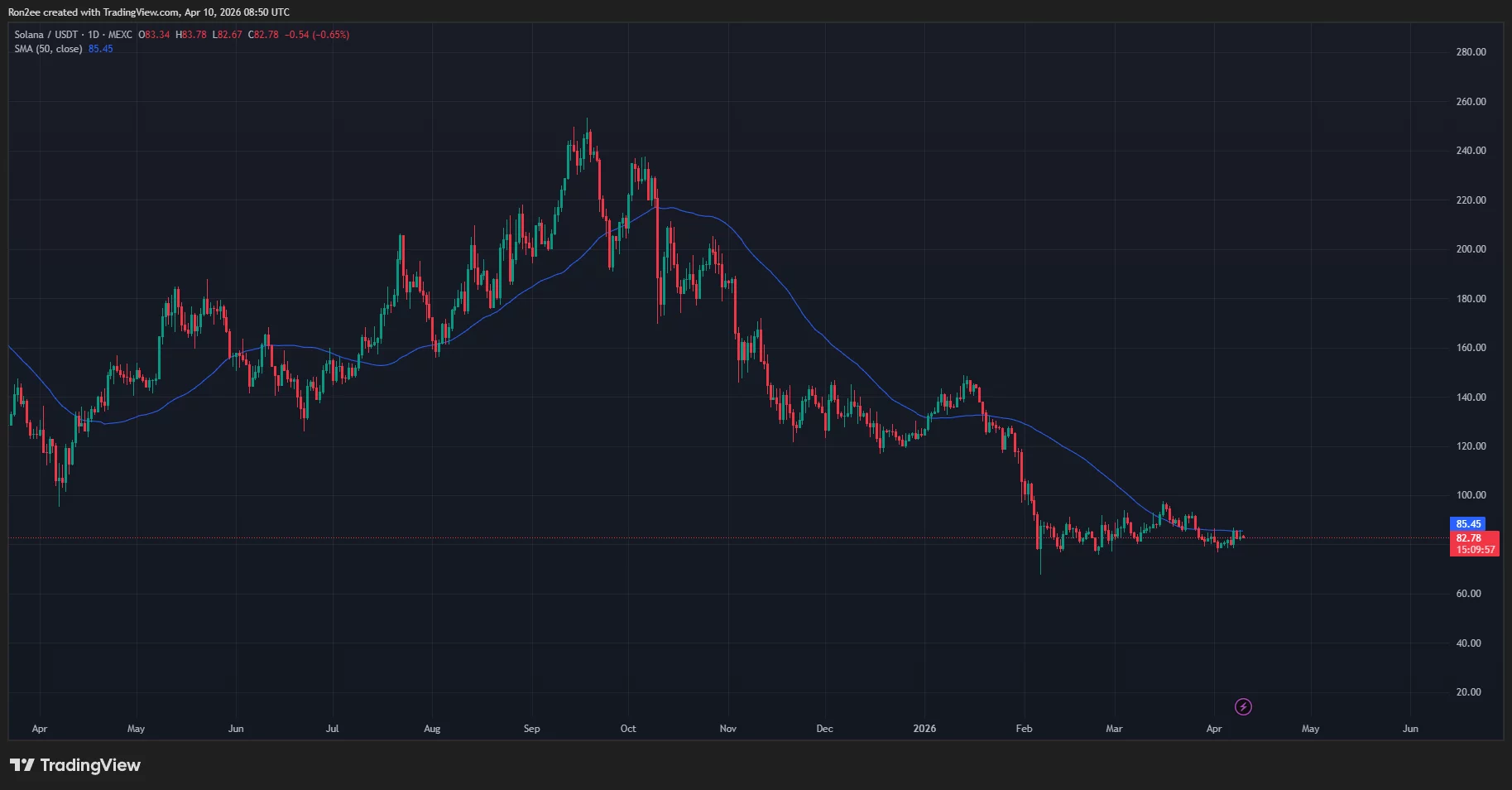
In doing so, Solana price has fallen below the 50-day SMA, which has historically been followed by significant bearish pressure since October 2023.
Notably, Solana price movement has been repeating a three-step cycle every time it prepares to transition to its next leg lower in the past six months.
The said pattern begins when Solana price reclaims the 50-day SMA, which is then followed by a rapid fall back below the indicator while losing the support of previous highs. Following this, the token enters into a consolidation trap, a period when the token moves sideways within a tight range before its final breakdown towards its next leg down begins.
As derived from the daily chart above, Solana price previously formed this pattern in November last year and again at the beginning of January this year, each time it fell below the 50-day SMA and subsequently entered a consolidation phase for weeks. Following this, it faced a strong sell-off, finally settling lower and forming a new local bottom.
In the most recent instance, Solana price moved above the key resistance in mid-March when it surged all the way to $97. The token has since been on a downtrend, making lower lows and lower highs in the process. Moving on to the last couple of days, the token has been stuck in its consolidation phase in the second step of the current cycle as it hovers between $79 and $81, and rests below the 50-day SMA around the $86 mark.
Assuming that the pattern holds, the ongoing sideways movement should not be interpreted as a sign of stabilization but as the token coiling before initiating its next leg down.
As such, if Solana fails to reclaim the $86 50 day SMA level in the coming sessions, it risks a rapid decline towards $52, a level calculated by subtracting the average percentage drop observed during previous cycles from the current consolidation peak.
Disclosure: This article does not represent investment advice. The content and materials featured on this page are for educational purposes only.
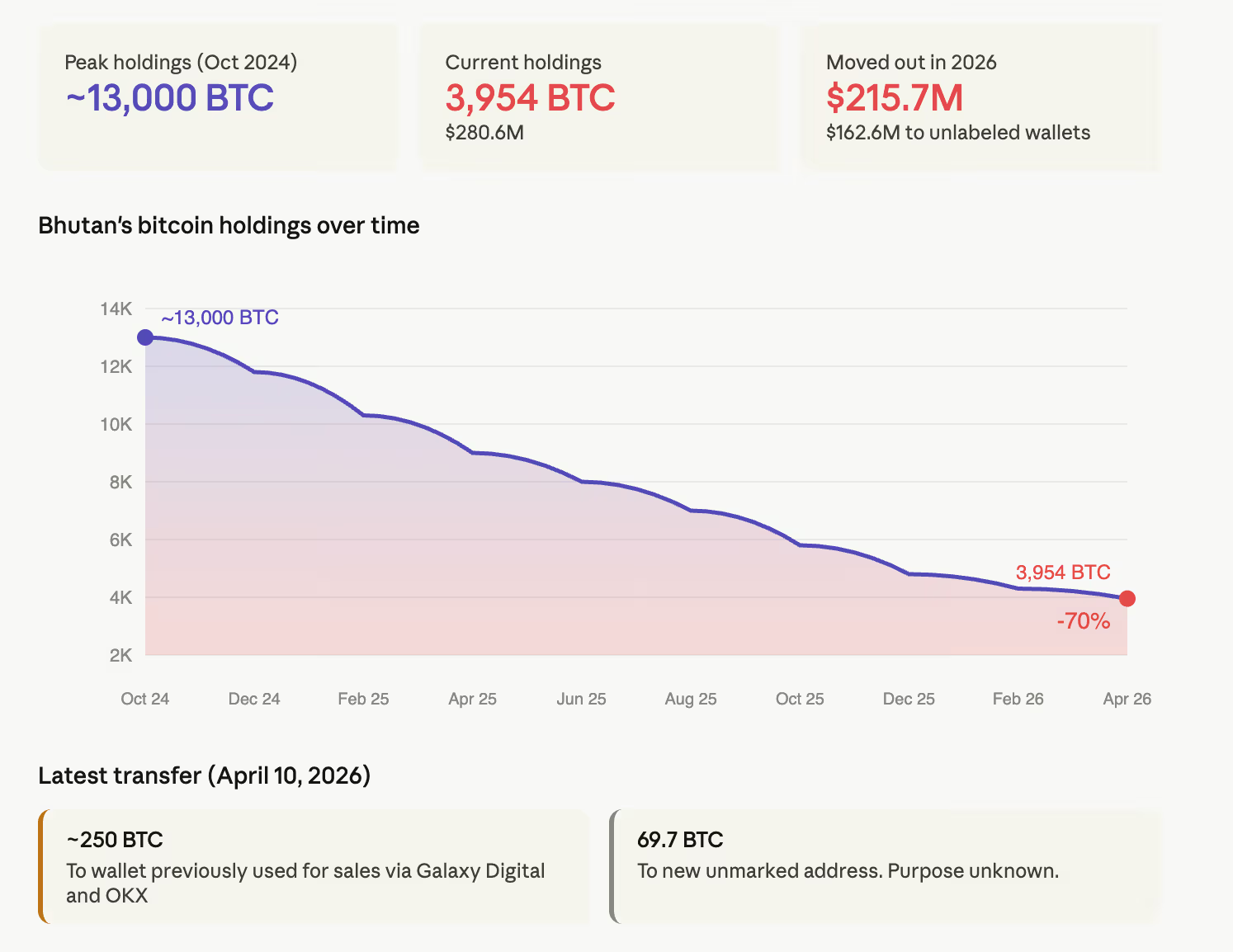
Bhutan is quietly unwinding one of the most unusual bitcoin experiments any government has ever run.
The Royal Government of Bhutan transferred roughly 319.7 BTC worth $22.68 million to two addresses on Thursday, according to Arkham Intelligence data. Roughly 250 BTC went to a wallet previously used to route funds for sale via Galaxy Digital and OKX. Another 69.7 BTC was sent to a new, unmarked address.
The transaction is part of a series of ongoing sales that have been going on for a while.
Bhutan held approximately 13,000 BTC in October 2024, accumulated through a hydropower-backed mining operation run by Druk Holding and Investments, the kingdom’s sovereign wealth fund.
That was the proof-of-concept for sovereign bitcoin mining. A tiny, landlocked country with cheap renewable energy, no legacy financial infrastructure to protect, and a sovereign wealth fund willing to experiment.
Since then, it has sold steadily. Holdings now stand at 3,954 BTC worth roughly $280.6 million, a 70% reduction in 18 months. Arkham data shows $215.7 million in bitcoin has moved out of Bhutan’s holding addresses this year alone, with $162.6 million of that going to unlabeled wallets.

The selling has accelerated into a market where virtually every other major holder is doing the opposite.
Strategy bought 4,871 BTC for $330 million last weekend, bringing its total to 766,970. U.S. spot ETFs absorbed approximately 50,000 BTC in March. The Ethereum Foundation staked $93 million of ether in a single day rather than sell. Even gold-backed sovereign funds have been adding to positions during the Iran conflict.
Bhutan is the only sovereign-level holder visibly liquidating. But there is also a question about whether the mining operation itself is still running.
Arkham data shows Bhutan’s last bitcoin inflow exceeding $100,000 was recorded over a year ago. A government that once generated bitcoin from power harnessed from its own rivers may now simply be spending down what it accumulated, with no new supply coming in to replace what it sells.
Druk Holdings has not responded to several emails and calls from CoinDesk over the past week, the latest of which was sent in the Asian morning hours on Friday. It has not publicly commented on the transfers or the status of its mining operation.
The economics may explain the shift, however.
Bhutan’s mining operation was viable when difficulty was lower, and bitcoin traded above $90,000. At current levels near $71,000, with network difficulty at all-time highs and the post-halving block reward reduced to 3.125 BTC, the margins on small-scale sovereign mining have compressed significantly.
The same hydropower that made Bhutan’s operation novel may now generate more revenue from electricity sold to neighboring India than from bitcoin mining, as mining hardware depreciates with every difficulty adjustment.
Choosing to sell rather than hold or mine is a data point about the gap between bitcoin’s narrative appeal to nation-states and the operational reality of maintaining a position through a prolonged drawdown.
Bhutan’s remaining 3,954 BTC is now smaller than what Strategy purchases in a typical week. The kingdom that once held 13,000 bitcoin mined from its own mountains is watching a single company in Virginia accumulate more in five days than Bhutan has left.
Read more: Bhutan moves another 500 bitcoin to exchanges as 2026 outflows top $150 million


HSBC and the Standard Chartered-backed Anchorpoint Financial have been granted Hong Kong’s first stablecoin issuer licenses.
Summary
- The Hong Kong Monetary Authority has granted the first stablecoin issuer licenses to HSBC and the Standard Chartered-backed venture Anchorpoint Financial.
- These initial approvals follow several months of delays after the regulator missed its original target to begin the licensing process in March.
The Hong Kong Monetary Authority (HKMA) released the names of the successful applicants on Friday, signaling the start of a new era for regulated digital assets in the region.
Among the approved firms is HSBC, a dominant local note-issuing bank, alongside Anchorpoint Financial, which operates as a joint venture between Standard Chartered, Animoca Brands, and Hong Kong Telecommunications.
Oversight and enforcement standards
These approvals establish the first group of participants under a licensing regime that officially launched on Aug. 1, 2025.
Under this regime, stablecoin issuers are required to obtain an HKMA license by meeting specific rules, including those for reserve backing and guaranteed redemption paths for users. Other obligations include following strict governance protocols and Anti-Money Laundering (AML) measures to remain in good standing.
The Legislation also grants the regulator the authority to investigate potential violations and police the sector, including the authority to levy fines, suspend operations, or revoke licenses entirely if an issuer fails to meet its legal obligations.
The rollout follows a period of administrative delays that saw the regulator miss its original goals for the year. Back in February, HKMA Chief Executive Eddie Yue stated that a “very small number of issuers” would be licensed by March.
While that deadline passed without an announcement, the regulator stated on April 1 that it was actively moving the process forward to finalize the first batch of applicants.
Analysts had largely foreseen this outcome following mid-March reports that highlighted HSBC and the Standard Chartered-backed venture as the most likely recipients of the licenses.


Disclosure: This article does not represent investment advice. The content and materials featured on this page are for educational purposes only.
AI stock trading bots gain traction in 2026 as beginners seek simple, automated ways to enter financial markets.
Summary
- AI stock trading bots gain traction in 2026, offering beginners automated, hands-free market entry
- MoneyFlare leads with one-click AI trading, combining stock and crypto automation for passive income
- Demand is rising for free AI trading tools as users seek simple, risk-managed investing solutions
As the financial markets continue to evolve, more beginners are turning to AI-powered tools to automate their stock trading. In 2026, AI stock trading bots are increasingly accessible, providing users with an easy, hands-off way to enter the market. For those who are beginners, looking to get started with AI stock trading, this guide will help them navigate the best free options available in 2026.
Whether someone is looking for a simple tool to automate their trades or seeking advanced features to fine-tune their strategies, the right AI trading bot can make all the difference. Let’s explore the top 10 free AI stock trading bots that are perfect for beginners in 2026.
What are AI stock trading bots?
AI stock trading bots are automated programs that use artificial intelligence algorithms to analyze market data, execute trades, and manage investments. These bots are designed to optimize trading strategies with minimal effort, making them perfect for beginners who want to avoid the complexity of manual trading.
In 2026, these bots offer advanced features like machine learning, sentiment analysis, and real-time market monitoring, all without requiring any coding skills. Many of these bots operate on a subscription-free basis, offering a risk-free introduction to the world of automated stock trading.
Top 10 free AI stock trading bots for beginners in 2026
1. MoneyFlare
Overview:
MoneyFlare is a sophisticated yet beginner-friendly AI trading platform that offers fully automated stock and crypto trading. Designed for individuals with no coding or technical experience, MoneyFlare leverages advanced AI algorithms to execute trades and manage investments 24/7.
Key Features:
- One-Click Activation: Start trading instantly with minimal setup.
- Pre-Built Quant Strategies: Choose from a variety of expert-crafted strategies tailored to maximize returns.
- 24/7 Automated Trading: Let the AI handle trades at any time, ensuring an opportunity is never missed.
- Risk Management Tools: Built-in stop-loss, take-profit, and exposure limits to minimize potential losses.
Best for:
Complete beginners who want a hands-off trading experience, as well as those looking for a safe, AI-driven approach to generating passive income with minimal effort.
Click to register and receive a free $10 real reward and $50 trial credit!
2. 3Commas
Overview:
3Commas offers an intuitive and flexible trading environment suitable for both beginners and advanced traders. It allows users to automate their trades using a variety of strategies, such as Dollar-Cost Averaging (DCA) and grid trading.
Key Features:
- Smart Trade Terminal: Execute trades with real-time analysis and risk management tools.
- Automated Portfolio Management: Rebalance and optimize a portfolio automatically.
- Multi-Exchange Support: Trade across multiple platforms like Binance, Kraken, and others, from one interface.
- Backtesting: Test strategies before going live.
Best for:
Beginners who want to start simple but also value the potential to scale their trading strategies as they gain experience.
3. Cryptohopper
Overview:
Cryptohopper is a cloud-based AI bot that combines automation with customization, making it ideal for both beginners and more experienced traders. Trades can ebe automated based on predefined strategies or real-time market signals.
Key Features:
- Strategy Marketplace: Choose from a wide range of pre-built strategies created by top traders.
- Social Trading: Follow expert traders and mirror their strategies in real time.
- Backtesting & Paper Trading: Test strategies risk-free before using real funds.
Best For:
Beginners looking for flexibility, with the option to gradually explore advanced features as they learn.
4. Pionex
Overview:
Pionex is an easy-to-use AI trading bot that offers over 16 different bots, including grid trading and arbitrage bots. It’s perfect for beginners who want to start automated trading without having to navigate complex features.
Key Features:
- Low Fees: One of the most cost-effective platforms, with trading fees as low as 0.05%.
- Pre-Built Strategies: Get started quickly with simple, effective strategies like grid trading and arbitrage.
- Automated Trading: Operate trades on autopilot 24/7.
Best For:
Beginners who want an all-in-one solution that simplifies automated trading with minimal setup and fees.
5. Zignaly
Overview:
Zignaly is a fully automated trading platform designed for those who want to follow expert traders or signal providers. It offers social trading and copy trading features, allowing beginners to learn from others while automating their own trades.
Key Features:
- Copy Trading: Automatically copy the strategies of top traders in real-time.
- Cloud-Based Automation: Run the bot seamlessly from the cloud without any setup hassles.
- Risk Management Tools: Protect investments with built-in risk controls.
Best For:
Beginners who prefer to follow professional traders’ strategies while automating their own trades with minimal input.
6. Autonio
Overview:
Autonio is a decentralized trading bot platform that allows users to trade across multiple assets using machine learning and AI. It’s ideal for beginners who want a hands-on approach to customizing their strategies with the power of AI.
Key Features:
- Machine Learning Algorithms: AI-powered trading that adapts to market conditions.
- Backtesting & Optimization: Test and refine strategies using historical data.
- Multi-Asset Support: Trade a variety of assets beyond just stocks and crypto.
Best For:
Beginners who want to dive deeper into customizable trading strategies while leveraging AI for decision-making.
7. HaasOnline
Overview:
HaasOnline offers a set of powerful, free trading bots that are ideal for beginners looking to explore automated trading. The platform allows full customization of trading strategies, providing more control over how trades are executed.
Key Features:
- Advanced Risk Management: Use features like stop-loss, trailing stop, and take-profit for safer trading.
- Multi-Exchange Support: Connect with several exchanges for a broader trading experience.
- Backtesting: Evaluate strategies and refine them before going live.
Best For:
Beginners who may want to start simple but gradually explore more complex features as they gain confidence.
8. Shrimpy
Overview:
Shrimpy offers a portfolio management tool with automated rebalancing and social trading. This bot is perfect for beginners who want to follow the strategies of top traders while managing their portfolios effortlessly.
Key Features:
- Portfolio Rebalancing: Keep investments aligned with goals by automating portfolio rebalancing.
- Social Trading: Copy the strategies of top traders and implement them automatically.
- Real-Time Performance Tracking: Track investments’ performance in real time.
Best For:
Beginners who want a simple and effective way to manage their portfolios with minimal effort.
9. Quadency
Overview:
Quadency is a versatile platform that offers AI-powered trading bots and an easy-to-use interface. It allows users to automate their trades and backtest strategies without needing any technical knowledge.
Key Features:
- Strategy Automation: Implement and execute various strategies with ease.
- Real-Time Data and Analytics: Make informed trading decisions based on real-time market data.
- Backtesting: Test strategies with historical data to ensure their effectiveness.
Best For:
Beginners who want a hassle-free, automated trading experience with powerful tools to track performance.
10. Bitsgap
Overview:
Bitsgap is an integrated trading platform that supports multiple exchanges and offers automated trading bots, including arbitrage and grid bots. It’s ideal for beginners looking to automate their trades across different platforms.
Key Features:
- Arbitrage Trading: Take advantage of price discrepancies across exchanges to maximize profits.
- Backtesting: Test strategies risk-free before live trading.
- Multi-Exchange Support: Trade across multiple exchanges from one platform.
Best For:
Beginners who want to explore more advanced features, such as arbitrage, without the complexity of setting up manual trades.
Why should beginners use AI stock trading bots?
For beginners, AI stock trading bots offer several advantages:
- Ease of Use: Most bots are designed to be user-friendly, with intuitive interfaces that don’t require prior trading experience.
- Automation: They run 24/7, meaning users can take advantage of market opportunities even while they sleep.
- Data-Driven Decisions: AI bots analyze vast amounts of market data, ensuring that trades are based on solid information rather than emotions.
- Risk Management: Many bots come with built-in risk management tools to protect investments.
How to get started with AI stock trading bots
Here’s a simple step-by-step guide to getting started for those who are new to AI stock trading bots:
- Choose the Right Bot: Select one of the bots listed above that suits a particular trading style and preferences.
- Set Up an Account: Most bots require users to create an account on their platform and link it to their brokerage or exchange account.
- Customize Settings: While some bots come with preset strategies, users can often adjust risk levels, trading pairs, and other parameters to suit their preferences.
- Monitor and Optimize: Once the bot is running, its performance can be monitored, and adjustments can be made if necessary. Some bots offer analytics to help track profitability.
Things to consider before using AI stock trading bots
While AI stock trading bots offer great advantages, they are not foolproof. Here are a few things to consider:
- Market Risk: The stock market can be volatile, and even AI systems can make losses in unpredictable market conditions.
- Initial Setup: Some bots may require initial configuration or a learning curve, even if they’re beginner-friendly.
- Fees: Some bots are free, but others may charge a fee for premium features. Be sure to check the cost structure before getting started.
Tips to avoid being scammed in AI stock trading
As AI stock trading becomes more popular, many investors are turning to automated trading systems to manage their investments. However, there are also fraudulent platforms and scams in the market, so it is crucial to ensure that protection comes first. Below are some effective tips to help traders avoid being scammed while using AI stock trading platforms:
1. Choose a reputable platform
Ensure a well-known platform with positive reviews is selected. Users can verify the platform’s credibility by researching user feedback, independent reviews, and whether the platform is regulated by financial authorities (such as the U.S. Securities and Exchange Commission [SEC] or the UK’s Financial Conduct Authority [FCA]). Legitimate platforms will disclose their registration information and be under the supervision of regulatory bodies, so avoid platforms with low transparency.
2. Avoid unrealistic high-return promises
Any platform that promises “guaranteed profits” or fixed high returns should raise suspicion. No investment can guarantee consistent returns, especially in the volatile stock market. Legitimate platforms typically include risk warnings in their terms of service and disclaimers, advising users of the potential for losses. Be wary of platforms that make unrealistic promises of high returns or quick profits.
3. Ensure platform security
When selecting a platform, make sure it offers strong data encryption to protect the account and funds. Legitimate platforms typically use SSL encryption protocols to secure data transmission, and they provide two-factor authentication (2FA) to enhance account security. This ensures that even if someone steals a password, they won’t be able to access the account easily. Verify that the platform follows industry-standard security measures to prevent hacking or data breaches.
4. Avoid following trading signals from unverified sources
Avoid blindly following trading signals or advice from unverified sources. Choose platforms where the signal sources are clearly identified and ensure these signals come from reputable professionals or verified traders. Social trading platforms (such as Zignaly) allow users to follow other successful traders’ strategies, but make sure these strategies are transparent and publicly available. Do not make decisions based solely on short-term profit claims.
5. Start with small investments, don’t invest all funds at once
Before fully trusting a platform, it’s best to start with small, test investments. This allows the user to assess the platform’s performance and the effectiveness of its AI strategies with minimal risk. Diversify investments to reduce risk and avoid putting all the funds into one platform or strategy.
6. Verify AI strategy transparency
Make sure the platform can explain how its AI algorithms work and the strategies used for trading. If a platform keeps its algorithms and operations highly secret or fails to provide enough transparent information, it’s best to avoid using that platform. Reputable platforms usually explain how their AI analyzes the market, makes trading decisions, and provides clear risk management tools.
7. Regularly check account and trading activities
Regularly monitor a trading account to ensure there are no unusual transactions or unauthorized fund transfers. Most platforms offer real-time trade alerts to help track trading activities. Set up alerts for important transactions to receive immediate notification and can take action if needed.
8. Be cautious about free platforms
Although many platforms offer free trials, completely free platforms often come with hidden fees or security risks. Be sure to understand the platform’s fee structure and whether there are any extra charges before getting started. Some scam platforms lure users with “free” services, but later obtain their funds or personal information through other means.
Conclusion
In 2026, AI stock trading bots are the perfect solution for beginners looking to automate their trading strategies and earn passive income. With the bots listed in this guide, anyone can start trading without needing to be a seasoned investor or a coding expert. Whether they want simplicity, advanced features, or a combination of both, these bots can help them navigate the stock market with ease.
Always keep in mind that while AI trading bots are powerful tools, they come with risks. It’s important to monitor trades, set appropriate risk management tools, and only invest what someone can afford to lose.
By choosing the right AI bot and following best practices, traders can set themselves up for success in the world of stock trading.
Disclosure: This content is provided by a third party. Neither crypto.news nor the author of this article endorses any product mentioned on this page. Users should conduct their own research before taking any action related to the company.


The US Treasury secretary, Scott Bessent, has reportedly met with major American bank leaders this week as officials assessed potential cyber threats that Anthropic’s latest artificial intelligence system poses.
Summary
- Scott Bessent convened major U.S. bank CEOs to assess cybersecurity risks linked to Anthropic’s Claude Mythos AI model following a code leak.
- The model reportedly uncovered thousands of long-standing software vulnerabilities, raising concerns over misuse by hackers and threats to financial stability.
- Anthropic’s revenue surpassed $30 billion annualized, driven by enterprise demand, major compute deals with Google and Broadcom, and the growth of its Claude Code platform.
According to reports, Treasury Secretary Scott Bessent brought together senior executives at the department’s Washington headquarters, with Jerome Powell also said to be present. The meeting followed the unveiling of Anthropic’s Claude Mythos model, which the company has described as posing “unprecedented” cybersecurity risks.
Concerns surrounding the model intensified after its code was leaked earlier this month. In a subsequent blog post, Anthropic said advanced AI systems had surpassed “all but the most skilled humans at finding and exploiting software vulnerabilities,” warning that the consequences for economies, public safety, and national security “could be severe.”
The gathering took place while bank executives were already in Washington for an industry event, with invitations largely extended to leaders of systemically important institutions. Regulators consider these banks critical to financial stability, meaning disruptions to their operations could have far-reaching consequences.
Attendees reportedly included David Solomon of Goldman Sachs, Brian Moynihan of Bank of America, Jane Fraser of Citigroup, Ted Pick of Morgan Stanley, and Charlie Scharf of Wells Fargo. Jamie Dimon of JPMorgan Chase was invited but did not attend.
In his annual shareholder letter released this week, Dimon cautioned that cybersecurity “remains one of our biggest risks,” adding that artificial intelligence “will almost surely make this risk worse.”
Anthropic said its yet-to-be-released Mythos model has already identified thousands of vulnerabilities across software and widely used applications. As a result, access to the system has been limited to a small group of companies, including Amazon, Apple, and Microsoft.
The move marks the first time the company has restricted a product rollout. Select infrastructure and technology groups, such as Cisco and Broadcom, have also been granted access, along with the Linux Foundation.
The developments come as fears grow that malicious actors could use advanced AI tools to uncover passwords or break encryption systems designed to protect sensitive data.
Anthropic said some of the flaws identified by Mythos date back as far as 27 years and had not been detected by developers or security monitors before the AI system surfaced them.
The Treasury meeting also follows a recent decision by the US government to classify Anthropic as a potential supply chain risk, a designation the company is currently challenging in court.
Despite the ongoing regulatory scrutiny and a supply chain risk designation from the U.S. Department of Defense, Anthropic has reported unprecedented financial momentum.
In a recent blog post released on April 6, the company said its annualized revenue run rate exceeded $30 billion as of early April 2026, more than tripling from roughly $9 billion at the end of 2025.
Part of that growth has been driven by new compute partnerships with Google and Broadcom, highlighting rising demand for large-scale AI infrastructure. This agreement secures multiple gigawatts of next-generation TPU capacity to power frontier Claude models through 2027 and beyond.
Its agentic coding platform, Claude Code, has emerged as a key contributor, generating more than $2.5 billion in run-rate revenue as of February.
Weekly active users on the platform have also doubled since the start of the year, pointing to rapid adoption of AI-driven development tools as the company shifts its focus toward high-value enterprise agents.

How a Met Police crackdown left Enfield sex workers living in fear | News UK

Guardrails for MFIs need to continue

Japan reclassifies cryptocurrency as financial instrument in major legislative change

Why Israel is blocking foreign journalists from entering

Bitcoin: We’re Entering The Most Dangerous Phase

Alan Cumming Brands Baftas Ceremony A ‘Triggering S**tshow’

XRP- Ripple Treasury Ceritified To Tap 11,000+ SWIFT Banks? Yes – Bitcoin Hits $200K What Is XRP???

ULTIMATE Cryptocurrency Trading Course (From Beginner To PRO)

Gs Finance – New Loan App for Low Cibil ( Review ) | New Loan App review 2026 | Only On KYC
-

 Business5 days ago
Three Gulf funds agree to back Paramount’s $81 billion takeover of Warner, WSJ reports
-

 Sports6 days ago
India men’s 4x400m and mixed 4x100m relay teams register big progress | Other Sports News
-

 Politics10 hours ago
US brings back mandatory military draft registration
-

 Fashion11 hours ago
Weekend Open Thread: Veronica Beard
-

 Business7 days ago
Expert Picks for Every Need
-

 Tech3 days ago
How Long Can You Drive With Expired Registration? What Florida Law Says
-

 Business6 days ago
No Jackpot Winner, Prize to Climb to $231 Million
-

 Fashion5 days ago
Massimo Dutti Offers Inspiration for Your Summer Mood Board
-
 Sports11 hours ago
Man United discover Nico Schlotterbeck transfer fee as defender reaches Dortmund agreement
-

 Fashion3 days ago
Let’s Discuss: DEI in 2026
-

 Crypto World3 days ago
Bitcoin recovers as US and Iran Agree a Ceasefire Deal
-

 Business8 hours ago
Tesla Model Y Tops China Auto Sales in March 2026 With 39,827 Registrations, Beating Cheaper EVs and Gas Cars
-

 Crypto World2 days ago
Canary Capital Files SEC Registration for PEPE ETF
-

 Business6 days ago
Akebia Therapeutics, Inc. (AKBA) Discusses Pipeline Progress and Strategic Focus on Kidney Disease Treatments at R&D Day – Slideshow
-

 Business17 hours ago
OpenAI Halts Stargate UK Data Centre Project Over Energy Costs and Copyright Row
-

 Politics7 days ago
The UK should not pay a penny in slavery reparations
-

 Tech5 days ago
Haier is betting big that your next TV purchase will be one of these
-

 Tech5 days ago
The Xiaomi 17 Ultra has some impressive add-ons that make snapping photos really fun
-

 Tech5 days ago
Samsung just gave up on its own Messages app
-

 Tech5 days ago
Gamer Restores the Original PlayStation Portal From Two Decades Ago
You must be logged in to post a comment Login