

Crypto World
Analysts’ Tesla (TSLA) Price Predictions for 2026-2030 and Beyond

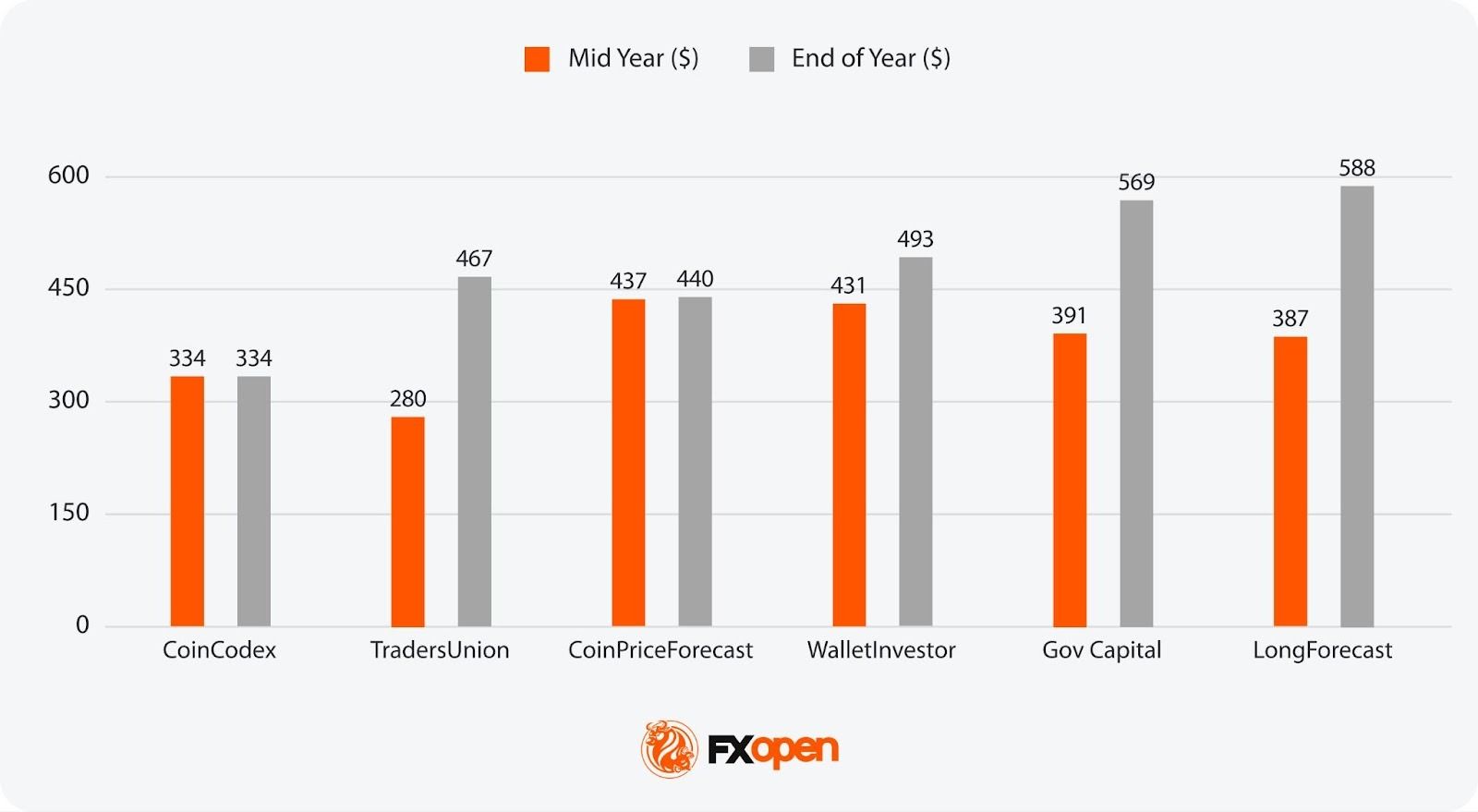
Tesla (TSLA) is one of the most closely watched growth stocks in the market. Analysts predict the stock could trade between $330 and $600 by the end of 2026, driven by its electric vehicle leadership and AI ambitions. Investors looking for a Tesla stock forecast for 2026–2030 are trying to assess whether the company’s AI ambitions and EV leadership can sustain long-term share price growth. While Tesla’s share price has experienced significant volatility, the company’s investments in artificial intelligence, autonomous driving, and energy storage continue to shape its long-term growth narrative.
In this article, we break down analysts’ Tesla price forecasts for 2026 to 2030, discuss key factors that are expected to influence the TSLA stock price direction, and go through the stock price history.
Forecast Summary
2026
Algorithmic forecasting sources project TSLA between $334 and $588 by year-end, a wide range reflecting deep disagreement over Tesla’s near-term trajectory. Wall Street analyst targets cluster between $400 and $600, with the Robotaxi rollout timeline, Cybercab production ramp, and FSD monetisation expected to be the dominant price drivers.
2027
Predictions range from $351 to $1,110. Sources at the bullish end assume Tesla successfully scales autonomous ride-hailing across multiple US cities, while bearish models reflect concerns over EV margin compression and intensifying competition from BYD and other Chinese manufacturers.
2028
Estimates span $347 to $814. The spread reflects uncertainty over whether Robotaxi and Optimus revenue can meaningfully offset a maturing core EV business, and whether Tesla can maintain pricing power as the global EV market becomes increasingly commoditised.
2029
Most projections fall between $494 and $1,200. Sources note that execution on Optimus commercialisation and international Robotaxi expansion could drive significant re-rating, while regulatory setbacks or autonomous safety incidents remain key downside risks.
2030
Long-range forecasts suggest $320 to $1,250, with the spread underscoring how speculative five-year projections for Tesla remain. Outcomes hinge largely on whether autonomy and robotics deliver the transformative revenue streams that currently underpin much of the stock’s premium valuation.
What Factors Could Impact Tesla’s Stock Price in 2026-2030 and Beyond?
Looking ahead to 2026 and beyond, Tesla’s future stock price is expected to be shaped by significant technological advancements, market expansions, and strategic initiatives. Analysts present a diverse range of forecasts, reflecting both optimistic and cautious perspectives on Tesla’s future.
Technological Advancements
Tesla’s ongoing development of Full Self-Driving (FSD) technology is a critical factor in its long-term outlook. By 2026, Tesla aims to fully integrate autonomous driving capabilities, potentially revolutionising the transportation industry. The success of FSD could open new revenue streams through autonomous ride-hailing services, with ARK Invest projecting a substantial market for these services.
Production and Market Expansion
Tesla plans to ramp up production capabilities significantly, aiming to produce millions of vehicles annually by the end of the decade. The company is expected to leverage its Gigafactories in Berlin, Shanghai, and Texas to meet global demand. Expansion into new markets, particularly in Asia and Europe, will be crucial for sustaining growth. Analysts believe Tesla’s ability to efficiently scale production while maintaining quality will be a major determinant of its success.
Energy Solutions
Beyond automotive, Tesla’s energy division, including solar and energy storage products, is poised for substantial growth. The demand for renewable energy solutions is expected to surge, and Tesla’s innovations in battery technology and energy storage systems could capture a significant share of this market.
Financial Performance
Analysts predict a wide range of outcomes for Tesla’s financial performance. Revenue growth is expected to be driven by increased vehicle deliveries, higher adoption of FSD, and expanding energy solutions.
Challenges and Risks
Tesla faces several potential challenges, including increased competition from other electric vehicle manufacturers and traditional automakers entering the EV market. Regulatory changes, supply chain constraints, and economic fluctuations could also impact Tesla’s growth trajectory. Despite these risks, many analysts remain optimistic about Tesla’s ability to navigate these challenges and continue its upward momentum.
Analytical Tesla Stock Price Forecasts for 2026 to 2030 and Beyond
Check the long-term analytical price projections for the TSLA stock price.
Wedbush Securities analyst Dan Ives maintains a Street-high $600 price target with an Outperform rating, projecting Tesla could reach a $2 trillion market cap in 2026 and up to $3 trillion in a bull case. Ives expects an accelerated Robotaxi rollout across more than 30 US cities this year. “We are raising our price target on Tesla to $600, reflecting our view that an accelerated AI autonomous path is now on the horizon in 2026 and investors are underestimating the major transformation underway,” Ives wrote. “We believe this will be the biggest growth chapter in Tesla’s history.”
Morgan Stanley expects Tesla to deploy around 1,000 Robotaxis by end-2026, with a path toward one million by 2035. Analyst Adam Jonas declared in October 2025 that “autonomous cars are solved,” comparing the moment to the invention of the steam engine and noting that Tesla’s camera-only system would “seriously challenge the conventional thinking of many in the robotaxi community.” The firm places Tesla’s broader product suite, including Tesla’s Full Self-Driving (FSD), charging, and licensing, at almost $160 per share. As of the TSLA stock price, Morgan Stanley believes that it may reach $415.
Goldman Sachs analyst Mark Delaney lowered its target to $405 from $420 following Q4 2025 earnings, maintaining a Neutral rating. Delaney flagged Tesla’s plan to increase capital expenditure to over $20 billion in 2026, partly to fund AI training infrastructure, writing: “We now expect negative overall free cash flow this year for Tesla.”
Stifel reiterated its Buy rating on Tesla with a $508 price target following Q4 2025 results, noting that revenue, gross profit, and operating income all exceeded estimations. The firm highlighted Tesla’s progress expanding its Robotaxi service in Austin and the Bay Area and plans to cover seven additional metro areas in H1 2026, alongside ongoing improvements in AI capabilities supporting FSD. Stifel also flagged Tesla’s shift to a monthly FSD subscription model and expects Optimus 3 supply chain development with production beginning by the end of 2026.
TD Cowen lifted their target to $519 from $509 after Q4 2025 results, retaining a Buy rating. The firm pointed to better-than-expected margins and encouraging Robotaxi developments, estimating that Tesla’s Cybercab could achieve operating costs of around $0.30 per mile – low enough to unlock growth in rideshare markets where penetration remains limited. The company flagged several near-term catalysts, including the start of Cybercab production, Robotaxi geographic expansion, continued FSD improvements, and progress on Optimus V3.
Tesla Stock Price Predictions for 2026
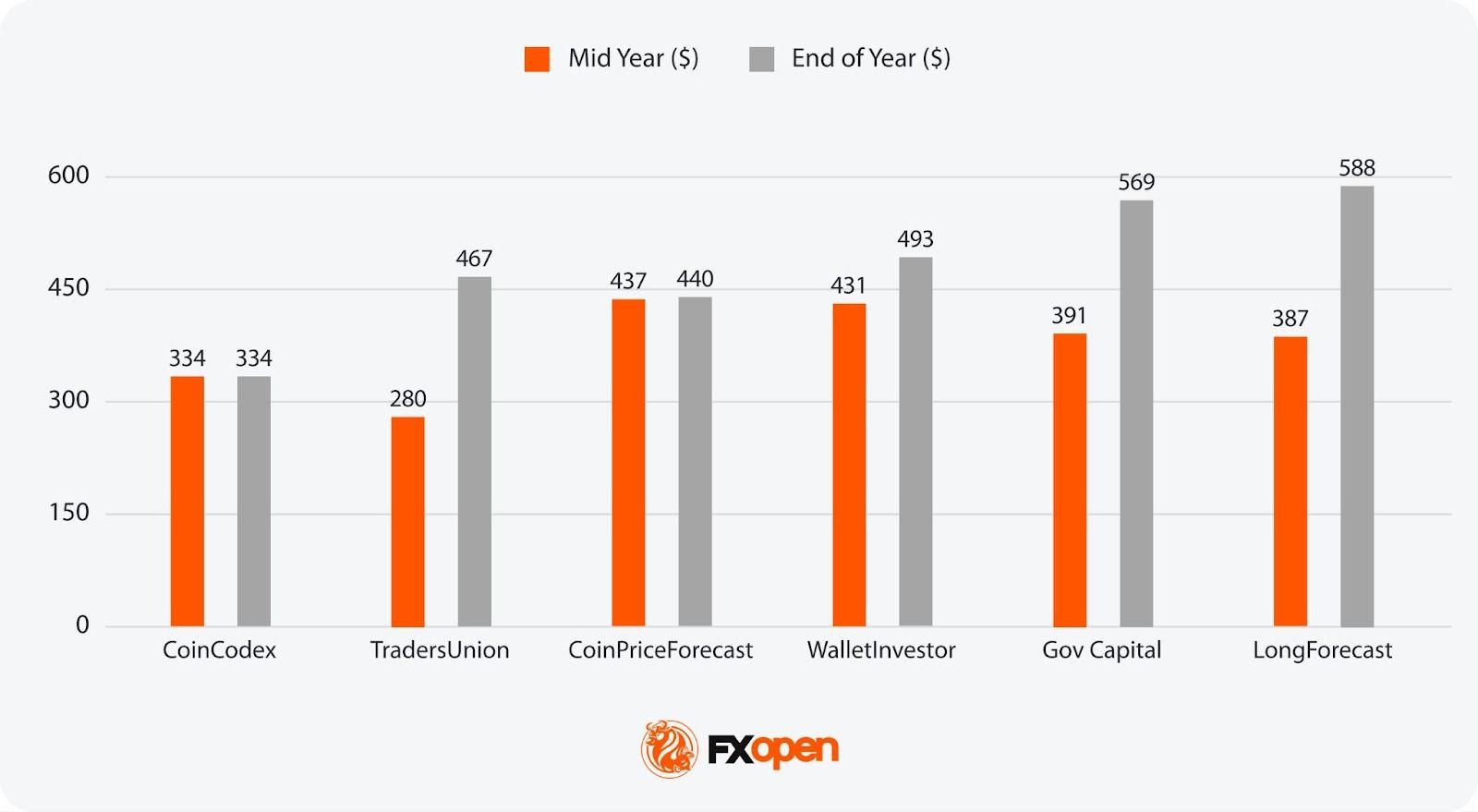
Mid-Year 2026:
- Most Bullish Projection: $437 (CoinPriceForecast)
- Most Bearish Projection: $280 (TradersUnion)
End-of-Year 2026:
- Most Bullish Projection: $588 (LongForecast)
- Most Bearish Projection: $334 (CoinCodex)
Tesla Stock Price Predictions for 2027
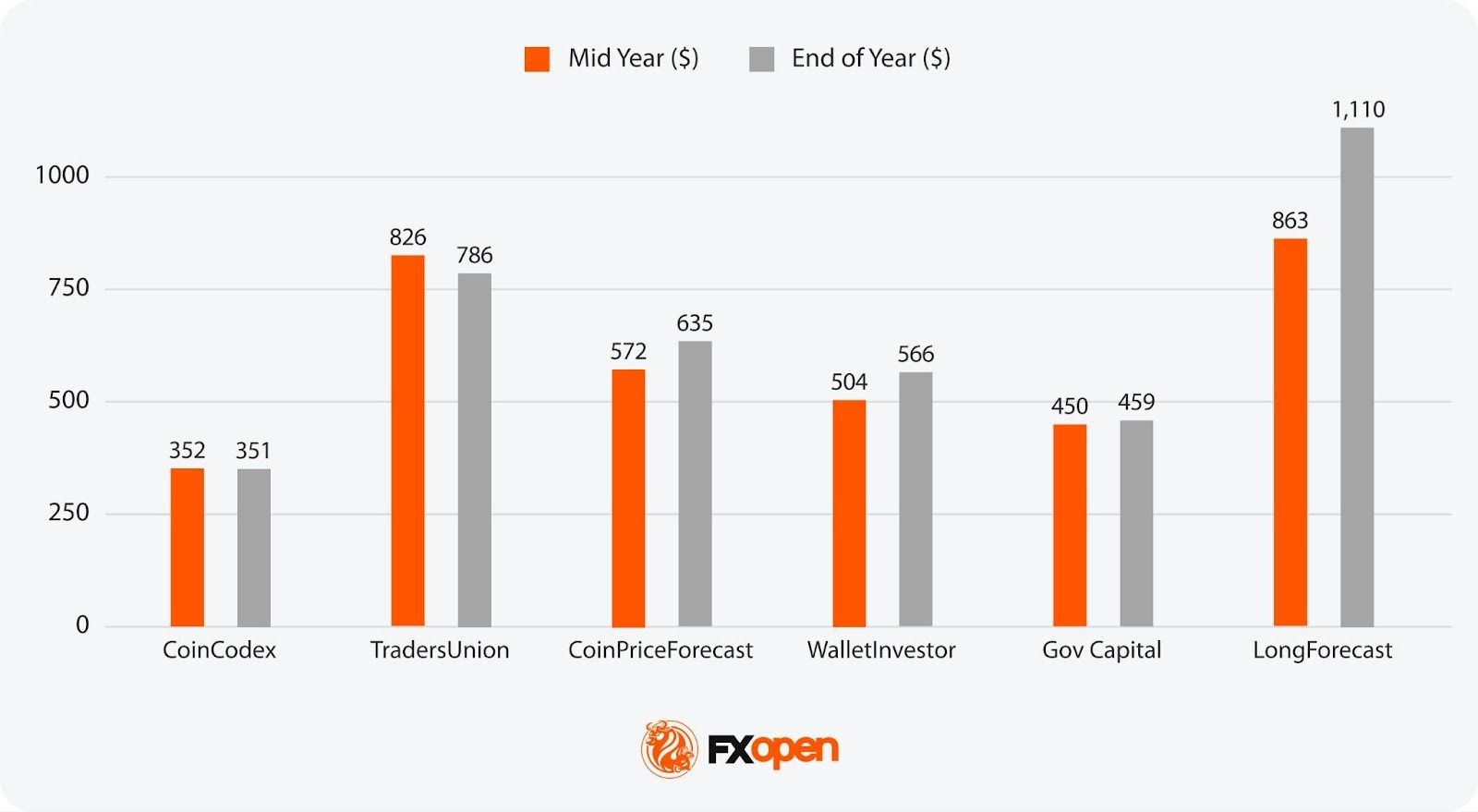
Mid-Year 2027:
- Most Bullish Projection: $863 (LongForecast)
- Most Bearish Projection: $352 (CoinCodex)
End-of-Year 2027:
- Most Bullish Projection: $1,110 (LongForecast)
- Most Bearish Projection: $351 (CoinCodex)
Tesla Stock Price Predictions for 2028
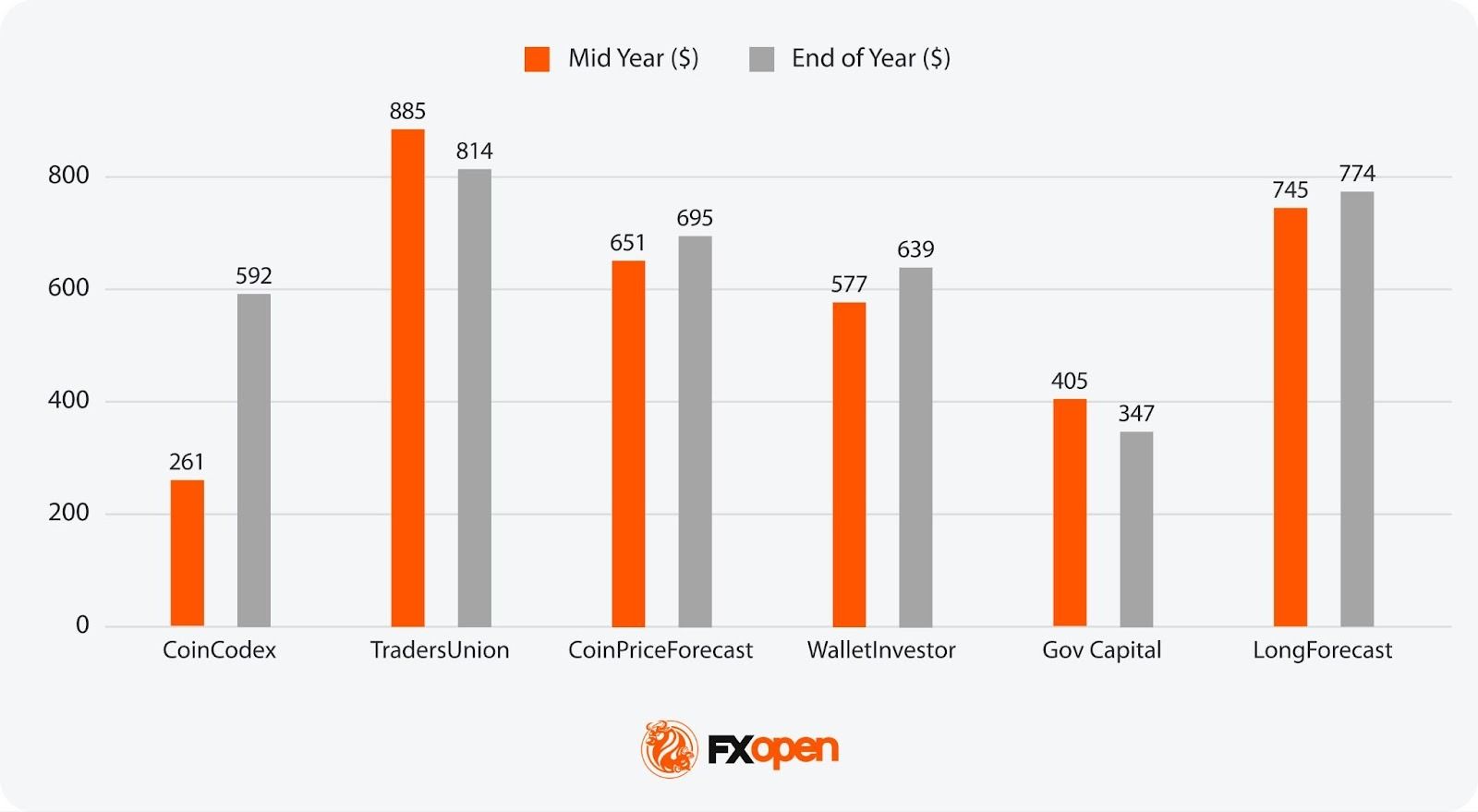
Mid-Year 2028:
- Most Bullish Projection: $885 (TradersUnion)
- Most Bearish Projection: $261 (CoinCodex)
End-of-Year 2028:
- Most Bullish Projection: $814 (TradersUnion)
- Most Bearish Projection: $347 (Gov Capital)
Tesla Stock Price Predictions for 2029
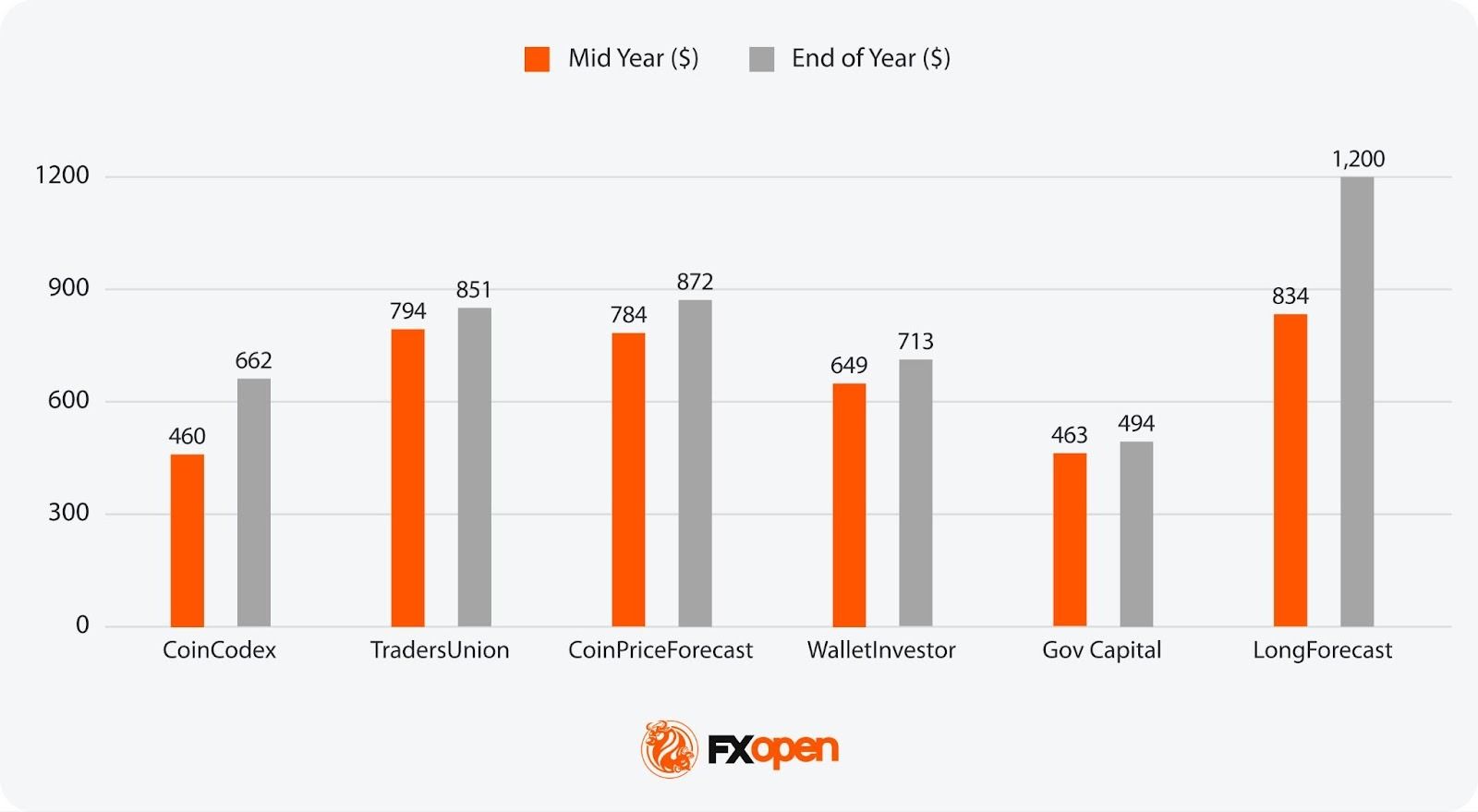
Mid-Year 2029:
- Most Bullish Projection: $834 (LongForecast)
- Most Bearish Projection: $460 (CoinCodex)
End-of-Year 2029:
- Most Bullish Projection: $1,200 (LongForecast)
- Most Bearish Projection: $494 (Gov Capital)
Tesla Stock Price Predictions for 2030
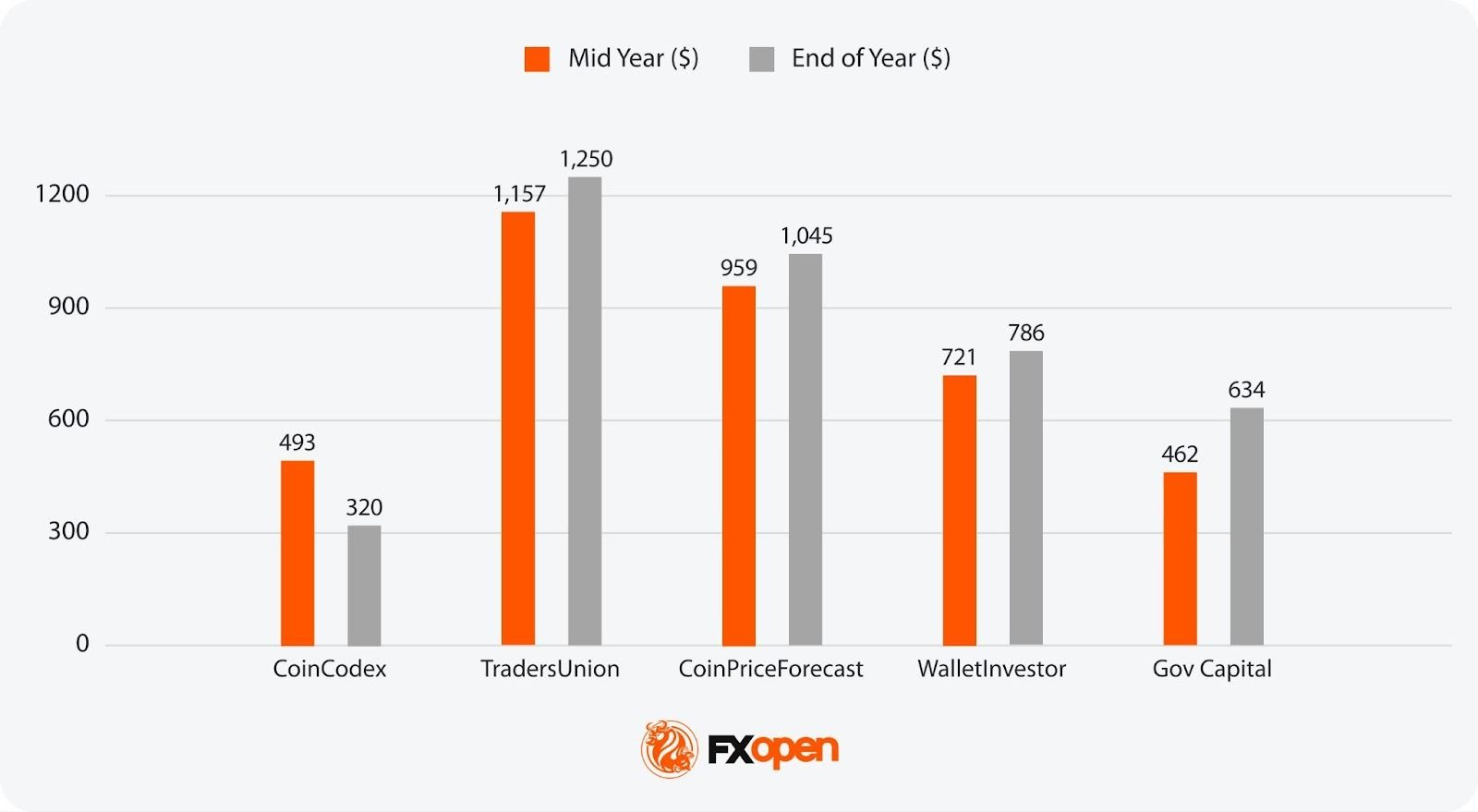
Mid-Year 2030:
- Most Bullish Projection: $1,157 (TradersUnion)
- Most Bearish Projection: $462 (Gov Capital)
End-of-Year 2030:
- Most Bullish Projection: $1,250 (TradersUnion)
- Most Bearish Projection: $320 (CoinCodex)
Tesla Stock Price Prediction Beyond 2030
While long-term forecasts for Tesla’s stock beyond 2030 are uncommon, several sources provide projections. By 2035, CoinPriceForecast estimates Tesla’s share price could reach $1,354, while TradersUnion projects $1,131. Looking further ahead to 2040, TradersUnion projects $3,935.
Tesla: How It Started
Tesla was established in 2003 by engineers Martin Eberhard and Marc Tarpenning, driven by a vision to develop electric vehicles that could compete with conventional internal combustion cars in both performance and design. Shortly thereafter, Elon Musk joined the company, assuming the role of CEO and spearheading critical investment rounds that played a pivotal role in defining Tesla’s long-term strategic direction.
Tesla’s first car, the Roadster, launched in 2008 and set the stage for what the brand would become—an innovator in high-performance electric vehicles. The Roadster could travel over 200 miles on a single charge, shattering public scepticism about EV capabilities and proving that electric cars could be fast, efficient, and practical.
This early success positioned Tesla as a serious player in the automotive industry. As the company continued to innovate, Tesla’s mission evolved: to accelerate the world’s transition to sustainable energy, a goal that would define its trajectory in the years to come.
Tesla’s Recent Price History
Tesla’s journey in the stock market has been marked by significant milestones and periods of volatility. Since its initial public offering (IPO) in June 2010, when it debuted at $17 per share, Tesla has seen dramatic price changes driven by key events and developments.
If you want to follow TSLA CFD price movements, consider heading over to the TickTrader trading platform.
2010-2012
Tesla’s early years as a public company were challenging. After its IPO, the stock price fluctuated but remained relatively low. A pivotal moment came in 2012 with the launch of the Model S, Tesla’s first mass-market electric vehicle (EV), which boosted investor confidence and put TSLA at a high of $2.66 in March 2012.
2013
This year marked a turning point as Tesla reported its first profitable quarter. The stock price soared from $2.33 at the start of 2013 to over $10 by the end of the year, reflecting increased market confidence and investor enthusiasm.
2014-2016
Tesla continued to innovate and expand. The announcement of the Gigafactory in Nevada in February 2014 aimed to scale up battery production, boosting TSLA’s price further. It closed 2014 at $14.83. In 2016, the introduction of the Model 3 and the acquisition of SolarCity were significant milestones. However, the stock faced volatility due to high capital expenditures and production challenges, reaching a low of $9.40 in February 2016 before closing the year at $14.25.
2017-2019
The release of the Model 3 in 2017 was a turning point, making EVs vastly more accessible to the general public. Despite production bottlenecks, the stock price reached new heights, peaking at $25.97 in mid-2017. The unveiling of the Cybertruck in 2019 and the ramp-up of production in the Shanghai Gigafactory kickstarted significant bullish momentum, with TSLA ending 2019 at $27.89.
2020-2024
Tesla’s stock experienced explosive growth in 2020. While the onset of the COVID-19 pandemic prompted a brief downturn, Tesla quickly became one of 2020/2021’s biggest success stories. It closed 2020 and 2021 at $232.22 and $352.26, respectively. This surge was fueled by four consecutive profitable quarters (the middle of 2020), the S&P 500 index inclusion (December 2020), and increasing global demand for EVs.
However, a generally restrictive economic environment led Tesla to experience its most notable slump to date. As US interest rates began to rise in March 2022, sales of EVs began to decline while competition in the market increased—particularly in China, one of its key markets. Elon Musk’s acquisition of Twitter also raised concerns about potential distractions and conflicts of interest. TSLA opened 2022 at $382.58 and closed the year at $123.18.
Stocks began to rebound in 2023, and Tesla was a prime beneficiary. After cutting prices, increasing production, and working to improve profitability, sentiment around TSLA began to rise again, with the stock rising to a high of $299.29 in July 2023.
Since then, TSLA has seen volatility. After beginning 2024 at $250.08 and trending downward for the first half of the year—factors including a slowing adoption rate of EVs, declining Tesla sales, competition from Chinese rivals like BYD, and general economic uncertainty—TSLA has since recovered to break its 2023 high.
Confidence has bounced back, with developments in full self-driving (FSD) capabilities and the unveiling of FSD-enabled Robotaxis in October 2024 helping drive the stock higher. Following the US presidential election, Tesla surged amid speculation that Elon Musk’s strong relationship with Donald Trump could benefit the company. As a result, by the end of the year, on 17th December 2024, Tesla reached its all-time high of $479.86.
2025-2026
After an all-time high the price needed to correct, and despite the S&P 500 index continuing to rise, TSLA moved down. By March 2025, the price had dropped below $250, and it wasn’t just the price correction that sent the stock down. One of the main reasons was weak global sales. Another major factor that initially drove TSLA’s price higher but then had a negative impact on it was concerns about Elon Musk’s close ties to Donald Trump. A leading position in the US Department of Government Efficiency (DOGE) raised doubts about whether this could shift Musk’s focus from Tesla. Another potential reason for TSLA stock depreciation was Musk’s controversial political activities, which could significantly reduce the number of Tesla customers.
Between late April and early September 2025, Tesla’s stock demonstrated notable resilience and volatility. Following a dip in April as global EV sales slowed and Chinese demand softened, TSLA rebounded in May amid optimism over its upcoming robotaxi initiative.
A significant factor driving the turbulence was the public feud between Elon Musk and President Donald Trump. Their conflict ignited following Musk’s criticism of Trump’s “Big Beautiful Bill,” which proposed eliminating EV tax credits, triggering a sharp ~14% one‑day drop in TSLA shares in early June—the stock losing over $150 billion in market capitalisation in mere hours.
In July, market sentiment remained fragile as Musk’s announcement of the “America Party” raised concerns about distraction from Tesla’s core business.
Tesla’s Q2 2025 earnings report on 23 July showed weaker margins and slowing profit growth, leading to another sell-off despite positive news about the first builds of a lower-cost vehicle. In early August, the board’s approval of a $29 billion stock-based compensation package for Musk added volatility, as investors debated dilution risks and governance issues.
Between September and mid-October 2025, Tesla’s stock rose sharply as investor sentiment turned positive. Elon Musk’s $1 billion share purchase in mid-September acted as a strong confidence signal, boosting demand for TSLA. The company also reported better-than-expected Q3 deliveries, though analysts warned that some sales were pulled forward ahead of expiring US tax credits.
Optimism increased further after Tesla gained new approvals to expand autonomous-vehicle testing in Arizona and Nevada, reinforcing its position in the “physical AI” space. But the third-quarter earnings report exposed weaknesses in the company, which, as it evolves into a hybrid automaker and artificial intelligence company, faces the growing pains of trying to juggle both.
TSLA surged to an all-time high of $498.83 on 22 December 2025, fuelled by Robotaxi testing milestones in Austin, including the first rides without a safety driver, and Elon Musk’s $1 billion personal share purchase in September. However, the stock has since pulled back, trading around $417 in mid-February 2026 amid weaker Q4 2025 deliveries (down ~16% year-on-year), escalating US-EU trade tensions, and growing investor scrutiny over whether Tesla’s ambitious AI and autonomy spending can deliver near-term returns.
The Bottom Line
Tesla’s long-term trajectory to 2030 will largely depend on its ability to sustain technological leadership, scale production efficiently, and navigate evolving macroeconomic conditions. While short-term volatility remains inherent in high-growth equities, Tesla’s strategic position in electric vehicles, AI-driven automation, and energy storage provides a solid foundation for continued development. Maintaining an objective outlook and regularly reassessing valuation metrics against operational performance is important in evaluating Tesla’s progress throughout its next growth cycle.
If you are interested in trading Tesla stock and other financial assets via CFDs, you may consider opening an FXOpen account and gain access to tight spreads and low commissions (additional fees may apply).
FAQ
Will Tesla Stock Go Up in 2026?
Analytical Tesla stock forecasts in 2026 are divided. Most Wall Street analysts hold targets above the current price of ~$417, with a consensus around $400–$500. However, declining deliveries, negative free cash flow from heavy AI spending, and rising EV competition mean gains are far from guaranteed.
What Is the 12-Month Forecast for Tesla Stock?
Forecasts for TSLA over the next 12 months range from around $334 to $588. This wide spread reflects deep disagreement over whether Tesla’s Robotaxi and FSD initiatives can offset slowing growth in its core automotive business.
How Much Will Tesla Stock Be in 5 Years?
Analytical Tesla price targets in 5 years range from $320 to $1,250 by 2030. The outcome depends heavily on whether Tesla can commercialise its autonomy and robotics programmes at scale, and maintain market share against intensifying global EV competition.
How Much Will Tesla Stock Be Worth in 10 Years?
CoinPriceForecast projects Tesla could exceed $1,350 by 2035, while TradersUnion predicts around $1,100 over the same period. These long-range outlooks factor in Robotaxi scaling, Optimus production, and energy division growth, though predictions this far out are inherently speculative.
Can Tesla Stock Reach $1,000?
Several algorithmic sources project TSLA crossing $1,000 between 2027 and 2030. However, reaching this level requires successful execution on autonomy, robotics, and sustained investor confidence in Tesla’s premium valuation.
This article represents the opinion of the Companies operating under the FXOpen brand only. It is not to be construed as an offer, solicitation, or recommendation with respect to products and services provided by the Companies operating under the FXOpen brand, nor is it to be considered financial advice.

Washington erupted in political crossfire Friday after the Supreme Court of the United States struck down President Donald Trump’s sweeping global tariffs.
The ruling triggered sharp partisan reactions and exposed a widening divide over trade, executive power, and the country’s economic future.
Partisan Firestorm Erupts as Lawmakers Clash Over Trade, Power, and $150 Billion in Tariffs
In a 6–3 decision, the Court ruled that Trump exceeded his authority under the International Emergency Economic Powers Act (IEEPA) when he imposed broad “reciprocal” tariffs in 2025 without clear authorization from Congress.
The ruling invalidates most of those global duties, marking a major setback for a signature pillar of Trump’s second-term economic agenda.
Just like how stock and crypto markets reacted, the political reaction was immediate — and explosive.
Democrats Declare Victory
Senate Democratic Leader Chuck Schumer framed the ruling as a consumer win.
“This is a win for the wallets of every American consumer. Trump’s chaotic and illegal tariff tax made life more expensive and our economy more unstable.”
He added:
“Trump’s illegal tariff tax just collapsed — He tried to govern by decree and stuck families with the bill. Enough chaos. End the trade war.”
Similarly, Senator Elizabeth Warren emphasized the financial toll on households and small businesses.
“No Supreme Court decision can undo the massive damage that Trump’s chaotic tariffs have caused. The American people paid for these tariffs, and the American people should get their money back,” she stated.
In a broader statement, Warren argued that any refunds stemming from the ruling “should end up in the pockets of the millions of Americans and small businesses that were illegally cheated out of their hard-earned money.”
House Budget Committee Ranking Member Brendan Boyle echoed the sentiment:
“This ruling is a victory for every American family paying higher prices because of Trump’s tariff taxes. The Supreme Court rejected Trump’s attempt to impose what amounted to a national sales tax on hardworking Americans.”
Republicans Split Over Executive Power
Republican reaction, however, revealed a party divided between constitutional purists and economic nationalists.
Senator Rand Paul praised the decision as a safeguard against executive overreach.
“In defense of our Republic, the Supreme Court struck down using emergency powers to enact taxes. This ruling will also prevent a future President such as AOC from using emergency powers to enact socialism,” he said.
But Senator Bernie Moreno sharply condemned the Court’s move:
“SCOTUS’s outrageous ruling handcuffs our fight against unfair trade that has devastated American workers for decades. These tariffs protected jobs, revived manufacturing, and forced cheaters like China to pay up,” he noted.
Moreno warned that “globalists win” under the ruling and called for Republicans to codify the tariffs through reconciliation legislation.
Trump Fires Back
Trump himself reportedly responded with a single word during a White House breakfast with governors:
“Disgrace.”
The US President also signaled that his administration has a “backup plan,” hinting at possible efforts to reimpose tariffs through alternative legal authorities such as Section 301 or Section 232.
A Constitutional and Economic Flashpoint
Beyond the immediate political theater, the decision represents a rare rebuke of executive trade authority from a conservative-majority Court.
The ruling reinforces Congress’s constitutional control over taxation and trade regulation, limiting the scope of emergency economic powers under IEEPA.
At the same time, it raises practical questions about potentially billions in tariff refunds and whether lawmakers will attempt to restore elements of Trump’s trade policy through new legislation.
What began as a legal battle over tariffs has evolved into a broader confrontation over presidential power, economic nationalism, and who ultimately controls America’s trade agenda.
“The Supreme Court got it right. But they also did Trump a huge favor, as his tariffs are harming the U.S. economy and are paid by Americans. But since the tariff revenue will now stop and past revenue must be returned, the already rising U.S. budget deficit will soar. Got gold?” Peter Schiff quipped.
The fight is far from over.
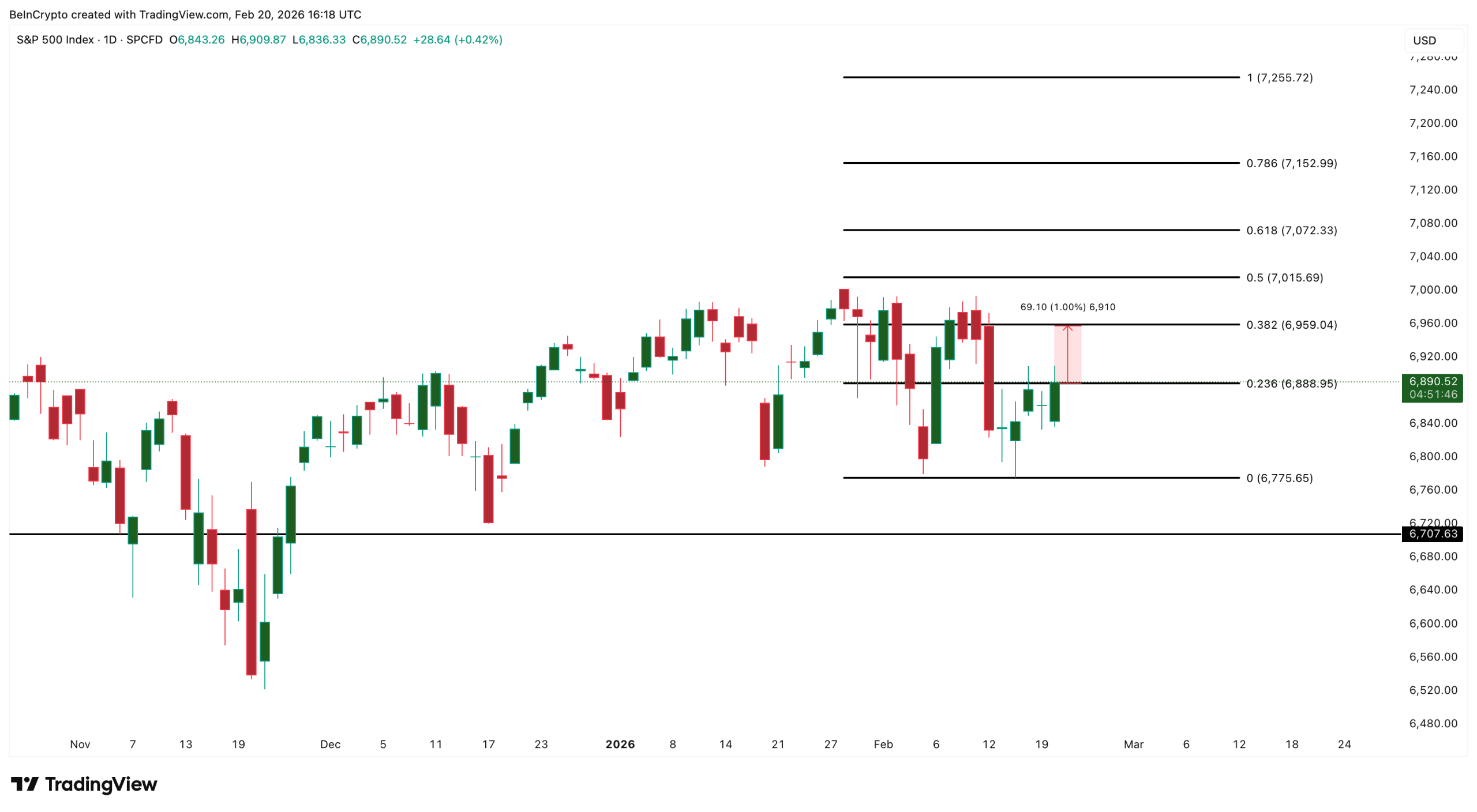
The US stock market recovered sharply on February 20, after the Supreme Court struck down President Trump’s tariffs in a landmark 6-3 ruling. The S&P 500 is trading around 6,890 at press time, up 0.45% from yesterday’s close, at the time of writing.
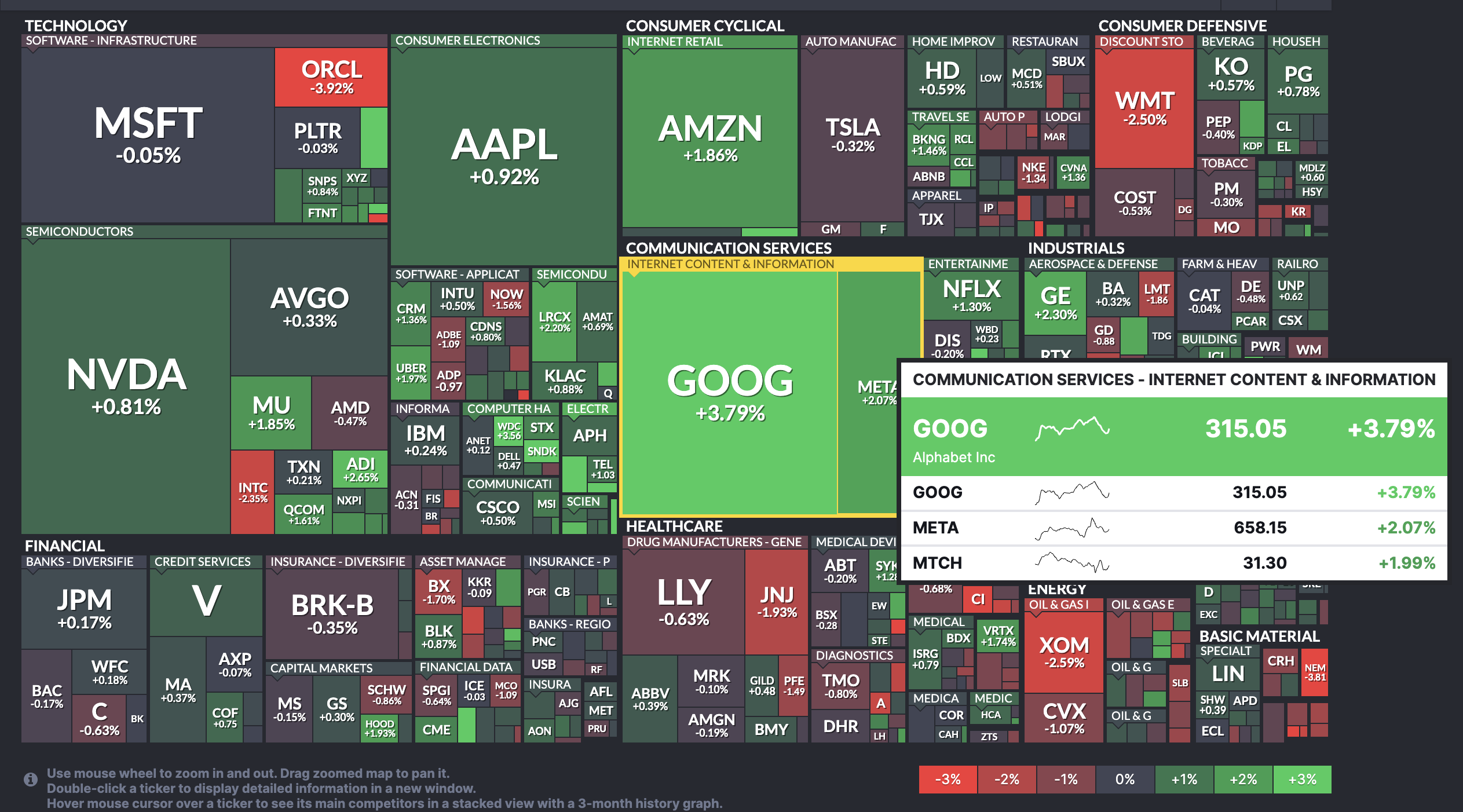
Tech (XLK) leads the rebound on tariff relief while Energy (XLE) gives back early gains despite rising oil prices. Alphabet (GOOGL) stands out, almost independently, with a 3.8% surge as it attempts to break free from a bearish pattern.
Top US Stock Market News:
Wall Street Recovers From Stagflation Scare As Tariff Ruling Sparks Relief Bounce
Wall Street faced one of its most dramatic intraday reversals on February 20, 2026. The morning opened with panic as the “data deluge” delivered a stagflation-like combination.
Advance Q4 GDP slowed sharply to 1.4% (well below the 2.8% consensus), while Core PCE accelerated to 3.0% YoY, its hottest reading since mid-2025. S&P 500 futures dropped immediately after the 8:30 AM ET release.
But the mood flipped mid-session when the Supreme Court struck down President Trump’s sweeping emergency tariffs in a landmark 6-3 ruling. Markets interpreted the decision as a major deflationary catalyst going forward.
The S&P 500 is trading at approximately 6,890 at press time, up 0.45% from yesterday’s close. Moreover, the index is now flirting with a strong zone near 6,888.
A sustained move above this level opens the path toward 6,959, and clearing that could prime the index for the psychological 7,000 milestone.
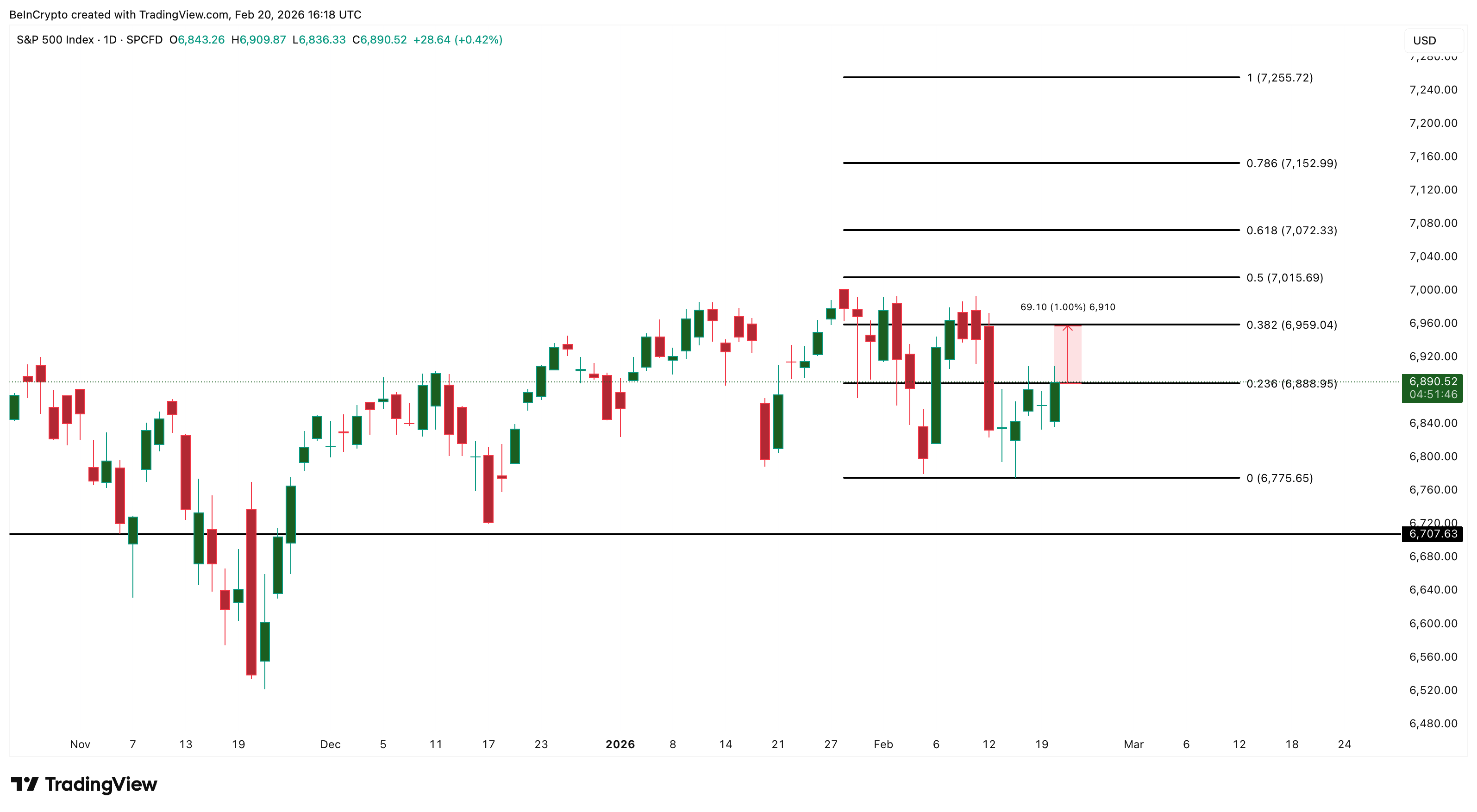
On the downside, 6,775 is the key support to watch. A break below that level would invite weakness toward 6,707.
However, upside conviction is not without risk. Experts are already flagging that the tariff ruling may not be the final word — the administration could pursue alternative tariff mechanisms, which could weigh on sentiment as the session progresses.
A move to key resistance still requires roughly a 1% push from current levels.
The Nasdaq leads the recovery, up 172 points (0.76%), and the DOW is up 68 points, at the time of writing.

The CBOE Volatility Index (VIX) dropped sharply, falling approximately 5%. The move below 20 signals that the initial stagflation panic has eased and the market is shifting back toward a cautiously optimistic posture.
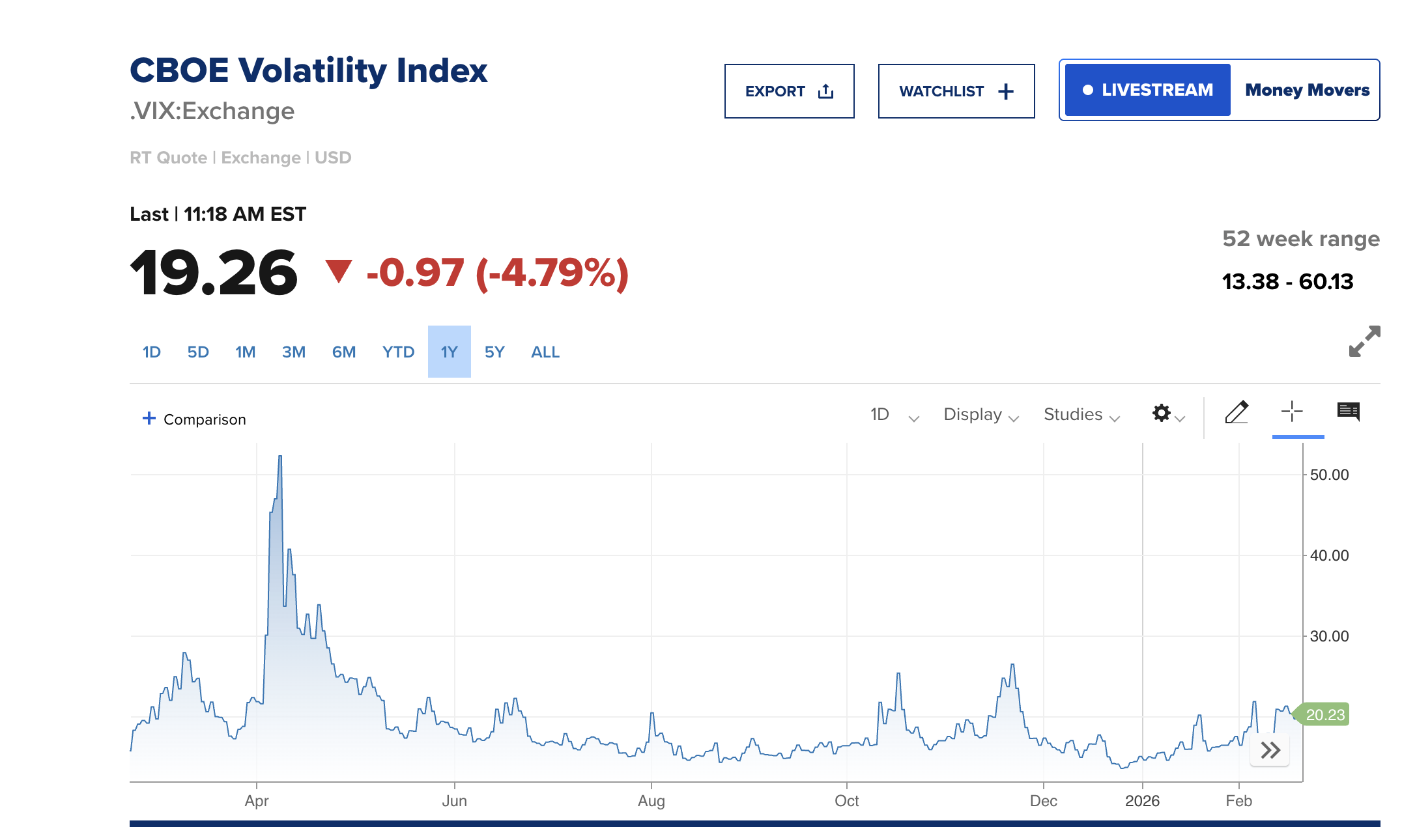
The tug-of-war is clear: stagflation data pulling markets down, tariff relief pulling them up. Onto the sectors now.
Tech Rallies While Energy Dips, But Builds Bullish Case
The sector story on February 20, 2026, takes an unexpected turn. The surface numbers tell one story, but the charts tell another.
Technology (XLK) is up 0.36% at $140.72, benefiting from the Supreme Court’s tariff strike-down as lower import costs directly support hardware and semiconductor supply chains.
However, the rally faces a ceiling. XLK attempted to cross above the $141.29 resistance, but sellers stepped in. A daily close above this level is needed to open the path toward $144.78 and eventually the $149–$150 zone.
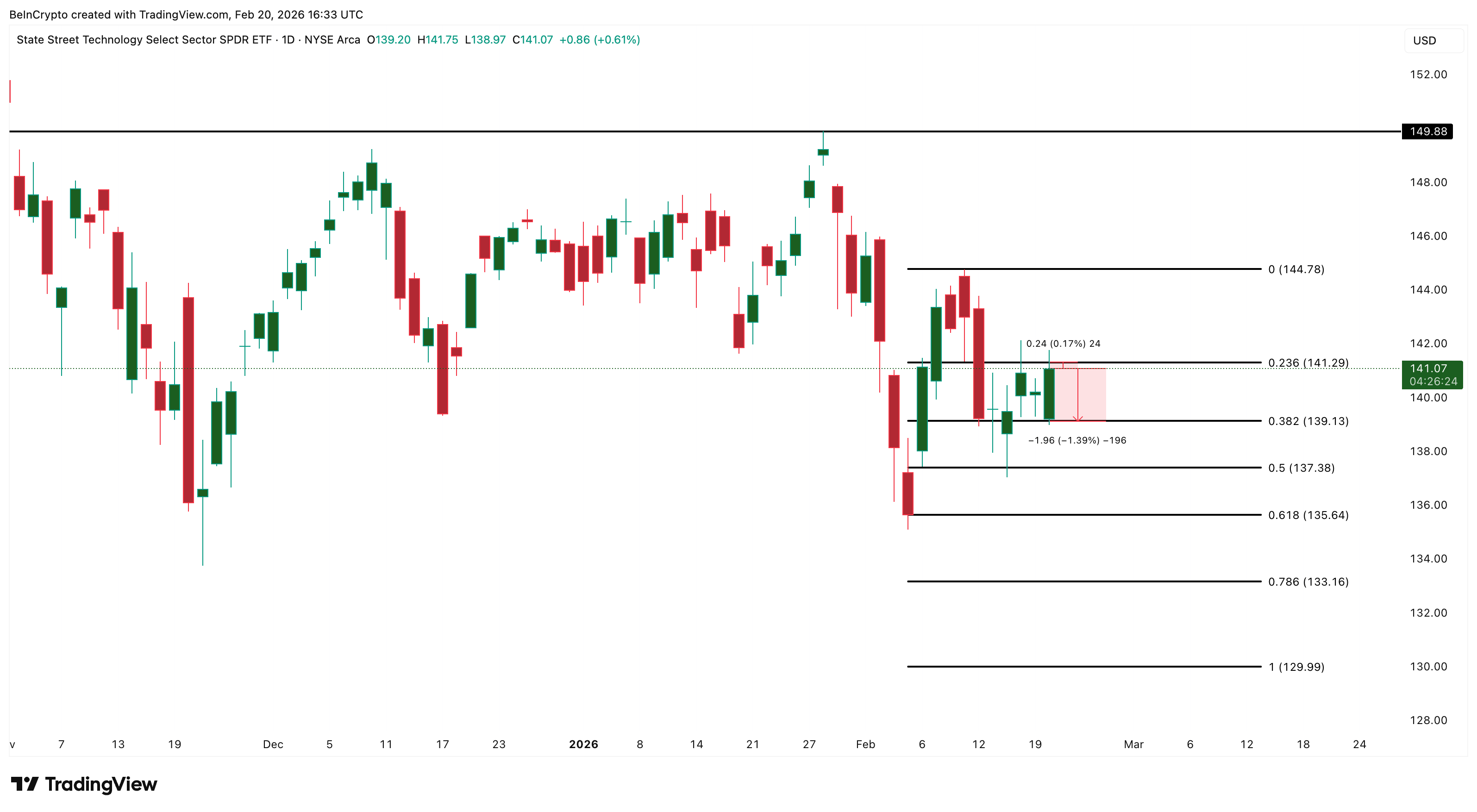
A failure to hold above $139 would flip the short-term structure bearish. The tariff relief provides the US stock market catalyst, but with Core PCE at 3.0%, reinforcing higher-for-longer rates, tech valuations remain under pressure.
Energy (XLE) tells the opposite story. The sector looked strong as US-Iran tensions pushed oil higher: WTI held above $66 and Brent above $71. But gains faded through the session, with XLE now down 1.09% since yesterday.
Yet the XLE chart tells a more constructive story underneath the red. The ETF appears to be consolidating inside a bullish flag. If the breakout confirms above $55.90, it could target $60.29 — roughly a 10% move.
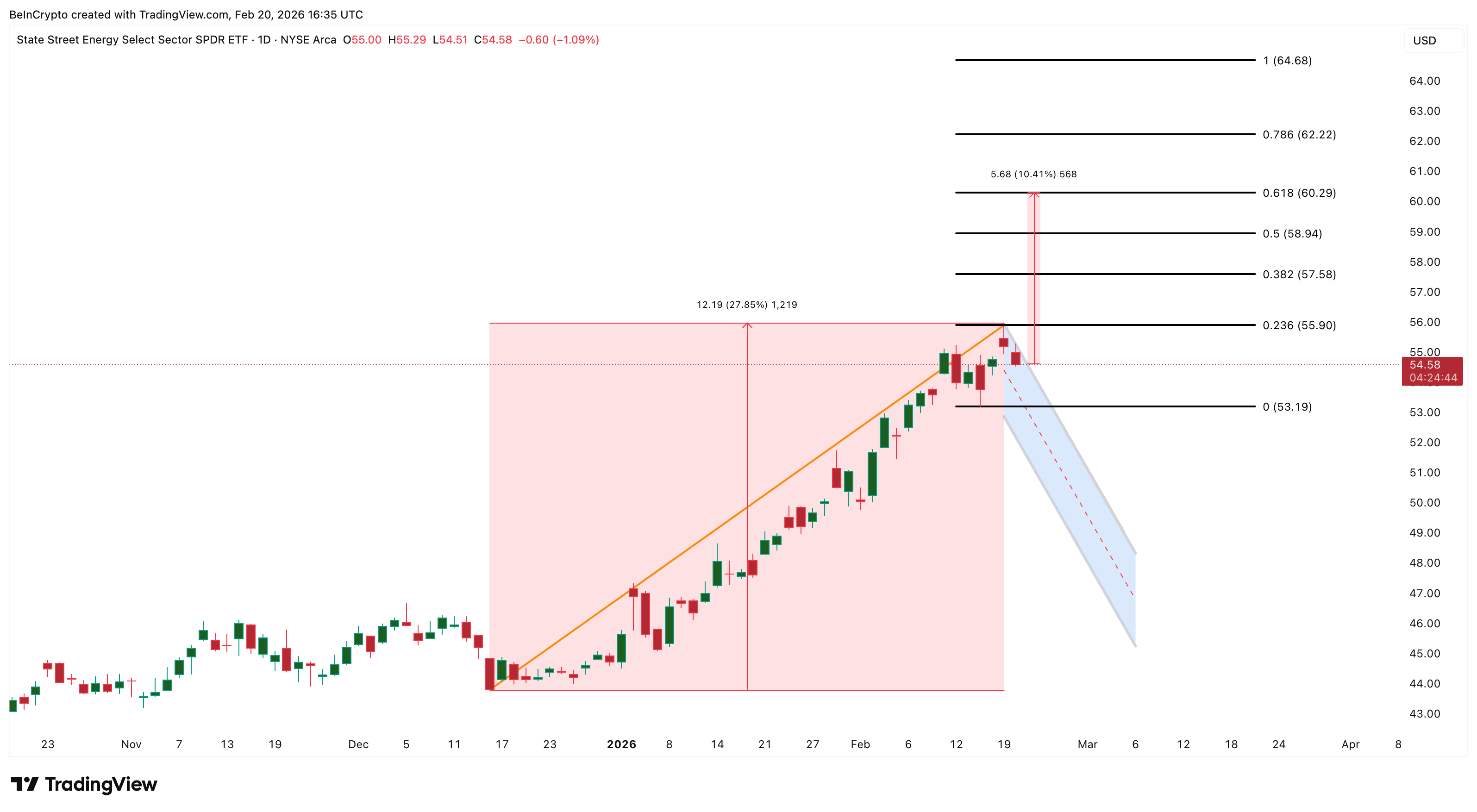
The full measured move from the previous leg projects a potential 27% rally. A drop below $53.19 would invalidate the setup.
Alphabet (GOOGL) Surges As Bears Lose Grip
Alphabet (GOOGL) is the standout US stock market mover on February 20, 2026, surging approximately 3.8% to trade around $316. The stock has shown sustained buying momentum with no significant upper wick, yet, a sign that sellers have not stepped in to cap the bounce.
The move is notable because Alphabet had been trapped inside a bearish flag pattern after pulling back from its early February highs. Today’s surge is attempting to break down that bearish structure, reversing off the $296–$300 support zone and pushing toward pattern invalidation.
However, Alphabet is not out of the woods yet. A sustained move above $327 — extending to $330 — is needed to fully invalidate the bearish setup and confirm a larger bullish reversal. Until those levels are cleared, the risk of a failed breakout remains real.
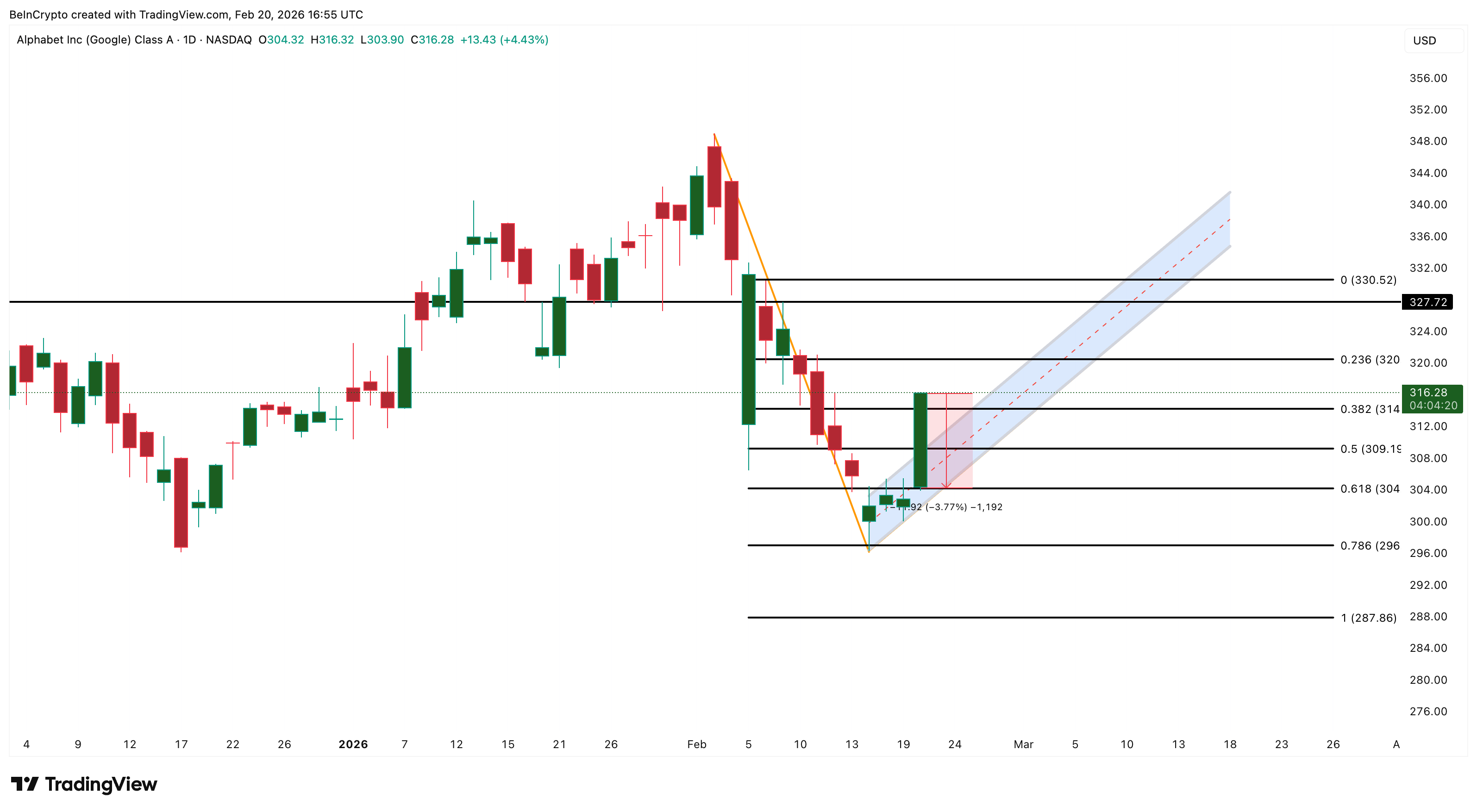
On the downside, a drop back below $304 would weaken the breakout attempt and reintroduce bearish pressure. Further weakness under $296 could accelerate selling, potentially re-testing lower supports and resuming the bearish flag pattern — erasing today’s entire gain.
Within Communication Services, Alphabet is leading while Meta also posts gains, as over 51% of stocks are in the green.

While other sectors stabilize with muted moves, Alphabet’s sizable independent rally signals that dip-buyers are aggressively positioning in AI-linked growth names.
Large institutional investors continued to add exposure to crypto treasury companies over the past week, even as bear-market illiquidity forced another round of shakeouts across decentralized finance (DeFi).
The biggest corporate shareholders of Bitmine Immersion Technologies, including Morgan Stanley and Bank of America, increased exposure to the Ether (ETH) treasury company during Q4 2025 despite a broader market sell-off.
Still, ongoing bear-market illiquidity is forcing some protocols to wind down operations, with DeFi lender ZeroLend shutting down. Crypto analytics platform Parsec has also shuttered, citing crypto market volatility as the main reason.
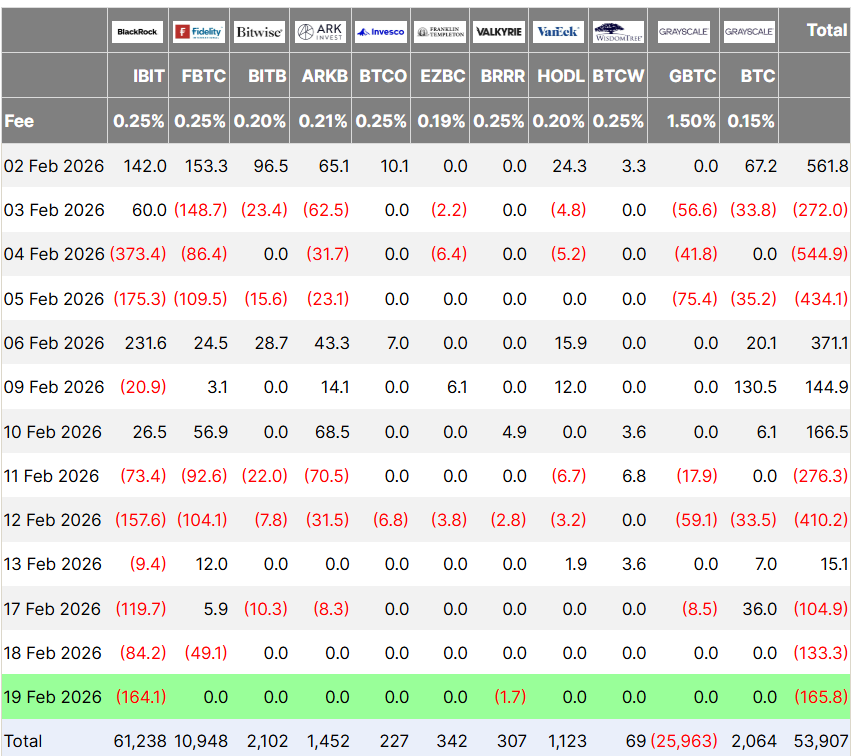
Meanwhile, Bitcoin (BTC) and ETH each rose about 2.6% during the past week, amid mounting outflows from US spot Bitcoin exchange-traded funds (ETFs), which logged three consecutive days of selling leading up to Thursday’s $165 million outflow, Farside Investors data shows.
Ether ETFs started the week with $48 million in inflows on Tuesday, but reversed to log two successive days of outflows, including $41 million in outflows on Wednesday and $130 million on Thursday.

Morgan Stanley, other top holders add Bitmine exposure amid sell-off
The largest shareholders of Bitmine Immersion Technologies (BMNR) stock increased their investments in the leading Ethereum treasury company in the fourth quarter of 2025 despite a wider crypto market crash and poor stock price performance.
Morgan Stanley, the top reported holder, increased its position by about 26% to more than 12.1 million shares, valued at $331 million at the quarter’s end, according to its Form 13F filing with the US Securities and Exchange Commission. ARK Investment Management, the second-biggest holder, increased its stake by about 27% to more than 9.4 million shares worth $256 million, its filing shows.

Several other top institutional holders also increased exposure. BlackRock increased its BMNR holdings by 166%, Goldman Sachs by 588%, Vanguard by 66% and Bank of America by 1,668%.
Wall Street adds BMNR exposure despite 48% stock slide
Each of the top 11 largest shareholders increased exposure to BMNR during Q4 of 2025, including Charles Schwab, Van Eck, Royal Bank of Canada, Citigroup and the Bank of New York Mellon Corporation, according to official filings compiled by crypto investor Collin.

The accumulation came despite a sharp drop in Bitmine’s share price. BMNR fell about 48% in the fourth quarter of 2025 and about 60% over the past six months, trading near $19.90 in premarket action Thursday, according to Google Finance.
DeFi lender ZeroLend shuts down, blames illiquid chains
Decentralized lending protocol ZeroLend said it is shutting down completely after the blockchains it operates on suffered from low user numbers and liquidity.
“After three years of building and operating the protocol, we have made the difficult decision to wind down operations,” ZeroLend’s founder, known only as “Ryker,” said in a post the protocol shared to X on Monday.
“Despite the team’s continued efforts, it has become clear that the protocol is no longer sustainable in its current form,” he added.
ZeroLend focused its services on Ethereum layer-2 blockchains, once touted by Ethereum co-founder Vitalik Buterin as a central part of the network’s plan to scale and remain competitive.
However, Buterin said earlier this month that his vision for scaling with layer 2s “no longer makes sense,” that many have failed to properly adopt Ethereum’s security, and that scaling should increasingly come from the mainnet and native rollups.
DerivaDEX debuts Bermuda-licensed derivatives DEX
DerivaDEX has launched a Bermuda-licensed crypto derivatives platform, becoming what it says is the first DAO-governed decentralized exchange to operate under formal regulatory approval.
According to a statement from the platform, the exchange received a T license from the Bermuda Monetary Authority and has begun offering crypto perpetual swaps trading to a limited number of advanced retail and institutional participants.
The BMA’s T, or test license, is issued for a digital asset business seeking to test a proof of concept.
At launch, DerivaDEX supports major crypto perpetual products and said it plans to expand into additional markets, including prediction markets and traditional securities. The company said the platform combines offchain order matching with onchain settlement to Ethereum, while allowing users to retain non-custodial control of funds.
Parsec shuts down amid ongoing crypto market volatility
Onchain analytics company Parsec is closing down after five years, as crypto trader flows and onchain activity no longer resemble their past configurations.
“Parsec is shutting down,” the company said in an X post on Thursday, while its CEO, Will Sheehan, said the “market zigged while we zagged a few too many times.”
Sheehan added that Parsec’s primary focus on decentralized finance and non-fungible tokens (NFTs) fell out of step with where the industry has now headed.
“Post FTX DeFi spot lending leverage never really came back in the same way, it changed, morphed into something we understood less,” he said, adding that onchain activity changed in a way he never understood.
NFT sales reached about $5.63 billion in 2025, a 37% drawdown from the $8.9 billion recorded in 2024. Average sale prices also declined year-on-year, falling to $96 from $124, according to CryptoSlam data.
Kraken’s xStocks tops $25 billion in volume with more than 80,000 onchain holders
Kraken’s tokenized equities platform, xStocks, has surpassed $25 billion in total transaction volume less than eight months after launch, underscoring accelerating adoption as tokenization gains traction among mainstream investors.
Kraken disclosed Thursday that the $25 billion figure includes trading across centralized exchanges and decentralized exchanges, as well as minting and redemption activity. The milestone represents a 150% increase since November, when xStocks crossed $10 billion in cumulative transaction volume.
The xStocks tokens are issued by Backed Finance, a regulated asset provider that creates 1:1 backed tokenized representations of publicly traded equities and exchange-traded funds. Kraken serves as a primary distribution and trading venue, while Backed is responsible for structuring and issuing the tokenized instruments.
When xStocks debuted in 2025, it offered more than 60 tokenized equities, including shares tied to major US technology companies like Amazon, Meta Platforms, Nvidia and Tesla.

Kraken said onchain activity has been a key growth driver since launch, with xStocks generating $3.5 billion in onchain trading volume and surpassing 80,000 unique onchain holders.
Unlike trading that occurs solely within centralized exchanges’ internal order books, onchain activity takes place directly on public blockchains, where transactions are transparent and wallets can self-custody assets.
Growing onchain participation suggests users are not only trading tokenized equities but also integrating them into broader decentralized finance (DeFi) ecosystems.
Kraken said that eight of the 11 largest tokenized equities by unique holder count are now part of the xStocks ecosystem, signaling increased market share in the emerging tokenized equities sector.
DeFi market overview
According to data from Cointelegraph Markets Pro and TradingView, most of the 100 largest cryptocurrencies by market capitalization ended the week in the green.
The layer-1 blockchain Kite (KITE) token rose 38% as the biggest gainer in the top 100, followed by stablecoin payment ecosystem token Stable (STABLE), up over 30% during the past week.

Thanks for reading our summary of this week’s most impactful DeFi developments. Join us next Friday for more stories, insights and education regarding this dynamically advancing space.


Dutch regulators have ordered crypto prediction platform Polymarket to stop operating in the Netherlands, warning it could face fines of up to €840,000 if it fails to comply.
The decision marks the latest escalation in Europe’s widening crackdown on the platform.
Polymarket is Losing the European Market
The Kansspelautoriteit (Ksa), the Dutch gambling authority, issued a formal enforcement order against Polymarket’s operator, Adventure One QSS Inc., on Friday. The regulator said Polymarket was offering illegal gambling services without a Dutch license.
Authorities imposed a penalty of €420,000 per week if Polymarket continues serving Dutch users. The fines could reach a maximum of €840,000, with additional revenue-based penalties possible later.
“In recent months, Polymarket has been in the news frequently, especially around bets on the Dutch elections. After contact with the company about the illegal activities on the Dutch market, no visible change has occurred and the offer is still available. The Gaming Authority therefore now imposes this order under penalty,” the regulator wrote.
The regulator said prediction markets qualify as gambling under Dutch law, regardless of how the platform classifies them. It also stressed that betting on elections is prohibited entirely, even for licensed operators.
Importantly, regulators highlighted Polymarket’s activity around Dutch elections as a key concern. It warned that election betting could create societal risks, including potential influence over democratic processes.
The Netherlands’ decision follows similar action in Portugal, where regulators recently blocked Polymarket nationwide.
Portuguese authorities intervened after the platform saw heavy betting tied to the latest presidential election outcomes.
Meanwhile, several other European countries have taken similar measures. Italy, Belgium, and Romania have blocked access to Polymarket, while France restricted betting functionality.
Hungary also issued a formal ban, citing illegal gambling activity.
Prediction Markets as Financial Infrastructure or Gambling Platform?
These actions reflect a growing consensus among European regulators. Authorities increasingly classify prediction markets as gambling when they operate without licenses.
However, Polymarket’s creator, Shayne Coplan, has consistently rejected that classification. He argues that prediction markets function as financial infrastructure, similar to derivatives markets, rather than gambling platforms.
Coplan maintains that prediction markets help aggregate information and forecast real-world events. Regulators across Europe disagree.
As a result, Europe has become one of the strictest regions globally for prediction market platforms. The Netherlands’ threat of direct financial penalties signals that enforcement is moving beyond access blocks toward sustained legal pressure.
Crypto World
Pakistan Goes Live With Crypto Regulatory Sandbox: Here’s What It Means for Digital Assets

TLDR:
- Pakistan’s PVARA formally launches a live crypto sandbox to test real-world virtual asset use cases under regulatory oversight.
- The sandbox framework targets stablecoins, tokenization, remittances, and on- and off-ramp infrastructure inside a supervised environment.
- PVARA Chairman Bilal bin Saqib joined global crypto and finance leaders at the World Liberty Forum in Mar-a-Lago, Florida.
- Goldman Sachs, Nasdaq, Franklin Templeton, and Coinbase participated in forum talks centered on stablecoins and financial innovation.
Pakistan launches crypto sandbox to test digital assets in a live, supervised environment built for real-world virtual asset use cases.
The Pakistan Virtual Assets Regulatory Authority formally approved the framework, marking a concrete step toward structured digital asset oversight.
The sandbox covers tokenization, stablecoins, remittances, and on- and off-ramp infrastructure. All operations run under direct PVARA supervision.
Sandbox Guidelines and the application process will be published on the PVARA website shortly, giving interested firms a clear path forward.
A Controlled Framework for Real-World Digital Asset Testing
The crypto sandbox gives companies a working environment to test virtual asset solutions within defined regulatory boundaries.
PVARA will monitor live operations and review outcomes before building broader compliance rules around them. This approach allows the authority to gather practical market data without reducing its oversight responsibilities.
Rather than regulating from theory alone, Pakistan is now working from observed, real-world results gathered inside a controlled setting.
The sandbox targets several key segments of the virtual asset market. Tokenization, stablecoins, remittance solutions, and on- and off-ramp infrastructure are all within the program’s scope.
Each use case will be tested against Pakistan’s specific financial and regulatory environment. This targeted structure ensures the framework remains focused and produces results that are directly applicable to domestic market conditions.
Firms that qualify for the sandbox can operate in a live market environment while remaining accountable to the authority.
The full Sandbox Guidelines and application details will be released on the PVARA website in the coming days. Companies working in the virtual asset space should watch the official website closely for submission deadlines and participation requirements.
PVARA Chairman Attends World Liberty Forum as Pakistan Moves Toward Global Alignment
Bilal bin Saqib, Chairman of PVARA, attended the World Liberty Forum at Mar-a-Lago in Florida earlier this week. The event brought together financial executives, crypto innovators, and policymakers from across the global financial sector.
Discussions centered on the future of finance and digital technology’s growing role in reshaping traditional systems.
Saqib shared updates from the forum directly on social media, describing it as a gathering focused on stablecoins, tokenization, and financial innovation.
Representatives from Goldman Sachs, Nasdaq, Franklin Templeton, and Coinbase were among the participants in those discussions. The forum reflected a growing global consensus around structured frameworks for digital asset development.
Pakistan’s decision to launch a crypto sandbox to test digital assets aligns with the direction taken by leading financial institutions worldwide.
The domestic framework now gives Pakistani firms a regulated channel to pursue innovations similar to those discussed at the global forum.
As countries move toward structured virtual asset oversight, Pakistan’s sandbox places it among nations actively shaping the next phase of digital finance regulation.


XRP slips ~0.5% in 24h as 200m tokens exit Binance over ten days.
Summary
- Binance’s XRP exchange supply ratio fell from 0.027 to 0.025 in ten days, implying about 200m XRP moved off the platform into private custody.
- XRP trades near $1.43, down roughly 0.5% on the day, with about $2.2B in 24h spot volume as centralized‑exchange balances sit near multi‑year lows.
- 2025 reserve data show the current withdrawal wave has already surpassed last year’s net accumulation, reinforcing a structural trend toward self‑custody and reduced immediate sell‑side liquidity.
XRP (XRP) exchange reserves on Binance have declined over the past ten days, with approximately 200 million tokens withdrawn from the platform.
The token supply ratio on Binance, which measures the proportion of XRP’s total circulating supply held on the exchange, dropped from 0.027 to 0.025 during the period, the data showed. The metric displayed a steady downward trend rather than a single-day movement, according to the analysis.
Exchange reserve data tracks the movement of digital assets between trading platforms and private wallets. Rising reserves typically indicate holders are transferring assets to exchanges, often in preparation for selling, while declining reserves suggest withdrawals into private custody.
XRP price headwinds
The recent outflow appears to reflect user-driven movement rather than internal exchange reallocation, which cited transparency in Binance’s published custody addresses as enabling distinction between operational adjustments and organic withdrawals.
XRP has declined significantly since the beginning of 2025. Sustained exchange outflows following price corrections have historically indicated renewed investor interest at lower price levels, according to market observers.
When digital assets leave exchanges, the immediately available supply for selling on trading platforms decreases. While reduced exchange supply does not guarantee price increases, it can affect market structure if demand returns, according to market analysts.
The current level of token withdrawal has already exceeded the total accumulation seen throughout 2025, the data indicated.
Market participants continue to monitor whether the shift toward private storage will translate into price momentum or remain a structural change in holding patterns.
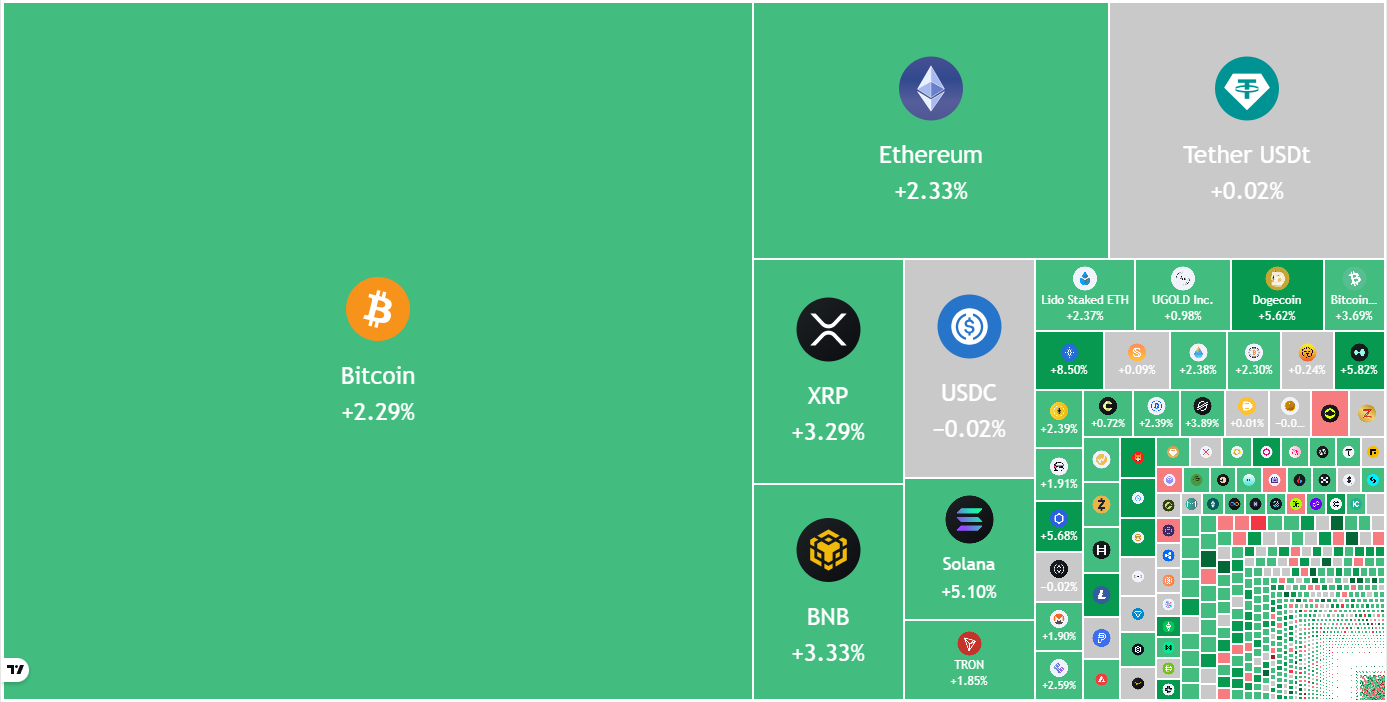
Bitcoin and most altcoins, including popular names like Dogecoin, Shiba Inu Coin, and XRP, were in the green today, February 20, as investors bought the dip after some key catalysts.
Summary
- Bitcoin and most altcoins rose on Friday, with the market capitalization of all tokens rising to over $2.3 trillion.
- The rally happened after the Supreme Court ruled against Donald Trump’s tariffs.
- They also rose after the latest US GDP report, which showed that the economy slowed in Q4.
Bitcoin (BTC) jumped to $68,000, while Dogecoin (DOGE), Shiba Inu Coin (SHIB), and Ripple (XRP) rose by over 4%. The market capitalization of all tokens rose by 2.2% to over $2.3 trillion.
Dogecoin, Shiba Inu Coin, and XRP rose after the Supreme Court ruling
The main reason why altcoins like DOGE, SHIB, and XRP rose is that the Supreme Court ruled against President Donald Trump’s tariffs.
In theory, the ruling will have a positive impact on the US economy by lowering inflation. Such a move raises the possibility that the Federal Reserve will cut interest rates, especially now that the recent data showed that the headline Consumer Price Index dropped in January.
In reality, however, the decision will not have a major impact as Trump has some backup strategies that he will use to implement tariffs on key countries like China, India, and those in the European Union.
Weak US GDP data and impact on the Federal Reserve
Bitcoin and other altcoins rose after the US published a weak GDP report. According to the Bureau of Economic Analysis, the economy expanded by 1.4% in the fourth quarter, badly missing the expected 3%.
The economic growth was much lower than the 4.4% experienced in the third quarter. This slowdown was mostly because of the prolonged government shutdown that happened during the quarter.
The weak economic report is bullish for cryptocurrencies because it raises the possibility that the Fed will cut interest rates later this year.
Donald Trump gave Iran more time to reach a deal
Bitcoin and most altcoins also rose after Donald Trump gave Iranian leaders more time to reach a nuclear deal with the United States. He gave them 15 days, meaning that an attack may not happen during the weekend as some analysts were expecting.
Still, most analysts believe that he will ultimately attack the country later this year, a move that will lead to lower crypto prices. As such, there is a risk that the ongoing rebound is a dead-cat bounce, a situation where assets rise briefly and then resume the downtrend.
Key points:
-
Bitcoin bulls are struggling to sustain the intraday rallies, indicating that every minor rise is being sold into.
-
Select major altcoins are showing weakness, signaling a drop to their strong support levels.
Bitcoin (BTC) bulls pushed the price above $68,300 but are struggling to maintain the higher levels. BTC is likely to record its fifth consecutive red monthly candle in the absence of a major rally in the next few days. That is the longest losing streak since 2018/19 when BTC fell for six successive months. A minor positive for the bulls is that the losing streak in 2018/19 was followed by a 131.6% rally over the following five months, per CoinGlass data.
Another indicator signaling a possible rally to the upside is the Bollinger Bands. According to crypto analyst Dorkchicken, the monthly Bollinger Bands are at their “tightest” level on record. All previous such instances have resulted in a bullish breakout, except the breakdown to $16,000 from $20,000 in 2022.

Although signs point to a possible up move, traders should keep a close watch on BTC exchange-traded funds (ETFs) flows to gauge institutional activity. US spot BTC ETFs have recorded $403.9 million in net outflows this week, according to SoSoValue data. Unless Friday witnesses sharp inflows, reversing losses of the past three days, the ETFs are on track for a five-week outflow streak. A sustained recovery may be difficult without institutional participation.
Could buyers push BTC and select major altcoins above their overhead resistance levels? Let’s analyze the charts of the top 10 cryptocurrencies to find out.
Bitcoin price prediction
BTC bulls have maintained the price above the immediate support at $65,118, indicating demand at lower levels.

Buyers will have to push the Bitcoin price above the 20-day exponential moving average ($71,247) to gain the upper hand. If they manage to do that, the BTC/USDT pair may climb to the breakdown level of $74,508. Sellers are expected to aggressively defend the $74,508 level, as a break above it suggests the pair may have formed a short-term bottom. The pair may then ascend to the 50-day simple moving average ($82,258).
Sellers will have to yank the price below the $65,118 level to signal strength. The pair may then retest the Feb. 6 low of $60,000, which is likely to attract solid buying by the bulls.
Ether price prediction
Ether (ETH) has been consolidating between the $1,750 and the $2,111 level, indicating uncertainty about the next directional move.

There is minor support at $1,897, but if the level cracks, the ETH/USDT pair may drop to the $1,750 support. Buyers are expected to fiercely defend the $1,750 level, as a close below it may sink the pair to $1,537.
The bulls will be back in the driver’s seat on a close above the $2,111 resistance. If they can pull it off, the Ether price may rally to the 50-day SMA ($2,665). Sellers may again attempt to halt the recovery at the 50-day SMA, but if the buyers prevail, the pair may surge to $3,045.
XRP price prediction
The failure of the bulls to push XRP (XRP) above the 20-day EMA ($1.50) suggests a lack of demand at higher levels.

The XRP/USDT pair may slide to the support line, which is a crucial level to watch out for. If the XRP price turns up sharply from the support line and breaks above the 20-day EMA, it suggests that the pair may remain inside the descending channel for some more time. Buyers will have to pierce the downtrend line to signal a short-term trend change.
Contrarily, a break and close below the support line indicates that the bears are in command. The pair may then tumble to $1.11 and subsequently to $1.
BNB price prediction
BNB (BNB) has been gradually sliding toward the $587 to $570 support zone, indicating that the bears are in control.

If the BNB price turns down and skids below the support zone, the BNB/USDT pair may start the next leg of the downtrend to the psychological level at $500.
This bearish view will be negated in the near term if the bulls push the price above the $669 resistance. If that happens, the pair may surge to the breakdown level of $730 and then to the 50-day SMA ($797). Such a move suggests that the pair may have bottomed out in the short term.
Solana price prediction
Solana (SOL) bulls are attempting to maintain the price above the immediate support at $76, but the bounce lacks strength.

That heightens the risk of a break below the $76 level. If that happens, the SOL/USDT pair may plummet to the Feb. 6 low of $67. Buyers are expected to mount a strong defense at the $67 level, as a close below it may sink the pair to $50.
The first sign of strength will be a break and close above the breakdown level of $95. That indicates the bears are losing their grip. The Solana price may then rally to the 50-day SMA ($114).
Dogecoin price prediction
Buyers are attempting to push Dogecoin (DOGE) above the 20-day EMA ($0.10), but the bears have held their ground.

A minor positive in favor of the bulls is that they have not given up much ground to the bears. That increases the possibility of a break above the 20-day EMA. If that happens, the DOGE/USDT pair may rally to the breakdown level of $0.12.
Contrary to this assumption, if the Dogecoin price turns down and breaks below $0.09, it suggests that the bulls have given up. That might sink the pair to the critical $0.08 support.
Bitcoin Cash price prediction
Bitcoin Cash (BCH) has slipped below the 20-day EMA ($548), indicating that the bears are attempting to take charge.

If the Bitcoin Cash price sustains below the 20-day EMA, the BCH/USDT pair may plummet to the next major support at $500. Buyers are expected to vigorously defend the $500 level, as a close below it may open the doors for a fall to the vital support at $443.
The bulls will have to push and maintain the price above the 50-day SMA ($575) to signal strength. The pair may then jump to $600 and later to $631. Buyers are expected to encounter aggressive selling in the $631 to $670 zone.
Related: Here’s what happened in crypto today
Hyperliquid price prediction
Hyperliquid (HYPE) bounced off the 50-day SMA ($27.89) on Thursday, indicating that the bulls are buying on dips.

Buyers will have to drive the Hyperliquid price above $32.50 to seize control. The HYPE/USDT pair may then pick up momentum and surge to the $35.50 to $38.42 resistance zone.
On the contrary, if the price turns down from the 20-day EMA ($30.01) and breaks below the 50-day SMA, it suggests that the bulls are losing their grip. The pair may then slump toward the $20.82 support, where buyers are expected to step in.
Cardano price prediction
Buyers are struggling to push Cardano (ADA) above the 20-day EMA ($0.28), but a minor positive is that they have not ceded much ground to the bears.

The bulls will again attempt to drive the Cardano price above the 20-day EMA. If they succeed, the ADA/USDT pair may march toward the stiff overhead resistance at the downtrend line. Buyers will have to achieve a close above the downtrend line to signal a potential short-term trend change.
Sellers are likely to have other plans. They will strive to tug the price below the support line, indicating the resumption of the downtrend. The next stop on the downside is likely to be $0.15.
Monero price prediction
Monero (XMR) has been consolidating in a downtrend, indicating that the bears have kept up the pressure.

Sellers will attempt to strengthen their position by pulling the Monero price below the $309 level. If they manage to do that, the XMR/USDT pair might drop to the $276 level. Buyers are expected to defend the $276 level with all their might, as a close below it may sink the pair to $247.
On the upside, the bulls will have to drive and maintain the price above the 20-day EMA ($360) to signal strength. The pair may then climb to the 61.8% Fibonacci retracement level of $414.
This article does not contain investment advice or recommendations. Every investment and trading move involves risk, and readers should conduct their own research when making a decision. While we strive to provide accurate and timely information, Cointelegraph does not guarantee the accuracy, completeness, or reliability of any information in this article. This article may contain forward-looking statements that are subject to risks and uncertainties. Cointelegraph will not be liable for any loss or damage arising from your reliance on this information.
TLDR:
- The Supreme Court struck down Trump’s IEEPA tariffs, putting $150B+ in potential refunds on the table for U.S. firms.
- Refunds won’t be automatic; companies must file claims or lawsuits to recover payments made under the tariffs.
- If tariffs ease, import costs may fall, inflation could cool, and the Fed may have room to cut rates sooner.
- Trump retains tariff authority under Sections 232, 301, and 122, though broader tariffs now require stronger legal grounds.
The Supreme Court has ruled Trump’s sweeping tariffs unconstitutional, upending a cornerstone of his trade policy.
Importers across the U.S. paid over $150 billion under these tariffs. The government now faces pressure to return that money. The ruling reshapes the trade landscape and carries wide economic consequences.
Supreme Court Tariff Ruling Opens Door to $150 Billion in Refunds
The tariffs in question relied on the International Emergency Economic Powers Act, known as IEEPA. The court’s decision strips that tool from the administration’s trade arsenal. It does not, however, eliminate the president’s authority to levy tariffs altogether.
Refunds will not flow automatically to affected companies. According to Bull Theory, businesses will likely need to file formal claims or pursue litigation. That process could take months or years to resolve.
If the government approves large-scale refunds, federal revenue takes a serious hit. The fiscal gap could force higher borrowing, which tends to push Treasury yields upward. That creates a new pressure point for bond markets.
At the same time, removing these tariffs could ease cost burdens on importers. Lower import costs typically reduce what businesses charge consumers. That could translate into softer inflation readings over time.
Crypto and Financial Markets Watch Fed’s Next Move Amid Tariff Fallout
The Federal Reserve currently faces a difficult position. Growth signals are soft. Inflation remains sticky. The tariff ruling adds a new variable to that calculation.
If import costs fall and inflation cools, the Fed gains more room to cut interest rates. Bull Theory notes that reduced tariff pressure and easing prices could support more aggressive rate cuts. Lower rates historically benefit risk assets, including crypto markets.
Rate cuts tend to lift consumer spending and business investment. Housing markets also respond quickly to cheaper borrowing. Crypto traders watch these macro signals closely.
Trump still holds several legal tools for imposing tariffs. Section 232 covers national security-based tariffs and applies to specific industries. Section 301 targets countries engaged in unfair trade practices, and it already underpins most China-related tariffs.
Section 122 offers a faster but narrower option, limited in size and duration. Anti-dumping and countervailing duties remain available too, though they require formal legal proceedings.
Bull Theory points out that what changes most is speed. IEEPA allowed near-instant, broad tariffs. Future tariffs will require investigations and stronger legal grounds.


A Polymarket trader has lost hundreds of thousands of dollars in crypto because of a Uniswap phishing ad that appeared at the top of a Google search result. Hundreds of friends and associates filled up the comment section with condolences.
The founder of DefiLlama broadcasted the terrible story as a warning to the crypto community.
The founder of Uniswap – the real Uniswap – repeated that warning, “These scams are horrible, we’ve been fighting them for years.” He called the disturbing industry of fake websites that rely on ads to lure crypto investors “the ad economy” and implored that it “needs to go.”
Uniswap is a common way for crypto traders to exchange digital tokens without trusting a centralized crypto exchange with custody of their funds.
The six-figure loss is the latest example in an ongoing series where scammers buy Google Ads to direct users to fraudulent, lookalike websites that mimic real crypto interfaces like Uniswap. Victims click the ad, connect their wallet, and sign a malicious transaction. That approval grants the power to drain assets or make trades from the wallet.
For years, fraudulent Google search ads have led users to phishing pages that impersonate well-known crypto apps.
Uniswap phishing scam-as-a-service
The particular wallet drainer tool used in this attack was AngelFerno. This ‘scam-as-a-service’ wallet drainer script targets DeFi users, including prior front-end attacks that impersonated OpenEden and Curvance websites.
AngelFerno is live on multiple domains that are itemized on GitHub phishing blocklists. Users should not navigate to them.
Particularly nefarious attackers use Cyrillic characters in URLs, also known as Punycode URLs, to make the fake domain appear visually indistinguishable from the real URL.
Read more: Crypto phishing blitz hits CoinMarketCap, Cointelegraph, and Trezor
Chainalysis and other security researchers have flagged Google phishing ads as a major attack vector. In July 2025, for example, a DeFi user lost $1.2 million through a nearly identical Uniswap scam involving fraudulent Google Ads.
Forensic investigator ZachXBT called for severe consequences against Google for failing to prevent phishing ads.
Protos has reached out to the victim for confirmation about the mid-six-figure and “entire net worth” estimate of his loss but did not receive an immediate response prior to publication. The victim has said publicly that he lost six figures after being fooled by a Google ad.
Got a tip? Send us an email securely via Protos Leaks. For more informed news, follow us on X, Bluesky, and Google News, or subscribe to our YouTube channel.

Why Islamic finance could provide an ethical model for funding the green transition

Slideshow: New products from Tattooed Chef, Kodiak and Caulipower

What Next After Supreme Court Strikes Down Trump Tariffs?


-

 Video4 days ago
Bitcoin: We’re Entering The Most Dangerous Phase
-

 Tech6 days ago
Luxman Enters Its Second Century with the D-100 SACD Player and L-100 Integrated Amplifier
-

 Crypto World3 days ago
Can XRP Price Successfully Register a 33% Breakout Past $2?
-

 Sports4 days ago
GB's semi-final hopes hang by thread after loss to Switzerland
-

 Video17 hours ago
XRP News: XRP Just Entered a New Phase (Almost Nobody Noticed)
-
 Tech4 days ago
The Music Industry Enters Its Less-Is-More Era
-

 Business3 days ago
Infosys Limited (INFY) Discusses Tech Transitions and the Unique Aspects of the AI Era Transcript
-

 Entertainment2 days ago
Kunal Nayyar’s Secret Acts Of Kindness Sparks Online Discussion
-

 Video3 days ago
Financial Statement Analysis | Complete Chapter Revision in 10 Minutes | Class 12 Board exam 2026
-

 Tech2 days ago
Retro Rover: LT6502 Laptop Packs 8-Bit Power On The Go
-
 Crypto World7 days ago
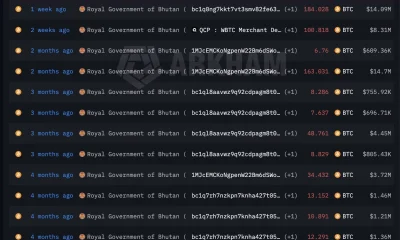
Bhutan’s Bitcoin sales enter third straight week with $6.7M BTC offload
-
 Sports2 days ago
Clearing the boundary, crossing into history: J&K end 67-year wait, enter maiden Ranji Trophy final | Cricket News
-

 Entertainment2 days ago
Dolores Catania Blasts Rob Rausch For Turning On ‘Housewives’ On ‘Traitors’
-

 Business2 days ago
Tesla avoids California suspension after ending ‘autopilot’ marketing
-
 NewsBeat5 days ago
The strange Cambridgeshire cemetery that forbade church rectors from entering
-

 Crypto World2 days ago
WLFI Crypto Surges Toward $0.12 as Whale Buys $2.75M Before Trump-Linked Forum
-
 NewsBeat5 days ago
Man dies after entering floodwater during police pursuit
-

 Crypto World22 hours ago
83% of Altcoins Enter Bear Trend as Liquidity Crunch Tightens Grip on Crypto Market
-

 NewsBeat6 days ago
UK construction company enters administration, records show
-

 Politics3 days ago
Eurovision Announces UK Act For 2026 Song Contest