
Crypto World
Anthropic wins court pause on Pentagon Claude ban



A US federal judge in San Francisco has temporarily blocked Pentagon action against Anthropic, giving the AI company short-term relief in its fight with the Trump administration.
Summary
- Judge Rita Lin paused Pentagon action against Anthropic and blocked the federal Claude stop-use order.
- Anthropic sued after the Pentagon labeled it a supply chain risk during contract dispute talks.
- The ruling keeps pressure on Washington as Anthropic defends limits on military and surveillance use.
The ruling keeps federal agencies from enforcing a stop-use order against Claude for now and places the legal focus on whether the government acted beyond its authority.
Judge Rita Lin of the US District Court for the Northern District of California granted a preliminary injunction on Thursday. The order stops the Pentagon from enforcing its supply chain risk label against Anthropic while the case moves forward.
The ruling also pauses President Donald Trump’s directive that told federal agencies to stop using Anthropic’s chatbot, Claude. The judge said the record did not support the government’s position at this stage of the case.
Judge Lin wrote,
“Nothing in the governing statute supports the Orwellian notion that an American company may be branded a potential adversary and saboteur of the US for expressing disagreement with the government.”
She also described the measures against Anthropic as “arbitrary, capricious, [and] an abuse of discretion.”
The case follows a breakdown in talks between Anthropic and the Pentagon. In July 2025, the company had reached a deal that would have made Claude the first frontier AI model approved for use on classified networks.
That process later changed course. Anthropic said Pentagon officials wanted the company to permit military use of Claude “for all lawful purposes” and without limits. The company refused to allow uses tied to lethal autonomous weapons and mass domestic surveillance.
Anthropic has said its technology should not support those activities. The disagreement became public after contract talks collapsed in February and the company challenged the government’s response in court.
Court reviews retaliation claim
Anthropic filed its lawsuit on March 9 in federal court in Washington, DC. The company argued that Defense Secretary Pete Hegseth exceeded his authority by naming Anthropic a national security supply chain risk.
During a March 24 hearing in San Francisco, Judge Lin pressed government lawyers on whether Anthropic faced punishment for publicly criticizing the Pentagon’s position. The March 26 ruling said, “punishing Anthropic for bringing public scrutiny to the government’s contracting position is classic illegal First Amendment retaliation.”
Anthropic later said it was “grateful to the court for moving swiftly” and said the ruling showed it was likely to succeed on the merits.
Furthermore, the court fight comes as Anthropic holds a strong place in enterprise AI. Menlo Ventures said the company held 32% of that market in 2025, ahead of OpenAI at 25%.
A government-wide ban could have weakened that standing. For now, the court order gives Anthropic time to defend its position while the wider case moves ahead.

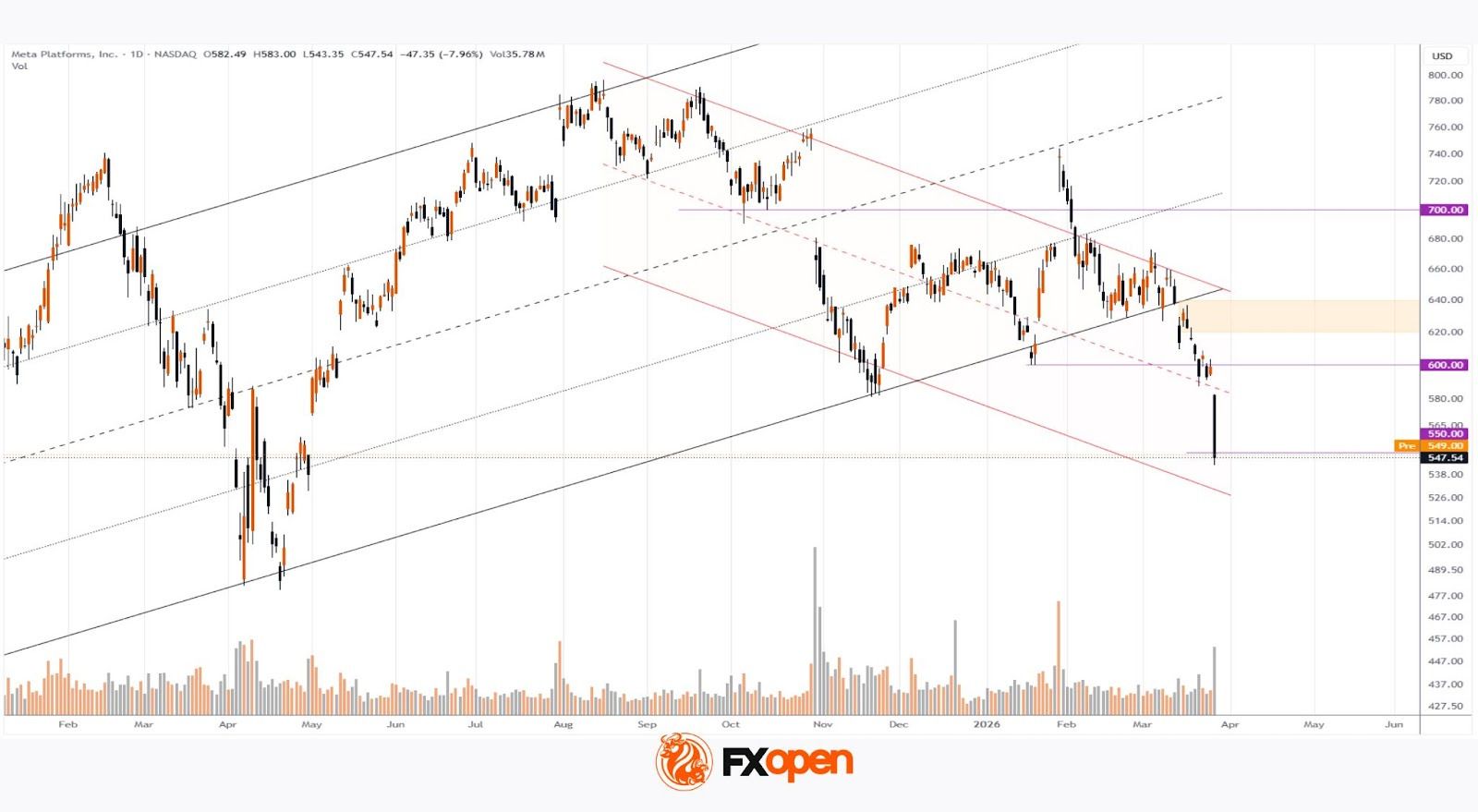
Yesterday, shares of Meta Platforms saw a sharp decline, dropping by approximately 8%, with trading closing below the $550 level for the first time since late April 2025.
Why META Shares Declined
The move was driven by a combination of factors, including:
→ Jury ruling. According to media reports, a jury ordered Meta to pay $375 million for misleading parents about the safety of Instagram and Facebook. The court also found the company liable for developing addictive algorithms that harm teenagers’ mental health.
→ Confirmed capital expenditure (CapEx) for 2026 in the range of $115–135 billion. Significant funds are being directed towards energy infrastructure, including a 6.6 GW nuclear energy deal to power the Prometheus supercomputer. The market may question whether returns on AI investments will justify such large-scale spending.
Sentiment has also been weighed down by reports of plans to cut up to 20% of the workforce. While layoffs are typically viewed positively due to cost savings, in this case they may signal that profit margins are being squeezed more than expected due to AI-related expenditure.
Technical Analysis of META
At the end of January, we:
→ constructed a system of two trend channels;
→ noted that META’s share price had moved above the psychological $700 level.
As it turned out, this was a bull trap formed in the wake of strong quarterly earnings. In early February, the price fell towards the lower boundary of the long-term ascending channel, and by the 13th, that boundary was broken under selling pressure.
As a result, the upward trajectory is losing relevance, giving way to the previously identified descending trend channel. In this context, the bearish breakout zone at $620–640 may now act as resistance, where sellers previously showed strength.
Additionally, it is worth noting that:
→ the psychological $600 level has lost its role as support;
→ yesterday’s candle featured a wide body with a close near the low, accompanied by high volumes — a clear sign of heavy selling pressure.
Against this backdrop, it cannot be ruled out that continued bearish control may push META’s price towards the lower boundary of the red channel.
Buy and sell stocks of the world’s biggest publicly-listed companies with CFDs on FXOpen’s trading platform. Open your FXOpen account now or learn more about trading share CFDs with FXOpen.
This article represents the opinion of the Companies operating under the FXOpen brand only. It is not to be construed as an offer, solicitation, or recommendation with respect to products and services provided by the Companies operating under the FXOpen brand, nor is it to be considered financial advice.
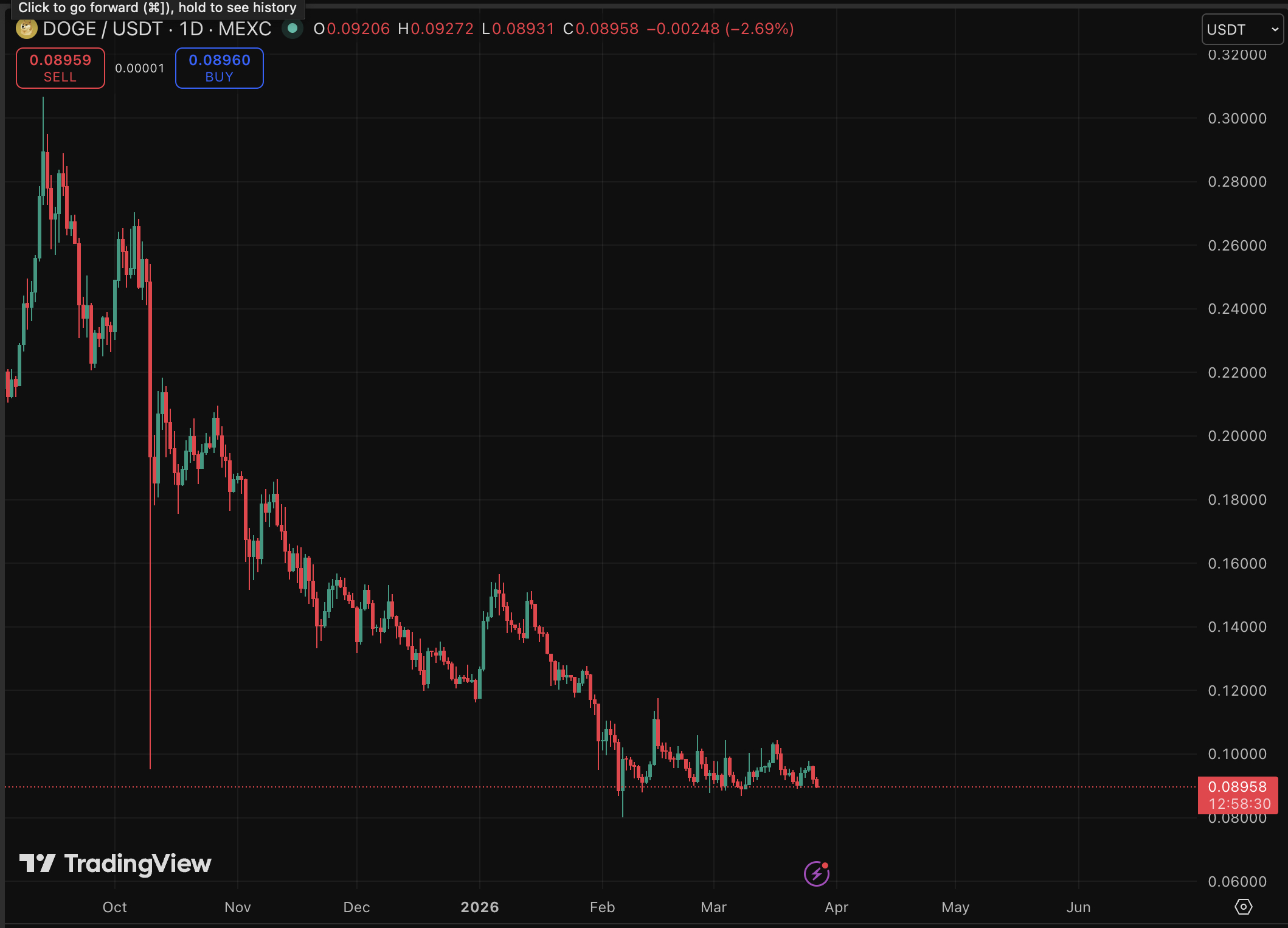
DOGE price is sliding to just 9 cents after a 2% drop in 24 hours, bleeding through support, while the broader crypto market also shed 3% to settle at under $2.4 trillion in total capitalization, and the prediction might get uglier. The Elon Musk wildcard leaves traders asking who, exactly, is buying this dip.
On-chain data offers a partial answer. Kraken users snapped up nearly 7.6 million DOGE tokens within a single hour window as prices retreated.
However, eight consecutive days of zero net ETF flows tell a different story at the institutional level: neither commitment nor panic, just paralysis. Blockchain behavior and ETF data are pointing in opposite directions, which rarely stays comfortable for long.
The buy dominance metric shows aggressive purchase orders have outpaced selling pressure across major spot venues for the entire prior 90-day period. With technical indicators flashing warning signs and no major catalyst on the immediate horizon, the next 72 hours could define DOGE’s directional bias for Q2.
Discover: The best crypto to diversify your portfolio with
DOGE Price Prediction: Can Dogecoin Price Reclaim $0.1 Before the Death Cross Takes Hold?
DOGE is clinging to its $0.087–$0.092 accumulation zone, a range that has so far absorbed selling pressure and where large holders appear to be building positions. A death cross has formed, with shorter-term moving averages crossing beneath longer-term counterparts, a pattern alongside a downward-sloping EMA 50 and EMA 100 that keeps medium-term momentum firmly negative.

Bulls need a close above $0.094 (EMA 20) to shift momentum. Clear that level and the next meaningful targets stack at $0.103 (EMA 50) and $0.123. Fail to hold $0.093, and the floor drops toward $0.0884.
Projection put the 2026 range of $0.0891–$0.2049 with an average of $0.116, optimistic against the current structure, but not impossible if sentiment turns. The path to $0.116 from $0.091 implies a 27% move.
Discover: The best pre-launch token sales
Maxi Doge Targets Early-Mover Upside as Dogecoin Tests Key Levels
DOGE at $0.091 offers a defined setup, but a $13.3 billion market cap means a 10x from here requires moving the entire meme coin market. That math frustrates traders who want asymmetric exposure. Established assets rarely deliver multiples.
That’s the gap Maxi Doge ($MAXI) is pitching into. The ERC-20 meme token positions itself as the gym-bro evolution of DOGE culture, a 240-lb canine juggernaut built around 1000x leverage trading mentality, holder-only trading competitions with leaderboard rewards, and a Maxi Fund treasury allocated to liquidity and partnerships. The tagline: Never skip leg-day, never skip a pump.
The presale has raised more than $4.7 Million at a current price of $0.000281, with huge 66% staking APY available to participants.
Visit Maxi Doge here, and join the maximum velocity community.
This article is not financial advice. Cryptocurrency investments are highly volatile. Always conduct your own research before investing.
The post DOGE Price Prediction: Big Holders Accumulate, Elon Musk? appeared first on Cryptonews.


Vietnamese authorities have opened a wide fraud case tied to the ONUS crypto ecosystem after detaining several suspects and accusing them of using token promotions and controlled trading to take investor funds.
Summary
- Vietnam detained ONUS-linked suspects after police alleged token promotions and market control were used deceptively.
- Authorities said the case involved VNDC, ONUS, and HNG tokens promoted through the platform directly.
- Vemanti said it hired US legal counsel after reports named two board members in indictments.
The case puts fresh focus on crypto enforcement in one of the world’s busiest retail digital asset markets.
Vietnam’s Ministry of Public Security launched criminal proceedings on March 23 over alleged “appropriating property through computer networks” and “money laundering” linked to the ONUS ecosystem, according to local reporting that cited the ministry’s investigation agency. The probe covers Hanoi and several other provinces and cities.
Authorities named several suspects in the case, including Vuong Le Vinh Nhan, Tran Quang Chien, and Ngo Thi Thao, based on Vietnamese reports. Investigators say the group promoted and traded tokens through the ONUS platform while keeping control over supply, demand, and pricing.
Investigators allege the group used promotions and coordinated trading activity to present certain tokens as real investment products while managing their markets from the center. Local reports said the case involves tokens such as VNDC, ONUS, and HNG.
Vietnamnet reported that police view the matter as one of the country’s largest cybercrime investigations tied to digital assets. Authorities have not published a full public breakdown of investor losses, though reports on the case said the scheme drew in funds worth billions of US dollars.
Vemanti Group said it learned through the ministry’s announcement and local media that Nhan Vuong, its board chairman, and Chien Tran, a board member, had been indicted. The company said it had received no earlier notice from authorities in any jurisdiction before the public reports appeared.
Vemanti added that it had hired US legal counsel to review the matter. The statement linked the investigation to ONUS Pro, the platform at the center of the Vietnam case.
Vietnam’s crypto market faces more fraud scrutiny
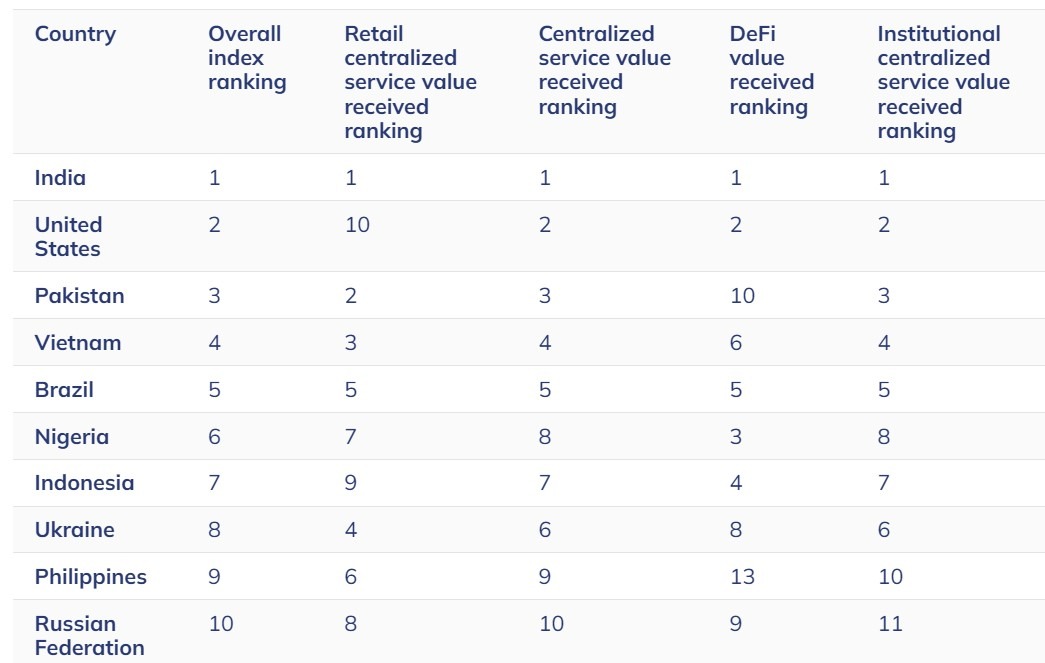
The case lands at a time when Vietnam remains a major crypto market. Chainalysis ranked Vietnam fourth in its 2025 Global Crypto Adoption Index, placing it among the world’s most active countries for grassroots digital asset use.
Regional enforcement has also widened beyond Vietnam. In India, the CBI said it arrested a Mumbai-based suspect accused of sending people to scam compounds in Myanmar, where trafficked victims were allegedly forced to run online fraud, including cryptocurrency investment scams and romance scams.
Key Highlights
- Brent crude climbed close to $110 per barrel while WTI hit $96 amid escalating Middle East tensions through early April.
- President Trump postponed the deadline for potential strikes on Iran’s energy sector until April 6, citing active diplomatic discussions.
- Iranian officials have publicly rejected claims that negotiations with Washington are underway.
- Approximately 8 million barrels daily remain unavailable due to the continued blockade of the Strait of Hormuz.
- Energy analysts from Macquarie project oil could surge to $200 per barrel if hostilities persist beyond spring.
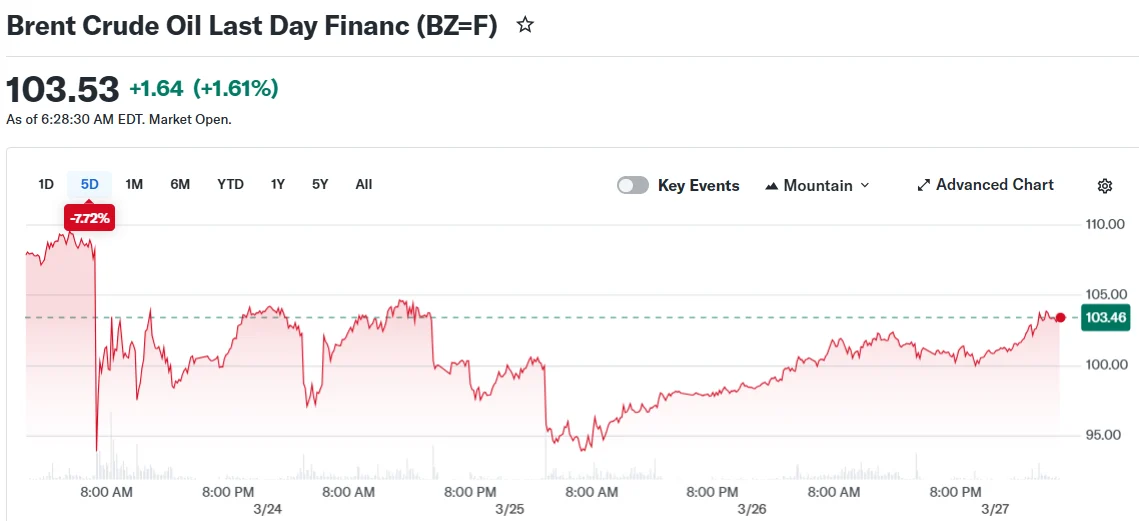
Global crude markets continue their sharp ascent as geopolitical strife involving the United States, Israel, and Iran throttles critical energy transport routes. Brent crude advanced nearly 2% to reach $109.92 per barrel during Friday trading. Meanwhile, U.S. West Texas Intermediate climbed to $96.08.
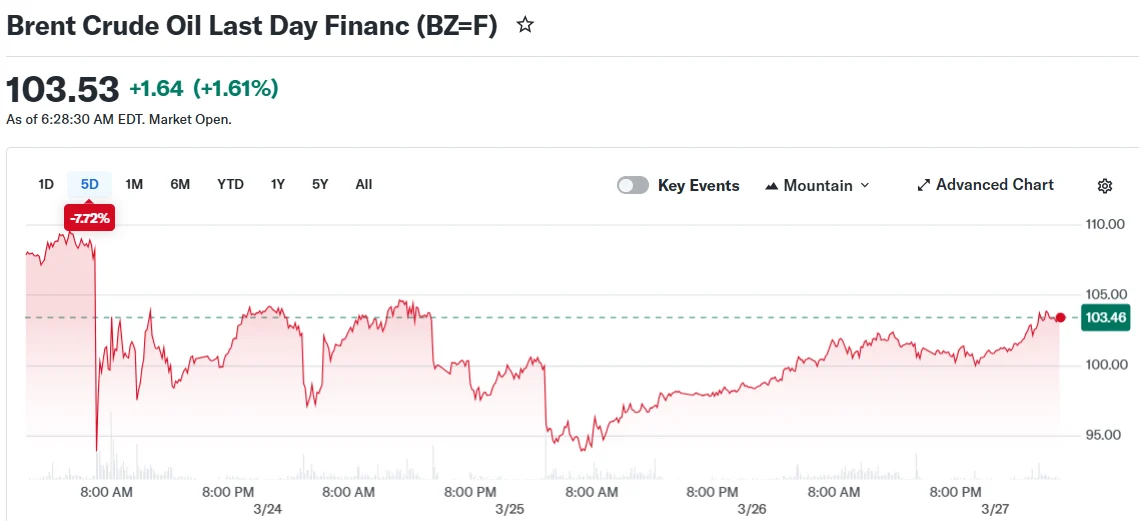
March appears set to deliver unprecedented gains for Brent crude. The benchmark has jumped approximately 52% throughout the month, representing one of the most dramatic monthly advances in modern energy trading history.
Hostilities erupted in late February and have resulted in the virtual shutdown of the Strait of Hormuz. This narrow maritime passage typically handles roughly 20% of the world’s petroleum shipments.
The strait’s closure has removed roughly 8 million barrels daily from international markets. Ole Hansen, Saxo Bank’s commodities strategy chief, noted that supply constraints are accelerating rapidly as vessels that departed Gulf ports before the crisis have completed their deliveries and offloaded their cargo.
President Trump pushed back the White House’s ultimatum for Iran to restore access to the strait or risk American military action against its energy infrastructure. April 6 now marks the revised deadline. Trump indicated that Iran requested the postponement and characterized ongoing discussions as productive.
Tehran contradicted this narrative through official channels. Iranian authorities stated that no diplomatic engagement with the United States is currently in progress.
Military Operations and Troop Deployments Expand
Combat operations have persisted throughout the region. Israeli forces announced they targeted a primary Iranian production center for missiles and naval mines located in Yazd. Kuwait confirmed drone strikes against two of its port facilities. Saudi authorities intercepted unmanned aircraft in the kingdom’s eastern provinces.
The Pentagon is evaluating the deployment of as many as 10,000 additional ground forces to the area, potentially including elements from the 82nd Airborne Division and Marine Expeditionary Units.
The Trump administration is simultaneously working to organize a diplomatic gathering in Pakistan scheduled for this weekend. Vice President JD Vance and additional high-ranking officials may participate in discussions aimed at identifying a pathway toward resolution.
Iranian leadership indicated it declined a 15-point American peace framework and presented alternative conditions. Tehran’s terms reportedly include formal acknowledgment of Iranian authority over the Strait of Hormuz.
Economic Ripple Effects and Global Market Reaction
The dramatic oil spike is amplifying wider economic anxieties. Government debt yields have climbed as market participants anticipate that elevated energy costs may compel monetary authorities to implement tighter policy.
The benchmark 10-year U.S. Treasury yield advanced to levels not observed since July. European bond markets in Germany and France experienced similar yield increases.
Numerous nations have implemented measures to cushion the impact on their populations. India reduced taxation on diesel and gasoline products. Vietnam implemented a temporary freeze on fuel-related levies through mid-April. New Zealand authorities documented evidence of consumer stockpiling of petroleum products.
Macquarie’s analytical team estimates a 40% probability that military confrontations will continue through June. Under that scenario, their forecasts suggest crude could reach $200 per barrel.
Two commercial container vessels operated by China’s Cosco Shipping made an attempt to transit the Strait of Hormuz on Friday but reversed course in proximity to Iranian territorial waters.

Vietnamese authorities have detained multiple ONUS-linked suspects after alleging they used false promotions and manipulated token trading to misappropriate investor funds through the crypto platform.
The Ministry of Public Security said Thursday that the investigation targeted a group accused of selling digital tokens through the Onus platform, using misleading promotions and coordinated trading activity to attract users. Authorities claim the group manipulated supply and demand and adjusted token prices, presenting the assets as legitimate investment opportunities while maintaining centralized control over their markets.
Investigators named several suspects in the case, including Vuong Le Vinh Nhan, who is linked by Vemanti to XPLOR, the Singapore-based parent company of ONUS Pro; Tran Quang Chien, identified in Vietnamese reporting as the technical administrator of the ONUS exchange; and Ngo Thi Thao, director of HanaGold Jewelry JSC.
Authorities said the suspects are accused of creating and promoting tokens, including VNDC, ONUS and HNG, through the ONUS platform. Police say the scheme raised billions of dollars from investors. However, the authorities did not provide a breakdown of the losses.
The case adds to scrutiny of crypto activity in Vietnam, one of the world’s most active retail digital asset markets.

Vietnam widens ONUS fraud probe
According to the Ministry of Public Security, the arrests follow a multi-agency investigation spanning several cities, with police summoning over 140 individuals for questioning and seizing evidence, as part of a broader effort to dismantle large-scale crypto-linked fraud operations.
On Thursday, Vemanti said it learned of the indictments of Nhan Vuong and Chien Tran through the ministry announcement and Vietnamese media, and had engaged US legal counsel to assess the situation. Vemanti identified Vuong as chairman of its board and Tran as a board member.
Related: Indian court says ‘no case’ against CoinDCX founders in impersonation fraud
The ONUS platform presents itself as a digital asset ecosystem offering trading, staking and investment products, claiming more than seven million users and backing from the US-based fintech company Vemanti Group.
Its official X account has more than 885,000 followers. However, market data aggregator CoinMarketCap lists the ONUS token with a self-reported market capitalization of around $25 million, highlighting a gap between the scale of alleged losses and publicly available token metrics.
Onus has not released an official statement addressing the situation.
Cointelegraph reached out to Onus for comment, but had not received a response by publication.

India case points to wider scam network risks
In a separate case, India’s Central Bureau of Investigation said Thursday that it arrested a Mumbai-based suspect accused of helping traffic victims to scam compounds in Myanmar, where individuals were allegedly forced to carry out online fraud schemes, including crypto investment scams and romance scams.
The agency said victims were lured with job offers in Thailand before being diverted to scam centers in Myanmar’s Myawaddy region, where they were subjected to confinement, intimidation and abuse while being made to target victims globally.
Magazine: Banks want to run Vietnam’s crypto exchanges, Boyaa’s $70M BTC plan: Asia Express

Binance Australia Derivatives has been ordered to pay a A$10 million civil penalty after Australia’s Federal Court found failures in how the platform classified clients for crypto derivatives trading.
Summary
- Australia fined Binance A$10 million after 524 retail clients were wrongly classified as wholesale investors.
- ASIC said Binance let users retry quizzes without limits, weakening checks for complex derivatives access.
- Binance had already paid A$13.1 million in compensation before the court imposed the new penalty.
The ruling adds to earlier compensation paid to affected users and comes as Binance faces pressure in other markets in the region.
The Australian Securities and Investments Commission said the court ordered Oztures Trading Pty Ltd, which operated Binance Australia Derivatives, to pay the penalty after misclassifying more than 85% of its Australian client base over a nine-month period. ASIC said 524 retail investors were wrongly treated as wholesale clients between July 2022 and April 2023.
According to ASIC, those clients were given access to high-risk crypto derivatives without the consumer protections required for retail investors. The regulator said the group later recorded A$8.66 million in trading losses and paid A$3.89 million in fees.
ASIC said Binance admitted serious failures in client onboarding and staff training. The regulator said some users could take a multiple-choice quiz without limit until they reached a passing score that allowed them to qualify as sophisticated investors.
The regulator also said senior compliance staff did not provide proper oversight of client applications and supporting documents. In one example cited by ASIC, Binance accepted a client as a professional investor after the person described themselves as an “exempt public authority” without enough verification.
Furthermore, the court penalty comes on top of about A$13.1 million in compensation that Binance Australia paid to affected clients in 2023 under ASIC oversight. Justice Moshinsky also ordered the company to contribute to ASIC’s legal costs.
ASIC Chair Joe Longo said,
“Binance failed to set up basic compliance checks and incorrectly approved hundreds of applications for complex, wholesale investor products.”
Binance said the issue was self-identified, reported to ASIC, and fully remediated in 2023.
Philippines move adds to regional scrutiny
Binance has also faced restrictions in the Philippines. Local outlet BitPinas reported in February that the main Binance app was no longer available for download on the Philippine Google Play Store, while the exchange’s website remained blocked for many users.
BitPinas said the removal followed earlier action by Philippine regulators against unlicensed offshore exchanges. The report said searches for Binance on the Play Store redirected users to local and region-specific alternatives instead of the main global app.
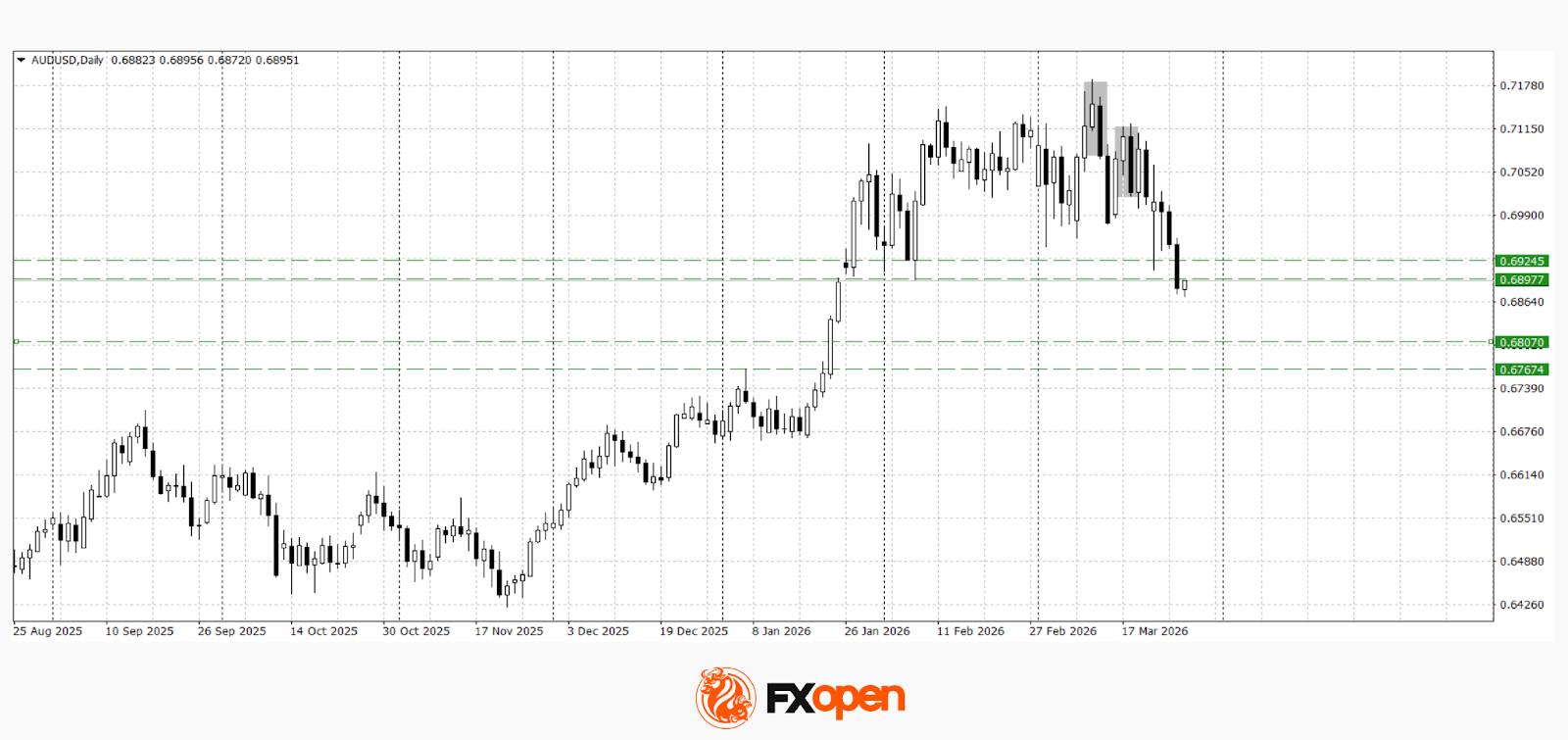
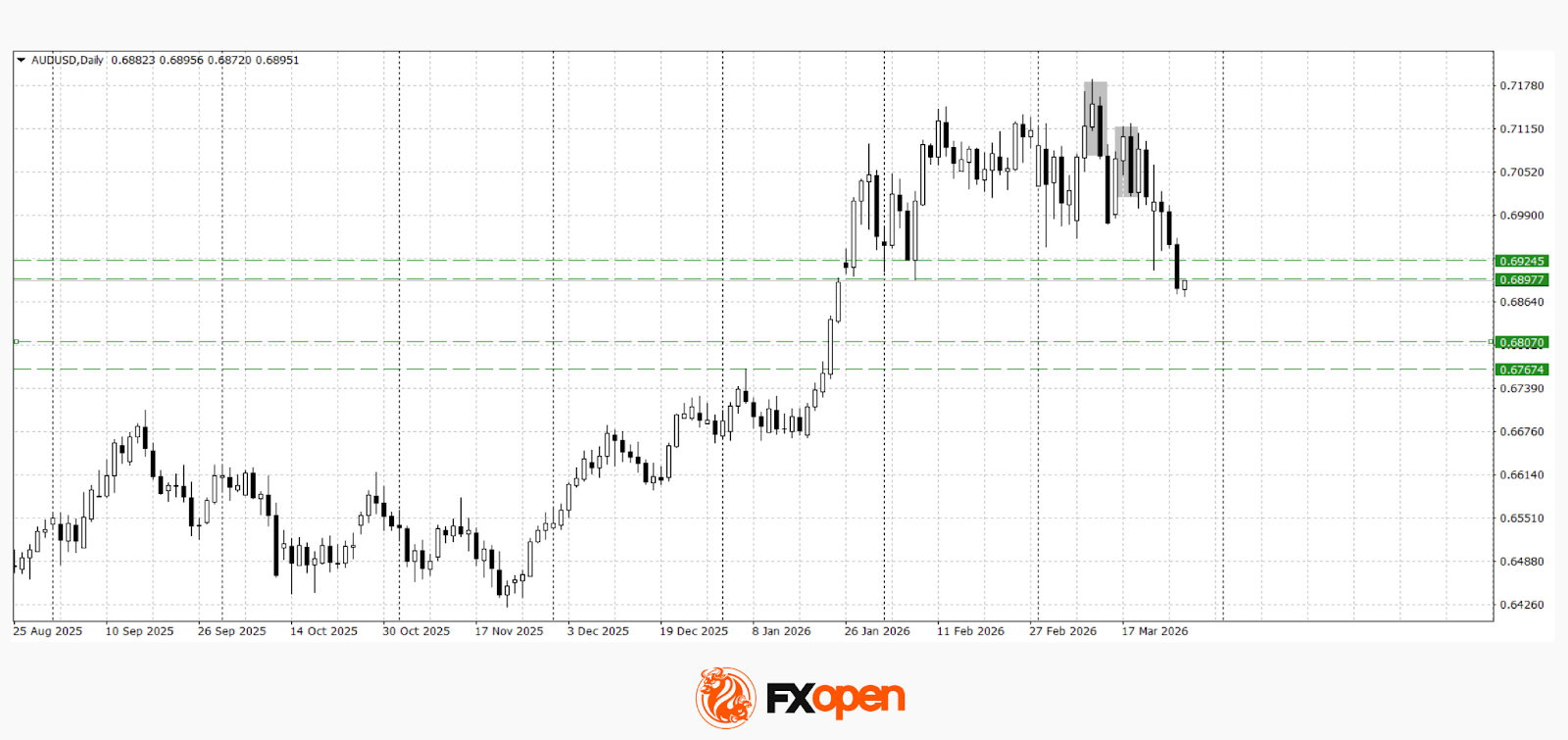
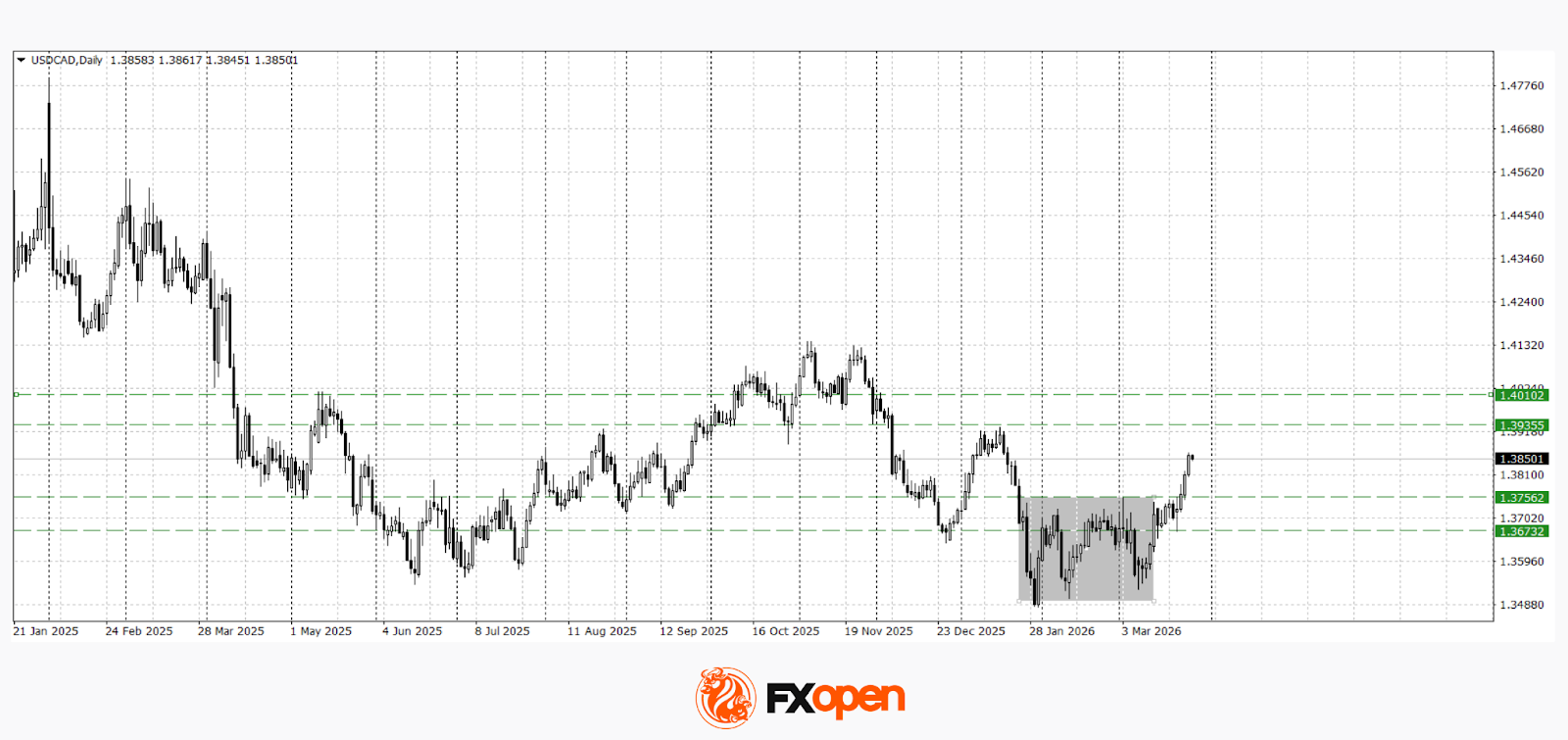
Commodity-linked currencies continue to weaken amid rising geopolitical tensions, which are boosting demand for safe-haven assets and increasing volatility across both FX and commodity markets. The US dollar is gaining support from demand for liquid and defensive assets, while currencies sensitive to commodities and global risk appetite remain under pressure. Against this backdrop, AUD/USD and USD/CAD have broken through key technical levels, pointing to strengthening momentum and raising the likelihood of further moves in the same direction.
Additional pressure on the market comes from escalating tensions in the Middle East. Reports of fresh strikes, risks of disruptions to energy supplies, and potential restrictions on key shipping routes have pushed oil prices higher. Rising energy costs are fuelling inflation concerns and reducing investors’ appetite for risk, supporting the dollar while weighing on commodity currencies.
AUD/USD
AUD/USD broke below a key support range of 0.6900–0.6930 yesterday. If this zone now acts as resistance, the downward move may extend towards 0.6760–0.6800. Technical analysis also supports a continuation of the bearish trend, as a series of reversal patterns has formed on the daily timeframe. A bullish invalidation scenario would require a sustained move back above 0.6930.
Key events for AUD/USD:
- today at 16:00 (GMT+2): University of Michigan inflation expectations
- today at 17:00 (GMT+2): speech by FOMC member Thomas Barkin
- today at 22:30 (GMT+2): CFTC net speculative positioning in AUD
USD/CAD
USD/CAD has established a firm foothold above the key resistance range of 1.3750–1.3800. This zone had capped gains for several weeks, and if current momentum persists, the pair may move towards 1.3940–1.4000. On the daily timeframe, a “Frying Pan Bottom” reversal pattern has formed, further supporting the bullish outlook. A return of selling pressure would likely require a sustained move back below 1.3750.
Key events for USD/CAD:
- today at 14:30 (GMT+2): Canadian wholesale sales
- today at 17:00 (GMT+2): Canada budget balance
- today at 19:00 (GMT+2): US Baker Hughes total rig count
Trade over 50 forex markets 24 hours a day with FXOpen. Take advantage of low commissions, deep liquidity, and spreads from 0.0 pips (additional fees may apply). Open your FXOpen account now or learn more about trading forex with FXOpen.
This article represents the opinion of the Companies operating under the FXOpen brand only. It is not to be construed as an offer, solicitation, or recommendation with respect to products and services provided by the Companies operating under the FXOpen brand, nor is it to be considered financial advice.

TLDR:
-
- Nonagon Capital and Startale Group partner to pioneer JPYSC agentic payment proof-of-concept initiatives in 2026.
- JPYSC is Japan’s first trust bank-backed yen stablecoin, exempt from the JPY 1 million domestic transfer cap.
- Deloitte projects AI agent-driven commerce will reach USD 17.5 trillion by 2030, fueling stablecoin demand.
- Planned use cases include agent-to-agent settlements, autonomous purchasing, and real-time micropayments globally.
- Nonagon Capital and Startale Group partner to pioneer JPYSC agentic payment proof-of-concept initiatives in 2026.
JPYSC, Japan’s first bank-backed yen stablecoin, is now part of a new strategic partnership. Nonagon Capital and Startale Group announced the collaboration on March 27, 2026.
Nonagon Capital is a San Francisco Bay Area venture fund focused on digital assets. Startale Group is a Singapore-headquartered global fintech company.
Both firms plan to run proof-of-concept initiatives for AI agent-driven payments using JPYSC. Deloitte projects AI agent-driven commerce will reach $17.5 trillion by 2030.
Japan’s Trust Bank-Backed Stablecoin Targets Enterprise Settlement
Shinsei Trust & Banking, a subsidiary of SBI Shinsei Bank, issues JPYSC under Japan’s Payment Services Act. It is classified as an Item (iii) Electronic Payment Instrument, taking the form of trust-beneficiary rights.
SBI VC Trade handles distribution, while Startale Group leads technical development. This includes smart contract architecture and security infrastructure.
Startale Group took to X to announce the collaboration, stating the two companies would work to “pioneer agentic payment use cases for Japan’s first bank-backed yen stablecoin.”
The post further referenced plans for “agent-to-agent settlements, autonomous purchasing & real-time micropayments.” These use cases are designed to serve global enterprises across multiple industries.
The announcement signaled both firms’ commitment to building next-generation payment infrastructure.
The stablecoin is not subject to Japan’s JPY 1 million per-transaction cap on domestic transfers. This makes it well-suited for large enterprise-grade financial settlements.
It also supports interoperability between traditional financial systems and blockchain networks. The official JPYSC launch is targeted for Q2 2026, subject to regulatory approvals.
JPYSC’s design combines institutional backing with blockchain-level programmability. Its trust bank structure provides regulatory credibility under Japanese law.
Its on-chain architecture also offers flexibility for cross-border enterprise use cases. This combination sets it apart from conventional digital payment instruments.
Partnership Proof-of-Concepts to Shape JPYSC Global Rollout
Nonagon Capital announced in February 2026 its strategic focus on the agentic payment space. The Startale Group partnership marks its first major initiative in that direction.
Both firms view the convergence of AI and blockchain as a pivotal economic development. Their joint effort begins with proof-of-concept experiments using JPYSC as the payment layer.
On-chain identity verification, referred to as Know Your Agent (KYA), is a core feature of JPYSC. This mechanism allows it to function natively within autonomous AI payment environments.
Programmable settlement capabilities further position it as a next-generation payment layer. These features support regulated digital yen transactions on a global scale.
These insights will form the operational blueprint for a swift global rollout. Both companies plan to use their combined international reach to scale results.
Further announcements will follow as developments progress. The partnership draws together expertise in digital assets, fintech, and AI infrastructure.
JPYSC’s programmable settlement rails make it suited for high-frequency AI transactions. Regulatory compliance and institutional backing from SBI Group add credibility to the framework.
As the Q2 2026 launch nears, both companies continue to refine their execution strategy. The agentic payment space is growing, and this partnership positions both firms at the forefront.
Crypto World
Worldcoin price at risk of $0.20 breakdown amid rising exchange inflows and bearish setup
Worldcoin price has dropped over 30% this month as market sentiment remains risk-off amid geopolitical tensions in the Middle East.
Summary
- Worldcoin price declined sharply amid risk-off sentiment driven by Middle East tensions, with the token down over 30% this month.
- Exchange inflows surged as $26 million worth of WLD moved to centralized platforms, increasing concerns over potential selling pressure.
- Bearish technical indicators and a descending channel pattern point to further downside risk, with a break below key support exposing a drop toward $0.20.
According to data from crypto.news, Worldcoin (WLD) was trading at $0.27 last check on Friday, March 27, with a market capitalization of over $867 million. The altcoin has fallen 15% over the past week and over 40% since the beginning of this year.
Worldcoin price fell as escalating geopolitical tensions in the Middle East, particularly after Iran rejected a peace proposal from the U.S. to end the war between the two nations, triggered a risk-off sentiment among investors who are increasingly rotating their capital to gold and other traditional safety plays.
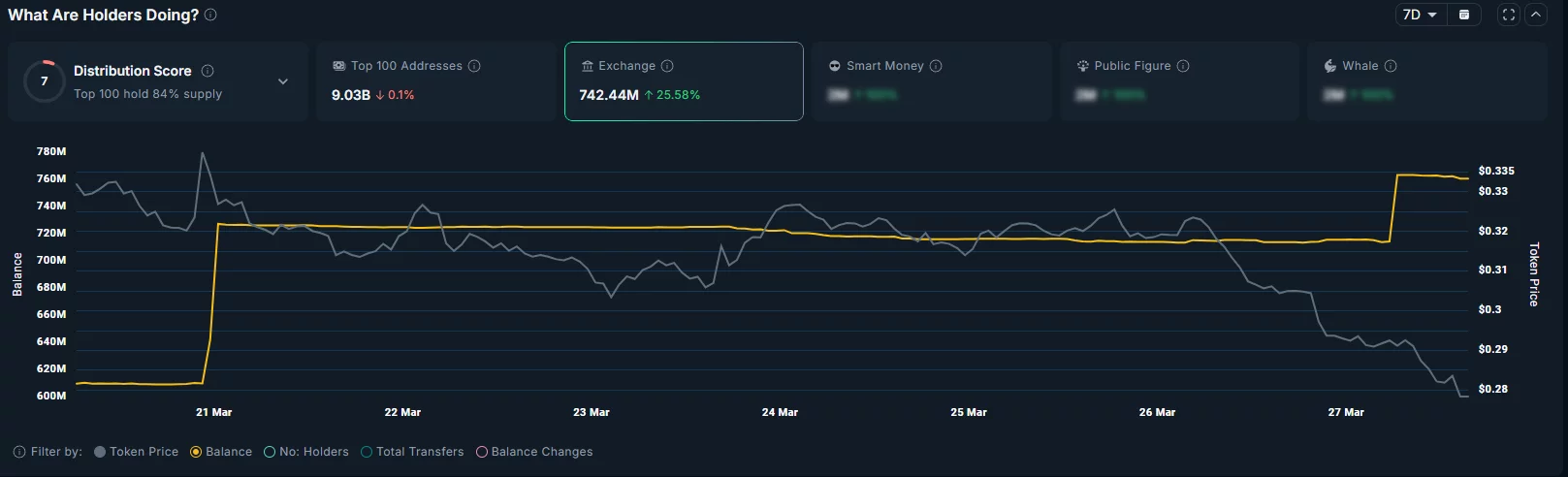
The downward momentum also intensified after reports revealed that the Worldcoin team transferred around $26 million worth of WLD tokens to centralized exchanges. Over the past week, the total amount of tokens held across all exchanges rose over 25% to $742 million, data from Nansen shows.
A jump in balances held on exchanges tends to increase selling pressure for a token as investors remain uneasy over a potential supply overhang should these entities decide to sell them.
Additionally, continued scrutiny of Tools for Humanity, the main developer behind the Worldcoin project, over biometric data collection has led to operational suspensions in countries like Brazil and Indonesia in early 2026, creating persistent investor uncertainty.
On the daily chart, Worldcoin price has been trading within a descending parallel channel pattern since early October 2025 while forming lower highs and lower lows. As long as the asset price remains within the two parallel trendlines that mark the boundaries of the ongoing Worldcoin price decline, the token will likely remain trapped in a bearish structure.
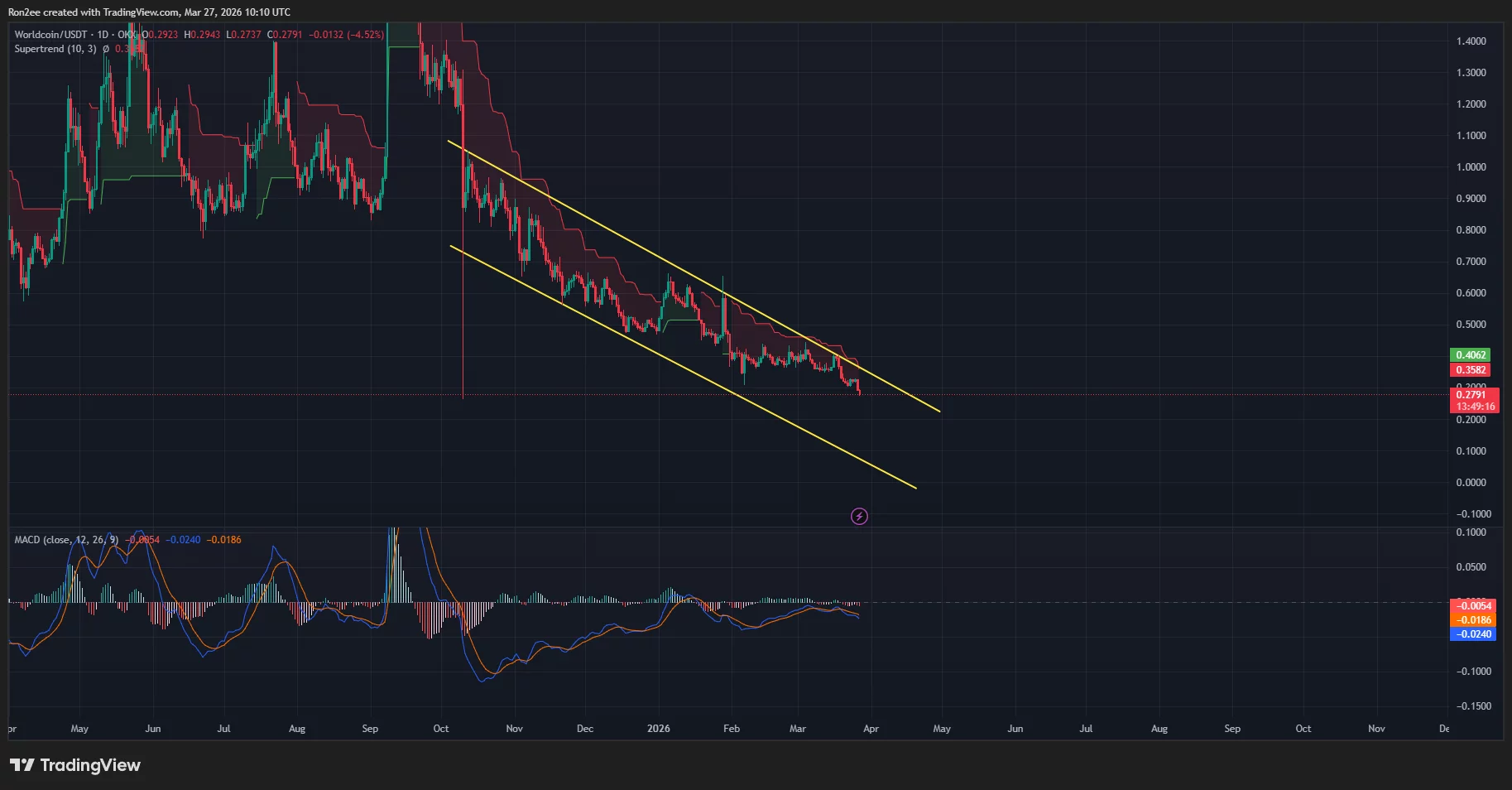
The Supertrend indicator has flashed a red sell signal, which means that the bearish momentum is still firmly in control. Additionally, the MACD lines have confirmed a bearish crossover with both lines remaining below the zero line, a sign that selling pressure is accelerating rather than cooling off.
For now, traders would likely be keeping an eye on $0.25, as this level serves as a critical support zone. A break below which could further deteriorate market sentiment for the token and likely lead to a deeper plunge toward $0.20.
On the contrary, a break above $0.35 could spark a bullish exit from the upper side of the descending channel, potentially ending the months-long downtrend.
Disclosure: This article does not represent investment advice. The content and materials featured on this page are for educational purposes only.


Anchorage Digital, the first crypto firm to get a U.S. banking charter, said it will add support for the Tron blockchain, starting with institutional custody for TRX, the network’s native token.
The announcement gives institutions a regulated way to hold TRX through the company’s platform and its self-custody wallet, Porto. Anchorage Digital said support for TRC-20 assets and native TRX staking be added later.
Tron has become one of the busiest networks for moving stablecoins and other digital assets. DeFiLlama data shows that the supply of stablecoins on the network has grown steadily over the last three years and now stands at $86 billion. That’s more than a quarter of the total stablecoin supply.
Anchorage is pitching the integration as a compliance-focused bridge between traditional institutions and a network that has seen heavy use in crypto payments. CEO Nathan McCauley said the addition brings “one of crypto’s largest ecosystems into an institutional framework.”
The rollout will happen in stages. First comes custody for TRX, with plans to add Tron-based TRC-20 assets later. That’s followed by staking for institutions that want to earn rewards while taking part in network validation.
Anchorage already supports major networks including Ethereum and some of the biggest layer-2 networks such as Arbitrum, Optimism, Base and Linea. It also supports bitcoin and solana (SOL) tokens, and other major layer-1 networks like Avalanche and BNB Chain.

Dermot Kennedy’s Belfast gig ends early due to medical emergency
RenovoRx appoints Dr. Ramtin Agah as executive chairman and updates compensation

Meta Platforms (META) Shares Fall by Around 8%


-
 Crypto World6 days ago
NIO (NIO) Stock Plunges 6.5% as Shelf Registration Sparks Dilution Worries
-
 NewsBeat2 days ago
Manchester United reach agreement with Casemiro over contract clause amid transfer speculation
-

 Fashion7 days ago
Weekend Open Thread: Adidas – Corporette.com
-

 Politics7 days ago
Jenni Murray, Long-Serving Woman’s Hour Presenter, Dies Aged 75
-

 Crypto World6 days ago
Best Crypto to Buy Now: Strategy Just Spent $1.57 Billion on Bitcoin During Fear While Early Investors Quietly Enter Pepeto for 150x Potential
-

 Crypto World6 days ago
Bitcoin Price News: Bhutan Sells $72 Million in BTC Under Fiscal Pressure, but the Smart Money Entering Pepeto Sees What the Market Does Not
-

 News Videos1 day ago
Parliament publishes latest register of MPs’ financial interests
-

 Sports4 days ago
Remo Stars and Kano Pillars Strengthen Survival Hopes in NPFL
-

 Sports4 days ago
Gary Kirsten Accuses Pakistan Cricket Board Of ‘Interference’, Mohsin Naqvi Responds
-

 Tech5 days ago
Give Your Phone a Huge (and Free) Upgrade by Switching to Another Keyboard
-

 Business5 days ago
No Winner in March 21 Drawing as Prize Rolls to $133 Million for Next
-

 Sports7 days ago
2026 Kentucky Derby horses, odds, futures, preview, date: Expert who nailed 12 Derby-Oaks Doubles enters picks
-

 Tech5 days ago
AI enters the chat: New Seattle dating app relies on tech to facilitate meaningful human connections
-

 News Videos4 days ago
Ch 9 Financial Management Part 1 | Detailed One Shot | Class 12 Business Studies Boards 2026
-
Business6 days ago
Columbia Sportswear enters $500 million credit agreement with JPMorgan Chase
-

 Tech5 days ago
Today’s NYT Connections Hints, Answers for March 22 #1015
-

 Business14 hours ago
Instagram, YouTube Found Responsible for Teen’s Mental Health Struggle in Historic Ruling
-
 Crypto World7 days ago
Small-cap Russell 2000 enters correction territory
-

 Business5 days ago
Will Duke Basketball Win It All? Duke Basketball Enters Second Round as Third Favorite to Claim NCAA Title
-

 Sports4 days ago
2026 Kentucky Derby horses, odds, futures, preview, date: Expert who hit 12 Derby-Oaks Doubles enters picks
You must be logged in to post a comment Login