

Crypto World
Binance Australia adds new crypto transfer rule from July 1



Binance Australia will require users to provide extra information when sending or receiving crypto from July 1, 2026.
Summary
- Binance Australia users must provide sender details for crypto deposits from July 1, 2026 onward.
- Outgoing withdrawals will require beneficiary information, including full name, country, and city or locality details.
- Related crypto.news coverage says AUSTRAC rules add mandatory Travel Rule compliance from July 1, 2026.
The exchange said the change applies only to Australian users and supports compliance with local rules.
Binance said users will need to provide sender information when receiving crypto deposits into their accounts. The rule applies to any amount of crypto sent to Binance Australia.
The exchange will also require beneficiary information when users withdraw crypto from Binance. Binance described the new process as a “mandatory requirement” for Australian users.
Deposits and withdrawals face new checks
For withdrawals, users must provide the beneficiary’s full name, country of residence, and city, town, or locality. If users send assets to themselves on another exchange, Binance said they only need to provide the name of the receiving exchange.
For deposits, users must go to the crypto deposit page and click the pending transaction. Binance said the pop-up will ask for the sender’s full name, country of residence, unique identifier, and city, town, or locality.
Missing details may delay transactions
Binance warned that transfers may be delayed or not processed if users do not provide the required details. In some deposit cases, the exchange said it may return the crypto assets to the sender or originating exchange.
The platform also said users will need to log in again from July 1, 2026, when the changes begin. Users who do not make crypto transfers do not need to take any action.
Australia moves toward stricter crypto oversight
The update comes as Australia expands anti-money laundering rules for virtual asset services. AUSTRAC said separate Travel Rule obligations apply to transfers of value involving virtual assets.
AUSTRAC’s transitional guidance says some virtual asset obligations are deferred until July 1, 2026. It also tells firms to prepare for customer checks, reporting, transfer of value, and record-keeping duties that start from that date.
Related crypto.news coverage reported that Australia’s 2026 rules include mandatory Travel Rule compliance from July 1, 2026. Separate coverage also said Australia has been moving toward bank-style rules for crypto exchanges and custody providers.
The Binance update shows how those rules may affect daily users. Crypto deposits and withdrawals will still work, but users must be ready to provide names and location details before transfers clear.

Crypto World
Solana Q1 Performance Defies Market Slump With Record Transactions and Rising App Revenue

TLDR:
- Solana recorded 112.6M average daily non-vote transactions in Q1, marking a new all-time high for the network.
- Launchpad platforms generated $144M, making up 42% of total Solana app revenue in the first quarter of 2025.
- Solana’s RWA market cap grew 43% QoQ to $2.01B, with BlackRock’s BUIDL fund doubling to $525.4M in Q1.
- Solana added support for x402 and Stripe’s Machine Payments Protocol, linking it to both major agent payment standards.
Solana Q1 performance remained surprisingly resilient even as broader crypto markets experienced sharp corrections.
On-chain activity held steady across multiple metrics, including transaction volume, fee payers, and application revenue. While token prices faced pressure, the underlying network continued to process record activity.
This divergence between price and fundamentals has drawn attention from analysts tracking the chain’s long-term trajectory heading into Q2 2025.
Transaction Activity and App Revenue Hold the Network Together
Daily non-vote transactions on Solana reached a new all-time high in Q1. The network printed 112.6 million average daily non-vote transactions, up 50% quarter-over-quarter. That figure alone signals that user activity was not slowing down despite market conditions.
Chain GDP stayed nearly flat at approximately $342.2 million for the quarter. Daily fee payers also held steady at around 2.2 million, showing consistent demand for block space. These numbers suggest the network maintained a stable base of active users.
Crypto analyst Kaff posted on X, noting that apps on Solana were “still making real money,” with launchpads alone generating roughly $144 million.
That figure represented about 42% of total Solana application revenue for the quarter. Solana’s App Revenue-to-Chain Revenue ratio also rose to 382%, meaning applications captured far more value than the base layer itself.
Trading platforms continued to lead in revenue generation. Pump.fun brought in $124.7 million, up 17% QoQ, while Axiom Exchange posted $42.4 million, up 36%. Raydium generated $34.6 million, Phantom earned $23.4 million, and Jupiter recorded $23.1 million across a broader revenue mix.
RWAs and Payments Emerge as the Next Major Catalyst
Beyond trading, real-world assets are drawing serious institutional interest on Solana. RWA market cap on the chain grew 43% quarter-over-quarter, reaching approximately $2.01 billion. BlackRock’s BUIDL fund doubled to $525.4 million after Anchorage Digital added custody support.
Kamino Finance saw only an 8% decline in the quarter while integrating PRIME and ONyc into its DeFi infrastructure.
That positions it as a growing hub for institutional-grade liquidity on Solana. Tokenized card and collectible platforms also saw activity, with Collector Crypt capturing 89% of that segment.
Payments represent another area gaining momentum. Visa, Stripe, Worldpay, Western Union, Fiserv, and PayPal have all moved closer to Solana-based settlement and product development.
The network also added support for x402 and Stripe’s Machine Payments Protocol, making it compatible with both major agent payment standards.
DePIN revenue reached $9.1 million in Q1, up 28%, led by Helium and GEODNET. Perpetuals DEX volume fell 29% QoQ to roughly $1.14 billion daily, though GM Trade saw its daily volume surge over 8,000% after pivoting toward RWA-based perpetuals.

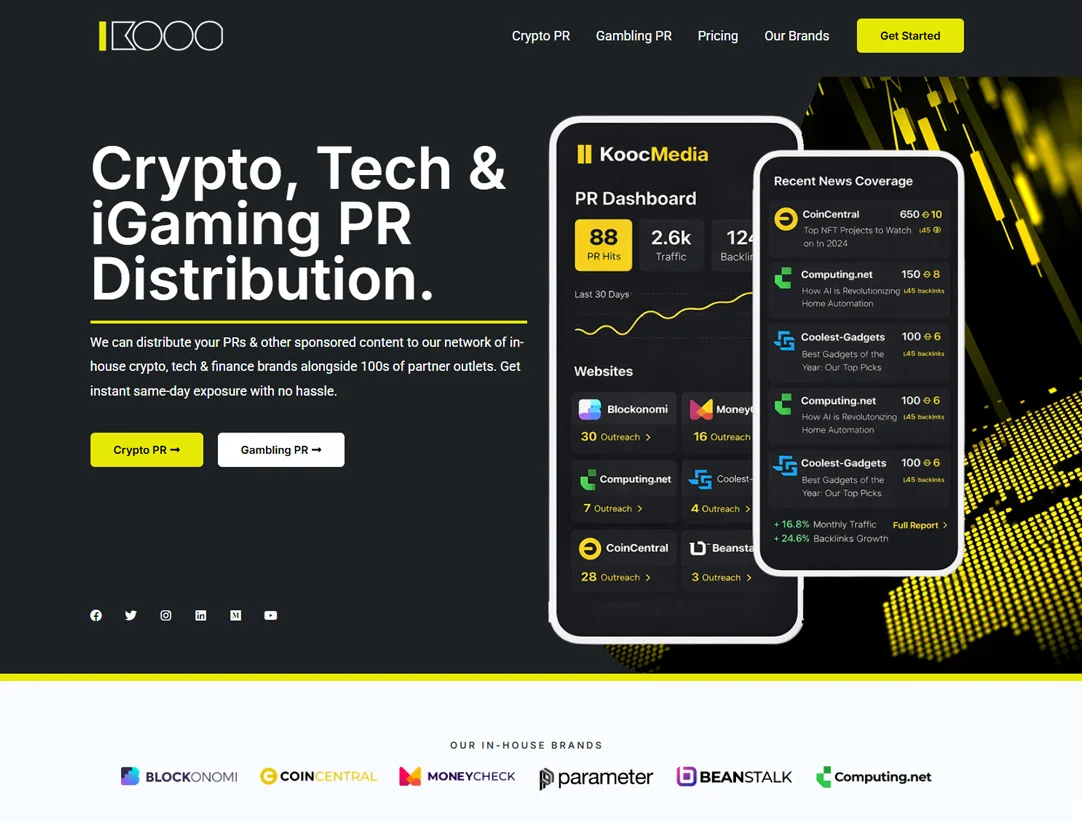
AI platforms are launching at an unprecedented rate, but most of them face the same problem: nobody knows they exist. Building the technology is one thing. Getting it covered by the media is something else entirely. Kooc Media, a PR distribution agency that has been delivering guaranteed press coverage for crypto, fintech and iGaming companies since 2017, is now offering dedicated PR and news coverage packages for AI platforms and artificial intelligence companies.
The Media Challenge Facing AI Platforms
The AI industry is one of the most competitive sectors in technology right now. New AI platforms, machine learning tools and intelligent automation products are entering the market constantly. For every company that breaks through and gains widespread recognition, dozens of equally capable platforms go unnoticed because they never secured meaningful media coverage.
The problem is not a lack of newsworthy stories. AI platforms are doing genuinely interesting things — launching new capabilities, closing funding rounds, forming partnerships, solving real business problems. The problem is access. Most AI companies are built by technical teams that do not have PR experience, media relationships or the budget to hire a traditional agency that charges monthly retainers with no guaranteed results.
This is where Kooc Media steps in. The agency operates on a model that guarantees placements on named publications at fixed prices. There are no retainers, no uncertain timelines, and no risk of paying for outreach that produces nothing.
“AI companies are in a similar position to where crypto startups were a few years ago,” said Michelle De Gouveia, spokesperson for Kooc Media. “There is a huge amount of innovation happening, but many of these companies do not have the PR infrastructure or media contacts to get their story in front of the right audience. That is exactly what we help with.”
Guaranteed News Coverage on Owned Publications
The reason Kooc Media can guarantee coverage is that it owns and operates its own network of news websites. This is unusual for a PR agency. Most firms rely entirely on pitching third-party journalists, which means results are never certain. Kooc Media’s portfolio includes established publications such as Blockonomi, CoinCentral, MoneyCheck, Parameter, Beanstalk and Computing — sites that cover technology, finance, digital innovation and the AI sector directly. The full network can be viewed on the agency’s brands page.
Because these publications are controlled in-house, client content can be published the same day it is submitted. For AI platforms announcing product launches, platform updates, new integrations or investment news, same-day coverage means the announcement reaches readers while it is still fresh and relevant.
Each placement is on a real publication with an existing audience and genuine domain authority. These are not press release dumps or placeholder pages. They are active news sites that publish daily content and attract organic traffic from search engines and direct readership.
Wider Distribution Through Partner Networks
Kooc Media’s owned sites are the foundation of every package, but the agency also offers full newswire distribution that extends coverage well beyond its own network. Press releases are distributed to hundreds of partner websites and thousands of syndicated outlets, significantly increasing the reach of every announcement.
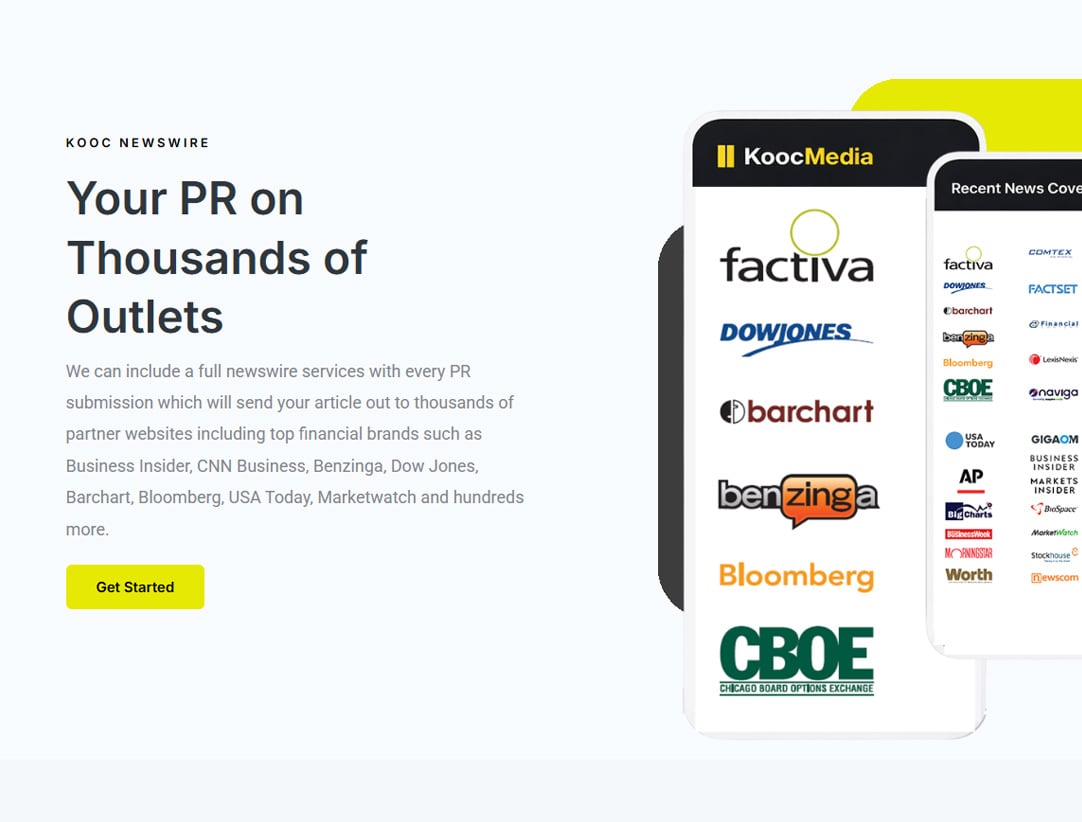
For AI platforms that want maximum exposure, higher-tier packages can place content on major business and financial media outlets. These include Business Insider, Bloomberg, Benzinga, MarketWatch, USA Today and Dow Jones feeds. Having an AI platform featured alongside mainstream financial and technology news adds a level of credibility that is difficult to achieve through organic outreach alone.
Every campaign includes full reporting with live links to each placement. Clients can see exactly where their news appeared, share those links with stakeholders, and track the coverage directly. The AI-specific packages and pricing are detailed on Kooc Media’s AI PR page.
How News Coverage Supports Long-Term Search Visibility
For AI platforms, the value of press coverage extends far beyond the day an article is published. Every article placed on a high-authority news domain creates a backlink to the company’s website. These backlinks carry significant SEO weight, helping the platform rank higher in search results for competitive terms.
AI platforms need to be discoverable when potential users search for phrases like “AI platform,” “AI tools for business,” “machine learning platform,” “AI automation software” or “enterprise AI solutions.” Ranking well for these terms drives a steady stream of organic traffic that no amount of social media posting can match.
Because Kooc Media’s packages distribute content across multiple high-authority sites simultaneously, each campaign builds a cluster of quality backlinks rather than a single mention. Over time, this accumulation of authoritative links has a compounding effect on search performance.
AgentLocker.ai: A Dedicated AI Directory for Clients
As part of its commitment to the AI sector, Kooc Media has launched AgentLocker.ai, an AI tools and agents directory built to help users discover, compare and evaluate artificial intelligence products. The directory covers the full range of AI platforms, from task-specific automation tools to large-scale autonomous agent systems.
AgentLocker.ai is owned and operated by Kooc Media, and every client that purchases an AI PR package will be included and featured on the directory at no extra cost. This gives AI platforms a permanent, searchable presence that works alongside their press coverage.

A directory listing on AgentLocker.ai serves a different purpose to a press release. While news coverage drives a burst of attention around a specific announcement, a directory listing provides continuous discoverability. People browsing AgentLocker.ai are actively looking for AI solutions, which means the traffic it sends is highly relevant. The listing also adds another quality backlink from a niche AI domain, reinforcing the SEO gains from press distribution.
“We built AgentLocker.ai because we saw a need for a straightforward, well-organised directory of AI tools and agents,” said De Gouveia. “Giving our PR clients a free listing there was an obvious step — it adds real value on top of the media coverage they are already getting.”
Experience Built in Fast-Moving Industries
Kooc Media’s move into AI PR is backed by years of proven delivery in equally demanding sectors. The agency’s crypto PR services have been used by token launches, DeFi protocols, blockchain infrastructure companies and Web3 startups to secure coverage across leading crypto and finance publications. Its gambling PR packages support online casinos, sportsbooks and iGaming operators that need guaranteed placements on finance and entertainment news sites.
The publishing infrastructure, editorial team and distribution network that powers these services is the same system now available to AI platforms. Nothing has been assembled from scratch. AI clients are accessing a mature, tested operation that has been refined over years of delivering results in fast-paced markets.
Services across all sectors include press release writing, sponsored articles, homepage placements on owned publications, newswire distribution to partner outlets, and fully managed campaigns run by Kooc Media’s internal editorial team. AI platforms that do not have a marketing department can hand the entire process to the agency and have professional news coverage live within days.
Getting AI Platforms the Coverage They Deserve
The AI industry is moving quickly, and the platforms that establish media presence early will carry that advantage as the market grows. Kooc Media’s combination of owned news sites, partner newswire distribution, same-day publishing, full reporting and a free AgentLocker.ai listing gives AI platforms a practical, results-driven path to the coverage they need.
Kooc Media’s PR packages are available now through the company’s website at https://kooc.co.uk.
Disclaimer: This is a Press Release provided by a third party who is responsible for the content. Please conduct your own research before taking any action based on the content.
Crypto World
AI agents are starting to pay with crypto as Coinbase, Stripe and Visa want in, Keyrock report says


Artificial intelligence (AI) agents autonomously spending money online is still a tiny market, but some of the world’s largest tech, payments and crypto firms are already racing to build the infrastructure for it, Keyrock said in a new report.
The crypto trading and investment firm estimated that AI agents settled over $73 million across roughly 176 million transactions on blockchain rails between May 2025 and April 2026.
The volumes remain negligible compared to traditional finance (TradFi). Visa, for example, alone processes $14.5 trillion annually. But the significance lies less in the headline U.S. dollar value and more in how quickly the infrastructure stack is forming, the report argued. Global firms such as Coinbase (COIN), Stripe, Google (GOOG) and Visa (V) all rolled out competing systems for machine-to-machine payments.
The broader idea behind agentic payments is that software increasingly consumes digital services autonomously rather than through human-managed subscriptions and accounts. An AI trading agent, for example, could continuously purchase market data, cloud computing or AI-generated analysis in tiny increments throughout the day without a human authorizing each payment manually.
That potential is driving ambitious forecasts how big the agentic payment sector could grow. Gartner projects AI agents could intermediate $15 trillion in purchases by 2028, while McKinsey estimated retail agentic commerce could reach $3 trillion-$5 trillion by 2030, according to the Keyrock report.
Those projections imply growth rates even faster than stablecoins experienced during their breakout years, the report said, but said the pace of infrastructure deployment already signals the market is moving beyond its experimentation phase.
Coinbase’s x402 protocol has emerged as one of the leading crypto-native systems. The protocol allows AI agents to pay directly with USDC for services such as blockchain analytics or cloud infrastructure without creating accounts or subscriptions.
Stripe, with its Tempo blockchain, launched a competing framework called Machine Payments Protocol (MPP), while Google introduced AP2, a system focused on delegated spending authorization for AI agents. Visa has extended its card network with tokenized credentials designed for AI-driven commerce.
Crypto rails and stablecoins are emerging as the preferred settlement layer, and the economics help explain why.
Some 76% of agent transactions fall below the 30 cent fixed-fee floor common in card payments, according to the report. Most payments ranged between one and 10 cents, making traditional rails impractical for automated software agents buying data, AI inference or API access. Meanwhile, stablecoin settlement on some blockchains like Base and Tempo costs fractions of a cent.
Currently, 98.6% of machine payments settle in USDC, the stablecoin issued by Circle (CRCL). That solidifies Circle’s position in crypto payments, but also introduces risk of concentration, creating dependency on a single issuer.
Regulation could be a source of constraint for the growth. MiCA in Europe, the U.S. GENIUS Act and the EU AI Act are all expected to take effect around mid-2026, yet none of them directly address autonomous machine-to-machine transactions or questions around liability and agent identity, the report noted.


BlackRock, Franklin Templeton, JPMorgan, Citadel Securities, Société Générale, the NYSE, Nasdaq, and the Bank of England are all building the same thing right now. Not Bitcoin holdings. Not ETFs. They are rebuilding the global financial system’s plumbing on blockchain rails.
Summary
- Tokenized real-world assets crossed $29 billion, with the market on track for $100 billion this year.
- Tokenized U.S. Treasuries grew from $380 million in 2023 to $13.4 billion by April 2026.
- BlackRock, Franklin Templeton, JPMorgan, Citadel Securities, Nasdaq, and others are building tokenization infrastructure.
- Tokenization is shifting from crypto-native experiments to regulated financial rails used by major institutions.
The market for tokenized real-world assets just crossed $29 billion. It is on track for $100 billion this year. And it is happening with almost no coverage in the crypto press, because tokenization is boring, technical, and run by exactly the firms that crypto Twitter spent a decade insisting would never show up.
The most important crypto story is the one no one is talking about
If you wanted to understand what crypto will look like in five years, you would not start with Bitcoin price predictions. You would not start with Ethereum’s roadmap. You would not start with the latest meme coin or the newest layer two. You would start with a quiet line item on RWA.xyz that read, in early May 2026, “Total tokenized asset value: $29.27 billion.”
That number doesn’t sound dramatic. It is dwarfed by Bitcoin’s market cap. It is smaller than several individual altcoins. The category does not have a flagship token to rally around. The headlines it generates are dry. And yet, of all the things happening in digital assets right now, the slow institutional migration of traditional financial instruments onto public blockchains is the one most likely to matter in ten years, and it is the one getting the least attention from the audience that is supposedly built to care about it.
The numbers, briefly. The tokenized real-world asset market (excluding stablecoins) grew from roughly $1.5 billion in early 2023 to $29.27 billion by April 2026, a near-twentyfold expansion. Within that, tokenized US Treasuries went from $380 million in Q1 2023 to $13.4 billion by April 2026, a 37x jump. Tokenized commodities, mostly gold, hit $7.3 billion. Tokenized equities crossed $960 million, more than doubling from mid-2025. Yield-bearing on-chain dollar instruments, the bridge category between stablecoins and tokenized funds, added another $8 billion or so on top.
Over forty major financial institutions are now actively issuing tokenized products on public blockchains. That includes BlackRock, the largest asset manager in the world, which has its $2.4 billion BUIDL fund running on Ethereum, recently extended to multiple chains, and as of Q1 2026 plugged into Uniswap.
Franklin Templeton runs its BENJI tokenized money market fund across multiple blockchains and recently partnered with Ondo Finance to launch tokenized versions of five ETFs tradable 24/7 via crypto wallets. Circle, Fidelity, WisdomTree, JPMorgan, Citadel Securities, Société Générale, Nomura, HSBC, the DTCC, Euroclear, the London Stock Exchange Group, and the Bank of England are all building infrastructure in this space.
What is being built, in plain language, is a new layer for the financial system. Treasuries that settle in seconds rather than days. Money market funds that can be used as DeFi collateral. ETFs that trade twenty-four hours a day. Stocks that can be borrowed against without being sold. Private credit that used to sit in illiquid, opaque, multi-million-dollar minimum vehicles, now sliced into tokens with on-chain provenance and continuous price discovery. Real estate debt. Bonds. Repos. Gold. Eventually, equities. The list keeps growing.
And the people building it are exactly the ones the crypto industry spent ten years insisting did not understand what was coming.
Why $29 billion sounds small but is not
It is fair to ask: $29 billion is not a lot in the context of a $130 trillion global capital market. Why does this matter now, if at all?
Three reasons.
First, the rate of change is what matters here, not the absolute size. The tokenized RWA market grew 263 percent year-over-year in 2025. It grew roughly 30 percent in Q1 2026 alone. That compound monthly growth rate above ten percent puts the sector on a trajectory that, if it merely holds, will cross $100 billion this year and reach trillion-dollar scale within five. The McKinsey, BCG, and Standard Chartered analyst notes that put 2030 tokenization at $5 to $30 trillion are not lottery-ticket forecasts. They are what happens if today’s growth rate continues.
Second, the quality of the participants has changed. The 2021 wave of tokenization was mostly DeFi-native projects experimenting at the margins. The 2026 wave is the largest asset managers, custodians, exchanges, and central banks in the world. In Q1 2026 alone: BlackRock’s BUIDL fund went live on Uniswap, the first time a major asset manager connected a regulated tokenized fund to a decentralized exchange. The DTCC, Euroclear, Tradeweb, Citadel Securities, and Société Générale completed the first cross-border intraday repo using tokenized UK gilts on the Canton Network. Galaxy Digital’s tokenized GLXY shares became available as collateral on Solana’s largest lending protocol. Binance relaunched tokenized stock trading in partnership with Ondo Finance. None of these moves is the work of crypto-native startups looking for a niche. These are TradFi institutions wiring their own products onto blockchain rails.
Third, the regulatory environment has shifted meaningfully in the institutions’ favor. In Q1 2026, the SEC issued its first formal statement on tokenized securities in January. In February, it approved WisdomTree’s tokenized money market fund for intraday trading.
In March, the SEC and CFTC released joint guidance on digital asset taxonomy. The GENIUS Act on stablecoins took effect in 2025. The CLARITY Act on market structure cleared committee in May 2026 and is on track for a possible signing this summer.
Larry Fink, the CEO of BlackRock, who eight years ago called Bitcoin “an index of money laundering,” now publicly describes tokenization as the future of finance, with the explicit endorsement that tokenizing traditional assets will “make investments easier to issue, easier to trade, and easier to access.”
These three things together, the growth rate, the participants, and the regulatory tailwind, make the current $29 billion number a deeply misleading anchor. The right way to read it is not “small.” The right way to read it is “early.”
What is actually being tokenized, and why
To see why this matters in practice, look at what is being put on chain first and ask why a sophisticated CFO or treasurer wants it there.
Tokenized US Treasuries are the biggest category at $13.4 billion. The pitch is direct. A short-dated Treasury bill earns yield, but holding a T-bill traditionally means using a fund vehicle, paying for custody, and being unable to move the asset without selling. A tokenized Treasury fund pays the same yield but settles in seconds, runs twenty-four hours a day, can be transferred peer-to-peer between accounts, and crucially can be used as collateral in on-chain lending markets without first being liquidated. For a corporate treasurer managing operating cash, this is a meaningful upgrade. The yield comes from the same Treasuries; the operational flexibility is entirely new.
The leading products tell the story. Circle’s USYC sits at $2.7 billion. Ondo’s suite, including OUSG, at $2.6 billion. BlackRock’s BUIDL at $2.4 billion. Franklin Templeton’s BENJI at $1 billion. WisdomTree’s WTGXX at $861 million. The architecture varies, BUIDL is a regulated fund wrapper for qualified investors, OUSG is a tokenized note that holds BUIDL as its underlying asset, USDY is yield-bearing for non-US investors, but the common theme is “Treasury exposure plus on-chain composability.”
Tokenized commodities are the third-largest category at $7.3 billion. Gold dominates. The pitch here is simpler still: a tokenized gold claim trades twenty-four hours a day, settles in seconds, and is divisible to fractions of a gram. HSBC’s Hang Seng Investment announced plans to launch a gold ETF with tokenized shares. Hong Kong’s HashKey Chain supports the territory’s first regulated silver-backed RWA token. Tokenized commodities are slowly broadening from gold into other metals.
Tokenized equities crossed $960 million by March 2026, up sharply from $424 million at mid-2025. Ondo holds roughly sixty percent of this segment through its Global Markets platform, which offers tokenized versions of US stocks including BlackRock, Coinbase, Coupang, and Circle, among others. The use case here is partly about access (non-US investors who want exposure to US equities) and partly about composability (tokenized stocks usable as DeFi collateral). The NYSE and Nasdaq are both building their own 24/7 tokenized securities infrastructure on different architectural approaches, with the NYSE working through a partnership with Securitize and Nasdaq receiving SEC approval in March for tokenized stock trading.
Private credit is the second-largest category at roughly seventeen percent of total RWA value. This is the segment with the largest long-term upside and the most structural complexity. Global private credit is a $1.7 trillion asset class largely locked inside multi-million-dollar minimum funds with quarterly liquidity and minimal transparency. Tokenization promises continuous price discovery, fractional access, and instant settlement. Most of that promise is still ahead of the product, but the firms working on it, Apollo, Hamilton Lane, Securitize, Centrifuge, are not crypto tourists.
Tokenized repo is the most under-noticed development of Q1 2026. The DTCC, Euroclear, Tradeweb, Citadel Securities, and Société Générale executed the first cross-border intraday repo using tokenized UK gilts on the Canton Network. The Bank of England launched its Synchronisation Lab in the same quarter to explore tokenized settlement with central bank money. The repo market is one of the most plumbing-heavy pieces of global finance, with trillions of dollars of daily volume. Moving any meaningful share of it onto tokenized rails is the kind of structural change that, once it starts, does not stop.
The three firms running the institutional layer
For the segment that has scaled most, tokenized Treasuries, the institutional layer comes down to three names: BlackRock, Franklin Templeton, and Ondo Finance. Each plays a different role, and the way they interact tells you most of what you need to know about how this sector is being built.
BlackRock anchors the institutional credibility layer. Its BUIDL fund is the largest tokenized Treasury product on a public blockchain. The architecture, a regulated fund wrapper distributed through Securitize on Ethereum and now several other chains, with BNY Mellon as custodian, is the template every competitor has copied. BUIDL went live on Uniswap in Q1 2026, the first time a regulated tokenized fund became tradable through a decentralized exchange. The top ten holders of BUIDL control roughly 98 percent of supply, which sounds concentrated until you realize it reflects BUIDL’s role as the wholesale liquidity backbone for the entire sector. Other products, including Ondo’s OUSG, hold BUIDL as their reserve asset.
Franklin Templeton holds the first-mover credential. Its BENJI tokenized money market fund launched on a public blockchain in 2021, making it the first SEC-registered tokenized money market fund. BENJI now operates across multiple blockchains with $1 billion in AUM, up roughly 140 percent over two years. Franklin Templeton has described tokenization as “structural rather than cyclical,” language designed to signal the firm is in this to build infrastructure rather than run a pilot. In Q1 2026 the firm partnered with Ondo to launch tokenized versions of five ETFs, tradable 24/7 through crypto wallets.
Ondo Finance is the connector. Unlike BlackRock and Franklin Templeton, Ondo is crypto-native, founded in 2021 with backing from Coinbase Ventures and Founders Fund. Ondo’s role is to take institutional-grade underlying assets, like BUIDL, and wrap them in smart contracts that are usable in DeFi, accessible to a broader base of investors, and deployable across multiple chains. OUSG holds BUIDL as its primary reserve. USDY, Ondo’s yield-bearing dollar product for non-US investors, is backed by short-term Treasuries and bank deposits, and has generated over $1.5 billion in cumulative DEX volume across chains like BNB Chain and Solana. Ondo Global Markets, the tokenized equities platform, holds about sixty percent market share in its segment with $550 million in TVL. The SEC closed its investigation into Ondo without charges in November 2025, and the firm filed a voluntary registration statement in February 2026.
The most important observation about this trio is that they are partners as much as competitors. BUIDL provides the institutional plumbing. BENJI provides the compliance precedent. Ondo provides the distribution and composability layer. The sector is not a winner-take-all market. It is a stack, and the firms occupying different positions in the stack reinforce each other’s growth.
What this means for the rest of crypto
This is the part of the story that most directly affects readers who do not care about tokenized money market funds but do hold crypto.
Tokenization is the channel through which traditional finance is, in practice, adopting crypto. Not by buying Bitcoin. Not by launching ETFs as marketing exercises. By moving its own products, the funds, the bonds, the equities, the repos, the commodities, onto the same public blockchains crypto-native projects use. Every tokenized Treasury fund deployed on Ethereum builds that blockchain’s institutional usage, fee revenue, and stickiness. Every tokenized equity on Solana does the same. Every tokenized repo on the Canton Network strengthens the case for institutional-grade blockchain infrastructure broadly.
That has knock-on effects.
For Ethereum, tokenization is the single most important long-term demand driver. The largest tokenized funds in the world settle on Ethereum or Ethereum L2s. If even a small fraction of the projected $100 billion-plus tokenization market lands on Ethereum’s rails, the network’s institutional usage in 2027 will look fundamentally different from its retail-dominated profile in 2021.
For Solana, tokenization is the most credible institutional use case beyond meme trading. Galaxy Digital chose Solana for its tokenized equity collateral pilot. BNB Chain saw $1.3 billion of USDY DEX volume. Tokenized equities scaling on Solana would meaningfully shift the perception of the chain among allocators.
For DeFi protocols, tokenization is the long-awaited “real yield” thesis arriving in concrete form. Lending markets like Aave and Morpho can now hold tokenized Treasuries as collateral, which pulls in capital that was structurally unable to engage with DeFi when the only collateral on offer was volatile crypto. The result is a class of DeFi user who is not a degenerate trader chasing 200 percent APY but a corporate treasurer earning four percent on tokenized T-bills while keeping the option to borrow against them.
For Bitcoin holders, the tokenization story is more indirect. Bitcoin itself does not host tokenized RWAs at scale, and its base layer is not designed to. But Bitcoin sits in the same regulatory and institutional ecosystem as the rest of the tokenized asset complex. The capital and credibility that flow into tokenized Treasuries flow into the same custody platforms, prime brokers, and compliance frameworks that hold Bitcoin. Indirectly, this builds the rails that make Bitcoin allocation easier and more durable for the institutions that have already begun, and that pipeline is wider than any single ETF approval would be.
What can still go wrong
A piece that only described the upside would be marketing, so here is the honest side.
Tokenization remains operationally complex. A tokenized Treasury fund is still a fund, with off-chain custody, off-chain administration, off-chain audit, and off-chain regulators. The blockchain wrapper does not eliminate counterparty risk. It changes where claims are recorded, not where assets live. The 2023 USDC depeg over Silicon Valley Bank exposure is the cautionary tale every tokenized asset issuer now writes against. If the institutions providing custody fail, the tokens are only as good as the recovery process for the underlying.
Regulation remains a moving target. The Q1 2026 SEC and CFTC clarifications were a step forward, but tokenized equities, tokenized private credit, and tokenized real estate each carry distinct regulatory questions that have not been fully answered. A tokenized equity issued in one jurisdiction may face restrictions when held by an investor in another. Tax treatment of yield-bearing tokenized instruments remains messy across borders.
Concentration is real. The top ten BUIDL holders own 98 percent of supply. The top three tokenized Treasury products account for more than half the segment. Early-stage market structure looks oligopolistic, which is fine until a major participant has a problem and creates a contagion path that did not exist in the pre-tokenized version of the same instruments.
And the gap between current scale and the trillion-dollar projections is enormous. The forty-times growth required for the sector to reach $1 trillion is not impossible at current rates, but it requires sustained institutional adoption, regulatory continuity, and the absence of a serious failure event. Any of those three can falter, and the entire growth curve flattens.
The story underneath the story
The reason tokenization is the real story, and the reason most coverage misses it, is that it does not look like crypto. There is no token to pump. There is no community to rally. The growth chart is steady rather than parabolic. The companies involved are the firms crypto Twitter spent a decade dunking on. The progress arrives in SEC press releases and BlackRock product announcements rather than in CT threads. None of this is the aesthetic of crypto, which is partly why coverage of it has been so thin.
But it is the substance. The thing crypto was supposed to be for, depending on which generation of the argument you grew up with, was the disintermediation of legacy finance, or the upgrade of money to internet speeds, or the creation of programmable financial infrastructure that did not depend on permission from banks. Tokenization is, quite literally, all three of those things happening at once. The fact that it is happening through banks, with permission, on regulated rails, is what makes it real and durable rather than ideological and brittle. The ideological version of crypto, the one that promised to make TradFi obsolete, mostly failed. The pragmatic version, the one that takes TradFi’s products and ships them on better rails, is succeeding.
That is the story. It is happening at scale. It is accelerating. The biggest financial institutions in the world are building it together rather than fighting it. And the crypto press is mostly looking the other way, because tokenization does not photograph well and does not have a meme.
In ten years, the question will not be whether Bitcoin or Ethereum won. It will be whether the global financial system runs on tokenized rails. The answer to that question is being written right now, $29 billion at a time, and it is being written by the firms most people thought would never show up.
They showed up. They are building. And the rest of us, if we are paying attention, will eventually catch on.
This article is for informational purposes and does not constitute financial or investment advice. Tokenized asset markets, regulatory frameworks, and product structures evolve quickly; the figures and product details described reflect reporting available as of mid-May 2026. Always do your own research.
Senior officials at the Commodity Futures Trading Commission who raised concerns about prediction market companies were suspended, investigated and eventually pushed out of the agency.
According to a New York Times investigation published Sunday, the officials had flagged concerns about Polymarket, Crypto.com and a Gemini affiliate, each with alleged business ties to the Trump family. Career staff worried that Crypto.com was not treating small bettors fairly, that Polymarket lacked adequate fraud protections and that Gemini’s affiliate had not completed the required regulatory review to operate.
Despite those concerns, then-acting CFTC chair Caroline Pham and her senior counsel intervened to help the firms get what they wanted, sources told the NYT. By the end of 2025, two officials who had raised questions were placed on administrative leave and under internal investigation. Three others who had enforced crypto laws faced the same fate. None were told what they had done wrong.
“But current and former agency staffers said in interviews that the commission’s work force took away a clear message: Don’t cause trouble for those industries,” the report wrote.
Related: US Senate Banking Committee votes to advance CLARITY Act
CFTC pulls back on crypto enforcement
The report noted that the CFTC has significantly pulled back on crypto enforcement. The agency dropped at least five crypto investigations and went from filing more than 80 crypto enforcement actions under Biden to just two under Trump. Both of the recent cases targeted individual operators, not major firms.
Pham left the agency to join MoonPay, a crypto firm partnered with Polymarket. Her senior counsel, Brigitte Weyls, became general counsel at Gemini Titan, the same company whose application she helped approve, the NYT claimed. Current chair Michael Selig, the agency’s sole commissioner, previously represented crypto firms as a corporate lawyer.
Crypto.com is a business partner of Trump Media. Polymarket received investment from Donald Trump Jr-backed venture capital firm 1789 Capital. Gemini’s founders are financial backers of American Bitcoin Corp, a crypto firm co-founded by Eric Trump.
“President Trump only acts in the best interests of the American public,” Davis Ingle, a White House spokesman, told the outlet. “There are no conflicts of interest.”
Cointelegraph reached out to Polymarket, Crypto.com and Gemini for comment, but had not received a response by publication.
Relateed: CFTC no-action letter eases event contract reporting rules
CFTC sues states over prediction markets
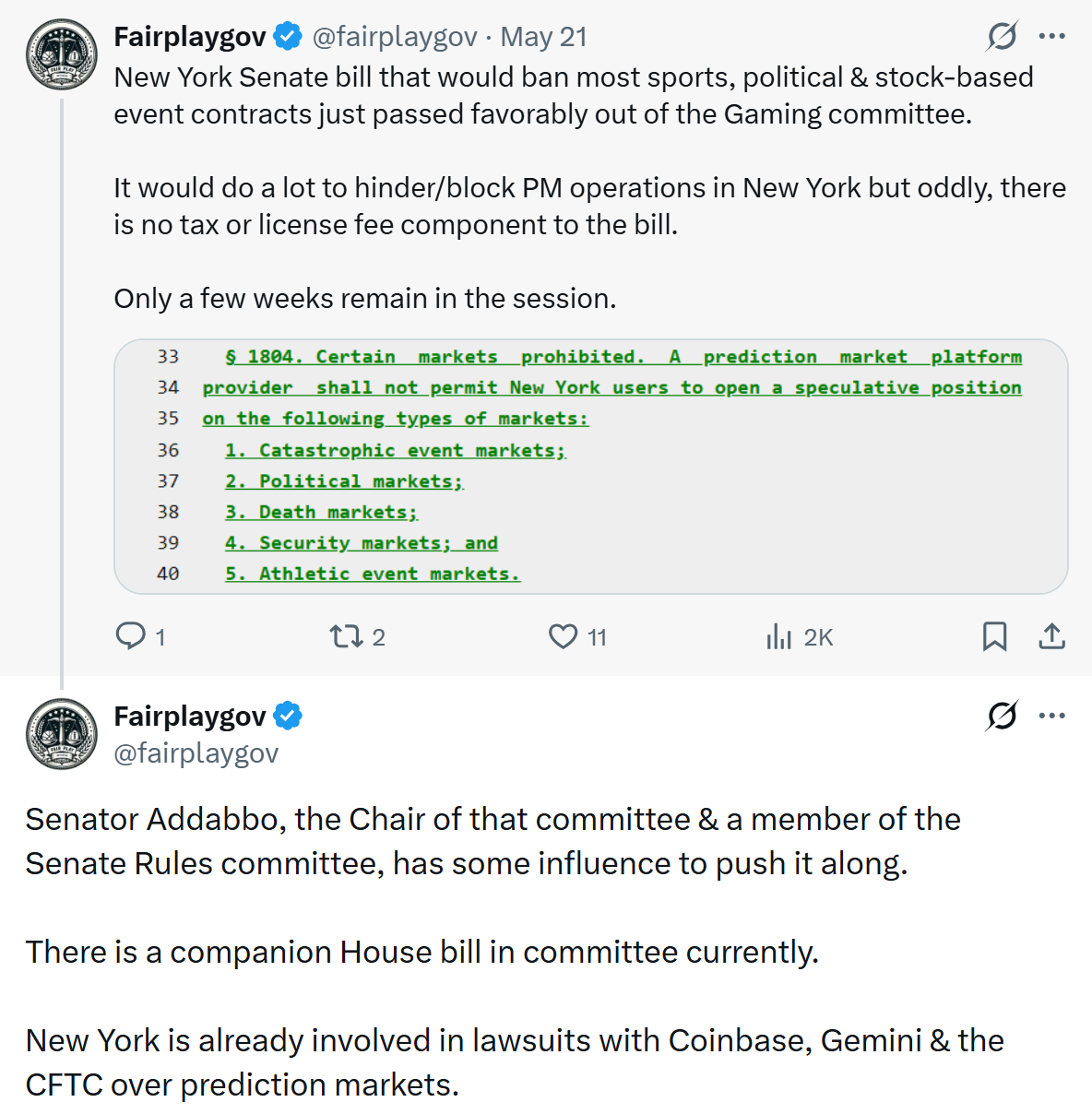
As Cointelegraph reported, the CFTC has filed lawsuits against over their legal proceedings against prediction market platforms, launching action against regulators in Wisconsin, Minnesota, New York, Arizona, Connecticut and Illinois.
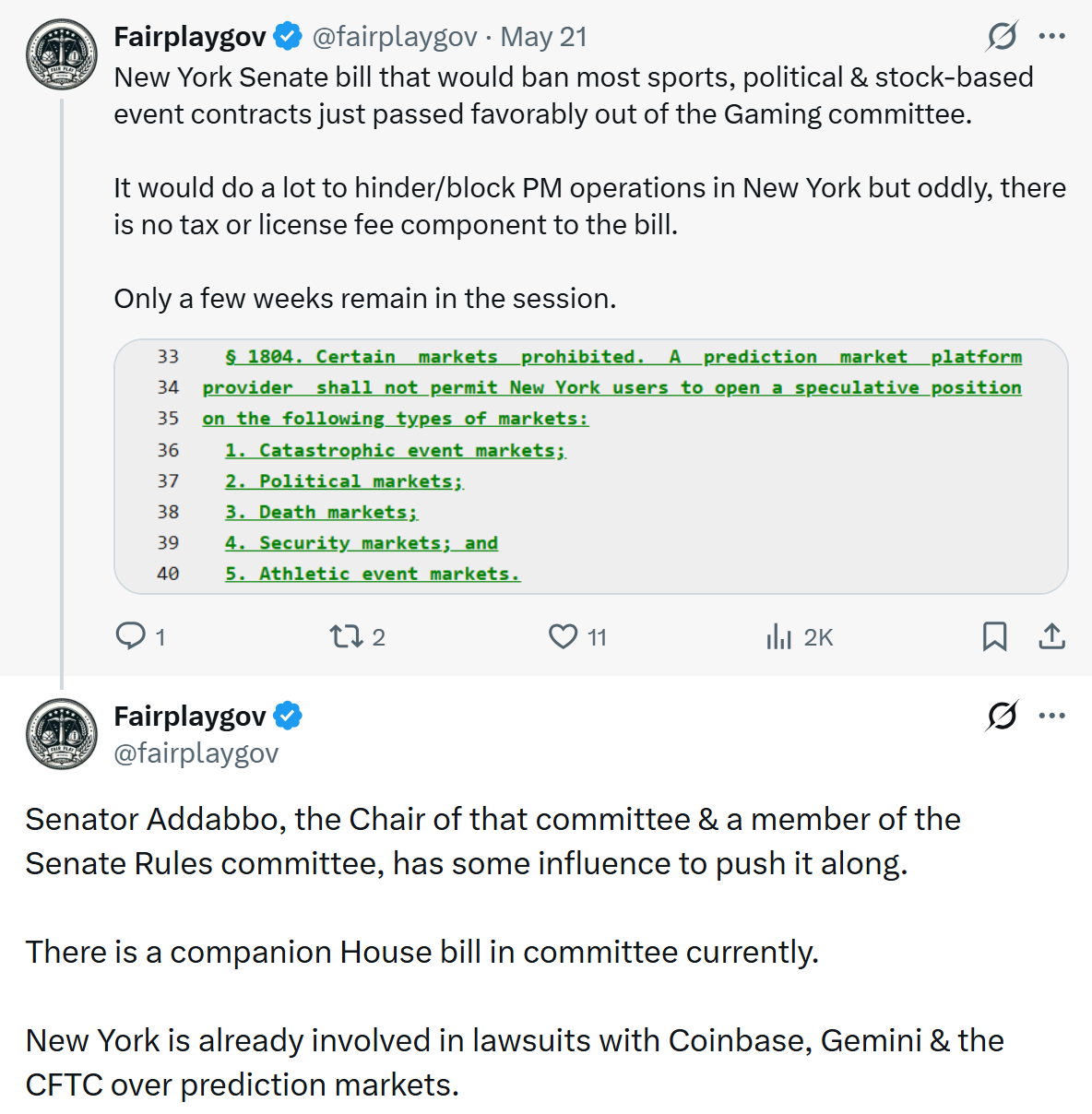
Source: Fairplaygov
Last week, the House Agriculture Committee urged Trump to nominate four commissioners to the CFTC, warning the agency is ill-equipped to handle its growing responsibilities with only one member in place.
Magazine: Guide to the top and emerging global crypto hubs — Mid-2026


Senior Commodity Futures Trading Commission officials who raised concerns about prediction market firms were suspended, investigated and pushed out, according to a New York Times investigation.
Summary
- NYT reported CFTC officials raised concerns about Polymarket, Crypto.com and a Gemini affiliate before suspensions.
- Crypto.news reported CFTC relief for event contracts as prediction market legal fights widened nationwide.
- The CFTC sued New York after state actions against Coinbase and Gemini prediction markets.
The NYT reported that career officials questioned activity tied to Polymarket, Crypto.com and a Gemini affiliate. Staff raised concerns over consumer treatment, fraud controls and whether one affiliate had finished a needed regulatory review.
The report said then-acting CFTC chair Caroline Pham and senior counsel Brigitte Weyls later helped the firms move forward. The NYT said two officials who raised questions were placed on administrative leave by late 2025. Three other staff members tied to crypto enforcement also faced the same action.
Crypto enforcement falls under scrutiny
The NYT report said the CFTC pulled back from crypto enforcement under the current administration. It said the agency dropped at least five crypto probes and filed only two crypto enforcement cases, both against individual operators.
The article also said staff saw a clear message inside the agency: “Don’t cause trouble.” The White House denied conflict claims. Spokesman Davis Ingle told the NYT, “There are no conflicts of interest.”
Prediction market rules remain contested
Related crypto.news coverage reported that the CFTC gave no-action relief for fully collateralized event contracts listed on regulated exchanges. The relief covered some swap data reporting and recordkeeping duties for designated contract markets, clearing firms and market participants.
The CFTC also opened a wider rule process for prediction markets in March. The Federal Register notice said the agency sought public comment on event contracts, public interest limits, cost-benefit issues and possible future rules.
Meanwhile, crypto.news reported that prediction market platforms face state-level legal fights even as federal officials support broader CFTC control. The report said the CFTC had challenged actions in Arizona, Connecticut, Illinois, New York and Wisconsin.
Reuters also reported that the CFTC sued New York on April 24. The agency accused the state of intruding on federal authority after New York sued Coinbase Financial Markets and Gemini Titan over prediction market products.
As crypto.news reported, Congress has also raised concern over the CFTC’s thin leadership bench. The House Agriculture Committee last week pressed President Trump to fill the agency’s four vacant commissioner seats, saying a one-member commission cannot keep pace with its expanding crypto and prediction market duties.
Polymarket talks add to pressure
Crypto.news reported that Polymarket has been in active talks with the CFTC to lift a four-year U.S. ban tied to a 2022 enforcement action and $1.4 million settlement. The report said the talks center on contract design, KYC and reporting.
The same coverage said Polymarket bought QCX LLC, a CFTC-registered exchange, for about $112 million in 2025. That deal could help the platform build a regulated U.S. path if officials approve the plan.
The dispute now comes as Congress weighs broader crypto rules. Crypto.news reported that the Senate Banking Committee advanced the CLARITY Act in a 15-9 vote, a bill that would split digital asset oversight between the SEC and CFTC.

After more than eight years at the helm of America’s central bank, Jerome Powell’s term ended on Friday, and he was replaced by the seventeenth Federal Reserve Chair, Kevin Warsh.
Given US President Trump’s growing public issues with Powell for refusing to lower the key interest rates, the POTUS’s new pick is expected to have a more open-minded approach to the institution’s monetary policy. He has also expressed support for BTC in the past, which has some altcoin fans questioning whether it extends to other crypto assets.
As such, we decided to ask one of the most popular AI models whether XRP, the third-largest non-stablecoin altcoin, could benefit as well.
Far More Nuanced
Gemini said that BTC benefits from being viewed as “digital gold,” but the landscape around utility-focused alts such as XRP under a Warsh-led Federal Reserve is “far more nuanced.” It added that the new Fed head is likely to bring a “mix of strict macroeconomic discipline and an open-minded approach to financial innovation that could uniquely impact the Ripple ecosystem.”
His pre-office disclosures revealed investments across the DeFi space, Layer-1 blockchains, and digital asset exchanges, which shows an appetite for cryptocurrency utility beyond just store-of-value propositions.
More importantly for XRP, Warsh has been vocal about the “modernization of money.” He has argued in the past that central banks must “proactively engage with digital currencies and has pushed for the US to consider a Central Bank Digital Currency to remain competitive, especially against initiatives like China’s digital yuan.”
Ripple has positioned the XRP Ledger to act as a neutral bridge asset for various CBDCs, which could benefit the underlying asset.
“A Fed Chair who is actively exploring the integration of digital, blockchain-based money into the traditional financial system provides a massive structural tailwind for Ripple’s core business model,” concluded Gemini for its bull case.
But There’s More
However, it’s not all promising and bullish predictions. The AI warned that Warsh has repeatedly noted that the explosion of alternative digital assets is largely a byproduct of loose monetary policy. XRP, similar to most altcoins, relies heavily on broad market liquidity.
Gemini believes capital is likely to become more expensive in the US as Warsh would want to reduce the Fed’s footprint in financial markets. In such tight liquidity environments, investors typically “flee from altcoins toward safer assets or bitcoin,” added Gemini.
If the new Fed Chair executes his vision of higher real rates and a smaller Fed balance sheet, XRP could “face severe downward price pressure as speculative capital dries up.”
The post Will XRP Skyrocket With Warsh Heading the Fed? Gemini Outlines Ripple’s Path Forward appeared first on CryptoPotato.
Crypto World
VELO Protocol Emerges as a Key Player in the Next Generation of Global Payment Infrastructure
TLDR:
- Velo and Lightnet share ties to CP Group, giving the ecosystem deep regulatory and banking access across Asia
- USDV is backed by BlackRock’s BUIDL fund via Securitize, making it a regulated, yield-bearing settlement asset.
- mBridge, the BIS-backed multi-CBDC platform, mirrors the exact settlement architecture Velo has been building.
- Regional V-Stablecoins tied to local fiat currencies point to a multilayered, interoperable payment framework.
VELO Protocol and its associated ecosystem are drawing renewed attention as observers examine parallels between the project’s infrastructure and emerging frameworks for cross-border settlement.
With regulated stablecoins, tokenized real-world assets and multilateral payment corridors gaining traction globally, VELO’s positioning has become a topic of discussion in institutional crypto circles.
USDV and the Shift Toward Regulated Settlement Assets
Crypto analyst Marco Salzmann recently shared observations on X, noting that VELO may be “one of the most misunderstood infrastructure plays in crypto.” He pointed to its connections with Lightnet, XRPL, EVOLVE and multi-CBDC initiatives as evidence of a broader architectural alignment.
At the center of this discussion is USDV, Velo’s native settlement stablecoin. Unlike conventional stablecoins, USDV carries exposure to BlackRock’s USD Institutional Digital Liquidity Fund, known as BUIDL, tokenized through Securitize. This structure positions USDV as a yield-bearing, regulated digital asset rather than a simple liquidity tool.
As global regulators tighten oversight, particularly following MiCA implementation in Europe, the market has begun separating regulated institutional assets from unregulated bridges.
USDV appears designed for the former category, which may carry weight with institutional payment infrastructure.
Velo has also explored additional V-Stablecoins tied to regional fiat currencies. This points toward a multilayered settlement architecture built around interoperable regional liquidity rather than a single dominant asset.
Lightnet, mBridge and the Asian Payment Corridor
Velo and Lightnet share a co-founder in Chatchaval Jiaravanon, a member of the family behind CP Group, one of Asia’s most influential conglomerates.
That connection carries practical weight, given that cross-border payment systems depend heavily on regulatory access, banking relationships and geopolitical trust.
Lightnet’s presence in Hong Kong is particularly relevant here. The city is increasingly functioning as a regulated digital asset sandbox and a potential gateway into broader Chinese financial experimentation.
Through partnerships such as WeLab and its pursuit of Money Service Operator licensing, Lightnet has established itself within a key future payment corridor connecting ASEAN, Hong Kong and China.
Adding another layer is mBridge, the BIS-backed multi-CBDC platform involving the central banks of China, Hong Kong, Thailand and the UAE.
Its focus on multilateral netting, national currency settlement and blockchain accounting closely mirrors the infrastructure Velo and Lightnet have been building over several years.
Whether these overlaps translate into formal integration or simply reflect parallel development remains an open question.
However, the convergence of regulated stablecoins, tokenized treasury exposure, OTC fiat gateways and multi-CBDC corridors around a common set of players is worth monitoring closely going forward.
Crypto World
Five Key Stocks to Monitor Next Week: Marvell, Dell, Salesforce, Costco, and Tesla Take Center Stage

Key Takeaways
- Marvell Technology’s earnings will spotlight custom AI chip demand and data center infrastructure trends
- Dell Technologies must demonstrate that strong AI server revenue is driving improved profitability
- Salesforce results will reveal whether enterprise spending on AI-powered software is accelerating
- Costco’s quarterly report offers insight into spending patterns among value-conscious consumers
- Tesla remains a focal point without earnings, as investors track robotaxi developments, China sales, and AI initiatives
The coming week brings a packed calendar with five significant companies poised to influence market sentiment across artificial intelligence infrastructure, enterprise technology, consumer retail, and electric vehicles.
AI Infrastructure Takes Center Stage
Marvell Technology delivers its quarterly results next week, positioning itself as a crucial indicator for AI infrastructure investment. The semiconductor company specializes in custom chip solutions, optical networking technology, and data center connectivity components. The primary question: are hyperscale cloud providers maintaining aggressive AI capital expenditure?
Marvell Technology, Inc., MRVL
The bar is elevated following impressive share price performance. Strong results would validate the thesis that AI-driven semiconductor demand extends well beyond Nvidia to encompass the broader chip ecosystem.
Dell Technologies also announces results this week. Market perception has evolved from traditional PC manufacturer to a proxy for enterprise AI server adoption. Recent momentum stems from robust orders in high-performance computing and data center infrastructure.
The critical question centers on margin expansion. While AI server revenue looks impressive, these systems carry substantial build costs. Investors demand evidence that this business generates meaningful bottom-line improvement, not just top-line growth.
Enterprise Software and Retail Under Examination
Salesforce provides a contrasting perspective on artificial intelligence adoption. Unlike hardware manufacturers, it serves as a litmus test for actual enterprise investment in AI software tools and intelligent automation platforms.
The software giant has emphasized AI agents and integrated data solutions as its primary growth catalyst. Key metrics include revenue acceleration, operating margin trends, and tangible evidence of customer adoption for these newer offerings.
Costco represents the week’s bellwether for consumer spending patterns. The warehouse club appeals particularly to affluent and value-oriented households, making it an effective gauge of discretionary spending.
Analysts will scrutinize comparable store sales, membership renewal rates, and customer traffic patterns. Given the stock’s premium multiple, investors require both robust current performance and optimistic forward guidance.
Tesla won’t release quarterly results but consistently commands attention. Market participants monitor robotaxi timeline updates, Chinese market performance, vehicle margin trends, and public statements from CEO Elon Musk.
The electric vehicle manufacturer emphasizes a long-horizon narrative encompassing artificial intelligence, fully autonomous driving technology, and robotics applications. However, investors simultaneously seek near-term validation of sustained demand and stable profitability.
Key Monitoring Points
This quintet represents distinct market segments. Marvell and Dell illuminate AI infrastructure investment trends. Salesforce demonstrates whether capital flows into enterprise AI software. Costco reflects consumer financial health. Tesla functions as both a sentiment indicator for retail investors and a barometer for AI-adjacent growth narratives.
Results from these five companies could establish clearer market direction as June approaches.
Key Takeaways
- The S&P 500 has completed its most impressive winning streak since 2023, yet market experts are flagging potential summer weakness.
- Historical data from Dow Jones Market Data shows the S&P 500 typically loses 2.8% between April and September during midterm election cycles.
- Crude oil prices climbing toward $110 per barrel and the 10-year Treasury yield reaching a 12-month peak of 4.61% are creating market headwinds.
- Semiconductor names including Sandisk, Micron, and AMD have experienced declines ranging from 9% to 14% across five trading sessions amid broader concerns.
- According to Deutsche Bank, a full market correction would require sustained oil shocks, contractionary economic indicators, or aggressive Federal Reserve policy tightening.
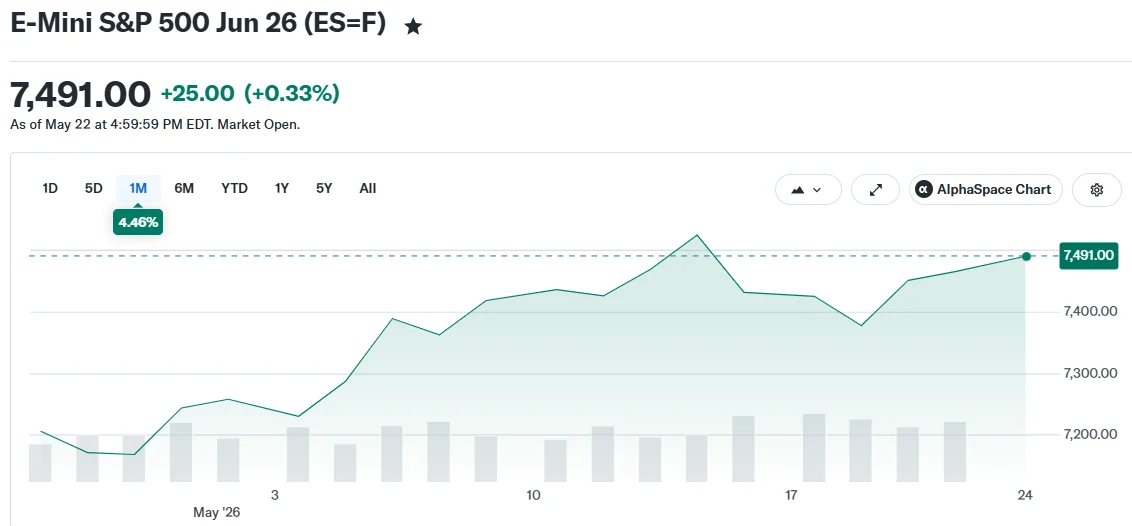
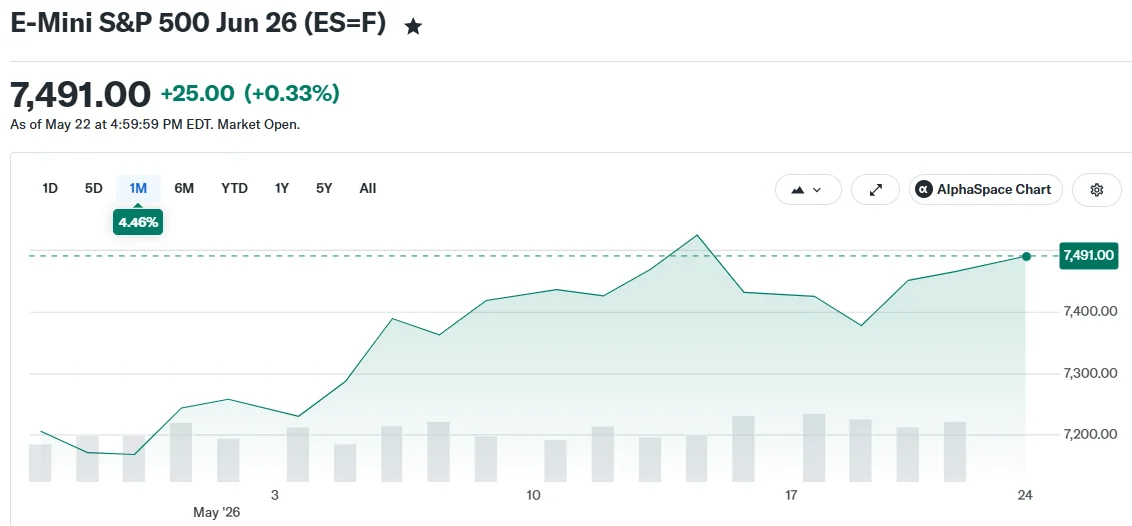
The S&P 500 has achieved eight consecutive weeks of positive returns — marking its strongest performance streak since 2023. Friday’s session concluded with all three major indices posting gains, extending the weekly winning pattern.
However, as we transition into June, market analysts are raising yellow flags. Historical patterns suggest that summer months during midterm election cycles have traditionally presented challenges for equity markets.
Data compiled by Dow Jones Market Data reveals that the S&P 500 typically experiences an average decline of 2.8% from late April through late September in years featuring midterm elections. Through May, the benchmark index has already climbed 3.7% this year.
Historical midterm summers have witnessed dramatic declines. The benchmark index plummeted over 25% in 1930, dropped nearly 30% in 1974, and tumbled 24% in 2002 — all during midterm cycles. Even when these extreme cases are excluded from the calculation, the average return for this period registers virtually zero, showing a minimal gain of just 0.006%.
The Cboe Volatility Index is currently trading at 16.7%. Charlie McElligott, a strategist at Nomura, has highlighted this level as notably elevated for a market experiencing such a robust upward trajectory, indicating potential underlying vulnerabilities.
Jeffrey Hirsch, who publishes the Stock Trader’s Almanac, explains that midterm election years typically redirect investor attention from corporate earnings toward political uncertainty. While he doesn’t anticipate a full bear market, he suggests the market may experience “sideways choppy” movement throughout the summer months.
Jay Hatfield from Infrastructure Capital Advisors highlights a cyclical seasonal trend: equity markets typically demonstrate strength during earnings reporting periods but show weakness in the intervals between them.
Crude Oil Surge and Yield Increases Compound Market Concerns
Meanwhile, international markets have experienced downward momentum over recent weeks due to escalating tensions involving Iran.
Brent crude oil has rallied near $110 per barrel, fueled by supply chain disruptions affecting the Strait of Hormuz. This surge is driving gasoline prices upward just as Memorial Day weekend travel approaches.
The 10-year US Treasury yield has advanced to a new 12-month high of 4.61%. Elevated yields enhance the attractiveness of fixed-income securities relative to equities while simultaneously increasing corporate financing costs.
The pairing of persistent inflation readings and climbing yields has triggered selling pressure within technology and semiconductor sectors. Sandisk and Micron have each declined approximately 14% over five consecutive sessions. AMD has retreated roughly 9% during the same timeframe.
Henry Allen, a strategist at Deutsche Bank, indicated that a significant market pullback would necessitate at least one of three catalysts: a prolonged oil price shock, definitively contractionary economic metrics, or aggressive interest rate increases from central banking authorities. He observed that while crude prices remain elevated, none of these conditions have clearly materialized.
Nevertheless, Hatfield suggested a potential positive scenario. Should Democrats secure the House while Republicans maintain Senate control, the resulting divided government could benefit markets. Historical evidence shows that legislative gridlock has generally supported equity valuations by minimizing the probability of substantial policy transformations.
“Gridlock is generally great for stocks,” Hatfield said.

Woman, 19, hit by tram in Edinburgh and seriously injured as major road closed

Analysis-US Treasury rout tests Washington’s tolerance for higher borrowing costs
Solana Q1 Performance Defies Market Slump With Record Transactions and Rising App Revenue

US brings back mandatory military draft registration

Steven Gerrard disagrees with Gary Neville over ‘shock’ Chelsea and Arsenal claim | Football

Register Renaming | Hackaday

A MAN’S PRAYER FOR FINANCIAL BREAKTHROUGH #masculinefocus #spiritualawakening #manupdaily.

That’s one way to do it! #funny #money #job #work #shorts

More news for XRP & Ripple this week! #xrp #ripple #crypto #cryptocurrency #bitcoin #btc #xrpnews
-

 Crypto World3 days ago
Blockchain.com files with SEC for U.S. IPO
-

 Fashion2 days ago
Holiday Weekend Open Thread – Corporette.com
-

 Business2 days ago
Dell Technologies DELL Stock Surges 15% on AI Server Momentum and Analyst Upgrades in 2026
-

 Crypto World2 days ago
Space X IPO Is ‘Bad News’ for Tech Stocks: But What About Bitcoin?
-

 Crypto World2 days ago
Bitcoin Accumulation Weakens as BTC Realized Losses Hit $600M
-

 Crypto World1 day ago
Robinhood crypto COO Tanya Denisova exits
-

 Politics2 days ago
Makerfield: a tale of two social-media histories
-

 Tech3 days ago
WhatsApp ads could make Irish debut after discussions with DPC
-

 Crypto World2 days ago
AI infrastructure race heats up as IREN pitches full-stack strategy, WhiteFiber lands $160M deal
-
 Tech2 days ago
A 0.12% parameter add-on gives AI agents the working memory RAG can’t
-

 Business2 days ago
Trump Invests $1M-$5M in Kura Sushi USA Chain With 27 California Locations
-
Crypto World6 days ago
Revolut Launches Dogecoin Debit Card Across UK and EU
-

 Tech2 days ago
You Can Now Add ChatGPT To PowerPoint
-

 Sports3 days ago
2026 CJ Cup Byron Nelson leaderboard: Brooks Koepka finds putting stroke in Round 1
-

 Crypto World2 days ago
Trump Media’s Bitcoin Stash Shrinks Again as 2,650 BTC Lands on Crypto.com
-
 NewsBeat3 days ago
Charity run by Reform leader Malcolm Offord accused of ‘law breaking’ over Scottish registration
-
Business2 days ago
Goldman Sachs reinstates Ageas stock coverage with neutral rating
-
 Crypto World6 days ago
SEC to propose tokenized stock framework as Wall Street efforts deepen: Bloomberg
-

 Crypto World2 days ago
MicroStrategy’s Saylor Says Miners No Longer Set Bitcoin Price, Another Force Has Taken Over
-

 Politics7 days ago
SECOND secret Israeli base discovered in Iraqi desert
You must be logged in to post a comment Login