
Crypto World
Binance to shift $1 billion user protection fund into bitcoin amid market rout

Top cryptocurrency exchange Binance announced said Friday that it shall switch the stablecoin in its $1 billion emergency user protection fund to bitcoin over the next 30 days.
The move targets the Secure asset Fund for Users (SAFU), which is a security fund created to protect users from losses due to unforeseen events such as hacks. The exchange plans to gradually convert the stablecoin holdings within 30 days, committing to regular audits.
It added that if bitcoin’s price swings drop the fund’s value below $800 million, the exchange will top it back up to $1 billion.
“This initiative is part of Binance’s long-term industry-building efforts, and we will continue to advance related work, gradually sharing more progress with the community,” the translated version of the exchange’s post on X, said.
As of 2025, the exchange’s proof-of-reserves report showed users holding roughly $163 billion in crypto tokens on the platform.
Stablecoins are digital tokens with values pegged to an external reference such as the U.S. dollar. Bitcoin is the world’s leading cryptocurrency with a market value of over $1.6 trillion.



A U.K. High Court judge allowed a lawsuit over the alleged theft of more than 2,323 bitcoin to move forward last week, in a case that highlights how the country’s legal system is still adapting traditional property law to cryptocurrency.
U.K. resident Ping Fai Yuen claimed in court filings in last week that his estranged wife, Fun Yung Li, used CCTV cameras in their home to secretly obtain the recovery phrase to his hardware wallet and transferred 2,323 bitcoin without his permission in August 2023, according to the docket in the High Court of England and Wales.
The bitcoin was worth just under $60 million at the time of the alleged theft 30 months ago, but is now worth roughly $172 million at the current price of just over $74,000.
The stolen crypto was stored in a Trezor cold wallet secured by a PIN. But anyone with the wallet’s 24-word recovery phrase could recreate the wallet and move the funds, the court noted. It was then transferred through several transactions and now sits across 71 blockchain addresses not held at exchanges. The funds have not moved since Dec. 21, 2023, according to the court.
Yuen said he later installed audio recording devices in the home after his daughter warned him Li was trying to take the bitcoin. After discovering the transfer, Yuen confronted Li and assaulted her. He later pleaded guilty to assault occasioning actual bodily harm and two counts of common assault in 2024. Officers seized several hardware wallets and recovery seeds during a search of her home, though authorities later took no further action pending new evidence.
Earlier, according to the filings, the wife asked the court to throw out the case, arguing that because the husband’s main claim was conversion, which in England is a legal term traditionally used when someone takes physical property, it could not apply to digital assets, such as bitcoin.
The judged agreed with the wife, but ruled the case can still proceed under different legal claims that could allow the husband to recover the bitcoin if his allegations are proven. The case will now proceed to trial, the judge said.

TLDR
- Ripple partnered with i-payout to enhance cross-border payouts into the United States and Canada.
- i-payout integrated Ripple Payments to accelerate settlement and improve payment transparency.
- The collaboration aims to reduce settlement delays and lower working capital requirements for global platforms.
- i-payout stated that cross-border payments into North America previously took several days to complete.
- Ripple recently outlined plans to secure an Australian Financial Services License to expand its payments offering.
Ripple has entered a new partnership to accelerate cross-border payouts into the United States and Canada. The company confirmed that i-payout has integrated Ripple Payments into its global payout platform. The collaboration targets faster settlement times and improved transparency for high-volume transactions.
i-payout announced the integration in a statement titled “real-time cross-border payouts into the US and Canada.” The company stated that it aims to enable “fast, transparent cross-border payouts” into both markets. It also seeks to reduce settlement delays and minimize working capital requirements for global platforms.
The partnership allows i-payout to use Ripple’s enterprise-grade digital asset infrastructure. As a result, the platform can accelerate settlement and improve payment visibility. The companies confirmed that they will focus on high-volume cross-border payout flows.
Ripple and i-payout Target Faster North American Settlements
i-payout said it operates as an API-first payout platform serving businesses worldwide. The company has worked in the payments sector for nearly two decades. It provides compliant payouts to workers, merchants, and partners across multiple regions.
Before this integration, cross-border payments into North America often took several days to settle. Those delays tied up working capital for global platforms. As a result, companies could not deliver funds to users quickly.
i-payout stated that integrating Ripple Payments addresses those settlement bottlenecks. The company said the collaboration will “accelerate settlement, improve payment transparency, and support high-volume cross-border payout flows.” It confirmed that the solution supports real-time payout capabilities into the United States and Canada.
The platform expects the new setup to reduce reliance on traditional correspondent banking networks. It also plans to streamline liquidity management for enterprise clients. Both companies confirmed that they will focus on operational efficiency and compliance.
Ripple Expands Licensing Efforts and Launches $750 Million Buyback
Last week, Ripple outlined plans to secure an Australian Financial Services License. The license would allow the company to expand its payment offering in Australia. It aims to serve financial institutions, fintech firms, and enterprises in the country.
The company confirmed that it wants to strengthen its regulated presence in the region. It stated that the license would support broader payment services. Ripple continues to pursue regulatory approvals in multiple jurisdictions.
Separately, Ripple launched a share buyback program valued at up to $750 million. The company will repurchase shares from employees and investors. Bloomberg reported that the transaction values Ripple at $50 billion.
Ripple confirmed that it structured the buyback as a tender offer. The program reflects internal capital management decisions. The company continues to expand its payments infrastructure across global markets.

Crypto World
Stablecoin Liquidity Rises as Crypto Assets Resist Pressure From Escalating War Tensions


As geopolitical tensions rise, more users are going on-chain in search of cross-border liquidity, which is boosting stablecoin supply.
The broader financial market is under pressure due to rising tensions stemming from the ongoing Middle East crisis. However, crypto assets are pushing back and resisting the pressure.
In fact, a recent report from the Asian crypto trading firm, QCP Capital, revealed that stablecoin liquidity is rising despite equities and gold buckling under pressure. This is a sign that the crypto market is navigating the turbulence caused by heightened geopolitical tensions.
Crypto Resists Pressure From War Tensions
According to the latest QCP Market Colour report, cryptocurrencies are striking back and not letting the war get the most of their price movements in what analysts call a “late-quarter plot twist.” Both bitcoin (BTC) and ether (ETH) are trading in the green over daily and weekly timeframes. At the time of writing, BTC was hovering above $73,550, while ETH changed hands around $2,250.
Bitcoin’s safe-haven and geopolitical-hedge narrative is resurfacing, with market volatility testing the thesis in real time. Equities, on the other hand, are testing key support levels amid heightened oil volatility and geopolitical tensions. This reflects the decoupling between crypto, equities, and gold.
It is worth noting that crypto has decoupled from gold and equities to the upside before; this happened during the early stages of the Russian-Ukrainian war in 2022. Although the implosion of the Terra-Luna ecosystem and the downfall of FTX reversed bitcoin’s upward momentum, the asset climbed from $35,000 to $48,000 within a month. Analysts say a similar pattern could play out this time, however, without the same level of systemic shock due to the industry’s maturity.
Stablecoin and Institutional Liquidity Rise
As geopolitical tensions rise, more users are going on-chain in search of cross-border liquidity and capital mobility. This is evident in the supply of USD Coin (USDC) reaching a record $81.1 billion. An increase in stablecoin supply signals the entrance of fresh liquidity into the crypto market.
Additionally, institutional liquidity is rising, with spot Bitcoin exchange-traded funds (ETFs) logging five consecutive days of inflows. BlackRock’s product alone has recorded three straight weeks of inflows totaling $1.75 billion. Bitcoin treasury firms like Michael Saylor’s Strategy are steadily increasing their BTC holdings, regardless of market conditions.
You may also like:
Meanwhile, BTC faces a challenge at $74,500, as a large cluster of short liquidations sits above that level. With spot options approaching a large open interest strike by month’s end, it remains to be seen if bitcoin will amplify its rally or experience a pullback.
Binance Free $600 (CryptoPotato Exclusive): Use this link to register a new account and receive $600 exclusive welcome offer on Binance (full details).
LIMITED OFFER for CryptoPotato readers at Bybit: Use this link to register and open a $500 FREE position on any coin!


Artificial intelligence-linked cryptocurrencies extended their surge Monday after Nvidia CEO Jensen Huang laid out the company’s vision for the next phase of AI infrastructure during his keynote at Nvidia’s GTC developer conference.
Among the big movers were AI-focused blockchain , climbing more than 10% over the past 24 hours, reaching its strongest level since late January. Decentralized AI project Artificial Superintelligence Alliance’s FET token surged as much as 20% intraday before trimming gains later in the session.
Meanwhile — the identity-focused crypto project co-founded by OpenAI CEO Sam Altman — rose about 10%, trading near $0.40, its strongest level since early March. Grass (GRASS), a decentralized network that lets users monetize unused internet bandwidth to train AI models, surged 13% to fresh 2026 highs.
The moves came as Huang reinforced in his speech Nvidia’s central role in the global AI boom. During the keynote, he said the company expects roughly $1 trillion worth of chip demand backlog through 2027, with hyperscale cloud providers accounting for about 60% of its business.
Huang also highlighted the rapid rise of agentic AI systems, praising the viral OpenClaw project that has gained traction among developers in recent weeks. He said that Nvidia worked to adapt the system into an enterprise-ready version called NemoClaw, designed to make autonomous AI agents safer for corporate use without exposing sensitive data.
While Huang did not reference crypto during the speech, a growing number of blockchain projects are betting that the next wave of AI agents will rely on crypto rails to transact and coordinate autonomously. Other projects are racing to build decentralized networks for computing power, AI training and agent infrastructure, pitching blockchain as an alternative to centralized AI platforms.
Shares of Nvidia (NVDA), widely seen as the bellwether of the AI trade, initially jumped about 2% during the keynote before pulling back. The stock ultimately closed roughly 1.5% higher on the day.
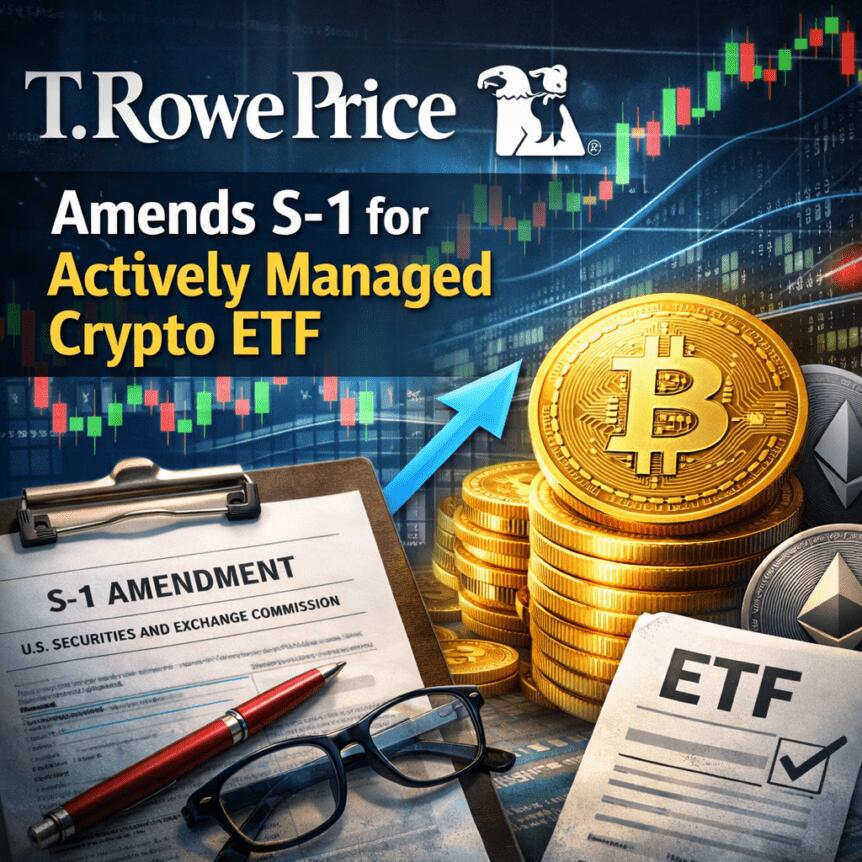
T. Rowe Price, a $1.8 trillion asset manager best known for its mutual funds and retirement offerings, has updated the registration statement for its proposed Active Crypto ETF, signaling continued institutional curiosity about direct crypto exposure within a traditional fund framework. The amended Form S-1, filed with the U.S. Securities and Exchange Commission (SEC) on Monday, preserves the core structure of an actively managed ETF that would invest directly in digital assets, while expanding operational specifics and the universe of eligible assets. This move comes as traditional asset managers increasingly explore crypto-related vehicles, even as the broader market has cooled from peak 2024–25 levels.
Key takeaways
- The amendment to the Form S-1 confirms 15 eligible digital assets that could be included in the actively managed ETF, expanding beyond a narrow crypto exposure while maintaining an explicitly active management approach.
- Anchorage Digital Bank is named as the ETF’s crypto custodian, with updated details around share creation and redemption to enhance operational clarity for investors.
- Sui (SUI) has been added to the list of eligible assets, widening the potential exposure set beyond the previously disclosed lineup.
- The asset list remains largely consistent with the October filing, indicating a measured approach rather than a wholesale redesign of the fund’s potential holdings.
- Disclosure updates touch on the FTSE Crypto US Listed Index, including constituent weights as of January 2026, and expand risk disclosures related to turnover and the fund’s active trading strategy.
- Traditional asset managers continue to pursue crypto ETFs, with BlackRock, Fidelity, Franklin Templeton, VanEck, and Invesco cited as peers moving into crypto investment products.
Tickers mentioned: Bitcoin (BTC), Ether (ETH), Solana (SOL), XRP (XRP), Avalanche (AVAX), Shiba Inu (SHIB), Sui (SUI)
The amendment is accessible via the SEC filing, which provides the procedural backbone for a product that would blend active management with direct asset ownership. The document—an amendment to the original S-1—is available here: SEC filing. Earlier reporting on the filing noted that the move surprised some observers given the manager’s traditional emphasis on conventional mutual funds rather than crypto ETFs, highlighting the evolving stance of traditional finance toward digital assets.
Beyond the asset roster, the amended filing confirms Anchorage Digital Bank as the ETF’s crypto custodian. This choice aligns with a broader industry shift toward established crypto-native custodians to provide secure safekeeping, settlement, and related governance controls for actively managed portfolios that could hold a mix of tokens. The amendments also broaden the disclosures around how shares are created and redeemed, a necessary step for an actively managed vehicle that may experience more frequent inflows and outflows relative to passive crypto ETFs.
Another notable development is the inclusion of SUI on the eligible-asset list. SUI’s addition broadens the scope of potential holdings for the active fund and reflects the managers’ posture toward newer layer-1 ecosystems and evolving token utilities. The SUI entry complements the well-known assets already on the list, creating a diversified mix that could, in time, span multiple sectors within the broader crypto economy.
The overall asset list remains largely aligned with the October filing, indicating a deliberate approach rather than a dramatic pivot in strategy. This consistency is underscored by industry observers who noted that the initial filing—made during a period when Bitcoin traded above the $120,000 mark—arrived amid exceptional market volatility and a consequential liquidation event on October 10. The market backdrop at that time featured billions of dollars in forced liquidations across leveraged crypto derivatives positions, a context that shaped investor sentiment in the months that followed.
The amended filing also includes updates related to the FTSE Crypto US Listed Index, with constituent weights as of January 2026, and expands risk disclosures tied to portfolio turnover and the fund’s active trading approach. These disclosures are critical in helping potential investors understand how frequently the portfolio might rebalance and how active management could influence costs, tracking error, and performance relative to more passive benchmarks. In parallel, industry commentary around the sector has highlighted the role of such disclosures in addressing investor concerns about transparency and risk as institutions expand into crypto exposure through listed vehicles.
In the broader context, the move by T. Rowe Price sits within a wave of traditional asset managers pursuing crypto ETFs. In October, Nate Geraci of NovaDius Wealth Management described T. Rowe Price’s filing as coming from “left field,” given the company’s entrenched conservative posture toward crypto. Nonetheless, the industry has seen a growing roster of incumbents—BlackRock, Fidelity, Franklin Templeton, VanEck, and Invesco—launching crypto investment products in various forms. The trajectory suggests that more mainstream asset managers view digital assets as a legitimate, if still nascent, component of diversified portfolios.
From a market standpoint, the crypto ETF narrative has evolved alongside price movements and liquidity dynamics. After the peak of 2024 and 2025, prices retreated, and crypto ETFs reported notable outflows at times, reflecting a period of risk-off sentiment. Recent reporting, however, indicates a shift: net inflows into crypto ETFs have turned positive in recent weeks, a sign that investor demand for regulated crypto exposure persists despite a broader pullback in the crypto cycle. These flows, coupled with ongoing product innovations from traditional players, suggest a maturing ecosystem where regulated, exchange-traded access to digital assets remains a focal point for mainstream investors.
As the SEC reviews and weighs the amended filing, market participants will watch for how the custodian arrangement performs under custody risk scenarios, how the active strategy translates into actual holdings, and whether the portfolio evolves to reflect changing market dynamics and regulatory considerations. The SEC’s ongoing oversight of crypto product disclosures—highlighted by discussions around simpler disclosure rules and tokenization debates—also remains a backdrop for any final approvals or listings that could shape liquidity and accessibility for retail and institutional buyers alike.
TradFi asset managers embrace crypto ETFs
The filing narrative reflects a broader trend in traditional finance. In the months around the initial submission, observers noted that established managers were testing the waters of direct crypto exposure through regulated products. The move ties into a wider industry dialogue about how best to offer regulated access to digital assets, balancing innovation with investor protections and clear disclosures. The shift is also taking place in a market environment where crypto prices have cooled from earlier surges, but where many investors remain interested in diversified exposure to the sector through regulated vehicles rather than bespoke unregistered products.
In parallel, media coverage of the sector has highlighted ongoing debates about tokenization, disclosure standards, and the appropriate balance between risk disclosure and product flexibility. The SEC has signaled a focus on setting robust disclosure baselines for crypto-related investment products, as evidenced by related reporting on the agency’s discussions and industry responses. This backdrop frames the current filing as part of a longer arc toward mainstream financial integration of digital assets, with regulators seeking to balance investor protection and innovation.
Why it matters
For investors, the amended filing signals increased access to a regulated, actively managed crypto exposure via a traditional ETF wrapper. If approved, the product could provide a framework for professional management of a diversified digital-asset portfolio, with a custodian-grade security layer and transparent share creation and redemption mechanics. The expansion to 15 eligible assets and the addition of SUI broaden the potential exposure set, offering the possibility of nuanced sector bets within the crypto economy rather than a single-asset bet on Bitcoin or Ethereum alone.
For the crypto ecosystem, the development reinforces the growing legitimacy of digital assets within mainstream asset management. It also places greater emphasis on governance, risk management, and operational readiness—themes that have grown in importance as more incumbents launch crypto-related products. For builders and infrastructure providers, the evolution signals sustained demand for compliant custody solutions, reliable liquidity, and rigorous disclosure practices that could standardize how crypto products are marketed and sold to retail and institutional investors alike.
What to watch next
- SEC action on the amended S-1 and potential listings or approvals for the Active Crypto ETF.
- Operational readiness and risk controls associated with Anchorage Digital Bank as custodian, including custody and settlement performance in a live product.
- Indications of which of the 15 eligible assets move into actual portfolio holdings, and how the active strategy performs against benchmarks.
- Updates to FTSE Crypto US Listed Index weights and any related benchmark revisions used for performance comparisons.
- Regulatory disclosures and market reactions to expanded risk considerations tied to portfolio turnover and trading activity.
Sources & verification
- SEC filing: Active S-1 amendment, available at https://www.sec.gov/Archives/edgar/data/2089855/000199937126005896/active-s1a_031626.htm
- Cointelegraph reporting on T. Rowe Price’s crypto ETF filing: https://cointelegraph.com/news/t-rowe-price-makes-surprising-filing-crypto-etf
- Related coverage on the SEC’s stance and disclosure debates: https://cointelegraph.com/news/sec-crypto-mom-simpler-disclosure-rules-flags-tokenization-debate
- ETF flows data referenced in industry coverage: https://www.coinglass.com/etf
- Historical market context and commentary from coverage on Bitcoin price and liquidity events: https://cointelegraph.com/news/19b-crypto-crash-200k-bitcoin-2025-finance-redefined
Key figures and next steps
The path forward for the T. Rowe Price Active Crypto ETF hinges on regulatory clarity and the ability to translate an expanded asset universe into a disciplined, cost-conscious, and transparent actively managed product. As more traditional institutions venture into crypto ETFs, investors can expect ongoing refinements in disclosure standards, custody arrangements, and risk management practices, all aimed at delivering regulated exposure to a market that remains volatile but increasingly integrated with conventional financial markets.
Polymarket users reportedly threatened to kill an Israeli journalist after his coverage of an Iranian missile strike in Israel apparently jeopardised a number of big-money wagers.
On March 10 Emanuel Fabian, a reporter for the Times of Israel, covered an Iranian missile strike outside of the city of Beit Shemesh as the war between the US and Israel, and Iran raged on.
However, Fabian revealed today that his coverage was met with a barrage of demands, threats, and misinformation from apparent Polymarket users.
The first email he received, written in Hebrew, asked him to change his report to state that the “missile” was instead a fragment from one of Israel’s missile interceptors.
The email claimed this was the finding of the Beit Shemesh municipality and Israel’s national medical emergency body. However, rather than retract is report, Fabian, doubled down, clarifying that, based on reports from the Israeli military and footage of the strike, the incident involved a missile warhead and not interceptor fragments.
Read more: Nigel Farage aide George Cottrell bets US war will last four more months
He continued to receive emails and messages from Discord and WhatsApp users asking him to make the same correction.
Fabian then noticed that multiple X accounts involved with Polymarket gambling were replying to his posts with similar correction demands.
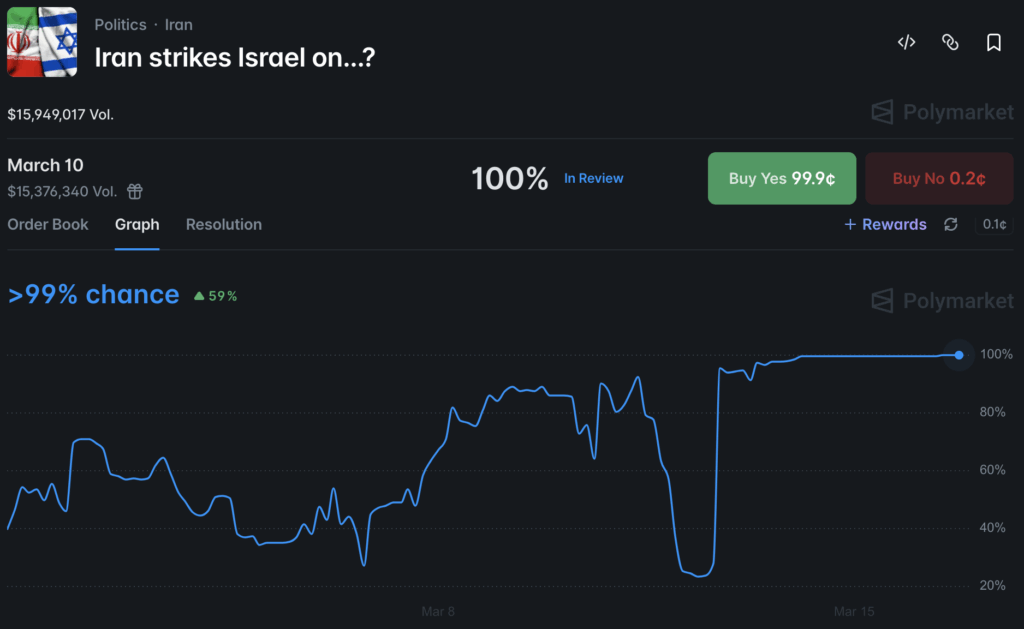
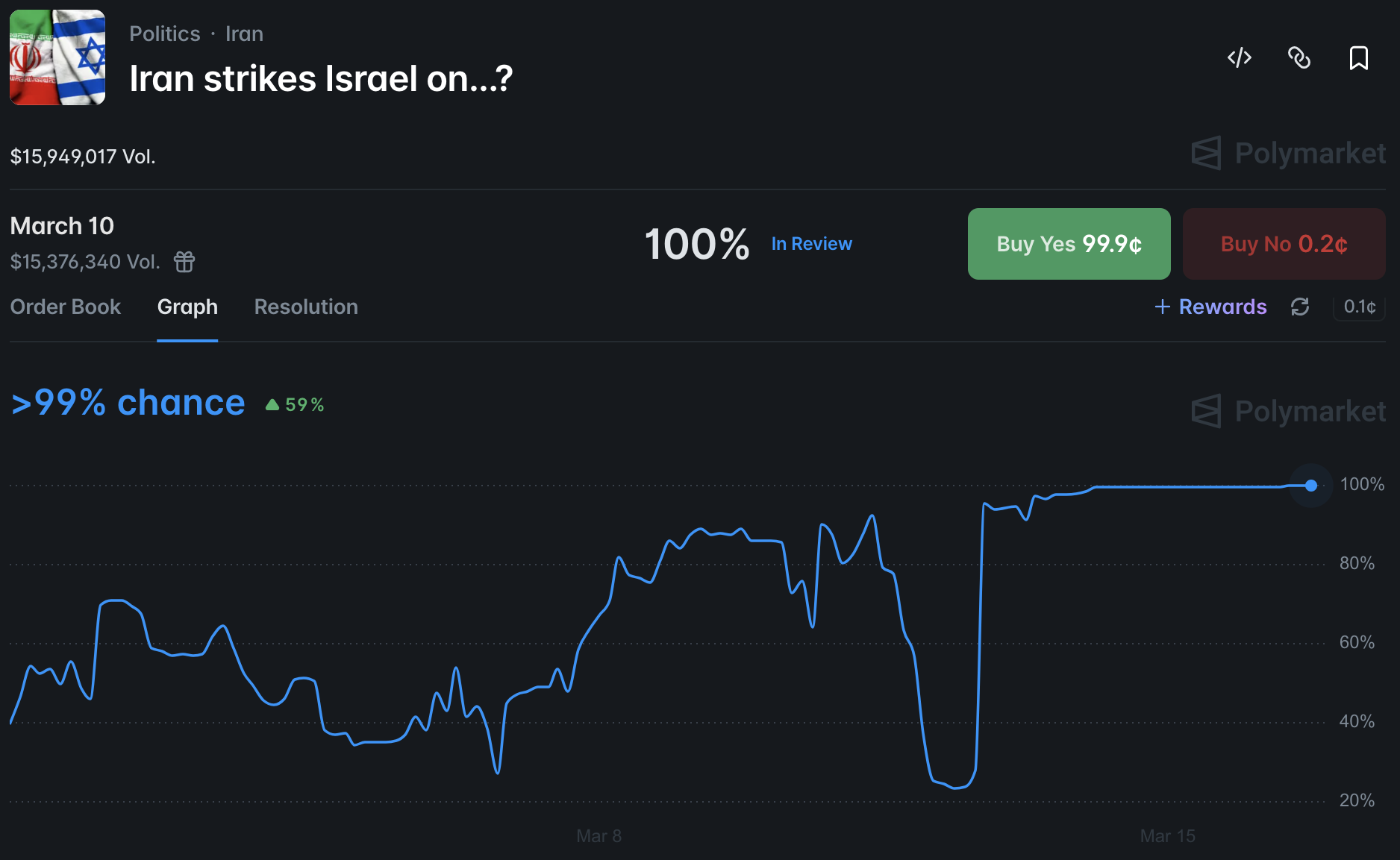
He deduced that his harassers were trying to resolve a bet on Polymarket, with $14 million worth of volume, that asked if Iran would strike Israel on March 10.
The respondents appeared desperate for the strike to be classified as fragments of an interceptor, as that would resolve the market to “No.”
Polymarket users threatened to kill Israeli journalist
Five days after the missile struck, the demands became more threatening.
One WhatsApp user named “Haim” threatened to kill Fabian unless he changed his reporting, and repeatedly gave him correction deadlines.
“After you make us lose $900,000 we will invest no less than that to finish you,” one of Haim’s messages read.
Another said, “You are choosing to go to war knowing that you will lose your life as you’ve grown accustomed to it — for nothing.”
Haim then began to list specific details related to Fabian’s family and home in another threat to his life.
Read more: Kalshi uses ‘death carve-out’ to avoid paying out on Ali Khamenei ousting
Shortly after Haim’s messages, someone posing as a lawyer rang Fabian and told him that he was now the subject of an investigation into his supposed Polymarket market manipulation.
Fabian ended the call and reported the situation to the police, who are now investigating his claims.
Fabian concerned journalists might be weak to Polymarket users
Fabian wrote, “The attempt by these gamblers to pressure me to change my reporting so that they would win their bet did not and will not succeed.”
He worries, however, that “other journalists may not be as ethical if they are promised some of the winnings.”
Indeed, he detailed how one of his colleagues from another publication was approached by someone asking him to encourage Fabian to change the details of the story.
Fabian informed them about the Polymarket bet, and his colleague confronted the individual, who admitted they’d placed a bet on Iran not being struck by Israel.
The confronted individual reportedly offered a cut of his winnings to Fabian’s colleague if they managed to convince Fabian to make the correction.
At the time of writing, the Polymarket bet is still unresolved and is waiting for a final resolution from UMA, the platform’s oracle system which allows tokenholders to resolve disputes about various outcomes.
Read more: Are Polymarket and Kalshi decentralized?
It now has over $15 million in volume and has resolved to “Yes” twice in the past two resolutions.
Prediction markets rife with insider trading
Fabian’s story offers a glimpse into the scale of insider trading on Polymarket and tactics employed by bettors to pressure people with the power to sway a market.
Polymarket and Kalshi both host bets on the outcomes and potential for military action, as well as pop culture happenings and sports bets.
Several large and timely bets made before military actions have prompted suspicions of rampant insider trading and leaking of confidential documents.
Just last month, Israel’s government arrested one of its reserve soldiers and an associate of theirs in connection with a series of Polymarket bets that gambled on Israel striking Iran in 2025.
The pair is suspected of using secret information to make the bets and, in the process, threaten the national security of Israel.
Protos has reached out to Fabian for comment and will update this piece should we hear anything back.
Got a tip? Send us an email securely via Protos Leaks. For more informed news and investigations, follow us on X, Bluesky, and Google News, or subscribe to our YouTube channel.


Trump says Iran war oil spike will ‘drop like a rolling stone’ once fighting ends, even as crude stays above $100 and crypto trades through the turmoil.
Summary
- Trump dismisses Iran war oil spike as budget “negligible” while crude trades above $100.
- He signals more strikes are possible even as he claims to spare key Iranian oil infrastructure.
- Bitcoin and Ethereum rally, reinforcing the “digital macro hedge” narrative despite still behaving like high‑beta risk assets.
Trump is again trying to sell markets on the idea that the Iran war–driven oil spike is temporary, even as crude trades comfortably above the three‑digit threshold. In new comments flagged by Jinshi Finance, he told PBS reporters the US is “doing very well” on Iran, calling the budget impact of the conflict “negligible” because Tehran is “involved in terrorism.” He insisted that “once the war is over, oil prices will drop like a rolling stone,” echoing earlier statements that the surge in crude is a “small price to pay” for dismantling Iran’s nuclear program.
Trump also claimed he has deliberately held back from targeting key civilian energy infrastructure, saying he “left a lot of infrastructure in Tehran” and could destroy the country’s power plants “in an hour” but is trying to avoid a years‑long reconstruction process and deeper social trauma. He added that the US has kept a “100 yards” buffer around “everything related to oil facilities,” and specifically cited Kharg Island, a major Iranian export hub, saying he chose not to blow up its pipelines because “it would take years to connect them.” At the same time, he warned he would still “strike again,” signalling that escalation risk remains firmly on the table.
Those comments follow days of market turmoil as Iran‑related supply fears pushed benchmark crude above 100 per barrel and forced insurers to reprice risk in and around the Strait of Hormuz. Trump has repeatedly framed the situation as a trade‑off, arguing that short‑term pain at the pump is acceptable if it neutralizes Iran’s ability to threaten global shipping and regional stability. For now, that narrative appears to be holding with parts of his domestic base, but it does little to change the underlying reality for refiners, airlines, or import‑dependent economies that are now exposed to higher input costs and tighter margins.
Crypto markets, by contrast, are digesting the conflict with relative composure. Bitcoin (BTC) is changing hands near $73,800, up roughly 5.8% over the last 24 hours, with a 24‑hour range between about $69,460 and $73,770 and turnover above $55 billion. Ethereum trades around $2,200, higher by roughly 6.8% on the day, after swinging between about $2,042 and $2,200 in the same period. That mix of elevated volatility and net gains has reinforced the “digital macro hedge” narrative some funds are leaning into, even as skeptics point out that BTC and ETH continue to trade like high‑beta risk assets whenever energy, rates, or war headlines surprise.


The post Leading AI Claude Predicts the Price of XRP, Bitcoin and Ethereum by The End of 2026 appeared first on Cryptonews.
Crypto World
Bitcoin, Ethereum outpace gold as ETF demand and corporate treasuries tighten BTC supply


Institutional spot ETF inflows and aggressive treasury buying are reinforcing Bitcoin’s “digital reserve” status while Ethereum grinds higher despite a bid for traditional safe havens.
Summary
- Institutional spot ETF inflows and balance-sheet buying are reinforcing Bitcoin’s role as a digital reserve while Ethereum grinds higher.
- MicroStrategy-style treasuries are concentrating a meaningful slice of free-floating BTC and acting like a quasi-central bank balance sheet.
- Gold ETFs see outflows as BTC and ETH post stronger year-to-date gains than bullion and broad equities despite the Iran conflict and higher oil.
Bitcoin (BTC) and Ethereum (ETH) are quietly beating gold and global equities again, with institutional flows doing most of the heavy lifting. A recent note argues that BTC’s resilience through the Iran conflict underscores a structural shift in ownership, with spot ETFs and balance‑sheet buyers now dominating the float. Analysts quoted in the report say Bitcoin and Ethereum have outperformed gold and broad stock indices this year, even as geopolitical risk and higher oil prices would typically favor bullion.
The same commentary highlights one listed software company, widely understood to be MicroStrategy, as acting like the “last central bank of Bitcoin.” According to Jinshi’s summary, the firm has added 22,337 BTC at an average price near $70,194, taking its total stash to 761,068 BTC with a blended cost basis around $75,696. That is functionally a monetary reserve strategy rather than a conventional treasury allocation, and it concentrates a non‑trivial share of free‑floating supply inside a single corporate vehicle.
At the same time, spot Bitcoin ETFs have seen roughly $2.1 billion in net inflows over the past three weeks, equal to about 6.1% of new available supply, even as retail investors have been net sellers. Jinshi’s recap notes that around 60% of outstanding BTC has not moved on‑chain for a year, a classic sign of long‑term holder conviction and a constraint on tradable float. That lock‑up effect is part of why each marginal dollar into a spot product, or a corporate treasury like MicroStrategy’s, can have an outsized impact on price compared with prior cycles.
Crypto markets are reflecting that dynamic in real time. Bitcoin is trading near $73,800, up about 5.8% over the last 24 hours, after moving between roughly $69,460 and $73,770 on volume above $55 billion. Ethereum sits around $2,201, higher by roughly 6.8% on the day, with a 24‑hour range between about $2,042 and $2,200 and turnover close to $27.8 billion. Those moves come as gold ETF products continue to leak assets, with one recent data set showing multi‑billion‑dollar outflows from the yellow metal even as Bitcoin funds attracted fresh capital after the Iran shock.


Lido’s new IDVTC design lets verified solo stakers form DVT clusters, slashing collateral needs while hardening Ethereum validator risk and sustaining staking yields.
Summary
- IDVTC groups four verified community stakers into one DVT-backed validator cluster, reducing single-operator failure risk.
- Lower collateral becomes viable as DVT makes slashing and downtime tail events instead of structural threats.
- Launch with CSM v3 in Q2–Q3 2026 positions Lido against rival restaking and LST platforms on resilience instead of raw TVL.
Lido’s community staking module is about to stop pretending this is still a game for whales only. A new proposal to introduce an “Identified DVT Cluster” (IDVTC) operator type would let verified independent stakers pool into distributed validator clusters, cutting collateral requirements while hardening the protocol’s weakest link: operational risk.
Under the plan, each IDVTC cluster consists of four independent community stakers, all running validators via Obol or SSV with keys created through distributed key generation (DKG). In practice, that means no single operator can take a validator down, mis‑configure a client, or disappear without the rest of the cluster absorbing the shock. Distributed validator technology (DVT) spreads duties and key shares across multiple nodes, so slashing and downtime events become outliers instead of structural risk.
Because the risk profile improves, Lido can justify lowering collateral requirements for these operators. That is the capital-efficiency play: you move from over‑collateralized, quasi‑professional setups to leaner independent operators whose main constraint is competence, not balance sheet size. For Lido, this broadens the operator base without opening the door to pure anon fly‑by‑night nodes, since IDVTC membership is restricted to verified Independent Community Stakers (ICS) who pass onboarding checks.
Timing matters. The IDVTC feature is targeted for launch with CSM v3 in Q2–Q3 2026, squarely into the next phase of Ethereum’s staking cycle and a more competitive liquid staking market. Restaking, AVSs and competing LSTs are already bidding for the same underlying validator set. Bring down collateral, keep slashing risk contained, and you have a better story for decentralization and yield sustainability than “more TVL, same handful of operators.”
If executed, IDVTC pushes Lido closer to a model where independent stakers look more like a distributed credit book: risk‑tiered, clustered, and modular. For investors, the signal is simple: Lido is trying to buy resilience and decentralization with better engineering instead of higher issuance. In a market where basis trades and ETF flows are already compressing staking spreads, that is the only credible way to keep the yield machine running without blowing up the tail risk.

Scotland coach Steve Clarke ‘hasn’t had new contract offer’ from employers

Uber co-founder Travis Kalanick joins billionaire exodus from California to Texas

U.K. judge allows lawsuit over alleged $172M bitcoin theft between spouses


-
 Tech6 days ago
A 1,300-Pound NASA Spacecraft To Re-Enter Earth’s Atmosphere
-
Crypto World3 days ago
HYPE Token Enters Net Deflation as HyperCore Buybacks Outpace Staking Rewards
-

 Business6 days ago
ExxonMobil seeks to move corporate registration from New Jersey to Texas
-

 Fashion3 days ago
Weekend Open Thread: Addict Lip Glow
-

 Tech6 days ago
ChatGPT will now generate interactive visuals to help you with math and science concepts
-
Sports2 days ago
Why Duke and Michigan Are Dead Even Entering Selection Sunday
-

 NewsBeat5 days ago
Residents reaction as Shildon murder probe enters second day
-
 NewsBeat7 days ago
Pagazzi Lighting enters administration as 70 jobs lost and 11 stores close across Scotland
-

 Business6 days ago
Search Enters Sixth Week With New Leads in Tucson Abduction Case
-

 Business1 day ago
Search for Savannah Guthrie’s Mother Enters Seventh Week with No Arrests
-

 Business2 days ago
US Airports Launch Donation Drives for Unpaid TSA Workers as Partial Government Shutdown Enters Fifth Week
-
Crypto World2 days ago
Coinbase and Bybit in Investment Talks: Could Bybit Finally Enter the US Crypto Market?
-

 NewsBeat5 days ago
I Entered The Manosphere. Nothing Could Prepare Me For What I Found.
-

 Business2 days ago
Country star Brantley Gilbert enters growing non-alcoholic beer market
-

 Business13 hours ago
Australian shares drop as Iran war enters third week
-

 Sports5 days ago
PWHL, Senators discussing plan to keep Charge in Ottawa
-
 Crypto World6 days ago
Will Chainlink price reclaim $10 amid volatility squeeze?
-

 Sports3 days ago
College Basketball Best Bets: Conference Tournament Semifinal Picks
-

 Crypto World13 hours ago
Crypto Lender BlockFills Enters Chapter 11 with Up to $500M in Liabilities
-

 Politics6 days ago
Trump Says Middle East Is ‘Very Lucky’ That He’s President


You must be logged in to post a comment Login