

Crypto World
Binance’s CZ Says He Played a ‘Tiny’ Part in UAE’s Embrace of Bitcoin as Store of Value



Over the years, the UAE has increased its Bitcoin holdings through mining and ETF purchases, with exposure now exceeding $1 billion.
Changpeng Zhao (CZ), founder and former CEO of the world’s largest crypto exchange, Binance, has revealed his role in the United Arab Emirates’ (UAE) Bitcoin adoption.
In a tweet highlighting information that the UAE has formally recognized bitcoin (BTC) as a store of value similar to gold, CZ disclosed that his advocacy contributed to the development.
CZ Influenced the UAE’s Bitcoin Adoption
“I might have done a tiny bit of advocacy for this,” the Binance founder said.
It is no news that CZ established his primary residence in Dubai in 2021, due to the city’s pro-crypto and forward-thinking environment. His presence in the city and influence on prominent figures have certainly affected their stance on Bitcoin and the crypto industry as a whole.
Over the years, the UAE has increased its Bitcoin exposure through mining and the purchase of exchange-traded funds (ETFs). By 2022, Abu Dhabi’s royal family had ventured into Bitcoin mining through its affiliated firm, Citadel Mining. The royal family, through Citadel, established large-scale mining operations on AI Reem Island and has since amassed over $450 million in bitcoin.
Earlier today, the market intelligence platform, Arkham, revealed that the UAE has mined $453.6 BTC. On-chain data shows the entity has been holding the majority of BTC produced, with its last outflow recorded 4 months ago. The royal family is now $344 million in profit on their BTC, minus energy costs.
UAE’s Bitcoin Exposure Crosses $1B
Besides the Bitcoin mining ventures, two major Abu Dhabi sovereign wealth entities, namely Mubadala Investment Company and Al Warda Investments, have purchased millions of shares in spot Bitcoin ETFs. By the end of 2025, the companies had amassed more than $1 billion in combined holdings of BlackRock’s iShares Bitcoin Trust (IBIT).
Separate 13F filings with the U.S. Securities and Exchange Commission (SEC) revealed that by the end of last year, Mubadala held over 12.7 million shares in IBIT. On the other hand, Al Warda owned at least 8.21 million shares of the same product. The shares were worth $631 million and $408 million, respectively.
You may also like:
Although the value of the ETF shares has plummeted alongside bitcoin’s price, the combined Bitcoin exposure for the UAE remains well above $1 billion. With the government recognizing BTC as a store of value, the cryptocurrency is likely to be treated as a permanent reserve asset going forward.
SECRET PARTNERSHIP BONUS for CryptoPotato readers: Use this link to register and unlock $1,500 in exclusive BingX Exchange rewards (limited time offer).

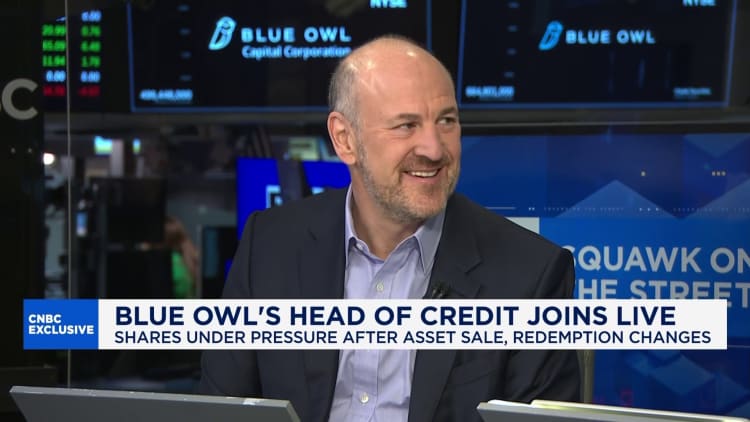
Blue Owl BDC’s CEO Craig Packer speaks during an interview with CNBC on the floor at the New York Stock Exchange (NYSE) in New York City, U.S., Nov. 19, 2025.
Brendan McDermid | Reuters
The latest tremor in the private credit world involved a deal that should’ve been reassuring to markets.
Blue Owl, a direct lender specializing in loans to the software industry, said Wednesday it had sold $1.4 billion of its loans to institutional investors at 99.7% of par value.
That means sophisticated players scrutinized the loans and the companies involved and felt comfortable paying nearly full price for the debt, a message that Blue Owl co-President Craig Packer sought to convey in interviews several times this week.
But instead of calming markets, it sent shares of Blue Owl and other alternative asset managers diving on fears of what could follow. That’s because as part of the asset sale, Blue Owl announced it was replacing voluntary quarterly redemptions with mandated “capital distributions” funded by future asset sales, earnings or other transactions.
“The optics are bad, even if the loan book is fine,” Brian Finneran of Truist Securities wrote in commentary circulated Thursday. “Most investors are interpreting the sales to mean that redemptions accelerated and led to forced sales of higher quality assets to meet requests.”
Blue Owl’s move was widely interpreted as the firm halting redemptions from a fund under pressure, even as Packer pointed out investors would get about 30% of their money back by March 31, far more than the 5% allowed under its previous quarterly schedule.
“We’re not halting redemptions, we’re just changing the form,” Packer told CNBC on Friday. “If anything, we’re accelerating redemptions.”

Coming amid a broad tech and software selloff fueled by fears of AI disruption, the episode shows that even apparently strong loan books aren’t immune to market jitters. This in turn forces alternative lenders to scramble to satisfy shareholders’ sudden demands for the return of their money.
It also exposed a central tension in private credit: What happens when illiquid assets collide with demands for liquidity?
Against a backdrop that was already fragile for private credit since the collapse of auto firms Tricolor and First Brands, the fear that this could be an early sign of credit markets cracking took off. Shares of Blue Owl fell Thursday and Friday. They are down more than 50% in the past year.
Early Thursday, the economist and former Pimco CEO Mohamed El-Erian wondered in social media posts whether Blue Owl was a “canary in the coal mine” for a future crisis, like the failure of a pair of Bear Stearns credit funds in 2007.
On Friday, Treasury Secretary Scott Bessent said that he was “concerned” about the possibility that risks from Blue Owl had migrated to the regulated financial system because one of the institutional buyers was an insurance company.
Mostly software
With skepticism over loans to software firms running high, one question from investors was whether the loans they sold were a representative slice of the total funds, or whether Blue Owl cherry-picked the best loans to sell.
The underlying loans were to 128 companies across 27 industries, the largest being software, the firm said.
Blue Owl indicated it was a broad swath of overall loans in the funds: “Each investment to be sold represents a partial amount of each Blue Owl BDC’s exposure to the respective portfolio company.”
Despite its efforts to calm markets, Blue Owl finds itself at the nexus of concerns around private credit loans made to software firms.
Most of the 200-plus companies Blue Owl lends to are in software; more than 70% of its loans are to that category, executives said Wednesday in a fourth-quarter earnings call.
“We remain enthusiastic proponents of software,” Packer said on that call. “Software is an enabling technology that can serve every sector and market and company in the world. It’s not a monolith.”
The company makes loans to firms “with durable moats” and is protected by the seniority of its loans, meaning that private equity owners would need to be wiped out before Blue Owl saw losses.
But, for now at least, the problem Blue Owl faces is one of perception bleeding into reality.
“The market is reacting, and it becomes this self-fulfilling idea, where they get more redemptions, so they have to sell more loans, and that drives the stock down further,” said Ben Emmons, founder of FedWatch Advisors.
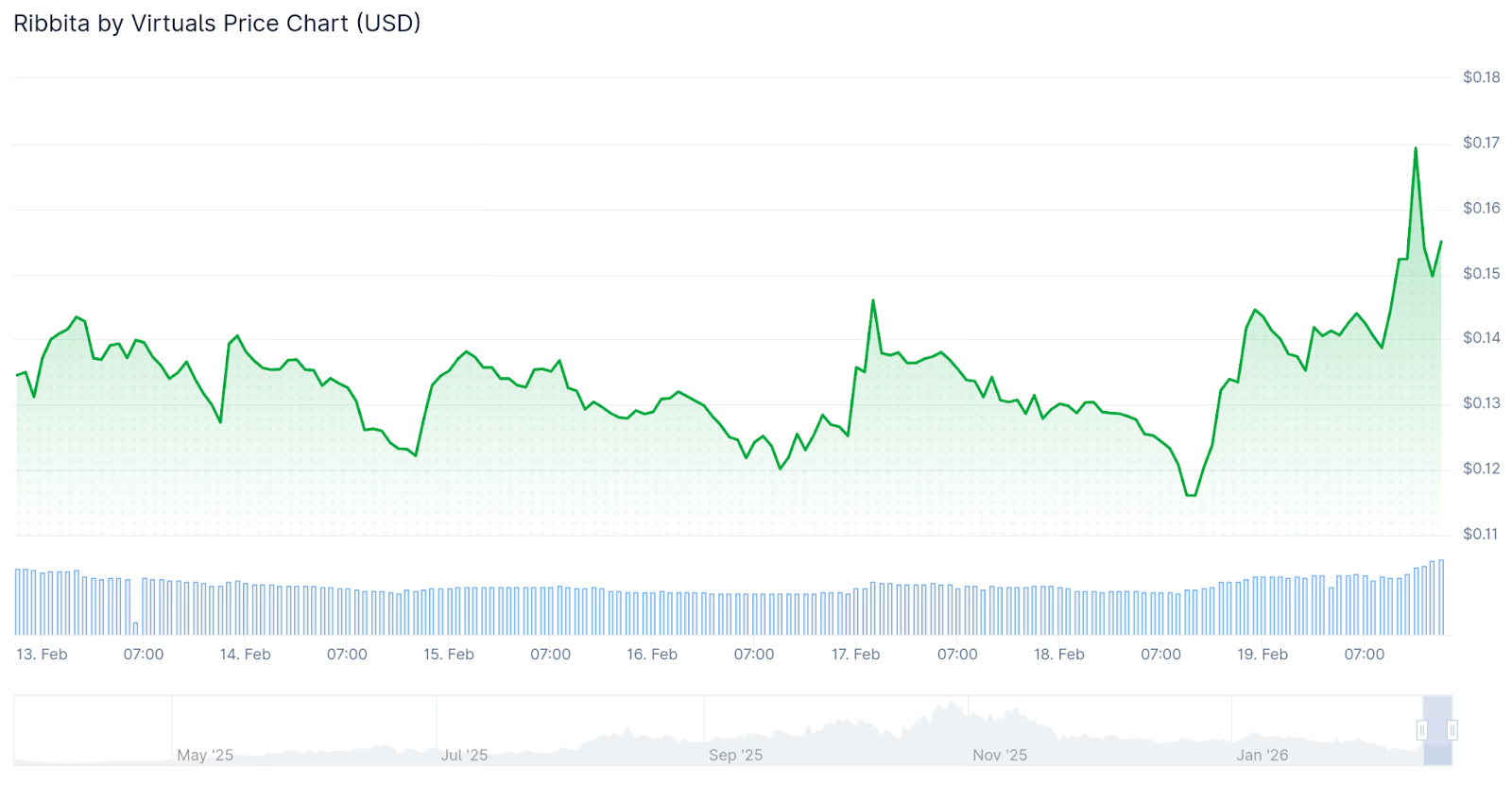
Speculation is heating up as tokens like VVV and TIBBIR surge, while Vitalik Buterin calls out a new token launch.
Artificial intelligence (AI) tokens on Base are leading the market again, with established tokens like VVV and TIBBIR outperforming, while new launches are turning heads but also drawing criticism from Ethereum co-founder Vitalik Buterin.
TIBBIR and VVV are up 16% and 23%, respectively over the last 24 hours, and sentiment surrounding the AI sector continues to slowly make a comeback after flaming out in 2025.

As is tradition, new market leaders attract increased attention to new launches, and one making a lot of noise despite its relatively small valuation is CONWAY.
Developer Sigil Wen, a Fellow at Peter Thiel’s Thiel Fellowship, published an article on what he calls “Web 4.0,” in which AI is intended to earn and improve its own existence through automation and open web access.
Wen’s work has caught the attention of the broader AI development community beyond those who focus solely on crypto-adjacent work, and yesterday he announced that he will use fees accrued by the community-made CONWAY token to scale the “Conway Ecosystem”.
As a result, the CONWAY token soared to a market capitalization of $12 million before retracing sharply today.
Following the token’s brief explosion, Ethereum co-founder Vitalik Buterin took to X to criticize Wen’s vision, saying, “This is wrong.”
Buterin argued that putting more distance between humans and AIs is “not a good thing for the world” as “the point of Ethereum is to set *us* free, not to create something else that goes off and does some stuff freely while our own situation is unchanged or worsened.”
Wen, however, argues that the automation and issue Buterin is looking to avoid is inevitable, calling it “democratic input into AI.”
The back-and-forth has potentially shaken some $CONWAY holders’ confidence, and the token is down 55% over the last 24 hours, trading at a $3 million valuation. The market has seen a number of new “AI community-led tokens” in 2026, all of which have burned out quickly as developers distanced themselves from them.
The future of CONWAY remains to be seen, but while the trenches fight over the next big thing, established agentic AI tokens such as TIBBIR and VVV continue to lead the charge.
Hyperliquid price rebounded 6% on Friday shortly after the decentralized perpetual futures exchange revealed the launch of a new advocacy group in Washington. This fresh catalyst has investors questioning whether HYPE can finally recover from its losses throughout the year.
Summary
- Hyperliquid price rose 6% following the launch of the Hyperliquid Policy Center in the U.S.
- An upcoming token unlock and weakening on-chain stats could negate any short-term recovery attempts.
- HYPE price action has remained below a key descending trendline resistance since early February.
According to data from crypto.news, Hyperliquid (HYPE) price rebounded over 6% on Friday morning during Asian trading hours before settling around $29.23 at the time of writing.
HYPE’s price saw a notable uptick following the launch of the Hyperliquid Policy Center in Washington, D.C. This new advocacy and research nonprofit is dedicated to securing regulatory clarity for decentralized finance, specifically targeting on-chain derivatives and perpetual futures.
To jumpstart the initiative, the Hyper Foundation, the ecosystem’s independent growth arm, committed 1 million HYPE tokens, valued at approximately $29 million, as reported earlier by crypto.news.
As Hyperliquid takes on a leading role in framing the regulatory landscape for the decentralized industry, it is likely to benefit from the exposure and visibility, which could support long term adoption.
However, the impact of such a strategic move on HYPE’s long-term price action may be undercut as the project’s on-chain stats still point to weakness.
Data from DeFiLlama show that the total value locked in the network has dropped from $4.7 billion recorded on to $4.2 billion at the time of writing. At the same time, the weekly revenue generated by DeFi protocols on the network has slumped 55% to $11.83 million since Feb. 9.
Such a drop in TVL and revenue can be interpreted as a fundamental erosion of network utility and engagement, which inevitably dampens investor demand.
Looking ahead, another major headwind for Hyperliquid price is a 9.92 million token unlock set for March 6.
At press time, the upcoming unlock was worth around $291 million and represented 2.72% of the total circulating supply. Token unlocks can drive prices lower, especially if there’s not enough demand from new buyers to absorb the liquidity.
The latest recovery also follows a difficult period where the token fell over 25% from its yearly high of $37.84.
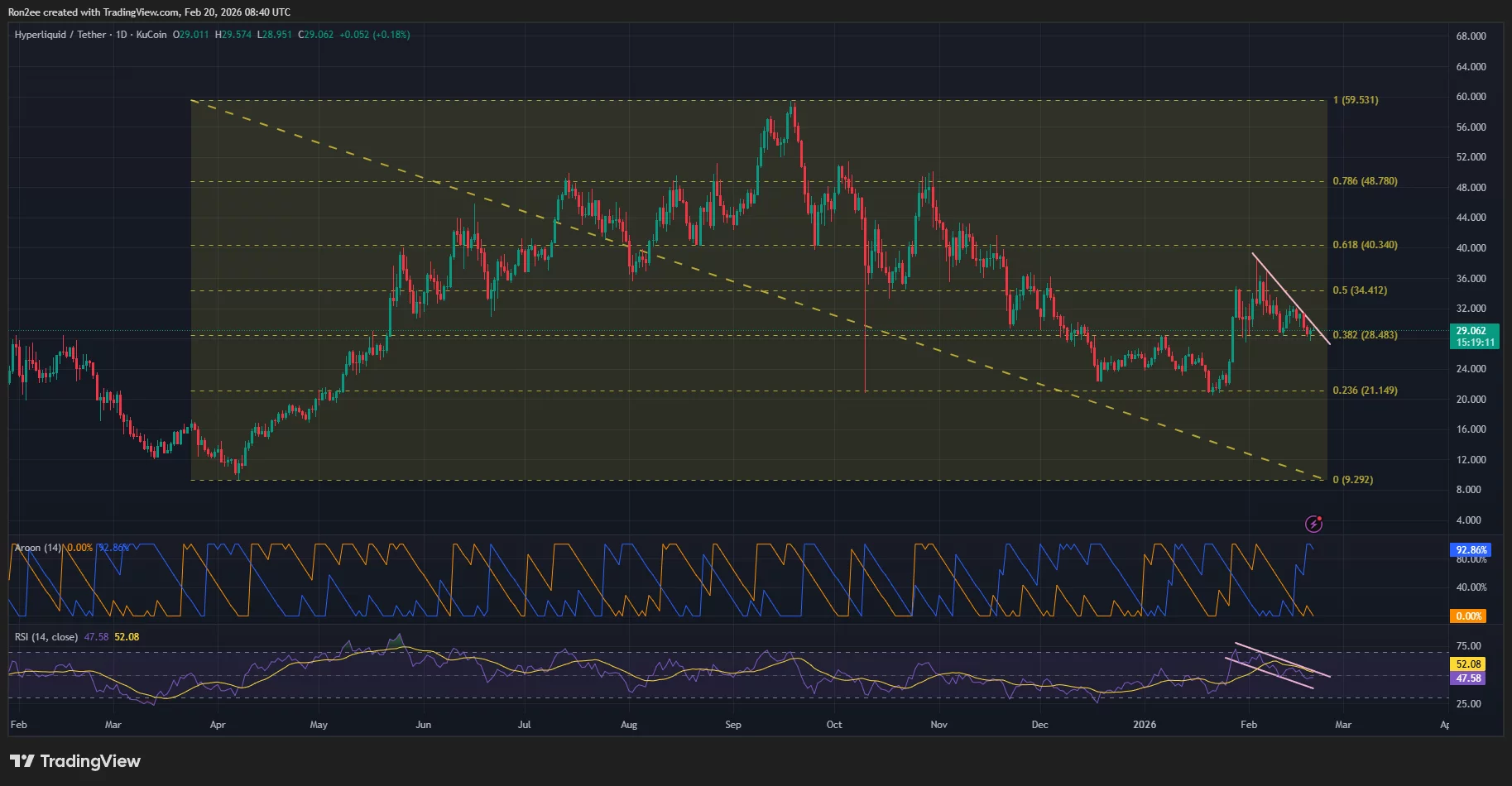
On the daily chart, Hyperliquid price has been trading under a descending trendline that has served as a dynamic resistance level since early February, suggesting that bears continue to dominate the market by capping any recovery attempts by bulls.
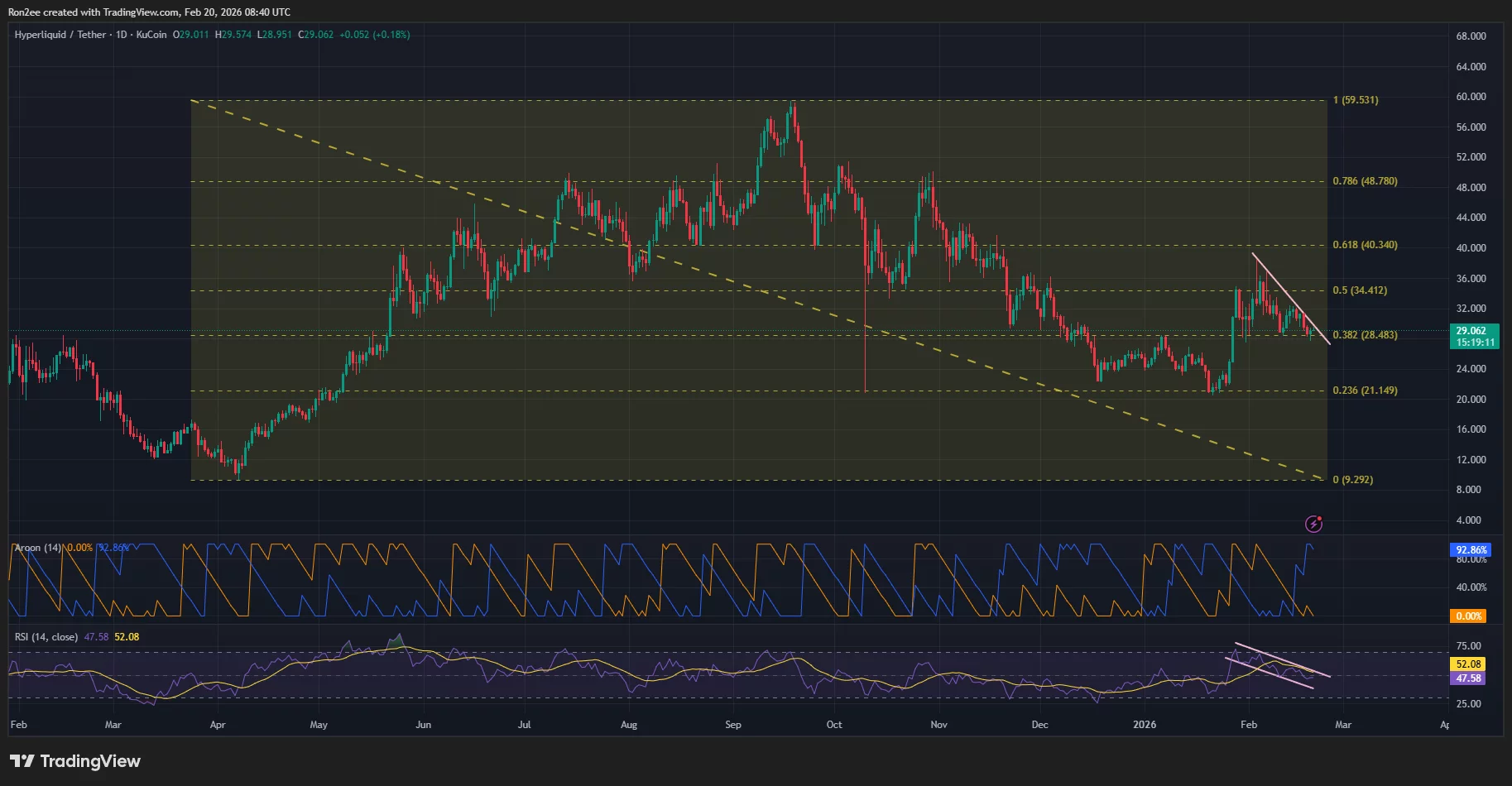
The ongoing bearish market, driven by Bitcoin’s failure to retain key support levels, has also added to investor caution and hurt HYPE price.
The Aroon indicator largely remains in support of a continuation of the bearish trend, with the Aroon Down at 92.86%, which means selling pressure still stands at an extreme level.
Meanwhile, the Relative Strength Index metric has formed a falling channel slipping below neutral territory, a sign that momentum remains weak.
For now, the key support for Hyperliquid price lies at $28, which aligns with the 38.2% Fibonacci retracement level, where bulls could lodge a defense and spark a healthy correction. However, a breach below this level could embolden bears to push for lower prices toward $21, the next key support level on the Fibonacci extension.
Disclosure: This article does not represent investment advice. The content and materials featured on this page are for educational purposes only.


- Pi Coin remains under pressure after losing over 90% from its peak.
- Migration delays and locked balances continue to hurt user confidence.
- Traders are watching the resistance at $0.18 and the support at $0.15 support closely.
Pi Coin is marking a difficult anniversary as selling pressure continues to weigh on the price.
The past year has been one of big promises, uneven delivery, and fading market confidence.
As the open mainnet clocks its first birthday, many holders are still waiting for clarity.
The token’s price action reflects that uncertainty.
A one-year milestone filled with mixed signals
The first year of the open Pi Network mainnet was supposed to be a turning point for the ecosystem. Instead, it has highlighted how far the project still has to go.
Pi Network has expanded its infrastructure and rolled out several technical upgrades.
These updates were meant to improve stability and prepare the network for broader use. At the same time, millions of users have successfully migrated to the open mainnet.
That progress shows the scale and ambition behind the project. Yet a large group of early participants remains stuck.
Many users report locked balances, incomplete migrations, or stolen coins.
KYC delays and new verification requirements have slowed access for others. This gap between development milestones and user experience has hurt sentiment.
Confidence is hard to rebuild when access to funds feels uncertain. That frustration has quietly spilt into the market.
Pi Coin price performance tells a harsh story
Pi Coin’s market performance over the past year has been unforgiving. After peaking near $3 shortly after trading began, the token has lost most of its value.
Recent data shows the price hovering near $0.17.

That represents a decline of more than 90% from its all-time high of $2.99. Short-term rallies have appeared, but they have not lasted.
Each bounce has been met with renewed selling pressure. Profit-taking has become a recurring theme.
Large token transfers to centralised exchanges suggest that holders are eager to exit on strength. Trading volume, however, remains modest compared to the size of the circulating supply.
This imbalance keeps upward momentum fragile, and the market is clearly struggling to find a strong base.
Pi Network adoption hopes clash with market reality
On paper, the ecosystem continues to grow with new tools, developer initiatives, and venture funding underway.
The idea is to build real use cases beyond speculation.
However, the market is focused on what exists today, not what may come later.
Liquidity remains thin relative to supply, and major exchange listings are still limited, restricting price discovery and keeping many institutional players on the sidelines.
While community optimism remains, it is more cautious than before. Many long-term supporters now want results instead of roadmaps.
Until access issues are resolved at scale, confidence may remain fragile. This tension between vision and execution defines the current phase.
Pi Coin price forecast
From a trading perspective, Pi Coin is sitting at a critical crossroads. The area around $0.18 has acted as a stubborn resistance zone.
Repeated failures to break above it suggest weak buying conviction. A daily close above this level would be the first sign of renewed strength.
Above $0.18, traders will be watching the $0.20 region closely.
That zone previously marked a short-term peak and heavy selling. On the downside, $0.17 is now an important psychological level.
A sustained move below it could expose support near $0.15. If selling accelerates, a deeper pullback toward $0.13 cannot be ruled out.
Momentum indicators remain mixed, leaning slightly bearish. This suggests consolidation or further downside before any meaningful recovery.


- $56.9M have exited Arbitrum, pressuring ARB near key support levels.
- Arbitrum Network activity remains steady despite the token price decline.
- Critical levels to watch are the support around $0.093–$0.095 and the resistance around $0.100–$0.105.
Arbitrum has found itself under renewed pressure after a sharp wave of capital outflows unsettled market confidence.
In the last 24 hours, roughly $56.9 million exited the Arbitrum ecosystem, according to Artemis, raising concerns about whether the recent attempt at a price rebound can survive.

Arbitrum capital outflow against ARB’s price decline
The outflow comes at a time when ARB was already trading near historical lows, leaving little room for error.
The token is hovering around the $0.096 region, a level that now carries heavy psychological weight for traders and long-term holders alike.
Despite the sell pressure, Arbitrum’s broader network activity has not collapsed.
According to data from Artemis, daily transactions and active addresses have shown resilience, suggesting that users are still interacting with the chain even as capital flows out.
This disconnect between network usage and token price has become one of the most talked-about themes around ARB.
It reflects a market where sentiment and liquidity matter more in the short term than raw on-chain activity.
The outflows appear to be driven more by capital rotation than by a fundamental rejection of Arbitrum itself.
A portion of the existing funds moved back into Ethereum, while some flowed into newer or more speculative ecosystems.
This behaviour signals caution rather than panic, as traders look for short-term safety or higher volatility elsewhere.
Still, the impact on ARB’s price has been hard to ignore.
Over the past month, the token has lost nearly half of its value, underperforming many comparable assets.
The decline has also been accompanied by weakening market sentiment, with bullish conviction fading quickly.
Derivatives data adds another layer of concern.
Funding rates have slipped into negative territory, showing that short positions are gaining dominance.
When combined with heavy outflows, this setup often leads to choppy price action rather than a clean recovery.
At the same time, selling pressure appears to be slowing near the current lows.
ARB recently printed a fresh all-time low around $0.093, only to bounce modestly afterwards, suggesting that buyers are willing to defend this zone, at least for now.
However, confidence remains fragile.
Any further surge in capital exiting the network could push ARB back toward that low with little resistance in between.
On the other hand, if outflows ease and market conditions stabilise, ARB could attempt to build a short-term base.
Such a base would not guarantee a strong rally, but it could reduce downside risk.
ARN price prediction
For now, Arbitrum (ARB) sits at a crossroads between stabilisation and continuation of its broader downtrend.
Much will depend on whether sentiment improves or deteriorates further in the coming days.
From a technical perspective, the $0.093 to $0.095 zone stands out as the most critical support area.
A clear daily close below this range would expose ARB to deeper losses, with little historical structure to slow the fall.
On the upside, the $0.100 to $0.105 region acts as the first meaningful resistance.
This area aligns with prior breakdown levels and could attract selling from traders looking to exit on relief rallies.
On the upside, a recovery would require ARB to reclaim the $0.12 level, which previously acted as short-term support.
Until that happens, rallies are likely to be viewed as corrective rather than trend-changing.
And while momentum indicators remain weak, early signs of seller exhaustion are starting to appear.
For traders, patience is key, as volatility around these levels can be deceptive.
A sustained hold above $0.10 could improve short-term outlooks, while a breakdown below $0.093 would likely reinforce bearish control.

The Supreme Court’s decision on Friday sharply curtailed the executive branch’s authority to deploy tariffs under the International Emergency Economic Powers Act (IEEPA). In a 6-3 ruling, the justices concluded that the President lacks inherent power to impose broad tariffs under peacetime conditions, signaling a significant check on executive power in U.S. trade policy. The majority’s view was clear: IEEPA does not authorize tariffs at the scale seen in recent years, and the presidential interpretation of the statute extended beyond its legitimate reach. The ruling hinges on historical precedent and the breadth of authority claimed by the administration, suggesting a reevaluation of the tariff policy framework used during peacetime emergencies. The decision was issued on Friday, February 20, 2026, with the court emphasizing the statute’s limited scope.
“In IEEPA’s half-century of existence, no president has invoked the statute to impose any tariffs, let alone tariffs of this magnitude and scope. That ‘lack of historical precedent,’ coupled with the breadth of authority that the President now claims, suggests that the tariffs extend beyond the President’s ‘legitimate reach.’”
At issue was whether tariffs imposed as a means of addressing perceived national emergencies could be sustained under IEEPA. The court’s opinion rejected that premise, noting that the administration had not demonstrated a statutory basis strong enough to justify the breadth and scale of the measures in question. The decision, while narrow in its focus on statutory interpretation, carries broad implications for how future administrations might leverage tariff tools in times of perceived distress. The ruling’s central thrust is that IEEPA does not authorize sweeping tariff regimes, and the absence of a sustained, historically grounded precedent undermines the President’s justification for such measures.
Trump criticizes court, says he’ll get tariffs reinstated
Following the ruling, former President Donald Trump blasted the justices who voted to strike down the tariffs and signaled that the policy would persist through alternative channels. A report noted that he pledged to pursue reinstatement via other avenues, raising questions about what policy instruments could replace tariffs as a means to influence trade dynamics. The courtroom decision, contrasted with Trump’s rhetoric, underscores a broader political debate over how the United States should calibrate its use of trade tools in pursuit of fiscal and industrial goals.
Trump asserted that tariffs were a lever to address perceived imbalances with Canada, China, and Mexico, and he framed the decision as a setback for U.S. economic strategy. Critics argued that tariff policy risks provoking retaliatory actions, disrupting supply chains, and injecting volatility into already fragile macro conditions. The clash between judicial limits and executive ambitions has intensified scrutiny over the federal policy toolkit available to safeguard domestic industries while maintaining competitive leverage on the global stage.
Historically, the tariff discourse has had tangible spillovers across asset markets. In 2025, for example, the prospect or announcement of new tariffs sent shockwaves through equities and cryptocurrencies alike, amplifying uncertainty at a moment when investors were already grappling with a shifting macro backdrop. The prevailing narrative suggested that aggressive tariff posturing tended to compress risk sentiment and tilt asset pricing toward risk-off dynamics, a trend that reverberated across multiple sectors of the market.
As policy discourse continues, observers will watch for how the administration retools its approach. The White House has indicated it may pursue alternate mechanisms to achieve similar objectives, but the legal and economic costs of doing so remain a focal point for lawmakers, market participants, and international partners alike.
Trump claims tariffs could replace income tax, but crypto markets are paying the price
Earlier in the campaign cycle, Trump floated a controversial idea that tariff revenue could be used to replace federal income taxes, a proposition he described as potentially lowering the budget deficit. He argued that tariffs would substantially reduce taxes for many households, a claim that fed into a broader debate about the role of tariffs in fiscal policy. The implications for tax structures, consumer prices, and corporate planning were hotly contested among economists and policymakers, but the idea underscored how tariff revenue could be framed as a substitute for conventional taxation in certain scenarios.
Public disclosures and posts on social platforms reflected a broader narrative that tariff policy could be a transformative fiscal tool. While supporters argued that tariffs might boost domestic production and protect strategic industries, skeptics warned of distortions, higher consumer costs, and diminished global competitiveness. The policy rhetoric matched a volatile market environment where crypto assets, equities, and risk assets had shown sensitivity to tariff-related headlines and policy signals.
In practical terms, the tariff episode left crypto markets exposed to policy-driven risk. When tariffs targeted China in 2025, investors watched liquidity and volatility as leading indicators of how risk assets would respond. In that episode, Bitcoin (BTC) traded with noticeable swings, reflecting the broader interplay between regulatory expectations and appetite for alternative stores of value during periods of uncertainty. The price action mirrored the tension between policy risk, macro fundamentals, and the evolving sentiment around decentralized finance as a potential hedge against traditional financial channels.
Market commentators pointed to a combination of leverage, liquidity constraints, and sentiment factors as drivers of the crypto drawdown observed during tariff episodes. A notable pattern emerged: traders frequently viewed tariff announcements as catalysts for broader risk-off moves, reinforcing the idea that policy shocks can function as macro triggers for price movements across digital assets. In the wake of the latest ruling, traders and investors are parsing how policy space will evolve and what that means for risk parity, hedging strategies, and the resilience of crypto markets to regulatory shocks.
Market context
Market context: The ruling arrives amid a broader phase of regulatory scrutiny and ongoing debate about the role of tariffs in U.S. economic policy, which continues to ripple through crypto markets and risk assets as investors reassess policy risk and liquidity conditions.
Why it matters
The Supreme Court’s decision narrows the executive branch’s tariff toolkit, potentially altering the trajectory of U.S. trade policy in an era of rapid technological change and global supply-chain disruption. For investors, the ruling clarifies what authorities the administration can credibly rely on to shape market dynamics, reducing the likelihood of ad hoc tariff shocks that could surprise markets. For crypto market participants, the episode underscores the sensitivity of digital assets to macro policy developments and the need for resilience in volatile environments. Firms building in this space must consider how shifting tariff and regulatory landscapes could affect cross-border operations, energy pricing, and financial infrastructure decisions. Finally, the ruling adds to the ongoing discourse about the balance between national policy interventions and market-based mechanisms, a debate that will continue to influence capital flows and innovation in the crypto ecosystem.
In the near term, traders will be watching how the administration navigates alternatives to tariffs and whether Congress steps in to provide clearer statutory guardrails. The decision may also spur renewed attention on how the U.S. coordinates with its trading partners to establish a more predictable policy environment, an outcome that could stabilize investor expectations and reduce speculative volatility in volatile assets like cryptocurrencies.
What to watch next
- Clarification on any alternative measures the executive branch may pursue to influence trade, including potential regulatory or administrative actions.
- Legislative responses or bipartisan discussions that could shape the future use of tariffs or trade tools.
- Crypto market reactions to future tariff-related headlines and potential policy shifts, with attention to liquidity and volatility metrics.
- Ongoing court considerations or challenges related to the scope of executive powers in economic policy.
- Further official statements or documentation detailing the scope and limits of IEEPA in modern policy applications.
Sources & verification
- Official Supreme Court ruling: The ruling PDF provides the Court’s reasoning and the formal holding on IEEPA’s authority (https://www.supremecourt.gov/opinions/25pdf/24-1287_4gcj.pdf).
- Politico coverage of Trump’s reaction to the ruling (https://www.politico.com/news/2026/02/20/donald-trump-tariff-supreme-court-reaction-00791245?utm_medium=twitter&utm_source=dlvr.it).
- Cointelegraph reporting on tariff-related market dynamics and related policy debates (https://cointelegraph.com/news/trump-liberation-day-tariffs-markets-recession).
- Truth Social posts by Donald Trump referenced in coverage (https://truthsocial.com/@realDonaldTrump/posts/114410073592204291 and https://truthsocial.com/@realDonaldTrump/posts/115351840469973590).
- Market analysis linking tariff news to crypto sentiment (https://cointelegraph.com/news/crypto-traders-us-donald-trump-tariffs-market-decline-santiment).
Key details and implications for markets
Introduction to the core finding: The Supreme Court has curtailed the scope of presidential tariff powers under IEEPA, reinforcing a constitutional check on executive actions in times of economic strain. The ruling, while focused on statutory interpretation, triggers a broader recalibration of policy risk and how market participants price macro surprises. In the immediate aftermath, the president’s reception of the decision and his stated intention to pursue tariffs through other channels raised questions about the timing and nature of any forthcoming policy shifts. Investors will be watching for any formal policy proposals or regulatory steps that could reintroduce tariff pressures, particularly around cross-border trade with major partners.
What to watch next
- Dates for any anticipated policy proposals or regulatory actions outlining alternative tariff mechanisms.
- Potential shifts in congressional discussions that could frame future tariff authority or trade policy instruments.
- Monitoring of crypto market liquidity and volatility around new tariff-related announcements or debates.
Endnotes
Note: The coverage reflects developments reported across multiple outlets, including legal filings, political reporting, and market analysis linked above. The information should be verified against primary documents and official releases as policy positions evolve.
Crypto World
Crypto Market News Today: Pepeto Presale Hits $7.2M as 300X Forecasts Grow and Michael Saylor Says Bitcoin Is Going to a Million

What if the biggest crypto opportunity of 2026 isn’t buying Bitcoin at $67,000? What if it’s finding the one altcoin set to explode the hardest when Bitcoin starts its next leg up? Because every crypto cycle has proven the same thing. When Bitcoin recovers, altcoins don’t just follow. They multiply. And the altcoin positioned to make the most people rich this year is Pepeto.
Geoffrey Kendrick from Standard Chartered told DL News that Bitcoin could fall to $50,000 in the coming months. According to CNBC, Bitcoin dropped below $61,000 earlier this month before recovering to $67,000. The total market has shed over $2 trillion since October.
But Michael Saylor just put it plainly. Bitcoin is not going to zero. It’s going to a million. Wall Street institutions keep accumulating. ETF inflows are still positive yearly. Every major dip in Bitcoin’s history has been followed by a bigger rally. The fear is temporary. The trajectory is not.
Given how this is where the real opportunity opens up. Every time Bitcoin rebounds, altcoins do 5x, 10x, even 100x what Bitcoin does. That pattern repeated in 2017, 2021, and it’s about to repeat again. The question is which altcoin you’re in before it happens.
Best crypto presale: Why Pepeto is the altcoin set to explode this year
Forget about scrolling through lists of coins hoping one moons. Pepeto is the one to watch.
Pepeto built the tools the meme coin economy is missing. PepetoSwap for instant trades. A cross chain bridge for moving assets between blockchains. An upcoming exchange that only lists verified projects. These aren’t concepts. They’re working demos that presale holders can test at pepeto.io. While other altcoins promise roadmaps for 2027, Pepeto already delivered.
This clear infrastructure has pushed Pepeto into crypto media headlines. Recent talk suggests 300X projections could play out once trading opens on Binance. Some longtime traders say missing Pepeto at this stage is like missing Bitcoin back when nobody cared. That might sound extreme. But when SHIB hit $40 billion with zero products, and PEPE reached $7 billion on memes alone, a project with actual working tools at $0.000000184 doesn’t need much imagination to see where it goes.
Pepeto is priced at $0.000000184 with $7.2M raised during one of the worst markets in years. Founded by a Pepe cofounder. Dual audits by SolidProof and Coinsult. Zero transaction tax. Put $5,000 in at this price. If Pepeto reaches just 200X after listing, that’s $1,000,000. On top of that, the 214% staking APY generates $10,700 a year on that same $5,000 while you wait. Staking is just the holding bonus. The real play is what Bitcoin’s recovery does to an altcoin with real products at a micro cap price. 70% already filled.
More people in crypto media are starting to notice
A crypto news site recently wrote that Pepeto could be a strong presale for 2026 given its live products and ground floor pricing. According to The Motley Fool, the CLARITY Act and GENIUS Act could bring billions in institutional capital this summer. When that capital arrives, it flows into projects with real utility at early valuations. Pepeto checks every box.
Conclusion
Standard Chartered sees short term pain. Michael Saylor sees a million dollar Bitcoin. History sides with Saylor. And when Bitcoin climbs, altcoins fly harder. Pepeto at $0.000000184 with working demos, dual audits, a Pepe cofounder, and a Binance listing ahead is built to capture that wave. 70% filled. This is the opportunity crypto was designed to create.
Click To Visit Official Website To Buy Pepeto: https://pepeto.io
FAQs
Why is the crypto market down today?
Standard Chartered predicts Bitcoin could fall to $50K due to macro headwinds. But Michael Saylor and institutions see long term upside to $1 million. Presale tokens like Pepeto are shielded from daily swings because the entry price stays fixed until listing.
Can Pepeto really reach 300X?
SHIB hit $40 billion with no utility. PEPE hit $7 billion with no products. Pepeto has swap, bridge, exchange demos holders can test, dual audits, and a Pepe cofounder at $0.000000184. When Bitcoin recovers, altcoins multiply harder. The 300X math is grounded in real cycle patterns.
Is it worth buying presale crypto during a crash?
Presale prices don’t drop when Bitcoin drops. $5,000 in Pepeto at 200X becomes $1,000,000. The 214% staking APY adds $10,700 a year on top. Every major Bitcoin dip has led to an even bigger rally, and altcoins with utility benefit the most.
Disclaimer: This is a Press Release provided by a third party who is responsible for the content. Please conduct your own research before taking any action based on the content.

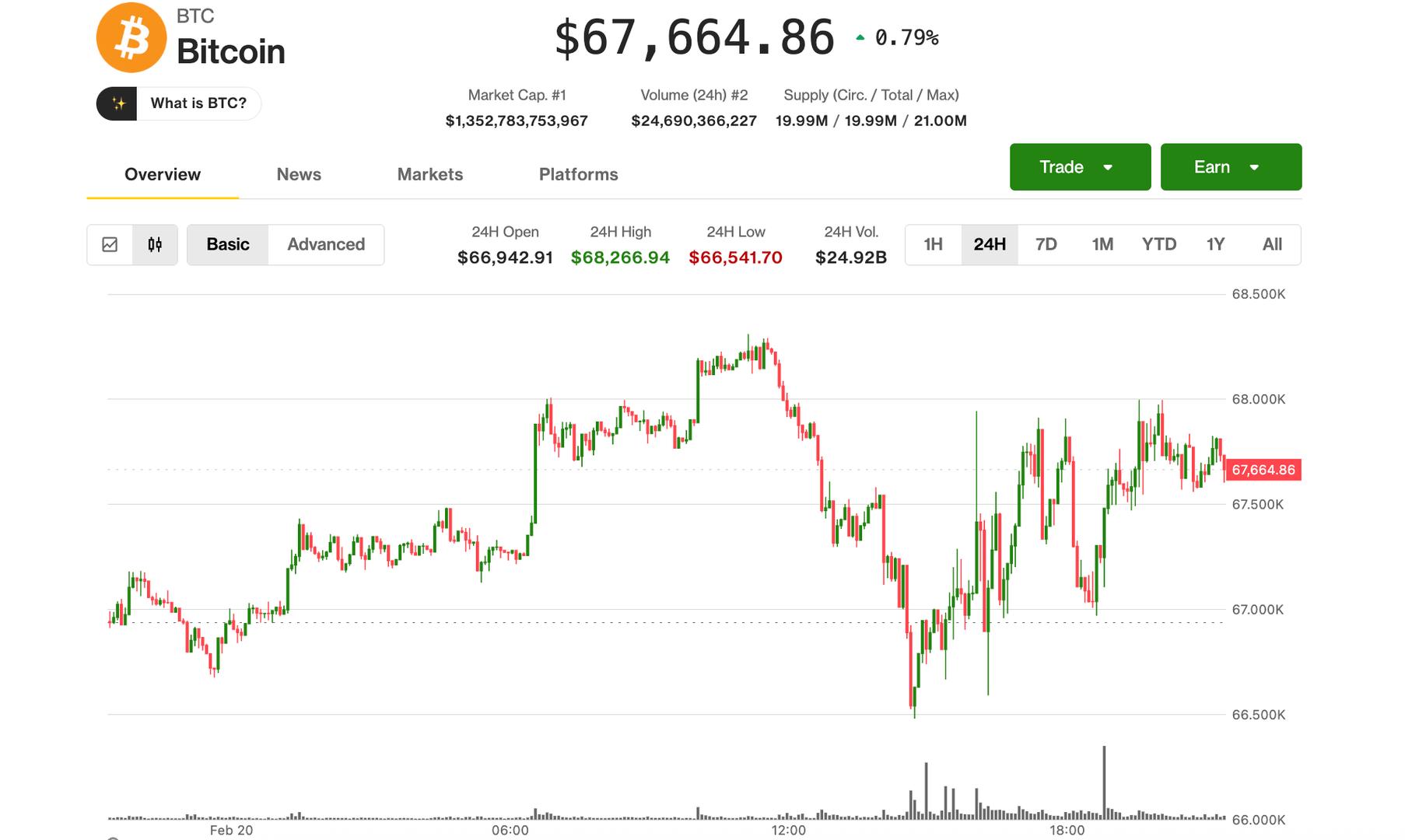
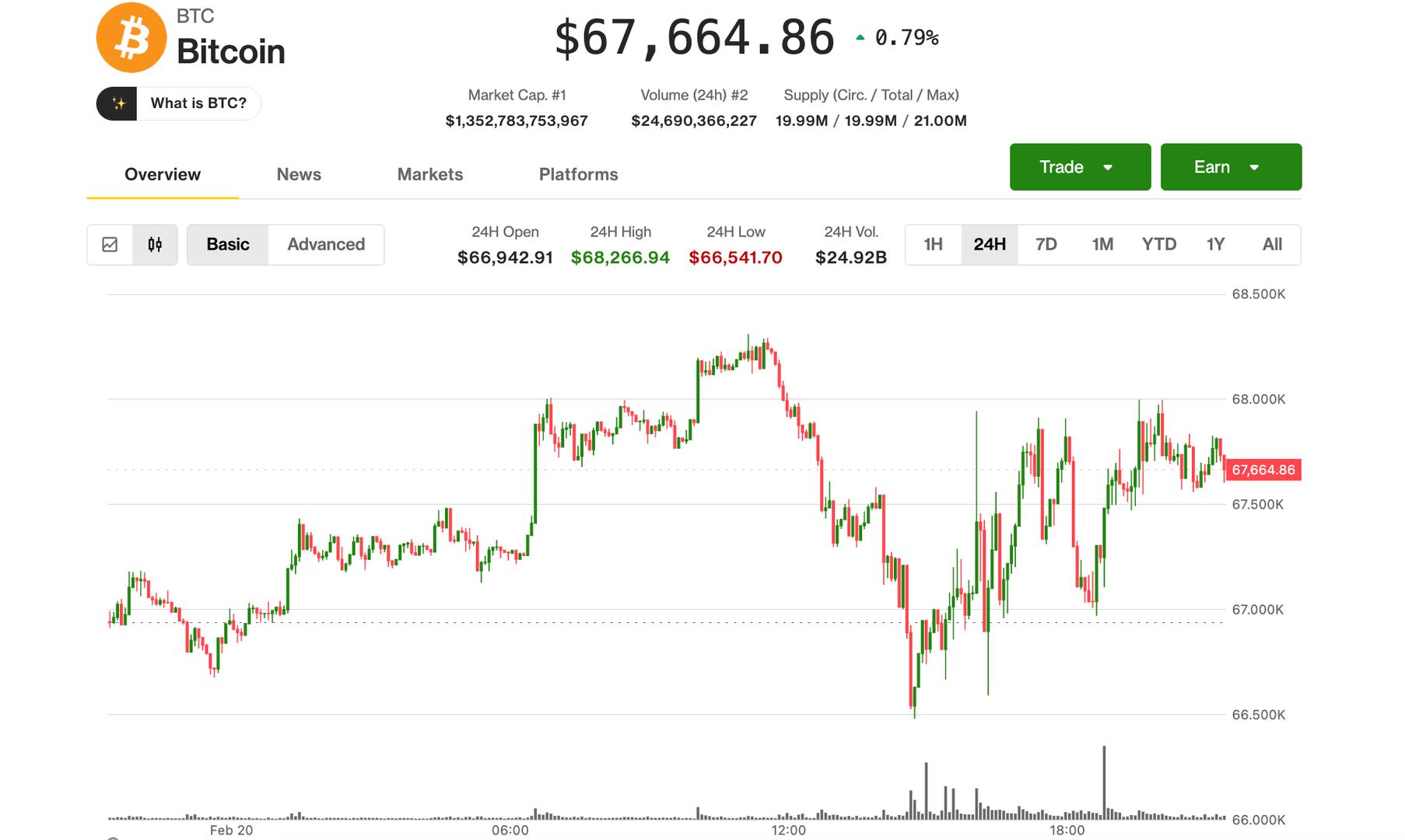
Bitcoin brushed aside a volatile round of U.S. tariff headlines on Friday, inching toward $68,000 and altcoins modestly bouncing.
The day began with the U.S. Supreme Court ruling President Donald Trump’s global tariff rollout illegal. The decision did not clarify what should happen to tariff revenue already collected, and it doesn’t necessarily spell the end of Trump’s trade agenda, with multiple legal and executive avenues still available.
By the afternoon, President Trump announced an additional 10% global tariff to be rolled out under Section 122 for roughly five months, effective in three days.
The fresh levy, imposed on top of existing tariffs, barely dented sentiment.
Risk assets, including crypto, pushed modestly higher through the session. The broad-market CoinDesk 20 Index gained 2.5% over the past 24 hours, with BNB, , and Solana (SOL) outperforming with 3%-4% advances. Bitcoin was recently trading just below $68,000.
Meanwhile, the S&P 500 and Nasdaq 100 climbed 0.9% and 0.7%, respectively. Among crypto-linked stocks, exchange Coinbase (COIN), stablecoin issuer Circle (CRCL) and bitcoin treasury firm Strategy (MSTR) rose more than 2%. Bitcoin miners tied to AI infrastructure buildouts underperformed, with Riot Platforms (RIOT), Cipher Mining (CIFR), IREN and TeraWulf (WULF) falling 3%-6%.
Cryptos to stay rangebound
“We have seen a small rally for risk assets post-tariffs news as it leads into a narrative that tariffs are damaging for the macro environment,” said Paul Howard, director at trading firm Wincent.
Still, conviction remains light that prices could break out to the upside from the current tight range. “Volumes, however, remain muted and we can expect crypto to maintain range bound trading for the time being” barring any “macro or geopolitical shocks coming,” Howard added.
A key potential macro risk could be Trump ordering strikes against Iran over the next few days, following the significant military buildup in the region for weeks now.
Bitcoin holds near $67,700 while investors assess Trump’s new 10% global tariff plan.
Crypto markets traded slightly higher on Friday, Feb. 20, as traders reacted to the U.S. Supreme Court ruling that struck down President Donald Trump’s emergency tariffs.
Bitcoin (BTC) is trading at $67,728, up 1.2% over the past 24 hours, while Ethereum (ETH) is at $1,970, up 1.5%. Other large-cap tokens were also mostly higher, with XRP up 1.5% to $1.43, BNB rising 3.2% to $625, and Solana (SOL) gaining 4% to $85.
Meanwhile, the total cryptocurrency market capitalization is hovering near $2.4 trillion, up 1.3% on the day. Daily trading volume stood at around $114.5 billion, according to CoinGecko.
Among top gainers, Morpho (MORPHO) climbed 11%, Ethereum Classic (ETC) rose 5.3%, and Official Trump (TRUMP) added about 5%. On the downside, Aave (AAVE) fell roughly 4.6%, Pi Network (PI) dropped about 3%, and Rain (RAIN) slipped around 2%.
Liquidations and ETF Flows
About $180 million in leveraged crypto positions were liquidated in the past 24 hours, according to CoinGlass. Long liquidations accounted for roughly $71.9 million, while shorts made up about $108 million.
Bitcoin led liquidations with $67.9 million, followed by Ethereum at around $38.3 million. More than 78,600 traders were liquidated during the period.
In the ETF space, Bitcoin spot ETFs recorded $165.76 million in outflows, while Ethereum spot ETFs experienced $130 million in outflows. In contrast, XRP spot ETFs recorded around $4 million in inflows, while Solana spot ETFs posted $5.94 million in inflows, per SoSoValue data.
Supreme Court Strikes Down Tariffs
The market uptick came amid intensifying macroeconomic uncertainty after President Donald Trump announced plans to impose a 10% global tariff. Trump’s announcement immediately followed a Supreme Court ruling that deemed his emergency tariffs illegal.
Notably, President Trump’s new tariffs could only take effect for up to 150 days unless Congress approves an extension, CNN reported.
Investors also reacted to increased geopolitical tensions after Trump said he is considering a limited military strike on Iran if nuclear negotiations do not progress soon.
In traditional markets, safe-haven assets have continued to hold steady. Gold traded at $5,092, up 1.46%, while silver climbed 6% to $84.
Meanwhile, Paul Howard, Senior Director, Wincent, said in comments shared with The Defiant that there has been a “mix of developments” over the past two days impacting price action independently of larger macro trends.
“These include speculation around the U.S. stablecoin bill, the launch of a SUI ETF on Nasdaq, and several DATs marking down their books,” Howard said. “Given the noticeable thinning of liquidity over the past month, volatility risk is currently elevated relative to levels observed over the past 12 months.”
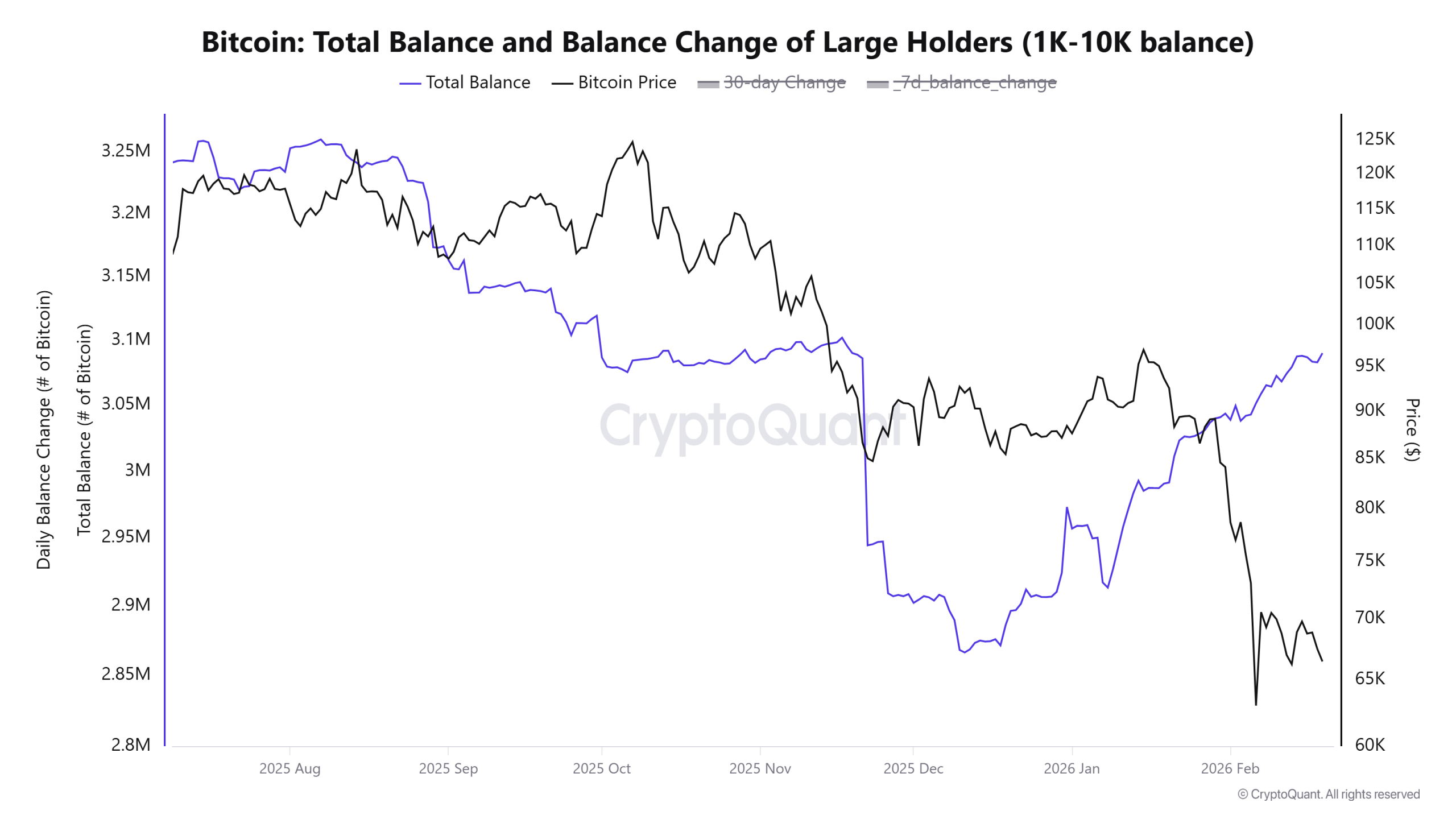
Large Bitcoin (BTC) holders have steadily increased their holdings in recent months, with the total balance climbing back to levels last seen before the October 10, 2025, market crash.
At the same time, crypto exchange data shows whale-related outflows averaging 3.5% of exchange-held BTC over a 30-day rolling period, the highest since late 2024.
BTC whale reserves return to pre-October peak
Bitcoin wallets or “whales”, holding between 1,000 and 10,000 BTC, have rebuilt reserves over the past three months. The cohorts increased their total balance to 3.09 million, from 2.86 million BTC on Dec. 10, 2025, a 230,000 BTC addition that restores their balance to pre-October 2025 levels.

Crypto analyst ‘Caueconomy’ said the full drawdown in whale reserves has been reversed over the past 30 days with the accumulation of 98,000 BTC. The broader distribution phase began in August 2025 (after BTC hit $124,000), after which Bitcoin struggled to sustain a rally significantly higher.
BTC spot market data supports the recovery. Throughout 2026, the average BTC order size has ranged between 950 BTC and 1,100 BTC, the most consistent stretch of large-ticket activity since September 2024.
Similar clusters appeared during the February–March 2025 correction. During that phase, retail orders accounted for the majority of activity, while large blocks appeared more intermittently and in smaller clusters.

Related: ‘Resilient’ Bitcoin holders defend BTC, but bear floor sits 20% lower: Glassnode
BTC exchange flows spike to 14-month highs
CryptoQuant analyst Maartunn reported $8.24 billion in whale BTC exchange flows moved into Binance over the past 30 days, marking a 14-month high. Retail flows reached $11.91 billion and have flattened over the same period. The retail-to-whale ratio now sits at 1.45, and it continues to drop as the larger-size deposits increase.

Parallel to these inflows, Glassnode data shows gross exchange whale withdrawals averaging 3.5% of total exchange-held BTC supply over a 30-day period, the strongest pace since November 2024.
Based on current exchange balances, that translates to roughly 60,000–100,000 BTC in withdrawals over the past month.
While gross inflows into exchanges have also increased, the elevated withdrawal ratio suggests that much of that incoming BTC is being offset by strong outbound transfers, leaving net exchange balances relatively stable.

Related: Quantum fears aren’t behind Bitcoin’s 46% drop, says developer
This article does not contain investment advice or recommendations. Every investment and trading move involves risk, and readers should conduct their own research when making a decision. While we strive to provide accurate and timely information, Cointelegraph does not guarantee the accuracy, completeness, or reliability of any information in this article. This article may contain forward-looking statements that are subject to risks and uncertainties. Cointelegraph will not be liable for any loss or damage arising from your reliance on this information.
Justin Jefferson’s Got Two Words for J.J. McCarthy

Microsoft Deletes Blog Telling Users To Train AI on Pirated Harry Potter Books

Nathan MacKinnon and Canada rally to beat Finland and reach the Olympic final


-

 Video4 days ago
Bitcoin: We’re Entering The Most Dangerous Phase
-

 Tech6 days ago
Luxman Enters Its Second Century with the D-100 SACD Player and L-100 Integrated Amplifier
-

 Crypto World4 days ago
Can XRP Price Successfully Register a 33% Breakout Past $2?
-

 Sports4 days ago
GB's semi-final hopes hang by thread after loss to Switzerland
-

 Video20 hours ago
XRP News: XRP Just Entered a New Phase (Almost Nobody Noticed)
-
 Tech4 days ago
The Music Industry Enters Its Less-Is-More Era
-

 Business3 days ago
Infosys Limited (INFY) Discusses Tech Transitions and the Unique Aspects of the AI Era Transcript
-

 Entertainment2 days ago
Kunal Nayyar’s Secret Acts Of Kindness Sparks Online Discussion
-

 Video4 days ago
Financial Statement Analysis | Complete Chapter Revision in 10 Minutes | Class 12 Board exam 2026
-

 Tech3 days ago
Retro Rover: LT6502 Laptop Packs 8-Bit Power On The Go
-
 Crypto World7 days ago
Bhutan’s Bitcoin sales enter third straight week with $6.7M BTC offload
-
 Sports2 days ago
Clearing the boundary, crossing into history: J&K end 67-year wait, enter maiden Ranji Trophy final | Cricket News
-

 Entertainment2 days ago
Dolores Catania Blasts Rob Rausch For Turning On ‘Housewives’ On ‘Traitors’
-

 Business3 days ago
Tesla avoids California suspension after ending ‘autopilot’ marketing
-
 NewsBeat5 days ago
The strange Cambridgeshire cemetery that forbade church rectors from entering
-

 Crypto World2 days ago
WLFI Crypto Surges Toward $0.12 as Whale Buys $2.75M Before Trump-Linked Forum
-

 Fashion4 hours ago
Weekend Open Thread: Boden – Corporette.com
-
 NewsBeat5 days ago
Man dies after entering floodwater during police pursuit
-

 Crypto World1 day ago
83% of Altcoins Enter Bear Trend as Liquidity Crunch Tightens Grip on Crypto Market
-

 NewsBeat6 days ago
UK construction company enters administration, records show