
Crypto World
Bitcoin Accumulation Trend Strengthens as Whales and Retail Add Holdings Amid Price Dip


TLDR:
- Bitcoin whales accumulated over 61K BTC in one month despite price hovering near key support levels
- Retail wallets matched whale accumulation pace, adding nearly 0.42% to holdings during market dip
- Historical trends show rallies often start when whales buy while retail sells, not current pattern
- Traders focus on $67K to $69K levels as Bitcoin remains range-bound with short-term setups forming
Bitcoin accumulation trend remains active as large and small holders continue adding to positions despite recent price weakness near the $68,000 level.
Data from Santiment shows coordinated accumulation across key wallet tiers, even as short-term price action stays range-bound.
This pattern reflects steady positioning during uncertainty, with market participants responding differently across timeframes while maintaining exposure to Bitcoin.
Whale and Retail Wallets Move in Parallel
Santiment data shows that wallets holding between 10 and 10,000 BTC added 61,568 BTC over the past month. This represents a 0.45% increase in holdings during a period of price retracement.
The accumulation occurred while Bitcoin briefly traded near $68,100, indicating sustained interest from larger market participants.
At the same time, smaller wallets holding less than 0.01 BTC also increased their holdings. Retail participants recorded a 0.42% rise over the same timeframe.
This places both cohorts on nearly identical accumulation paths, which is not always typical in similar market conditions.
Santiment shared this data publicly, noting that both whales and retail continue to accumulate despite macroeconomic uncertainty.
The firm also pointed out that historical cycles often behave differently. In previous cycles, strong upward moves followed periods where large holders accumulated while retail reduced exposure.
The current structure, therefore, presents a mixed signal. While accumulation is ongoing, the alignment between retail and large wallets suggests a more complex market phase. Price movement remains constrained, with no clear breakout confirmed yet.
Short-Term Trading Levels Remain in Focus
Market participants are also watching short-term price levels closely. Trader Lennaert Snyder outlined a cautious approach in a recent update.
He noted that Bitcoin is trading near the previous weekly low around $67,360, limiting late short opportunities.
According to his plan, short positions may only be considered after specific liquidity events. These include reactions near the $68,955 level or after addressing an imbalance around $86,399. Entry confirmation would rely on lower timeframe signals such as M15 engulfing patterns or structure breaks.
His commentary reflects a tactical approach to current price action. Rather than chasing moves, traders are waiting for confirmation signals before entering positions. This aligns with the broader range-bound structure seen in recent sessions.
At present, Bitcoin continues to trade within a narrow band, with both bullish and bearish setups dependent on key levels.
While accumulation data provides context, short-term execution remains driven by technical confirmation. As a result, market participants are balancing long-term positioning with immediate price reactions.



Anchorage Digital just handed TRON a major credibility upgrade, and the market hasn’t fully priced it in yet. TRON is trading at $0.31, with almost no change in price in 24 hours, even as institutional infrastructure around the network expands and prediction turns bullish. The gap between that price action and what this announcement could mean for demand is worth examining closely.
— The Crypto Times (@CryptoTimes_io) March 26, 2026
 BIG: Anchorage Digital brings TRON into the U.S. regulatory fold.@Anchorage @trondao pic.twitter.com/dVAbimz9lF
Anchorage Digital, the only crypto firm holding a U.S. federal banking charter, confirmed it will add institutional custody for $TRX, with TRC-20 asset support and native staking to follow in subsequent phases.
CEO Nathan McCauley framed it directly: the integration brings “one of crypto’s largest ecosystems into an institutional framework.”
The pitch is compliance-first, a regulated bridge for institutions that have watched TRON’s stablecoin dominance grow to $86 billion in supply. Anchorage already supports Ethereum, Solana, Arbitrum, Base, and BNB Chain, so this isn’t an experiment.
The question is whether TRX’s current consolidation zone absorbs this catalyst or finally breaks above it.
Discover: The best pre-launch token sales
TRON Price Prediction: Can TRX Price Hit $0.35?
TRX is consolidating in a narrow band after pulling back from its March 25 high near $0.3168. The 30-day return remains positive at +9%, and the yearly gain sits at +33%, but short-term momentum is stalling.
Key levels to watch: support clusters at $0.30 and $0.295. Resistance stacks up at $0.32 and $0.33. Breaking above the first resistance band with volume would be the initial confirmation signal.

The Anchorage news is structurally bullish. Whether it’s a this-week catalyst or a slow-burn setup depends entirely on whether institutions move quickly to custody positions, or queue up for TRC-20 and staking access down the line.
Discover: The best crypto to diversify your portfolio with
Bitcoin Hyper: Early Mover Upside as TRON Tests Key Levels
TRX’s sideways grind highlights a familiar dynamic: institutional validation arrives, but the largest upside often belongs to assets that haven’t yet been discovered by that wave of capital. With TRON already a $26B+ network, the percentage-gain math gets harder at scale. That’s pushing some traders to look further up the risk curve, toward early-stage infrastructure plays where entry prices are still in the fractions of a cent.
Bitcoin Hyper ($HYPER) is one project drawing attention in that context. It’s positioned as the first-ever Bitcoin Layer 2 with Solana Virtual Machine (SVM) integration, combining Bitcoin’s security with sub-second transaction finality that the team claims outperforms Solana itself.
The presale is currently priced at $0.0136 and has raised over $32 million, with a huge 36% staking APY already live for early participants. The core pitch: Bitcoin’s $1.7 trillion security model, unlocked for fast smart contracts, low-cost execution, and a decentralized canonical bridge for BTC transfers.
This article is not financial advice. Cryptocurrency investments are highly volatile. Always conduct your own research before investing.
The post TRON Price Prediction: Anchorage Digital Open US Institutional Access appeared first on Cryptonews.

TLDR
- Franklin Templeton’s Head of Digital Assets Roger Bayston said Ripple is redeploying XRP capital into operating businesses.
- Bayston stated that Ripple has committed about $3 billion to expand custody, liquidity, treasury, and brokerage services.
- He explained that XRP is moving beyond speculation and supporting financial infrastructure.
- Bayston said Franklin Templeton supports a multi-chain strategy instead of launching its own blockchain.
- He described blockchains as “digital nation-states” that evolve at different speeds.
Franklin Templeton’s Head of Digital Assets Roger Bayston said Ripple is redirecting accumulated XRP capital into operating businesses. He shared the remarks during the Thinking Crypto podcast with Tony Edward. Bayston said the company now focuses on infrastructure that supports real financial activity.
Ripple Deploys Capital to Expand XRP Infrastructure
Bayston said early blockchain networks built large capital reserves during previous market cycles. However, he explained that the next phase requires those networks to deploy resources into operating businesses. He pointed to Ripple and said it has “fantastic plans” to redeploy capital generated through XRP into infrastructure and services.
He said Ripple has committed about $3 billion to expand custody, liquidity, treasury management, and brokerage services. He explained that the company uses XRP-linked resources to finance this expansion. He added that this strategy supports broader institutional use and strengthens the XRP ecosystem.
Bayston stated that XRP now operates beyond market speculation and supports business infrastructure. He said the company channels accumulated capital into platforms that serve financial institutions. He noted that scale around the network will determine long-term utility.
Multi-Chain Strategy and Tokenization Growth
Bayston said Franklin Templeton will not launch a proprietary blockchain network. Instead, he explained that the firm supports a multi-chain structure across public networks. He described blockchains as “digital nation-states” that evolve at different speeds and serve different purposes.
He contrasted this approach with firms like Coinbase and Robinhood that operate closed ecosystems. He said Franklin Templeton prefers access across networks rather than control over a single chain. He added that this framework allows participation as each network develops.
Bayston said institutional investors continue adapting to crypto market structures. He explained that platforms now combine custody, trading, and infrastructure into unified systems. He said this shift changes how institutions access and distribute financial products.
He cited Binance, Kraken, and OKX as examples of integrated platforms serving millions of wallets. He called this structure the “wallet ecosystem” that delivers products directly on-chain. He said Franklin Templeton views these platforms as distribution channels.
Bayston said tokenization efforts now extend beyond digital assets. He confirmed that Franklin Templeton manages about $1.6 trillion in assets. He stated that the firm already operates tokenized money market funds.
He said the firm plans to expand tokenization into real estate, commodities, and securities. He explained that these assets retain their structure but move into digital form. He noted that networks such as the XRP Ledger could support liquidity and settlement for these assets.
Bayston said blockchain networks with capital and operational strategy will continue evolving. He stated that Ripple currently uses its XRP-linked capital base to build financial infrastructure. He reiterated these points during the Thinking Crypto podcast interview.
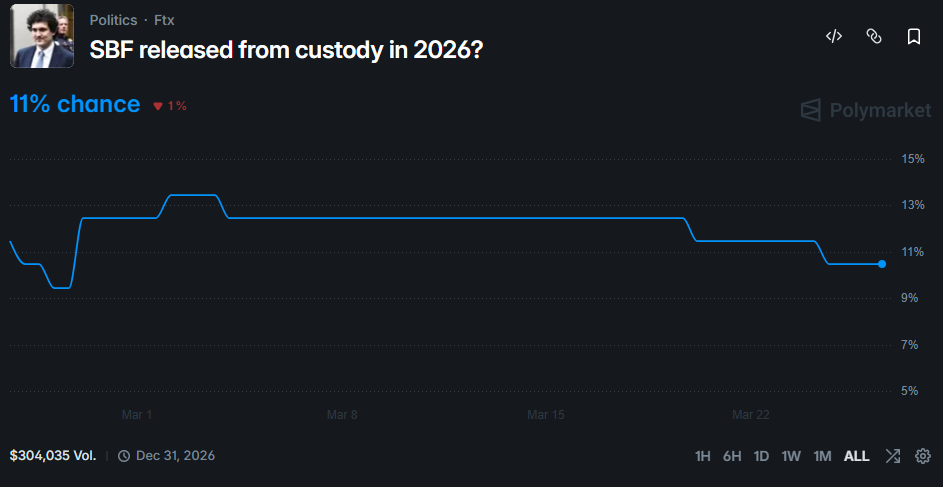
The chances of former FTX CEO Sam Bankman-Fried getting a pardon didn’t seem great this year, and a recent downtick on prediction markets shows that they aren’t getting any better.
Both major prediction markets in the United States, Polymarket and Kalshi, have the likelihood of Bankman-Fried receiving a presidential pardon this year at 11% and 9%, respectively.
Chances of a pardon have decreased 1% on Kalshi and 2% on Polymarket after a CNN interview on March 21 with Bankman-Fried’s parents, Joseph Bankman and Barbara Fried. In the interview, both explained why they’re challenging their son’s fraud conviction.
The change may be small, but the interview and the public appeals for a reconsideration of the case have drawn renewed attention to Bankman-Fried’s parents’ role.

Bankman and Fried challenge FTX narrative
In a new interview with CNN’s Michael Smerconish, Fried and Bankman said that the judgement against their son was wrong. “There’s an appeal on the case, but we don’t think it’s fraud,” Bankman said.
Bankman and Fried both agreed that Alameda Research had borrowed customer funds from their son’s exchange FTX. But Bankman said that the funds “were not used improperly.” On the exchange, “you were able to put in money, and you were able to borrow money. Alameda acted like everybody else, putting in money and borrowing money.”
Bankman and Fried’s claim challenges the public narrative on the case, one in which they themselves were involved. Bankman worked as a paid advisor to FTX, chiefly concerned with the exchange’s efforts regarding “effective altruism,” while Fried served as a political consultant, per the CNN interview.
FTX attempted to sue them as the exchange was restructuring in 2023. In a complaint in the Delaware Bankruptcy Court, FTX sought to recover millions of dollars that it claimed Bankman and Fried “fraudulently transferred and misappropriated.”
“Bankman played a key role in perpetuating this culture of misrepresentations and gross mismanagement and helped cover up allegations that would have exposed the fraud committed by the FTX Insiders,” the complaint alleged.
Chiefly, FTX claimed that “Bankman and Fried discussed with Bankman-Fried the transfer to them of a $10 million cash gift and a $16.4 million luxury property in The Bahamas.” The exchange sought the return of both of these funds and of the luxury property.
The case was eventually dismissed without prejudice in February 2025. This means that the case is not permanently closed and the plaintiffs could still refile at a later time and different venue.
A year later, in February 2026, Fried filed an appeal on behalf of her son. Documents filed in the New York Southern District Court said that new testimony, “would have refuted three principal claims the Government made about FTX’s financial condition on which its allegations of fraud rested.” These were that:
-
FTX was insolvent on Nov. 11, 2022,
-
There was no prospect that customers would be repaid, and
-
Alameda regularly ran a multi-billion-dollar deficit in its account on FTX.
Speaking to CNN, Bankman said that “the money was always there” and that Alameda “always had more than enough security to cover everything.” He said that everyone has already gotten paid back; “the money never left the companies.”
Fried said that “all the money was turned over by Sam voluntarily when there was a liquidity crisis. All the assets ended up in the estate in FTX which was taken over by the debtors, so-called debtors, who ran the bankruptcy. All the money, it was there, every penny of it.”
Looking for a pardon
The appeal filing also moved to change the judge, claiming “many instances of extreme prejudice” that Judge Lewis Kaplan showed to Bankman-Fried during the trial.
In the interview, Fried claimed that “Sam’s prosecution was essentially political.” She added that the “Biden administration had decided to destroy crypto, to strangle the baby in the crib, if I can use that horrible metaphor.”
Rather than clearly state the administration was not going to legalize crypto and outline how it would punish offenders, “they quite deliberately tried to sabotage the crypto industry behind the scenes.”
She further claimed the prosecutions were being used for political ambition. “I am describing a part of the Biden administration that I think did really bad things,” she said.
Bankman-Fried made significant political donations to the Biden administration and to Democratic lawmakers. But in the CNN interview, his parents attempted to distance him from liberal politics.
Bankman said, “Sam came to DC and did contribute to Biden. But by the time he got to DC, he had had bad experiences with the Biden administration on crypto and on business in general.”

“He ended up giving at least as much to Republicans. To think of Sam as just a liberal Democrat was never true,” he said.
Bankman-Fried himself has attempted to downplay any support he’d given to Democratic politicians. Last year, he told the media that he was “really frustrated and disappointed with what I saw of, you know, Biden’s administration of the Democratic Party.”
He also tried to liken himself to Trump in regards to his prosecution and frustrations with Judge Kaplan. Kaplan found Trump guilty of sexual abuse and defamation, awarding the plaintiff E. Jean Carroll $88 million in damages.
His parents doubled down on these claims and appeared to make a direct appeal to Trump. When asked, “What does Sam Bankman-Fried’s mother want to say to the President of the United States?” Fried replied, “I think that Sam was a victim of an out-of-control prosecution and I know that Trump himself feels he was.”
“I would say also that being one of the most brilliant, talented young men of this generation and the amount of good that he can do in this world, if he is free to live a life he wants, it would be of enormous benefit to the economy, to a lot of things that Trump cares about in this world. He [Trump] ought to regard Sam as a huge asset going forward for the country.”
Pardons have become an industry unto themselves. A Campaign Legal Center analysis showed that Trump usually pardons allies in exchange for loyalty, rewards people who broke the law on his behalf or, crucially, offers brokered pardons, “where deep-pocketed individuals hire well-connected lobbyists or political fixers to secure clemency.”
Amid the most recent push for a pardon, Pro-crypto Senator Cynthia Lummis told Politico, “I hope the president doesn’t fall for that. […] He hurt a lot of people.” Trump himself indicated to The New York Times that he would not pardon Bankman-Fried.
According to Bloomberg, Fried and Bankman have been exploring ways to get a pardon for their son since Trump took office in January of last year. This reportedly included speaking to lawyers and “other figures considered to be in Trump’s orbit.”
On March 18, Bankman-Fried wrote a post through legal proxies, supporting Trump’s decision to bomb Iran. Polymarket odds show the chance of a US/Iran ceasefire by year’s end at 78%, some 68 points higher than a pardon for Bankman-Fried.

Magazine: Nobody knows if quantum secure cryptography will even work
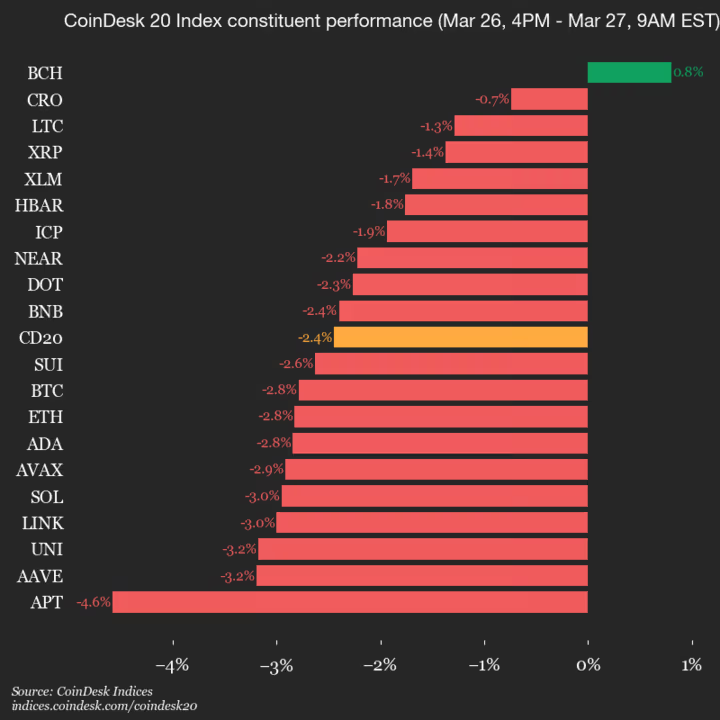
CoinDesk Indices presents its daily market update, highlighting the performance of leaders and laggards in the CoinDesk 20 Index.
The CoinDesk 20 is currently trading at 1912.59, down 2.4% (-47.98) since 4 p.m. ET on Thursday.
One of 20 assets is trading higher.

Leaders: BCH (+0.8%) and CRO (-0.7%).
Laggards: APT (-4.6%) and AAVE (-3.2%).
The CoinDesk 20 is a broad-based index traded on multiple platforms in several regions globally.

Key Takeaways
- CRM shares have plunged over 30% during 2026, hitting a 52-week low at $174.57
- Board directors purchased CRM shares in March at approximately $194–$195 apiece
- The iShares Expanded Tech-Software Sector ETF has declined roughly 24% year-to-date
- The company exceeded Q4 projections with earnings per share of $3.81 versus the anticipated $3.05, while greenlighting a $25 billion stock repurchase initiative
- Several institutional stakeholders expanded their CRM holdings during Q4 2024
Salesforce has faced significant headwinds throughout 2026. The enterprise software giant has witnessed its market value decline by more than 30%, pressured by widespread selling across the software industry and mounting anxieties regarding artificial intelligence competition.
The stock’s descent accelerated toward the end of January, with concerns about AI disruption repeatedly weighing on investor sentiment. A notable trigger emerged when reports surfaced that Anthropic’s Claude artificial intelligence system possessed the capability to operate computers autonomously, raising questions about the long-term viability of traditional enterprise software solutions.
Yet amid the ongoing volatility, a pair of company board members made notable purchases of CRM shares during March.
Board member Laura Alber — concurrently serving as Williams-Sonoma’s chief executive — acquired 2,571 CRM shares priced at approximately $195 on March 19, for a total investment of $451,166. This marked her inaugural open-market transaction since her appointment to the board in November 2021.
Meanwhile, David Kirk, another board director and former Nvidia chief scientist, secured 2,570 CRM shares at $194.62 per share on March 18. This represented his first open-market acquisition of the calendar year. Kirk’s direct ownership now stands at 13,689 CRM shares with an estimated value around $2.5 million.
Impressive Financial Results and Repurchase Plan Fail to Halt Decline
Salesforce unveiled its Q4 financial performance on February 25, surpassing Wall Street expectations. Earnings per share reached $3.81, comfortably beating the consensus forecast of $3.05. Quarterly revenue totaled $11.20 billion, representing 12.1% growth compared to the prior year period and modestly exceeding analyst projections.
The board additionally greenlit a $25 billion share repurchase authorization on March 16 — a program substantial enough to retire approximately 14.1% of shares currently outstanding. The quarterly dividend received an increase to $0.44 from $0.42, translating to an annualized distribution of $1.76 per share.
Despite these positive developments, the stock has continued its downward trajectory. From March 19 — when Alber executed her purchase — shares have dropped an additional 7%.
Institutional Investors Continue Accumulating Positions
Among institutional participants, CMH Wealth Management expanded its CRM holdings by 37.3% throughout Q4, acquiring 10,102 additional shares to reach a total position of 37,208 shares, valued at $9.87 million. Multiple other investment funds similarly increased their allocations during the same timeframe.
Institutional investors and hedge funds collectively control 80.43% of outstanding CRM shares.
Wall Street analyst perspectives remain predominantly optimistic. The stock maintains an aggregate “Moderate Buy” rating accompanied by a consensus price objective of $280.21 — significantly above present trading levels. Individual analyst price targets span from $250 (TD Cowen) to $430 (Citizens JMP).
Agilysys (AGYS), another software company experiencing insider purchasing activity in mid-March, has appreciated 5.6% following director Melvin Keating’s acquisition of $27,289 worth of shares between March 16 and 17.

Vietnamese authorities have moved to curb a multi-city crypto fraud case tied to the ONUS platform, detaining several suspects accused of using false promotions and manipulated trading to siphon investor funds. The Ministry of Public Security said the operation centers on a group that sold digital tokens via ONUS, employing misleading campaigns and coordinated market activity to lure users while maintaining centralized control over price and liquidity.
Among those named by investigators are Vuong Le Vinh Nhan, connected to Vemanti Group and tied to XPLOR, the Singapore-based parent company of ONUS Pro; Tran Quang Chien, identified as the ONUS exchange’s technical administrator; and Ngo Thi Thao, director of HanaGold Jewelry JSC. Authorities allege the group created and promoted tokens including VNDC, ONUS and HNG through the ONUS platform, with the probe suggesting billions of dollars were raised from investors. No official loss breakdown has been published.
In parallel to Vietnam’s widening probe, Vemanti Group said it had learned of the indictments from the ministry and Vietnamese media, and it has engaged U.S. legal counsel to assess the situation. Vemanti described Nhan as a board chair and Chien as a board member, though the company has not issued a formal statement on the specifics of the case.
The ONUS platform bills itself as a digital asset ecosystem offering trading, staking and investment products, and has publicly highlighted a user base it characterized as “more than seven million.” Its official X account remains active with a substantial following, while CoinMarketCap lists the ONUS token with a self-reported market capitalization near $25 million, underscoring a sizable gap between public token metrics and the scale of the alleged losses described by authorities. ONUS has not published an official response to the allegations, and Cointelegraph reached out for comment without receiving a reply by publication time.
Key takeaways
- Vietnam’s Ministry of Public Security publicly linked the ONUS platform to a scheme involving false promotions and market manipulation that allegedly defrauded investors, with arrests across multiple cities and a broad net cast over more than 140 individuals questioned.
- Authorities name specific suspects tied to the ONUS operation, including board-linked figures and a technical administrator, suggesting a centralized scheme rather than decentralized trading.
- The case highlights a discrepancy between ONUS’s self-promotion of millions of users and tangible market metrics, such as a roughly $25 million self-reported ONUS token market cap on CoinMarketCap.
- Industry observers should watch how Vietnam’s authorities pursue asset tracing and potential sanctions, given the cross-border links and the involvement of a U.S.-listed affiliate in Vemanti Group.
Vietnam’s crackdown widens and what it signals for investors
The Ministry of Public Security described the investigation as a coordinated, multi-agency effort spanning several Vietnamese cities, with police summoning more than 140 individuals for questioning and seizing evidence as part of a broader push to dismantle large-scale crypto-fraud networks. The authorities framed the ONUS case as emblematic of how promoters can use tokens to simulate legitimacy while concentrating decision-making and price control in a central group.
Within the case’s named actors, the involvement of Vuong Le Vinh Nhan—connected to Vemanti Group and linked to XPLOR, the ONUS Pro parent entity—puts a spotlight on cross-border corporate structures behind some crypto ventures. Tran Quang Chien’s role as a technical administrator, and Ngo Thi Thao’s leadership at HanaGold Jewelry JSC, illustrate how diverse business ties can intersect with token issuance and platform management in Southeast Asia. Prosecutors have not released a full ledger of losses, leaving open questions about the actual financial impact on investors to date.
ONUS presents itself as a broader ecosystem with trading, staking and investment features, a claim that will be weighed against regulator scrutiny and the allegations of misrepresentation. The company’s supporter base and stated figures—such as a seven-million-user claim—contrast with market data that shows a more modest public footprint, inviting questions about user growth, real-world usage and liquidity depth. The absence of an official commentary from ONUS adds another layer of uncertainty for users and builders evaluating the platform’s future viability.
Regulatory context and cross-border risk to watch
The Vietnamese investigation arrives amid an environment where the country is frequently cited as one of the world’s most active retail digital asset markets. Vietnam’s regulatory posture toward crypto has been evolving, with authorities intensifying oversight of exchange activity, token offerings and investor protections. The unfolding ONUS case could inform forthcoming policy responses or enforcement approaches, particularly around token promotions, disclosures, and market manipulation risks.
Beyond Vietnam, the case resonates with broader concerns about crypto-related fraud networks in the region. In a separate development, India’s Central Bureau of Investigation reported the arrest of a Mumbai-based suspect involved in steering victims toward scam compounds in Myanmar, where individuals were forced to run online fraud operations including crypto investment scams and romance scams. The case underscores the transnational nature of many crypto fraud schemes and the demand for cross-border cooperation in tracing illicit proceeds and prosecuting perpetrators.
Vietnam ranks high in global crypto-adoption metrics, with Chainalysis placing it among the more active markets in 2025. Some observers view the ONUS developments as a stress test for enforcement capabilities, liquidity integrity and investor protection in economies where crypto activity is accelerating but regulatory clarity remains a work in progress. The interaction between regulatory risk, platform incentives and user trust will be critical for those evaluating regional exposure to ONUS-like ventures.
As the investigation unfolds, observers will be watching for any court filings, asset-recovery actions, and how disclosures—or the lack thereof—from ONUS, Vemanti, and associated entities influence regulatory decisions and market sentiment. The case may also influence how exchanges and platforms in Vietnam and the wider region approach token issuance hygiene, user onboarding, and the visibility of centralized controls within ostensibly decentralized ecosystems.
Readers should monitor official statements from Vietnamese authorities, updates from Vemanti Group, and any forthcoming court proceedings that could clarify the scope of the alleged fraud, the assets involved, and the potential remedies for affected investors.


Opinion by: Kirill Avery, founder and CEO of Alien
AI-generated voices are already being used in ransom scams. Synthetic agents now trade, vote and interact on blockchain networks. In this environment, the greatest threat to crypto is no longer scalability or regulation; it is the collapse of trust.
As deepfakes, bots and synthetic agents saturate every corner of the internet and as scams increased by 1,400% in 2025, authenticity is becoming a scarce resource.
Scarcity produces markets. Every major technological shift has centered on what becomes hard to fake and costly to produce. In the industrial era, it was energy. In the internet era, it was attention. In the AI era, it is authenticity.
In the AI era, the crypto industry will stop competing on throughput and start competing on proof of humanity, and most existing identity and compliance models will collapse under synthetic users.
The great flood of the unreal
The internet was built to connect us through information; however, it now overwhelms us with imitation. Every day, new stories expose how generative models are collapsing the boundary between the real and the synthetic.
A mother in Arizona receives a ransom call: Her daughter’s voice pleads for help, matching her tone, cadence and even her breathing. But it isn’t real; the audio was stitched together by an AI model trained on a few seconds of public video. Across the country, a job seeker completes what seems like a normal interview, unaware that the “recruiter” asking questions is an automated agent collecting behavioral data for resale.
These aren’t edge cases. They mark the transition from the information economy to the imitation economy, an era where an abundance of data no longer guarantees truth. The internet once promised to democratize knowledge. Now, it demands we verify everything we see and hear. The problem isn’t that technology can fake reality; it’s that humans can no longer tell the difference.
Newsrooms fight algorithmic propaganda, financial systems battle synthetic users, and governance dissolves in digital fog. Reality itself is subject to replication without friction.
Realness as the new scarcity
When anything can be generated, creation ceases to be a constraint, and verification becomes the bottleneck, with authenticity acquiring economic weight. Proof that something, or someone, is real becomes an asset class.
Gold represented physical scarcity, and bandwidth represented informational scarcity. Authenticity represents epistemic scarcity. It underwrites the credibility of every domain: Social media requires real followers, finance requires Sybil resistance, and entertainment requires verifiable creators.
In “Nexus,” Yuval Noah Harari described a coming inversion in which artificial intelligence will not need money but will transact in reputation, credibility and identity. Machines will value proof over possession. What they demand is not currency but confirmation of trust, reliability and truth. Authenticity becomes the medium of exchange between humans and the system.
The invisible infrastructure of trust
Proof of what’s real is becoming part of the market itself. That means we need new infrastructure to support it.
Instead of relying only on things like fingerprints or face scans, we’ll need cryptographic proofs, decentralized identities and systems that can continuously verify trust and behavior.
Authenticity won’t be a one-time check; it will be something we demonstrate over time through our actions. Just as the last century built systems to measure creditworthiness, this one will measure realness. A “realness score” could become the new credit score of the AI era, with identity verified by protocols, authenticity built into platforms and markets rewarding those who prove they’re genuinely human.
This infrastructure will serve AI as secure sockets layer (SSL) once served e-commerce: unseen, indispensable and lucrative.
Verified or synthetic
The next social divide will not be rich versus poor but verified vs. synthetic. Verified humans will gain access to finance, governance and digital legitimacy. Unverified entities will operate in restricted zones, powerful but distrusted.
Related: Science needs prediction markets that can’t be Sybil-attacked
The moral issue is not verification itself but control. Surveillance models corrupt authenticity by owning it. Decentralized verification prevents ownership, separating proof from power. Identity then becomes the new passport, but only a neutral system can stamp it without subjugation.
The business of trust
For decades, the internet’s economy has been built on buying attention, not trust. Companies pour billions into ad networks chasing impressions and clicks that never convert. A brand might spend $1 million on online ads, only to later discover that half of those “views” came from bots, click farms or automated scraping tools that never had the capacity to buy, believe or belong.
Businesses already feel the cost of synthetic engagement, but they have no way to measure or verify authenticity at scale. In an AI-saturated internet, that problem becomes existential.
Trust — not reach — will determine value. The next generation of networks won’t sell eyeballs; they’ll sell verified human attention. Imagine a marketing system where advertisers pay only for provably real interactions, a verified consumer who actually watched, engaged or purchased. That is what authenticity infrastructure enables: an economy where truth itself becomes a performance metric.
Proof of being
Humanity has always outsourced trust to gods, states, banks and algorithms. That chain ends now. The next leap forward demands that proof originates not from institutions or code, but from the individual.
The true destination of AI is not to surpass humanity but to define where its edges end, to create a world where humans and machines operate under mutual proof, mutual respect and shared accountability.
In an era where imitation is infinite, authenticity is the last scarcity. And in the economy that follows, the most valuable currency will not be digital; it will be human realness itself.
Opinion by: Kirill Avery, founder and CEO of Alien.
This opinion article presents the author’s expert view, and it may not reflect the views of Cointelegraph.com. This content has undergone editorial review to ensure clarity and relevance. Cointelegraph remains committed to transparent reporting and upholding the highest standards of journalism. Readers are encouraged to conduct their own research before taking any actions related to the company.
Key Highlights
- Vietnamese law enforcement launches comprehensive investigation into ONUS platform fraud allegations
- Investigation uncovers evidence of systematic trading manipulation and deceptive marketing practices
- Law enforcement connects ONUS-issued tokens to extensive fraudulent activities
- Authorities broaden investigation scope to include ONUS network participants and leadership
- Case demonstrates Vietnam’s intensifying regulatory enforcement in cryptocurrency sector
Law enforcement agencies in Vietnam have escalated a comprehensive fraud investigation centered on the ONUS cryptocurrency platform following the detention of numerous individuals across several jurisdictions. Officials claim the organization exploited ONUS infrastructure to orchestrate token price manipulation and illegally transfer funds via structured trading operations. This development positions ONUS within Vietnam’s most significant cryptocurrency regulatory enforcement initiative to date.
Widespread Investigation Launched Following ONUS Fraud Allegations
Criminal proceedings commenced against ONUS-related operations throughout Vietnam, including Hanoi and surrounding provinces. Vietnam’s Ministry of Public Security orchestrated a collaborative enforcement effort examining activities associated with ONUS token issuance and distribution. Law enforcement officials scrutinized methods by which ONUS enabled organized promotional campaigns and artificial trading conditions.
Investigators summoned over 140 people while securing documentation connected to ONUS-facilitated transactions. Authorities contend suspects leveraged ONUS infrastructure to artificially manipulate market supply and demand dynamics for numerous digital tokens. The investigation concentrated on uncovering centralized manipulation tactics embedded within ONUS platform operations.
Criminal charges encompass internet-based property theft and financial laundering connected to ONUS activities. Officials assert the organization utilized ONUS to disguise artificially manipulated tokens as authentic investment opportunities. The enforcement action exposes significant structural weaknesses in developing cryptocurrency platforms.
VNDC, ONUS, and HNG Tokens Central to Investigation
Law enforcement pinpointed digital assets VNDC, ONUS, and HNG as primary elements within the ONUS-connected fraud operation. Investigators claim the organization created and marketed these tokens via ONUS using systematically coordinated tactics. Officials assert suspects retained price manipulation capabilities while generating false market demand indicators.
Authorities publicly identified multiple individuals associated with ONUS management, including Vuong Le Vinh Nhan and Tran Quang Chien. Officials additionally named Ngo Thi Thao, associated with HanaGold Jewelry JSC, regarding promotional activities for these tokens. Subsequently, investigators widened their inquiry to encompass business entities connected to ONUS operations.
Officials indicated the ONUS-related operation collected billions of dollars, though detailed financial loss calculations remain undisclosed. Available market intelligence indicates the ONUS token maintains substantially reduced market capitalization figures. Accordingly, investigators continue examining inconsistencies between claimed transaction volumes and verifiable market information.
Investigation Escalates Regulatory Scrutiny in Cryptocurrency Sector
The ONUS enforcement action intensifies regulatory examination within a nation recognized as among the world’s most vibrant cryptocurrency markets. Chainalysis identified Vietnam among leading nations for grassroots cryptocurrency adoption throughout 2025. The ONUS investigation demonstrates escalating enforcement priorities addressing platform misuse within this rapidly expanding sector.
Officials connected the ONUS inquiry to extensive regional enforcement initiatives targeting cryptocurrency fraud networks. Recently in India, authorities apprehended individuals involved in international scam operations utilizing digital currencies. The ONUS investigation parallels comprehensive initiatives designed to dismantle sophisticated financial cybercrime organizations.
Vemanti Group confirmed connections between company leadership and persons identified within the ONUS investigation. The organization retained legal representation to examine developments concerning ONUS Pro and affiliated operations. Consequently, the investigation remains active as authorities extend examination throughout the ONUS ecosystem.

Intercontinental Exchange (ICE) completed a new $600 million direct cash investment in Polymarket on March 27, fulfilling the final tranche of a multi-billion-dollar commitment to the prediction market platform.
The announcement confirmed that ICE also expects to purchase up to $40 million in Polymarket securities from certain existing holders.
From $1 Billion Seed to Full $2 Billion Commitment
ICE first invested $1 billion directly in Polymarket in October 2025. That initial deal valued the prediction market at roughly $8 billion pre-money and $9 billion post-money.
It marked one of the largest institutional entries into DeFi by a traditional financial firm.
With today’s additional $600 million and the anticipated share purchases, ICE has now completed all obligations under its original investment arrangement.
The NYSE parent company said the combined investments will not materially affect its financial results or capital return plans.
However, the valuation attached to this latest tranche remains hidden. ICE stated those terms will surface only after Polymarket finishes its broader equity fundraising round.
A Platform Accelerating Toward Mainstream Finance
Polymarket’s trajectory since ICE’s first check has been aggressive. The platform now counts over 1.3 million traders and has processed more than $18.1 billion in cumulative trading volume.
Daily active users grew from roughly 20,000 to nearly 58,000 over the past year.
The platform also struck a multi-year exclusive partnership with TKO Group Holdings, becoming the official prediction market for UFC and Zuffa Boxing.
Plans for a professional trading tier with advanced analytics and institutional-grade execution tools are also underway.
Meanwhile, Bloomberg reported in November 2025 that Polymarket was seeking fresh capital at a $12 billion valuation, a 20% jump from its previous round.
Speculation around a potential US IPO intensified after founder Shayne Coplan rang the NYSE opening bell alongside ICE CEO Jeffrey Sprecher.
ICE’s role has also expanded beyond capital. The company became the exclusive global distributor of Polymarket’s event-driven data to institutional investors and agreed to partner on future tokenization initiatives.
Whether this deepening relationship stays a partnership or evolves into something closer to operational control will depend on what terms emerge from the ongoing fundraise.
The post Line Between Partner and Owner Blurs As ICE Pours Another $600 Million Into Polymarket appeared first on BeInCrypto.


Two Chinese container ships linked to Cosco briefly moved toward the Strait of Hormuz on Friday before turning back near Iranian waters, adding to market concern over shipping access in the Gulf.
Summary
- Two Chinese-linked ships turned back near Hormuz as Iran enforced stricter control over vessel movements.
- Iran warned certain ships against transit, calling the strait closed to its stated enemies.
- Bitcoin and Ethereum fell as geopolitical tension increased and uncertainty spread across global financial markets.
Meanwhile, the moves came as Iran’s Revolutionary Guard repeated that traffic tied to countries aligned with the United States and Israel would not be allowed through the waterway, according to a Bloomberg report.
The CSCL Indian Ocean and CSCL Arctic Ocean headed northeast from waters near Dubai before making U-turns close to Larak and Qeshm islands, near the narrow entrance to the Strait of Hormuz. The vessels are linked to China’s state-owned Cosco Shipping.
Iran turned back two Chinese ships on Friday, while the IRGC said it had forced three container ships of different nationalities to withdraw. The guard also said the strait was “closed” for shipping to and from ports tied to Iran’s “Zionist-American enemies.”
The Associated Press reported that Iran has been operating what analysts described as a de facto control system for vessels moving through Hormuz. Under that system, some ships have been required to pass through Iranian-controlled routes or seek approval before transit.
Reuters also reported that the UAE is now willing to support an international force to help reopen the strait. That report followed a wider drop in shipping traffic and growing concern over energy flows through one of the world’s most important oil chokepoints.
Crypto market falls as traders react to war risk
Bitcoin and Ethereum both traded lower on Friday as investors responded to renewed Middle East risk. Bitcoin last traded at $66,619, down about 4.0% on the day, while Ethereum traded at $1,990, also down about 3.9%.
Some social media posts claimed Iran had destroyed another tanker in Hormuz, but Reuters results reviewed here did not confirm that specific claim.

Chargers Daily Links: Friday Open Thread

Netflix confirms it’s raising prices again

Luba Mushtuk Leaves Strictly Come Dancing In Pro Mass Exodus

Smart energy pays enters the US market, targeting scalable financial infrastructure

Why Israel is blocking foreign journalists from entering

Bitcoin: We’re Entering The Most Dangerous Phase

MS NOW: Trump ‘may have hoarded classified documents’ for financial gain

RIPPLE STABLECOIN RLUSD TO FOLLOW USDT IN YIELD TO INSTITUTIONS #stablecoin #crypto #cryptocurrency

Financial Planning for Your 20’s | Ft. Feroze Azeez | #SanjayKathuriaPodcast
-
 Crypto World7 days ago
NIO (NIO) Stock Plunges 6.5% as Shelf Registration Sparks Dilution Worries
-
 NewsBeat2 days ago
Manchester United reach agreement with Casemiro over contract clause amid transfer speculation
-

 Fashion7 days ago
Weekend Open Thread: Adidas – Corporette.com
-

 Politics7 days ago
Jenni Murray, Long-Serving Woman’s Hour Presenter, Dies Aged 75
-

 Crypto World6 days ago
Best Crypto to Buy Now: Strategy Just Spent $1.57 Billion on Bitcoin During Fear While Early Investors Quietly Enter Pepeto for 150x Potential
-

 Crypto World6 days ago
Bitcoin Price News: Bhutan Sells $72 Million in BTC Under Fiscal Pressure, but the Smart Money Entering Pepeto Sees What the Market Does Not
-

 News Videos1 day ago
Parliament publishes latest register of MPs’ financial interests
-

 Sports4 days ago
Remo Stars and Kano Pillars Strengthen Survival Hopes in NPFL
-

 Sports4 days ago
Gary Kirsten Accuses Pakistan Cricket Board Of ‘Interference’, Mohsin Naqvi Responds
-

 Tech5 days ago
Give Your Phone a Huge (and Free) Upgrade by Switching to Another Keyboard
-

 Business5 days ago
No Winner in March 21 Drawing as Prize Rolls to $133 Million for Next
-

 Sports7 days ago
2026 Kentucky Derby horses, odds, futures, preview, date: Expert who nailed 12 Derby-Oaks Doubles enters picks
-

 Tech5 days ago
AI enters the chat: New Seattle dating app relies on tech to facilitate meaningful human connections
-

 News Videos4 days ago
Ch 9 Financial Management Part 1 | Detailed One Shot | Class 12 Business Studies Boards 2026
-
Business7 days ago
Columbia Sportswear enters $500 million credit agreement with JPMorgan Chase
-

 Tech6 days ago
Today’s NYT Connections Hints, Answers for March 22 #1015
-

 Business17 hours ago
Instagram, YouTube Found Responsible for Teen’s Mental Health Struggle in Historic Ruling
-
 Crypto World7 days ago
Small-cap Russell 2000 enters correction territory
-

 Business5 days ago
Will Duke Basketball Win It All? Duke Basketball Enters Second Round as Third Favorite to Claim NCAA Title
-

 Sports4 days ago
2026 Kentucky Derby horses, odds, futures, preview, date: Expert who hit 12 Derby-Oaks Doubles enters picks
You must be logged in to post a comment Login