
Crypto World
Bitcoin gets its first working prototype of quantum-resistant wallet rescue tool



A top Bitcoin developer says he’s built something the community has debated for years but never actually produced: a way to rescue ordinary wallets if the network is ever forced to defend itself against a quantum computer.
in the face of quantum adversary, a commonly discussed emergency soft fork for Bitcoin would be to disable the Taproot keyspend path (https://t.co/Gzx8NVui3N), effectively turning it into something that resembling BIP-360
assuming an existing precautionary soft-fork to add a pq…
— Olaoluwa Osuntokun (@roasbeef) April 8, 2026
Olaoluwa “Roasbeef” Osuntokun, chief technology officer at Lightning Labs, unveiled the working prototype in an April 8 post to the Bitcoin developer mailing list. The tool targets a specific and uncomfortable flaw in Bitcoin’s long-term defense plan, a widely discussed “emergency brake” upgrade designed to protect the network from quantum attacks could also lock millions of users out of their own funds. Osuntokun’s proposal is an escape hatch.
Bitcoin relies on a form of encryption that could, in theory, be broken by sufficiently powerful quantum computers. If that happens, public data already visible on the blockchain could be turned into private keys, allowing attackers to seize funds.
One leading proposal, known as BIP-360, was merged into Bitcoin’s improvement-proposal repository in February as a draft. It would give users a new, quantum-resistant type of wallet to migrate their funds into ahead of any threat.
But migration takes time, and not everyone will move in time. That’s why developers have also been discussing a more drastic backstop — the “emergency brake.”
Every Bitcoin transaction today is authorized by a digital signature, a piece of cryptographic math that proves the sender owns the coins. Those signatures are exactly what a quantum computer would be able to forge.
The emergency brake would shut off Bitcoin’s current signature system network-wide, before an attacker could start draining wallets. Think of it as cutting power to the locks when you realize the keys have been copied.
The problem is what happens to everyone still inside. Most modern wallets — especially the single-user Taproot wallets introduced to Bitcoin in 2021 and now common across the ecosystem — rely on that signature system and nothing else to authorize spending. If it gets switched off, those wallets have no second way to prove ownership.
The coins inside them would be stranded, untouchable even by their rightful owners. The same upgrade designed to protect users could also freeze them out permanently.
Osuntokun’s prototype is designed to give those wallets a second way. Instead of proving ownership with a digital signature — the very mechanism a quantum attack would break and the emergency upgrade would disable — his system lets a user mathematically prove they were the one who originally created the wallet, using the secret “seed” that every Bitcoin wallet is generated from.
Crucially, the proof doesn’t require revealing the seed itself, so using it to rescue one wallet doesn’t compromise any others derived from the same seed. In effect, it replaces “I can sign this transaction” with “I can prove this wallet came from me.”
The prototype is already functional. Running on a high-end consumer MacBook, generating the proof took about 55 seconds, while verification took under two seconds. The resulting proof file was roughly 1.7 MB, about the size of a high-resolution image. Osuntokun said the system was built as a side project and remains unoptimized.
Right now there is no formal proposal to add it to the Bitcoin blockchain, no deployment timeline, and developers remain divided on how urgent the quantum threat actually is.
Academic researchers note that many widely cited quantum “breakthroughs” rely on simplified test conditions, and large-scale attacks on Bitcoin’s mining system would run into hard physical limits. But the risk to exposed wallets is considered real enough that developers have been sketching defensive upgrades for years.
Markets reflect that uncertainty. On Polymarket, traders currently assign roughly a 28% chance that BIP-360 is implemented by 2027.
But the prototype closes a gap that had lingered in theory: how to protect Bitcoin from a future threat without the collateral damage of locking users out of their wallets.

Canary Capital Group filed an S-1 registration statement with the US Securities and Exchange Commission (SEC) to launch an exchange-traded fund (ETF) tracking PEPE Coin (PEPE).
The proposed Canary PEPE ETF would hold the Ethereum (ETH)-based meme coin directly, mirroring the structure of existing spot ETFs.
According to the filing, the Canary PEPE ETF would sell or redeem shares in baskets of 10,000 units. The prospectus leaves the listing exchange, pricing benchmark, and digital asset custodian unnamed.
“The Trust’s investment objective is to seek to provide exposure to the price of PEPE Coin (“PEPE”) held by the Trust, less the expenses of the Trust’s operations and other liabilities,” the filing reads.
Follow us on X to get the latest news as it happens
A small portion of the Trust’s assets, capped at 5%, would initially be held in ETH to cover transaction fees on Ethereum. However, the asset manager stressed that the ETF will not “hold ETH for investment purposes.”
In addition to PEPE, Canary submitted an S-1 for a Mog Coin (MOG) ETF in November 2025 and has filed for funds tracking Pudgy Penguins (PENGU), Axelar (AXL), and others.
For now, Dogecoin (DOGE) is the only meme coin with live ETFs in the US. Three spot funds from Grayscale, 21Shares, and Bitwise trade on the NYSE and the Nasdaq.
However, demand remains thin. SoSoValue data shows that cumulative net inflows across all three totaled just $7.64 million as of April 8, with combined daily volume barely topping $209,000
Meanwhile, the news had little impact on PEPE’s price. The meme coin traded near $0.0000035 at press time.
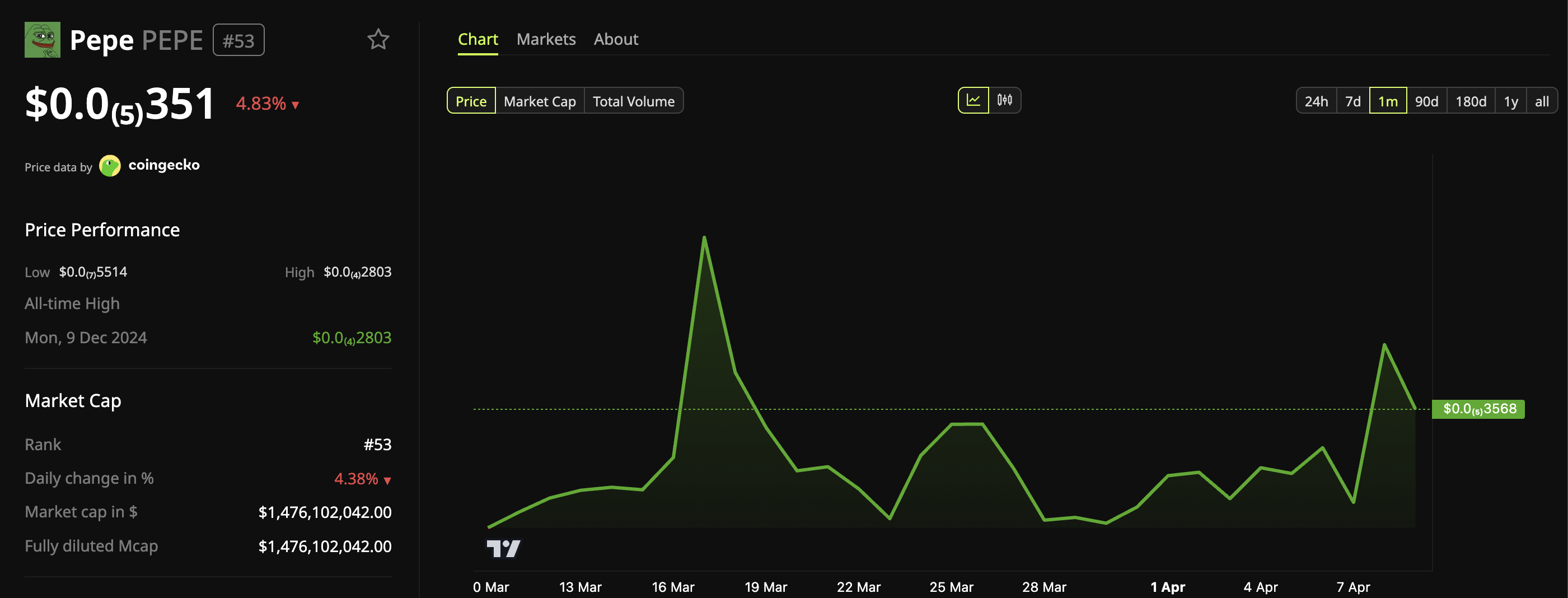
The token fell by more than 4.8% over 24 hours as broader geopolitical uncertainty continued to pressure risk assets.
Subscribe to our YouTube channel to watch leaders and journalists provide expert insights
The post Canary Capital Pushes Crypto ETF Frontier Further With PEPE Filing appeared first on BeInCrypto.


Bitcoin’s push toward $73,000 has lost traction, leaving the market exposed to renewed downside risks as macro uncertainty returned.
Summary
- Bitcoin rally to $72,698 stalled at resistance, triggering over $150M in long liquidations.
- Ceasefire tensions resurfaced after officials called the deal a “fragile truce” and reports pointed to violations.
The flagship cryptocurrency climbed to a weekly high of $72,698 on Tuesday, gaining nearly 6% in under four hours as global markets responded to news of a two-week ceasefire agreement between the United States and Iran.
Bitcoin rose as risk sentiment improved, as expectations that the Strait of Hormuz could reopen helped ease supply concerns.
However, the short period of euphoria faded quickly near the $72,000 level. A wave of liquidations hit derivatives markets at that point. More than $150 million in long positions were wiped out, confirming that bullish conviction remains weak at higher levels.
Price action also continued to track movements in traditional markets, with Bitcoin showing a tight correlation to S&P 500 futures during the rally. The link points to a market still heavily influenced by macro headlines rather than internal crypto-specific drivers.
Now, tensions surrounding the ceasefire have since raised fresh concerns. US Vice President JD Vance described the agreement as a “fragile truce,” while developments on the ground painted a less stable picture.
Reports from the Levant indicated repeated violations, with Israel launching “Operation Eternal Darkness” targeting underground infrastructure tied to Hezbollah in Lebanon.
Israeli officials maintained that their operations fall outside the scope of the Iran ceasefire, citing strategic independence.
Further strain came after Iran’s parliamentary speaker accused Washington of violating “the spirit of the roadmap,” warning that Tehran could resume strikes if attacks on its allies continue.
Any breakdown in the agreement risks reigniting conflict, a scenario that could weigh heavily on risk assets, including cryptocurrencies.
Market positioning remains sensitive to these developments. Bitcoin has struggled to secure a firm hold above $70,000 over the past week, and a sustained move below that level could open the door for a retest of the $64,000 support zone.
At last check, Bitcoin was trading just above $71,000, down less than 1% over the past 24 hours, as traders weighed the combined impact of geopolitical instability and shifting policy expectations.
Attention has also turned to monetary policy signals. Minutes from the Federal Reserve’s March 17–18 meeting showed that officials voted 11–1 to keep rates unchanged at 3.5% to 3.75%, while leaving the door open for potential cuts later this year.
The details of the discussion, however, pointed to caution. Policymakers signaled that any move toward easing would depend on inflation staying contained, particularly as energy prices remain a concern. Some members indicated that a tighter policy could still be required if price pressures persist.
Interest rate expectations continue to play a key role in crypto market sentiment. While lower rates tend to support risk assets, uncertainty around the timing of cuts can dampen demand and increase volatility.
Despite all the negative geopolitical headwinds, Bitcoin price could find some support and potentially decouple from traditional risk-off sentiment if reports of Iran circumventing traditional financial sanctions by using Bitcoin to facilitate trade at the Strait of Hormuz are confirmed.
On April 8, several regional maritime intelligence outlets reported that the Iranian Revolutionary Guard Corps (IRGC) was charging transit fees for commercial vessels with the option for direct payment in Bitcoin. If this is confirmed, it could help keep momentum afloat by providing a fundamental floor of demand in the short-term.

Polygon Labs is reportedly in early-stage fundraising discussions to back a new stablecoin payments business, aiming to raise as much as $100 million.
The firm is looking to sell equity shares worth between $50 million and $100 million in the new stablecoin unit.
Follow us on X to get the latest news as it happens
The fundraising push comes as broader crypto markets remain under pressure. The new venture might be a strategic move for the firm “to diversify out of a market that has stalled,” The Information noted.
In January, Polygon signed definitive agreements to acquire payments firm Coinme and wallet infrastructure provider Sequence.
“Together with Polygon’s blockchain rails, these acquisitions complete the core infrastructure required to offer regulated stablecoin payments in the U.S. and beyond, forming the foundation for Open Money Stack,” the announcement read.
The timing of Polygon’s pivot aligns with strong growth across the stablecoin sector. In 2025, stablecoins processed $28 trillion in real economic volume, according to Chainalysis.
BeInCrypto also reported that stablecoin monthly transaction volume then reached $7.2 trillion in February 2026, overtaking the Automated Clearing House (ACH) network’s $6.8 trillion for the first time.
Industry projections reinforce the long-term thesis. At XRP Tokyo 2026, Ripple shared a flyer projecting $33 trillion in onchain stablecoin volume for 2026. Meanwhile, Chainalysis estimates that adjusted stablecoin volume could reach $719 trillion by 2035 through organic growth alone.
Subscribe to our YouTube channel to watch leaders and journalists provide expert insights
The post Polygon Reportedly Targets $100 Million for Stablecoin Venture as Crypto Market Stalls appeared first on BeInCrypto.
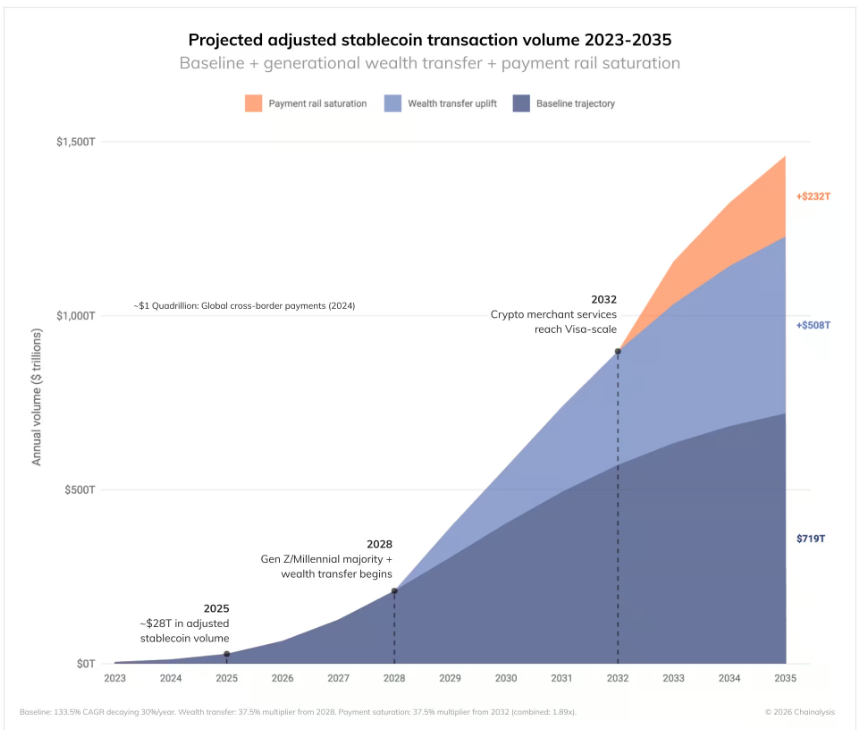
Blockchain analysis firm Chainalysis estimates that stablecoin volumes could hit a lofty $1.5 quadrillion within the next decade, beating the total volume of global cross-border payments today.
In a report on Wednesday, the Chainalysis team said that adjusted stablecoin volume could hit $719 trillion by 2035 just through organic growth, up from $28 trillion in 2025.
However, this figure could double by 2035 if two major catalysts come into play, said Chainalysis — the baby boomer generation passing $100 trillion in wealth to a crypto-loving generation and stablecoins knocking over traditional payment rails to become the default payment infrastructure.
“Factor in these catalysts, and our projections change: 2035 volumes could approach $1.5 quadrillion, a figure that would surpass the estimated $1 quadrillion in global cross-border payments today,” Chainalysis said.

The figure, should it come to pass, suggests that the stablecoin industry is extremely undervalued. It could be seen as a very generous estimate, as it would eclipse the annual volume of cross-border remittances, which was estimated at $865 billion in 2023 and $905 billion in 2024.
The number is even higher than World Population Review’s latest estimate of the total value of all global assets across banks, property and cash, which is around $662 trillion.
Even the $719 trillion would mean that stablecoins would need to continue their compound annual growth rate of 133% for the next decade.
$1.5 quadrillion stablecoin volume possible: Analyst
Rachael Lucas, a crypto analyst at Australian crypto exchange BTC Markets, told Cointelegraph $1.5 quadrillion is “a ceiling-case scenario, not a base case,” but said it could be possible, because growth is accelerating.
She also noted that volume measures how many times money moves, not how much exists; the same dollar can settle dozens of transactions a day.
Related: Stablecoin yields won’t harm banks, White House economists say
“The infrastructure is being built right now. Stripe acquiring Bridge, Mastercard partnering with BVNK, these are operational bets, not experiments. Add regulatory clarity from the GENIUS Act, and institutional participation can scale in ways that simply were not possible before,” she added.
“The generational wealth transfer will do the rest. Millennials and Gen Z are the first generations for whom on-chain is a default, not a deliberate choice.”
A January OKX survey found that among younger Americans, 40% of Gen Z and 36% of Millennials plan to increase their crypto activity this year, compared with 11% of Boomers.
Meanwhile, stablecoins are frequently cited as a major driver of crypto adoption. A September report by EY-Parthenon, the strategy consulting division of Ernst & Young, found that 13% of financial institutions and corporates globally use stablecoins and 54% of non-users expect to adopt them within 12 months.
Magazine: No more 85% Bitcoin collapses, Taiwan needs BTC war reserve: Hodler’s Digest
Bitcoin (BTC) miner Cango announced that it sold 2,000 BTC in March 2026. The firm used the proceeds to retire outstanding Bitcoin-backed loans.
The sale left the miner with a treasury of 1,025.69 BTC and $30.6 million in remaining loan obligations.
Cango Sheds 2,000 BTC and Debt in One Move
The firm said that this deleveraging, combined with recent capital infusions, including a $65 million equity investment from members of the company’s leadership team and a $10 million convertible bond from DL Holdings, has significantly strengthened its balance sheet.
“Collectively, these measures provide a solid financial foundation to navigate market volatility and support the Company’s planned transition into energy and AI infrastructure,” the press release read.
On the cost side, the company brought its average cash cost per coin down to $68,215 in March, a 19.3% drop from Q4 2025’s $84,552 in Q4 2025. It also decommissioned inefficient miners and shifted to hashrate leasing in regions with high hosting fees.
Subscribe to our YouTube channel to watch leaders and journalists provide expert insights
An Industry-Wide Bitcoin Selloff
Cango is not the only miner offloading BTC. Riot Platforms sold 3,778 BTC in Q1 2026 for roughly $289.5 million, more than 2.5 times its quarterly production. The company ended the quarter holding 15,680 BTC, down 18% from its 2025 close.
MARA went further, selling 15,133 BTC for approximately $1.1 billion in March. The firm directed the proceeds to retire over $1 billion in face value convertible debt.
On-chain tracker Lookonchain flagged additional transfers by both miners in early April, suggesting the selling has continued into Q2.
“Bitcoin miner MARA transferred out 250 BTC ($17.37 million) again,” the firm posted on April 7.
Follow us on X to get the latest news as it happens
Miners are selling into an environment where AI is increasingly competing for data center rack space. This shift is likely pushing Bitcoin mining towards more intermittent and cheaper power sources over the long term.
CoinShares estimates listed miners could derive as much as 70% of their revenue from AI by the end of 2026, up from roughly 30% at present.
The post Cango Sells 2,000 BTC to Retire Loans as Bitcoin Miners Ramp Up Liquidations appeared first on BeInCrypto.
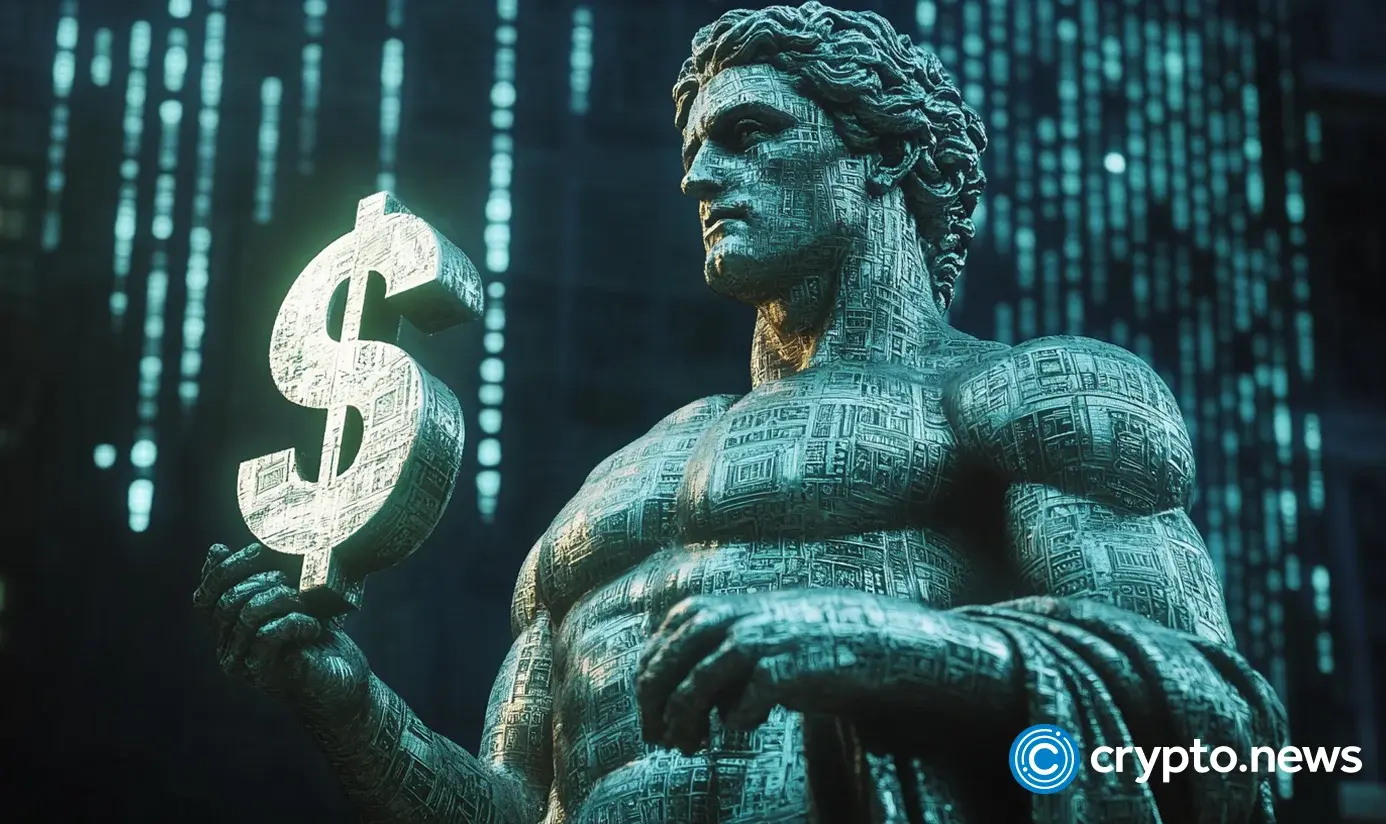
The U.S. Treasury Department has laid out a fresh set of expectations for stablecoin issuers, focusing on how firms must address illicit finance risks under the GENIUS Act.
Summary
- Treasury has proposed AML and sanctions rules that will bring stablecoin issuers under Bank Secrecy Act compliance.
- Issuers are required to build systems to block, freeze, or reject transactions and have appointed a US based compliance lead.
In a notice issued Wednesday, the department confirmed that its Financial Crimes Enforcement Network and Office of Foreign Assets Control had jointly proposed rules aimed at translating the law into operational requirements.
The proposal stems from provisions within the GENIUS Act, signed into law in July 2025, as regulators continue working to translate the legislation into enforceable rules.
According to the proposal, payment stablecoin issuers will need to put in place anti money laundering and counter terrorism financing programs, alongside sanctions compliance frameworks. The rules also require firms to build systems capable of identifying and acting on suspicious activity, including the ability to “block, freeze, and reject” transactions when necessary.
Authorities are effectively placing stablecoin issuers within the same regulatory perimeter as traditional financial institutions. By bringing them under the Bank Secrecy Act, the framework requires issuers to support law enforcement efforts tied to financial crime detection and prevention.
Further, each issuer must appoint a designated individual responsible for compliance systems, with eligibility limited to U.S.-based personnel who have no record of financial misconduct such as fraud, cybercrime, or insider trading.
“President Trump is strengthening American leadership in digital financial technology,” Treasury Secretary Scott Bessent said, adding that the proposal would “protect the U.S. financial system from national security threats without hindering American companies’ ability to forge ahead in the payment stablecoin ecosystem.”
FinCEN has opened a 60-day public comment period for feedback on the proposed rules.
GENIUS Act enforcement begins to take shape
Work on implementing the GENIUS Act has been unfolding across multiple agencies. FinCEN and OFAC are the latest agencies who have outlined their approach, following recent proposals from the Federal Deposit Insurance Corporation and earlier guidance issued by the Office of the Comptroller of the Currency.
The FDIC clarified that stablecoin holders themselves would not receive deposit insurance under the framework, though reserves backing issued tokens would be protected.
Parallel discussions have also been underway on how oversight responsibilities will be shared between federal and state authorities, particularly for smaller issuers that may qualify for state level supervision if they meet required standards.
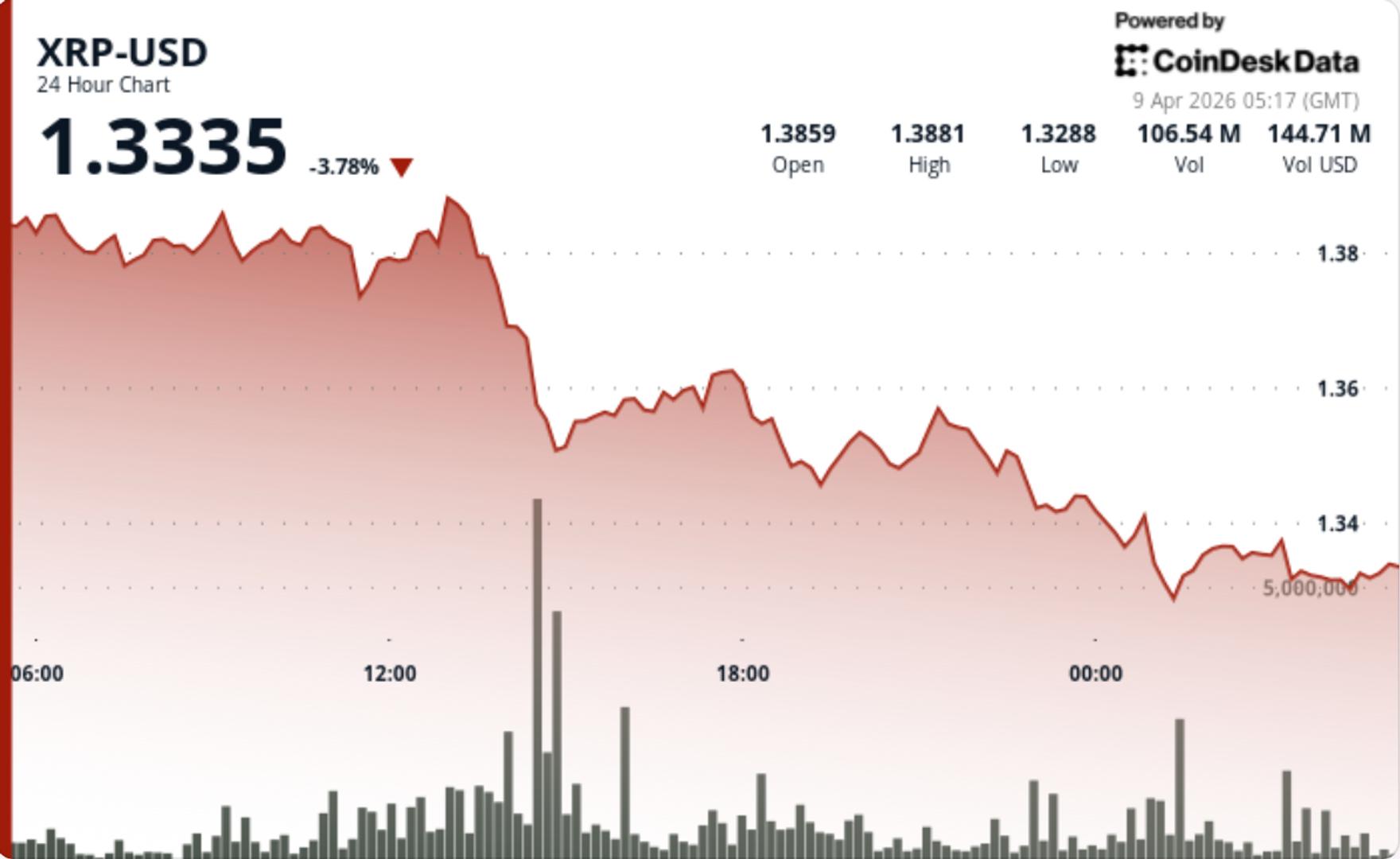
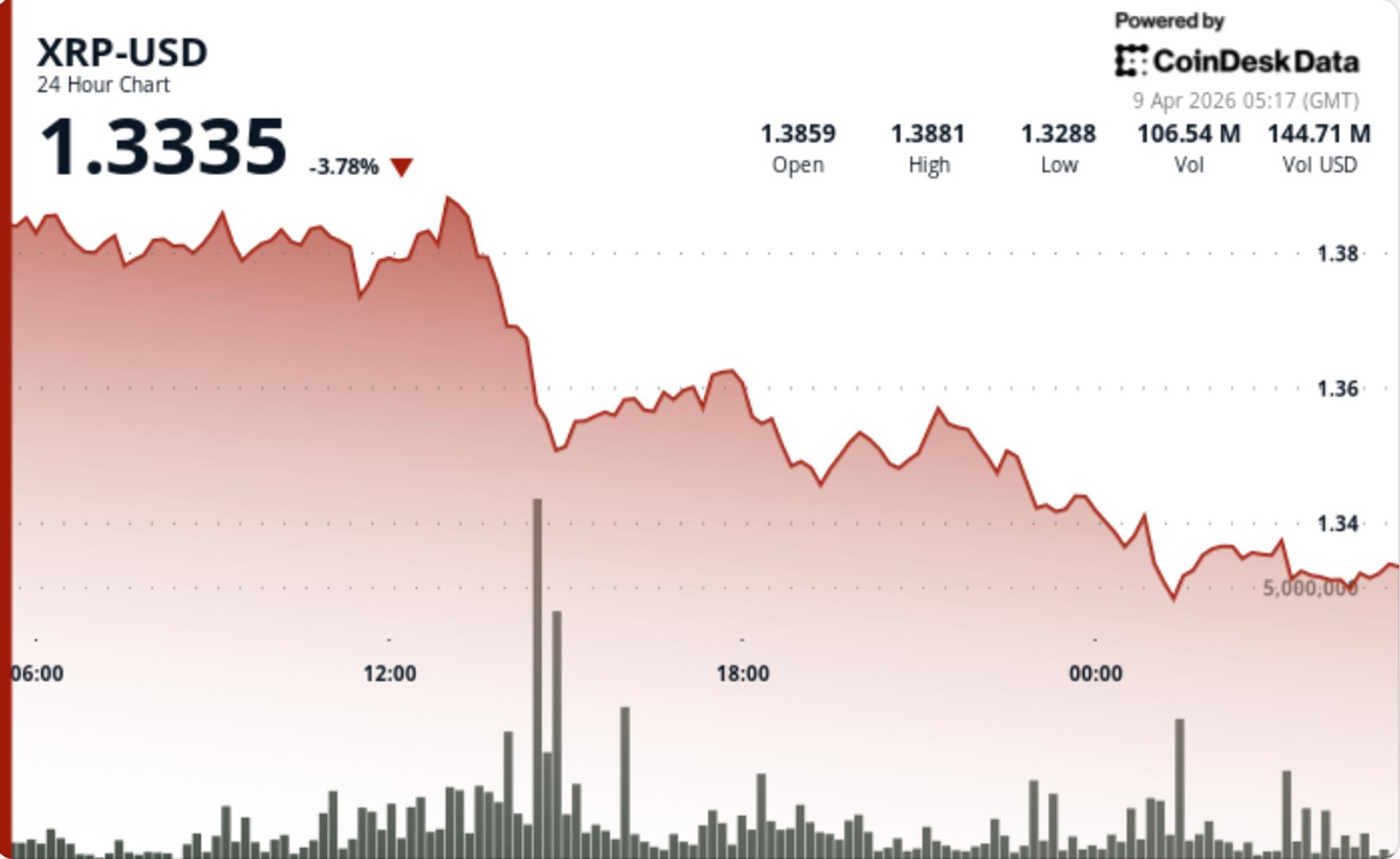
XRP dropped back toward $1.33 after failing to hold recent gains, with selling pressure still outweighing buying even as inflows turned slightly positive. The move suggests rallies are being used to exit positions, not build new ones, keeping the broader structure weak.
News Background
Ripple-linked products saw $3.32M in ETF inflows, marking a shift from March outflows but not enough to stabilize price.
At the same time, exchange liquidity has thinned sharply, increasing the risk of sharper moves once key levels break.
Price Action Summary
XRP declined from $1.37 to $1.33, with the breakdown accelerating after rejection near $1.38.
High-volume selling confirmed the move, with price failing to hold above $1.35 and forming lower highs into the close.
Late-session volatility pushed XRP to $1.31 before a minor stabilization, but recovery attempts remained weak.
Technical Analysis
The key signal is rising volume alongside falling price, which points to distribution rather than accumulation.
Repeated rejection near $1.37-$1.38 reinforces that supply remains heavy at those levels.
XRP also underperformed the broader market, showing capital is rotating elsewhere rather than into the token.
With price still below major moving averages and within a descending structure, the broader trend remains intact.
What traders should watch
$1.33 is immediate support, but the real level is $1.28 — a break there likely accelerates downside.
On the upside, XRP needs to reclaim $1.35 and then $1.38 to shift short-term momentum.
Until that happens, the setup remains one of weak bounces within a broader downtrend.


Summary
- OnchainLens flagged trader “Techno Revenant” unstaking about 2.4 million HYPE worth roughly $93.7 million after a six-month lock.
- The same address reportedly turned a $15 million seed bet on Trump-linked World Liberty Financial into about $250 million, or 1% of WLFI supply.
- No clear on-chain signal yet shows whether the HYPE will be sold, restaked, or used as collateral, leaving traders to front-run potential supply overhang.
A whale wallet tied to pseudonymous trader “Techno Revenant” has just unstaked roughly 2.4 million HYPE tokens after a six‑month lock-up, freeing an estimated $93.7 million worth of supply with no immediate indication of whether the position will be dumped, restaked, or redeployed into new trades, according to on-chain monitoring outlet OnchainLens. KuCoin’s community desk previously highlighted a similar move when “techno revenant is unstaking 2.42m $HYPE ($90.3m usd),” underscoring how quickly large unlocks around the $90–$120 million range can spook liquidity and order books. Tools like OnchainLens and Lookonchain have tagged multiple HYPE wallets to the trader, making his flows a de facto sentiment proxy for the broader market.
The same trader has a track record of outsized early-stage bets, most notably on the Trump-linked DeFi project World Liberty Financial (WLFI). “According to blockchain records, the trader allocated $15 million to WLFI during its token sale last year, acquiring 1% of the overall supply,” reported a September 2025 feature on the trade, which added that the position was worth around $250 million at launch. Research firm Arkham later labeled the top WLFI individual holder address moonmanifest.eth as belonging to Techno Revenant, noting that it had “invested about 15 million dollars in the first public round… which anchors a notable cost basis for potential inventory management.”
PANews, citing Lookonchain data, reported that a whale suspected to be Techno Revenant previously withdrew 2.39 million HYPE “valued at approximately $122 million,” accumulated nine months earlier at roughly $12 per token, leaving “unrealized gains exceeding $90 million.” That earlier withdrawal was framed as a classic supply-overhang event: “A whale (likely @Techno_Revenant) withdrew all 2.39M $HYPE($122M) 4 hours ago and could be selling for profit at any time,” one Binance Square alert warned.
In a previous crypto.news story on whale-driven volatility, analysts pointed out how concentrated positions can flip from silent support to sharp downside catalysts once unlocks hit and cost bases are deep in profit. Another crypto.news story on World Liberty Financial detailed how Trump’s political brand supercharged WLFI demand and liquidity, helping early whales like Techno Revenant exit with triple‑digit‑million windfalls. A third story on on-chain surveillance tools highlighted how feeds from platforms such as Arkham and Lookonchain have become must-watch for traders trying to front-run or fade the next whale move in thinly supplied tokens like HYPE and WLFI.
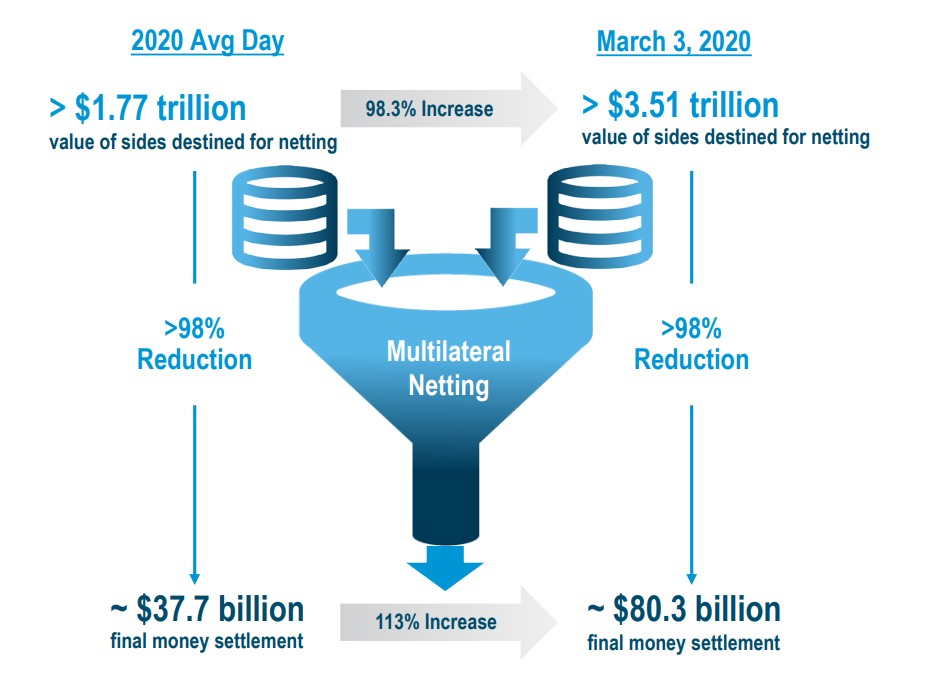
Crypto’s push for instant settlement is creating a capital inefficiency problem, forcing trading firms to fund every transaction in full and raising concerns about how the market can scale as volumes grow.
In practice, that usually means that firms cannot offset what they owe against what they are owed, forcing them to move more capital than necessary to settle trades.
Ethan Buchman, founder of Cycles Protocol and a co-founder of Cosmos, says crypto markets are “asset-brained.” He argues it treats the financial system like a global stock market where value is constantly moved and swapped.
“But that misses the whole other side of the balance sheet, which is liabilities, and every movement of assets is in service of discharging a liability,” Buchman told Cointelegraph.
Crypto optimized for instant settlement, stripping out the batching and netting that let traditional finance conserve liquidity. At the base layer, that design creates pressure to reintroduce clearing for the industry to scale further.

The logic behind TradFi’s delayed settlement
Clearing is the process of reconciling and netting obligations before settlement, allowing participants to offset what they owe against what they are owed, so only the difference needs to move.
For example, if Alice owes Bob $100 and Bob owes Alice $90, clearing means Alice only pays $10 instead of moving the full amounts both ways.
In traditional financial systems, settlement delays give time to batch and net trades before final payment.
“A lot of people look at T+2 settlement and think it’s inefficient and should be instant — that misses the point. Some of that delay exists to give time for batching and clearing,” Buchman said.
This happens at scale through clearinghouses like the Depository Trust & Clearing Corporation, which act as central counterparties that net obligations and manage settlement risk. As a result, financial systems can compress large volumes of transactions into much smaller net flows.
Before central banks, merchants at European trade fairs settled debts by netting obligations across multiple parties, reducing the need to move physical money. Over time, these practices evolved into more formal clearing systems.
Buchman also pointed to later experiments in Yugoslavia and Slovenia as examples of multilateral netting at scale.

Related: Prediction markets are testing legal limits in strict Asian markets
Following independence in 1991, Slovenia turned to multilateral set-off systems to manage liquidity during periods of economic stress. As inflation surged and output contracted, authorities used centralized payment infrastructure to coordinate obligations across firms, netting debts before settlement.
The system, later formalized through software known as “TETRIS,” applied liquidity-saving mechanisms to reduce how much capital needed to move, helping businesses continue operating despite widespread payment constraints.
Crypto’s instant settlement locks up liquidity
Instead of designing systems that batch and net obligations, most crypto markets are built around instant, atomic settlement, where each transaction is finalized independently.
For example, put simply, if Alice sends 10 ETH to Bob for a trade, that transfer is fully settled onchain at execution. If Bob later owes Alice 9 ETH from another trade, that is processed as a separate transaction rather than being netted against the first. Instead of settling a 1 ETH difference, the system processes 19 ETH of transfers across two transactions.
Across many trades, this forces participants to continuously move and pre-fund capital, even when their net exposure is close to flat.
“That means you need way more capital in the system than you otherwise would,” Buchman said.
Instant settlement removes counterparty risk, but it also removes the ability to offset positions across a broader network of participants. That compression layer is largely missing in crypto, which means more capital is required to support the same level of activity.

Related: Ethereum’s EEZ and the attempt to rebuild one Ethereum
“There is a kind of ceiling on how much trade you can do, depending on how much actual assets and capital you have to meet it,” Buchman said.
“A lot of the firms are doing a lot of trading on credit with each other, but then when it comes time for settlement, they have to scramble for the assets,” he said.
That forces crypto companies to overcollateralize positions on exchanges and lending platforms, tying up capital that could otherwise be deployed elsewhere. In periods of stress, the problem becomes more acute, as firms are left trying to meet settlement obligations while liquidity tightens.
The missing primitive is clearing, now being rebuilt without intermediaries
Replicating clearing in its traditional form requires building a central counterparty. The model may sit uneasily with an industry aiming to replace financial intermediaries with decentralized infrastructure.
Clearing entities are among the most heavily regulated and trust-intensive institutions in finance, Buchman said. They absorb default risk, stand between participants and require deep coordination to function.
Crypto avoided that model and instead fragmented clearing. Bilateral arrangements and off-exchange settlement venues introduced limited netting, but mostly within closed networks of trust, leaving the core problem unresolved.
Buchman and Cycles propose a coordination layer that nets obligations across participants before settlement, without acting as a central counterparty or taking custody of funds.
Its effectiveness, however, depends on broad participation and visibility into obligations, which may be difficult to achieve in a fragmented market where firms operate across venues and are reluctant to share exposures. Without a central counterparty, the system also does not absorb default risk, leaving participants to manage counterparty exposure themselves.
Coordinating multilateral netting across independent actors could also introduce operational complexity, particularly during periods of market stress when liquidity is already constrained.
Buchman argues this can be addressed using cryptographic techniques, with obligations posted privately onchain, netted in software and verified using zero-knowledge proofs.
In that sense, the trade-off for crypto is that trust in an institution is replaced by trust in the protocol’s design.
Magazine: ‘Phantom Bitcoin’ checks, Drift hack linked to North Korea: Asia Express


Bitcoin’s next big move may have less to do with crypto fundamentals and more to do with the direction of oil prices.
The leading cryptocurrency by market value has rebounded to $70,900 from early-week lows near $67,000, tracking a broader risk-on move after the U.S. and Iran agreed to a two-week ceasefire late Tuesday that sent oil prices tumbling roughly 15% to below $100 a barrel.
Bitcoin has been here before – prices have climbed above the $70,000 mark several times in recent weeks, only for the rallies to fizzle out quickly, underscoring the lack of sustained upside momentum.
Will it be different this time? It largely depends on whether oil price weakness sustains, according to analysts at crypto exchange Bitfinex.
“A 15–16 percent collapse in crude, if sustained, materially brings forward the potential cut window. Futures markets will likely reprice additional rate-cut probability for late 2026, which is a structural tailwind for non-yielding risk assets, including bitcoin,” analysts said in a market update.
A sustained decline in oil prices could ripple through the global economy, partially unwinding the inflationary shock triggered by the March surge and giving the Federal Reserve and other major central banks greater room to cut rates later this year.
Should that happen, bitcoin could rally to $80,000, with gains driven by the unwinding of short positions.
“Bitcoin is sitting at $72,000, pressing into a massive cluster of short liquidity. Derivatives heatmaps show roughly $6 billion in leveraged shorts concentrated between $72,200 and $73,500, with peak density around $72,500. If spot demand can force the price through that zone, the resulting liquidation cascade would likely catapult Bitcoin through the supply gap toward $80,000,” Adam Saville Brown, head of commercial at Tesseract Group, said in an email.
However, as of now, rate-cut expectations remain muted. Per some analysts, the recent rise in energy costs risks keeping inflation elevated without significantly denting demand, potentially locking the Fed into a prolonged holding pattern in which rates stay at 3.5% with neither hikes nor cuts on the table.
The ceasefire between Iran and the U.S. appears to have already unraveled, according to media reports. Tensions flared after Israel launched intense strikes in Lebanon, saying the territory was not covered under the agreement — a claim that contradicted the supposed mediator, Pakistan. In a further escalation, an Iranian news agency reported that oil traffic through the Strait of Hormuz was halted again, just hours after the first tankers were allowed to pass, citing the renewed hostilities.
This means that oil could rally again, triggering risk aversion if the warring parties fail to reach an agreement in the coming days.
“The bear case is simpler: if talks collapse, oil rips back above $100, and we’re back to where we were ten days ago. The two-week window creates a binary setup that derivatives markets will price aggressively,” Brown said.
Bitfinex analysts said that oil could rise to $120 if the Strait of Hormuz remains closed, denting prospects of Fed rate cuts.
“This creates a known binary event approximately 13 days out. Participants holding risk exposure are working within a two-week window. The oil move has been priced; a ceasefire collapse would be incrementally more damaging than the original shock,” analysts noted.

Michelle Obama Says We’re In The ‘Janky Version’ Of America

ACCA F3/FIA – Chapter 1 – Introduction to Financial Reporting (Part 1) (HINDI)

Pro-Iran memes use AI to troll US President Donald Trump


-

 NewsBeat6 days ago
Steven Gerrard disagrees with Gary Neville over ‘shock’ Chelsea and Arsenal claim | Football
-

 Business6 days ago
No Jackpot Winner and $194 Million Prize Rolls Over
-

 Fashion6 days ago
Weekend Open Thread: Spanx – Corporette.com
-

 Business5 days ago
Expert Picks for Every Need
-

 Business3 days ago
Three Gulf funds agree to back Paramount’s $81 billion takeover of Warner, WSJ reports
-

 Sports4 days ago
India men’s 4x400m and mixed 4x100m relay teams register big progress | Other Sports News
-

 Tech1 day ago
How Long Can You Drive With Expired Registration? What Florida Law Says
-
Business4 days ago
No Jackpot Winner, Prize to Climb to $231 Million
-

 Fashion3 days ago
Massimo Dutti Offers Inspiration for Your Summer Mood Board
-

 Tech7 days ago
Commonwealth Fusion Systems leans on magnets for near-term revenue
-
Politics6 days ago
Wings Over Scotland | The quality of mercy
-

 Fashion2 days ago
Let’s Discuss: DEI in 2026
-

 Business4 days ago
Akebia Therapeutics, Inc. (AKBA) Discusses Pipeline Progress and Strategic Focus on Kidney Disease Treatments at R&D Day – Slideshow
-

 Fashion6 days ago
Statement Sunglasses: The Accessory Shaping Modern Fashion
-
Sports7 days ago
Justin Jefferson’s Situation Remains Unchanged after JSN’s Deal
-

 Tech7 days ago
Every 3D Printable Film Camera, In One Place
-

 Politics6 days ago
East Jerusalem Palestinian families eviction orders
-

 Tech7 days ago
Larger, More Spacious 2027 Kia Seltos Debuts With New Hybrid Variant
-

 Fashion7 days ago
Thursday’s Workwear Report: Merino Wool Blend Short-Sleeved Sweater
-

 Fashion6 days ago
For Love & Lemons’ Spring 2026 Line is for the Romantics
You must be logged in to post a comment Login