
Crypto World
Bitcoin Price Eyes $80,000 Liquidity Grab as ETFs Resume Buying BTC

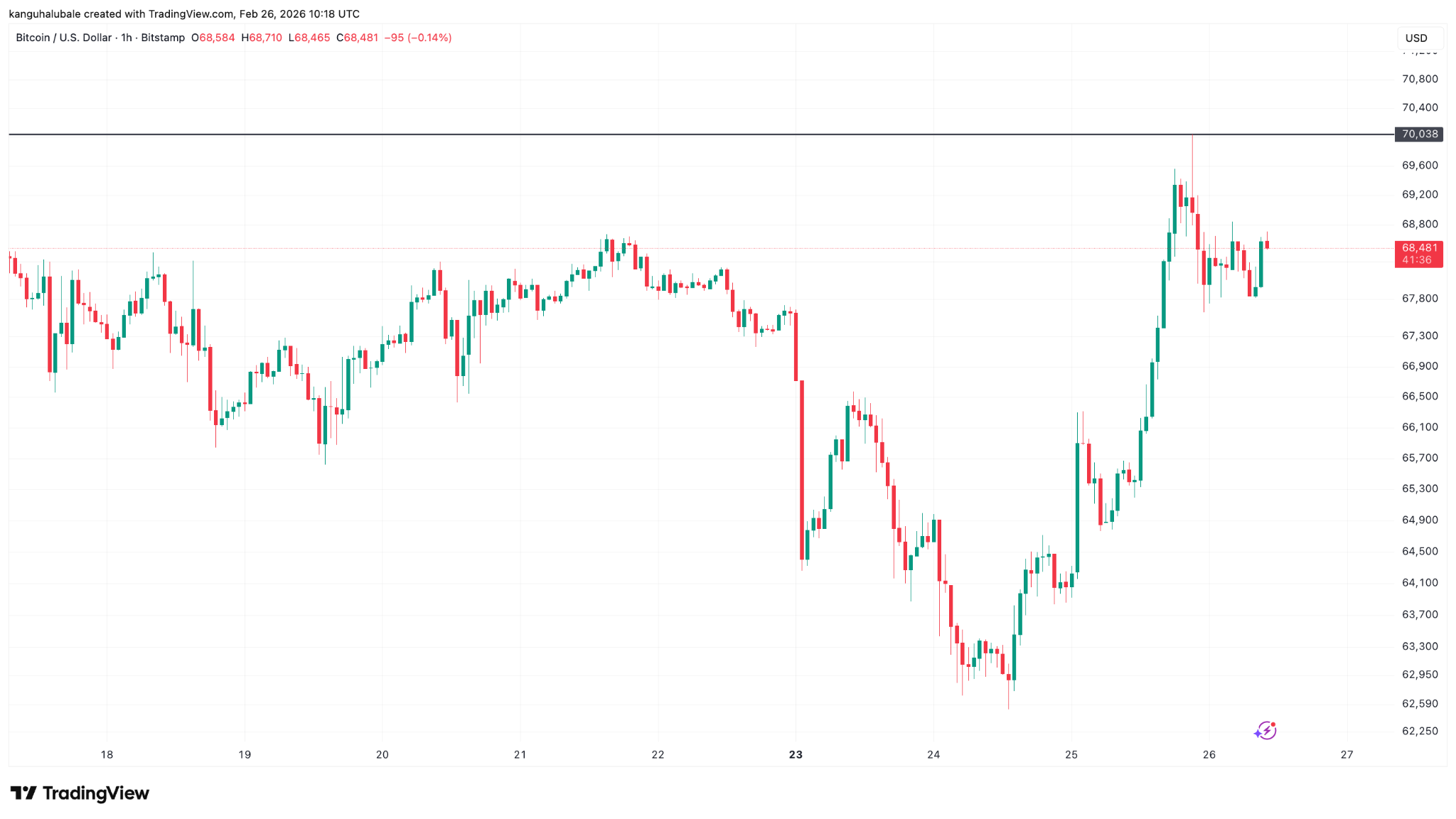
Bitcoin (BTC) tapped $70,000 during Wednesday’s New York session as bulls targeted sell liquidity.
Key takeaways:
-
BTC price support must hold above a key trendline at $68,000 for the rebound to continue.
-
$80,000 is a key level to watch as the next big liquidation cluster above.
-
Spot Bitcoin ETF inflows attracted half a billion dollars in inflows on Wednesday.

Bitcoin must close week above $68,000
Data from TradingView showed the BTC/USD pair at $68,480 on Bitstamp. This is just above the 200-week exponential moving average (EMA), which is currently at $68,338.
Related: Bitcoin tops $69.5K after stocks rebound, strong earnings data boost risk appetite
Analyst Rekt Capital spotted Bitcoin facing resistance from this trendline, saying that the latest recovery could turn into a “post-breakdown retest of the EMA into new resistance” based on historical price action.
“The moment of truth is coming for Bitcoin,” Rekt Capital said, adding:
“Bitcoin will need a Weekly Close back above the EMA and flip it into new support to go against the grain of history.”

Zooming in, fellow analyst Jelle said that the price needs to turn the 50 EMA (at $68,000) on the four-hour chart into support to confirm the recovery.

As Cointelegraph reported, the BTC/USD pair may rally to $74,508, where sellers are likely to step in, if the 20-day EMA, currently at $69,220, is broken by the bulls.
Will liquidations drive BTC price to $80,000?
Several traders are anticipating a possible liquidity grab where a cluster of ask-orders are placed above $72,000.
The latest data from monitoring resource CoinGlass showed BTC price tapping the liquidity around $70,000, with the bulk of interest still clustered above the spot price.
About $2 billion in ask orders are sitting between $72,450 and $75,000.

If the $75,000 level is broken, it could spark a liquidation squeeze, forcing short sellers to close positions and driving prices toward $80,000, the next major liquidity cluster.
“Bitcoin’s liquidity hunt has only just started,” analyst AlphaBTC said in his latest post on X, adding:
“Unless there is a catalyst to drop, I am expecting these higher levels to get run in the next few weeks.”
Spot Bitcoin ETF inflows support BTC’s upside
Institutional demand is showing signs of a comeback, with US-based spot Bitcoin ETFs recording inflows for two consecutive days, according to data from Farside Investors.
Investors poured a total of $765 million into these investment products on Tuesday and Wednesday, with $507 million flowing into the funds Wednesday, the largest since Feb. 2.

“ETF inflows and short liquidations doing the heavy lifting,” X user Raster said in a recent post, adding:
“This isn’t retail FOMO, it’s institutional accumulation with a technical breakout.”
This growing demand-side pressure could push BTC prices higher, particularly if combined with growing adoption and whale accumulation.

This article does not contain investment advice or recommendations. Every investment and trading move involves risk, and readers should conduct their own research when making a decision. While we strive to provide accurate and timely information, Cointelegraph does not guarantee the accuracy, completeness, or reliability of any information in this article. This article may contain forward-looking statements that are subject to risks and uncertainties. Cointelegraph will not be liable for any loss or damage arising from your reliance on this information.

Crypto World
Newly Launched Outset Media Index Gives Early Users Special Access Benefits in Exchange for Feedback

Outset Media Index (OMI), a newly soft-launched platform for standardizing media benchmarking, is running an early feedback round. The program is designed to turn the first wave of users into active contributors, helping refine how the index works in real-world media, PR, marketing, and research workflows. All participants will receive a level-up upgrade to their current plans in exchange for input.
The feedback round is expected to run for roughly one month ahead of OMI’s full launch. To participate, users must be registered on the platform on any plan, including Free, and complete a dedicated form covering their first experience with the index, which signals they find most useful in practice, and what would make the product more valuable in their day-to-day tasks. The form also includes an option for those who want to proceed with deeper in-person interviews.
The OMI team will reward submitted feedback with expanded platform entry. Users on the Free plan will receive two weeks of bonus access to the Starter plan. Paid subscribers will get a one-month upgrade to the next tier of their current plan.
The early feedback round is a key part of OMI’s soft launch. Rather than treating it as a closed testing period, the company is using it as an open customer development stage focused on learning how different professionals interpret media signals, compare outlets, and apply benchmark data to live decisions. This matters because the same metric can mean different things depending on whether the user is an advertiser, an agency, a publisher, an in-house communications team, or a researcher.
Outset Media Index, designed to provide better structure and comparability across the media landscape, entered soft launch on March 12. The platform currently indexes more than 340 publications with regular crypto coverage, including niche crypto titles as well as finance, technology, and general news outlets with digital asset sections. Its framework includes 37 performance and workflow metrics across reach, engagement, SEO, and practical collaboration factors.
OMI leverages partner data from sources such as Similarweb and Moz, with proprietary metrics and scores that add context to traffic and search behavior data.
For example, Unique Score tracks how consistent unique readership is across several months; Reading Behavior combines time on page, pages per visit, and bounce rate into one easily readable number to show how actively readers interact with the content; and Reprints measures how often coverage is picked up by aggregators or secondary outlets.
Taken together, these metrics feed into broader General and Convenience ratings intended to support strategic analysis and day-to-day execution.
“The goal of OMI is to provide teams with a unified way to analyze media quality and fit,” said Mike Ermolaev, founder and CEO of Outset Media Index. “The media landscape has evolved over recent years to the point where surface traffic numbers alone fail to explain how an outlet actually performs.”
“All inputs that contribute to final rankings are reviewed and normalized under the same methodology,“ added Sofia Belotskaia, product lead at Outset Media Index. “There is no option for media site owners to pay for higher positions or better visibility.”
Inside the platform, users can compare outlets, filter them by business-relevant parameters, and examine detailed profiles with historical context.
Outset Media Index, or OMI, is the first standardized benchmark for media outlets developed by Outset PR. It brings data-driven clarity and structured analysis to how media markets are understood across niches. The platform is used by teams who need meaningful context when planning media activity, allocating budgets, or interpreting how visibility behaves after publication.
By organizing traffic, engagement, SEO, and operational signals within a single analytical framework, it provides a reliable picture of how outlets actually perform beyond surface traffic indicators. Alongside familiar metrics, OMI introduces exclusive decision-ready parameters around audience quality, distribution patterns, and collaboration dynamics – built on years of team’s experience in media analytics.
The methodology is transparent, consistent, and non-negotiable, with no paid rankings or visibility boosts.
Contacts
Business inquiries: sales@omindex.io
Media inquiries: media@omindex.io
Telegram: t.me/omindex
Substack: omindex.substack.com
Disclaimer: This is a Press Release provided by a third party who is responsible for the content. Please conduct your own research before taking any action based on the content.

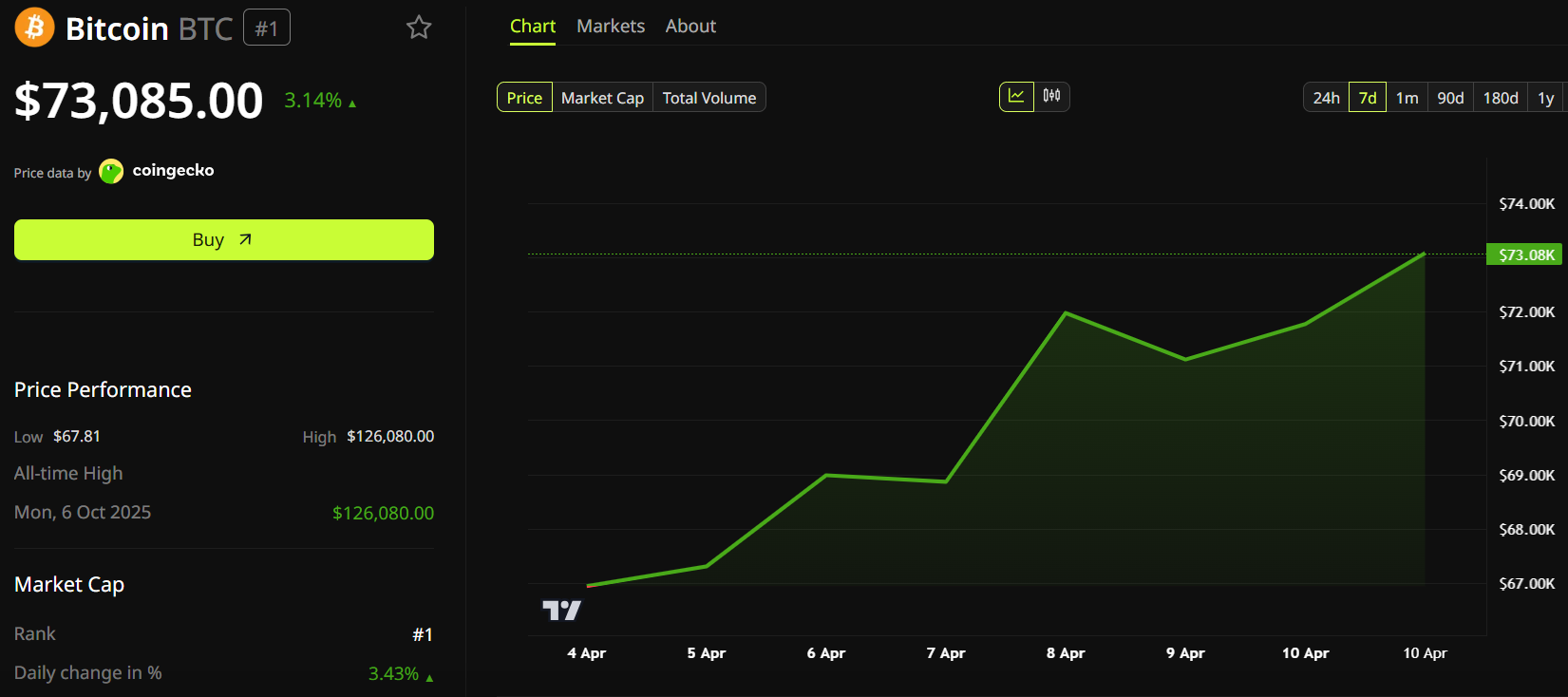
Coinbase Global Head of Investment Research David Duong said the US-Iran ceasefire provided markets with a relief valve, not a full reset, as Bitcoin price tops $73,000.
The two-week truce sent oil back into the low $90s and triggered a broad risk rally. However, Duong argued that underlying constraints from the war have not disappeared.
Why the Ceasefire Rally May Not Last
BTC was trading for $73,085 as of this writing, up by over 3% in the last 24 hours amid risk-on sentiment following the temporary US-Iran ceasefire.
Yet core disputes between the US and Iran remain unresolved. Shipping firms still want security assurances. The Strait of Hormuz may reopen only partially at first.
Meanwhile, the CPI report released Friday showed gasoline prices rose 21.2% in March. The Bureau of Labor Statistics confirmed this was the largest monthly increase since it began tracking the data in 1967.
Headline CPI climbed to 3.3% year over year, up from 2.4% in February.
Labor Data Adds Pressure on the Fed
Nonfarm payrolls rose by 178,000 in March, nearly triple the 65,000 consensus. On the surface, that supports the Federal Reserve keeping rates elevated.
However, Duong noted labor force participation stayed low at 61.9%. Wage growth slowed to 3.5% year over year. Prior payroll prints have also been consistently revised downward.
This leaves the Fed in an uncomfortable middle ground, according to Duong. Growth is softer than headline numbers suggest, but not weak enough to justify imminent rate cuts while war-driven inflation risks persist.
Duong identified $84 as the key oil level to watch. A sustained break below that threshold would signal fading inflation pressure and raise the odds of a quicker resolution.
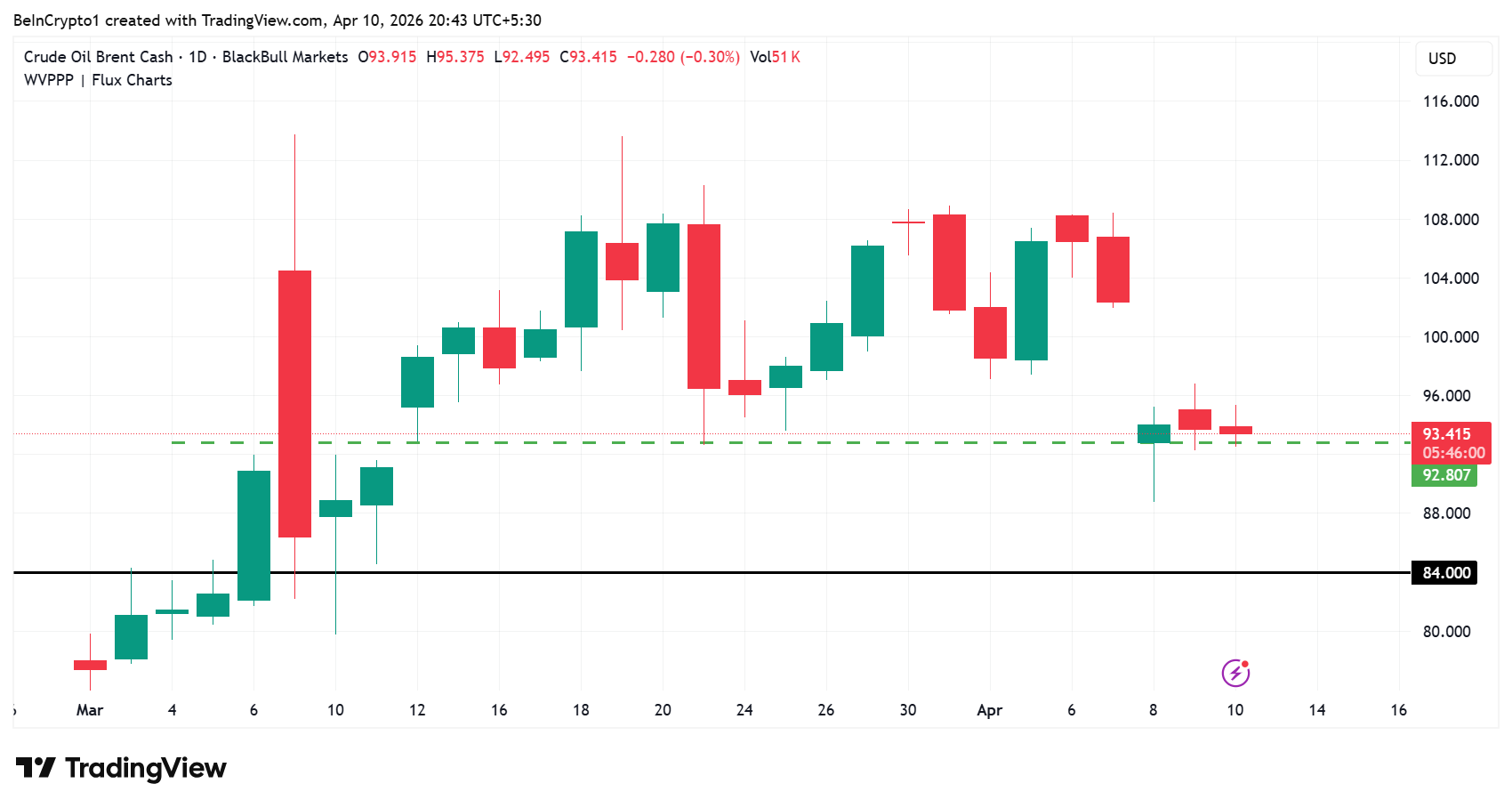
If oil reclaims and holds above $100, markets will likely begin pricing a longer conflict and renewed pressure on risk assets, including BTC.
Friday’s peace talks between the U.S. and Iran could determine whether this relief rally extends or reverses.
The post Bitcoin Hits $73,000 Amid Ceasefire Rally, But Coinbase Chief Gives Caution appeared first on BeInCrypto.


Justin Sun is an adviser to World Liberty Financial, a cryptocurrency project co-founded by President Donald Trump; however, his WLFI tokens have been losing value since the project decided to blacklist them.
In September of last year, the World Liberty team blacklisted 0x5AB26169051d0D96217949ADb91E86e51a5FDA74, a Sun-affiliated address that was labeled as “TRON DAO” on Etherscan.
World Liberty claimed it was blacklisting one address, believed to be Sun’s, because it was “suspected of misappropriation of other holders’ funds.”
Read more: Justin Sun clashes with World Liberty Financial over frozen WLFI
Sun, at the time, took to X to claim that his “address only carried out a few general exchange deposit tests with very small amounts, followed by an address dispersion. No buying or selling was involved” and called on World Liberty to “unlock my tokens.”
In total, Sun had approximately 544 million tokens frozen by this action.
At the time, the WLFI token was trading for $0.22 per token, making Sun’s stake worth approximately $119 million.
Now, the WLFI token trades for approximately $0.09, a fall of approximately 59%.
Sun’s blacklisted stake is currently worth approximately $49 million, a loss of $70 million.
Despite the fact that World Liberty has frozen millions of dollars’ worth of Sun’s wealth, it hasn’t soured his overall relationship with the greater Trump cryptocurrency ecosystem.
The $TRUMP memecoin team recently posted an image that showed that Sun was still at the top of the leaderboard for the upcoming memecoin conference that Trump is planning on hosting/attending/endorsing/profiting from.
This is despite the fact that those tokens aren’t held in a personal account of Sun’s but in an HTX exchange address.
Got a tip? Send us an email securely via Protos Leaks. For more informed news, follow us on X, Bluesky, and Google News, or subscribe to our YouTube channel.

Michael Burry attends “The Big Short” New York premiere at the Ziegfeld Theater in New York, Nov. 23, 2015.
Andrew Toth | Filmmagic | Getty Images
Michael Burry is sticking with his bearish wager against Palantir Technologies, even after a public endorsement from President Donald Trump helped lift the stock.
The investor of the “Big Short” fame said in a Substack post Friday that he continues to hold long-dated put options on the artificial intelligence software firm. Burry said he started betting against the company in the fall of 2025 and has repeatedly rolled the position.
“I now own the June 17 2027 Strike Price 50 Puts and the Decembers 19, 2026 Strike Price 100 Puts. I am not selling these today,” Burry wrote.
Burry’s comments came after Trump praised Palantir in a Truth Social post on Friday, boosting the stock off its intraday lows. Still, the shares were on track for a roughly 13% weekly drop, bringing their 2026 losses to about 28%.
“Palantir Technologies (PLTR) has proven to have great warfighting capabilities and equipment,” Trump wrote. “Just ask our enemies!!!”
The famed investor said the stock has weakened since reaching a peak near $200 last year and remains “wildly overvalued.” While acknowledging the possibility of a near-term rally, Burry argued that the company’s fundamental value is less than half of what it’s worth now.
“Trump’s post rallied the stock after the stock had fallen 18% the last three days. The stock may catch a wind here. It has been selling off with software stocks. As mentioned, I continue to hold the puts, as I believe the fundamental value of this company is well under $50/share,” he said. Palantir traded around $127 per share on Friday.
Some view Palantir as a beneficiary of the Iran war due to the amount of business the software and services vendor has with the U.S. military and intelligence agencies.
During Trump’s second administration, the company has been securing new government contracts and deepening its work with the Pentagon, while CEO Alex Karp has maintained regular engagement with the administration despite earlier tensions.
Last year, Burry’s former hedge fund, Scion Asset Management, disclosed bearish positions against Palantir and AI darling Nvidia, which prompted a sharp reaction from Karp, who called Burry’s wagers “super weird” and “batsh– crazy.”
Key Highlights
- French authorities advocate for enhanced MiCA regulations focusing on dollar-pegged stablecoins
- Enhanced MiCA enforcement introduces mandatory disclosure requirements for non-custodial wallets
- France challenges stablecoin market concentration through reinforced MiCA provisions
- MiCA regulatory expansion accelerates as France intensifies digital asset supervision
- France implements broader crypto transparency measures and stablecoin restrictions via MiCA
French financial authorities advance comprehensive cryptocurrency regulation within the MiCA framework, implementing enhanced surveillance on stablecoins and privately-held digital assets. This initiative demonstrates growing apprehension regarding dollar-denominated tokens and unmonitored wallet transactions. Additionally, regulatory officials coordinate their enforcement strategy with continental initiatives to restructure digital currency governance.
French Central Bank Advocates for Enhanced Stablecoin Restrictions
The Bank of France amplifies demands for reinforced stablecoin oversight within the European Union’s MiCA regulatory structure. Denis Beau advocated for limiting non-euro stablecoin transaction capabilities throughout the bloc. Subsequently, French financial authorities advance comprehensive cryptocurrency regulation within the MiCA framework to diminish foreign currency dominance.
He emphasized that stablecoins pegged to the U.S. dollar command significant global market presence and pose risks to European monetary sovereignty. Accordingly, supervisory bodies seek to decrease dependency on international digital currencies within payment infrastructure. French financial authorities advance comprehensive cryptocurrency regulation within the MiCA framework to bolster euro-denominated options.
Furthermore, policymakers champion central bank digital currency initiatives and tokenized transaction platforms to counterbalance external market control. Developments including Pontes and Appia demonstrate advancement in financial system modernization. French financial authorities advance comprehensive cryptocurrency regulation within the MiCA framework to reinforce domestic payment networks.
France Implements Disclosure Requirements for Private Crypto Wallets
France’s National Assembly enacted legislation addressing privately-controlled crypto wallets through anti-fraud legislation. The regulation mandates yearly disclosure for balances surpassing 5,000 euros. Consequently, French financial authorities advance comprehensive cryptocurrency regulation within the MiCA framework to enhance fiscal transparency.
Regulatory bodies intend to monitor decentralized holdings that function beyond supervised exchanges and institutional custodians. This provision extends surveillance from centralized services to self-managed asset repositories. French financial authorities advance comprehensive cryptocurrency regulation within the MiCA framework to eliminate existing oversight deficiencies.
Legislators and regulatory agencies expressed reservations regarding implementation feasibility and possible information security vulnerabilities. Certain policymakers questioned whether supervisors possess adequate capability to effectively track private wallet transactions. Nevertheless, French financial authorities advance comprehensive cryptocurrency regulation within the MiCA framework notwithstanding practical obstacles.
Europe Harmonizes Regulations With Digital Euro Initiative
European regulatory bodies persist in synchronizing cryptocurrency frameworks with comprehensive monetary and financial security objectives. The proliferation of dollar-collateralized stablecoins continues as a principal regulatory priority across the continent. French financial authorities advance comprehensive cryptocurrency regulation within the MiCA framework to advance strategic independence.
Previously, Italy’s central banking institution observed minimal uptake of MiCA-authorized stablecoins throughout Europe. This pattern underscores the necessity for more robust regulatory mechanisms and promotional measures for euro-based digital assets. French financial authorities advance comprehensive cryptocurrency regulation within the MiCA framework concurrent with digital euro progression.
Forthcoming sector gatherings such as Paris Blockchain Week will convene regulators and business executives. President Emmanuel Macron anticipates delivering remarks on transformations influencing the digital currency landscape. Ultimately, French financial authorities advance comprehensive cryptocurrency regulation within the MiCA framework as Europe consolidates its supervisory position.


Worldcoin will cut WLD’s daily unlock rate by about 43% from July 24, halving community emissions and trimming team and investor unlocks as selling pressure concerns mount.
Summary
- Worldcoin says 4.9b WLD (49% of supply) is unlocked, with around 3.3b in circulation; the daily unlock will fall from ~5.1m WLD to ~2.9m in July.
- Community unlocks drop 50% from 3.2m to 1.6m WLD per day, while team and investor unlocks fall 32% from 1.9m to 1.3m WLD.
- The project stresses WLD’s continuous linear unlocks “with no cliffs,” arguing the on‑chain adjustment is meant to “gradually reduce selling pressure” rather than shock markets.
Worldcoin’s development team has outlined a major change to the WLD token’s emission schedule, saying it will cut the daily unlocking rate by about 43% from late July in a move aimed at gradually easing structural selling pressure. In a blog post on its official site, the project said that from July 24, 2026, the aggregate unlock rate will fall from roughly 5.1 million WLD per day to about 2.9 million, as on‑chain contracts automatically adjust the flow of new tokens to the community, team and early investors.
According to Worldcoin, a total of 4.9 billion WLD — 49% of the token’s 10 billion maximum supply — has been unlocked so far, with approximately 3.3 billion WLD in actual circulation. The project emphasized that WLD uses a continuous linear unlocking mechanism with “no one‑time large unlocks (cliffs),” arguing that the scheduled rate change is “due to established on‑chain contract arrangements” rather than a discretionary decision by the foundation or contributors.
The adjustment will hit different stakeholder buckets in distinct ways. The unlock rate for the “World community” allocation, which covers tokens distributed to users and operators, will be cut from 3.2 million WLD per day to 1.6 million, a 50% reduction. At the same time, the unlock rate for “team and investors” will fall from 1.9 million WLD per day to 1.3 million, a smaller but still significant 32% reduction. In aggregate, daily unlocks drop from about 5.1 million WLD to roughly 2.9 million WLD, a change the team says is intended “to gradually reduce selling pressure” as more of the supply becomes liquid.
The blog frames this as a “tokenomics milestone,” suggesting that the most aggressive phase of emissions is now behind the project. Worldcoin officials argue that a predictable, linearly slowing unlock schedule is better for long‑term holders than either perpetual high emissions or lumpy cliff events that can shock markets.
For traders and existing holders, the immediate takeaway is nuanced. On one hand, a 43% cut in the daily unlock rate mechanically reduces the amount of new WLD that can hit secondary markets each day, all else equal. On the other, nearly half of the total supply is already unlocked, and about 3.3 billion WLD is circulating, meaning that any relief from slower future emissions has to be weighed against the large base of tokens that can already be sold.
Market reaction will ultimately depend on whether demand for WLD — from governance, staking, ecosystem incentives or speculative flows — grows faster than the slowed unlock curve. If activity around the Worldcoin protocol and its associated World ID infrastructure accelerates, the new schedule could help absorb selling and support price. If adoption stalls, slower unlocks alone may not be enough to prevent further dilution for existing holders.


A long-running dispute between OKX founder Star Xu and Binance founder Changpeng “CZ” Zhao resurfaced Thursday, with Xu calling CZ a “habitual liar” in a series of posts on X that revisit allegations dating back more than a decade.
The clash traces back to Zhao’s brief tenure at OKCoin, founded by Xu, when he was accused in 2015 of “harmful acts of conduct” and misleading statements tied to a contract dispute involving Roger Ver, claims Zhao has previously disputed.
This latest flare-up also follows an earlier public disagreement in January, when Xu blamed Binance-linked market dynamics for amplifying the Oct. 10 crypto crash, a claim Binance and other market participants disputed. The latest flare-up was triggered by CZ’s memoir, published earlier this week, Xu said.
He revived the decade-old issues, saying he had no “intention of revisiting these old issues involving CZ [..] but since I’ve been dragged into this again because of the book, let’s restate the facts,” he wrote.
“Out of the blue, Star [Xu] said that I had somehow forged a contract when working there [at OKCoin],” CZ said in his book. “… In May 2015, I got annoyed and made a public post on Reddit, obviously denying forging any contracts … while I was at it, I detailed a few problems I saw at OKCoin.”
Xu, in his recent posts, pointed to a video he said shows evidence of conflicting contract versions and reiterating that Zhao had misled the public about the matter.
“After spending four months in prison, he continues to make false statements to the world,” Xu wrote, adding that “a habitual liar never changes their nature.”
The dispute escalated when Xu questioned whether Zhao had misrepresented his marital status, referencing earlier CoinDesk reporting in which Zhao’s spouse was described as his “wife” in a letter submitted to a judge. Xu said he would apologize if Zhao could produce a divorce agreement signed by both parties.
Zhao responded that he is “officially divorced” and challenged Xu to a $1 billion bet or any amount Xu chose, that the divorce had been finalized, saying lawyers could verify the agreement while declining to publish documents.
Xu rejected the wager, citing compliance considerations tied to running a regulated exchange, and instead pressed Zhao on whether his Binance stake had been legally separated as part of any divorce.
Zhao dismissed the line of questioning, saying his Binance stake was “none of your business” and accused Xu of deflecting.
Crypto World
CrowdStrike (CRWD) Stock Rebounds After Anthropic Partnership Erases AI Disruption Fears

Key Takeaways
- CRWD shares tumbled more than 5% amid investor anxiety that AI-powered solutions might threaten conventional cybersecurity subscription revenues.
- Macroeconomic headwinds, including weakening GDP figures and conservative guidance from Zscaler, intensified selling pressure across the sector.
- Executive stock sales raised eyebrows despite management’s announcement of an enlarged buyback program.
- CNBC’s Jim Cramer countered bearish sentiment, claiming Anthropic’s AI capabilities would actually strengthen demand for cybersecurity services.
- The unveiling of “Project Glass Wing,” a collaborative security initiative between Anthropic, CrowdStrike, and Palo Alto Networks, sparked a major stock recovery.
CrowdStrike (CRWD) experienced significant turbulence recently as shares plunged more than 5% during a period of heightened anxiety across the cybersecurity industry. Investor apprehension centered on whether emerging agentic artificial intelligence platforms might eventually displace traditional subscription-based security solutions that form the revenue backbone for firms like CrowdStrike.
CrowdStrike Holdings, Inc., CRWD
The downturn extended beyond a single company. Cybersecurity stocks broadly faced renewed scrutiny as market participants reassessed the sector’s long-term revenue potential and profitability assumptions in an AI-driven landscape.
This unease had been percolating for several weeks. Central to the narrative was Anthropic, the organization responsible for developing the Claude AI model. Growing market chatter suggested that Anthropic’s advanced autonomous agent technology might possess sufficient sophistication to render conventional cybersecurity platforms redundant.
CrowdStrike and Palo Alto will no longer be manipulated when it comes to Anthropic after this announcement today ,,,CRWD and PANW can go much higher now
— Jim Cramer (@jimcramer) April 7, 2026
CRWD’s year-to-date trajectory already mirrored these mounting concerns, with shares retreating approximately 15.8% prior to the latest selloff. Daily trading volume typically hovers around 4 million shares, while technical indicators had flipped to bearish territory.
Broader economic conditions compounded the pressure. Recent data releases revealed decelerating U.S. economic expansion, while rival firm Zscaler (ZS) delivered a measured demand forecast that dampened sentiment. When industry leaders express reservation about future business conditions, markets typically extrapolate those concerns across comparable companies.
Executive Stock Disposals Undermine Repurchase Program
CrowdStrike attempted to bolster investor confidence through action. Management unveiled an enhanced share repurchase authorization, a signal ordinarily interpreted as faith in the company’s intrinsic worth.
Unfortunately, the announcement failed to gain traction. Disclosure of stock sales by senior leadership emerged simultaneously, creating doubt about whether executives truly share the optimistic outlook implied by the buyback expansion. The market registered this contradiction.
Cramer Challenges Bears as Anthropic Collaboration Emerges
The pessimistic narrative didn’t go unchallenged. Television personality Jim Cramer from CNBC mounted a defense, and his commentary proved remarkably prescient.
During a recent broadcast, Cramer confronted the Anthropic anxiety head-on. His position was that cybercriminals leveraging AI agents would amplify rather than diminish the necessity for established cybersecurity defenses. “Without the help of traditional cybersecurity, you’re more vulnerable than ever,” he stated emphatically.
CrowdStrike’s CEO George Kurtz reinforced this perspective during his appearance on Cramer’s program, characterizing the AI revolution as favorable for cybersecurity demand.
Shortly thereafter came the development that appeared to vindicate Cramer’s analysis. Anthropic introduced “Project Glass Wing,” a cooperative security framework incorporating both CrowdStrike and Palo Alto Networks (PANW), aimed at safeguarding Anthropic’s user base. The revelation triggered a 24-point surge in CRWD shares within a single trading day.
Palo Alto Networks experienced its own significant decline in recent trading, dropping approximately 7.3%, indicating that broader industry uncertainty persists despite positive partnership news.
CrowdStrike maintains a market capitalization of roughly $100.1 billion, though shares continue trading approximately 15.8% below their year-to-date starting point as markets prepare for the upcoming session.
Crypto World
Canary Capital’s Spot PEPE ETF Filing Puts Meme Coins Back in Focus as Maxi Doge Presale Nears $6M

Friday 10 April 2026 – Canary Capital has filed an S-1 with the US Securities and Exchange Commission for a spot PEPE ETF, a move that would bring direct PEPE exposure into traditional brokerage accounts if approved. The proposed trust would hold spot PEPE tokens and allocate a small amount of Ethereum to cover fees.
The filing lands as parts of the meme coin market show signs of selective strength rather than broad-based risk appetite. PEPE has flashed a bullish RSI divergence and saw whale accumulation of 1.23 trillion tokens on April 5, while Shiba Inu wallets have added 2.02 trillion SHIB since the start of the month, worth about $12.16 million at current prices.
Alongside that backdrop, the Maxi Doge presale is approaching $6 million, drawing interest from traders still willing to back newer meme-coin bets despite a cautious wider market.
The PEPE ETF proposal is notable less for any immediate approval odds than for what it signals: a mainstream asset manager is formally testing whether a meme coin can be packaged for conventional investors. That shifts the discussion from pure speculative trading toward market structure, access, and product eligibility.
The trust outlined in the filing would hold actual PEPE, with shares created in standard baskets. For meme coins, that is a meaningful step toward institutional-style infrastructure, even as the broader Crypto Fear & Greed Index remains in extreme fear.
Price action has been mixed, but on-chain positioning has stayed constructive. PEPE traded roughly 6% lower in the 24 hours after the filing news, yet daily-chart momentum showed a completed bullish RSI divergence, with price making a lower low while RSI posted a higher low. That setup has already been followed by an 11% spot rebound in recent sessions, though the token remains well below recent highs.
$PEPE ETF Approval sets it up for a very solid long-term bullish catalysts

Long-term this is very bullish for #PEPE

Latest #PEPE price and news action right here
pic.twitter.com/GSZjWH7emY
— Crypto Zeus
(@CryptoZeusYT) April 10, 2026
Whale Flows in PEPE and SHIB Point to Selective Accumulation
On-chain data suggests larger holders are still positioning in the largest meme names. PEPE whales accumulated 1.23 trillion tokens on April 5, reinforcing the idea that experienced market participants are buying into weakness rather than exiting the sector altogether.
Shiba Inu is showing a similar pattern. Large wallets have increased holdings to 773.79 trillion SHIB since April 1, while the token changes hands near $0.00000602 and remains up 11% over the past 30 days. Exchange reserves have also dropped to multi-year lows, a sign that fewer tokens are sitting on venues where they can be sold immediately.
Those flows are developing as Bitcoin consolidates near $72,000 and easing geopolitical pressure offers modest support to risk assets. In that context, meme-coin demand appears concentrated in liquid, well-established names rather than spread evenly across the category.
The broader implication is straightforward: if sentiment improves, assets such as PEPE and SHIB may be first to respond because they already have scale, liquidity, and active holder bases. The PEPE filing also raises the prospect that other meme assets could eventually be considered for similar regulated products.
Maxi Doge Draws Fresh Capital as Presale Closes In on $6 Million
While PEPE and SHIB dominate the high-liquidity end of the sector, newer projects are still attracting capital. Maxi Doge, an Ethereum-based meme token built around degen branding, is nearing the $6 million mark in its presale.
That pace stands out in a market where early-stage meme launches have often struggled to maintain attention. Maxi Doge has centered its pitch on community momentum and simple meme-driven positioning rather than an extensive early utility narrative, a strategy that has historically helped projects build recognition quickly across crypto social channels.
WHERE ALL THE BULLS AT? WE DON'T QUIT. pic.twitter.com/J30E70EV5f
— MaxiDoge (@MaxiDoge_) March 31, 2026
Maxi Doge is not competing with PEPE or SHIB on scale. Instead, it is being framed as a higher-risk entry for traders looking for earlier-stage exposure if capital rotates further down the meme-coin curve. Its Ethereum base gives it immediate compatibility with major wallets and decentralized exchanges, while the presale’s progress suggests there is still demand for new meme narratives when branding resonates.
If the PEPE ETF filing gains traction or prompts copycat applications, the strongest spillover would likely start with large-cap meme coins before reaching smaller names. But that kind of sector-wide attention can also benefit projects like Maxi Doge, particularly if they already have active communities and funded presales heading into listing.
Maxi Doge Presale Terms, Staking and Access
Anyone can join the Maxi Doge Token presale through WalletConnect or directly via Best Wallet. Buyers can use ETH, BNB, USDT, or USDC, or pay with a bank card. Best Wallet is available on Google Play and the Apple App Store.
MAXI tokens purchased in presale can also be staked immediately in Maxi Doge’s native protocol, earning a dynamic 66% APY.
The current presale price is $0.00028120, and the project states the price will rise within the next 48 hours.
The team also says the code has been audited by Coinsult and SOLIDProof.
Community channels are available on X and Telegram.
The post Canary Capital’s Spot PEPE ETF Filing Puts Meme Coins Back in Focus as Maxi Doge Presale Nears $6M appeared first on Cryptonews.
Circle said trust in digital assets depends on security, accountability, and the rule of law. The company made the case after the April 1 exploit at Drift Protocol. Public reports placed losses at more than $270 million. Circle said the event renewed debate over controls and open access in crypto.
The company said stablecoin issuers should not act as private police. It said legal process must guide any freeze action.
Circle also said open financial systems need better protection across the crypto stack. The statement placed the issue within current U.S. stablecoin policy work.
Circle Says Asset Freezes Follow Legal Orders
Circle said it freezes USDC only when the law requires action. It said sanctions, court orders, and law enforcement requests drive those decisions. The company said this is a compliance duty, not a discretionary move. It also said the process protects user rights and privacy.
Circle described USDC as a regulated financial instrument under U.S. and EU laws. It said that framework prevents arbitrary interference with user funds. The company argued that legal limits matter as much as technical controls. It said privacy and property rights remain core design goals.
Drift Exploit Renews Debate on Shared Security Duties
Circle linked its comments to the Drift Protocol exploit on April 1. It said bad actors do more than steal funds during such attacks. They also test weak points between wallets, protocols, exchanges, issuers, and regulators. Circle said those gaps let attackers move quickly.
The company argued that no single part of crypto can carry the full burden. It said security and accountability must be shared across the ecosystem. That includes protocols, wallet providers, infrastructure firms, exchanges, and stablecoin issuers. Circle said each layer needs defenses that match its role.
It also warned against rushed policy responses that could harm open systems. Circle referenced debates over self-hosted wallets and permissionless DeFi. It said poorly designed restrictions could weaken innovation and open blockchain access. At the same time, it said openness without accountability creates risk.
Circle suggested added technical safeguards at the protocol level. It pointed to circuit breakers that could pause activity under set conditions. The company said such tools may help during fast-moving cyber threats. It added that threats can include social engineering and physical security risks.
Circle Backs New Legal Frameworks for Faster Action
Circle said the tools for faster intervention already exist in many cases. Yet it said the legal framework for coordinated action remains incomplete. The company argued that regulation has not kept pace with internet-based finance. It said this gap is a policy issue that needs a policy answer.
The firm said it is working with policymakers in the United States and abroad. It wants safe harbor rules and updated laws for digital asset markets.
Circle said those rules should let firms act faster against illicit activity. It also said any new framework must protect privacy and property rights.
Circle stated, “The goal is not a system where private companies unilaterally decide who loses access to their assets.” It added that the aim is lawful intervention that can move at the speed of threats. The company said that balance matters for both safety and openness. It framed the issue as central to trust in digital assets.
Circle tied that work to stablecoin legislation now under discussion in the United States. It referenced the GENIUS Act and broader market structure rules under the CLARITY Act. The company said these efforts offer an opportunity to establish standards before another major incident. It said those standards should protect due process, privacy, and legal accountability.
Newly Launched Outset Media Index Gives Early Users Special Access Benefits in Exchange for Feedback

Starmer orders British drone to circle region

Giannis Antetokounmpo still sidelined; Bucks, Nets playing out season


-

 Business5 days ago
Three Gulf funds agree to back Paramount’s $81 billion takeover of Warner, WSJ reports
-

 Fashion7 days ago
Weekend Open Thread: Spanx – Corporette.com
-

 Sports6 days ago
India men’s 4x400m and mixed 4x100m relay teams register big progress | Other Sports News
-

 Business6 days ago
Expert Picks for Every Need
-

 Tech3 days ago
How Long Can You Drive With Expired Registration? What Florida Law Says
-

 Business5 days ago
No Jackpot Winner, Prize to Climb to $231 Million
-

 Fashion4 days ago
Massimo Dutti Offers Inspiration for Your Summer Mood Board
-

 Fashion3 days ago
Let’s Discuss: DEI in 2026
-

 Crypto World2 days ago
Bitcoin recovers as US and Iran Agree a Ceasefire Deal
-

 Business6 days ago
Akebia Therapeutics, Inc. (AKBA) Discusses Pipeline Progress and Strategic Focus on Kidney Disease Treatments at R&D Day – Slideshow
-

 Crypto World1 day ago
Canary Capital Files SEC Registration for PEPE ETF
-

 Politics7 days ago
The UK should not pay a penny in slavery reparations
-

 NewsBeat7 days ago
Kemi Badenoch talks ‘spring cleaning’ Reform defections
-

 Tech4 days ago
Samsung just gave up on its own Messages app
-

 Tech4 days ago
Haier is betting big that your next TV purchase will be one of these
-

 Business5 hours ago
OpenAI Halts Stargate UK Data Centre Project Over Energy Costs and Copyright Row
-
Sports7 days ago
A Kevin O’Connell Theory Can Now Be Retired
-

 Tech4 days ago
Gamer Restores the Original PlayStation Portal From Two Decades Ago
-

 Tech4 days ago
The Xiaomi 17 Ultra has some impressive add-ons that make snapping photos really fun
-

 Tech4 days ago
Italian court says Netflix must refund customers up to $576 over price hikes
You must be logged in to post a comment Login