
Crypto World
Bitcoin Slides to Lower Lows After Failed $76,000 Relief Bounce

Bitcoin (CRYPTO: BTC) slipped to fresh lows not seen since late 2024 after a wavering relief bounce failed to sustain momentum, with the asset testing new pressure near the $72,000 area as US traders returned to the desk. Data feeds from TradingView highlighted weakness in the US session, with dips briefly pushing BTC beneath $73,000 and lighting up the $72,000 mark on major venues such as Bitstamp. The move underscored a broader risk-off tone in macro markets, where gold struggled to reclaim lofty levels and equities drifted lower at the open. Traders and analysts alike flagged a potential safety net around the 200-week exponential moving average (EMA) near $68,000, a level that has historically been watched as a long-term anchor during drawdowns.
Key takeaways
- Bitcoin breached the previous Tuesday low, slipping to a sub-$73,000 print as Wall Street opened and sellers resurfaced.
- The broader macro backdrop cooled, with precious metals giving back gains and equity indices under pressure in the early session.
- Analysts emphasized the importance of the 200-week EMA around $68,000 as a potential long-term support line, should selling intensify.
- Market participants warned that ongoing volatility could push BTC toward psychological and technical levels that have historically invited capitulation bids or further setbacks.
- Uncertainty surrounding U.S. fiscal policy—specifically government funding deadlines—kept headlines active and contributed to headline risk over the near term.
Tickers mentioned: $BTC
Sentiment: Bearish
Price impact: Negative. The slide into sub-$73,000 territory and the failure of a relief rally reinforce a cautious to bearish stance among traders.
Trading idea (Not Financial Advice): Hold. The market is weighing potential further downside against possible stabilizations near key moving averages, warranting patience before committing to new longs.
Market context: The move comes as a broader risk-off environment takes hold, with macro assets showing renewed sensitivity to headlines and policy signals. Traders will be watching for continued liquidity shifts, near-term fiscal risk headers, and how these factors affect risk assets across crypto and traditional markets.
Why it matters
The latest price action illustrates how Bitcoin continues to trade in a high-volatility regime where macro headlines and on-chain signals interact in real time. The retreat below $73,000, following a brief relief rally above $76,000, signals that buyers are not yet reclaiming the recent highs with sustained force. Technical observers point to the 200-week EMA near $68,000 as a possible anchor if selling accelerates, given its historical role as a gravity point during prolonged pullbacks. The market’s attention on long liquidations—signaling aggressive positioning by leveraged traders—also underscores the fragility of near-term upside scenarios as risk appetite remains fragile.
Beyond price levels, the narrative is shaped by the broader macro context. Gold’s inability to recapture higher ground and the mixed performance of U.S. equities in early trading echo a risk-off mood that often spills into crypto markets. The scene is further complicated by a shifting policy backdrop in Washington. While a fresh government shutdown was avoided in the near term, the funding deadline extended only through mid-February keeps policymakers in the spotlight and potentially adds a layer of headline risk for financial assets, including BTC. In such moments, traders often search for wall-based support from familiar levels or moving averages, while hedging strategies come into play as a counterbalance to drawdown risk.
Industry commentary has reflected the ongoing difficulty of sustaining relief rallies in a market dominated by uncertain macro cues. Notably, market participants have flagged that recent price behavior resembles “bear market price action” rather than a durable bottoming process. The sense of urgency around downside risk was palpable across trading desks, with some analysts forecasting the next target in a scenario of continued weakness around the $50,000 to $60,000 region if macro conditions deteriorate further. The debate underscores how crypto markets are increasingly responsive to cross-asset dynamics, including shifts in precious metals, equities, and macro policy signals that set the tone for liquidity and risk tolerance across the sector.
What to watch next
- Watch BTC’s weekly close relative to the key levels around $74,000 and $68,000 (the latter aligning with the 200-week EMA) to gauge whether downside pressure accelerates or subsides.
- Observe liquidity and leverage indicators, including any uptick in long liquidations near the $72,000–$73,000 area, which could signal renewed selling pressure.
- Monitor macro headlines, especially any updates on U.S. fiscal policy deadlines (Homeland Security funding extended through February 13) that could reframe risk sentiment in both crypto and traditional markets.
- Track relief-bounce dynamics: a sustained move back above the $76,000–$77,000 zone would be a meaningful sign of a shifting intraday risk appetite, while failure to do so could reinforce the bear case.
- Pay attention to data from on-chain analytics and market commentators who tie volume patterns to potential trend reversals; sustained high-volume declines typically indicate persistent selling pressure.
Sources & verification
- BTC price action and levels referenced via analyses that cite TradingView price feeds and Bitstamp data.
- Historical reference to the 200-week EMA near $68,000 as a potential long-term anchor.
- Market comments from QCP Capital’s Asia Color update on volatility and headline risk.
- Market commentary from traders on social channels and related coverage discussing bear-market price action and resistance levels.
- Liquidation metrics from CoinGlass indicating ongoing long liquidations and total crypto liquidations.
Bitcoin price action and macro backdrop
Bitcoin (CRYPTO: BTC) faced renewed selling pressure after briefly testing higher ground, with the asset sliding back toward the lower end of the recent trading band as the U.S. market reopened. The intraday trajectory pointed to a deeper tilt toward risk-off dynamics that have characterized much of the recent price action in crypto, equities, and precious metals. A key focus for traders has been whether BTC can sustain any bounce above the $76,000 level or if sellers reassert themselves and push the price toward the next major magnetic price point around $68,000—the approximate footprint of the 200-week EMA that market technicians often monitor for long-term support.
TradingView data showed the weakness extended into a sub-$72,500 print on main venues, reinforcing the idea that relief rallies have struggled to gain traction in the current environment. The pattern aligns with a broader narrative in which macro assets give back gains after brief recoveries, as evidenced by gold failing to reclaim a higher plateau and U.S. stocks trading lower at the open. Within this framework, traders have looked to various anchors—technical, on-chain, and sentiment-based—to price the probability of further downside versus a potential stabilization or rebound.
Several observers have emphasized the persistence of bear-market price action, citing high-volume moves down as a signal that selling pressure remains dominant when price moves lower. A popular chart-focused view suggests that if BTC closes under the $74,000 threshold, the next meaningful objective could shift toward the $50,000–$60,000 area, a scenario that several analysts deem plausible given the current macro setup. In the meantime, market participants cited a potential safety net around $68,000, anchored by the 200-week EMA, a level that has historically attracted buyers during extended retreats. The market’s mood remains cautious, with risk tolerance tightly tethered to evolving macro headlines and policy signals.
“Ugly interim weekly candle for bulls. IF we close sub 74k – its safe to say 50k area is next,” trader Roman wrote in his latest analysis on X.
Beyond the price action, the market remains sensitive to policy developments and funding timelines, with headlines about government funding continuing to influence risk appetite. In a related note, the broader crypto ecosystem continues to digest liquidity dynamics, with long-liquidation pressure mounting whenever price breached key support zones. The combined effect is a landscape where investors weigh the probability of a sharp drawdown against the possibility of a sustained base-building phase that could set the stage for a longer-term recovery should macro conditions cool and liquidity improve.


[PRESS RELEASE – George Town, British Virgin Islands, March 18th, 2026]
Aster, a trading ecosystem backed by YZi Labs, today announced a major expansion of its collaboration with World Liberty Financial (WLFI).
The collaboration introduces USD1-denominated perpetual contracts and new trading incentives, including WLFI token rewards and reduced fees on USD1 pairs, while also allowing users to earn additional rewards on their holdings.
The integration is intended to support USD1 liquidity on the platform, laying the groundwork for Aster Chain, the project’s newly-launched Layer 1 blockchain.
Building a Diverse Foundation for Aster Chain
Adding USD1 as collateral and USD1-denominated perpetual markets reduce Aster’s reliance on any single stablecoin, giving users greater flexibility as the Aster Chain launches.
WLFI’s global community helps support Aster’s efforts to expand access to USD1 markets within DeFi.
“Aster Chain’s success depends on the depth of its underlying liquidity,” said Leonard, CEO at Aster. “By bringing USD1 into our core trading engine during this phase, we’re building the trading foundation for the Aster Chain launch. Our 0-bps maker fees are designed to encourage participation in USD1 markets on Aster as the mainnet launch.”
“Perpetual markets are where a significant portion of trading volume lives. Aster listing USD1 perps pairs and matching USDT collateral ratios means traders can use USD1 in a manner similar to any major stablecoin. That’s the bar we set: functional parity, rather than positioning USD1 a secondary option.” said Zak Folkman, Co-founder & COO of World Liberty Financial.
Establishing the USD1 Trading Hub
Aster supports USD1-denominated perpetual contracts, launching with BTC, ETH, and SOL pairs, with an additional 10+ pairs planned in the coming weeks.
To encourage market participation, Aster is offering zero-bps maker fees and a competitive 0.5-bps taker fee. USD1 is also supported as a core margin asset and collateral, with a collateral ratio on par with USDT – allowing traders to maximize capital efficiency.
Rewards for Early Adopters
This partnership introduces several incentives as part of Aster Chain’s mainnet launch:
- USD1 Perp Trading Rewards: Up to 2.5 million WLFI tokens distributed monthly through the USD1 perpetual trading incentive program based on trading activity, with rewards distributed weekly. WLFI reserves all rights regarding program interpretation and distribution.
- USD1 Holding Incentives: Users holding USD1 on Aster may be eligible to participate in platform incentive programs.
- Reduced Trading Fees: Zero maker fees and 0.5-bps taker fees on all USD1 pairs, a significant reduction compared to USDT pairs.*
Aster will also launch tracking tools including integrated Points Program entry points across web and mobile, allowing users to monitor their progress and participation in early Aster Chain market activity.
*Aster’s standard taker fee on USDT pairs is 4 bps. USD1 taker fee is 0.5 bps, representing an approximate 87.5% reduction. Maker fees on USD1 pairs are 0 bps. All fees are set by Aster and subject to change. See Aster’s fee schedule at Aster fee page for current rates.
About Aster
Aster is a privacy-first onchain trading platform backed by YZi Labs, featuring innovations like Hidden Orders to shield user trading activity. It offers perpetual contracts across crypto, stocks and commodities, as well as crypto spot trading, and is powered by Aster Chain, a Layer 1 blockchain built to power the future of decentralized finance.
Users can learn more about Aster on the official website or follow Aster on X.
About World Liberty Financial (WLFI)
World Liberty Financial (WLFI) operates at the intersection of traditional financial infrastructure with blockchain innovation, creating accessible, transparent, and scalable solutions for a new era of digital finance. This documentation is intended for developers, integrators, researchers, and community members seeking to understand the World Liberty Financial ecosystem.
Binance Free $600 (CryptoPotato Exclusive): Use this link to register a new account and receive $600 exclusive welcome offer on Binance (full details).
LIMITED OFFER for CryptoPotato readers at Bybit: Use this link to register and open a $500 FREE position on any coin!
Uniswap price risks a drop to $3.3 in the coming sessions if it confirms a break below a key trendline support on charts.
Summary
- Uniswap price fell to $3.85 after repeated rejection at $4.20, with a potential drop to $3.30 if key trendline support breaks.
- Network activity weakened, with TVL falling to $3.31 billion and weekly fees dropping sharply, signaling reduced usage.
- Bearish momentum builds as futures open interest declines and indicators turn negative, while a rebound above $4.10 could revive bullish structure.
According to data from crypto.news, Uniswap (UNI) price fell 3.8% on Wednesday, March 18, to $3.85 at the time of writing. The token fell after a series of failed attempts by bulls to break past $4.20, a resistance level that held firm at least three times this week.
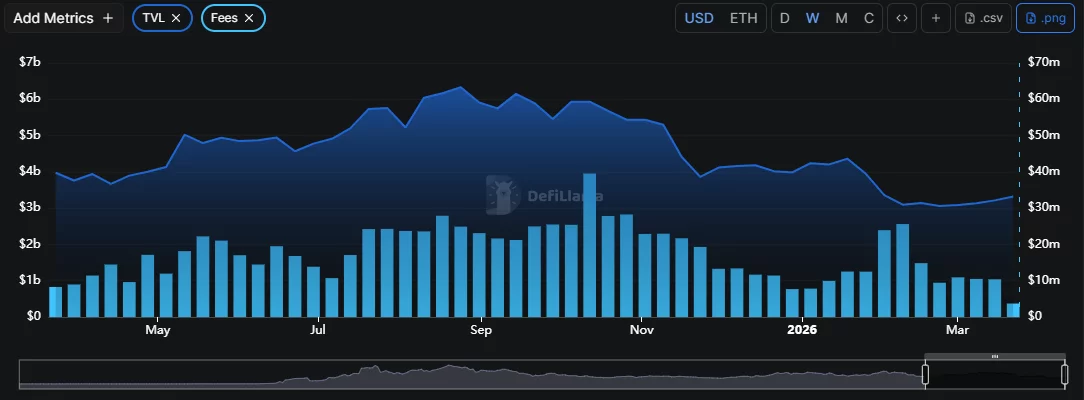
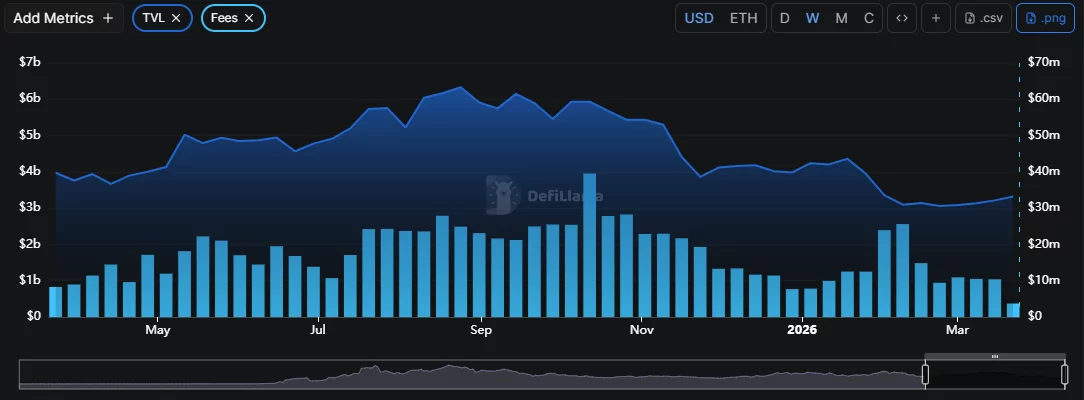
Beyond the price action, Uniswap has been struggling with a significant slump in network activity. Data from DeFiLlama shows that the total value locked on the platform has plummeted to $3.31 billion, which is significantly below the $6.3 billion record set in August last year.
At the same time, the weekly fees generated by the DeFi protocol on the network have shrunk to nearly one-fourth of the levels recorded in October.
Demand in its futures market has also dropped, leading to a visible cooling of investor sentiment. According to data from CoinGlass, the open interest in Uniswap futures has dropped 5.8% over the past 24 hours.
The altcoin also tanked as investors turned cautious ahead of the Federal Reserve rate decision scheduled for later today. At press time, the broader crypto market had dropped 1.8% to $2.56 trillion, while Bitcoin (BTC), Ethereum (ETH), and other major coins also printed red.
On the daily chart, the Uniswap price is on the cusp of breaking below an ascending trendline that has been acting as a dynamic support for the token since early February this year.
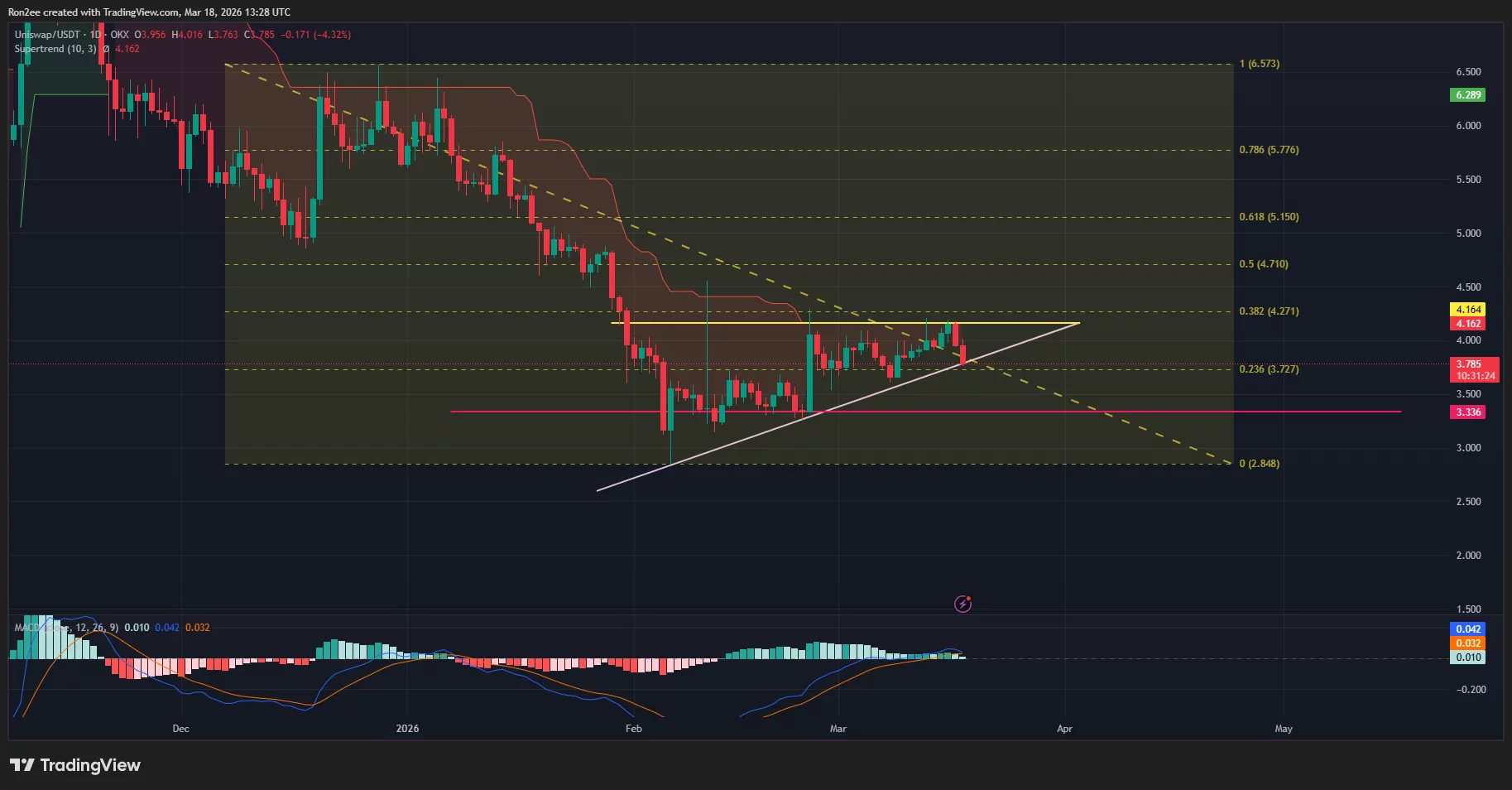
A break below this trendline support could lead bears to push for lower prices, potentially triggering a drop to the $3.3 support area where bulls previously managed to stage a recovery.
Technical indicators seem to support such a bearish outlook as they show bears gaining momentum. Notably, the Supertrend indicator has flashed red while the MACD lines are moving closer toward a bearish crossover, suggesting that the path of least resistance is currently to the downside.
However, a more nuanced outlook comes from the fact that the ascending trendline forms a part of an ascending triangle pattern on the chart with a horizontal resistance at $4.1. If Uniswap price manages to rebound above this level, it could confirm the bullish pattern and potentially end the current correction by sparking a fresh rally toward previous highs.
Disclosure: This article does not represent investment advice. The content and materials featured on this page are for educational purposes only.


Ethereum Foundation deploys 3,400 more ETH into Morpho vaults, cementing its shift toward active, on-chain DeFi treasury management instead of selling ETH to fund operations.
Summary
- The Foundation allocated 3,400 ETH (about $7.6M) to Morpho Vaults, including 1,000 ETH to Vaults V2, as part of an expanding DeFi treasury program.
- Since early 2025, it has funneled tens of thousands of ETH plus stablecoins into Morpho, Compound and Spark to earn yield while backing Ethereum-aligned, open-source protocols.
- The latest move signals confidence in Ethereum’s DeFi stack even as ETH trades near $2,239, with Morpho’s TVL near $5.8B and growing RWA exposure.
The Ethereum (ETH) Foundation announced Wednesday via its official X account that it has deployed an additional 3,400 ETH to Morpho Vaults, with 1,000 ETH directed specifically into Morpho Vaults V2. At current prices, the deployment represents approximately $7.6 million — but its significance extends well beyond the dollar figure. It marks the latest installment in an accelerating institutional pivot by the world’s most prominent blockchain foundation toward active, yield-bearing DeFi treasury management.
The move is not without precedent. In October 2025, the Foundation had already deployed 2,400 ETH and approximately $6 million in stablecoins into Morpho yield vaults, citing the protocol’s “commitment to Free/Libre Open Source Software principles” and its release of both Morpho Vault V2 and Morpho Blue V1 under open GPL 2.0 licenses. That deployment was itself part of a broader strategic overhaul initiated earlier in 2025, when the Foundation committed an initial tranche of up to 50,000 ETH to various decentralized finance platforms — including Compound and Spark (the lending arm of the Sky/MakerDAO ecosystem) — in a deliberate shift away from the previous practice of periodically selling ETH to fund operations.
The rationale is both financial and philosophical. According to data from Arkham Intelligence, the Ethereum Foundation holds total assets exceeding $820 million, of which approximately $735 million is denominated in ETH. Rather than leave that capital idle or convert it to fiat, the Foundation has positioned Morpho as a core pillar of a responsible liquidity management approach — using DeFi tooling to generate yield while simultaneously reinforcing the open-source infrastructure it has long championed.
Morpho itself has grown substantially into this role. The protocol scaled from 67,000 users to over 1.4 million users across 2025, with deposits rising from $5 billion to $13 billion and active loans reaching $4.5 billion by year-end. Total real-world asset (RWA) deposits on the platform grew from near zero at the start of 2025 to $400 million by the end of Q3. Morpho Vaults V2, which launched in November 2025, introduced an expanded curator model designed to give asset managers and institutions greater flexibility in structuring on-chain lending strategies.
Wednesday’s allocation to Vaults V2 is particularly notable. The newer architecture enables more sophisticated curation, compliance integration, and programmable liquidity conditions — features that align with the Foundation’s need to manage a large, institutionally sensitive treasury. With Morpho’s total value locked reported around $5.8 billion as of early March 2026, the protocol sits among the most battle-tested lending infrastructures in DeFi.
The deployment also carries a signalling dimension. As Ethereum faces ongoing questions about its competitive positioning against faster, cheaper chains, the Foundation deploying material ETH into its own ecosystem’s DeFi stack is a statement of confidence — one that comes at a moment of broader market stress, with ETH trading around $2,239, down 3.49% on the day. The message, whether intentional or not, is clear: the foundation is not just building Ethereum, it is putting its own balance sheet to work within it.


PlayNance, a unified on-chain infrastructure specifically engineered to power the entire world of gaming, betting, and prediction, has launched its highly anticipated native cryptocurrency, GCOIN.
This represents a massive milestone when it comes to the expansion of its Web3 entertainment ecosystem.
GCOIN Deposits at MEXC Now Live, 200K Holders Already
GCOIN will start trading on one of the most popular altcoin-oriented exchanges in the industry – MEXC, and deposits are already open. Speaking on the matter was the CEO of PlayNance, Pini Peter, who said:
“Today marks a defining moment for Playnance. […] We identified early the opportunity to bring real scale into Web3 entertainment, and we’re building one of the leading ecosystems to support it. With GCOIN now live, we’re opening the door to what comes next – a new wave of users, new models, and a much larger shift in how entertainment moves on-chain. This is just the beginning.”
The coin has already attracted over 200,000 holders, with the presale selling over 14 billion tokens.
It’s worth noting that the project’s entire ecosystem has built its token model around rewards, linking the value distribution directly to platform activity rather than relying on fixed emissions.
Playnance already hosts more than 10,000 on-chain games and processes more than 2 million on-chain transactions per day, which reflects a strong user engagement, as well as growing adoption across the entire network.
GCOIN: Powering an Impressive Ecosystem
GCOIN represents the utility token that powers the economic execution across the protocol’s ecosystem. It’s used as a unit for value movement and settlement, and it incentivizes distribution across the PlayBlock layer-3 solution and applications powered by Playnance.
By design, it is intended for high-frequency and real-time use.
That said, the team has also highlighted principles of wallet-based ownership and execution. This means that users hold the cryptocurrency directly in their wallets. Balances and state changes are written on-chain for complete transparency, while users can also verify all network activity through the explorer.
In terms of functionality, GCOIN is designed as a shared utility layer across all applications on Playnance.
This means:
- One wallet balance per user
- One token standard across the ecosystem
- No user-side bridging to move value between supported applications
- Gasless user experience
It’s also worth noting that the team recently launched GCOIN staking, providing yet another mechanism for users to earn rewards simply by staking their tokens. Naturally, the longer the staking period, the larger the reward. This model has proven to attract considerable interest, with more than 250 million tokens staked within hours.
Disclaimer: The above article is sponsored content. CryptoPotato doesn’t endorse or assume responsibility for the content, advertising, products, quality, accuracy, or other materials on this page. Nothing in it should be construed as financial advice. Readers are strongly advised to verify the information independently and carefully before engaging with any company or project mentioned and to do their own research. Investing in cryptocurrencies carries a risk of capital loss, and readers are also advised to consult a professional before making any decisions that may or may not be based on the above-sponsored content.
Readers are also advised to read CryptoPotato’s full disclaimer.
Binance Free $600 (CryptoPotato Exclusive): Use this link to register a new account and receive $600 exclusive welcome offer on Binance (full details).
LIMITED OFFER for CryptoPotato readers at Bybit: Use this link to register and open a $500 FREE position on any coin!


A Coinbase–EY survey of 351 institutions finds 74% expect crypto prices to rise and 73% plan to increase allocations, with stablecoins and tokenisation driving the next wave.
Summary
- A January 2026 Coinbase and EY-Parthenon survey of 351 institutions found 74% expect crypto prices to rise and 73% plan to increase allocations this year.
- Respondents now favour ETPs and other regulated vehicles for exposure, while 83% already use or plan to use stablecoins and view the GENIUS Act as a key catalyst.
- Sixty-three percent are interested in tokenised assets and 61% see tokenisation reshaping market structure, even as recent volatility pushes nearly half to tighten risk and liquidity management.
Despite a brutal Wednesday for digital asset prices — Bitcoin (BTC) sliding to $72,300 and a broad market selloff driven by Middle East conflict and hot inflation data — a major new institutional survey published this week tells a strikingly different story about where the smart money is heading. A joint report by Coinbase and EY-Parthenon, based on a survey of 351 institutional investors conducted in January 2026, found that 74% of respondents expect cryptocurrency prices to rise in the future, while 73% plan to increase their digital asset allocation before the end of the year.
The findings represent a significant institutionalisation of crypto conviction. The survey, which polled decision-makers at asset managers, hedge funds, private banks, venture capital firms, family offices, and asset owners globally, found that exchange-traded products (ETPs) and other regulated instruments have now become the preferred exposure vehicle for two-thirds of respondents. That shift — from direct on-chain holdings toward regulated wrappers — reflects both the maturing product landscape and the compliance imperatives of institutional capital, following the landmark approval and uptake of spot Bitcoin and Ethereum ETFs in the U.S. over the past two years.
When asked about the primary obstacle to further institutional engagement, more than three-quarters of respondents pointed to market structure regulation as the issue requiring the most urgent clarification. This finding echoes the prior year’s survey, in which 52% of respondents named regulatory uncertainty as their top concern and 68% identified greater regulatory clarity as the single most important catalyst for the industry’s next growth phase.
The regulatory landscape has shifted materially since then. The GENIUS Act — signed into law by President Trump on July 18, 2025 — established the first comprehensive federal framework for payment stablecoins in the United States, introducing 1:1 reserve mandates, licensing requirements, and federal preemption over conflicting state regimes. The Office of the Comptroller of the Currency subsequently issued proposed implementing regulations in March 2026, with a public comment deadline of May 1. The survey’s findings suggest institutions are watching this process closely: 83% of respondents said they have used or plan to use stablecoins for payments and financial management, while 83% also said passage of the GENIUS Act would enhance financial institutions’ willingness to participate in the stablecoin market.
The appetite for tokenised assets is similarly broad. Sixty-three percent of respondents expressed interest in tokenised assets, and 61% expect tokenisation to have a significant impact on market structure — a finding consistent with the rapid growth of real-world asset (RWA) tokenisation across DeFi platforms, where Morpho alone saw RWA deposits grow from near zero to $400 million over the course of 2025.
Amid widespread bullishness, the survey also captured the scars of recent volatility. Nearly half of respondents — 49% — said that recent market fluctuations had led them to place greater emphasis on risk management, liquidity, and position control, rather than reducing their holdings outright. That distinction matters: institutional capital appears to be recalibrating its approach rather than retreating, a posture that may prove consequential as markets navigate the current geopolitical shock.
The juxtaposition between Wednesday’s price action and the survey’s conclusions encapsulates the central tension facing institutional crypto allocators in 2026: near-term macro headwinds severe enough to test conviction, set against a structural adoption thesis that continues to broaden quarter by quarter.
Key takeaways:
-
Robert Kiyosaki’s $750,000 Bitcoin target implies a 95% discount versus gold, which is lower than the 2024 peak.
-
$750,000 Bitcoin might not be that significant if daily expenses, housing and energy rise in like kind.
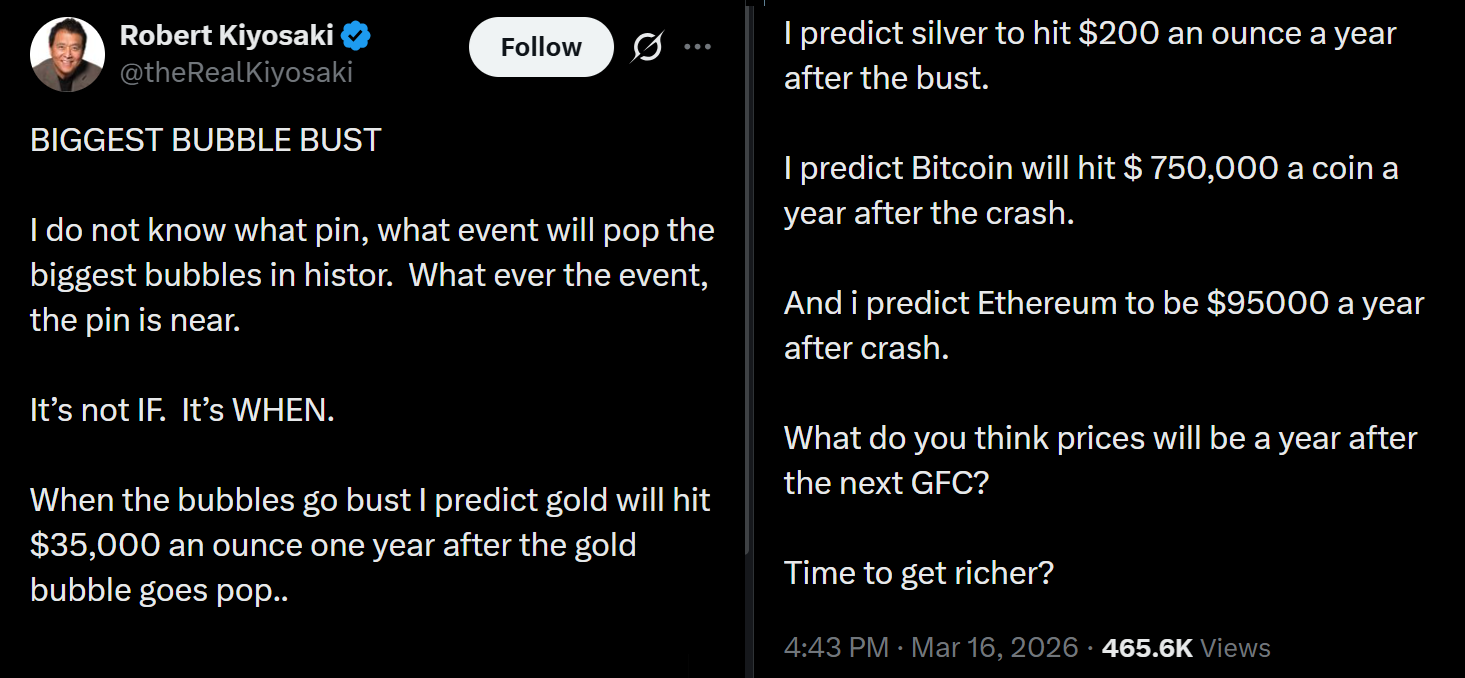
Robert Kiyosaki, author of the “Rich Dad Poor Dad” series, stated in a social media post on Monday that a massive financial “bubble burst” is imminent. The financial educator suggests this unprecedented economic crisis will eventually lead to a $750,000 Bitcoin (BTC) rally within one year of the crash.
While Kiyosaki’s estimate seems extremely bullish at first sight, a more granular view gives deeper meaning to his price prediction.

For a prediction to be valid, one needs a timeframe, even if it is stretched out over the next 12 months or more. Even if the Bitcoin price eventually reaches $750,000, the measure of success will largely depend on average US house prices or the annual cost of living for a typical family.
Accelerated expansion of the global monetary supply, such as the period between 2020 and 2021, tends to trigger a surge in demand for scarce assets, regardless of official government inflation metrics. For instance, the S&P 500 gained 52% between July 2020 and December 2021, while average home prices in major US capital cities surged by 38% in two years.

Kiyosaki anticipates that gold prices will surge to $35,000 per ounce one year after the financial “bubble burst,” which would be a 546% gain from its highest-ever daily close. As a comparison, Bitcoin’s optimistic $750,000 target stands 500% above its $124,724 record daily close.
Kiyosaki predicts gold will subjugate Bitcoin as a store of value
Kiyosaki’s target for gold yields a $243.2 trillion market capitalization, which is 4.4 times larger than the current aggregate market cap for the entire S&P 500.

Kiyosaki believes the Bitcoin-to-gold ratio should reach 21.5, far below the 40 all-time high from December 2024. More concerningly, the current 200-day moving average for the ratio stands at 22, making Kiyosaki’s estimate far from bullish for the cryptocurrency. Additionally, gold’s annual output should grow considerably if its price surges to such levels.
Kiyosaki has reportedly been predicting great economic crashes since at least 2011 without much success, according to US News. In a September 2015 post, Kiyosaki said, “I’ve been predicting since ’02 that we would see a stock market crash in ’16,” while the S&P 500 actually gained 9.5% in that year. Trying to time market moves more than 10 years in advance seems rather unconventional.
In May 2024, Kiyosaki posted that the biggest crash in history had begun, advising followers to “not get greedy” and avoid catching “falling knives.” The suggestion came five months after a prior warning about a bank credit sell-off similar to 2008. More than 20 months later, nothing remotely similar has occurred.
Related: Lyn Alden tips Bitcoin outperforming gold over next ‘two to three years’

In May 2024, Kiyosaki recommended saving in gold and silver, although Bitcoin was also mentioned. However, the S&P 500 rallied 16% over the following 8 months, while gold prices gained 15% and silver traded up 11%. Ultimately, Kiyosaki has a less-than-favourable track record and has been skewed toward favoring market collapses.
Even if Bitcoin hits $750,000, it does not mean the cryptocurrency will emerge as a top-5 asset by market capitalization, especially as Kiyosaki expects silver to surpass $11 trillion after the so-called “bubble burst.” Ultimately, the bold prediction is far from bullish for Bitcoin investors despite Kiyosaki’s high target price.
This article does not contain investment advice or recommendations. Every investment and trading move involves risk, and readers should conduct their own research when making a decision. While we strive to provide accurate and timely information, Cointelegraph does not guarantee the accuracy, completeness, or reliability of any information in this article. This article may contain forward-looking statements that are subject to risks and uncertainties. Cointelegraph will not be liable for any loss or damage arising from your reliance on this information.
Crypto World
Algorand Foundation cuts 25% of workforce amid crypto market downturn: Algorand Foundation


The Algorand Foundation has laid off a quarter of its staff, citing macroeconomic uncertainty and depressed crypto prices as conditions worsen across the industry.
The Algorand Foundation has cut 25% of its workforce due to macroeconomic uncertainty and lower cryptocurrency prices. The layoff at the organization behind the layer-1 Algorand blockchain reflects broader challenges facing the crypto sector as market conditions deteriorate.
The Algorand Foundation’s reduction joins a wave of workforce cuts sweeping through crypto and blockchain companies. Other major players including Blockchain.com, Optimism Labs, and Gemini Space Station have similarly announced 25% staff reductions, signaling sustained pressure on the industry as crypto prices remain depressed.
Sources: Algorand on X
This article was generated automatically by The Defiant’s AI news system from publicly available sources.
Bitcoin retraced about 7% after briefly touching the $76,000 mark earlier in the week, as a confluence of macro headlines trimmed risk appetite. A jump in oil prices tied to Middle East tensions and a hotter-than-expected producer price index added headwinds for risk assets, including equities. Yet optimism about the longer-term narrative persists: persistent spot-market demand, manageable leverage, and a potential rotation from gold could sustain the rally despite a near-term pullback.
Oil traded above $98 a barrel after reports of heightened tensions in the region, while the US producer price index rose more than expected, complicating the outlook for monetary policy. The S&P 500 remained within striking distance of its all-time highs just weeks earlier, even as recent US data showed some softness in the labor market. Against this backdrop, investors kept an eye on Bitcoin’s price action, viewing the move as a pause in momentum rather than a reversal of the bull case, particularly given how spot demand and institutional buying have shaped the market in recent weeks.
Key takeaways
-
Spot market demand, reinforced by US-listed spot Bitcoin inflows and significant buying by strategy-minded investors, has helped sustain upwards momentum.
-
Leverage in the Bitcoin long-side remains moderate, reducing the risk of cascading liquidations if prices slip further.
-
Rising inflation concerns and weaker fixed-income returns are fueling a potential rotation from gold into Bitcoin over time.
-
Derivative signals show bears are not flooding the market with excessive leverage; while funding rates have turned negative, they stay below historically aggressive levels, indicating a broader preference for cautious risk-taking.
Spot demand remains a stabilizing force
In recent sessions, Bitcoin’s move higher has been supported by a steady stream of demand from the spot market, rather than a heavy reliance on speculative leverage in the futures arena. Market observers pointed to ongoing accumulation inUS-listed spot-market products and notable buying activity by the Strategy group’s backers, highlighting a trend toward price discovery driven by real demand rather than purely synthetic liquidity. This dynamic is seen as a more durable underpinning for upside than a mere tilt toward derivatives-driven speculative bets.
Analysts also note that the immediate risk of a violent, cascading liquidation squeeze appears limited. Data on leveraged positions suggest traders are not collectively overexposed to bullish bets, even if Bitcoin tests lower levels in the near term. A hypothetical $450 million liquidation scenario tied to a move back toward the 68,000 area would still represent a small fraction of the overall open interest, reinforcing the view that current risk is more about price retries than systemic margin calls.
Macro backdrop and the path of policy
Although volatility has risen with energy prices and inflation concerns, the equity backdrop has not collapsed. The S&P 500 hovered within a short distance of record levels, while ongoing headlines around inflation and policy expectations shaped traders’ risk budgeting. The US 2-year Treasury yield stood around 3.71%, and inflation expectations from the Cleveland Fed around 2.27%, translating into a modestly positive carry for holders of cash and fixed income relative to the uncertain macro regime. In market terms, this environment tends to favor assets that can act as inflation hedges or portfolio diversifiers, which has historically been Bitcoin’s longer-run narrative for many participants.
Fed policy expectations also shifted. Volatility in rate outlooks was underscored by the CME FedWatch Tool, which indicated a sharp drop in odds of a near-term rate cut or hold, with probabilities of sustained rates by September moving from the mid-to-high range toward a tighter stance picture. In other words, the horizon for monetary support remains uncertain, nudging investors to consider hedges beyond traditional assets.
Derivatives signals and the risk outlook
From a derivatives perspective, negative funding rates for Bitcoin futures have been a feature of late, suggesting that shorts have paid to maintain positions and that bears may be more aggressive than the price action alone would imply. Yet, the funding rate has hovered below the neutral 6%–12% band even as Bitcoin traded above the previous highs, implying that the market’s buoyancy is being driven more by spot demand than margin-driven speculation. This nuance matters for risk managers and long-term holders alike, as it points to a steadier ascent rather than an abrupt, leverage-fueled ascent or collapse.
Industry trackers also highlight ongoing spot ETF activity. While inflows into spot product offerings can be lumpy, sustained accumulation supports a different dynamic than futures-only rallies, with investors signaling a willingness to own Bitcoin as a core asset rather than as a speculative bet on volatility alone.
Gold rotation and what it could mean for Bitcoin
Another angle traders are watching is the potential rotation away from gold as inflation pressures persist. Gold’s price action has shown signs of fatigue after a period of firmness, which could, over time, create room for Bitcoin to capture risk-off and risk-on demand that might otherwise have found a home in gold. While this is not a guaranteed path, the argument stands: if inflation remains stubborn and fixed-income alternatives underperform, Bitcoin could increasingly position itself as a diversifying asset in portfolios seeking inflation protection and asymmetric upside potential.
In the near term, the market will likely keep a close eye on both macro data and energy-price trajectories, as both have historically been proximate drivers of risk appetite and correlation patterns across assets. The balance between inflation signals, policy expectations, and real-world demand for Bitcoin will shape whether the current pullback evolves into a consolidation or a pause before renewed leg higher.
Related industry observations have underscored a broader sentiment among institutions: while interest in cryptocurrency exposure remains, investors are seeking more resilience in the face of macro uncertainty. The ongoing debate about how crypto assets fit within traditional portfolios—especially as a potential hedge against inflation—continues to inform how market participants allocate to Bitcoin in the months ahead.
What remains uncertain is how quickly spot-demand momentum translates into durable price gains, and whether external shocks—such as further geopolitical tensions or unexpected shifts in energy prices—could reintroduce volatility. Still, the current data points suggest Bitcoin’s upside is anchored less by speculative leverage and more by genuine demand from buyers who view it as a constructive component of a diversified, risk-managed crypto exposure.
Readers should watch for continued spot-market inflows, evolving ETF dynamics, and the macro data flow over the coming weeks to gauge whether Bitcoin can reclaim its recent highs or establish a new range as policy expectations firm up.
S&P Dow Jones Indices has licensed its S&P 500 Index to Trade[XYZ] for the launch of a perpetual futures contract on Hyperliquid, in what the company described as the first officially licensed onchain product offering continuous, leveraged exposure to the index for eligible non-US users.
According to Wednesday’s announcement, contract allows eligible non-US traders to take long or short positions on the index without an expiry date, with markets operating continuously outside traditional exchange hours using official index data from S&P Dow Jones Indices.
The contract also brings equity index exposure onto Hyperliquid, extending the use of perpetual derivatives beyond cryptocurrencies into traditional financial benchmarks.
Trade[XYZ] said its onchain markets have processed more than $100 billion in volume since October 2025, with an annualized run rate topping $600 billion.
The move comes after the index maker teamed with Centrifuge in July to bring the S&P 500 onchain through proof-of-index infrastructure and the launch of a tokenized index fund built on blockchain-based systems.
Related: Perp DEXs almost triple volume in 2025 as onchain derivatives mature
Crypto exchanges expand perpetual trading into traditional assets
Efforts to bring traditional financial markets into crypto are taking varied forms, including tokenized assets and perpetual derivatives tied to real-world markets.
In January, Binance launched “TradFi” perpetual contracts, offering USDT-settled derivatives linked to commodities such as gold and silver with 24/7, no-expiry trading. The following month, Kraken expanded the model to equities, introducing tokenized perpetual futures that provide leveraged exposure to US stock indexes, gold and specific companies.
Earlier this month, Coinbase said it would introduce round-the-clock trading for Bitcoin (BTC) and Ether (ETH) futures in the US and expand into perpetual-style contracts.

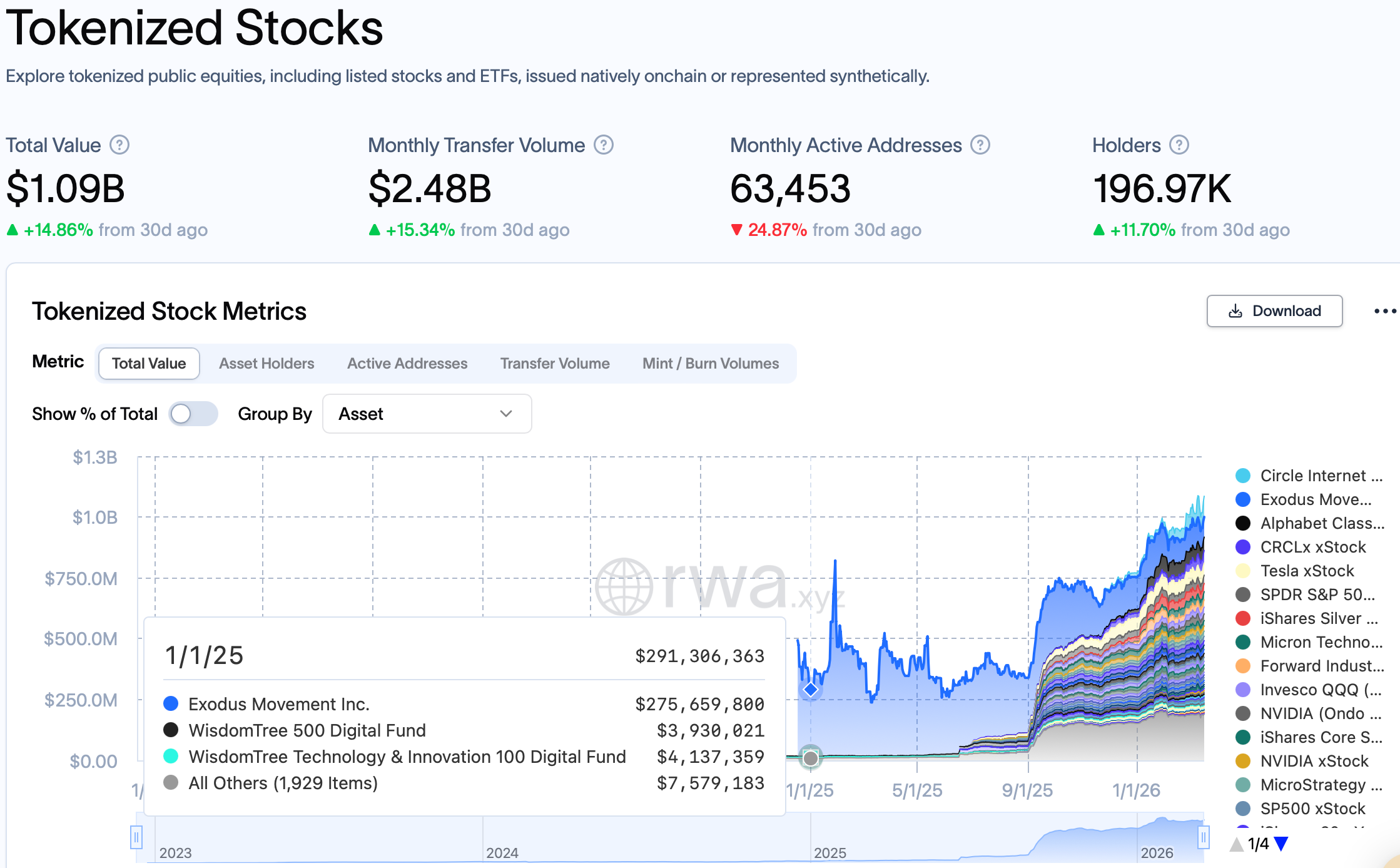
At the same time, tokenized equities have grown steadily. Data from RWA.xyz shows total onchain value rising to about $1.09 billion from roughly $300 million at the start of 2025.
The market remains relatively concentrated, led by a mix of tokenized equities and exchange-traded products. Circle Internet Group accounts for about $136.8 million in value, followed by Exodus Movement at $83 million and Alphabet at $72.9 million, with Tesla and the iShares Silver Trust also among the largest holdings.

Magazine: Big Questions: Can Bitcoin save you from the dreaded Cantillon Effect?


A pseudonymous whale called Jason has built a 2,281 BTC short on Binance, now in multi‑million profit, extending a pattern of eerily well‑timed macro trades.
Summary
- On-chain sleuths say Jason holds a 2,281 BTC short on Binance at a $74,238 entry, sitting on roughly $4.2 million in unrealized profit with BTC near $72,467.
- The trader’s history includes perfectly timed shorts during prior market crashes and a reported $58.89 million loss, underscoring a high‑conviction, high‑risk strategy.
- Today’s bet lands as Bitcoin slides on Iran-linked Strait of Hormuz tensions and hotter‑than‑expected U.S. PPI, with analysts split on whether Jason is signal or noise.
A pseudonymous trader known online as Jason (@Jason60704294) is once again drawing scrutiny from on-chain analysts after data published Wednesday by blockchain sleuth @ai_9684xtpa revealed that Jason currently holds a short position of 2,281.09 BTC on Binance, with a nominal value of approximately $169 million and an opening average entry price of $74,238. With Bitcoin (BTC) trading around $72,467 at the time of monitoring — roughly 2.38% below Jason’s entry point — the position carries an unrealized floating profit of approximately $4.155 million.
The trade is not an isolated event. It is the latest chapter in a documented pattern that has made Jason one of the most closely tracked retail-sized whale accounts in crypto markets. According to on-chain analysis aggregated by Blockchain.news, Jason had just days earlier closed a long position with a profit of $14.668 million before pivoting sharply to the short side, opening an initial position of 28.48 BTC at an estimated entry price of around $74,210. Wednesday’s data confirms that position has since been substantially scaled up to over 2,281 BTC — a markedly more aggressive commitment.
Jason’s history adds considerable weight to the current trade. In August 2025, the trader opened short positions on BTC at $120,948 and on ETH at $4,712, positions that — if held — would have generated substantial returns as both assets declined sharply in subsequent months. Earlier, the trader had reportedly exited positions recording a $58.89 million loss, underscoring that the strategy carries real risk despite its headline-grabbing wins.
The timing of today’s short aligns with a broader market deterioration. Bitcoin has been under sustained pressure since late February, when U.S.-Israel military strikes on Iran triggered a Strait of Hormuz crisis that has since disrupted approximately 15% of global oil supply. Wednesday’s release of U.S. February PPI data — coming in at 0.7% month-on-month against a 0.3% forecast — compounded the risk-off sentiment, further dimming expectations for Federal Reserve rate cuts that had previously underpinned crypto’s bull case.
It is worth noting the platform context. Jason’s current position is held on Binance, not on Hyperliquid, making real-time on-chain tracking of the exact account more difficult, as Odaily reported. The figures cited are derived from analyst monitoring of wallet behaviour and social media timestamps rather than direct smart contract reads. Nonetheless, the data is broadly consistent with Jason’s established trading fingerprint: high-conviction, concentrated directional bets placed at key technical inflection points.
Whether Wednesday’s short is prescient once again, or whether it becomes a cautionary tale in an eventual Bitcoin rebound, remains to be seen. What is clear is that a growing cohort of on-chain analysts are watching every move — and that in a market defined by opacity, Jason has become something of an unlikely signal in the noise.

Bold and Beautiful Early Spoilers March 23-27: Brooke Loses All Control & Ivy’s Behavior Spirals Further!

Liverpool to face PSG in Champions League quarter-finals after Galatasaray rout

Nabung #nabung #tabungan #menabung #money #savingchallenge #uang

Smart energy pays enters the US market, targeting scalable financial infrastructure

Why Israel is blocking foreign journalists from entering

Bitcoin: We’re Entering The Most Dangerous Phase
Nabung #nabung #tabungan #menabung #money #savingchallenge #uang

Biggest Crypto Crash Explained | Why Bitcoin Fell 25%? | Sanjay Kathuria

Financial Aid MYTHS: It’s NOT Just About Income! Financial aid isn’t just about income
-
 Crypto World5 days ago
HYPE Token Enters Net Deflation as HyperCore Buybacks Outpace Staking Rewards
-

 Tech3 days ago
Your Legally Registered ‘Motorcycle’ Might Not Count Under Proposed US Law
-

 Fashion5 days ago
Weekend Open Thread: Addict Lip Glow
-
Sports4 days ago
Why Duke and Michigan Are Dead Even Entering Selection Sunday
-
 Tech1 day ago
Are Split Spacebars the Next Big Gaming Keyboard Trend?
-

 Business3 days ago
Search for Savannah Guthrie’s Mother Enters Seventh Week with No Arrests
-

 Business5 days ago
US Airports Launch Donation Drives for Unpaid TSA Workers as Partial Government Shutdown Enters Fifth Week
-
Crypto World4 days ago
Coinbase and Bybit in Investment Talks: Could Bybit Finally Enter the US Crypto Market?
-

 Business3 days ago
Australian shares drop as Iran war enters third week
-

 Business5 days ago
Country star Brantley Gilbert enters growing non-alcoholic beer market
-

 Crypto World3 days ago
Crypto Lender BlockFills Enters Chapter 11 with Up to $500M in Liabilities
-

 Sports5 days ago
College Basketball Best Bets: Conference Tournament Semifinal Picks
-

 Politics17 hours ago
The House | The new register to protect children from their abusers shows Parliament at its best
-

 Business6 days ago
Trump demands Powell cut rates as Iran conflict raises energy prices
-

 Crypto World6 days ago
Senate Votes to Include CBDC Ban in Bipartisan Housing Bill
-

 Fashion3 days ago
25 Celebrities with Curly Hair That Are Naturally Beautiful
-

 News Videos9 hours ago
RBA board divided on rate cut, unusually buoyant share market | Finance Report | ABC NEWS
-

 NewsBeat6 days ago
Deane Road crash near Bolton colleges and university
-

 News Videos6 days ago
Tom Lee: The 100x Opportunity EVEN Bigger Than Bitcoin (New Ethereum Prediction 2026)
-

 Crypto World10 hours ago
Canada’s FINTRAC revokes registrations of 23 crypto MSBs in AML crackdown


You must be logged in to post a comment Login